
Ottoman and Pouf Ideas for a Reading Corner

If your reading corner is one slumped chair and a stack of books you keep kicking over, the fix is smaller than you think. It’s the thing under your feet. A reading nook ottoman turns a place you perch into a place you actually sink into, and most of these setups take one afternoon and zero drilling.
You rent. You’ve got maybe one awkward corner and a budget that laughs at custom millwork. Good. Every idea below works in a small space, and most of them fit a footprint you already have. I’ve built a few of these myself, so I’ll tell you what works and where people waste money.
Here’s the build order, the sizing rules nobody mentions, and nine ways to use a pouf, footstool, or storage ottoman so your corner finally earns the word cozy.
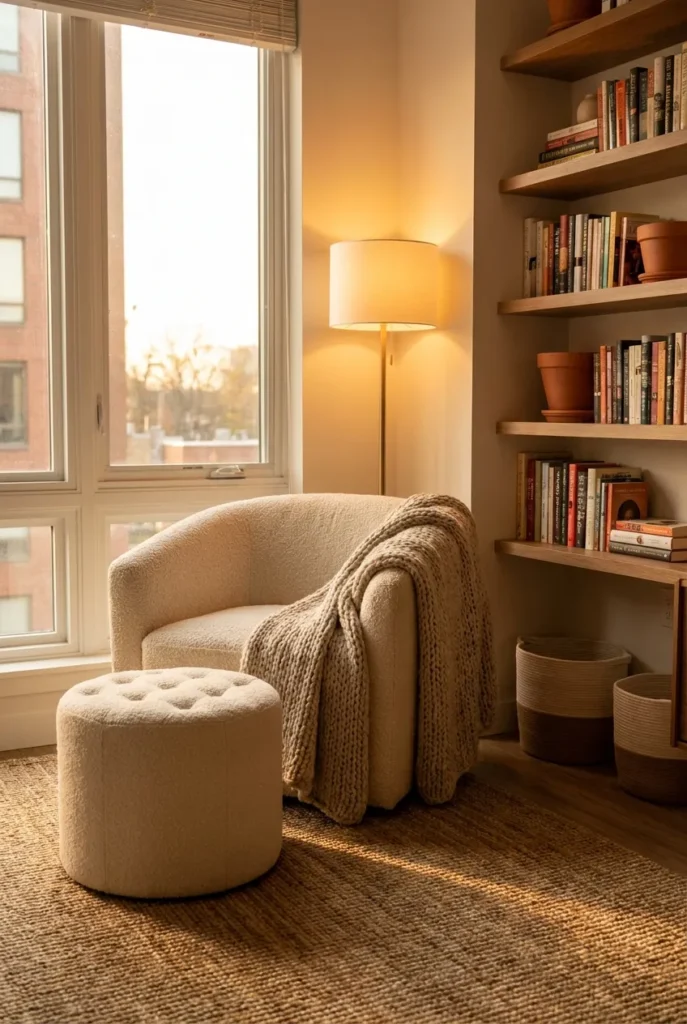
Start Here: Size and Place the Ottoman Before You Buy Anything
This is the step every listicle skips, and it’s why so many nooks feel off. Your ottoman has to match your chair, not just look nice in the cart.
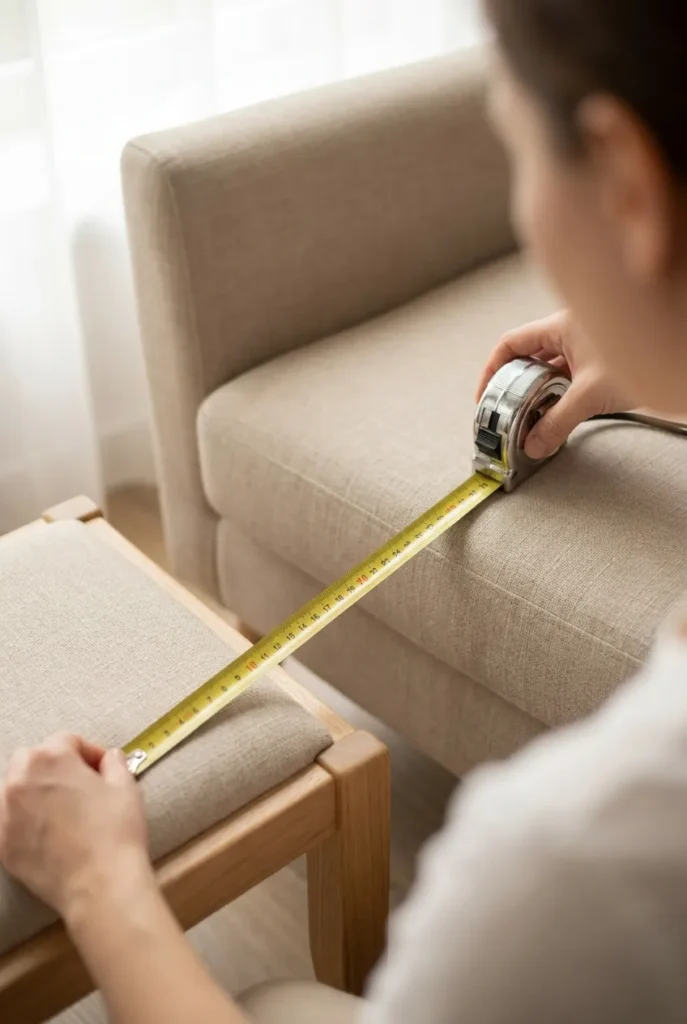
Two rules do most of the work. First, seat-height match: your ottoman top should sit within about an inch or two of your chair’s seat height so your legs stay level, not tilted up or drooping down. Second, the reach: leave roughly enough space that you can plant your feet without sliding off the chair, usually a small gap between chair and ottoman rather than shoving them tight together.
Walkway clearance matters too. Leave about 30 inches of clear path around the setup so you’re not shuffling sideways past it every day.
Failure mode: buy an ottoman that’s four inches too tall, and your knees fold up like a lawn chair after fifteen minutes. Measure your chair seat first. Always.
The Storage Ottoman That Hides Your Throw Blanket Pile
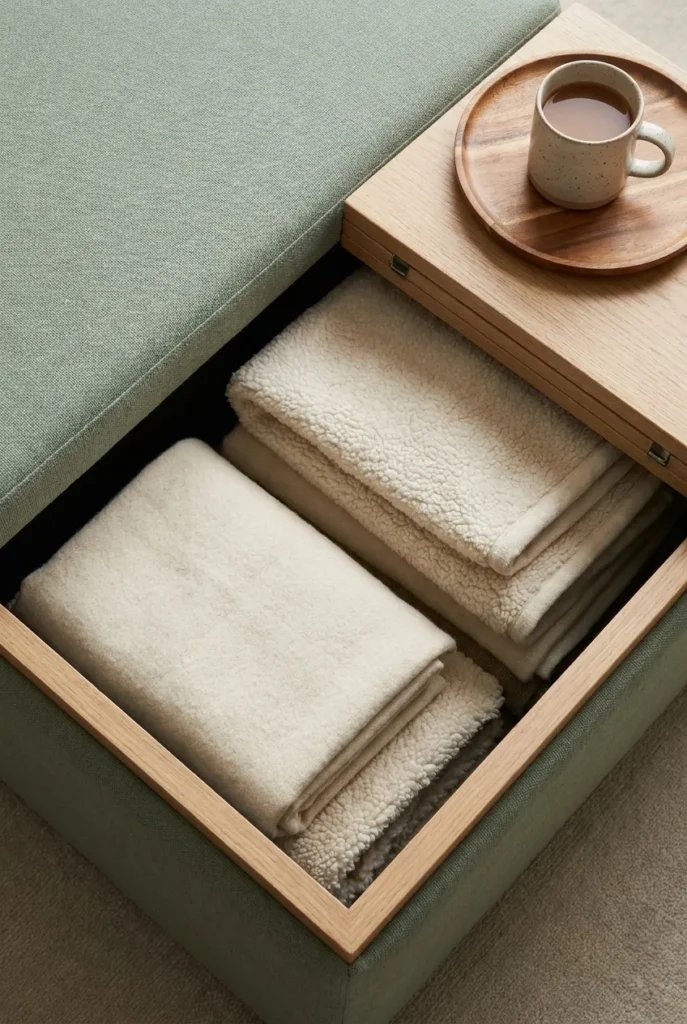
If your throws live in a heap on the floor, this is your first buy. A storage ottoman for a reading nook does two jobs: props your feet up and swallows the blanket clutter inside.
Look for a lift-top or a flip-lid style around 30 by 17 inches so it fits a folded wool throw, a sherpa blanket, and a lumbar pillow with room to spare. The Songmics and HomePop storage styles I kept seeing run a solid, no-fuss shape, and budget boucle versions show up under 60 dollars.
There’s a quiet bonus here: set a wood tray on top and it doubles as a side table for your tea. That’s the 18-inch reach rule at work, keep your mug within an easy arm’s length and you’ll never get up mid-chapter.
Failure mode: skip the storage version and those blankets end up back on the floor by week two.
Little Nook sizing cheat (screenshot-worthy):
| Ottoman type | Rough footprint | Best for |
|---|---|---|
| Round floor pouf | 20 to 24 in wide | Tiny corners, floor-cushion vibe |
| Storage bench ottoman | 30 x 17 in | Hiding throws, doubles as surface |
| Matching chair footstool | 20 x 16 in | Feet-up posture with an armchair |
The Round Pouf for a Corner With No Floor to Spare
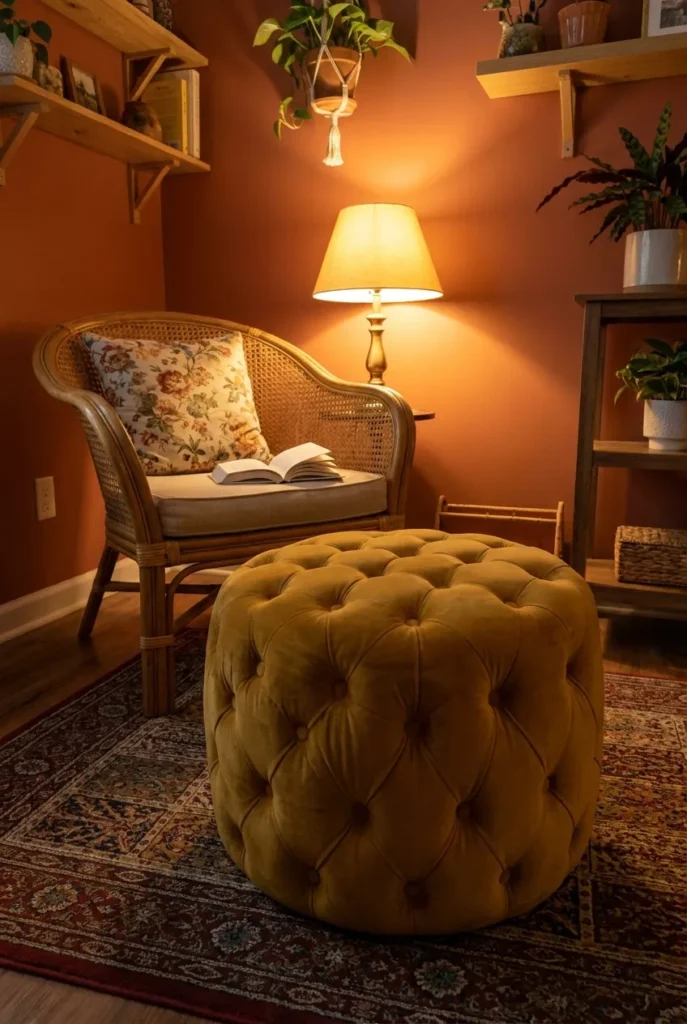
No room for a big footstool? A round pouf is the small-space answer. It tucks under the front edge of your chair when you’re not using it and pulls out when you want to stretch.
A 22-inch tufted velvet pouf gives you a soft, low place to rest your legs and reads as a design piece on its own. This is the exact look topping Pinterest right now, a big round tufted pouf as the hero of the whole corner. [LIVE: web-searched]
Texture is doing real work here. A boucle or velvet surface feels warm against bare feet on a cold morning, which a hard wood stool never will. That sensory detail is half the reason these corners feel like a retreat.
Failure mode: go too soft and squishy and your heels sink in with no support. Firm-filled poufs win for actual foot-propping.
The Matching Chair and Ottoman Set for a Real Lounge Feel
Want the pulled-together look without guessing at sizes? Buy the chair and ottoman as a set. The pieces are built to the same seat height, so the sizing problem solves itself.
An accent chair with a matching footstool, think the IKEA Poang and its footstool, or any swivel armchair with a coordinating ottoman, gives you a true recline without a bulky recliner. Sets ranged widely in the results, from around 100 dollars up past 1,000, so there’s a version for most budgets. [LIVE: web-searched — Wayfair range noted $103 to $1,299]
If a full recliner feels like too much for a rented living room, this is your move. It reads calm and low, not like a bulky leather throne.
For a softer take on the same feet-up idea, the deep-bowl approach in our papasan reading nook setup guide leans into full-body lounging rather than a separate footstool.
Failure mode: buy a chair now and hunt for a matching ottoman later, and you’ll spend months with mismatched heights that never quite line up.
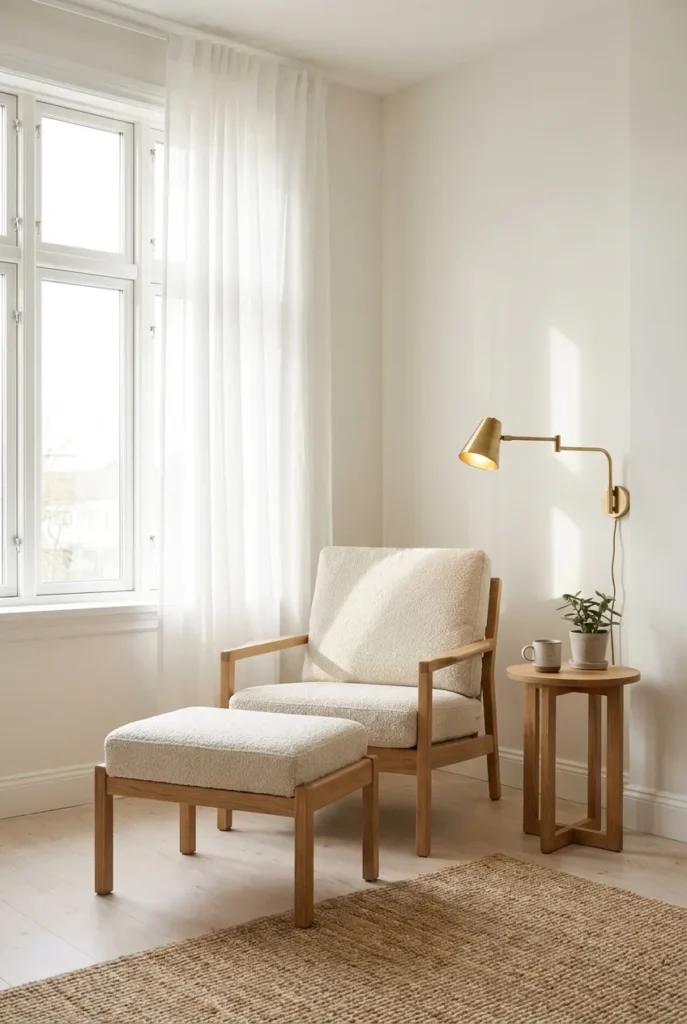
The Feet-Up Fix for Reading Light and Eye Comfort
Here’s a piece the inspiration posts miss entirely: getting your feet up changes how you sit, which changes where your book sits, which changes your lighting. Prop your legs and you naturally lean back, so your reading light needs to come from beside or behind your shoulder, not overhead where it throws glare on the page.
A warm 2700K bulb on a swing-arm or plug-in sconce, positioned over the shoulder opposite your dominant hand, kills page shadow. Give your eyes regular breaks too. The American Optometric Association’s 20-20-20 rule for eye strain is an easy habit for long reading sessions, and the American Academy of Ophthalmology’s guidance on reducing digital eye strain is worth a skim if you read on a tablet in your nook.
Sound and warmth matter as much as light. A wool throw over your knees and a quiet corner away from the TV is the difference between reading for ten minutes and reading for an hour.

The No-Drill, Renter-Safe Corner With an Ottoman as the Anchor
You can’t drill, can’t paint, can’t build. You don’t need to. This whole setup leans on freestanding pieces, so nothing touches the wall permanently.
Start with the ottoman as your anchor, add a comfortable chair, a plug-in sconce with a cord-cover strip, and a washable rug to define the zone. That’s a full nook with zero landlord conversations.
The rug is the trick most renters skip. A 4-by-6 washable jute or low-pile rug visually walls off the corner as “the reading spot” without a single stud or bracket. Your feet land on something soft, and the whole area suddenly reads intentional.
For carving a nook out of a shared room with no walls at all, our guide to creating a reading area in an open-plan living room walks through zoning tricks that pair perfectly with an ottoman anchor.
Failure mode: skip the rug and the corner never feels separate from the rest of the room, no matter how nice the chair is.
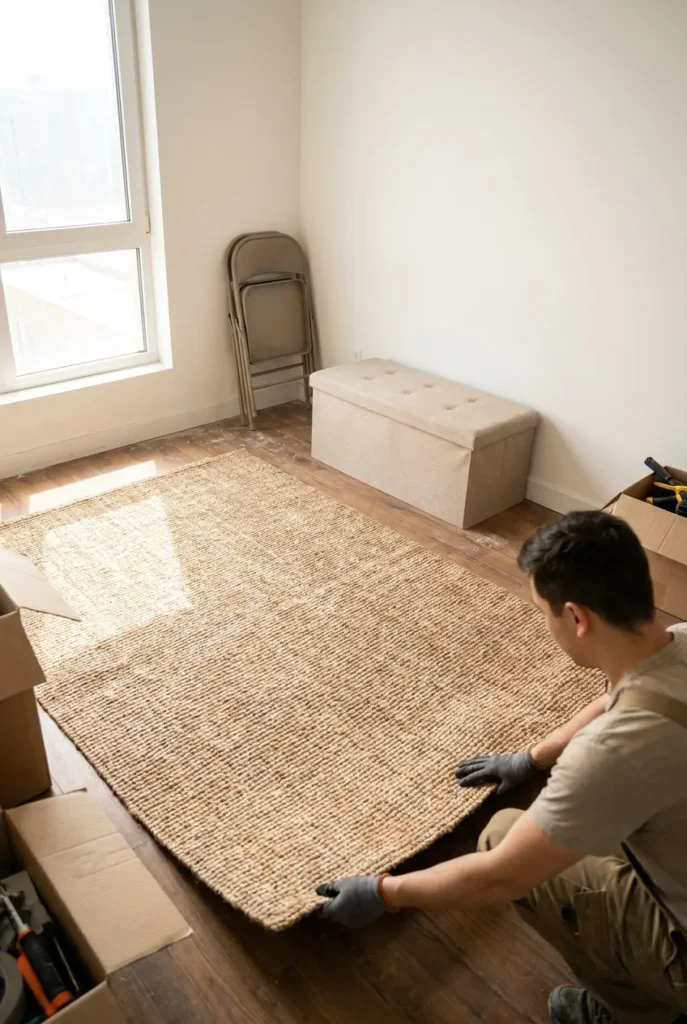
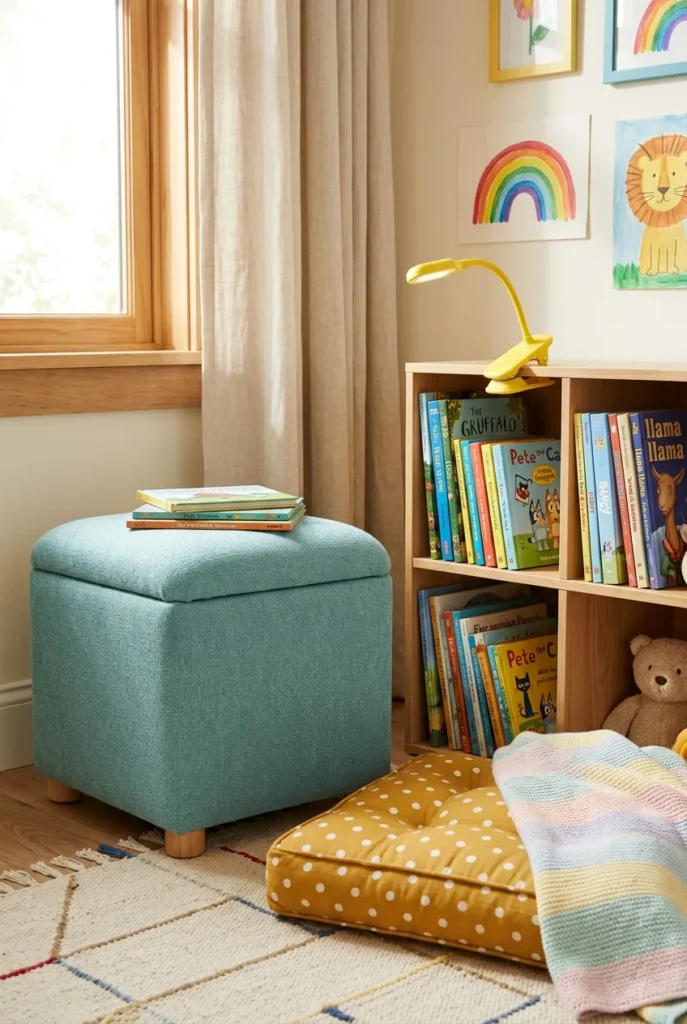
The Kids and Tween Corner With a Wipeable Ottoman
Building a reading corner for a kid or tween? The ottoman rules flip a little. You want low, sturdy, and wipeable over delicate and tufted.
A cube storage ottoman around 15 inches tall works as a seat, a footrest, and a bin for stuffed animals or library books all at once. Faux-leather or a tight woven fabric wipes clean when the inevitable juice happens.
Keep it low so small legs reach the floor and books stay within arm’s reach on a nearby ladder shelf or cubby. This is one spot where a floor cushion plus a low ottoman beats any grown-up armchair.
Failure mode: pick a plush velvet ottoman for a kids’ zone and you’ll be spot-cleaning it every weekend.
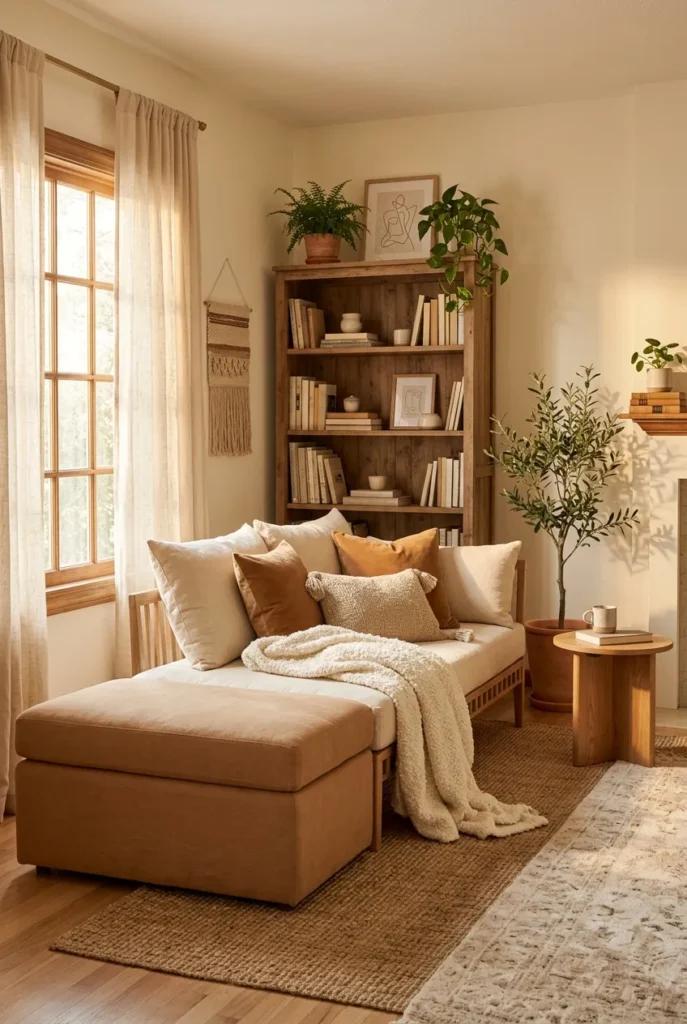
The Daybed-Style Sprawl When You Have a Little More Room
If your corner can spare the footprint, push two ottomans together in front of a chair, or set one wide bench ottoman against a daybed, and you get a stretch-all-the-way-out spot for marathon reading.
A 48-inch bench ottoman turns a single chair into something close to a chaise, so you can actually lie back on a rainy Sunday.This is the setup for the tertiary reader with a dedicated room, but even a small nook can borrow the idea with two matching poufs pushed together.
For a fuller version of this lie-down approach, our daybed reading nook ideas show how to turn one spare corner into a nap-and-read spot.
Failure mode: push mismatched-height ottomans together and you get a lumpy ridge right where your legs go. Match the heights or don’t bother.
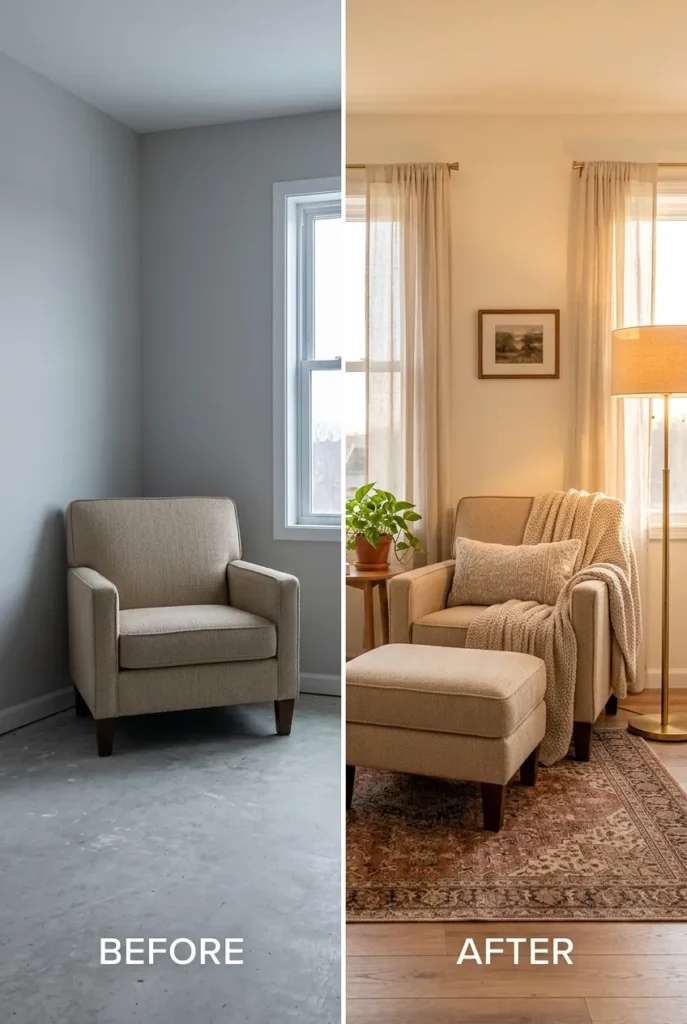
The Before-and-After: One Ottoman, Two Very Different Corners
Want proof the ottoman is the piece that changes everything? Put the same chair in a corner with and without one. Without it, you perch. With it, you lounge. Same square footage, completely different corner.
Start with your chair, add the right-height ottoman, layer one throw and one lumbar pillow, and add a warm light source. Four moves.
That’s the whole formula, and it scales from a nine-square-foot renter corner to a full dedicated room.
Frequently Asked Questions
Does a reading nook really need an ottoman?
No, but it changes the experience. An ottoman lets you stretch your legs and lean back, which is the difference between a chair you sit in and a corner you sink into for an hour. If space or budget is tight, a small pouf gives most of the benefit.
What size ottoman should I get for my reading chair?
Match the ottoman top to within an inch or two of your chair’s seat height so your legs stay level. Measure your chair seat first, then leave a small gap between the two so you don’t slide off. Roughly 30 inches of clear walkway around the setup keeps it comfortable to use daily.
Are storage ottomans good for small reading nooks?
They’re ideal. A storage ottoman for a reading nook hides throw blankets and books inside, props your feet on top, and can hold a tray to double as a side table. In a small space, one piece doing three jobs is a win.
What’s the best ottoman for a renter who can’t drill?
Any freestanding pouf, footstool, or storage ottoman works, since none of them touch the wall. Pair it with a plug-in sconce and a washable rug to define the corner without a single hole.
Round pouf or square footstool for a reading nook?
A round pouf suits tiny corners and tucks under a chair edge when idle. A square or rectangular footstool gives more surface for propping both feet and holding a tray. Pick round for looks in a small space, square for function.
How much should a reading nook ottoman cost?
Budget storage ottomans and poufs show up under 60 dollars, while matching chair-and-ottoman sets range from around 100 dollars into the several hundreds.
One Last Thing Before You Buy
The ottoman is the smallest piece in your reading nook and the one that does the most. Get the height right, pick the type that fits your space, and you’ve turned a corner you walked past into the seat you fight for.
Ready to build out the rest? Start with the piece you actually sit in, then come back and pick your ottoman to match. Your next quiet afternoon is waiting.
Keep reading
More cozy nook ideas
 Fall Decor
Read →
Fall Decor
Read →
Fall Door Decor on a Budget: Where to Spend and Where to Save
If your fall door every year is a wreath that sheds on the mat, two mums that are crispy by Halloween, and…
 Fall Decor
Read →
Fall Decor
Read →
12 Thanksgiving Tablescape Ideas for Small Spaces (That Still Leave Room for the Food)
Twenty-four inches. That’s how much table edge one person needs to eat without bumping elbows, and it’s the number most Thanksgiving tablescape…
 Fall Decor
Read →
Fall Decor
Read →
18 Fall Coffee Bar Ideas for Sweater-Weather Evenings
No counter space to spare, no espresso machine, no landlord permission needed. This fall coffee bar runs on three pieces: a slim…