
How to Carve Out a Reading Area in an Open-Plan Living Room

Picture 4 pm light, a linen throw, and a 2700K bulb on a swing-arm lamp, all of it sitting in one corner of a living room that also holds your couch, your TV, and the path to the kitchen. That’s the corner we’re building. Reading area ideas usually assume you have a spare room or a bay window.
You don’t. You have one open-plan living room and one stubborn wish for a quiet seat in it. Good news: an open floor plan is actually the easiest place to fake a separate room, because you get to draw the walls yourself with a rug, a lamp, and the back of your own sofa. If you rent, if your budget is closer to $120 than $1,200, if there’s a TV four feet away, this still works.
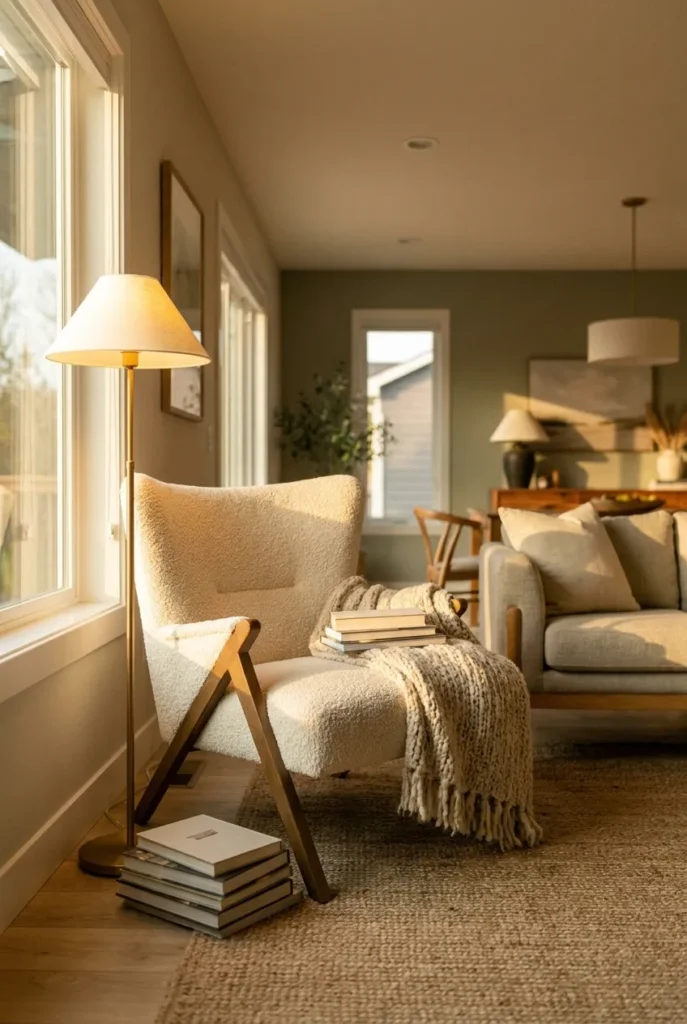
Start by Stealing a Corner (the 18-Inch Rule)
Here’s the one that gets everyone: people plop a chair in the dead center of a wall and wonder why the reading area feels like a waiting room. A reading spot wants a corner, even a soft one you invent. In an open-plan living room, the best corner is usually the one farthest from the kitchen traffic and angled away from the TV.
Pull the chair about 18 inches off the wall so the lamp arm clears your shoulder and the seat feels tucked, not pinned. That gap is the whole trick. It reads as intentional instead of leftover.
If your only option is a true corner where two walls meet, angle the chair at 45 degrees across it. You get a wider view, your knees aren’t jammed, and a small round side table fits neatly in the triangle of space behind.
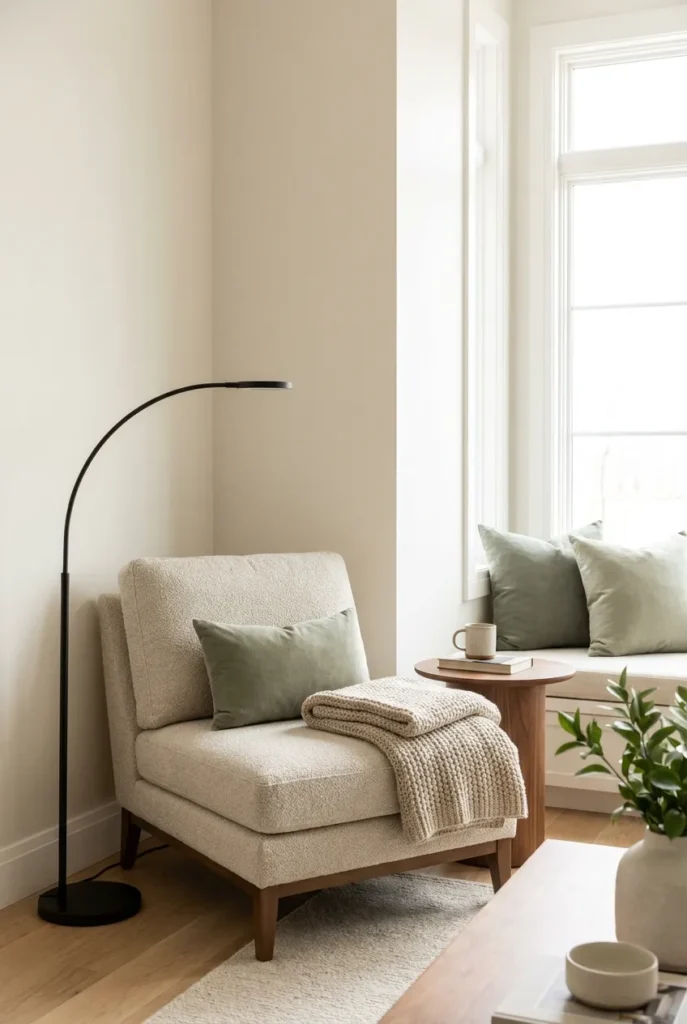
Draw Your Walls With a Rug
This is the move open-plan rooms are built for. You don’t have walls around your reading area, so you borrow them from the floor. A rug under the chair tells the eye “this is a different room” without a single nail.
Size it so the front legs of the chair (and the ottoman, if you use one) sit on the rug. A 4×6 works for a single chair corner; go 5×8 if you’re floating the zone off a wall. Designers leave at least 18 inches of bare floor between a rug and the nearest wall in a small space, which keeps the whole thing from looking crammed. For the full breakdown on legs-on versus legs-off placement, Houzz has a clear, no-nonsense guide in their area rug rules and how to break them.
Texture matters more than pattern here. A jute rug or a low wool pile says “settle in.” A flat printed rug under a reading chair tends to read as a doormat, so skip it.
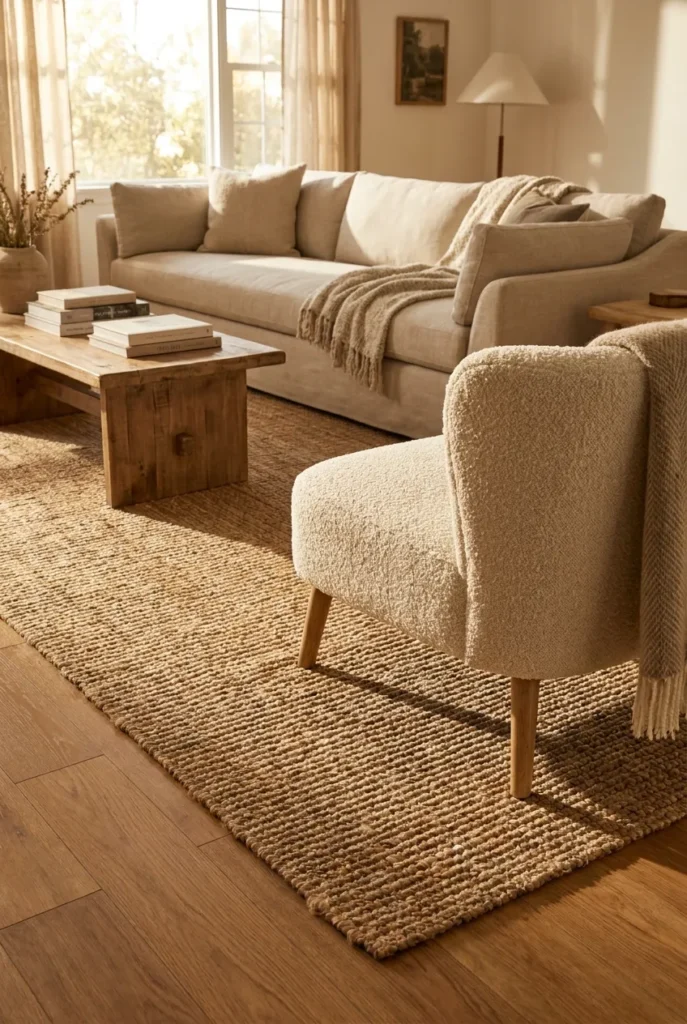
Use the Back of Your Sofa as a Divider
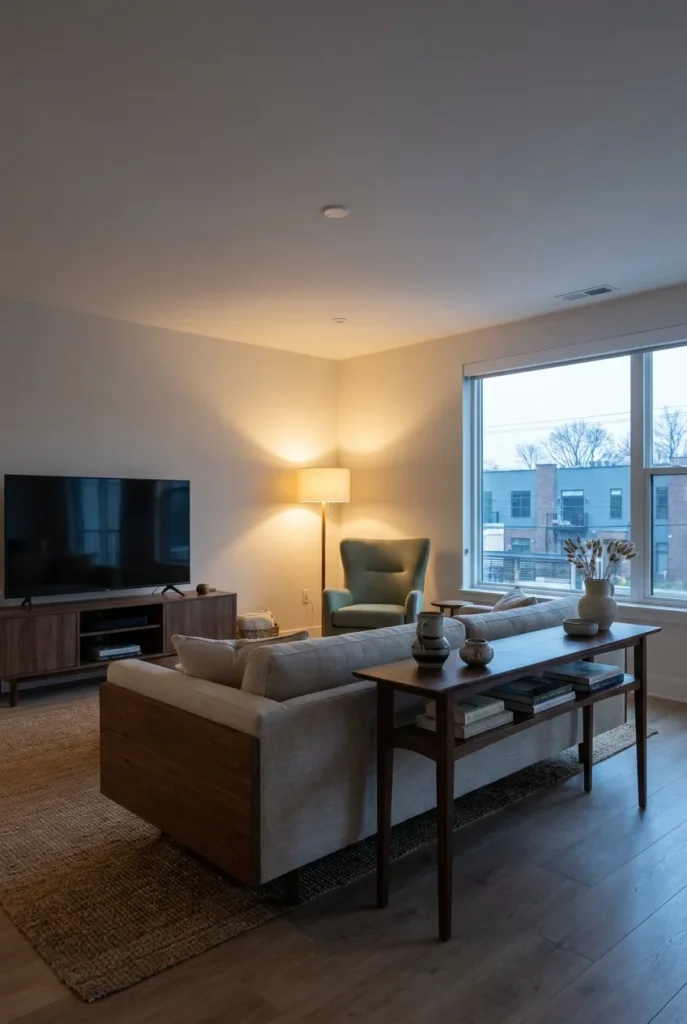
Your couch is already a wall. Most people just don’t use it that way. Float the sofa a foot or two off the main wall and the space behind it becomes a natural, rent-safe room divider with zero construction.
Slide a narrow console table (10 to 12 inches deep) against the back of the sofa, set a chair on the far side facing out, add a lamp, and you’ve built a reading area that the sofa visually fences off from the TV zone. People watching the screen see the back of the couch. You see your book.
This trick is the backbone of a lot of small open-plan layouts, and it pairs well with the broader set of corner solutions in our cozy book nook ideas you can actually build. Borrow the seat-and-light pairings from there and drop them behind the sofa.
Pick One Good Chair (Not Four Cute Ones)
The chair is the whole budget battle. Spend here and skimp elsewhere. A reading area lives or dies on whether the seat actually supports a 40-minute sit, not on whether it photographs well.
Floor cushions look dreamy in pins. After 40 minutes your back files a complaint. If you love the look, use a floor cushion as a footrest, not the main seat. For the seat itself, you want a real back.
Good archetypes by budget:
- A used or flat-pack accent chair, roughly $80 to $150 (think an IKEA Poäng with a fresh cushion).
- A bouclé barrel chair in the $200 to $350 range for the sage-green-and-cream look all over Pinterest right now.
- A small chaise or chaise corner if you have the floor space and want to stretch your legs out.
Whatever you pick, sit in it for the length of a chapter before you commit. Comfort over cute. Every time.
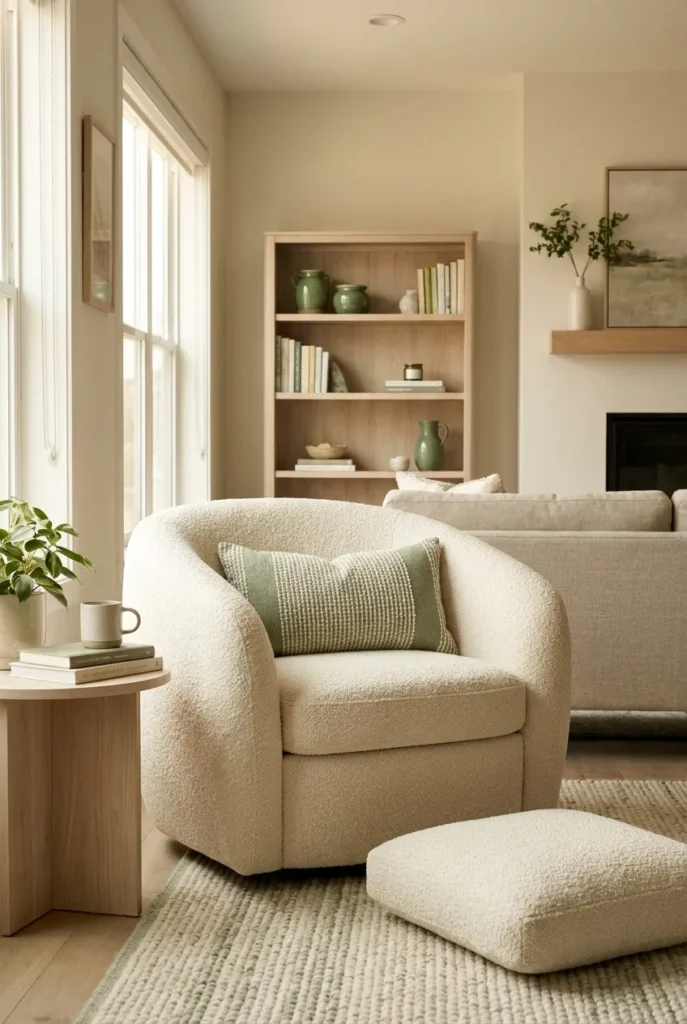
Light It Warm, Light It Low (2700K, Not the Ceiling)
Open-plan rooms almost always lean on bright overhead lighting, which is exactly wrong for reading. Skip the ceiling. Build a pool of warm light at the chair instead.
Reach for a 2700K bulb. That’s the soft, golden warm-white range that signals “wind down” instead of “fill out a form.” Color temperature and brightness are different things, so pair that warm 2700K with around 450 to 800 lumens at the chair for comfortable reading without glare. Lumens has a simple, accurate breakdown of the warm-to-cool scale in their Kelvin color temperature guide if you want to see where 2700K sits.
A swing-arm floor lamp is the workhorse: it reaches over your shoulder so light lands on the page, not in your eyes. Put it on a dimmer. Skip the dimmer and your nice warm bulb still blasts like a dentist’s office at night.
Renting and can’t add a fixture? A plug-in floor lamp does everything a hardwired one does. No drill, no deposit lost.
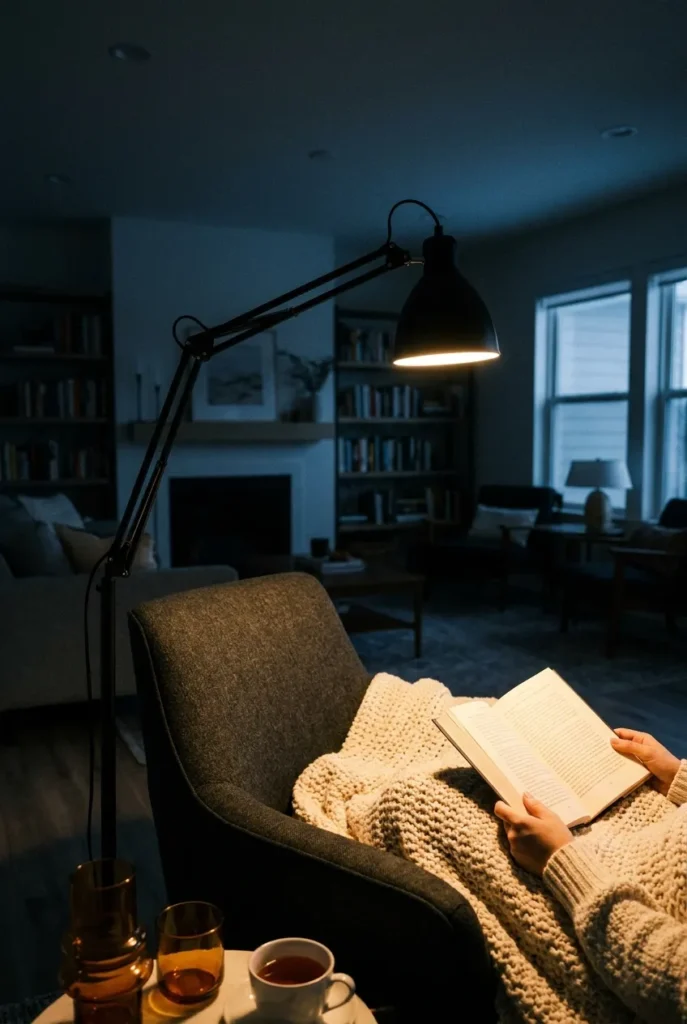
Mind the Sightline and the Sound
Here’s a gap most reading-area guides skip entirely. In an open-plan room, the enemy isn’t square footage. It’s the sightline to the TV and the noise from the kitchen.
Face your chair so the television falls behind you or off to one hard angle, never straight ahead. If the screen is in your eyeline, you’ll watch it. Every time. Turn your back to it on purpose.
For sound, soft stuff is your friend. A rug, a throw, a couple of pillows, even a tall plant beside the chair, all of it eats the open-room echo and dampens the clatter of someone unloading the dishwasher. A reading area that sits near a fireplace gets a bonus layer of cozy, and if that’s your setup, our guide to building a fireplace reading nook you’ll actually sink into walks through the warm-corner version of this same idea.
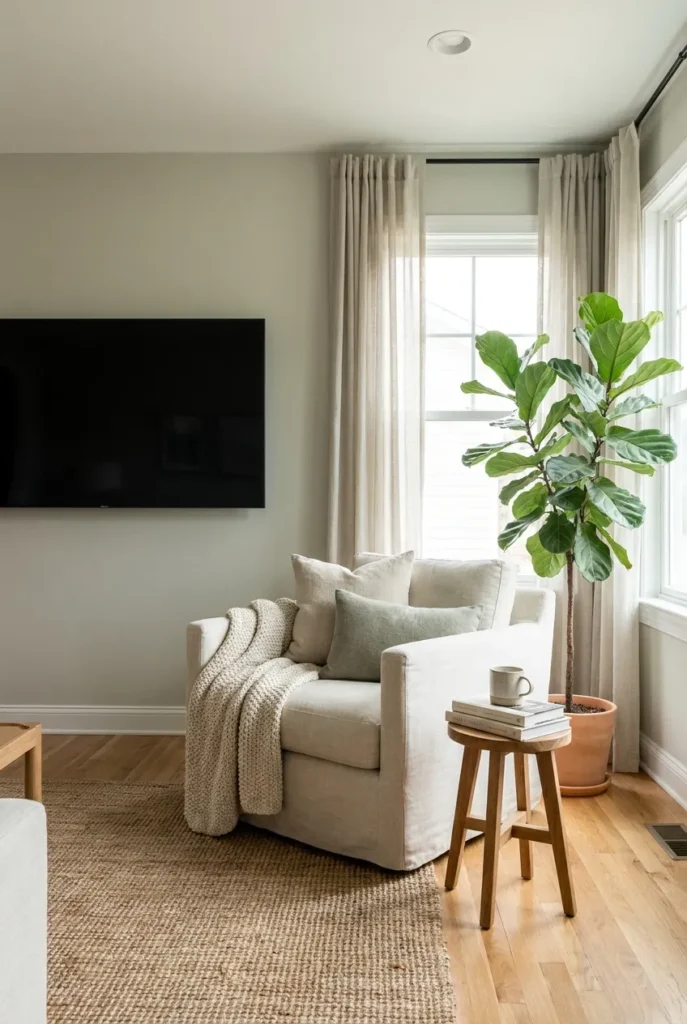
The Open-Plan Anchor Checklist
Screenshot this. It’s the fastest way to tell whether your reading area reads as a real zone or just a chair that wandered off.
A reading area in an open-plan living room is “anchored” when it hits these five:
- Rug underneath, front chair legs on it, 18 inches of bare floor to the nearest wall.
- Its own light source at the chair (2700K, on a dimmer), never relying on the ceiling.
- A back to something, a sofa, a console, a wall, so it feels held, not floating.
- A surface within arm’s reach, roughly 24 inches, for a mug and your current read.
- Faced away from the TV and angled out of the main traffic path.
Hit four of five and it works. Hit all five and people will ask where the wall went.
| Element | Budget pick | Spec to hit |
|---|---|---|
| Chair | Flat-pack accent chair | Real back support, 40-min comfort |
| Light | Plug-in swing-arm lamp | 2700K, 450 to 800 lumens, dimmer |
| Rug | Jute or low wool pile | Front legs on, 18 in. off the wall |
| Surface | Round side table | ~24 in. reach from the seat |
| Divider | Sofa back or console | 10 to 12 in. deep console |
A Quick Word on a Kids’ Reading Corner in the Same Room
Sharing the open-plan room with little ones? You can tuck a kid-sized reading corner into the same space without it taking over. Give it its own small zone: a washable rug, a floor cushion or a tiny chair, a low basket of books they can reach, and a soft clip-on light.
Keep it low and contained so it visually “belongs” to the kids and doesn’t sprawl into your seating. A reading area shared by two ages works best when each one gets a defined patch, which is the same spacing logic behind building a reading nook for two people, just scaled down for shorter legs.
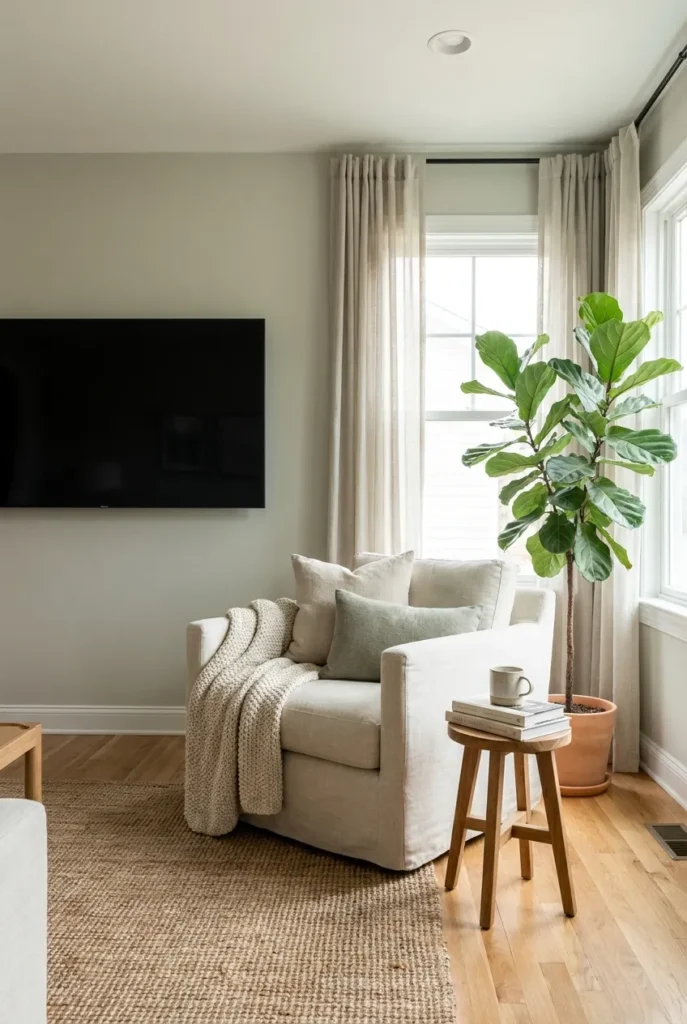
Style It So It Looks Like It Was Always There
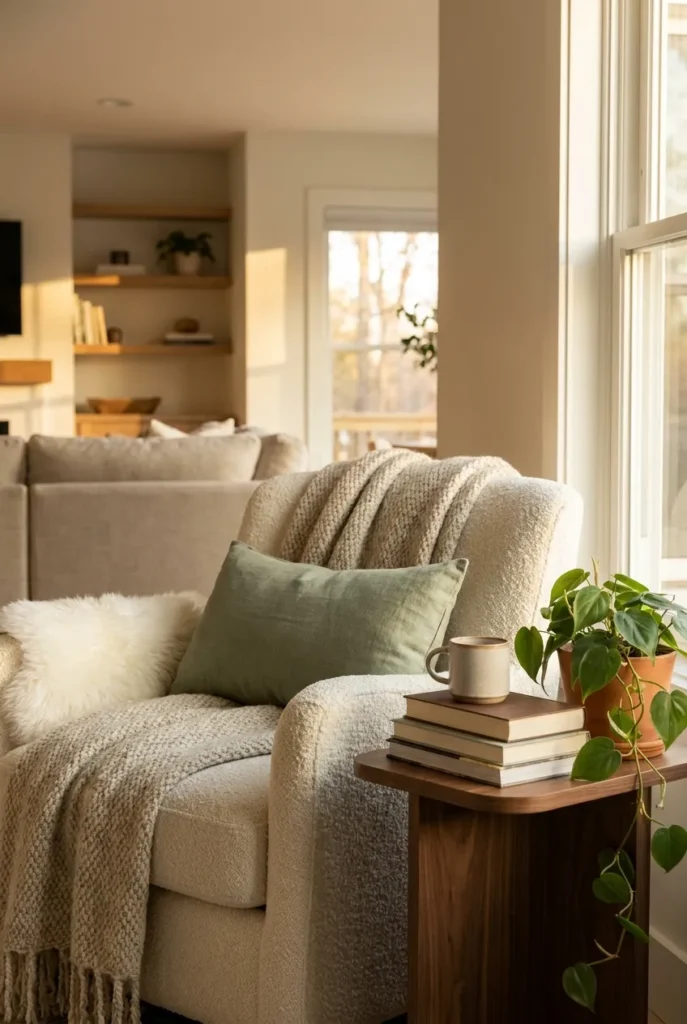
The finishing layer is what turns a functional setup into a spot you actually want to sit in. Keep it to three soft pieces: a throw, a lumbar pillow, and one textural thing (a sheepskin over the arm, a chunky knit, a wool runner).
Add a small stack of books and one plant. That’s it. Resist the urge to pile on. A reading area gets cozier the more restraint you show, because the eye needs somewhere to rest.
Match the palette to the rest of your open-plan room so the zone feels connected, not bolted on. Sage green, oatmeal, and warm wood is the combination doing numbers on Pinterest right now, and it plays nicely with almost any existing couch.
Reading Area Ideas Frequently Asked Questions
What should I put in a reading area?
The short list: one supportive chair, a rug to define the zone, a warm light source at the seat, and a small side table within arm’s reach. Add a throw and a lumbar pillow for comfort. Everything past that is optional styling. In an open-plan living room, the rug and the light do the heavy lifting because they’re what separate the spot from the rest of the room.
How do I create a reading area in an open-plan living room?
Pick the corner farthest from kitchen traffic, float a chair about 18 inches off the wall, anchor it with a rug (front legs on), and add a swing-arm lamp with a 2700K bulb on a dimmer. Use the back of your sofa or a slim console as a soft divider, and face the chair away from the TV. No walls or renovation required.
What makes a reading area comfortable?
Three things: real back support, warm low light, and arm’s-reach access to a mug and your book. A seat with an actual back beats a floor cushion for any sit longer than half an hour. Warm 2700K light at the chair (not the ceiling) reduces eye strain and signals your brain to relax. A side table about 24 inches away means you never have to get up mid-chapter.
What are some fun ways to encourage more reading?
Make the spot frictionless and visible. Keep your current read and a small “to be read” stack right on the side table so starting takes zero effort. A warm dimmable lamp makes the corner inviting at night. For kids, a low basket with book spines facing out (so they can see the covers) and a cozy floor cushion turns reading into something they choose on their own.
Can I make a reading area if I rent?
Yes, and an open-plan room makes it easier. Everything here is no-drill: a freestanding chair, a plug-in floor lamp, a rug, and a sofa or console as the divider. Nothing gets mounted, painted, or built in, so your deposit stays safe and the whole zone moves with you.
How small can a reading area be?
Smaller than you think. A single chair, a 4×6 rug, a slim lamp, and a 14-inch round side table fit in roughly a 4-foot by 4-foot patch. In an open-plan room you’re not closing off space, you’re just claiming a corner of it, so even a tight floor plan has room for one good seat.
Your Corner Is Waiting
The walls were never the point. A rug, a warm lamp, one good chair, and a sofa-back doing double duty as a divider, that’s a real reading area inside a room that already had a job. Start with the chair this weekend, add the rug and the light next, and let the styling come last. Which corner of your open-plan living room is about to get claimed?
Keep reading
More cozy nook ideas
 Living Room
Read →
Living Room
Read →
Cabin Living Room Checklist: Everything to Decide Before You Start
No log walls, no stone hearth, no lake outside the window. You can still build a cabin living room in a regular…
 Bedroom
Read →
Bedroom
Read →
English Cottage Bedroom Checklist: Everything to Decide Before You Start
You saved forty pins of floral quilts and sloped ceilings, then looked up at your own bedroom: beige walls, one window, a…
 Nursery & Teen Rooms
Read →
Nursery & Teen Rooms
Read →
25 Teen Boy Bedroom Ideas That Feel Grown-Up, Not Childish
If his room still has the race car lamp and the glow-in-the-dark stars, and the door has started staying shut, he’s telling…