
10 Patio Reading Nook Ideas That Are Actually Covered, Shaded, and Bug-Free

If your patio is currently a plastic chair, a spider web across the umbrella, and a book you abandoned after the first mosquito bite, this fixes it.
A good patio reading nook needs three things working at once: overhead cover, a plan for the bugs, and a seat you actually want to stay in past the first chapter. Most outdoor reading setups get one of those three right. We’re doing all of them, in order, with real measurements and products you can actually find this weekend.
And yes, you can pull this off as a renter. Zero drilling required.
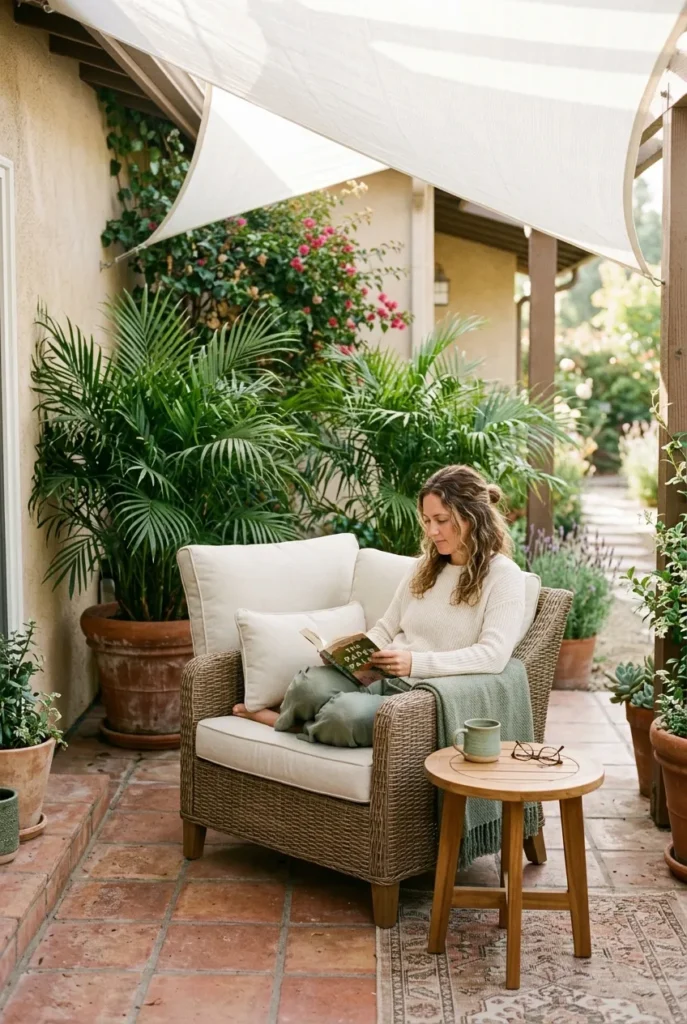
1. Shade First: Sail Shades, Market Umbrellas, and Canopy Pergolas
Before you pick a chair or a throw pillow, you need overhead cover. This isn’t decorative. The EPA’s SunWise program notes that UV exposure becomes a health concern when the UV index reaches 3 or above, which in most US states means every clear morning from April through September. Without shade, you’re not building a reading nook. You’re building a slow sunburn.
The fastest, cheapest setup is a triangular HDPE sail shade rated UPF 50 or higher. Anchor it diagonally across your patio corner using D-ring eye hooks screwed into fence posts or tied off on a freestanding frame. A 10-by-10-foot sail shade runs $30 to $55 at Home Depot or Amazon and covers one chair plus a side table with space left for a floor cushion or pouf. The diagonal angle matters. It sheds rainwater instead of pooling it.
I learned the tilt rule the hard way. My first sail shade was mounted flat, perfectly horizontal, taut as a drumhead. After one afternoon rainstorm it held about four gallons of water in the center and sagged like a hammock nobody asked for. Everything gets a 15 to 20-degree angle now.
For a more substantial setup, a freestanding pergola canopy kit does everything a sail shade does with more visual permanence. The Sunjoy and Outsunny styles at Walmart run $160 to $280, require no drilling into walls or fences, and come with a soft fabric canopy you can swap out or remove seasonally. A 10-by-10-foot footprint is the minimum for a one-chair nook with breathing room.
Failure mode: A sail shade without tight, equal tension on all three anchor points goes slack in the first afternoon breeze and covers about half the area it should. Tighten every connection point before you sit down.
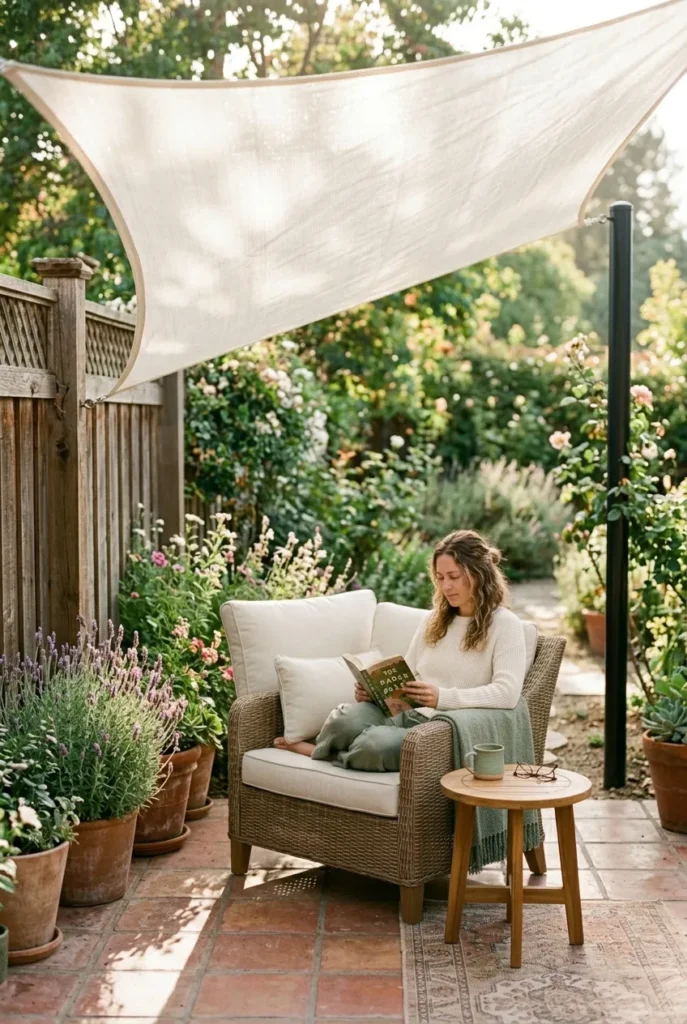
2. Bug-Proof Your Patio Nook Without Killing the Mood
This is the section nobody writes, which is exactly why every outdoor reading nook falls apart by mid-July. You set it all up. You sit down with your coffee and your novel. The mosquitoes arrive.
Here is what actually works, ranked by effort level.
The most effective zero-drill solution is a canopy mosquito net. These are large mesh nets, look for openings of 1mm or smaller, designed to drape over a chair or daybed from a single hook in a pergola beam, a branch, or a ceiling-mounted cup hook above a covered patio. You sit inside a sheer cocoon. The smell of the garden filters through. The mosquitoes don’t. The Flowerhouse and basic Amazon versions run $18 to $35 and fold into a carrying pouch when not in use.
For a more architectural result, outdoor mesh curtain panels hung across your pergola opening do double duty as bug screens and privacy panels. A spring tension rod rated for outdoor use spans most pergola widths without drilling. The mesh weave on outdoor sheer curtains keeps flying insects out while letting air move through. It reads like intentional decor, not like camping gear.
Citronella helps. But here’s the honest thing about it: citronella candles create an effective barrier in roughly a 3-foot radius. Two candles on your side table give you a narrow personal buffer. Four candles positioned at the corners of your nook give you real coverage. The scent sits somewhere between lemon zest and warm kerosene at 6 pm, which I personally find fine during a good chapter and deeply annoying during a boring one.
Failure mode: A single plug-in mosquito zapper is satisfying to listen to and mostly catches moths. Don’t rely on it as your primary strategy.
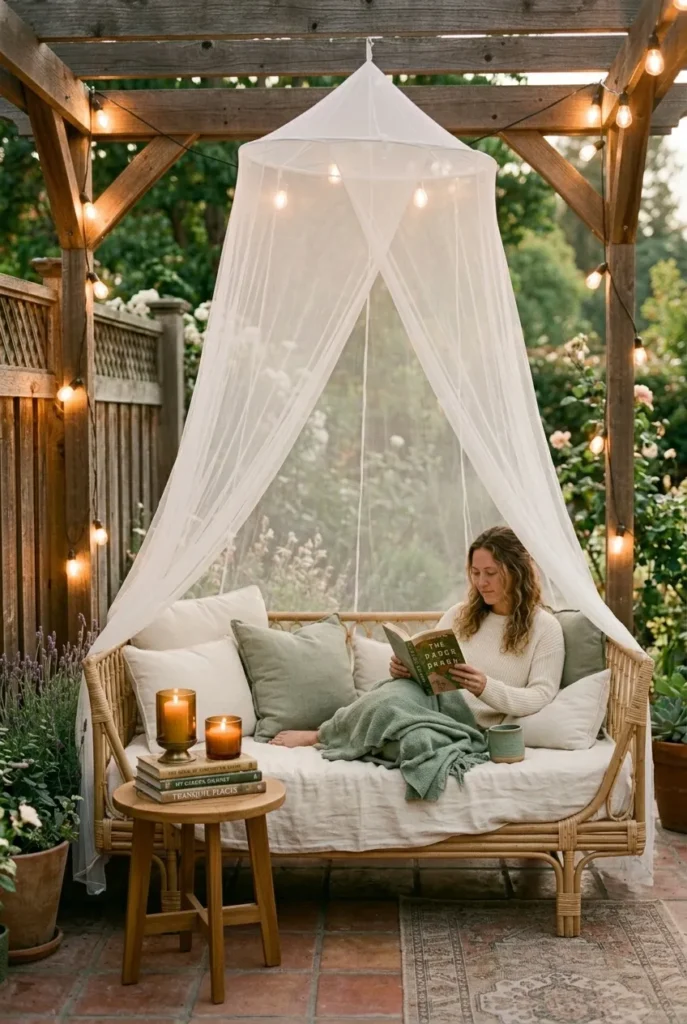
3. The Enclosed Patio Reading Nook: How to Build the Cocoon Effect
“Enclosed patio reading nook” is one of the top Pinterest autocomplete hits for this keyword, and none of the top-ranking articles actually explain how to build one. So here it is.
An enclosed outdoor reading nook doesn’t require walls. It needs at least two sides with visual or physical enclosure, which creates the tucked-away feeling without trapping heat or blocking airflow. You can get there with curtain panels on a pergola frame, a trellis covered in climbing vines, a tall bookcase or ladder shelf facing inward on one side, or a planted hedge of bamboo in containers on two sides.
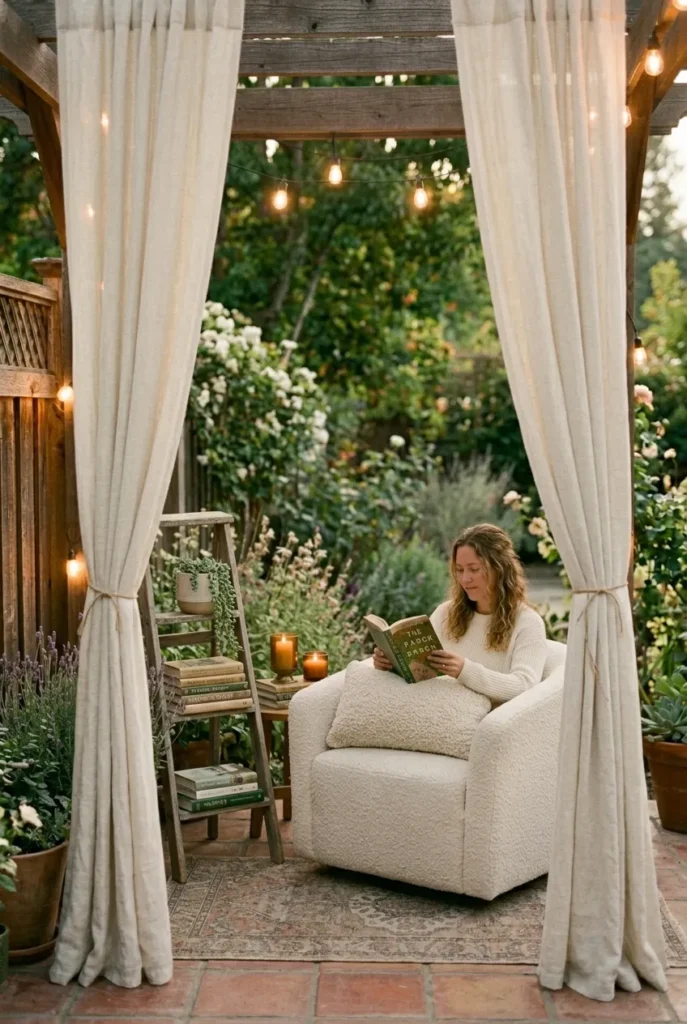
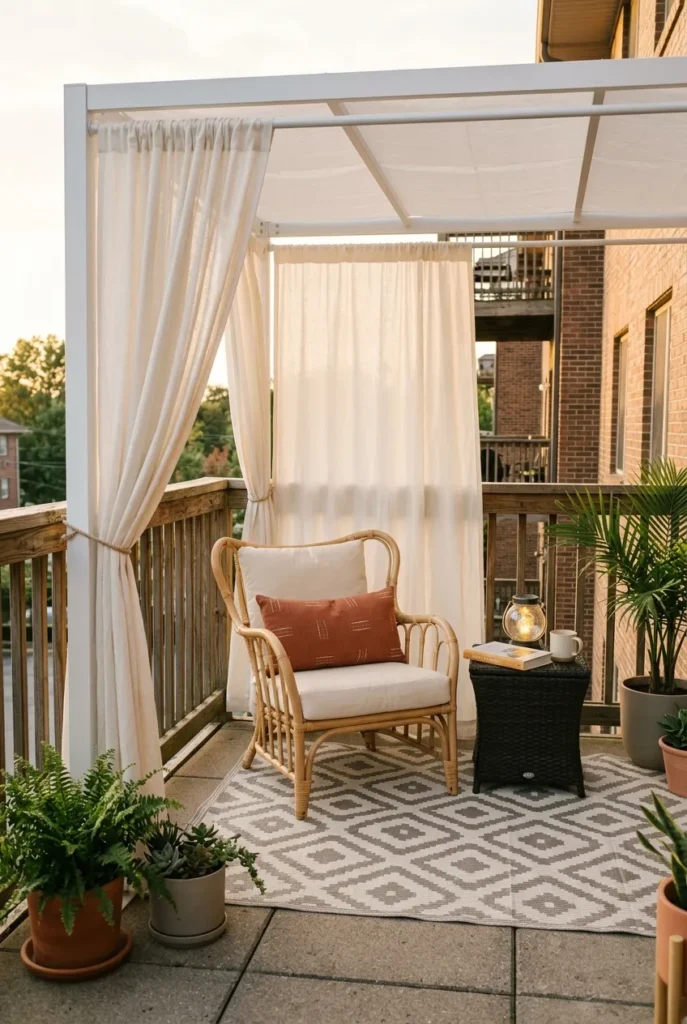
The quickest version uses outdoor curtain panels. Hang two panels of linen-look UV-resistant fabric from a tension rod or a clip-ring system across two pergola sides. Each panel should be at least 96 inches long so they skim the floor slightly when pulled closed. That small pooling detail changes the feel of the space from “chair on a slab” to “room with an outdoor wall.” Pull them half-open in the breeze and the nook still breathes. Close them fully and you disappear from the yard entirely.
Add a narrow ladder shelf just inside the open face of the nook, loaded with a few weatherproof books or a small basket of supplies, and the space starts reading as a real room.
Failure mode: A covered nook with no ventilation gap becomes a radiant heat box by noon in July across most of the South. Always leave at least one side fully open or maintain a 12-inch gap between curtain panels at the center.
4. Pick the Right Outdoor Chair (This One Decision Changes Everything)
A patio dining chair is designed for 45-minute meals. A hammock is designed for napping. Neither is a reading chair. What you want is a seat with a back angle between 100 and 110 degrees (reclined but not flat), a seat depth of at least 22 inches so you can shift position without falling off the front edge, and a seat height between 17 and 18 inches so your feet rest flat on the ground when you settle in.
The rattan-look resin wicker armchair is the most reliable outdoor reading chair in the $80 to $250 price range. It handles rain and UV exposure without warping, rusting, or requiring any seasonal treatment. The Christopher Knight and Better Homes and Gardens versions at Walmart hit every measurement above and typically include a cushion at that price. For a boho patio reading nook, the rattan disc hanging chair (the macrame or woven version, not a rope hammock) is visually beautiful and deeply comfortable once you’re in it. Getting out quickly is not an option. I’ve tipped two of them by stepping off at the wrong angle mid-chapter.
For bench seating rather than an armchair, the cushion does more work than the bench itself. Getting the cushion thickness and foam density right is the difference between 20 comfortable minutes and two comfortable hours. The guide on outdoor bench cushion sizing and foam density covers every spec you need before buying.
Failure mode: A canvas folding camp chair collapses forward if the patio has even a 2-degree slope and gives you neck strain within one chapter.
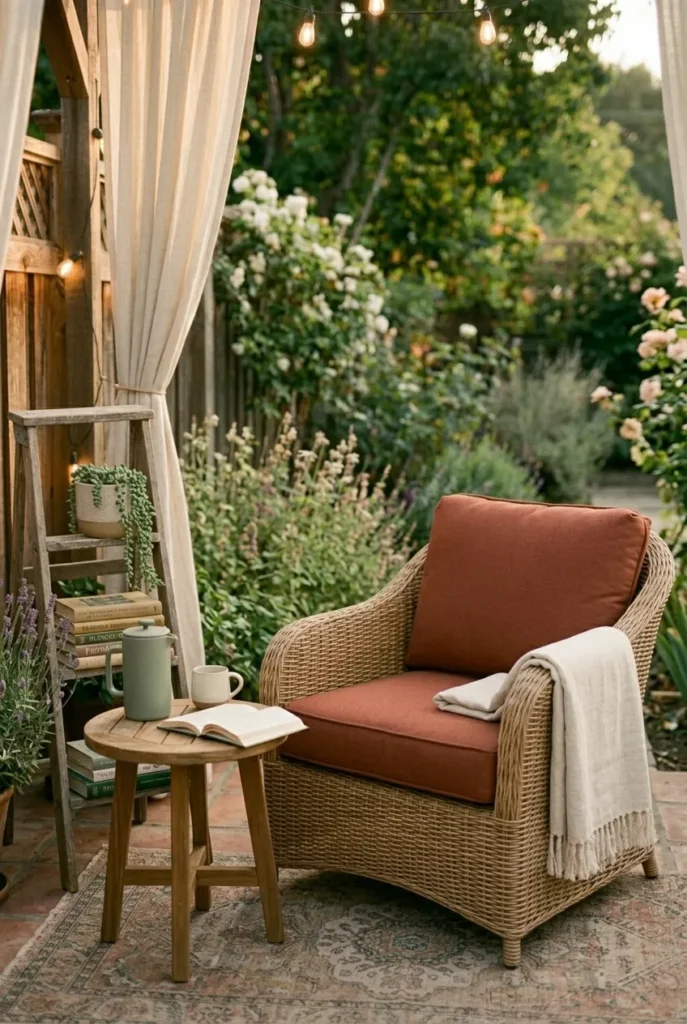
5. Outdoor Soft Goods That Survive Rain, Dew, and a Forgetful Owner
Every patio nook article tells you to add throw pillows and a cozy blanket. None of them tell you what happens three days after you leave those items outside.
Cotton goes mildewy within 48 hours of getting wet in a humid climate. Standard indoor linen pillows do the same. I ruined a $45 boucle throw I loved by leaving it on a patio chair through a Georgia July. It came in smelling like a wet dog who had been to the gym.
Here’s what actually holds up: solution-dyed acrylic fabric. Sunbrella is the well-known brand name, but store-brand versions using the same fiber structure are widely available at Target and HomeGoods. These pillows are fade-resistant, dry in under two hours, and don’t support mold growth the way natural fibers do. Current pricing in 2025 to 2026 runs $18 to $45 per pillow at HomeGoods or Amazon. For a throw you can genuinely leave outside, look for a flat-woven polypropylene blanket. It looks like a boho cotton throw, feels slightly waxy to the touch (the honest tradeoff), dries in 30 minutes, and weighs almost nothing when wet.
Clemson Cooperative Extension’s outdoor furniture fabric care research notes that solution-dyed acrylic retains color up to three times longer than solution-coated alternatives under direct UV exposure. That’s the difference between pillows that look intentional in year two versus pillows that look like they’ve been through five car washes.
For a full breakdown of what to rotate in and out as seasons shift, the seasonal nook refresh guide for warmer months and lighter textures is the companion read here.
Failure mode: “Outdoor-rated” is not the same as weatherproof. Check the label for a specific UV-hours rating. Anything under 500 hours will fade noticeably by mid-summer.
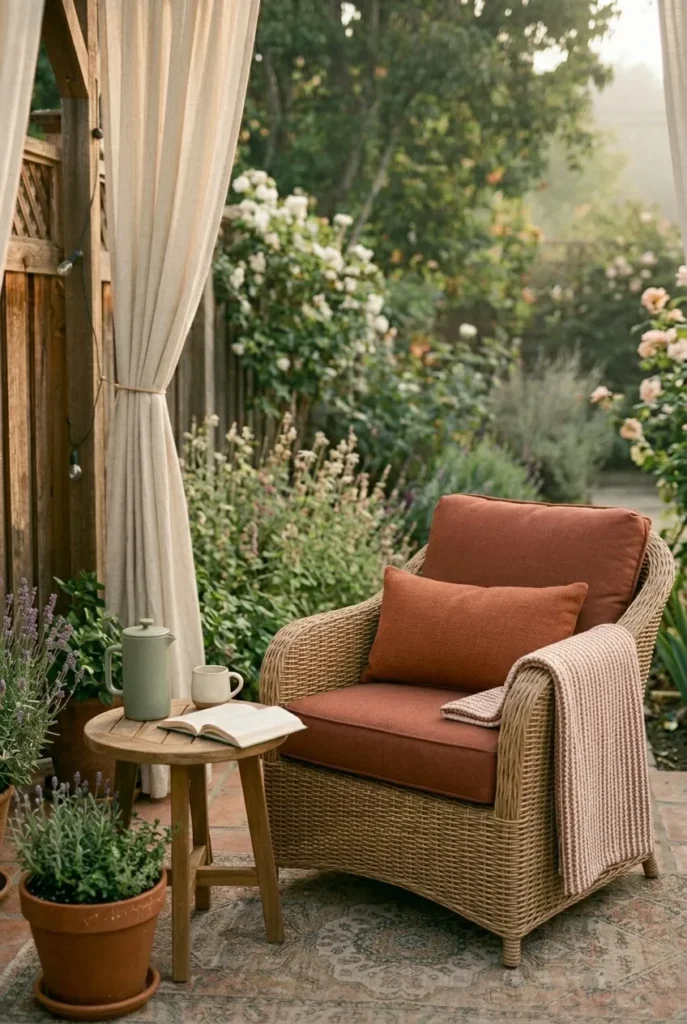
6. Lighting for Evening Reads: Two Layers, Not One
The mistake in almost every beautifully styled outdoor reading nook photo is the same: fairy lights for atmosphere, nothing else for actual reading. You cannot read comfortably by fairy lights alone. Your eyes strain after about 10 minutes. You’ll blame the chapter before you blame the lighting, and that’s a shame.
Build outdoor lighting in two layers.
Layer one is atmosphere: a warm Edison-style string set at 2700K, rated IP65 for full weatherproofing, draped in a loose catenary curve across your pergola frame. These set the visual tone of the space at dusk. They make the nook glow from the yard. They are not enough to read by.
Layer two is task: a clip-on reading light in the 40 to 60-watt-equivalent range clipped to your chair back or arm, angled over your shoulder at the page. The best options run on USB-C rechargeable batteries and hold 8 to 10 hours per charge. For a more permanent solution in a covered patio, a plug-in sconce mounted to a nearby post or pergola beam solves both atmosphere and task in one fixture. The full guide on plug-in sconces that need zero wiring or hardwiring covers which profiles work for covered outdoor corners specifically.
Solar string sets with less than a 6-hour battery runtime are a common budget purchase that sounds smart until the lights fade mid-chapter. Look for an 8-hour minimum runtime before buying.
Failure mode: A single cool-white overhead patio light at 4000K mounted directly above your head casts shadow onto your page and makes the space feel like a dentist’s waiting room after dark.
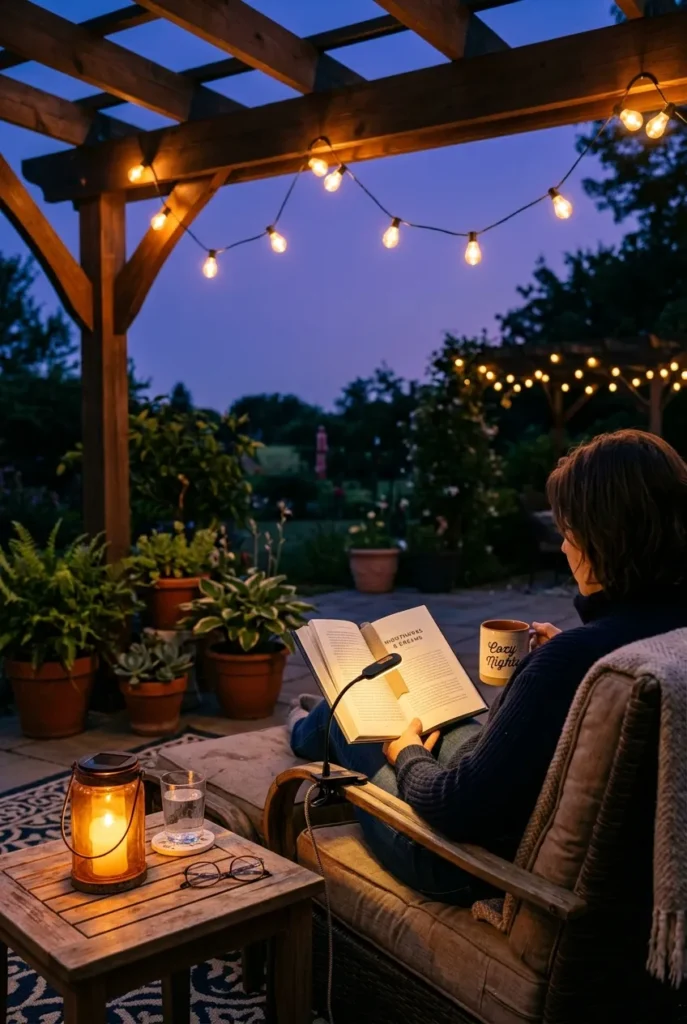
7. The Outdoor Side Table Rule Most Setups Get Wrong
The 18-inch reach rule applies outdoors exactly as it does inside: your side table surface should sit within 18 to 24 inches of your center seated position, and its height should fall within 2 inches of your chair arm. Any lower and you’re bending forward every time you reach for your mug. Any higher and you’re lifting your arm with every sip.
For outdoor use, material is the deciding factor. Teak, powder-coated steel, resin wicker, and concrete all handle moisture without warping or splitting across seasons. Untreated mango wood, any surface with a veneer layer, and anything with an MDF core painted to look like outdoor furniture will swell and delaminate within one season of regular dew and rain exposure.
The sweet spot for a single-chair patio nook is a 14-to-16-inch round teak end table or a flat-shelf resin wicker side table. Budget option: a terracotta pot turned upside down with a 12-inch round wooden tray on top. It costs $12, looks entirely intentional, and handles a full coffee mug without complaint.
Failure mode: A decorative 18-inch stool positioned near your chair tips with a full mug on it if the patio surface has even a slight slope. Test stability on your actual patio surface before committing.
8. Anchor the Space With an Outdoor Rug
A patio without a rug is furniture on a slab. An outdoor rug, even a $35 polypropylene flatweave from HomeGoods, converts the footprint into a room. It defines the boundary of the nook, softens the acoustic echo of a hard patio surface (concrete and tile echo more than you’d expect), and makes the whole setup look like a decision rather than an accident in photographs.
Size matters more than pattern here. For a single-chair nook with a side table, go 5 by 7 feet at minimum. Both the chair legs and the table leg should sit completely on the rug surface. If only the front two chair legs land on it, the setup looks unfinished no matter how beautiful everything else is.
For a boho patio reading nook, layer two rugs: a larger natural-fiber-look polypropylene base underneath and a smaller printed flatweave on top. The visual depth is worth the extra $25 and works especially well on plain gray or beige concrete.
Renters should know that polypropylene outdoor rugs lie flat within 24 hours on most hard surfaces and require no tape or anchoring hardware. Roll them up in late fall, roll them back out in April.
Failure mode: Indoor/outdoor rugs labeled “transitional” often have a felt backing that traps moisture underneath and develops mold on the concrete within weeks. Flip the rug before buying and verify a mesh or open-weave backing.
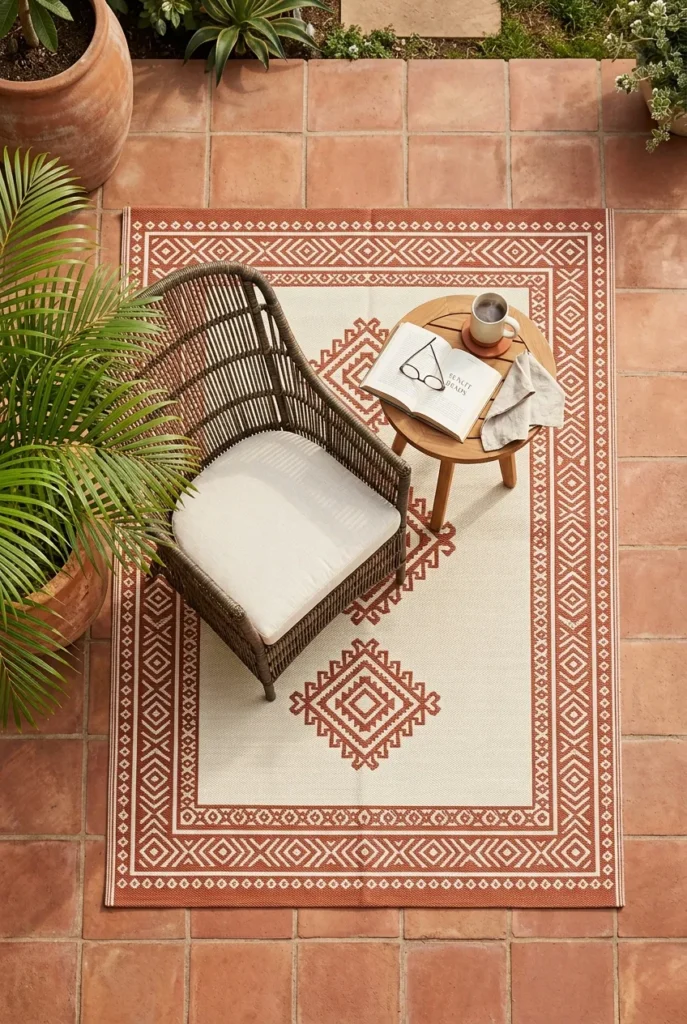
9. Use Plants as Your Privacy Screen
The most underused tool in a patio nook setup costs $20 and grows taller every month. Plants positioned on two or three sides of your reading chair give you privacy from neighbors, visual softness, and a green wall that makes the space feel like a sanctuary you designed, not furniture you rearranged one afternoon and then forgot to improve.
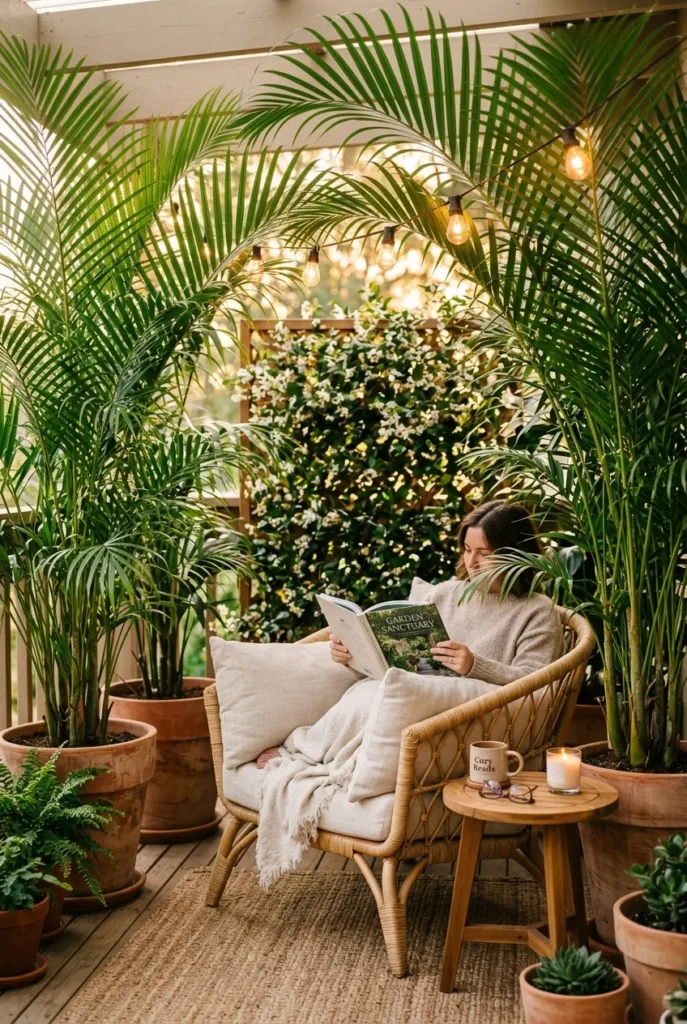
For privacy, you need mass and height. One potted succulent is a decorative object. Three areca palms in 18-inch galvanized tubs spaced 12 inches apart is a privacy screen. Areca palms grow to 6 to 8 feet in a large container and are available at Home Depot and Lowe’s for $25 to $45 each. They move with you when you leave.
For a cottagecore outdoor reading nook, climbing jasmine or a Rosa ‘Zephirine Drouhin’ on a trellis panel gives you a vertical soft wall that blooms mid-summer. The scent of jasmine on a warm evening while you’re 60 pages deep in something good is, genuinely, the whole point of building a reading nook outside. That’s not a design detail. That’s the reason.
Failure mode: Planting a privacy hedge directly into the ground on a rental patio. Your landlord will notice, and you won’t be getting that deposit back. Use containers only.
10. The Renter-Safe Patio Nook: Zero Drills, Full Setup, One Weekend
Most patio nook guides assume you own the patio. This one doesn’t.
The full renter-safe outdoor reading nook is built on five freestanding or tension-mounted elements. No wall anchors. No holes. No landlord conversations.
One: A freestanding pergola canopy kit at 10 by 10 feet minimum. The Outsunny and Sunjoy models at Walmart ($160 to $300) bolt together with included hardware and stand on their own four legs on any flat patio surface.
Two: A spring tension rod rated for outdoor weight spans the pergola opening for curtain panels. Removes in seconds, no surface marking.
Three: Clip-ring outdoor curtain panels on the tension rod create the enclosed, tucked-away feeling on two pergola sides.
Four: A freestanding arc floor lamp or a set of IP65-rated solar lanterns on a side table handles evening lighting with no hardwiring.
Five: A polypropylene flatweave outdoor rug lies flat without adhesive on any hard patio surface.
Full cost for this setup: $280 to $400. Assembly time: one long afternoon. Damage on move-out: zero. If you want more ideas for making a cozy corner work without putting a single hole in anything, the renter-safe tiny reading nook builds that fit under 10 square feet translate surprisingly well to small outdoor footprints.
Failure mode: A popup event canopy tent (the farmers market style) folds in a 25-mph wind and reads as a garage sale from the street. Invest in a pergola kit with cross-bracing and a solid canopy top.
Quick-Reference Build Spec: Patio Reading Nook
| Element | Minimum Spec | Budget Range | Failure to Avoid |
|---|---|---|---|
| Shade | 10×10 ft sail shade, UPF 50+ | $30 to $55, Home Depot | Flat-mount (pools water) |
| Bug screen | 1mm mesh canopy net or panels | $18 to $40 | Citronella alone |
| Chair | 22″ seat depth, 17–18″ height | Resin wicker, $80 to $200 | Canvas folding chair |
| Cushion fabric | Solution-dyed acrylic, 500+ UV hrs | Sunbrella-grade, $30 to $60 | Cotton outdoors in humidity |
| Task lighting | 2700K, IP65-rated | Edison string set, $25 to $40 | Cool-white 4000K overhead |
| Side table | Within 18″ reach, chair-arm height | 14–16″ round teak, $35 to $80 | Decorative stool on sloped patio |
| Rug | 5×7 ft minimum, mesh-backed | Polypropylene flatweave, $35 to $65 | Felt-backed “indoor/outdoor” |
Frequently Asked Questions
How do you make an outdoor reading nook?
Start with three things in this order: shade (sail shade, canopy, or pergola), a chair with at least 22 inches of seat depth, and a bug plan (mosquito net or mesh curtain panels). Everything else, the rug, the plants, the lighting, builds around those three. Most one-chair setups come together in a single afternoon for $150 to $350.
Where is the best place to read outside?
A covered corner with one or two sides sheltered by a fence, wall, or planted screen gives you the most control over light, wind, and privacy. Avoid spots with direct overhead sun between 10 am and 4 pm even under a canopy. A morning-east-facing or afternoon-west-facing orientation gives you natural reading light without full UV intensity.
What are the must-have items for an outdoor reading nook?
The non-negotiables: a shade structure, an outdoor-rated chair or daybed, weatherproof cushion fabric (solution-dyed acrylic), a bug management layer (mosquito net, mesh curtain, or citronella ring), and task lighting for reading at dusk. A side table and rug complete the setup without being structural.
How deep does a reading nook need to be?
Indoors or outdoors, the minimum functional depth for a seated reading nook is 24 inches (about 60 cm). That’s enough for an armchair with knee clearance. A 36-inch depth is comfortable and allows a side table within the 18-inch reach rule. A daybed setup needs at least 30 inches to lie down with bent knees.
Can you set up a patio reading nook as a renter?
Yes. The full setup uses a freestanding pergola canopy kit (no wall anchoring), tension-rod curtain panels, freestanding or solar lighting, and a polypropylene rug that lies flat without adhesive. The entire setup disassembles cleanly. Budget runs $280 to $400.
How do you keep bugs out of an outdoor reading nook?
The most effective method is a canopy mosquito net (1mm or smaller mesh) hung from a single ceiling hook in a pergola beam. Second option: outdoor mesh curtain panels across the pergola opening on a tension rod. Citronella candles create a useful buffer in roughly a 3-foot radius around your seat. Use four candles at the corners of your space for full coverage.
What outdoor fabric lasts longest for patio cushions and pillows?
Solution-dyed acrylic (Sunbrella and generic equivalents at Target and HomeGoods) holds color significantly longer than solution-coated alternatives under UV exposure. Look for a 500-hour UV rating minimum on any outdoor cushion label. For throws, flat-woven polypropylene is the most durable option: dries in 30 minutes and doesn’t support mildew growth.
Conclusion
A patio reading nook that actually gets used comes down to solving the three problems before you buy anything decorative: shade, bugs, and a chair worth sitting in. Get those right and the rest of the setup, the rug, the plants, the string lights, the polypropylene throw you’ve been saving on Pinterest, falls into place around them without much effort.
If you’re working with a small patio or an apartment balcony, start with the freestanding 10-by-10-foot canopy and one good chair. Build the rest across a few weekends at whatever pace feels right.
What does your current patio situation look like? Drop it in the comments and I’ll tell you which of these ten setups fits your space.
Keep reading
More cozy nook ideas
 Cottage Garden & Balcony
Read →
Cottage Garden & Balcony
Read →
20 Backyard Oasis Ideas on a Budget, Starting With a $152 Corner
Two folding chairs, a small outdoor rug, 24 battery globe lights, and two planters. At IKEA this October, that adds up to…
 Reading Sheds
Read →
Reading Sheds
Read →
12 She Shed Ideas for Small Yards
No acre, no contractor, no giant budget. You need about 64 square feet, a flat patch of ground, and a plan for…
 Garden Nooks
Read →
Garden Nooks
Read →
Container Gardening Ideas for Small Cottage Gardens That Fit a Rental Patio
One anchor pot, two mid-size pots, three little ones. That’s the whole cottage garden, and it fits on a patio smaller than…