
Best Reading Nook Wall Sconces for Cozy, No-Wiring Corners

Your reading corner is currently lit by a ceiling fan with one yellowed bulb and the cold glow of your phone. That’s about to change. A reading nook wall sconce is the cheapest, fastest piece of lighting that turns a sad corner into a place you actually want to sit at 9 pm. No drill. No electrician. No landlord conversation. You need one outlet (or a USB-rechargeable battery), one good 2700K bulb, and about twenty minutes. Here is the whole playbook, including plug-in picks, battery-operated picks, and the placement rule that took me three sconces to learn.
I have hung six wall sconces in three rentals over the last four years. Two were great. Three were fine. One nearly set my landlord’s wallpaper on fire when I picked the wrong bulb. Everything below is what I would have wanted to read before I made any of those purchases.
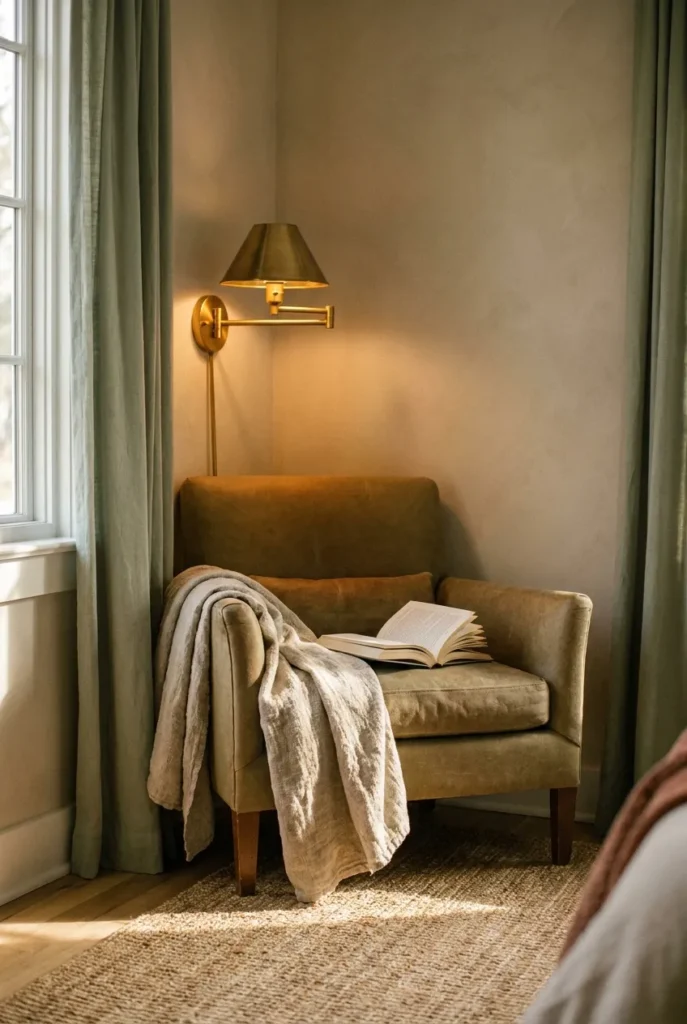
No-Wiring Reading Nook Sconces: The Renter-Safe Install Playbook
If the pin that brought you here promised no wiring, here is the math first. There are three real install paths for a reading nook wall sconce in a rental, and only three.
Path 1: Plug-in with a cord drop. A plug-in wall sconce uses a 6 to 15 foot fabric cord that runs from the back of the fixture down the wall to the nearest outlet. The fixture itself mounts with two small screws or a single picture-hanging hook. Spackle fills the holes when you move. Total visible damage: roughly the size of a thumbtack.
Path 2: Battery-operated, stick-on. A battery-operated wall sconce uses a magnetic backplate or 3M command-strip mount, no screws at all. You charge the sconce by USB-C every two to six weeks depending on use. Zero wall damage. Zero outlet required. This is the option that wins for closet conversions, attic nooks, and any corner more than 8 feet from an outlet.
Path 3: Hardwired (skip if you rent). A hardwired wall sconce ties into the wall’s electrical box. Requires an electrician in most US jurisdictions and explicit landlord permission. We will cover the homeowner version later in the article, but it is not your no-wiring solution.
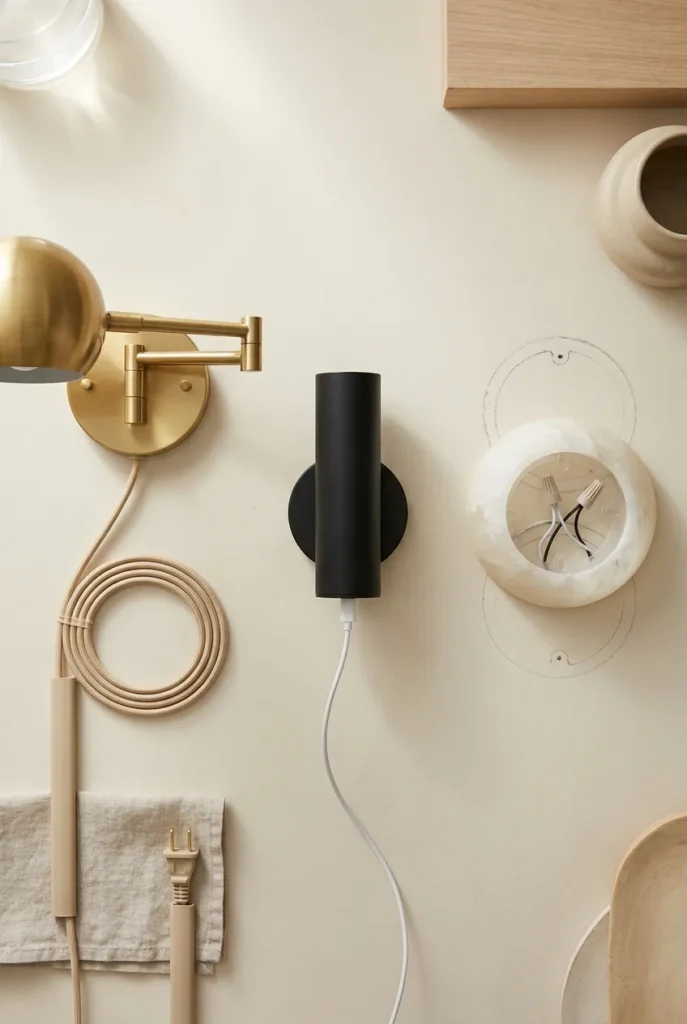
Quick reality check on battery life. Most USB-rechargeable sconces deliver 6 to 10 hours per charge at full brightness, closer to 30 hours on a dim setting. If you read 90 minutes a night on a dim warm setting, expect a charge cycle every two to three weeks. Set a reminder on your phone or the bulb will die mid-chapter. (Ask me how I know.)
For renters working with truly small footprints, the install rules above pair with the layout principles in our guide on tiny reading nook ideas under 1 square meter, where the same no-drill thinking applies to seating and shelving.
The Reading Sconce Placement Rule I Wish I’d Learned Sooner
Here is the original framework none of the big roundups will tell you. I call it the 60/18/30 rule, and it is the difference between a sconce that reads beautifully on Pinterest and one that actually lights your book.
| Measurement | Number | What it does |
|---|---|---|
| Sconce center height from floor | 60 to 66 inches | Sits at eye level for a seated adult, throws light down on the page |
| Sconce face to wall behind reader | 18 to 24 inches | Keeps the bulb out of your peripheral vision, prevents glare |
| Sconce arm angle from wall | 25 to 35 degrees | Aims the light cone onto the book, not the back of your head |
Why 60 to 66 inches? A seated reader’s eye sits roughly 42 to 48 inches off the floor in most armchairs. Putting the sconce 18 inches above eye level keeps the hot spot of the bulb out of your sight line while the cone of light still reaches the open book in your lap.
Why 18 to 24 inches from the wall behind the reader? Closer than 18 and the bulb glares into the corner of your eye every time you look up. Farther than 24 and the light cone misses the book entirely.
Why a 25 to 35 degree arm angle? Straight-down light bounces off glossy paper and into your face. A 30 degree angle bathes the page without reflection.
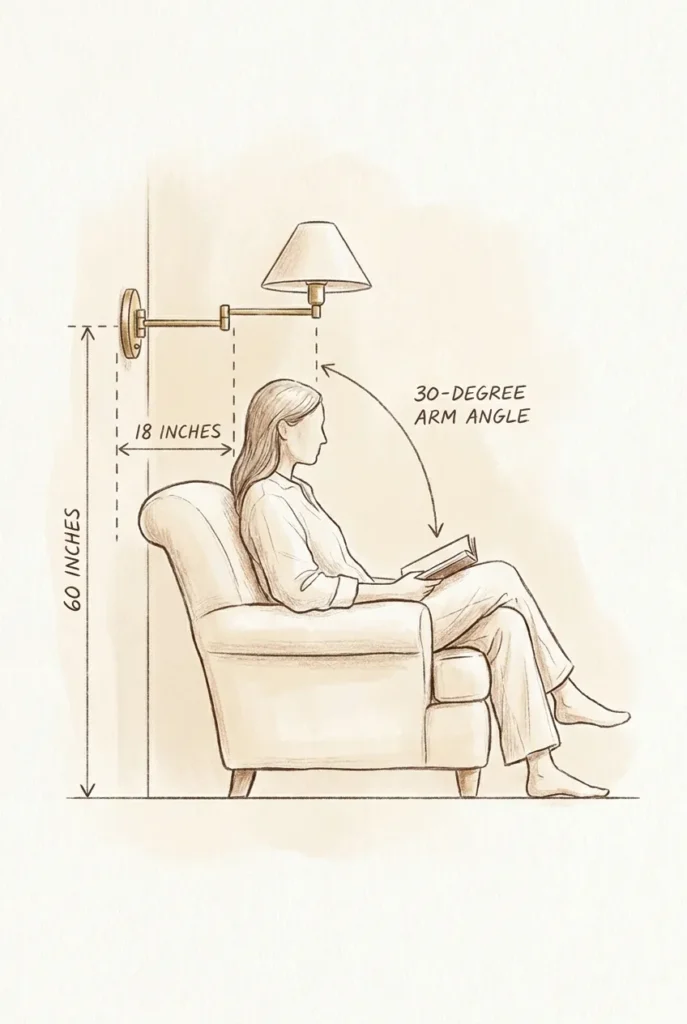
Print this rule. Tape it to your wall while you decide where to drill. Future-you will thank you.
Bulb Specs for a Reading Nook (Kelvin, Lumens, CRI Numbers That Matter)
A great sconce with the wrong bulb is a $90 mistake. Three numbers do most of the work.
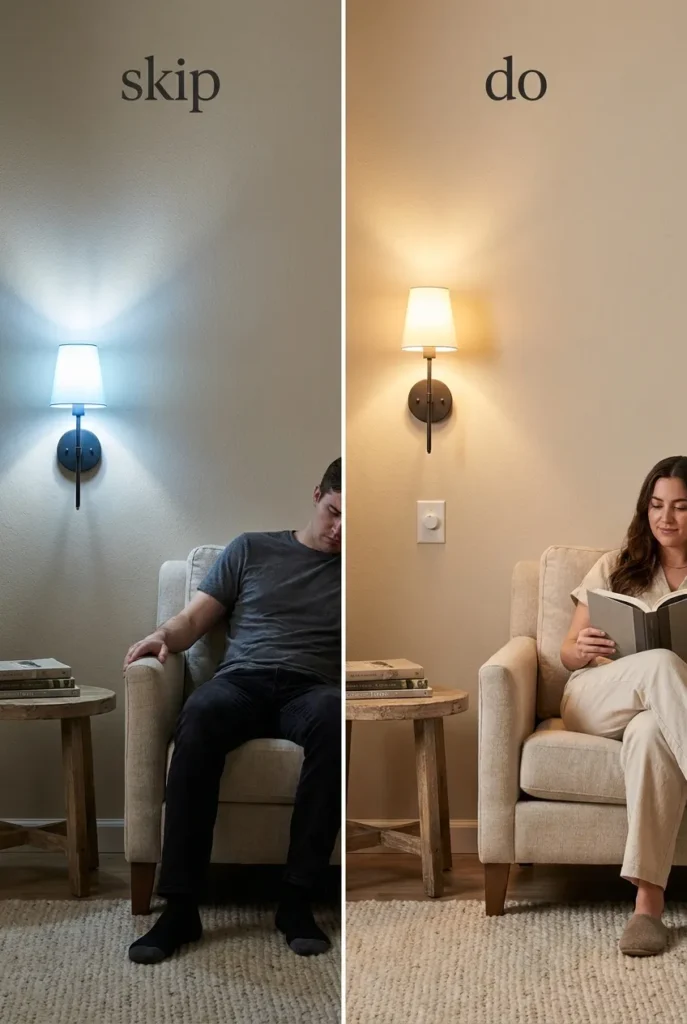
Color temperature: 2700K. This is the warm tungsten glow people mean when they say cozy reading light. Anything above 3500K reads cold and clinical at night. Anything below 2200K starts going amber and muddy on the page. The Energy Star bulb purchasing program offers more detail on the Kelvin scale for warm versus cool light, and a 2700 to 3000K range is the sweet spot for living rooms and bedrooms (which is where most reading nooks live).
Brightness: 450 to 800 lumens. Below 450 and you are squinting at the page. Above 800 and the corner reads like a hotel lobby. A 60-watt-equivalent LED at around 600 lumens is the most forgiving choice.
CRI: 90 or higher. Color Rendering Index measures how accurately a bulb shows the actual color of objects (and pages). Cheap bulbs hover around CRI 80. A CRI 90+ bulb makes paper read white instead of yellow and makes book covers look like themselves.
One bonus number: dimmer compatibility. Honestly, just pay for the dimmer. A reading sconce without a dimmer is a binary “on or off” decision when you really want a slider between “deep focus chapter” and “Sunday morning page turn.”
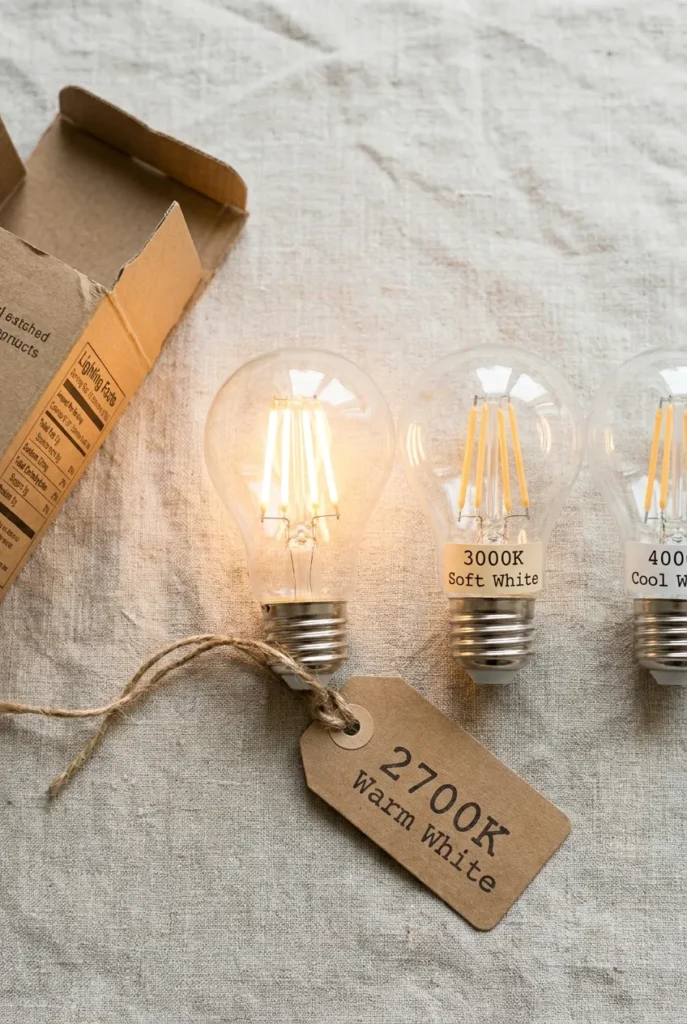
A note on heat. Pleated linen shades and woven rattan shades trap heat from incandescent bulbs. If your sconce has any fabric or natural-fiber element, run LED only. Not negotiable.
Best Plug-In Wall Sconces for Reading Nooks
These are the archetypes that have actually worked in real reading corners. I am naming categories instead of single models because product names move around quarter to quarter, and the archetype is what you are really shopping.
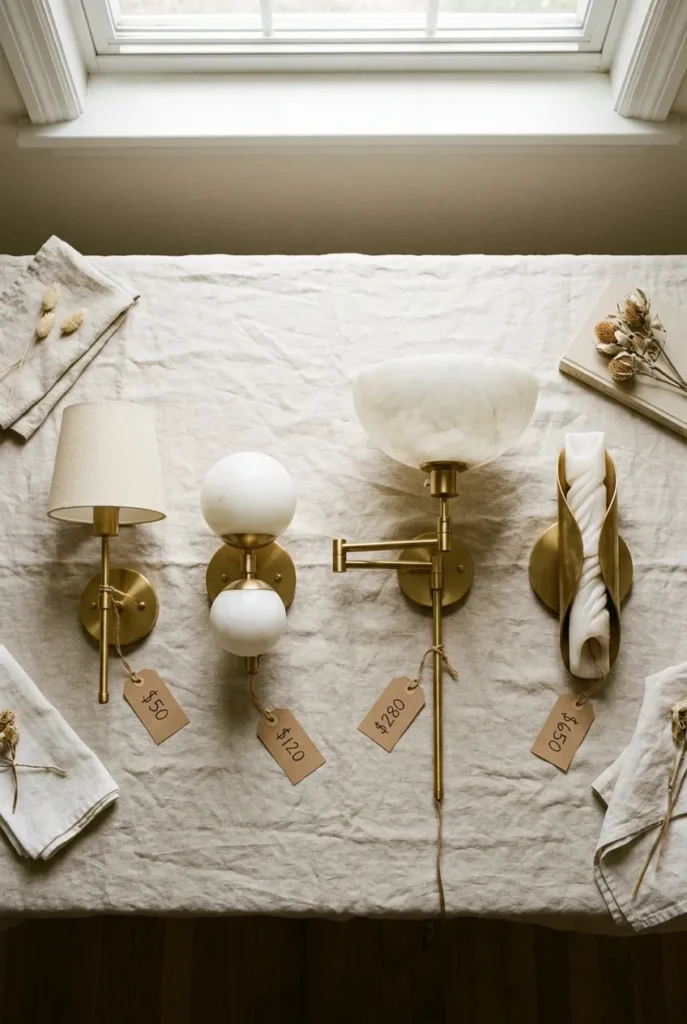
Brass swing-arm plug-in. Pivots a full 180 degrees, lets you angle the light onto your book without moving the chair. Brass is forgiving, ages well, and pairs with almost any palette. Price band in 2026: $80 at Target or Amazon for the budget version, $180 to $320 at Pottery Barn or West Elm for the heirloom version. The brass swing-arm at 2700K is also the exact lamp archetype that lives at the heart of the soft, grown-up pink reading nook palette we built last spring.
Pleated linen shade plug-in. Mitzi-style, drum-shape, soft diffused glow. Better for ambient mood than focused reading. Pair with a swing-arm in the same nook if you read a lot.
Articulating wood-arm plug-in. Mid-century, scandi-leaning. Often comes in walnut or natural oak with a black metal joint. IKEA used to sell a version for under $40 that punched far above its weight. Worth checking Article, West Elm, and CB2 for current options.
Faceted glass or alabaster plug-in. Sculptural, more for a daybed nook where you read in the morning. Light diffuses through the stone or glass, soft and warm. Goes deep into cottagecore territory in a good way.
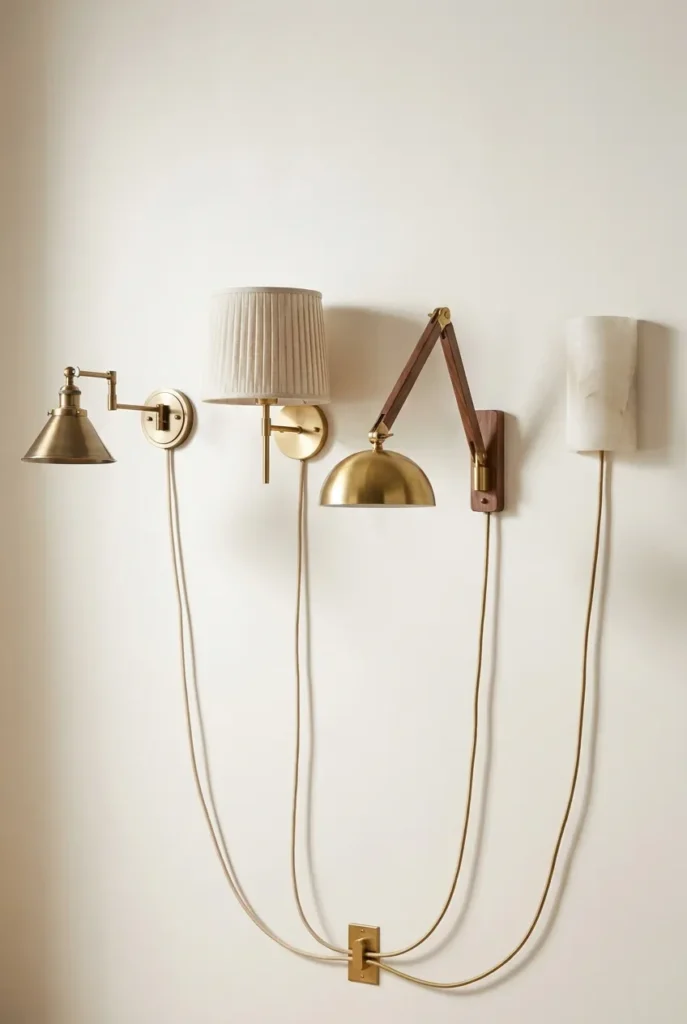
What I would skip in this category: anything with an exposed Edison bulb. Beautiful on the shelf, terrible at 10 pm with the bulb three inches from your eye.
Best Battery-Operated Wall Sconces for No-Outlet Corners
The battery-operated category exploded in the last two years, and most of the picks below cost less than a nice dinner.
USB-rechargeable swing-arm with magnetic mount. The category leader. Mounts to a small steel disc you stick to the wall with a 3M command strip. The sconce snaps off for charging. Light output sits around 400 lumens, charge lasts 8 to 12 hours. Look for ones with a stepless dimmer dial on the base. Price band: $45 to $120 in 2026.
Remote-controlled stick-on puck sconce. Less elegant. More flexible. The remote means you do not have to get out of the chair to dim or shut off. Useful for closet-conversion nooks where the sconce is mounted at an awkward reach.
Battery-powered picture light. A skinnier, longer fixture that mounts above a piece of art or a shelf. Throws downward light across the wall, which becomes ambient reading light if you are sitting in front of it. Lovely for dark academia and library-style nooks.
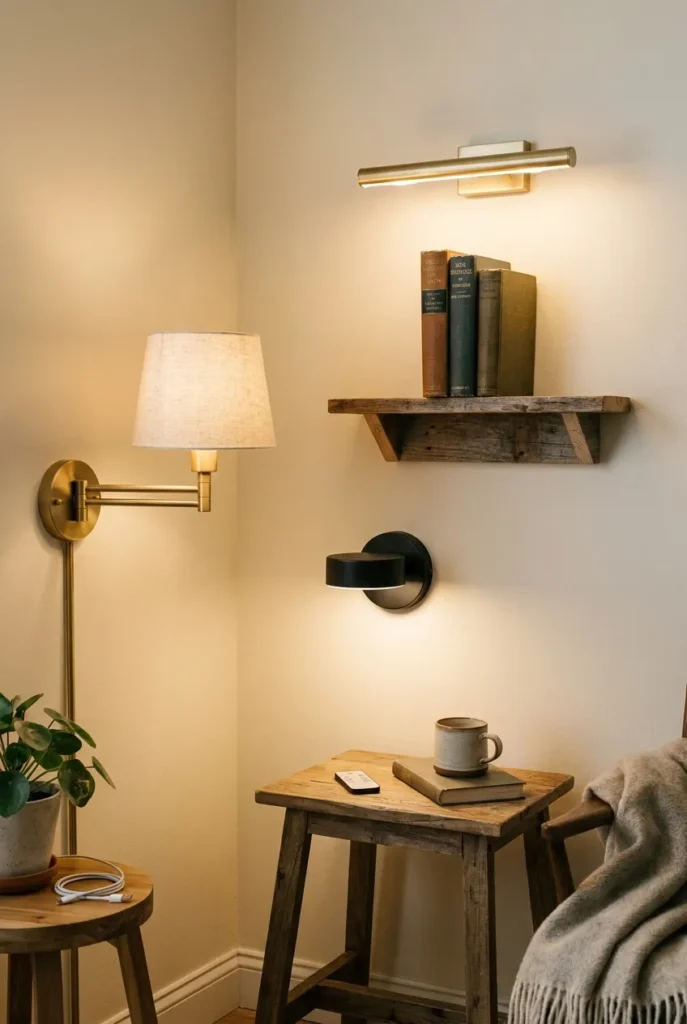
The honest tradeoff: battery sconces give you about 70% of the light output of their plug-in cousins. They are perfect for ambient reading and for renters with no outlet nearby. They are not the right pick if you read fine print or do close needlework in the chair. For that, you want the plug-in path.
One more thing. Cheap battery sconces use proprietary chargers that vanish from the market in 18 months. Pay an extra $15 for USB-C and you can replace the cable from any phone drawer.
Best Hardwired-Look Sconces for Built-In Reading Nooks (When You Own the Place)
If you own and you are building out a permanent nook, hardwiring opens up the prettiest fixtures on the market. The Rejuvenation Eden swing-arm, the Hudson Valley alabaster wall sconce, the Visual Comfort picture-light archetypes. These run $300 to $900 each and look the part for a decade.
Two practical notes for homeowners.
Install the junction box at 64 inches center. That puts the sconce center somewhere between 60 and 66 inches once the fixture canopy is attached, which lands you inside the 60/18/30 placement rule from earlier.
Pair every hardwired sconce with a dimmer switch. Lutron Caseta is the safe pick if you want smart-home compatibility. A basic Leviton works fine if you do not.
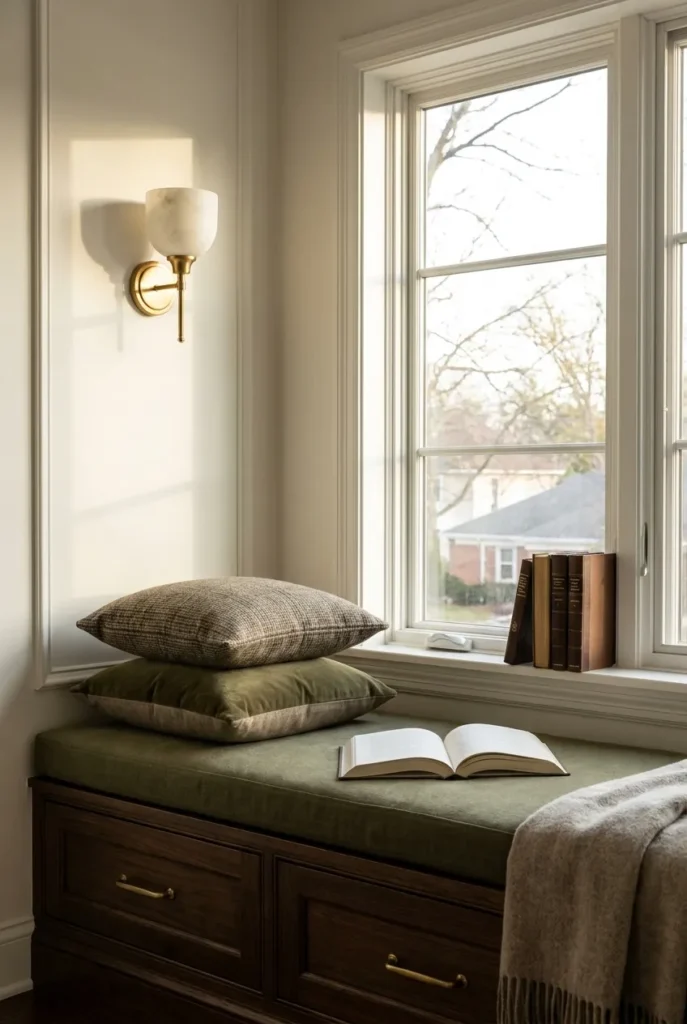
If hardwiring is six months away because you are saving up, install plug-in fixtures in the meantime at the same heights and angles. When the electrician comes, the holes line up and the wall patches are minimal.
Style-Matched Sconce Picks (Cottagecore, Dark Academia, Japandi, Scandi)
Pinterest is a style-led platform. Your sconce needs to match the rest of your nook, not float above it like a hardware-store afterthought. Here is the quick-match guide.
Cottagecore nook. Pleated linen shade in cream or putty, brass swing-arm, warm 2700K bulb at 450 lumens. Pair with a renter-friendly reading nook curtain in unbleached linen and a small rattan side table. The whole corner reads sun-warmed and quiet, even at 8 pm in January.
Dark academia nook. Alabaster or amber-glass sconce, antique-brass or oil-rubbed bronze hardware, picture light over a small bookshelf. Pair with deep green or burgundy walls and a wool throw in oxblood. The room sounds different at night with a dimmable sconce at 30%, the way an old library does.
Japandi nook. Walnut or oak articulating-arm sconce, paper or linen shade, matte black accents. Avoid brass here. The line of the arm is the entire design statement.
Scandi nook. White or pale-grey ceramic shade, plug-in cord wrapped in white fabric, 2700K LED at 600 lumens. Goes great in a small bedroom where the nook lives in a corner near a window.
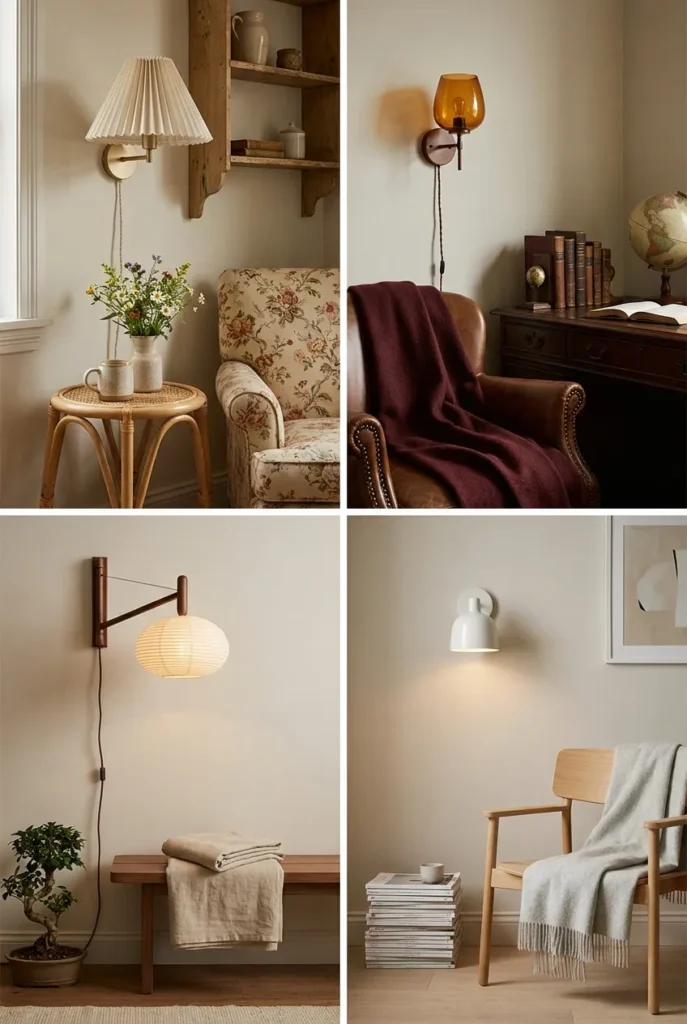
If your nook does not have an obvious style yet, the brass swing-arm with a 2700K bulb works in every category above. Start there. Decide the rest later.
Reading Nook Sconce Mistakes That Kill the Vibe
This is the section the product roundups never write, because they have no incentive to tell you what goes wrong.
Mounting the sconce too low. Below 56 inches and the bulb glares straight into your eye every time you look up from the page. The American Academy of Ophthalmology guidance on reading light makes the point that dim or poorly placed light does not damage your eyes but does fatigue them faster, which is why placement matters more than raw brightness.
Picking a 4000K bulb because it was on sale. I did this once with a closet-conversion nook. The corner read like a dentist’s office for two months before I gave in and bought the right 2700K bulb. Skip the detour.
Forgetting the dimmer. A reading sconce with no dimmer is a light switch, not a mood light. You will never sit in that corner to wind down at 10 pm if your only option is full blast or off.
Running the cord exposed when a cord cover costs $7. A white plastic cord cover from Amazon hides the entire drop from sconce to outlet and paints over with whatever wall color you have. Buy it the same day as the sconce.
Skipping the wall anchor on a swing-arm. Plug-in swing-arms torque against the wall when you reach the arm out. Use a hollow-wall toggle anchor rated for 30 pounds. Otherwise the screws walk out of the drywall in six months.
Where to Buy a Reading Nook Wall Sconce: Real 2026 Price Bands
I have shopped this category from every retailer below. Here is what each tier actually gets you.
| Tier | Price | Best for | Examples |
|---|---|---|---|
| Budget | $30 to $80 | First sconce, dorm, kid’s nook | Amazon, IKEA, Target |
| Mid | $90 to $200 | Adult reading nook, most renters | West Elm, CB2, Article |
| Heirloom | $220 to $600 | Built-ins, owned homes | Pottery Barn, Rejuvenation, Crate & Barrel |
| Designer | $700+ | Permanent install, statement piece | Visual Comfort, Schoolhouse, goop |
Budget tier honesty. Below $30 and you are buying a bulb holder, not a fixture. The light spread is uneven, the finish chips, the bulb sockets fail. Spend the $30 to $50 floor.
Mid-tier sweet spot. This is where most readers should shop. A $120 plug-in brass swing-arm from West Elm or CB2 will outlast three rentals.
Heirloom tier. Worth it if you own and the sconce is going on a permanent wall. Otherwise overkill.
Frequently Asked Questions
What is the best wall sconce for reading in bed?
A plug-in brass swing-arm at 60 to 66 inches above the floor, paired with a 2700K LED bulb at 450 to 600 lumens and a dimmer. The swing-arm lets you angle the light onto the book without disturbing a sleeping partner. Mitzi, Rejuvenation, and West Elm all carry strong options in the $120 to $300 band.
Are there wall-mounted reading lights that need no wiring?
Yes. USB-rechargeable battery sconces with magnetic or command-strip mounts give you a true zero-drill, zero-outlet install. Expect 6 to 10 hours of light per charge at full brightness, longer on dim. Pay extra for USB-C compatibility so you are not locked into a proprietary charger.
What is the best lighting for a reading nook?
Layered, warm, and dimmable. One wall sconce as the primary reading light at 2700K and 450 to 600 lumens, plus one small floor lamp or table lamp for ambient fill at 200 to 300 lumens. Skip overhead lighting in a nook entirely.
Does IKEA make a good reading wall sconce?
IKEA’s plug-in sconce options rotate frequently. The brand has historically sold solid budget articulating-arm sconces under $40 that work well for scandi and japandi nooks. Check current inventory in store, since the IKEA US lineup turns over every six months.
Are swing arm wall sconces good for reading?
They are the gold standard. The arm articulates 180 degrees, which means you can angle the bulb directly over the book in your lap without moving the chair. Pair a swing-arm with the 60/18/30 placement rule and a 2700K bulb, and you have the best reading setup on the market under $150.
How high should a wall sconce be above a reading chair?
The sconce center should sit 60 to 66 inches off the floor for a typical armchair. That puts the bulb above the seated reader’s eye level, which kills glare, while keeping the light cone close enough to land on an open book in the lap.
What bulb wattage should I use in a reading nook sconce?
With LED bulbs, ignore the watt number and look at lumens. Aim for 450 to 600 lumens for focused reading, with a CRI of 90 or higher and a color temperature of 2700K. A 60-watt-equivalent LED in those specs uses around 8 to 10 actual watts.
Pick Your Sconce This Weekend
Pick the install path that matches your space (plug-in, battery, or hardwired), buy a 2700K bulb with CRI 90 and 600 lumens, mount the fixture at 60 to 66 inches center, and add a dimmer if your sconce did not come with one. That is the entire build.
If your reading corner is currently a slumped pillow on the floor and a phone screen at midnight, this is the cheapest thing in your house that will fix it. The first time you read by warm sconce light at 9 pm on a Tuesday, you will understand why this category has its own corner of Pinterest.
Which corner of your home is getting the sconce? Save the placement rule so you have it the next time you reach for a tape measure.
Keep reading
More cozy nook ideas
 Fall Decor
Read →
Fall Decor
Read →
How to Decorate Your Entryway for Fall (Even If You’re Not Handy)
No drill, no ladder, no awkward email to your landlord. This fall entryway decor goes up with an over-the-door hanger, a tape…
 Fall Decor
Read →
Fall Decor
Read →
Fall Coffee Table Decor: The Complete Guide for Small Apartments
No mantel, no entry console, no spare shelf. In a small apartment, the coffee table is the one surface everyone sees, and…
 Fall Decor
Read →
Fall Decor
Read →
The Fall Kitchen Checklist: Everything to Decide Before You Start
Most fall kitchen regret starts the same way. You buy the pumpkins first, carry them in, and discover the counters were never…
2 Comments