
21 Modern Bookshelf Ideas for Small Spaces That Actually Fit

Your books are in three stacks on the floor and every bookcase you like is 32 inches wide. That is the whole problem, and it is a measuring problem before it is a style problem. A modern bookshelf in a small room has to earn its footprint in inches, not in mood boards, which is why most shelf roundups are useless to anyone under 1,400 square feet: they are photographs of architecture, not of apartments.
So this one runs on numbers. Real widths, real depths, real prices pulled this month, a real load rating that will change your mind about one very popular idea, and the renter version first every single time. Where a shelf has a downside, you will read about the downside.
Twenty-one ideas follow, arranged roughly from the narrowest wall you own to the most convincing built-in fake. Some need a drill and a free Saturday. Most need neither, because a landlord and a security deposit are part of the brief for most of us.
Start with number one. It is 15 3/4 inches wide, it costs $59, and it fits the strip of wall next to your door.
1. The 15 3/4-Inch Tower That Fits Where Nothing Else Does
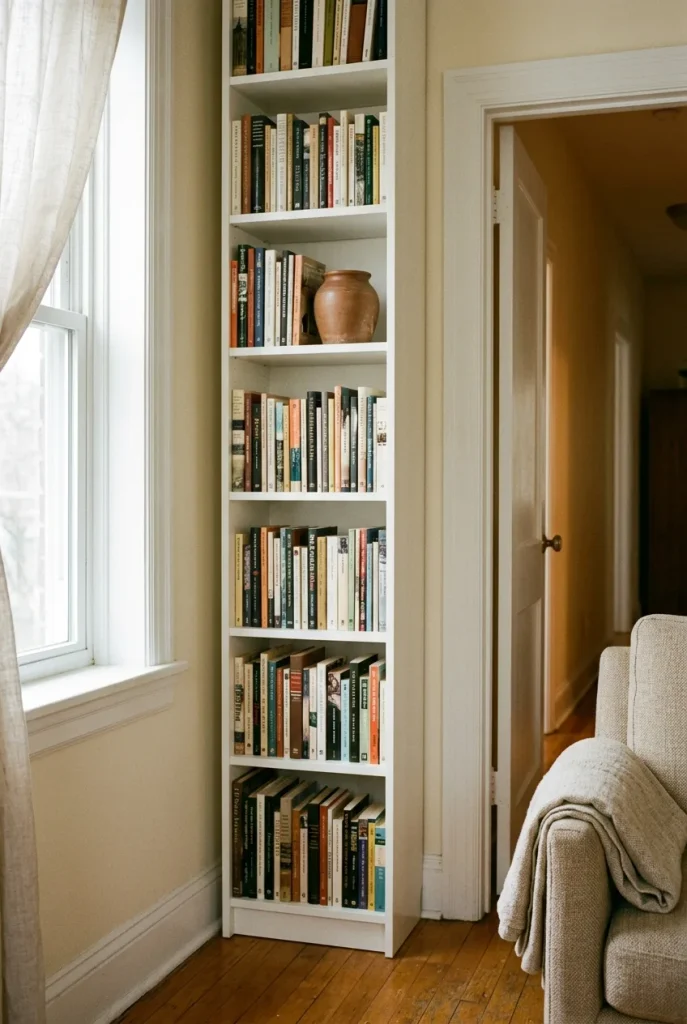
Most small rooms have one leftover strip of wall, usually beside a doorway or between a window and a corner, and a narrow full-height bookcase is the only thing that will live there.
- IKEA’s narrow BILLY runs 15 3/4 in wide, 11 in deep, 79 1/2 in tall, at $59.00
- The standard width is 31 1/2 in for $79.00, which needs double the wall
- Vertical height is free in a small room, floor space is not
- Two narrow towers flanking a window read as a built-in for $118
Height is the cheat here. You are buying storage in the direction nobody else is using.
Safety note: anchor tall furniture to the wall, keep candles and cords away from fabric, and use a licensed electrician or contractor for hardwired lighting, ceiling mounts, or anything structural. Entry 12 covers the anchoring properly.
| Piece | Size | Price |
|---|---|---|
| 📚 Narrow tower | 15 3/4 x 11 x 79 1/2 in | $59.00 |
| 📚 Second tower | 15 3/4 x 11 x 79 1/2 in | $59.00 |
| 🔩 Anchor kit | screws and plugs for your wall type | sold separately |
| Total, two towers | 31 1/2 in of wall | $118.00 |
Prices and dimensions from ikea.com/us, September 2026.
2. Float the Shelves Above the Sofa, Not Beside It
Wall above seating is the most wasted surface in a small living room. Nobody puts anything there except one piece of art, and a run of floating shelves turns it into a library without touching the floor plan at all.
Getting it right is a three-step job.
Find the studs before you buy the shelves, not after. Most US walls are framed 16 inches on center, so your bracket spacing is decided for you.
Set the lowest shelf about a hand’s width above the sofa back, high enough that nobody knocks their head sitting down.
Load heavy at the bottom, light at the top. A four-foot run of hardcovers is far more weight than it looks: IKEA rates a single KALLAX compartment at 29 lb, and a packed shelf run passes that easily.
Skip the stud finder and you will learn about drywall anchors the loud way.
3. Lean It, Don’t Drill It
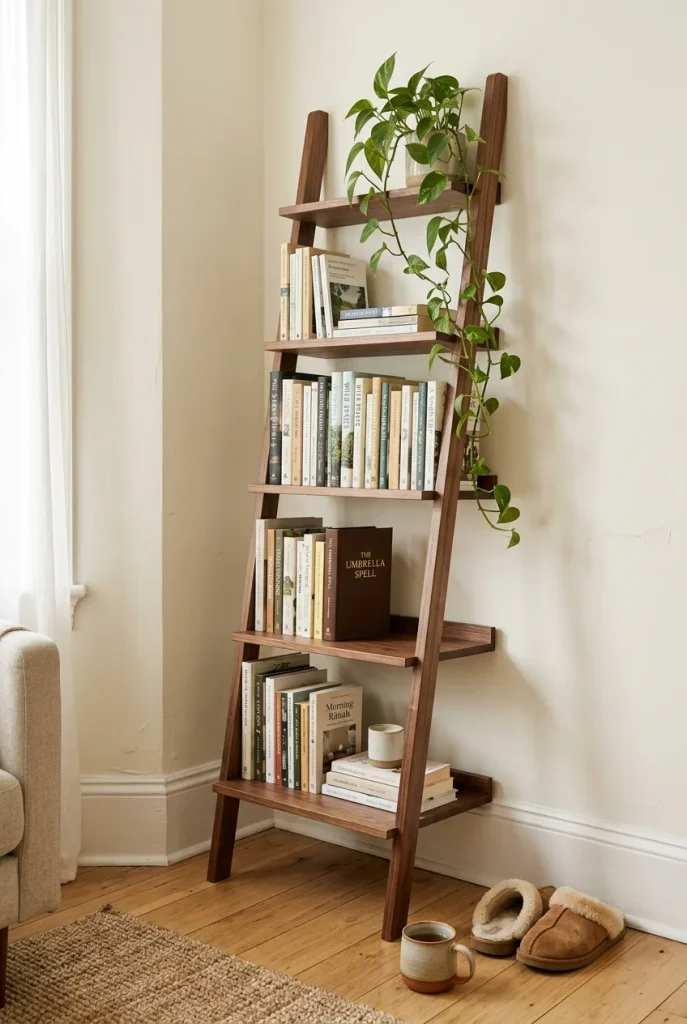
Renting changes the question from “what looks good” to “what comes down clean,” and a leaning ladder shelf answers both. It rests against the wall on its own weight, leaves nothing behind but a dust line, and takes about four minutes to set up.
The honest downside: a ladder shelf loses depth as it climbs, so the top tier holds paperbacks and a small plant and nothing else. Plan your hardcovers for the bottom two rungs. If you are building the whole corner around this, the renter-friendly reading nook ideas on the site go further into what comes down clean at move-out.
4. Bridge the Doorway With One Long Shelf
Above a door frame sits eight to twelve inches of dead wall that exists in literally every room you own.
One long shelf spanning that gap gives you a full row of storage in space you were never going to use, and because it lives above head height, it reads as architecture rather than clutter.
Two cautions before you cut anything.
⚠️ Watch Out
Check the door swing first. A door that opens inward needs its full arc clear of the shelf lip, and an inch of overhang you did not plan for becomes a scrape every single time. Anything over a doorway also needs stud fixing, never drywall anchors alone.
Payoff: a bridged doorway is where oversized art books finally go.
5. Take the Corner Seriously
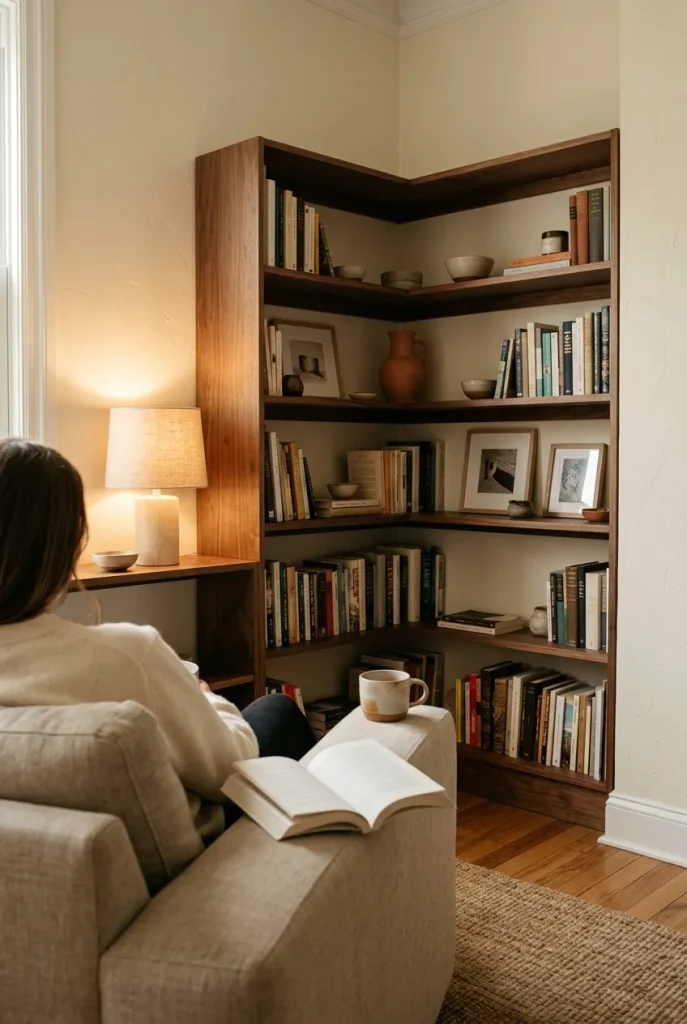
A 90-degree corner is the single most wasted square footage in a small home, because a rectangular bookcase pushed into it leaves a triangle of nothing behind it.
Corner units come in two honest shapes, and they solve different problems.
Pick the triangular one if a chair is going in front of it. The corner bookshelf reading nook setup walks through that pairing in detail. Pick the L if the corner is purely storage and nobody sits there.
6. Run It Low and Long Under the Window
Tall is not always the answer. Under a window you cannot go up, so go sideways, and a low horizontal run does something a tower never will: it keeps your sight lines open, which makes a small room read bigger.
| Low run, 41 3/4 in tall | Tall tower, 79 1/2 in |
|---|---|
| Fits under a window sill | Blocks the window entirely |
| Top becomes a lamp and plant surface | Top is out of reach |
| $49.00 for 31 1/2 in wide | $79.00 for the same width |
| Half the book capacity | Double the book capacity |
IKEA US pricing, September 2026.
Two low units side by side under a wide window give you a window seat’s worth of surface for $98 and a cushion.
7. Make It the Wall You Don’t Have
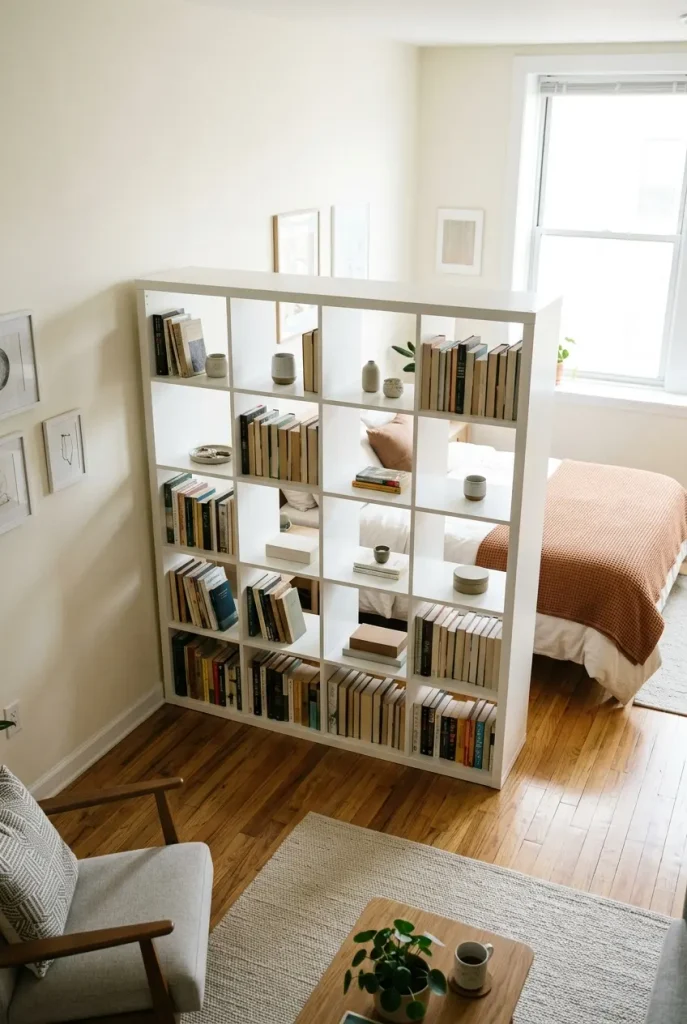
Studio apartments have no walls, which is the entire problem with living in one. An open-backed shelving unit standing perpendicular to a wall becomes a partial wall that light still passes through, so you get a bedroom edge without building a bedroom
One open room where the bed is the first thing anyone sees from the front door, and there is nowhere for books to live.
A 57 5/8 in cube unit set crosswise screens the bed, holds both rooms’ books, and still lets morning light through the open squares.
IKEA’s KALLAX in this size measures 30 1/8 in wide, 15 3/8 in deep, 57 5/8 in tall, at $79.99. There is a real bonus nobody mentions: a full divider of books noticeably softens the echo in a hard-floored studio. Books are terrible at reflecting sound, which is exactly what you want at 11pm.
Free-standing dividers must be anchored. A unit with nothing bracing it is the most tippable object in your home.
8. Stagger the Shelves Into a Modern Bookshelf Wall
Shelves that line up exactly read as storage. Offset them and the same wall reads as design, at no extra cost and with no extra hardware.
- ▸Break the run into two or three short shelves per row instead of one long one
- ▸Offset each row so no two shelf ends line up vertically
- ▸Keep every shelf the same depth, or the wall starts to look like a mistake
- ▸Leave one gap deliberately empty so the eye has somewhere to rest
Same shelves. Same screws. Completely different wall.
9. The Cube Bench Idea, and the Number That Ruins It
A cube unit laid on its side under a window, cushion on top, books in the squares, is one of the most-pinned small-space ideas on the internet.
Here is the part the pins leave out. IKEA lists a maximum load of 55 lb on the top of the 30 1/8-inch KALLAX, and 29 lb per shelf. Fifty-five pounds is a stack of laundry. It is not an adult sitting down, and it is certainly not a teenager landing on it.
So do this instead.
The cube bench, done safely
Load ratings from the IKEA US KALLAX product page, September 2026.
I would rather tell you this than have you find out mid-sentence on page 200.
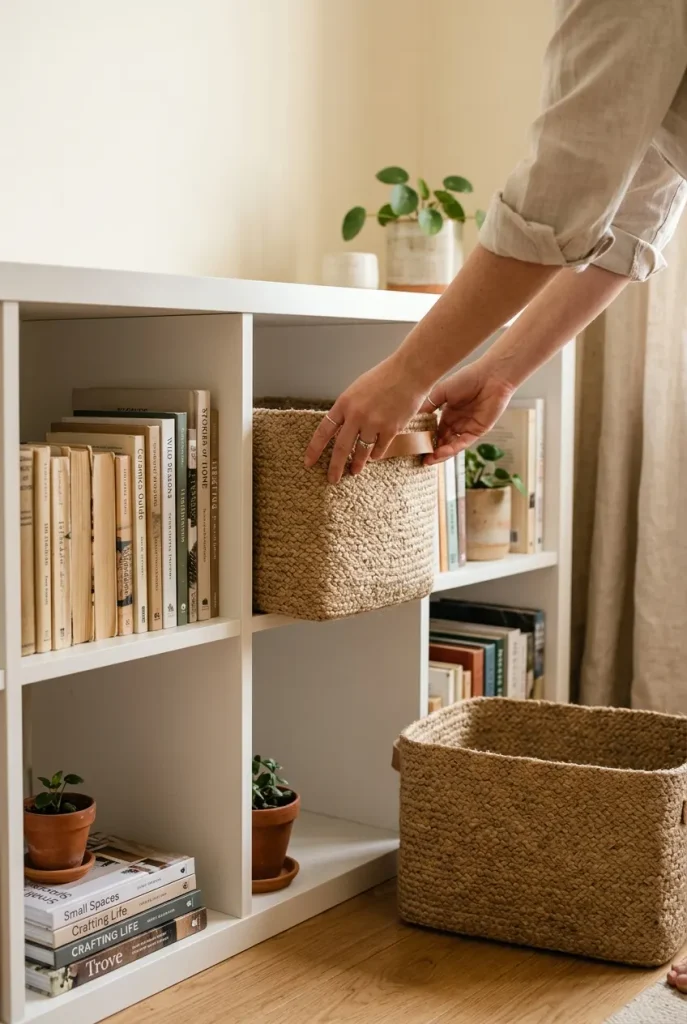
10. Picture Ledges Are the Paperback Answer
Deep shelves waste space on paperbacks. A mass-market paperback is barely over four inches wide, so putting it on an 11-inch shelf throws away more than half the depth you paid for.
Run shallow ledges in a tight vertical stack, four to six rows high.
Face a few covers outward. Paperback covers are the best free art in the house.
Stacking hardcovers on a ledge built for picture frames.
Spacing the rows so far apart that the wall looks half empty.
Ledges also let you rotate what is on display in about thirty seconds, which matters more than it sounds.
11. The 11/30 Rule
Every shelf decision in a small room comes down to two measurements, and if you remember nothing else from this page, remember these.
Eleven inches of depth, thirty inches of walkway.
Eleven inches is the depth that holds nearly every hardcover you own with the spine flush to the front edge, and it is not an arbitrary number: it is the depth the most-sold bookcase in the world has used for decades. Go deeper and you are buying floor space to store air behind your books.
Thirty inches is the narrowest gap a person can walk through without turning sideways, since adult shoulders run roughly sixteen to twenty inches across and you need clearance on both sides. Measure your wall, subtract the shelf depth, and if what remains is under 30 inches, the shelf is too deep for that wall no matter how good it looks.
Shelves no deeper than 11 inches. Walkways no narrower than 30 inches.
If the shelf depth plus 30 inches is wider than your floor gap, the shelf loses. Measure before you buy, not after it is boxed in your hallway.
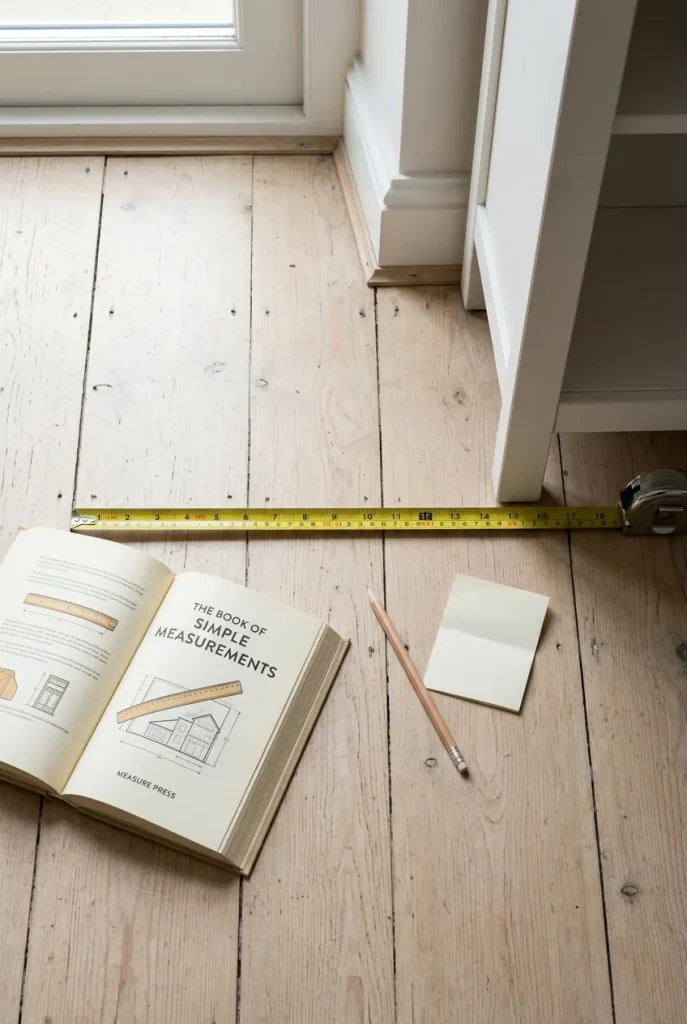
12. Anchor It Before You Fill It
Narrow and tall is the most tip-prone combination in furniture, and small rooms push you toward exactly that shape. This is the one job on the list that is not optional.
The federal rule on furniture stability took effect September 1, 2023, and the CPSC’s campaign puts the reason plainly: between 2017 and 2019, an estimated 11,300 children a year were treated in US emergency rooms for tip-overs involving furniture, TVs, and appliances. Half of child tip-over fatalities recorded between 2000 and 2019 happened in bedrooms.
Gather the four things the job needs: an anchoring kit, a drill and bit, a screwdriver, and a stud finder.
Fix one bracket to the wall at a stud, then the matching plate to the back or top of the bookcase.
Connect the strap to both brackets, tighten it, then tug hard to confirm it holds.
Renting? Two small screw holes patch with a dab of filler at move-out. That is a far easier conversation than the alternative.
Note that flat-pack bookcases often ship without the hardware. IKEA’s own product pages warn that the unit must be securely anchored and tell you to supply screws and plugs suited to your wall type. The CPSC’s furniture anchoring steps cover what to buy for drywall, plaster, and masonry.
13. Light the Shelves, Not the Ceiling
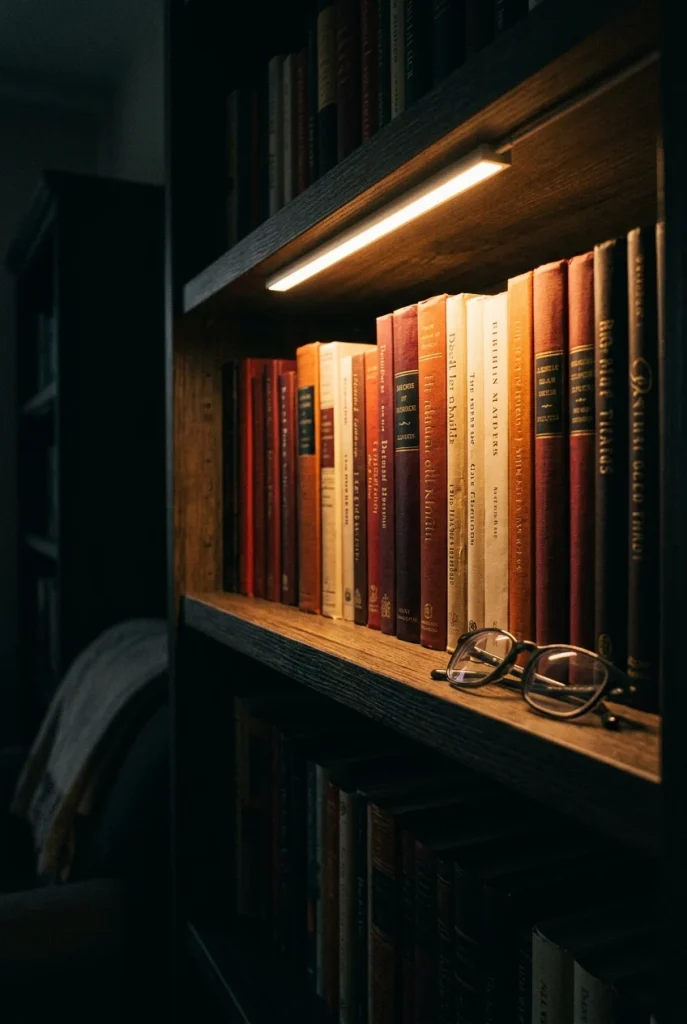
Overhead light hits the tops of your books and leaves every spine in shadow. Light coming from the side or from within the shelves is what makes a modern bookshelf look like the pinned versions, and warmth matters more than brightness.
| Color temperature | How the light reads |
|---|---|
| 2200 to 3000K | Matches old incandescent warmth. This is your shelf light. |
| 3500 to 4100K | Whiter. Fine for a desk, wrong for a reading corner. |
| 5000 to 6500K | Bluer white. Reads as a garage at night. |
| 800 lumens | The brightness of an old 60 watt bulb, for reference. |
Those ranges come straight from Energy Star’s color temperature ranges, and the 800-lumen figure is their published equivalent for a 60 watt incandescent.
Renter path first: plug-in sconces mounted with the cord run neatly down the wall, or battery LED pucks stuck under each shelf. Hardwired picture lights are gorgeous and belong to an electrician and a home you own.
14. The Column Behind the Door
Behind an open door sits a strip of wall that, by definition, nobody looks at and nothing else can use.
A single narrow column of shelves there is pure found storage, and because it sits behind the swing, it never crowds the room visually.
📌 Good To Know
Open the door fully and mark where the handle lands before you mount anything. Leave at least two inches between the handle’s arc and the shelf edge, or the door will do the marking for you.
Best use: the overflow you reach for least, kept out of the room’s sight line entirely.
15. Wrap the Desk Instead of Standing Beside It
Small-space desks and small-space bookshelves compete for the same wall, so stop letting them. Shelves that run above and beside a desk turn two pieces of furniture into one piece of architecture, and you recover the entire footprint of the bookcase you did not buy.
Keep the desk surface itself clear of shelving within eighteen inches of where you sit, or you will feel boxed in by week two.
16. Go Low and Long for the Mid Century Modern Bookshelf Look
The mid century shape is horizontal, and that is genuinely useful in a small room rather than just fashionable. Long low units on thin tapered legs let the floor run underneath them, and visible floor is what makes a room read as larger.
- ▸Raised legs, not a plinth. The gap underneath is doing real visual work
- ▸Warm woods with a visible grain, walnut or teak-toned, against a pale wall
- ▸Thin shelf edges. Chunky shelves read as farmhouse, not mid century
- ▸Mix closed and open sections so not everything is on display
Sweep under it occasionally, though. Raised legs mean visible dust bunnies.
17. Paint the Back Panel, Change the Whole Unit
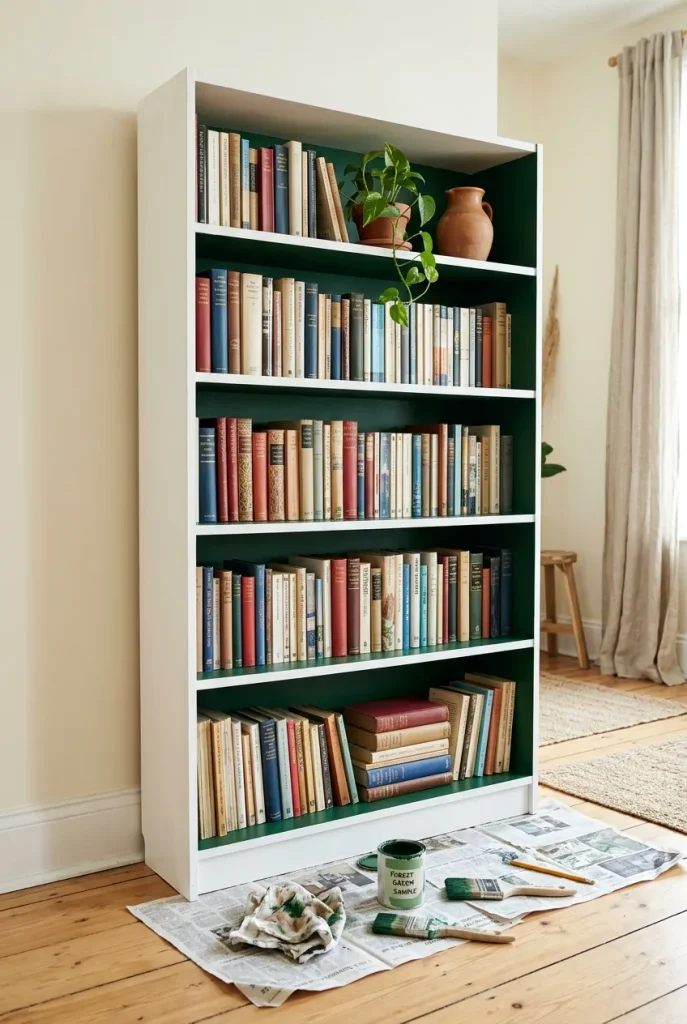
A plain white flat-pack bookcase costs under sixty dollars and looks like it. Paint just the back panel a deep saturated color and the books pop forward off it, the unit reads as intentional, and nobody can tell what you paid.
White shelves against a white wall. The unit disappears and the books look like clutter floating on nothing.
Back panel in deep umber or forest green. Every spine gains an outline, and the shelves read as a built-in niche.
Renting, and worried? Paint the back panel of the furniture, not the wall behind it. The panel leaves with you, and one sample pot covers a standard back.
18. Modern Bookshelf Styling in Threes
Shelves look crowded when every inch is doing something. The fix is a rhythm you repeat, not a look you chase, and three moves per shelf is enough.
Three moves, every shelf
The gap is the part people skip, and it is the part that does the work. More on the full approach in shelf styling for a reading nook.
19. Thin Frames Make a Modern Bookshelf Feel Lighter
A bulky unit and a slim one can hold identical books and occupy identical floor space, yet one of them makes a small room feel full and the other does not. Visual weight is the difference, and it comes down to frame thickness and whether you can see through the piece.
The trade-off is real: open-backed and glass-shelved units show every bit of dust, and they have no back panel to hide a messy wall.
20. Put It on Wheels
Small rooms change jobs constantly. The desk becomes a dinner table, the living room becomes a guest room, and a shelf bolted to the wall cannot follow.
Keep it narrow and waist height so it rolls under a window or beside a chair.
Choose locking casters, and lock them.
Anything tall on wheels. Height plus casters is a tip-over waiting to happen.
Loading it so heavy that it stops being movable, which defeats the point.
A rolling shelf beside a chair is also the only bookshelf that comes to you.
21. Fake the Built-In, Keep Your Deposit
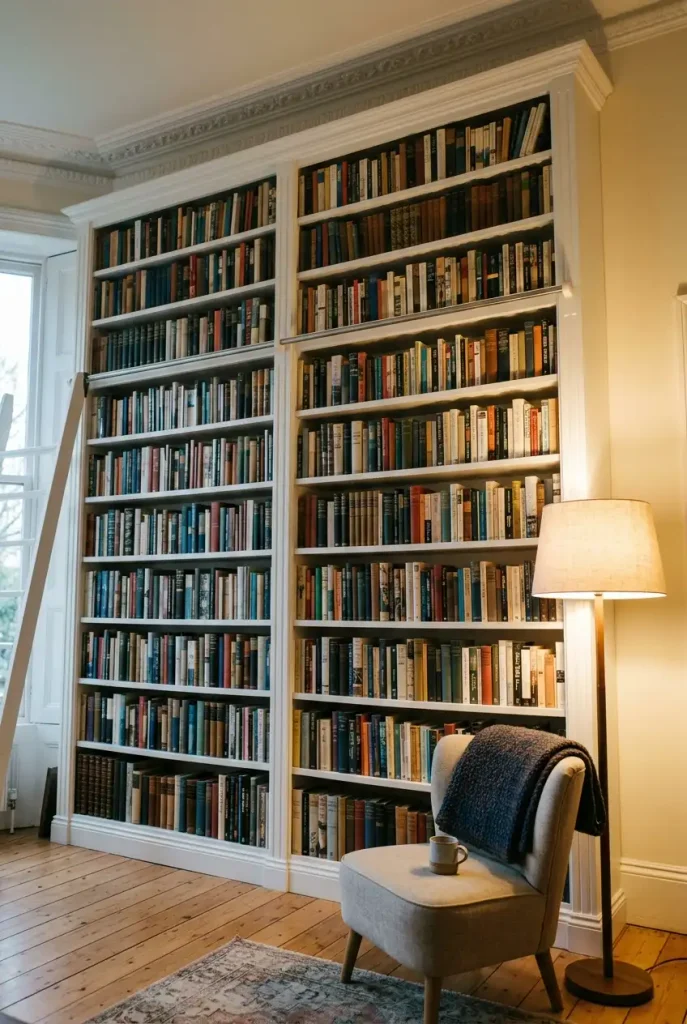
Two flat-pack towers, a strip of trim, and one afternoon will give you something that photographs like millwork. The trick is closing the gaps: the space between the units, the gap above them, and the visible edge where raw board meets wall.
| Piece | What it does | Price |
|---|---|---|
| 📚 Two narrow towers | 15 3/4 x 11 x 79 1/2 in each, set side by side | $118.00 |
| 🪵 Trim and filler strip | closes the seam and the gap to the ceiling | hardware store, cut to length |
| 🎨 One sample pot | trim painted to match the units | one pot covers it |
| Footprint | 31 1/2 in of wall, 11 in deep | from $118.00 |
Tower pricing from ikea.com/us, September 2026. Renting? Attach the trim to the bookcases, never to the wall, and the whole thing unbuilds in twenty minutes.
FAQ
How deep should a bookshelf be in a small room?
Eleven inches handles nearly every hardcover with the spine flush to the front edge, and it is the depth the best-selling flat-pack bookcases have used for years. Anything deeper stores air behind your books and eats floor you cannot spare. For paperbacks alone, a shallow picture ledge of four to five inches is plenty and frees up even more room.
What kind of modern bookshelf works on a narrow wall?
Look for a full-height tower around 15 3/4 inches wide rather than the standard 31 1/2 inches. It fits the leftover strip beside a doorway or window, costs roughly $59 in white flat-pack, and buys storage vertically where nothing else is competing. Two of them flanking a window read as a built-in for well under $150.
How do I make my shelves look less cluttered?
Use a repeating rhythm instead of filling every inch. Per shelf: one vertical run of spines pushed to one side, one short horizontal stack with a single object on top, and one deliberate empty gap about a fist wide. Alternate which side the vertical run sits on as you move down. The empty gap is the piece most people skip and the one that does the work.
Can renters put up shelves without drilling?
Yes, and three options cover most situations. A leaning ladder shelf holds itself up on its own weight. A freestanding narrow tower needs only an anchor strap, which leaves two small filler-patchable holes. A rolling cart needs nothing at all. Lead with these, and save drilled floating shelves for a place you own.
Do tall bookcases really have to be anchored to the wall?
Yes. Tall and narrow is the most tip-prone furniture shape there is, and manufacturers say so on the product page. IKEA’s own listings carry a tipping-hazard warning and tell you to supply screws and plugs suited to your wall type, since the hardware is often not included. The federal furniture stability rule took effect September 1, 2023 for exactly this reason.
How do I style shelves without buying anything new?
Shop your own home first. Pull three objects of different heights from other rooms, turn a few paperback covers face out for color, and lay some books flat as pedestals. Then remove about a fifth of what is currently on the shelves. Subtraction costs nothing and does more than any new object will.
How often should I restyle my bookshelf?
Twice a year is plenty for the whole unit, usually when the seasons turn and you are moving throws and cushions anyway. Between those resets, swap only what is face-out: a picture ledge or a single forward-facing cover takes about thirty seconds to change and makes the whole wall feel current without touching anything else.
Conclusion
The shelf that works in your place is the one whose depth you already measured against your walkway, not the one that photographed best. Start with the wall you actually have, check the 11/30 numbers, anchor whatever goes tall, and let the styling come last, because styling a shelf that does not fit is just rearranging a problem.
Pick one idea from this list, measure the wall tonight, and order the piece tomorrow. And save the pin so it is waiting for you when the tape measure comes out.
💡 Quick Tip
Before you order anything, tape the shelf’s width and depth onto your floor with painter’s tape and live with it for a day. A footprint you keep walking around is telling you something a product photo never will.
Keep reading
More cozy nook ideas
 Home Library & Bookshelves
Read →
Home Library & Bookshelves
Read →
16 Dark Academia Library Ideas That Nail the Look Without Overdoing It
The fastest way to wreck a dark academia library is to buy one of everything. Skulls, fake cobwebs, five candle holders, a…
 Home Library & Bookshelves
Read →
Home Library & Bookshelves
Read →
10 Library Wall Ideas for Book Lovers With One Blank Wall
No custom millwork, no contractor, no awkward conversation with a landlord. A library wall comes down to three decisions: how deep the…