
How to Style a Reading Nook Bookshelf (So It Reads Cozy, Not Cluttered)

If your reading corner is a shelf crammed spine-to-spine with three stacks about to slide off, this fixes it. You don’t need a bay window, a built-in budget, or a landlord who says yes to drilling. You need one shelf, a handful of objects you already own, and about an hour.
Here’s the honest problem. Most reading nook bookshelf styling advice tells you to “add decor and greenery” and stops there. Then you add stuff, it looks worse, and you can’t tell why. The why is almost always ratio and spacing, not the objects themselves. So that’s where we start, with a formula you can copy on the first pass, then repeat down every shelf.
This is written US-first (inches, feet, watts, Kelvin, USD), and every method here works whether you rent a 600 square foot studio or own your place.
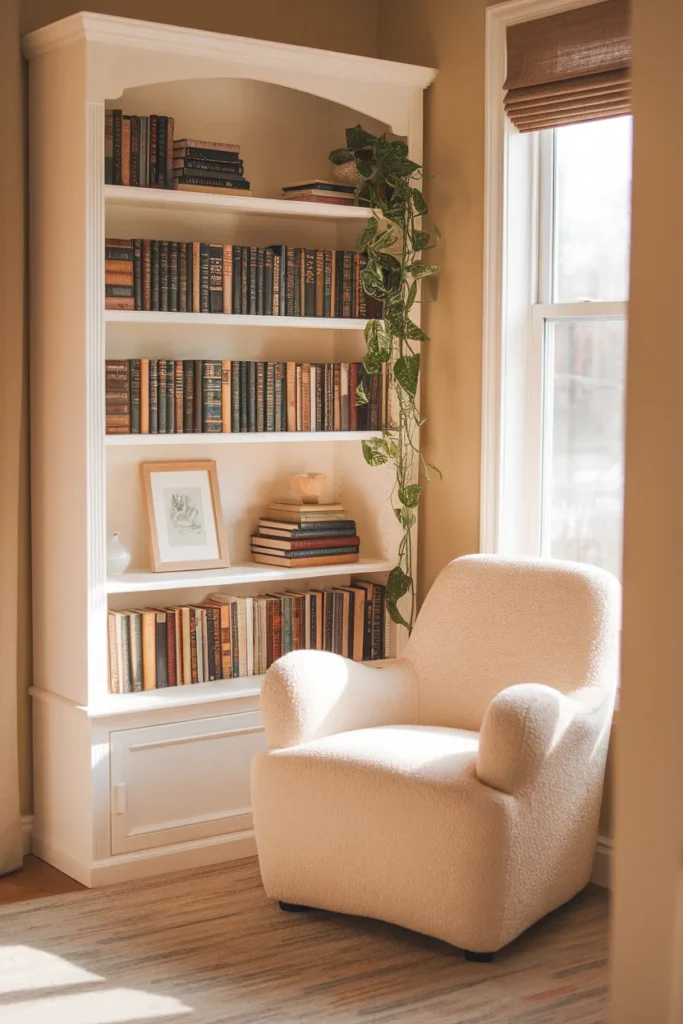
Start Here: The 60/30/10 Shelf Formula (The Whole Trick in One Rule)
Before you touch a single book, memorize this ratio. On any one shelf, aim for about 60 percent books, 30 percent objects, and 10 percent empty space. That last slice is the part everyone skips, and it’s the reason styled shelves breathe while packed ones feel like a supply closet.
Books do the heavy lifting. Objects (a small plant, a framed photo, a ceramic dish) break up the spines so your eye has something to land on. The empty gap is the rest note in a song. Leave it out and the whole thing feels loud.
Try this on your worst-looking shelf first. Pull everything off. Put back roughly six books for every three objects, and leave one clear pocket about the width of your hand. Step back. That single shelf will already look intentional, and now you just repeat it.
Quick copy-me version:
- 60% books: mix tall and short, don’t sort by rainbow unless you love the look.
- 30% objects: odd numbers win. One plant, one frame, one small stack topped with a candle.
- 10% air: one deliberate gap per shelf, minimum.
The failure mode here is real: skip the 10 percent gap and no amount of pretty objects will save the shelf. It’ll read “storage” every time.
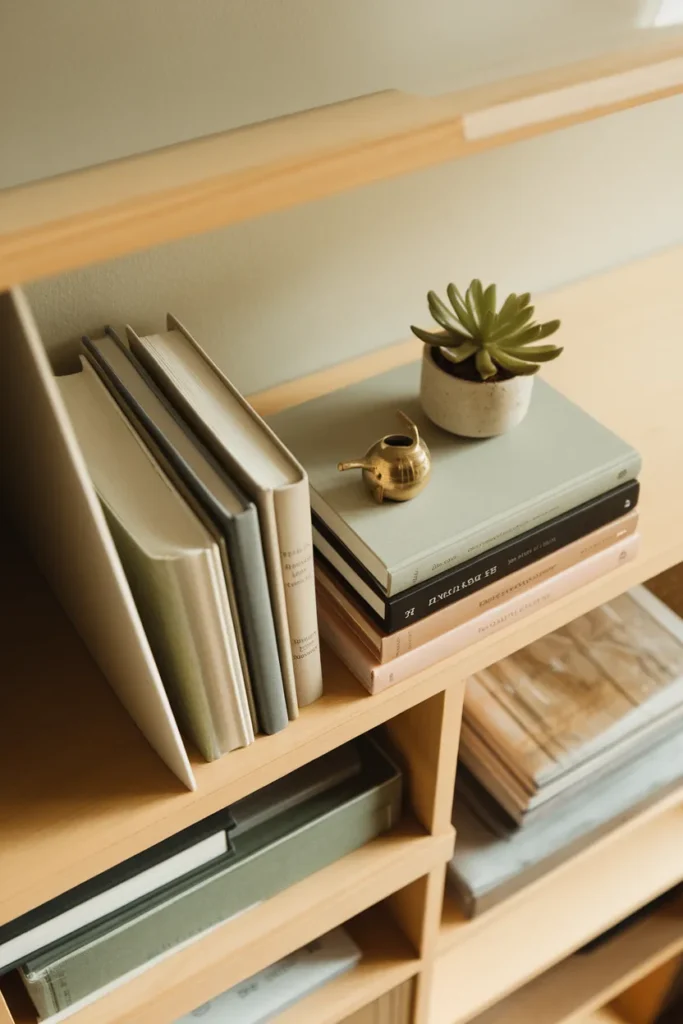
Arrange the Books First: Vertical, Horizontal, and Why You Mix Both
Now the books themselves. The move that makes shelves look designed instead of stocked is mixing orientations. Stand most of your books upright, then lay a small stack of three or four on its side right next to them. That horizontal stack becomes a little pedestal, and it stops the shelf from reading like a library return cart.
Vary the heights on purpose. Tall art book, then a run of paperbacks, then that horizontal stack, then a gap. Up, down, flat, air. Your eye follows the rhythm instead of sliding off a flat wall of spines.
Two things people ask about constantly:
Spines out or covers out? Mostly spines. But turn one or two favorite covers face-out per shelf as a little pop of color and personality. It’s the cheapest way to add art.
Color-sort or not? Only if you genuinely love the rainbow look and don’t need to find books fast. Sorting by color is pretty in photos and slightly annoying in real life when you’re hunting for a specific title.
One more real constraint: keep the books you actually reach for at arm’s height, roughly 30 to 54 inches off the floor when you’re seated. The gorgeous top shelf is for the ones you display, not the ones you grab mid-marathon-read. That’s the arm’s-reach rule, and it’s the difference between a nook you use and one you photograph once.
If you want a whole corner built around books rather than one shelf, this walkthrough of small home library corner ideas shows how to scale the same logic up to a full wall.
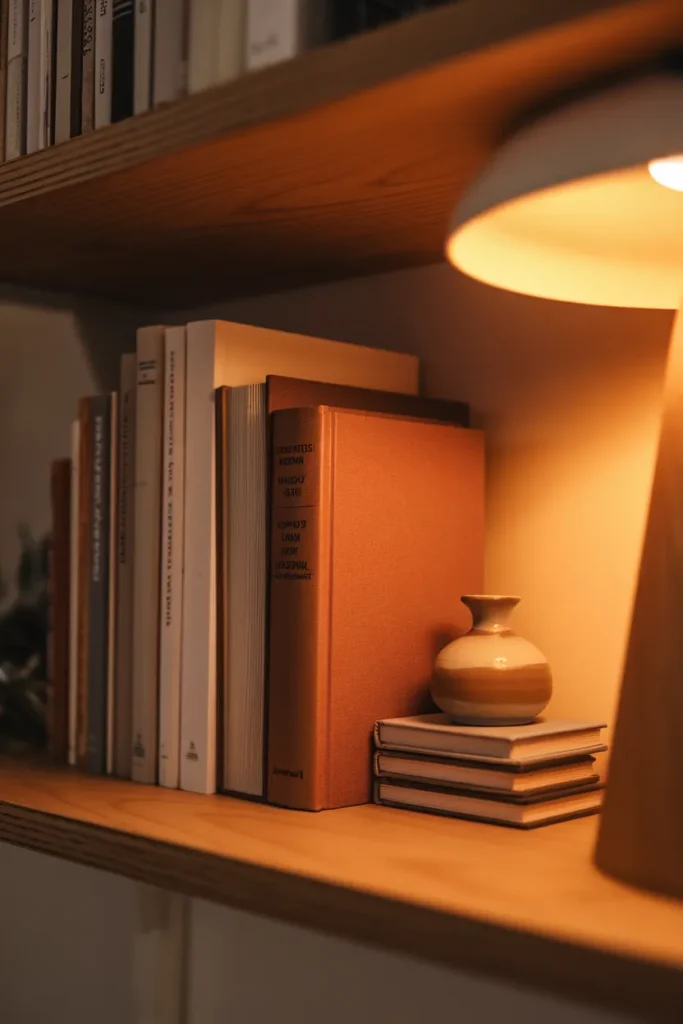
The Objects: What Actually Goes on the Shelves Besides Books
Objects are where nooks go wrong, because more feels safer and it isn’t. Work in threes and keep a loose theme so the shelf looks collected, not cluttered.
Pull from these, and use maybe two or three per shelf:
- One living thing: a trailing pothos or a string-of-pearls draped off a higher shelf softens every hard edge. Faux is fine if your corner gets no light.
- One framed piece: lean a small print against the back of the shelf instead of hanging it. Leaning reads casual and, bonus, needs zero nails.
- One texture object: a small woven basket or a ceramic dish that hides your bookmarks, reading glasses, and the charger you keep losing.
- One anchor stack: three books laid flat with a candle or a small brass object on top.
Use the zigzag trick to balance weight. If a heavy stack of books sits middle-left, put a plant or a frame middle-right on the shelf below. You’re drawing a gentle Z down the bookcase so no side feels like it’s tipping.
Sensory beat worth chasing: add one candle you’ll actually light. The faint warm smell when you sit down to read does more for the “cozy” feeling than any object you can see.
Renter-Safe Shelving: No Drill, No Lost Deposit
Here’s the angle most guides ignore: you can style a beautiful reading nook bookshelf without putting a single hole in the wall. If you rent, this section is the one that matters.
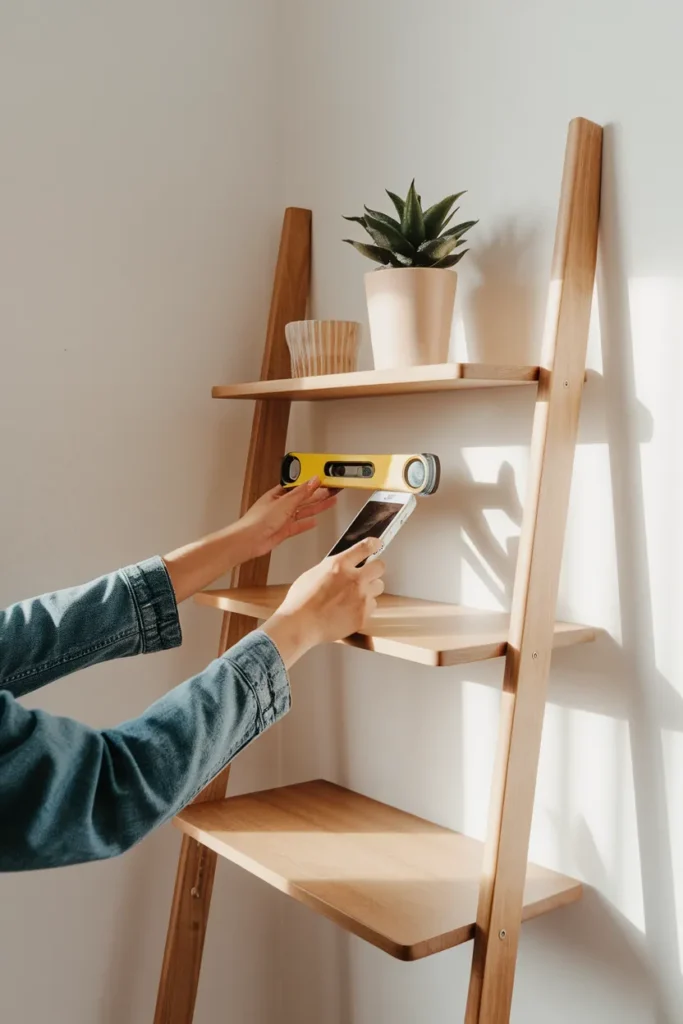
Skip the built-ins and reach for a freestanding piece. An IKEA Billy bookcase or a Kallax cube unit stands on the floor, holds a serious book collection, and moves with you. A slim ladder shelf leans against the wall and takes up almost no floor depth, which is perfect for a tight corner.
If you truly want floating shelves without drilling, use heavy-duty damage-free strips rated well above your load. Weigh your books first. A stack of hardcovers gets heavy fast, so keep floating shelves to lightweight decor and paperbacks and let a floor-standing unit carry the real weight. The failure mode here is painful: overload an adhesive shelf and it peels off the wall at 2 a.m., taking a strip of paint with it.
One anti-tip note that matters if kids or pets share the space: tall freestanding bookcases should be secured. Most renters can use a tension-mounted or low-profile anti-tip strap that doesn’t require real anchors. Safety first, deposit intact.
Light the Shelves So the Corner Works After Dark
A styled bookshelf that you can’t read by is just decor. Lighting is what turns the corner into a nook you actually sit in past sunset.
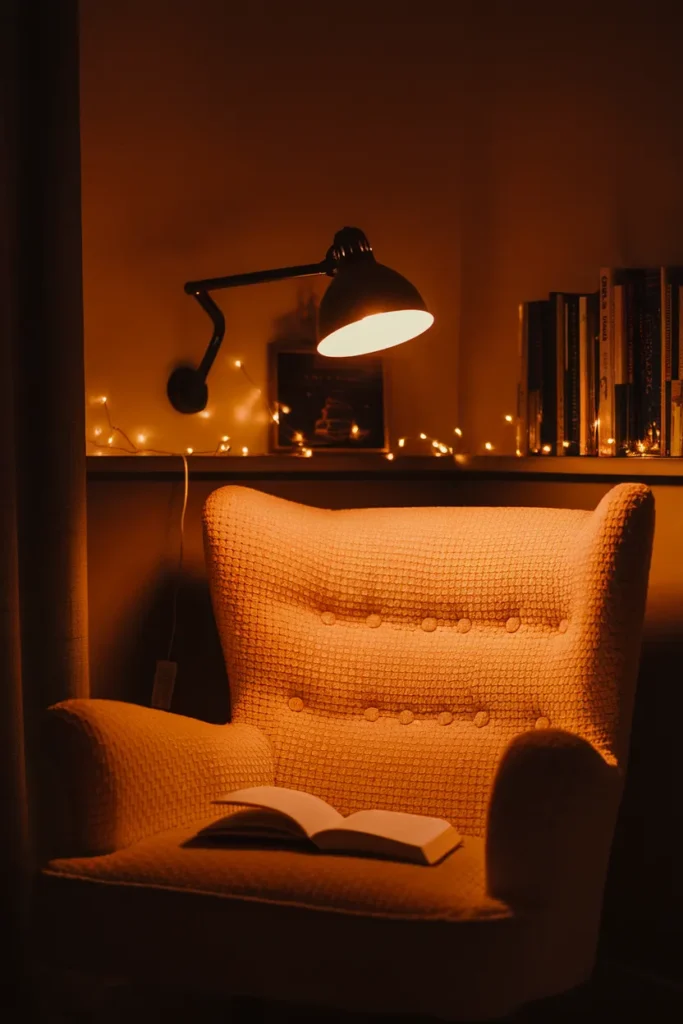
Go warm. Aim for 2700K bulbs, the warm-white end of the color-temperature scale, which reads as the cozy, slightly golden light people associate with lamplight rather than an office. The U.S. Department of Energy’s overview of choosing energy-efficient light bulbs is a solid plain-language reference, and the EPA’s guidance on ENERGY STAR light fixtures explains how lower Kelvin numbers give you that warmer glow.
For a renter, a plug-in swing-arm sconce or a slim floor lamp beside the chair does the job with zero wiring. Add a small dimmer plug so you can drop the brightness for evening reading. If you want the soft, magazine-cover glow without a fixture at all, tuck warm string lights along the back edge of a shelf. This roundup of fairy lights reading nook ideas shows a few soft-glow setups you can copy this weekend.
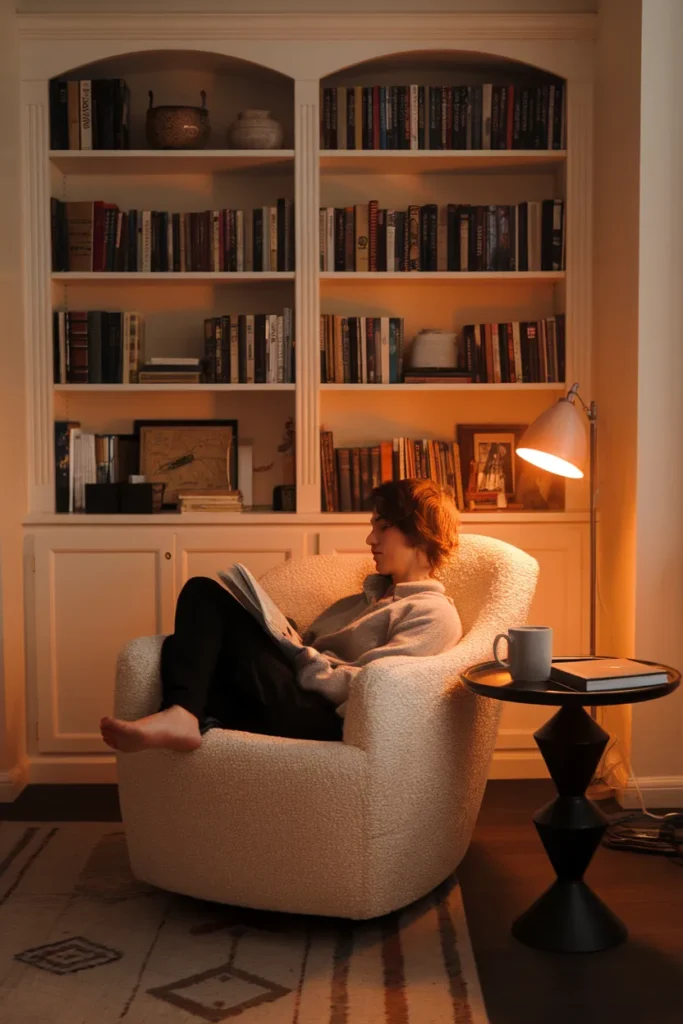
Put task light where your book is, not on the ceiling. Overhead light throws a shadow straight onto the page. A lamp at shoulder height, just behind and to the side of the chair, lights the page and leaves the shelves softly lit behind you.
Add Art and a Gallery Moment Without Nails
Books and objects handle the shelves. The wall around them is your bonus real estate, and it’s how a small corner starts to feel like a designed room.
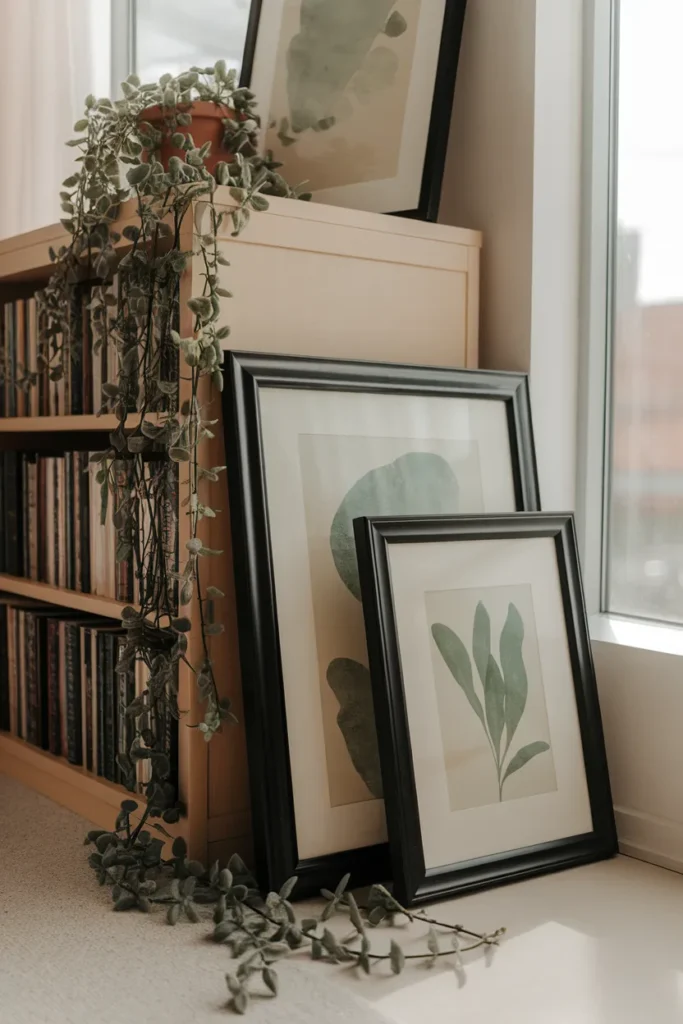
The renter move is leaning, not hanging. Prop a larger framed print on the top of the bookcase and let it overlap the wall behind. Layer a smaller frame in front. Instant depth, zero holes. If you want a fuller wall, a small salt-and-pepper cluster of leaning frames on a picture ledge reads as a gallery wall and comes down in five minutes on moving day.
Keep the palette tight. Two or three colors pulled from your books and throw will make the whole corner feel cohesive instead of busy. If you want the step-by-step on arranging frames around a corner, this guide to a reading nook gallery wall breaks down spacing and layout for a small space.
Make a Tiny Corner Feel Bigger
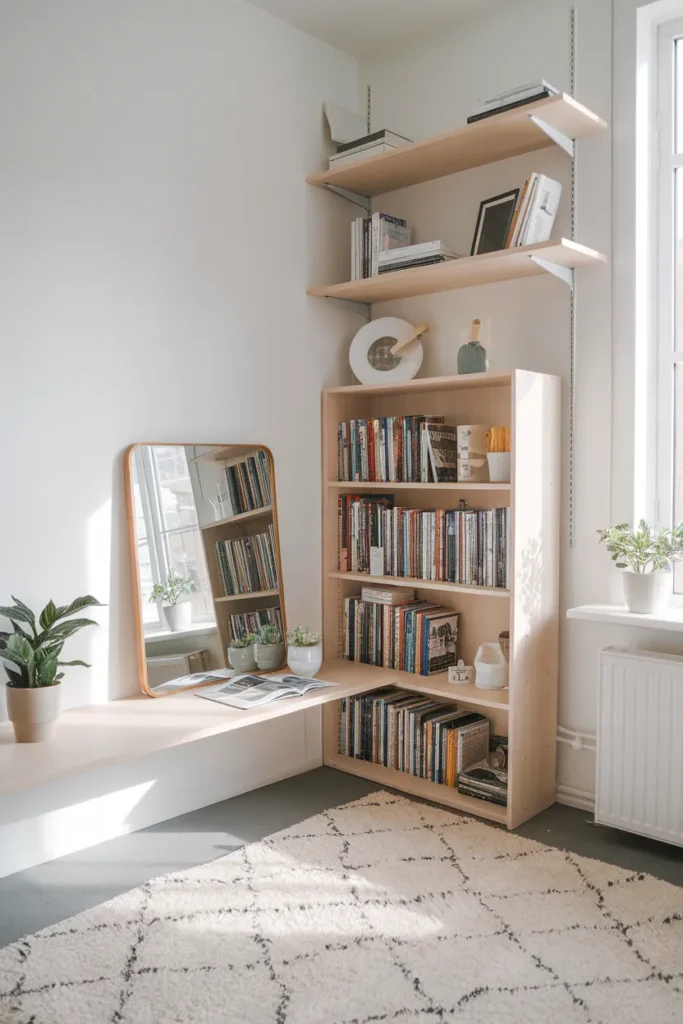
Small space? Styling still wins, you just tilt the choices. Keep the bookcase light in color and low in visual weight. White or pale oak recedes; a heavy dark unit in a tiny corner can swallow the light.
Leave a little more negative space than the formula suggests, closer to 15 percent air per shelf, so the eye reads room. Float one shelf higher up to draw the eye upward and make the ceiling feel taller. A pale washable rug under the chair defines the nook as its own zone, which tricks a small room into feeling like it has distinct areas.
Mirrors help too. A small mirror leaned on a shelf bounces window light deeper into the corner and doubles the sense of space. It’s the oldest small-space trick there is because it still works.
Style by Mood: Cottagecore, Dark Academia, or Scandi
Same formula, three different feelings. Pick the one that matches how you want the corner to feel when you sink into it.
Cottagecore: warm woods, a jute rug, dried florals in a small vase, cream linen, a few cloth-bound classics face-out. Soft and sun-warmed.
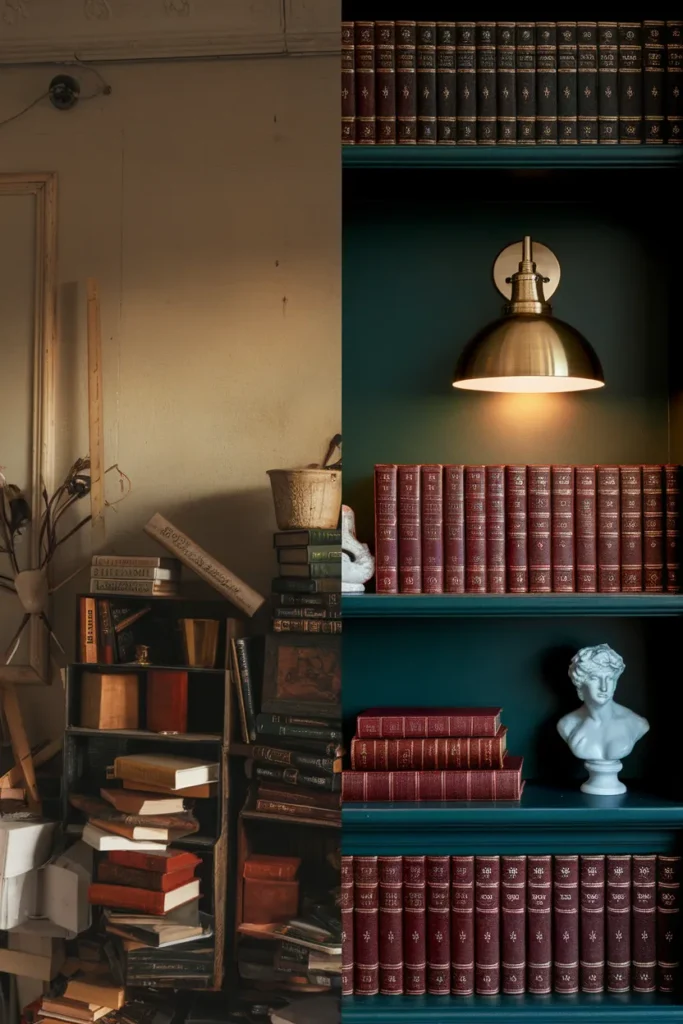
Dark academia: a moodier palette, deep green or oxblood, leather-bound spines, a brass picture light, a stack of hardcovers with an old map or a small bust. Candlelit and studious.
Scandi / japandi: pale wood, lots of that 10 percent air, one sculptural object, a single trailing plant, nothing extra. Calm to the point of quiet.
Whichever you choose, commit the palette across the shelves, the throw, and the frames. Consistency is what separates a styled nook from a pile of nice things.
Your One-Hour Styling Order (Copy This Exactly)
When you don’t know where to start, follow this order. It’s the sequence that keeps you from redoing work.
- Clear every shelf. All of it. You can’t style around clutter.
- Place the books using the 60/30/10 mix, mixing vertical and horizontal, keeping grab-books at arm’s height.
- Add objects in threes, zigzagging weight down the unit.
- Leave the gaps. Protect that 10 percent air on each shelf.
- Lean the art, big behind, small in front, no nails.
- Set the light at 2700K, beside the chair, on a dimmer.
- Sit down and read for ten minutes. Whatever annoys you (glare, a book you can’t reach, a wobble) fix now, not later.
Front-loaded tip, because it’s the highest-value one: do step 7 for real. The nook you test from the chair is the nook you’ll actually use. The one you style and never sit in is just a shelf.
Reading Nook Bookshelf Styling FAQ
How do you style a bookshelf in a reading nook?
Use the 60/30/10 rule per shelf: about 60 percent books, 30 percent objects in odd-numbered groupings, and 10 percent deliberate empty space. Mix vertical and horizontal book stacks, keep your everyday reads at arm’s height, and add warm 2700K light beside the chair.
Should books go vertical or horizontal on the shelves?
Both. Stand most books upright and lay a short stack of three or four flat next to them to use as a pedestal for a small object. The mix creates rhythm so the shelf looks styled rather than stocked.
How much empty space should I leave on each shelf?
At least 10 percent, and closer to 15 percent in a very small room. One clear pocket about a hand-width wide per shelf keeps the whole bookcase from reading as cluttered.
What do you put on reading nook shelves besides books?
Work in threes: one living or faux plant, one leaning framed print, one texture object like a woven basket or ceramic dish, and one anchor stack topped with a candle. Keep to two or three objects per shelf.
Can I do this if I rent and can’t drill?
Yes. Use a freestanding IKEA Billy or Kallax, or a leaning ladder shelf. For floating looks, use heavy-duty damage-free strips rated above your load and keep the real weight on the floor-standing unit. Secure tall bookcases with a renter-friendly anti-tip strap.
What bulb makes a reading nook feel cozy?
A 2700K warm-white bulb, which sits at the warmer end of the color-temperature scale and mimics soft lamplight. Put it in a lamp or plug-in sconce beside the chair, on a dimmer, rather than overhead.
How much does it cost to style a reading nook bookshelf?
Most first setups land between $80 and $400 depending on whether you already own the bookcase.
Sit Down and Test It Tonight
Styling a reading nook bookshelf isn’t about owning prettier things. It’s ratio, spacing, and warm light, in that order. Clear a shelf, run the 60/30/10 mix, lean some art, and set a 2700K lamp beside the chair.
Then do the only step that counts: sit in the chair with a book and see what bugs you. Fix that one thing. Next up, borrow a few soft-glow tricks from our fairy lights reading nook ideas to warm up the corner even more.
Keep reading
More cozy nook ideas
 Fall Decor
Read →
Fall Decor
Read →
Holiday Decor on a Budget: Where to Spend and Where to Save
If last December’s holiday decor money went to plastic picks, a glitter sign, and a box of red balls you were tired…
 Fall Decor
Read →
Fall Decor
Read →
21 Vintage Pumpkin Ideas for Small Apartments, No Porch or Nails Needed
No porch, no mantel, and a lease that frowns on nail holes. You still get a fall corner. You need one shelf,…
 Fall Decor
Read →
Fall Decor
Read →
14 Witchy Backyard Ideas for a Whimsical, Storybook Halloween
No old oak grove, no permission to dig, no money for a garden cottage. A witchy backyard still fits. You need one…