
Corner Bookshelf Reading Nook Ideas: 9 Cozy Builds for a Small Space

No bay window, no reno budget, no friendly landlord required. You need one empty corner, a corner bookshelf, and a chair that swallows you a little. That is the whole recipe for a corner bookshelf reading nook, and this post gives you nine ways to build one, each with real sizes, a product to copy, and the mistake that quietly ruins it.
Here’s who I’m picturing: you rent a 700-ish square foot place, you read on your phone in bed because there’s nowhere better, and one corner of your living room is currently holding a laundry pile and a sad floor lamp. That corner is about to become your favorite spot in the apartment.
Let’s start with the fastest win, because the pin promised cozy corners you can actually pull off, and I want to cash that on the first scroll.
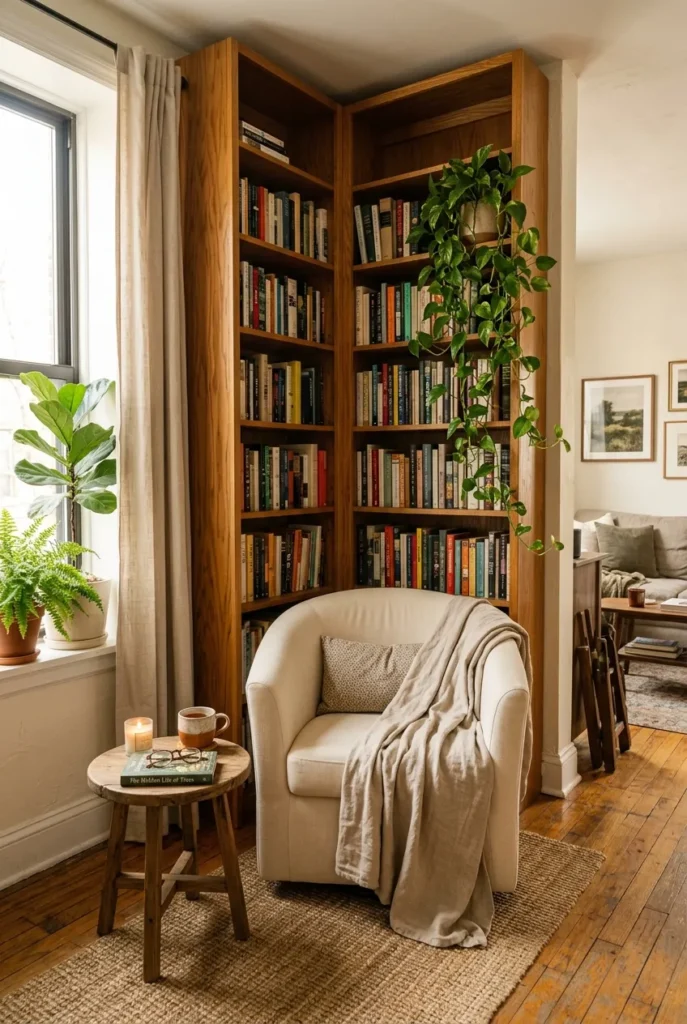
Start With an L-Shaped Corner Shelf and a Chair (the 5-minute layout)
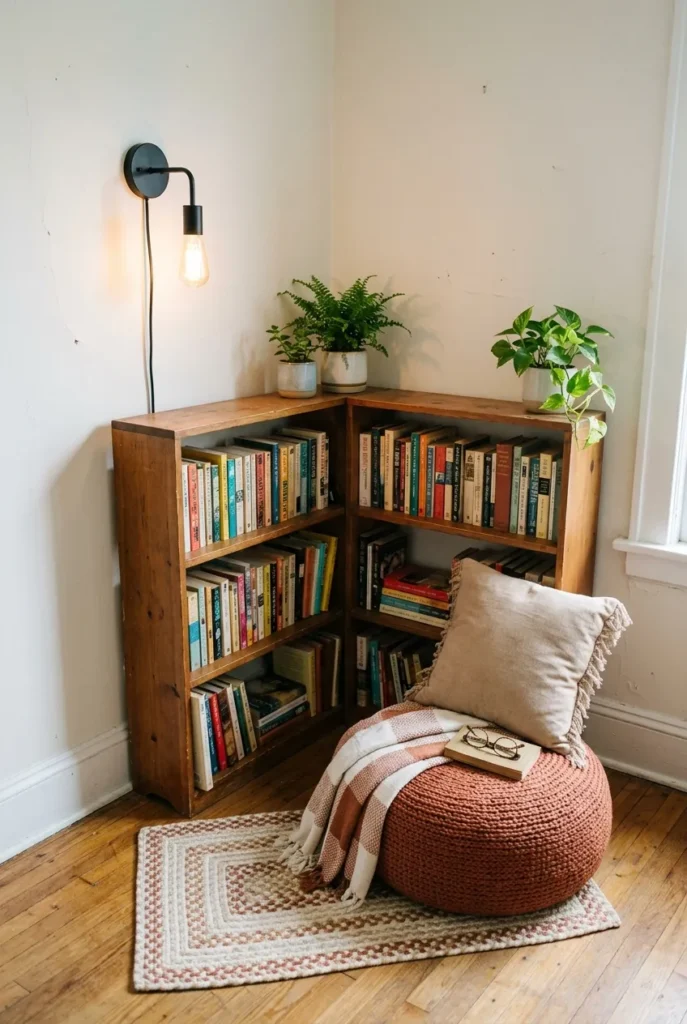
The simplest corner bookshelf reading nook is two things: a tall shelf hugging the corner and a soft chair angled across it at roughly 45 degrees. That angle matters. Facing the chair straight into the wall feels like a time-out. Turning it to catch the corner opens the seat toward the room and gives your legs somewhere to go.
Leave about 30 inches of clear floor in front of the chair so you can stretch out and swing your legs up. Any tighter and you’ll feel boxed in.
Product to copy: any 60 to 80 inch tall corner unit plus a rounded-arm accent chair or a well-loved IKEA Poäng.
Failure mode: skip the angle and shove everything flat against two walls, and you get a storage corner, not a reading corner. It photographs fine. Nobody ever sits in it.
The Renter Move: Freestanding Corner Shelves, Zero Drilling
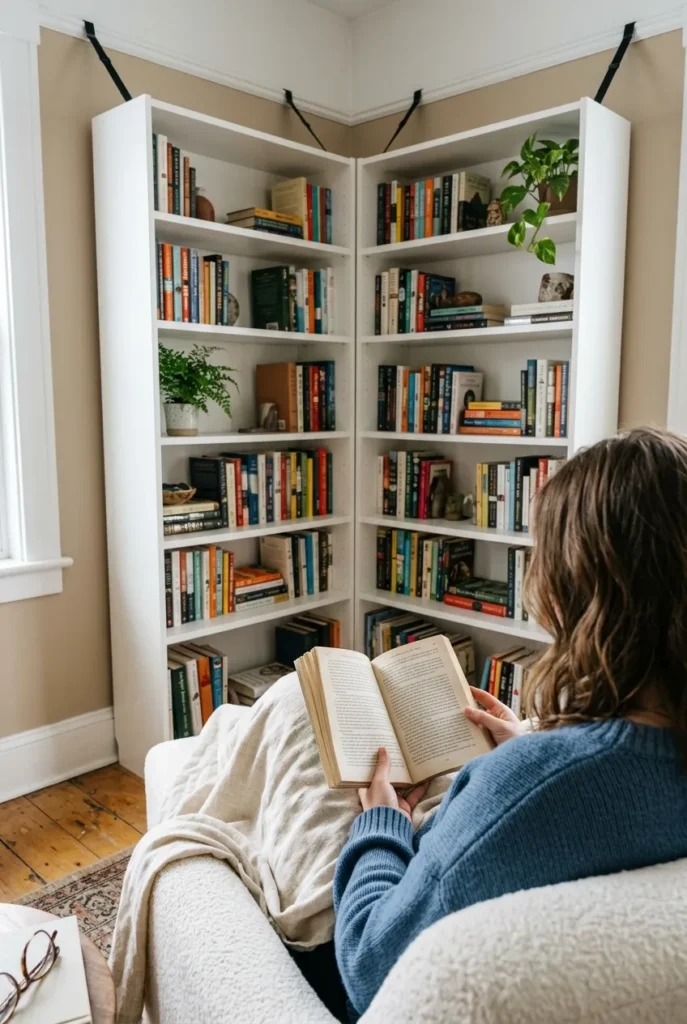
Here’s the gap almost every other guide skips. You can get the built-in look without touching the walls. Buy a freestanding corner bookcase, or set two standard bookcases at a right angle so they meet in the corner, and you’ve framed a nook without a single anchor.
Renting means anti-tip hardware is non-negotiable, and there’s a no-damage way to do it. A tension-mounted setup or a furniture strap into a single small pin hole (spackle-and-forget when you leave) keeps a loaded shelf from tipping. A tall bookcase full of hardcovers is genuinely top-heavy, so this is a safety step, not a nice-to-have.
For a shelf that reads as custom without a build, IKEA’s classic bookcase archetype works because the footprint is predictable. The standard BILLY bookcase dimensions run 31½ inches wide, 11 inches deep, and 79½ inches tall, so two of them meeting in a corner eat about a 31 by 31 inch square of wall and give you a warm, book-lined backdrop.
If you want the exact playbook for turning a corner into a reader-friendly zone in a rental, my reading nook ideas for renters walks through the no-damage setups room by room.
Failure mode: mounting nothing at all. A curious kid, a cat, or one hard tug on a low shelf, and the whole thing comes down.
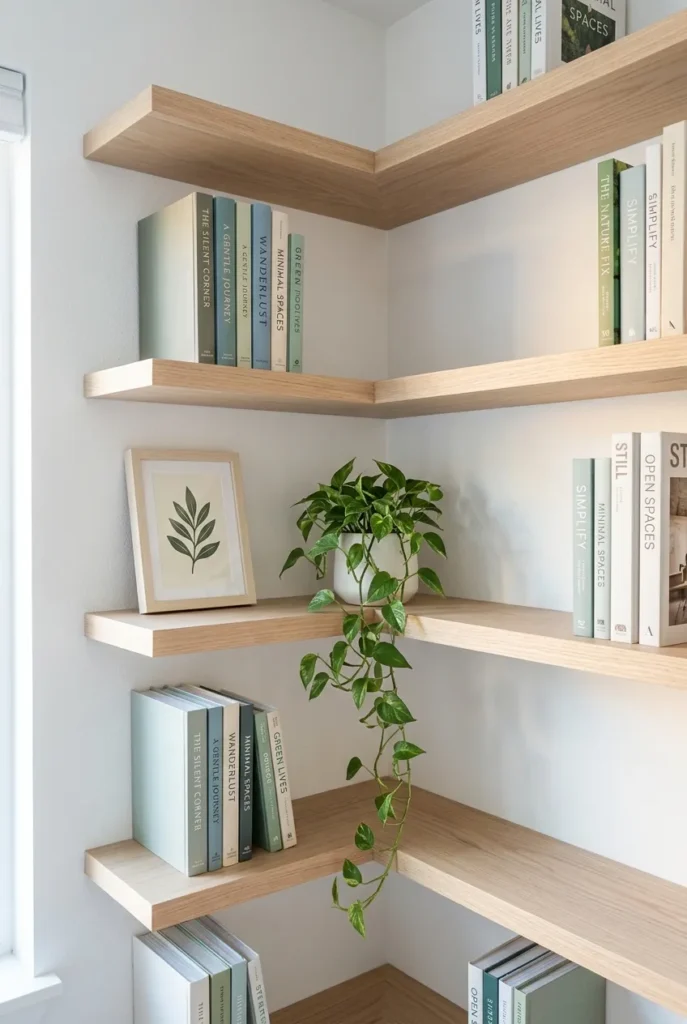
Wrap the Corner in Floating Shelves for a Lighter Look
Bulky bookcases can crowd a tiny room. Floating corner shelves solve that. Run three or four staggered shelves up both walls of the corner, taper the book count as you go up, and the whole thing feels airy instead of heavy.
Space the shelves 12 to 14 inches apart vertically so a standard hardcover stands upright with breathing room. Cram them at 9 inches and you’ll be laying books on their sides, which looks messy fast.
Product to copy: 24 inch solid wood shelves with hidden brackets, two per wall.
Failure mode: overloading a single long floating shelf. Anything past about 30 inches unsupported will bow in the middle within a season. Keep spans short or add a center bracket.
The IKEA BILLY Corner Hack (custom look, real budget)
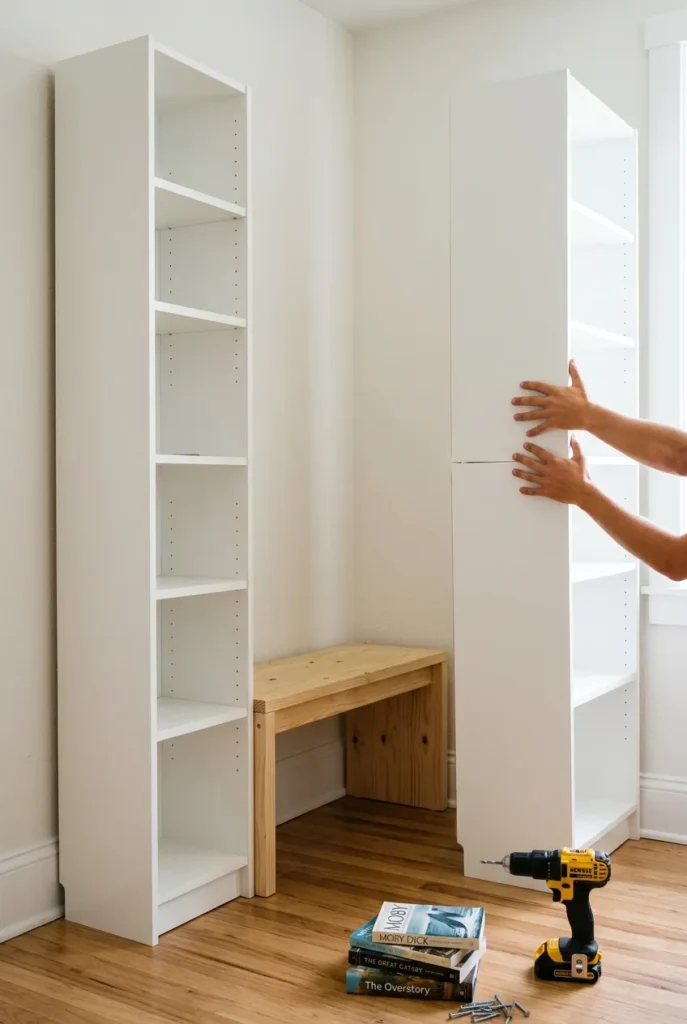
This is the crowd favorite for a reason, and it directly matches what people search for. Take two BILLY bookcases, meet them in the corner, add a low bench or a slim daybed between the shelf ends, and you’ve faked a built-in library nook for a fraction of a millwork quote.
The build order is the part people get wrong: anchor both bookcases first, then slide the seat in, then style. Do it in that sequence and the seat tucks cleanly against the shelf sides with no awkward gap.
I’ve laid out the whole thing, cut list, seat height, and the finish trick that hides the seams, in my BILLY bookcase reading nook build.
Failure mode: styling before anchoring. Once the shelves are full of books, tipping them forward to add hardware is a two-person nightmare.
Add a Window-Free Corner Nook (no natural light, no problem)
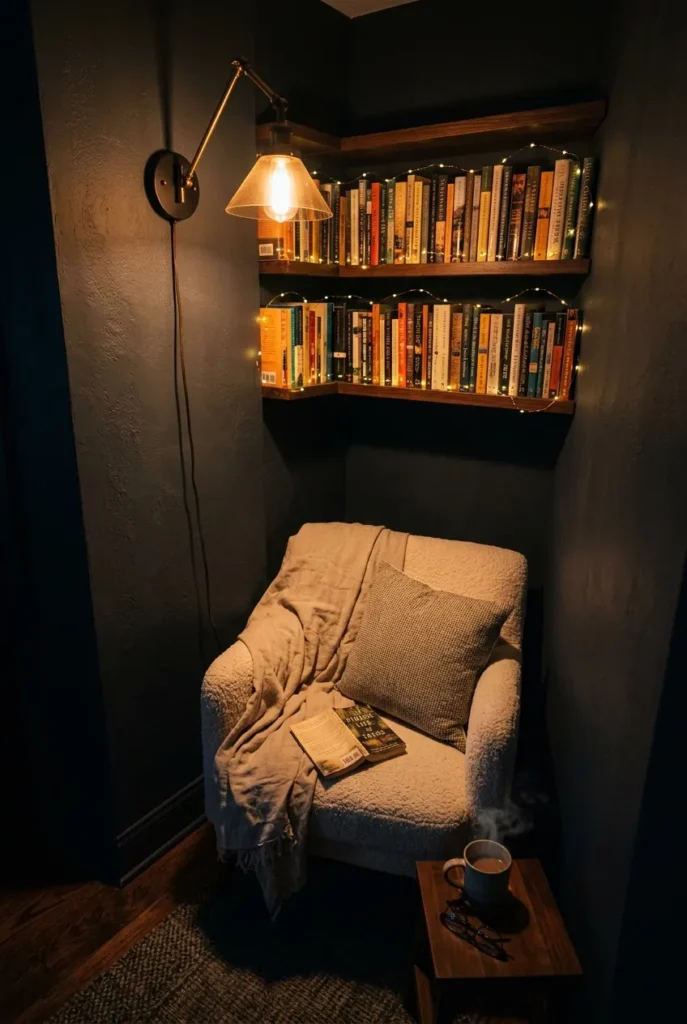
Not every good corner has a window, and that’s fine. You replace daylight with layered warm light and lean into the cave-like coziness instead of fighting it.
Aim for warm 2700K bulbs, never cool white, and stack two sources: a swing-arm wall lamp for reading and a small lamp or fairy lights on a shelf for ambient glow. Good task light genuinely matters here. The American Academy of Ophthalmology notes that poor lighting contributes to eye strain during close-up tasks, so a dedicated reading light beside the chair earns its keep.
Product to copy: a plug-in swing-arm sconce (no hardwiring, renter-safe) at about 15 inches above your seated shoulder.
Failure mode: one overhead bulb doing all the work. It casts shadows onto the page and makes a windowless corner feel like a basement.
Build the Seat Into the Corner (the geometry nobody explains)
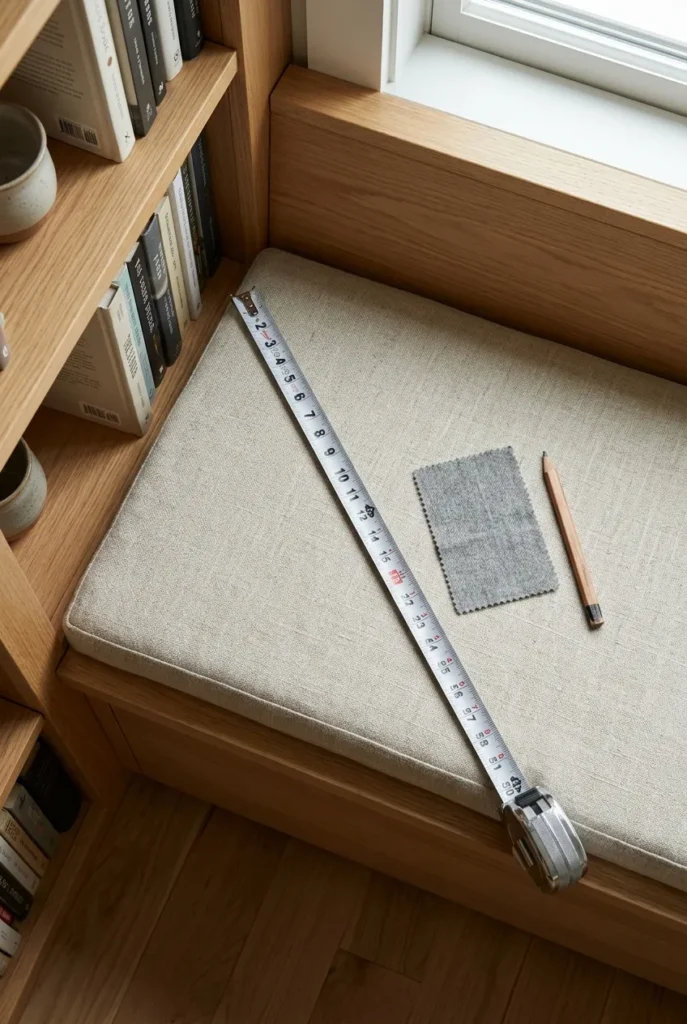
Here’s the second gap. If you want the seat to nest properly inside the L of your shelves, the dimensions are not a guess. A comfortable adult reading seat wants to be about 18 inches deep for the cushion, 16 to 18 inches off the floor, and at least 24 inches wide so you can turn sideways and pull your knees up.
Set the shelves so their inner edges frame a pocket at least 26 inches wide, which leaves a little air on each side of a 24 inch seat. Tighter than the seat itself and it looks jammed in.
Product to copy: a 30 inch storage bench or cube unit topped with a firm foam cushion.
Failure mode: a squishy sofa cushion on a hard bench. It bottoms out in ten minutes and your tailbone files a complaint.
Here’s a quick reference so you’re not measuring blind:
| Element | Target size | Why it matters |
|---|---|---|
| Seat depth | 18 in | Room to tuck legs without sliding off |
| Seat height | 16–18 in | Feet reach the floor, knees stay comfy |
| Seat width | 24+ in | Turn sideways, curl up |
| Corner pocket width | 26+ in | Seat fits with breathing room |
| Shelf spacing | 12–14 in | Hardcovers stand upright |
Layer the Soft Stuff So the Corner Feels Like a Hug
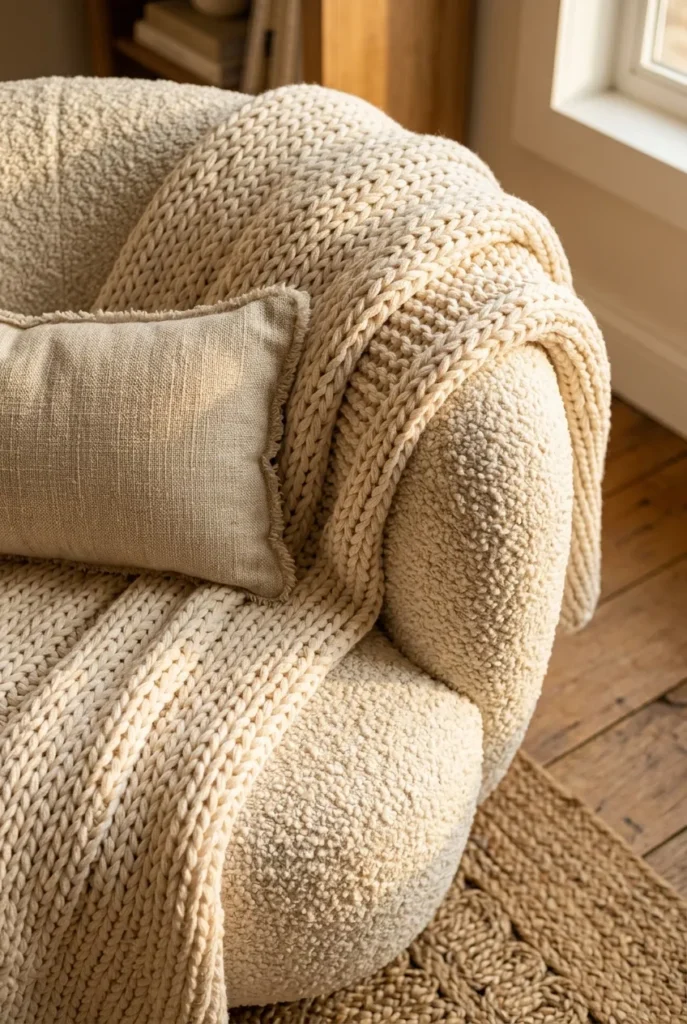
A corner bookshelf reading nook lives or dies on texture, and this is the 25% cozy part of the job. One chunky wool or boucle throw, a lumbar pillow at your low back, and a jute or washable rug to anchor the floor. That’s the base layer.
The sensory beat that sells it: a rug underfoot means bare feet don’t hit cold floor when you slip out of the chair at 11 p.m. to grab the next book. Small thing, huge difference on a winter night.
Product to copy: a 3 by 5 foot washable rug (renter and coffee-spill friendly) plus one 14 by 20 inch lumbar pillow.
Failure mode: matching everything to one flat color. No texture contrast means the corner reads as boring, even when the layout is perfect.
Style the Shelves So They Frame You, Not Bury You
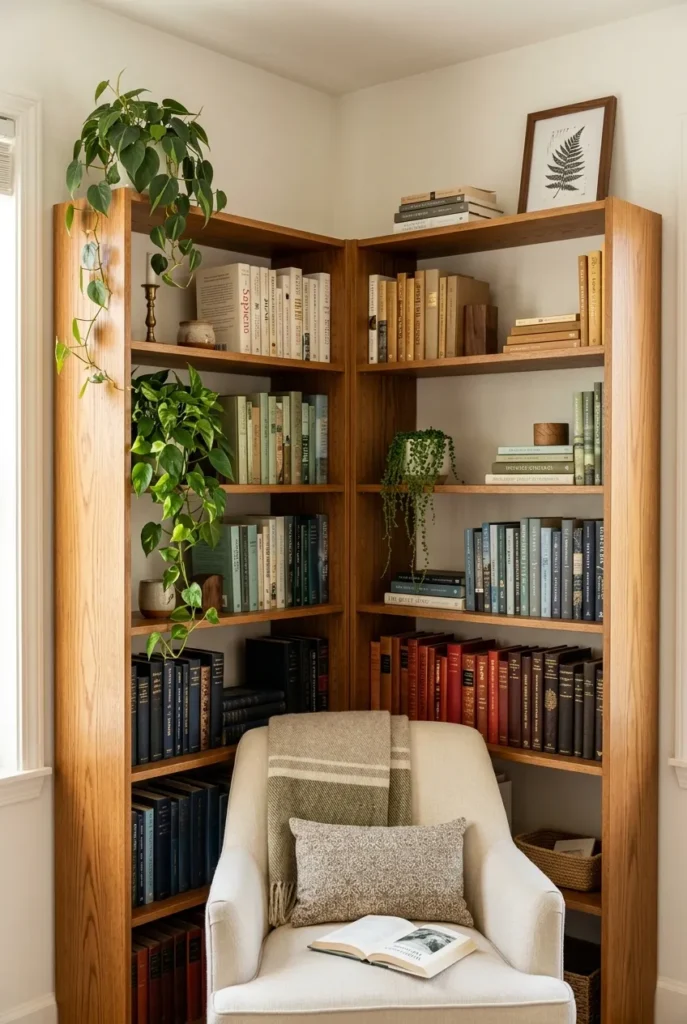
The shelves are the backdrop of every photo you’ll ever take of this corner, so style them with restraint. Fill about 70 percent with books and leave 30 percent for breathing room: a trailing pothos, a couple of framed prints, one small object you actually love.
Keep the heaviest, darkest books low and let the palette lighten as it climbs. That draws the eye up and makes an 80 inch shelf feel intentional instead of stuffed.
For more ways to let the books be the main event, my reading nook with bookshelves ideas has setups from moody to bright.
Product to copy: three or four trailing plants in 4 to 6 inch pots spaced up the shelves.
Failure mode: packing every inch spine-out. A wall of solid book spines with zero gaps feels tense, not cozy.
The Under-$200 Corner Nook (a real, totaled build)
You do not need a big budget. Here’s the third gap competitors skip: an actual itemized corner nook, not a vague “keep it affordable.”
The bones: one tall corner bookcase, a floor cushion or slim bench, a plug-in sconce, a warm bulb, a small washable rug, and a throw. Buy the shelf secondhand and the whole thing lands cheap.
Product to copy: a marketplace-sourced solid wood corner shelf plus a $30-ish floor pouf.
Failure mode: blowing the budget on the chair and leaving nothing for light. A great chair under a bad bulb is still a bad reading spot.
Make It Yours (one last styling beat)
The best corner reading nooks have one personal object that has no design job at all. A mug that’s always there. A stack of your current TBR pile leaning against the shelf leg. The blanket that’s objectively too ugly to display and objectively the coziest one you own.
That’s the difference between a corner that looks like a catalog and one that’s clearly yours.

Frequently Asked Questions
What size bookshelf works best for a corner reading nook?
A tall unit in the 60 to 80 inch range gives you real storage without eating floor space. A standard bookcase footprint (around 31 inches wide, 11 inches deep) fits most corners, and two set at a right angle frame the seat nicely.
How do I make a corner bookshelf reading nook in a small space?
Angle a soft chair across the corner at 45 degrees, put a tall or floating corner shelf behind it, and add a small side table within about 18 inches of the seat. Layer a rug and a throw, add warm light, done.
Can I build a corner reading nook if I rent and can’t drill?
Yes. Use a freestanding corner bookcase (or two bookcases meeting in the corner), secure it with a no-damage anti-tip strap or tension mount, and choose a plug-in sconce instead of a hardwired one. Zero permanent changes.
Is an IKEA BILLY good for a corner bookshelf reading nook?
It’s a popular pick because the footprint is predictable and cheap to duplicate. Two units meeting in a corner give a built-in look, and a bench slotted between them completes the nook.
How much does a corner reading nook cost to set up?
It scales with the seat. A secondhand shelf plus a floor cushion, sconce, and throw can come in under $200, while a new chair and custom-style shelving climbs from there.
What lighting is best for reading in a corner without a window?
Warm 2700K bulbs and a dedicated task light beside the chair, like a plug-in swing-arm sconce, plus a soft ambient source. Avoid a single cool-white overhead, which casts page shadows and strains your eyes.
How do I keep a tall corner bookcase from tipping over?
Always use anti-tip hardware. Renters can use a strap into one small pin hole (easy to patch later) or a tension-mounted brace. Load heavy books low and lighter items up high to keep the center of gravity down.
Your Next Step
Pick the one idea that fits your corner today, whether that’s the two-bookcase renter setup or the full BILLY hack, and set up just the shelf and the chair this weekend. You can layer the throws and plants later. Once the bones are in, the cozy part happens on its own.
If your corner has zero natural light and you’re not sure it can work, start with the BILLY bookcase reading nook build and add the warm-light layers first. That’s the fastest way to prove the spot before you invest in it.
Keep reading
More cozy nook ideas
 IKEA Hacks
Read →
IKEA Hacks
Read →
12 IKEA Furniture Ideas That Look Custom, Not Homemade
You can spot flat-pack from across a room, and it’s rarely the furniture’s fault. It’s the gaps. A strip of bare wall…
 IKEA Hacks
Read →
IKEA Hacks
Read →
20 IKEA Besta Ideas That Look Custom, Not Homemade
Four skinny legs, a gap at the wall, a cushion that slides off every time you lean back. That’s how most IKEA…
 DIY
Read →
DIY
Read →
12 Furniture Makeover Ideas for Beginners Who Have Never Painted a Thing
Your dresser is fine. It works, it holds socks, and it has looked exactly the same since the day you carried it…
One Comment