
12 Ideas for Built-In Bookshelves Around the Fireplace for Book Lovers

Thirty-two inches between uprights. Six inches of bare masonry around the firebox. Twelve inches of shelf depth. Get those three numbers right andbuilt in bookshelves around fireplace look like they came with the house.
Get one wrong and you get sagging boards, a firebox that looks sunk into a hole, or wood trim sitting too close to the flame.
These 12 ideas are for book lovers who own the wall and want shelves that hold real hardcovers, not three vases and a plant. Maybe you just bought the place. The fireplace sits alone on a long, blank wall, and you aren’t sure where to start.
So the list opens with the spec sheet for a library-grade flank, then the clearance rule your carpenter should already know. After that comes the fun part: a window seat, arches, deep paint, glass doors, a TV that hides, and a rolling ladder.

Idea #12 prices the whole thing by the linear foot, so you walk into every quote knowing the numbers. Renting instead? Idea #12 points you to the version you can take with you.
1. The Floor-to-Ceiling Library Flank, Sized for Real Books
Book lovers fill every inch, so plan for weight first and looks second. A loaded bookshelf carries about 20 to 25 pounds per running foot, according to one woodworking design guide.
That same guide puts the no-sag limit for a 3/4-inch plywood shelf at 32 inches. Past that, carpenters split the opening with a vertical divider instead of trusting one long board.
Here’s the spec sheet for a flank built to hold a serious collection:
| 📚 Library flank spec | Build to this number |
|---|---|
| Shelf depth | 10 to 12 in |
| Clear height for hardcovers | 11 to 12 in |
| Clear height for oversized art books | 13 to 15 in |
| No-sag span, 3/4 in plywood | 32 in |
| No-sag span with one 1 1/2 in cleat | 42 in |
| Lowest shelf off the floor | 3 to 4 in |
| Easy reach limit | about 84 in |
Shelves above that 84-inch reach line are for the books you open once a year. Or for idea #11.

2. The 6-and-12 Rule: How Close Wood Can Sit to the Firebox
Your fireplace sets the floor plan, not your Pinterest board.
For masonry fireplaces, the 2018 International Residential Code (Section R1001.11, Exception 4) keeps combustible trim at least 6 inches from the fireplace opening. Inside 12 inches, that trim may only stick out 1/8 inch for every inch of distance. At 8 inches away, the limit is 1 inch deep.
🔥 The 6-and-12 Rule (masonry fireplaces)
Gas inserts and factory-built units play by a different rulebook: the manufacturer’s manual. Those numbers can be much bigger. On one hearth forum thread, a wood insert’s manual called for 50 inches between the insert’s base and the first combustible material above it.
Loose things follow a simpler rule. NFPA’s home heating safety tips say to keep anything that can burn at least 3 feet from a fireplace. That covers baskets, throws, and the stack of library books on the hearth.
Safety note: anchor tall furniture to the wall, keep candles and cords away from fabric, and use a licensed electrician or contractor for hardwired lighting, ceiling mounts, or anything structural.
Find your model number before anyone cuts a board.
3. Turn One Flank Into a Window Seat for Long Reads
Shelves hold books. A seat gets them read.
When a window sits beside the fireplace, stop the shelves at the window frame and build a bench beneath it. Fire on one side, daylight on the other. Here are the numbers builders use:
- Height: about 19 inches off the finished floor, the same as a dining chair.
- Depth: 17 to 22 inches for sitting, or 24 inches if you plan to nap there.
- Cushion: at least 3 inches thick, plus a big pillow if you lean sideways.
- Window: keep the glass at least 6 inches above the bench.
- Length: 48 inches or more lets you sit sideways with your back to the shelves.
One catch: if a heating duct runs under that window, have an HVAC pro extend it so the air blows out the front of the seat. Do that before the bench goes in.
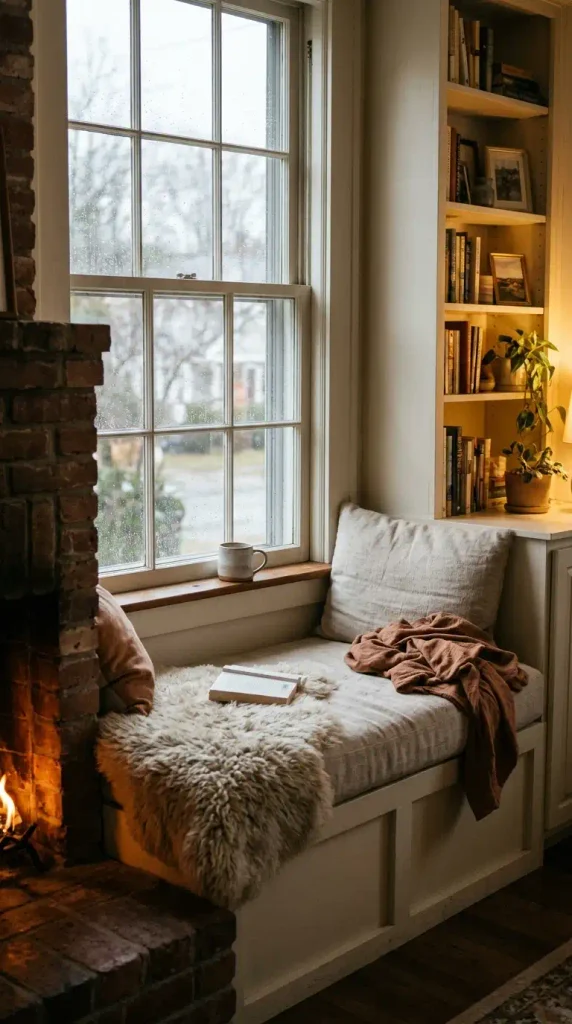
That’s where your TBR pile finally shrinks.
4. Flush Fireplace? Build the Hearth Out, Not the Shelves Back
Here’s the trap with a fireplace that sits flat against the wall. Standard 12-inch shelves on both sides stick out past it, and the firebox ends up looking sunk into a dark hole.
On a flush fireplace on an exterior wall, one Houzz commenter estimated side shelves top out around 8 inches deep unless you build back into the next room. That’s shallow for hardcovers.
A flush fireplace with 12 in shelves on each side. The shelves jut forward, the firebox looks recessed, and the wall reads as three separate pieces.
A framed bump-out brings the fireplace face forward to match the shelf fronts. One flat plane, full-depth shelves, and a mantel that lines up with the shelf tops.
So flip the problem. Instead of shrinking the shelves, frame the fireplace forward. A contractor builds a box around the firebox (often called a chimney breast) so its face sits flush with the shelf fronts. Factory-built fireplaces already sit inside a framed cavity, and the manual tells the builder how close that framing can go.
Green With Decor faced a version of this on a non-recessed wall. Their contractor cut the mantel down so the fireplace and built-ins read as one project.
Either way, decide the depth on paper first. Moving a fireplace face later costs real money.

5. Use Stock Kitchen Cabinets for the Base Run
Kitchen aisles hide the best shortcut for built in shelves around a fireplace. Stock upper cabinets come 12 inches deep, which matches bookshelf depth. Base cabinets come 24 inches deep, which is usually too deep for a fireplace flank. Heathered Nest’s roundup shows one homeowner who used kitchen cabinets to add built-in seating and storage around her fireplace.
Build a level 2×4 platform about 4 in tall on each side. That becomes your toe kick.
Set 12 in deep wall cabinets on the platform. Shim both sides to the same height so the mantel line stays straight.
Cap them with a wood top, then build open shelves above using the spans from idea #1.
HGTV’s fireplace bookshelf tutorial stresses the same point as step 2: level base cabinets keep the mantel and header straight. For more ways to make store-bought boxes pass as millwork, these IKEA furniture ideas that look custom cover trim, toe kicks, and hardware.
Buy one extra filler strip. Walls are never as square as the cabinet boxes.
6. Put Library Lights Over the Books, Not Just the Room
Sundown changes the whole wall. Without shelf lighting, built-ins turn into dark boxes the moment the sun drops, and you’re squinting at spines.
You have two routes. Hardwired library lights, like the brass fixtures Jenna Kate at Home spotted on Oak Stone Homes’ whitewashed birch built-ins, mount on the face frame and look original to the house. They need a licensed electrician. Battery or plug-in LED puck lights tuck under each shelf with no wiring at all.
Bulb color matters more than fixture style. The Energy Department’s guide to color temperature calls 2700K to 3000K warm light. That’s the range that sits easy next to a fire instead of fighting it.
Pick 2700K bulbs so shelf light matches the fire.
Put the switch inside a shelf or beside the mantel.
Light the top run of each side so the wall glows evenly.
Cool 5000K strips that make paper look gray.
Lighting only one side, which tips the balance.
DIY hardwiring. That’s a job for an electrician.

Green With Decor even set their light switch inside the bookshelf, so it disappears behind the books.
7. Cut Arches Into the Top Openings
Square boxes read as storage. Arches read as architecture.
Livingetc featured a homeowner named Mel who turned six 15 3/4-inch-wide IKEA BILLY bookcases into an Art Deco fireplace wall. She added OXBERG doors at the bottom, cut arch shapes from an MDF sheet, and wrapped the edges in trim. Strip wood gave the doors a ribbed look.
The whole wall took her about four weeks. Most of that was waiting for three coats of color over primer to cure.
📌 Good To Know
Trace every arch from one hardboard template. Freehand arches drift, and a quarter inch of difference between the left and right side shows from across the room.
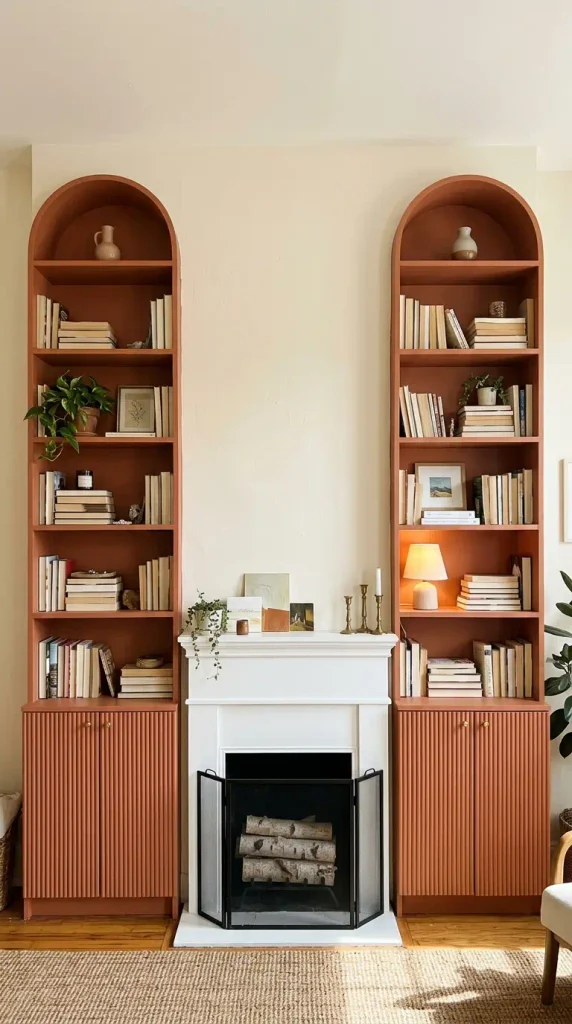
Mismatched arches are the giveaway. Make them match.
8. Paint the Whole Built-In One Deep Color
Go dark, and the books do the decorating.
Jenna Kate at Home points to Craftberry Bush’s black built-ins as proof: the dark backdrop adds depth and makes everything on the shelves stand out. The Mega Mom’s roundup suggests charcoal, navy, or forest green for the same effect without taking over the room.
Paint the shelves, backs, trim, and the wall above in the same color and sheen. One trade-off: dark shelves show dust faster and need idea #6 to stay readable after dark. If the moody library look is where you’re headed, this gothic home library on a budget prices out the rest of the room.

Dark walls, warm light, a fire going. The room feels smaller in the best way.
9. Give Your Keepers Glass-Front Doors
Some books are for reading. Some are for keeping.
Signed copies, first editions, and old cloth-bound sets collect dust and fade on open shelves. Heathered Nest’s roundup includes a traditional fireplace build with a low bookcase behind glass doors, which keeps the collection visible but protected.
Plan for the price, though. HomeAdvisor notes that custom touches like glass doors, sliding ladders, and paint can push a built-in bookshelf budget up by as much as 50%.
Before you order glass doors

Put the books you’d rescue first behind the glass.
10. Hide the TV in a Center Niche So the Sides Stay Books
Every fireplace wall has to answer the TV question. Here’s how the two common answers compare:
| 📺 TV in a niche above the fireplace | 📚 TV off to one side |
|---|---|
| Both flanks stay full of books | One flank gives up shelves to the screen |
| Symmetry holds | Wall reads lopsided unless the other side has a tall piece |
| Screen sits high, so viewing angle suffers | Screen can sit lower, closer to eye level |
| Needs the manual’s clearance above the firebox | No heat question at all |
If books are the point of the wall, the niche usually wins. One Hometalk build had a contractor frame the whole surround in MDF and box out an inset niche sized for the TV and sound bar. The homeowner ran it to the ceiling and listed the project at about $500 in materials and two weeks of work, rated advanced.
The Mega Mom’s tip for that niche: frame the TV with trim so it reads as part of the millwork.

Check the fireplace manual before the niche goes in. Heat rises, and electronics hate it.
11. Add a Rolling Library Ladder When the Shelves Hit the Ceiling
Tall ceilings waste their top shelves without one. A rolling ladder turns those dead shelves into usable space.
The specs on a common kit show what you’re planning around. Lowe’s lists the Meadow Lane library ladder at 92 inches tall with 12 feet of rail, a 300-pound weight capacity, and a rail mounting height of 88 1/4 to 89 1/4 inches.
- Leave at least 2 1/2 inches between the top of the rail and the ceiling or crown molding, per that kit’s instructions.
- This Old House’s ladder tutorial spaces rail brackets no more than 32 inches apart, lined up with the bookcase uprights.
- Run the rail across both flanks and over the mantel if you want one ladder to reach both sides.
For every 4 inches of rail height, the ladder’s feet sit about 1 inch out into the room. An 89 inch rail needs about 22 inches of clear floor in front of the shelves.

Measure the floor before you order. Furniture in front of the shelves stops the ladder cold.
12. Price It by the Linear Foot Before You Call a Carpenter
$300 to $1,200 per linear foot. That’s HomeAdvisor’s range for fully custom built-in bookshelves, and labor makes up 70% to 80% of it.
For built-ins around a fireplace specifically, HomeAdvisor puts typical projects at $500 to $5,000. Here’s what 8 feet of shelving (two 4-foot flanks) looks like by route:
| Route | Price band | Two 4 ft flanks |
|---|---|---|
| 🪚 Fully custom | $300 to $1,200 per ft | $2,400 to $9,600 |
| 📦 Premade, installed | $150 to $300 per ft | $1,200 to $2,400 |
| 🔨 BILLY hack, DIY | materials plus your time | one documented wall: about $3,000 |
| Add-ons | glass doors, ladder, paint | up to 50% more |
That BILLY row is real. Apartment Therapy featured a DIYer, Dalia Aly, who was quoted $13,000 for custom shelving and spent about $3,000 doing it herself with BILLY bookcases, extenders, plywood arches, trim, caulk, and paint.
Before you sign a quote, ask four things:
- Is this price per linear foot or a flat total, and what’s included in that foot?
- Does it include paint or stain, or is finishing separate?
- Who checks the fireplace manual and the 6-and-12 Rule?
- Are the shelves 3/4-inch plywood with a solid edge, and what’s the longest span?
If you rent or aren’t ready for carpentry, this guide to budget fireplace bookshelves on each side gets the framed look with freestanding pieces you can take when you move.
Get three quotes. Prices for the same wall can swing by thousands.
Built In Bookshelves Around Fireplace Frequently Asked Questions
How deep should built-in bookshelves around a fireplace be?
For books, 10 to 12 inches is the standard shelf depth, and it fits almost every hardcover. The bigger question is how far your fireplace sticks out. If it sits flush with the wall, 12-inch flanks will make the firebox look recessed. Stay shallow, around 8 inches on a flush exterior wall, or frame the fireplace forward so both faces line up.
How much do built-ins around a fireplace cost?
HomeAdvisor puts built-ins around a fireplace at $500 to $5,000 for a typical project. Fully custom shelving runs $300 to $1,200 per linear foot, and premade units run $150 to $300 per foot installed. Labor makes up 70% to 80% of the bill, which is why a careful DIY build with stock bookcases can come in far lower.
Should fireplace built-ins go all the way to the ceiling?
Full height reads more custom and holds more books, but it needs a plan for reach. Shelves above about 84 inches are hard to use without a step stool or a rolling ladder. In rooms with low ceilings, or windows above the flanks, lower built-ins topped with art or a window seat can look more balanced.
How far should wood shelves be from a fireplace opening?
For masonry fireplaces, the International Residential Code keeps combustible trim at least 6 inches from the opening. Within 12 inches, trim may project only 1/8 inch for every inch of distance. Gas and factory-built units follow the manufacturer’s manual, which can call for far more. Keep loose decor 3 feet away, and have a licensed pro confirm before you build.
Will built-ins make my fireplace look recessed?
They will if the shelves stick out farther than the fireplace face. Measure that projection first. If the surround barely leaves the wall, keep the shelves shallow or frame a bump-out so the fireplace comes forward to meet them. Some owners also cut the mantel down so the mantel and built-ins read as one piece.
Can you put built-ins on only one side of a fireplace?
Yes. Walls with a window, door, or soffit on one side often work better that way. Balance the empty side with something tall, like a floor lamp, an indoor tree, or a reading chair, so it looks planned. Some owners regret one-sided built-ins because the fireplace felt off balance, so mock up the layout with painter’s tape first.
Start With the Tape Measure
Built in bookshelves around a fireplace all start the same way: three numbers on a scrap of paper. Shelf depth, span between uprights, and distance from the firebox. Write those down before you fall for arches or a ladder, and every other choice gets easier.
Then pick the one idea that matches how you read. A seat if you read for hours. Glass doors if you collect. A ladder if your ceiling keeps going. Deep paint if you read late, with the fire low and the lamps at 2700K.
Save this to your home library board so the 6-and-12 Rule is on your phone when the carpenter shows up.
Keep reading
More cozy nook ideas
 Home Library & Bookshelves
Read →
15 Corner Bookshelf Ideas on a Budget
Twenty-six dollars. That’s the lowest price on this list for a corner bookshelf that still holds a real stack of paperbacks. The…
 Home Library & Bookshelves
Read →
14 Ideas for a Fireplace with Bookshelves on Each Side on a Budget
Two bookcases, two plug-in lamps, two wall straps. At IKEA US list prices this month, that adds up to $237.98 before tax,…
 Home Library & Bookshelves
Read →
How to Create a Gothic Library on a Budget
Seven pieces, one weekend, $324.80. That’s the whole gothic library in this post, priced line by line at IKEA, Home Depot, and…
One Comment