
Cottagecore Dorm Room Ideas That Work Around a Twin XL, a Roommate, and an RA

No drilling. No painting. Half a room, one Twin XL, and a wall in a color somebody else picked in 1997.
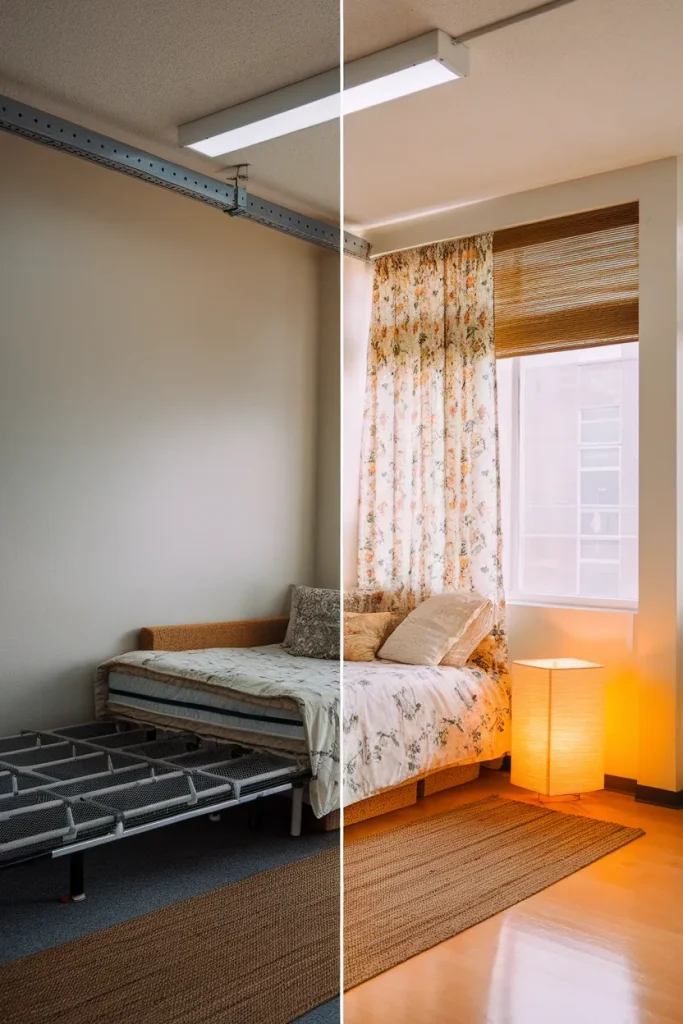
A cottagecore dorm room still happens here. You need three pieces, a tension rod, and one afternoon of move in weekend. Most of what the internet tells you to buy first is a trap.
Below is the buy order, the two specs that decide whether any of it stays on the wall, and the housing rules that quietly cost people a fine every September.
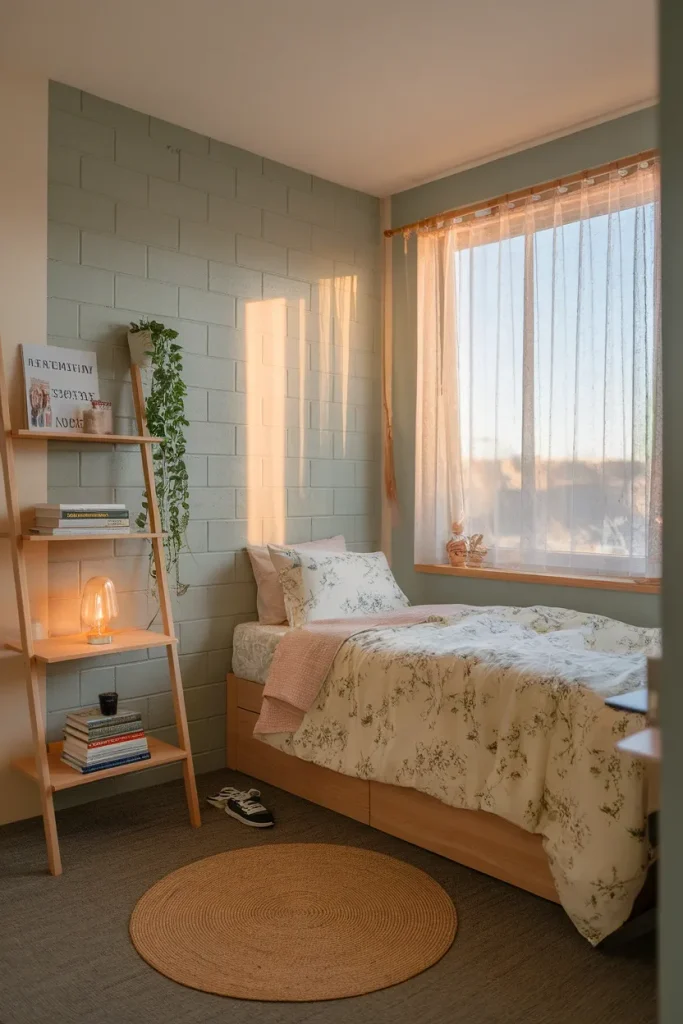
1. Buy These Three Pieces First, In This Order
Nothing below needs a drill, a nail, or a drop of paint. Assume that constraint from here on, because every idea in this article was picked to survive a move out inspection.
Bedding, light, floor. That is the order, and the order matters more than the budget.
Your duvet is roughly 40 percent of every square foot a visitor’s eye can see, because a Twin XL takes up most of your half of the room. Get that wrong and no amount of wall art rescues it. Get it right and you could stop there and the room would read finished.
Second comes one warm lamp, because the ceiling fixture is the single ugliest thing in the building.
Third is something soft underfoot. A 2 by 3 foot washable rug or a jute runner beside the bed does more for the room than four framed prints.
Here is the mistake almost everyone makes: they buy wall art first, on move in day, in a panic, from the campus bookstore. Wall art is the last 10 percent. Buy it in October once you know what the light does.
2. The Twin XL Trap Nobody Warns First-Years About
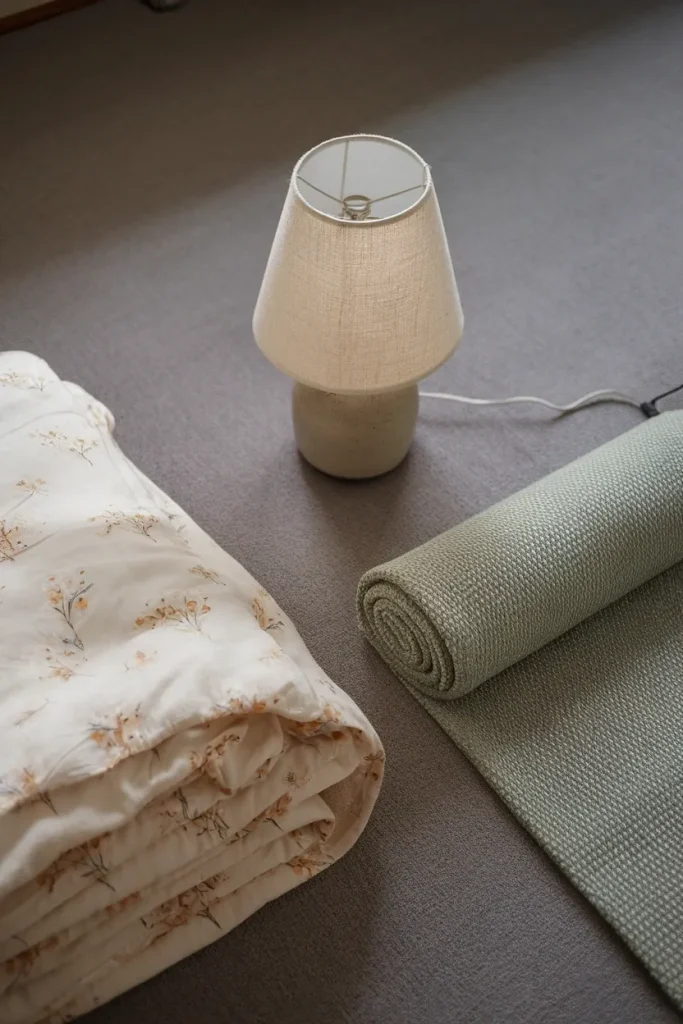
Dorm beds take Twin XL bedding, which is 38 by 80 inches on the package. A regular Twin is 38 by 75. Same width, five inches shorter, and those five inches decide whether your bed reads made or reads rumpled.
Call it the five inch rule: the fitted sheet must be Twin XL, and nothing else has to be.
Now the part almost nobody mentions, because it takes ten minutes of looking things up. The mattress underneath is usually narrower than the bedding sold for it. Georgia Tech, UC Davis, and Ohio University all publish 36 by 80 for their residence hall mattresses. Wisconsin lists some halls at 33 by 80. Illinois lists one building at 35 by 78. So a Twin XL fitted sheet sits a little loose across the width, which is normal and not a defect, while a regular Twin sheet still will not reach the length. Your school almost certainly publishes a furniture dimensions page. Find it before you buy.
| Piece | Buy this size | Why |
|---|---|---|
| Fitted sheet | Twin XL only | 5 inches short and the corners pop off nightly |
| Flat sheet | Twin or Twin XL | Tucks either way |
| Duvet cover | Twin is fine | Hangs 5 inches shorter at the foot, invisible once made |
| Comforter insert | Twin is fine | Same reason |
| Mattress topper | Twin XL | Sits on the mattress, so length is fixed |
This matters for cottagecore specifically because the prettiest floral duvets are almost never made in Twin XL. So people skip the print they wanted and settle for a plain XL set. Do not settle. Buy the floral duvet in Twin and spend the difference on an XL fitted sheet in a plain coordinating color.
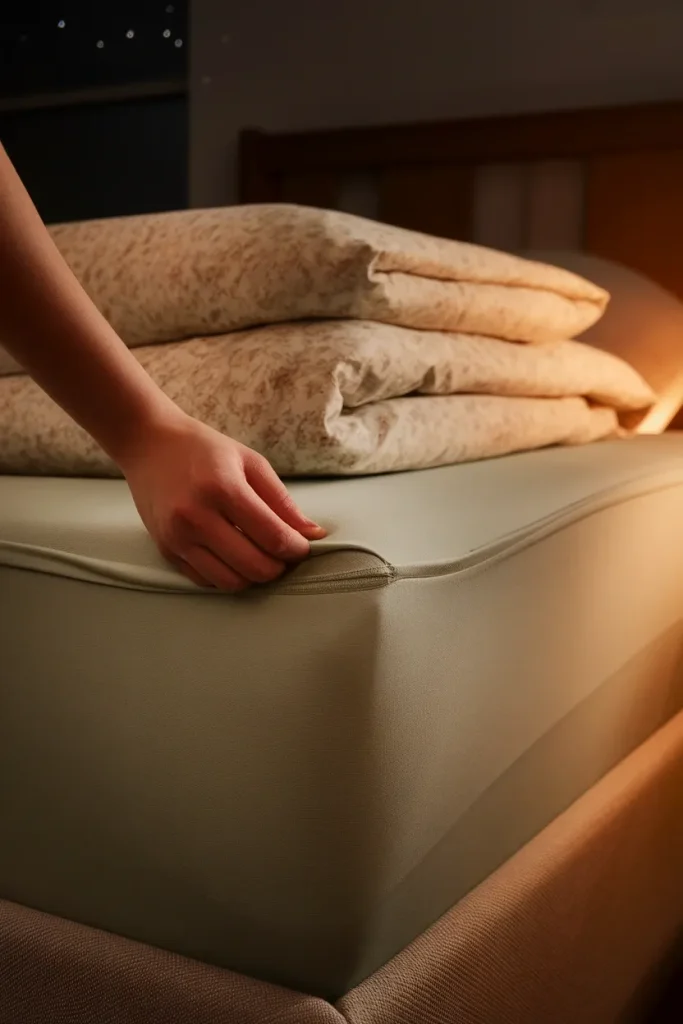
Dorm mattresses also run thin, roughly 6 to 8 inches, so a deep-pocket sheet made for a 14 inch mattress will bag and slide all semester. Check the pocket depth before the thread count. For the full ruleset on making a print read soft instead of loud in daylight, our guide to choosing floral bedding for a cottagecore bedroom walks through motif scale and ground color.
3. What Actually Sticks to a Dorm Wall
Most guides say “just use Command strips” and stop there. That advice costs people their damage deposit every May.
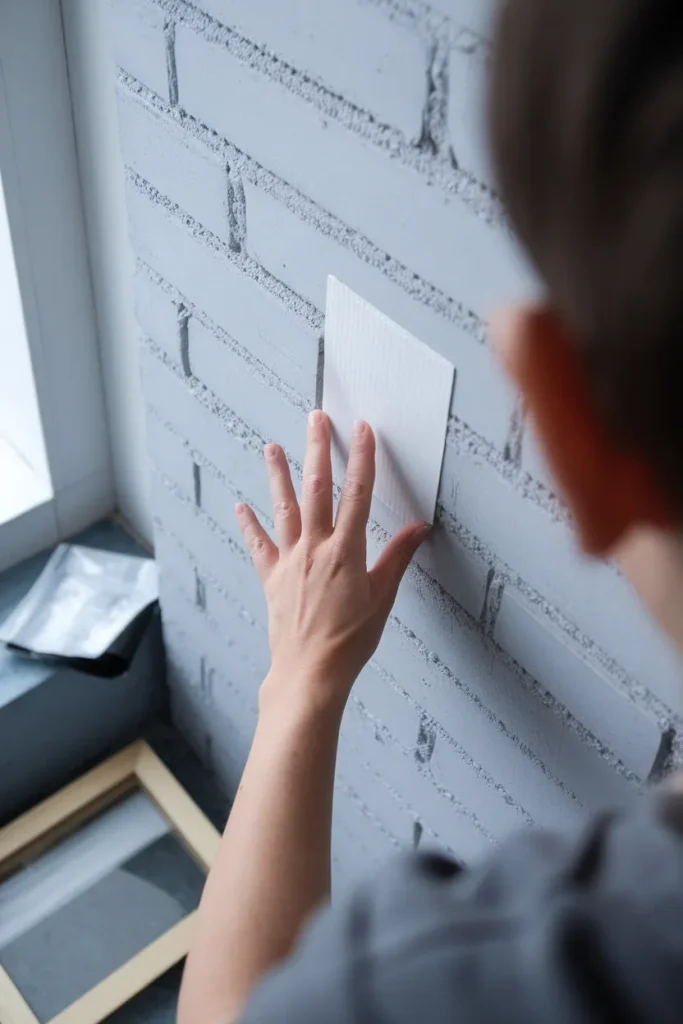
Straight from the manufacturer, and worth reading before you buy anything: 3M lists the approved surfaces in the official Command product FAQ as painted, stained or varnished wood, glass, tile, painted cinder block, metal, and painted wallboard.
Read that again: painted cinder block is approved. Bare brick is not. If your building is the 1960s block tower, you are fine. If you got the historic brick hall, you need a different plan entirely, which usually means a freestanding ladder shelf and a leaning mirror instead of anything on the wall.
Three rules from the same source that people skip:
- Wait a full hour after mounting before you hang anything on it. That hour is the adhesive building its bond, not a suggestion.
- Do not clean the wall with household cleaner first. It leaves a residue film that ruins adhesion. Isopropyl alcohol only.
- Fresh paint has to be fully cured. 3M points you to the cure time on the paint can and recommends waiting a week as a floor, not a ceiling. If maintenance repainted your room in August, wait.
And the weight limits, which are lower than everyone assumes:
| Product | Holds |
|---|---|
| Poster Strips | 1 lb |
| Small Picture Hanging Strips | 1 lb per set |
| Medium Picture Hanging Strips | 3 lb per set |
| Large Picture Hanging Strips | 4 lb per set |
| Small hook | 1 lb |
| Medium hook | 3 lb |
| Large hook | 5 lb |
Watch the Clear versions specifically, because they hold less than the white ones and the packaging looks nearly identical: a Clear Medium hook is 2 lb, not 3, and a Clear Large is 4 lb, not 5.
A thrifted 8 by 10 frame with real glass runs past 1 lb easily. That is why the gallery wall falls at 2 a.m. in week three, and it always lands glass side down.
Here is a rule worth writing on the inside of your closet door.
The Move Out Test: if you cannot take it down in 20 minutes, with nothing but a hairdryer and your fingernails, do not put it up.
Peel-and-stick wallpaper fails that test in most buildings, by the way. It comes off painted drywall reasonably well and takes paint with it off cinder block. Every Pinterest dorm makeover leads with it. Almost none of them show May.
4. Kill the Overhead and Build Two Pools of Light
The ceiling fixture in a residence hall is a flat, cool, buzzing rectangle. You can hear it in a quiet room at midnight. Nothing you buy will read cottagecore underneath it.
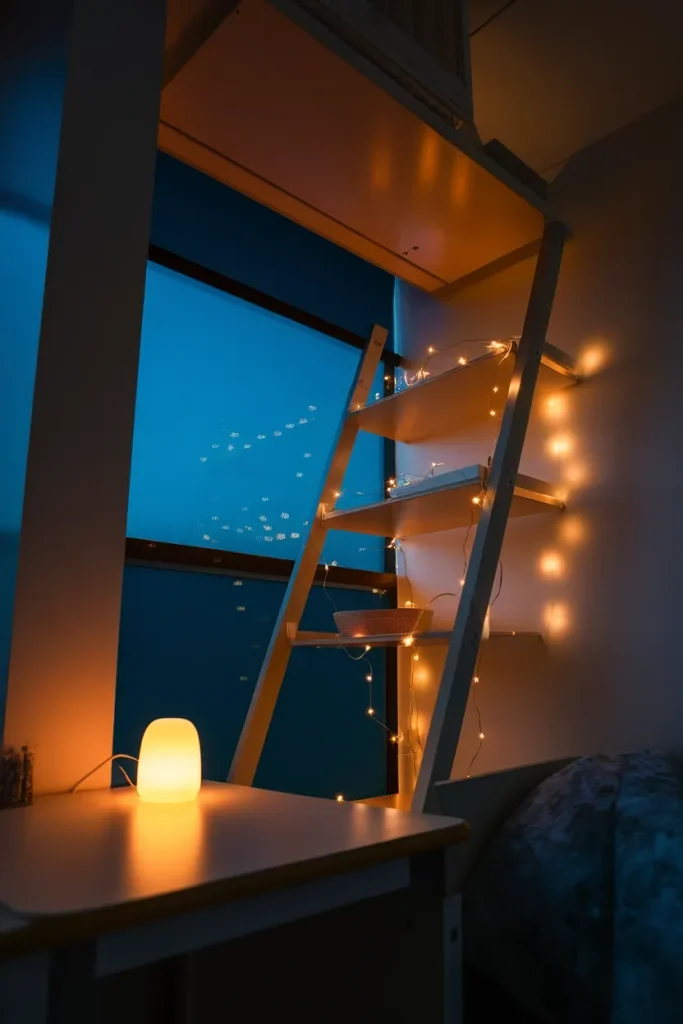
The fix is what I call the two pool rule: two warm light sources at 2700K, both below eye level, and the overhead switch stays off.
Pool one goes at the bed. A small ceramic or milk glass lamp on the desk corner nearest your pillow, or a clip-on reading light on the bed frame if surface space is gone.
Pool two goes across the room, low. A plug-in sconce on the wall, a lamp on the floor behind a chair, fairy lights along the underside of a shelf. The distance between the two is what makes a small room feel deeper than it is.
The number that matters is 2700K. Not “warm white,” not “soft white,” the actual Kelvin figure printed on the box. At 3000K a cream floral duvet starts to look beige. At 4000K it looks gray, and every thrifted brass thing you own looks like a nickel.
Fairy lights are the cheapest way to get pool two, and there is a right and wrong way to run them. Our placement guide for cottagecore fairy lights covers seven layouts and the spec that separates the ones that look like a cottage from the ones that look like a freshman dorm.
5. Fake a Window With a Tension Rod and a Cafe Curtain
Dorm windows come with an institutional blind and no rod. You are allowed to fix that without a single screw.
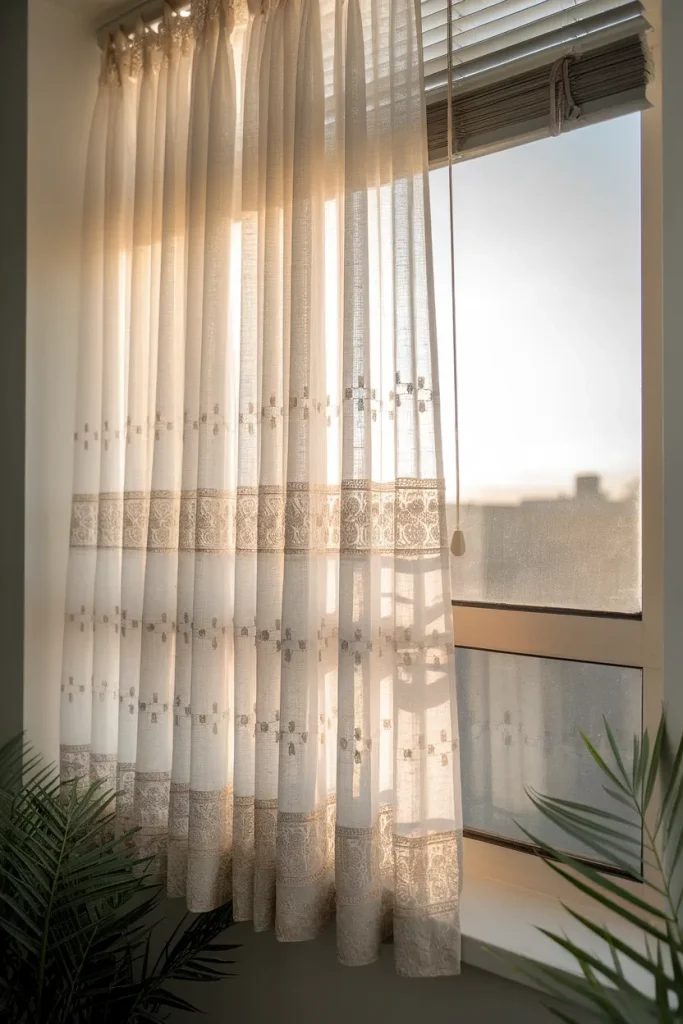
A spring tension rod sized to your window frame goes up in about ninety seconds. Hang a sheer cream or ivory panel and the blind disappears behind soft light instead of aluminum slats.
Two things to get right. Buy the rod one size range down from your measurement, not up, because tension rods hold by compression and a rod at the very end of its range will slide down the wall in the middle of the night. And hang the panel at cafe height, covering the bottom two thirds, rather than floor to ceiling. Cafe height keeps daylight coming over the top and keeps you legal on window coverage, which matters more than you would think (see the next section).
If your bed sits against a blank wall with no window at all, run the same tension rod trick between two walls in a corner and hang a light linen panel behind the headboard. It reads as a window that just happens to be closed.
6. Put the Reading Corner in the Dead Space Under a Lofted Bed
If your bed lofts, you have roughly 30 square feet of the best real estate in the building sitting empty under it. Most people shove a mini fridge there and call it done.
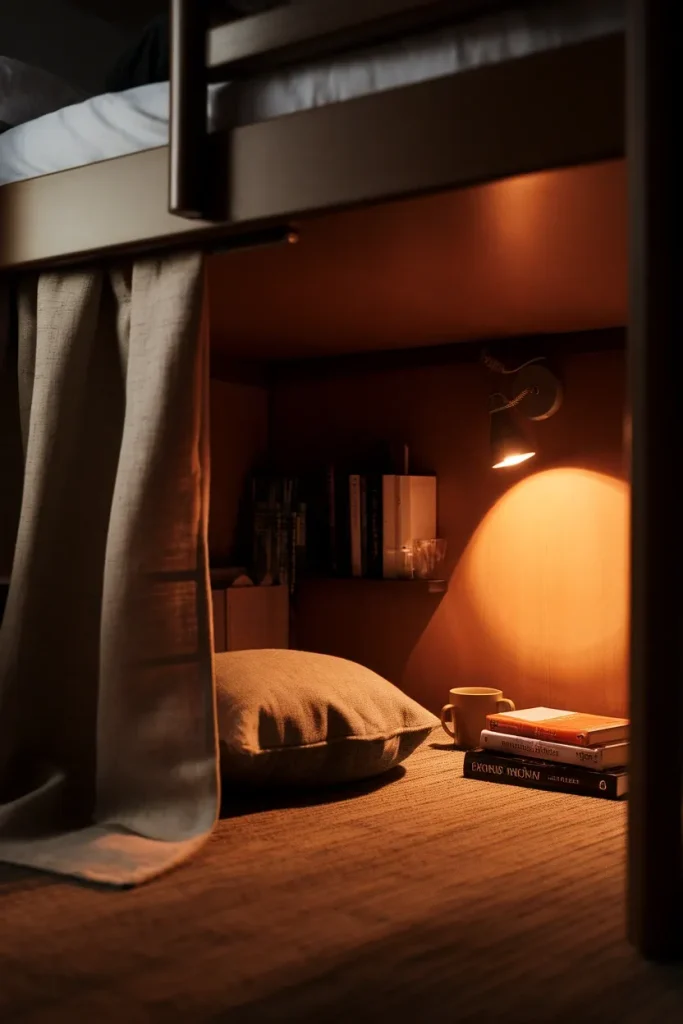
A floor cushion or a small pouf, a jute rug remnant, a clip-on light on the bed frame post, and a stack of books within arm’s reach turns it into the one place in the room that is not about studying. Hang a light linen panel across the open side and it becomes a proper hideaway.
Honest trade-off, because nobody says this part: floor cushions photograph well and your lower back gives up at about the forty minute mark. If you actually plan to marathon read there, put something with a back against the wall, even a folded bolster or a cheap floor chair. A reading corner you abandon in three weeks is just expensive storage.
The setup logic is the same one we use in full bedrooms. Our breakdown of reading corner setups you will actually sit in covers the seat, light, and side table relationship that decides whether a nook gets used or becomes a laundry pile.
7. Read Your Housing Contract Before You Buy a Single Candle
This is the section every other cottagecore dorm article skips, and it is the one that saves money.
Real residence hall policy, not a rumor. Penn State Altoona’s published residence hall decorations and displays policy states plainly that candles are not permitted, that “live trees or greens are not permitted due to fire hazard concerns,” and that tape, adhesives, glue, paste, nails, tacks, staples, and screws are all banned on “walls, furniture, doors, or other woodwork or glass.” Command brand items and poster putty are the allowed alternative, with one condition people skim past: the student remains “responsible for any costs to repair damages that may result from use.” Allowed is not the same as free. The policy also requires that “one-half of the total window space should remain transparent for emergency situations.”
Your school’s rules differ in the details and rarely in the shape. Which means:
- Candles are almost universally out. Flameless LED pillars with a warm flicker are the swap, and a wax warmer is usually allowed where an open flame is not. Check yours.
- Dried florals and dried eucalyptus can fall under “greens” at strict schools. Faux stems are safe everywhere.
- Half your window has to stay clear. Which is exactly why cafe height beats floor length.
- String lights are usually permitted but frequently must be UL listed and LED, never the old incandescent sets.
Ten minutes with the PDF your school emailed you in July is worth more than any shopping list on the internet. Search it for the words “decorations,” “candles,” and “adhesive.”
8. Choose Plants That Survive a Cinder Block Room
Assuming live plants clear your housing rules, dorm conditions are genuinely hostile: one window, often north facing, heat that runs dry all winter, and you gone for a month at winter break.
Four that tolerate it, per Iowa State Extension’s low-maintenance houseplant guidance: the ZZ plant does exceptionally well in low light, pothos grows in low to moderate light, snake plant handles anything from low to direct, and cast iron plant endures low light as its entire personality.
Pothos is the cottagecore pick. Put it high on a shelf and let it trail. Within a semester it will run a few feet down the wall, which does the vine thing that everyone tries to fake with plastic garlands.
The winter break problem is real. A month with no water kills most things. Snake plant and ZZ will both shrug it off. Pothos will sulk and recover. Anything flowering will be dead when you get back, so leave that at home.
If live plants are banned in your building, go faux but go faux selectively: one good quality trailing stem beats six cheap ones, and the tell is always the plastic stem, so tuck the base behind a book or into a crock.

9. Thrift the Three Things That Cost the Most New
Thrifting is not just the budget move here, it is the aesthetic move. Cottagecore falls apart when everything in the room was made in the same year.
Three categories where secondhand wins on both counts:
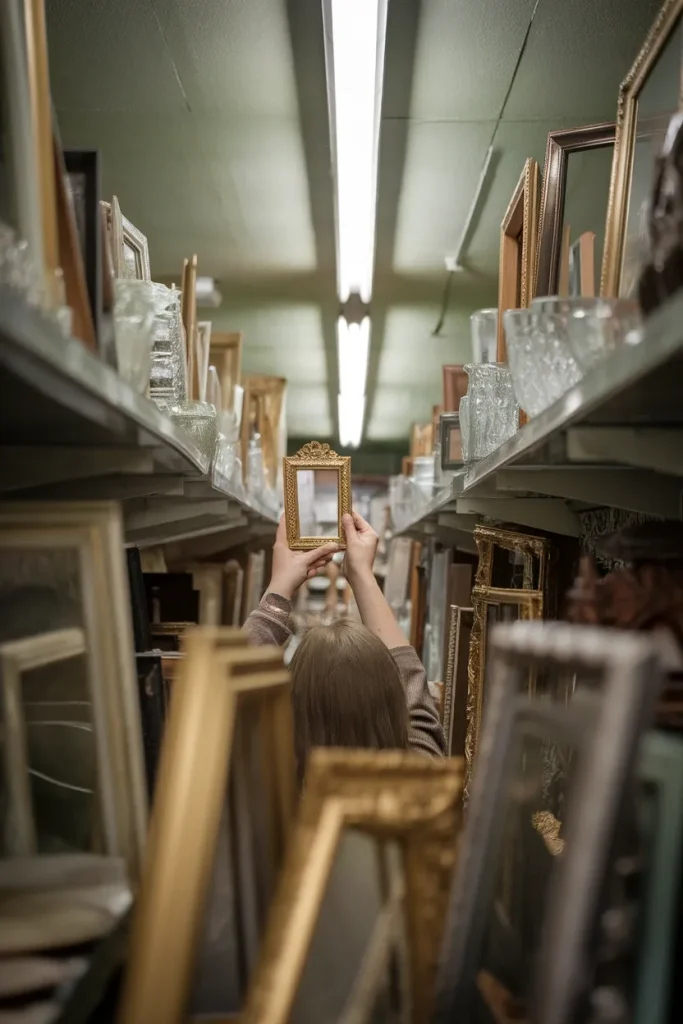
Frames. A dense gallery cluster of eight mismatched frames costs a fortune new and about a Saturday at a thrift store. Pull the glass out before you hang them. It drops the weight under the 1 lb Poster Strip limit and removes the thing that shatters when one falls.
A mirror. One leaning mirror doubles your light and makes a half-room read whole. New decorative mirrors are absurdly priced. Thrifted ones are usually the cheapest large item in the store.
Anything ceramic or brass. Lamp bases, small crocks, candlesticks, little dishes. Cottagecore reads as accumulated over decades, and this is the fastest way to get there honestly.
What not to thrift: anything upholstered, because of bed bug risk in shared housing, and anything electrical without a visible intact cord.
10. Going Cottagecore on Half a Room
You share this space. Your roommate may be deep in a completely different aesthetic, and negotiating that badly makes for a long year.
The thing that works is going vertical and staying on your side of an invisible line. Your wall, your bed, the three feet of floor in front of it. Build density there instead of spreading a thin layer of florals across the whole room, which reads as a takeover and also looks worse.
Shared surfaces stay neutral. The rug in the middle, the window treatment, the door: agree on those or leave them alone. Cream and sage are diplomatic. A full chintz floral on a shared curtain is not.
One thing genuinely worth splitting: the overhead light situation. If you both agree to keep the ceiling fixture off and each run a warm lamp, the entire room gets better regardless of whose aesthetic wins.
11. The $180 Build, Allocated
Below is an allocation, not a set of price quotes. Prices move and product links go stale, so what follows is where the money should go rather than what any specific item costs today. Set your own number and keep the percentages.
| Category | Target spend | What it buys |
|---|---|---|
| Bedding (duvet cover + XL fitted sheet) | $65 | The 40 percent of the room you see first |
| Lamp + 2700K bulbs | $30 | Pool one, and killing the overhead |
| Fairy lights or plug-in sconce | $18 | Pool two |
| Rug or runner, 2 by 3 ft | $25 | Softens institutional carpet |
| Tension rod + sheer panel | $20 | Hides the blind, fakes the window |
| Thrifted frames, mirror, ceramics | $15 | Where the character comes from |
| Mounting hardware (strips, hooks, putty) | $12 | The part everyone forgets to budget |
| Plant + pot | $10 | One pothos, one terracotta pot |
| Total | $195 |
Cut to $180 by thrifting the lamp base and skipping the sconce. Cut to $120 by borrowing bedding from home and buying only the XL fitted sheet.
12. Five Ways a Cottagecore Dorm Room Goes Wrong
- Everything is new. Same store, same year, same finish. Cottagecore needs at least three things that predate you.
- The bulbs are 4000K. Cream goes gray, brass goes silver, and nobody can tell you why the room feels wrong.
- Too many small florals at once. Duvet, curtain, wall art, and pillows all in tiny prints turns to visual static. One large print leads, everything else is texture.
- Wall art hung over the 1 lb limit. It falls, the glass goes, and you patch the paint in May.
- It only works at night. Rooms styled entirely for lamplight look tired at 10 a.m. Check yours in daylight before you commit.
Cottagecore Dorm Room FAQ
How do you make a dorm room cottagecore? Start with bedding, then a warm 2700K lamp, then something soft on the floor. Add secondhand frames and one trailing plant after that. Skip anything that needs a nail.
What is the cottagecore aesthetic? A romanticized rural look built on natural materials, floral and botanical prints, warm low light, and objects that appear collected rather than bought at once. In a dorm it translates to soft textiles, warm bulbs, and thrifted accents over matched sets.
How can I decorate a dorm room without damaging the walls? Use adhesive mounting strips and poster putty only. 3M approves painted cinder block and painted wallboard but not brick or most wallpaper. Wait one hour after mounting before hanging, and prep with isopropyl alcohol rather than household cleaner.
Can you have plants in a dorm room? Usually yes, but check first. Some schools ban live greens as a fire hazard. Where they are allowed, ZZ plant, snake plant, pothos, and cast iron plant all handle low light and a month alone over winter break.
What size bedding do I need for a dorm bed? Buy the fitted sheet in Twin XL, which is sold as 38 by 80 inches. The duvet cover and comforter can be regular Twin, because the five inch length difference disappears once the bed is made. Note that the mattress itself is often narrower than the bedding, commonly 36 by 80 and sometimes less, so an XL sheet fitting slightly loose across the width is expected. Check pocket depth too, since dorm mattresses run only 6 to 8 inches thick.
How much does a cottagecore dorm room cost? Around $180 to $200 if you buy everything, and closer to $120 if you bring bedding from home and thrift the frames and lamp. Bedding and lighting deserve roughly half the total.
Are candles allowed in dorms? Almost never. Most residence halls ban open flames outright. Flameless LED candles with a warm flicker are the standard workaround, and many schools allow wax warmers.
Start With the Sheet
If you do one thing this week, buy the Twin XL fitted sheet and a 2700K bulb. Total cost is small, the change is immediate, and everything else you add afterward will land better on top of those two.
Then come back for the rest once you have seen what your window actually does in October.
Keep reading
More cozy nook ideas
 Small Spaces
Read →
Small Spaces
Read →
10 Small Reading Nook Ideas for Adults
One high-back chair, one clamp-on lamp, one $19.99 tray table. At IKEA US prices this month, that’s a full reading corner for…
 Small Spaces
Read →
Small Spaces
Read →
18 Twin Bed Ideas for a Small Room
A twin bed in a small room can look like a leftover dorm setup or like the best seat in the house.…
 Small Spaces
Read →
Small Spaces
Read →
14 Modern Apartment Decor Ideas That Make a Small Room Feel Bigger
Four hundred and sixty square feet. That is the average size of a new US studio apartment, according to RentCafe’s 2025 numbers,…
2 Comments