
Bedroom Reading Corner Ideas: 10 Nook Setups You Will Actually Sit In

Your bedroom corner is probably holding a laundry chair and a phone charger right now.
Bedroom reading corners fail for one reason almost nobody writes about: the bed sits four feet away, warm, already made, and it wins every night. Most bedroom reading corner ideas skip straight to throw pillows. We are starting with a thirty second test that decides whether your corner gets used or quietly becomes a second laundry pile.
Ten setups below. Real dimensions, a $149 chair with published specs, a bulb temperature backed by the Department of Energy, and one sleep trade-off worth knowing before you read in bed every night.
Nothing here needs a drill.
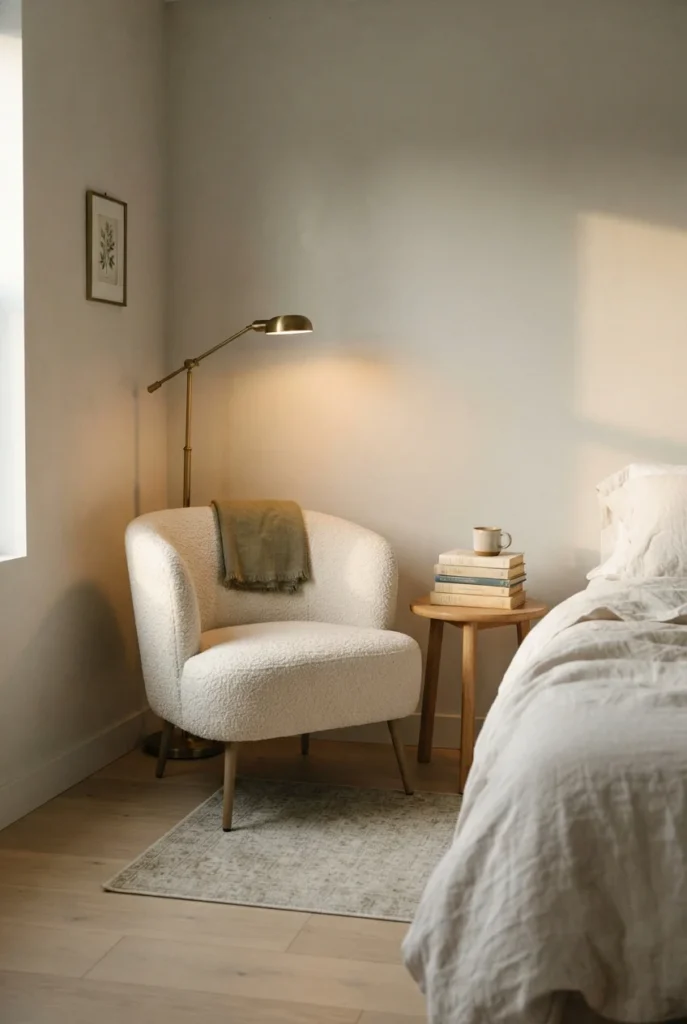
Start With the Bed-Blindness Test
Before you buy anything, sit down.
This is the whole reason bedroom corners underperform compared to living room corners, and it takes thirty seconds to check. Your brain treats anything in the same sightline as the bed as an extension of the bed. So the chair stops being a reading chair and becomes the place you drop a hoodie on the way to lying down.
The Bed-Blindness Test
- Drag any chair you already own into the corner, angled however feels natural.
- Sit down, open a book, set a timer for two minutes.
- Look up. If the bed is the first thing in your sightline, the corner loses.
- Rotate the chair until the bed sits behind your shoulder or fully out of frame. If the room will not allow that, put something solid in the sightline instead: a floor lamp shade, a five-foot fiddle leaf, or an open ladder shelf.
Run this before you spend a dollar. A $400 armchair pointed at your pillows will still lose to the pillows.
One caveat worth naming: a few people read best facing the bed, because the bed reads as safety rather than temptation. If that is you after two honest minutes, ignore step four and keep going

Anchor It With One High-Back Chair, Not a Matching Set
A bedroom corner needs one seat with a back tall enough to hold your head. That is the entire brief.
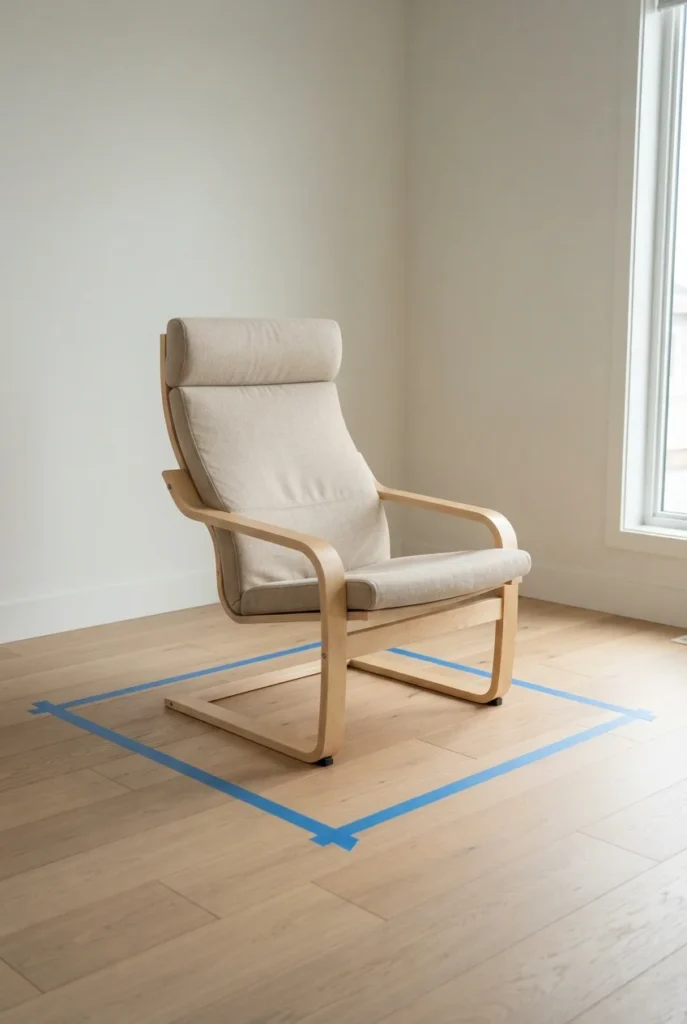
The IKEA POÄNG is the honest default here, not because it is fashionable, but because its numbers are published and it fits corners other armchairs cannot. Per the official POÄNG armchair dimensions, it lists at $149.00 and measures:
| Measurement | POÄNG armchair |
|---|---|
| Width | 26¾ in |
| Depth | 32¼ in |
| Height | 39⅜ in |
| Seat width | 22 in |
| Seat depth | 19⅝ in |
| Seat height | 16½ in |
We plan around six extra inches behind the frame for the bent-wood flex, which puts the real corner footprint at roughly 33 by 38 inches. Chalk that rectangle on the floor with painter’s tape before you order. It is a free five-minute check that has saved more than one return trip.
Tight on floor space? A pouf plus a wall-leaning sheepskin gives you a floor cushion setup in about 18 by 18 inches.
Failure mode: skipping the tape rectangle. A chair that technically fits but blocks the closet door swing gets moved within a week, and then it lives by the dresser forever.
Drop the Light Below Eye Level and Keep It at 2700K
Overhead light is what makes a bedroom corner feel like a waiting room.
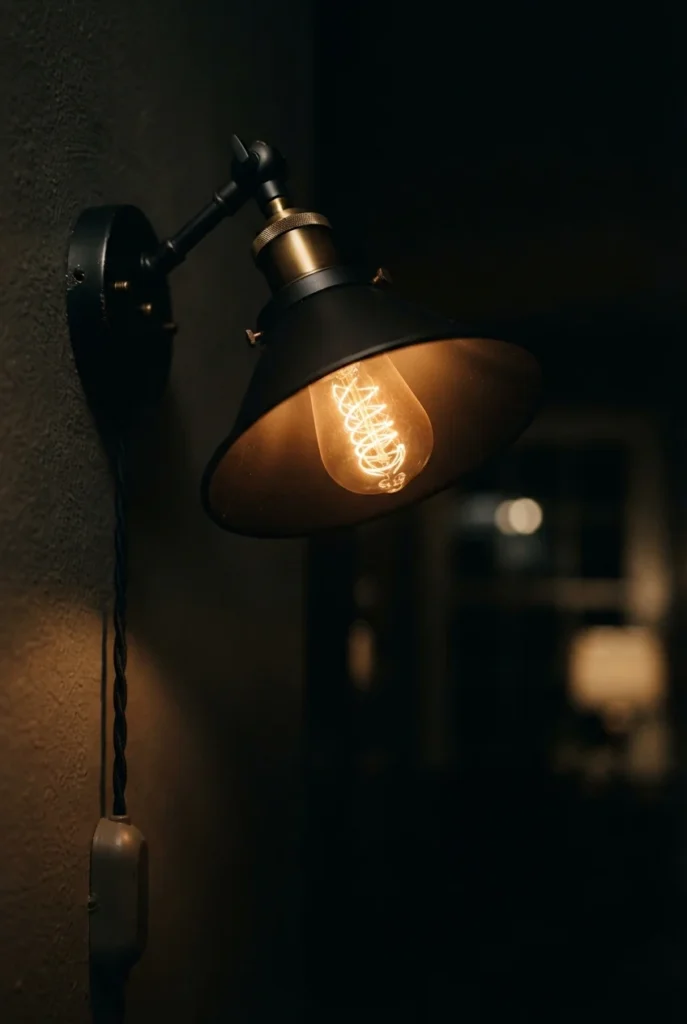
Two rules do almost all the work. Put the light source below your eye line when seated, roughly 40 to 48 inches off the floor for a shade bottom, and choose the bulb by Kelvin rather than by wattage. The Department of Energy bulb color guidance files 2,700K as “friendly, personal” and lists homes and libraries as its recommended settings, which is about as close to an official endorsement of the reading-lamp glow as you will find. The same page notes a 60-watt incandescent puts out 800 lumens, and an efficient LED hits that on 5.9 to 10.5 watts.
So: one 800-lumen bulb at 2700K, on a dimmer, aimed at the page rather than the room.
For hardware, the IKEA HEKTAR floor lamp runs $89.99 and the HEKTAR wall or clamp spotlight is $24.99, which is the cheapest legitimate reading light I can point you to with a verified price. A clip-on reading light on a shelf edge works too and costs less than a paperback.
Failure mode: buying 5000K “daylight” bulbs because they seem brighter. They are brighter. They also make a bedroom corner feel like a dentist’s office at 10pm, and you will stop sitting there.
Float a Small Rug So the Corner Owns Its Floor
A rug is what tells your eye the corner is a separate room.
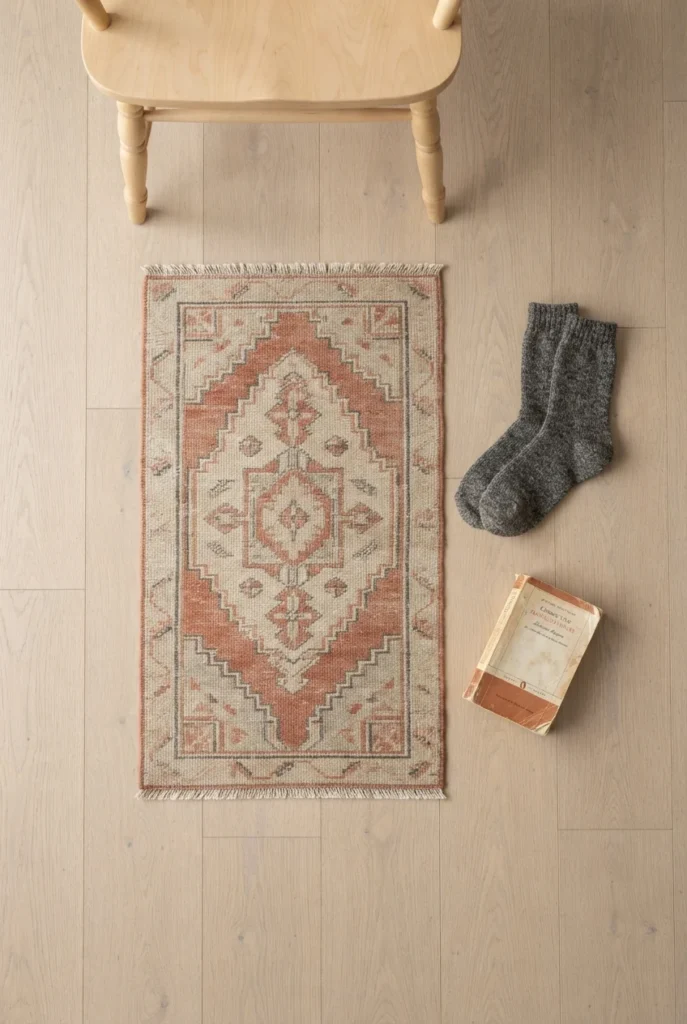
You do not need a 5×7. In a bedroom corner, a 2×3 or 3×5 washable rug placed so the chair’s front legs sit on it does the whole job, and it costs a fraction of a full-room piece. Budget roughly $30 to $80 for a washable accent rug in that size (estimate, since prices shift weekly and I will not quote a fake SKU price).
Jute reads warmer under a wood-frame chair. A low-pile washable option makes more sense if you drink tea while you read, which, statistically, you do.
Here is the part people get wrong: leave two to three inches of bare floor between the rug edge and the baseboard. A rug shoved flush to the wall looks like a mistake. Floated slightly off it, the corner suddenly looks designed.
Size the Side Table to the Seat, Not to the Room
A side table that is too tall turns your mug into a reach.
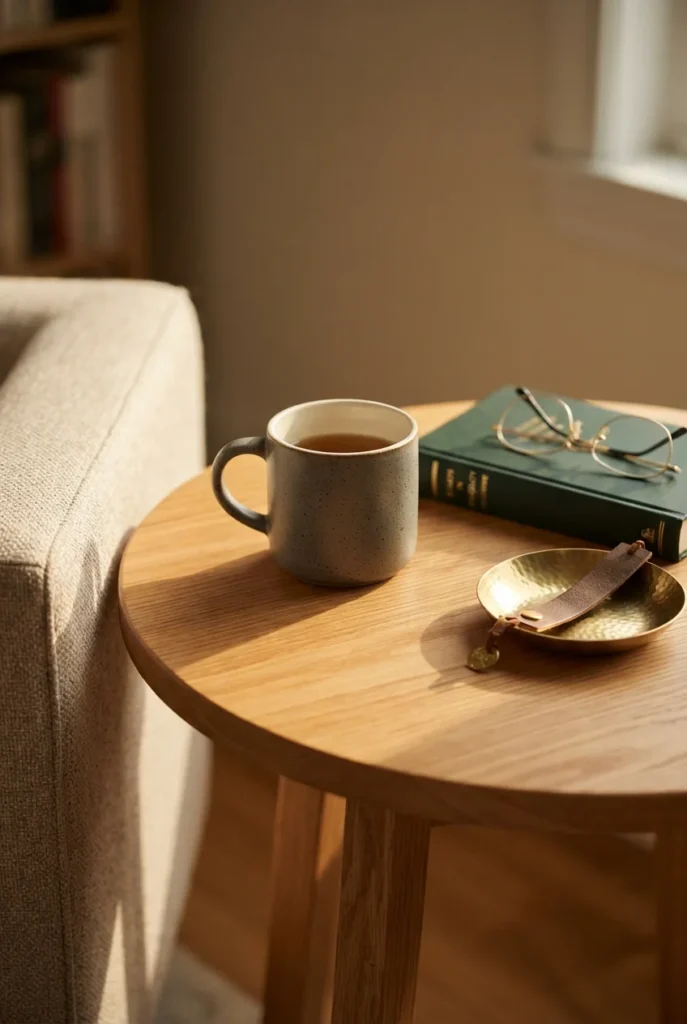
Match the tabletop to within a couple of inches of your seat height. With a POÄNG at 16½ inches, that lands you at a 16 to 19 inch table, which is shorter than most people instinctively buy. Anything at standard 24-inch nightstand height means lifting your arm instead of dropping it.
Round beats square in a corner. You will hit a corner with your hip at least once a week otherwise, usually in the dark.
Depth matters more than width. Twelve to sixteen inches across is plenty for a mug, a phone, and one book face-down. Any bigger and it collects mail.
If floor space is genuinely gone, a wall-mounted ledge at 20 inches high does the same job on zero footprint, or a slim rolling cart tucks behind the chair when you are not reading.
Layer Exactly Three Textures and Then Stop
Three. Not seven.
A bedroom corner that photographs beautifully and feels chaotic in person almost always has too many competing soft goods. Pick one smooth, one nubby, one plush, and let that be the whole story:
- Smooth: a washed linen throw over the chair back
- Nubby: a bouclé or chunky knit lumbar pillow at the small of your back
- Plush: a sheepskin or sherpa square on the seat, or draped over one arm
A lumbar pillow around 12 by 20 inches sits at the right height for most adults in a 16½ inch seat. Square 18-inch pillows push your shoulders forward and get relocated to the bed within a month.
The texture that matters most is the one you notice with your eyes closed. Wool holds warmth against an exterior-wall corner in February in a way that a polyester throw simply does not, and you feel that difference in the first ninety seconds.

Hang the Wall Story Without a Single Drill Hole
Renting is not the constraint people think it is.
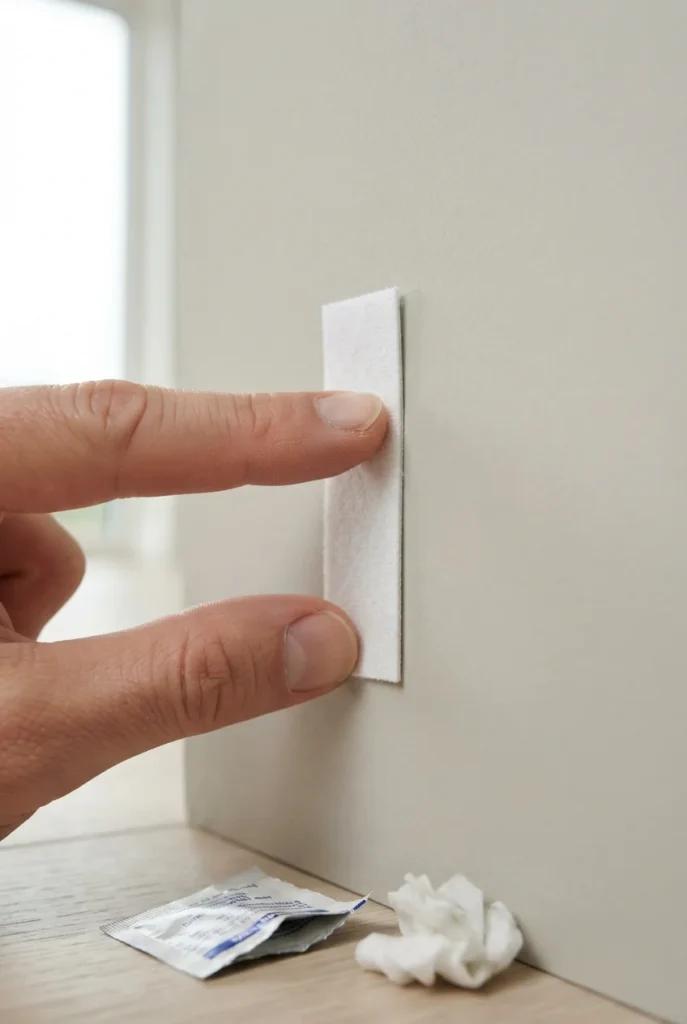
3M’s own spec for Command Large Picture Hanging Strips puts four pairs at 15 pounds with a maximum frame size of 24 by 36 inches, which covers most of what you would hang above a reading chair. What they explicitly do not cover: wallpaper, fabric, textured walls, and brick. Check your wall before you commit, because a strip that lets go at 2am takes paint with it.
Three no-drill moves that hold up:
- A pair of 11 by 14 frames stacked vertically, bottom frame 8 to 10 inches above the chair back
- A peel-and-stick wallpaper panel behind the chair only, cut to roughly 30 inches wide, to fake an alcove
- A tension rod across the corner with a sheer curtain, which visually walls off the nook without touching the ceiling
Tension rods and adhesive hooks also handle a plug-in sconce, and a fabric cord cover keeps the wire from advertising itself.
Failure mode: hanging heavy first. Adhesive strips need a clean, alcohol-wiped wall and an hour to cure before you load them. Hang the light thing, wait, then hang the heavier one.
Keep the Current Read Within Arm’s Reach, Not on Display
A tower of forty books beside the chair is decor. It is not a reading system.
Keep three to five books at the chair and nothing else. Your current read, the next one, and one you might abandon. Everything else lives on a bookcase across the room where getting up is a small, useful friction.
Storage that works in a corner without eating floor:
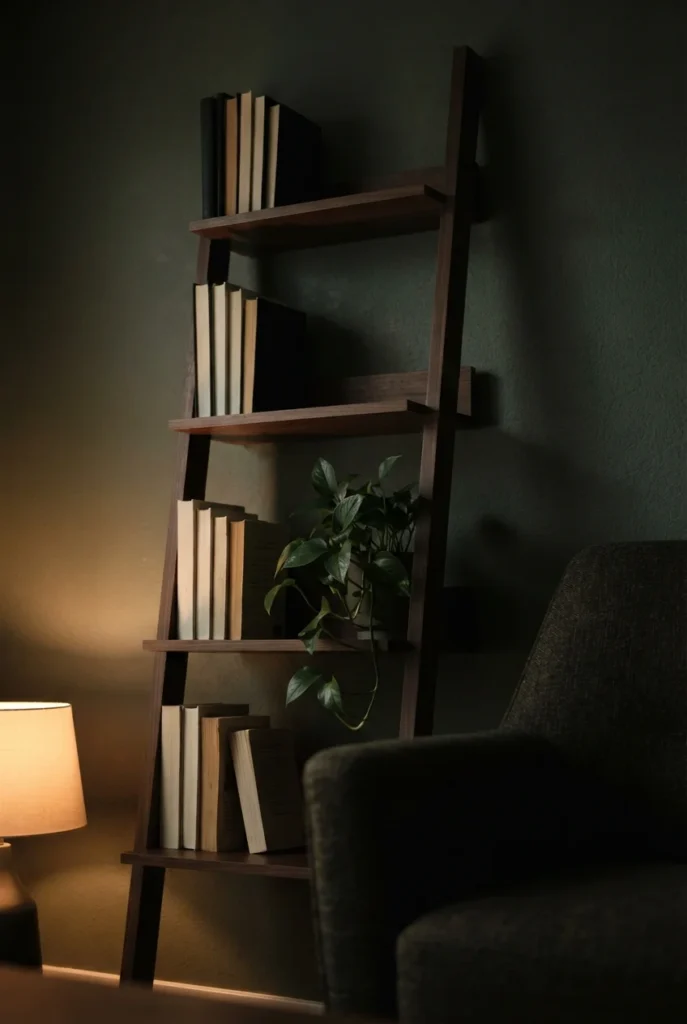
- A slim ladder shelf, 16 to 18 inches wide, leaned in the adjacent corner
- Two wall ledges at 4 inches deep, stacked 12 inches apart
- A lidded basket that doubles as a footrest, roughly 14 inches tall
- A magazine file screwed to the side of the chair-adjacent nightstand
The point is that your TBR pile stops being a guilt monument and starts being a menu.
Fake the Window If Your Corner Does Not Have One
Most bedroom corners are the corner without the window. That is fine.
You are recreating two things a window gives you: a light source at a believable height, and something for your eye to land on when it lifts off the page. Handle them separately.
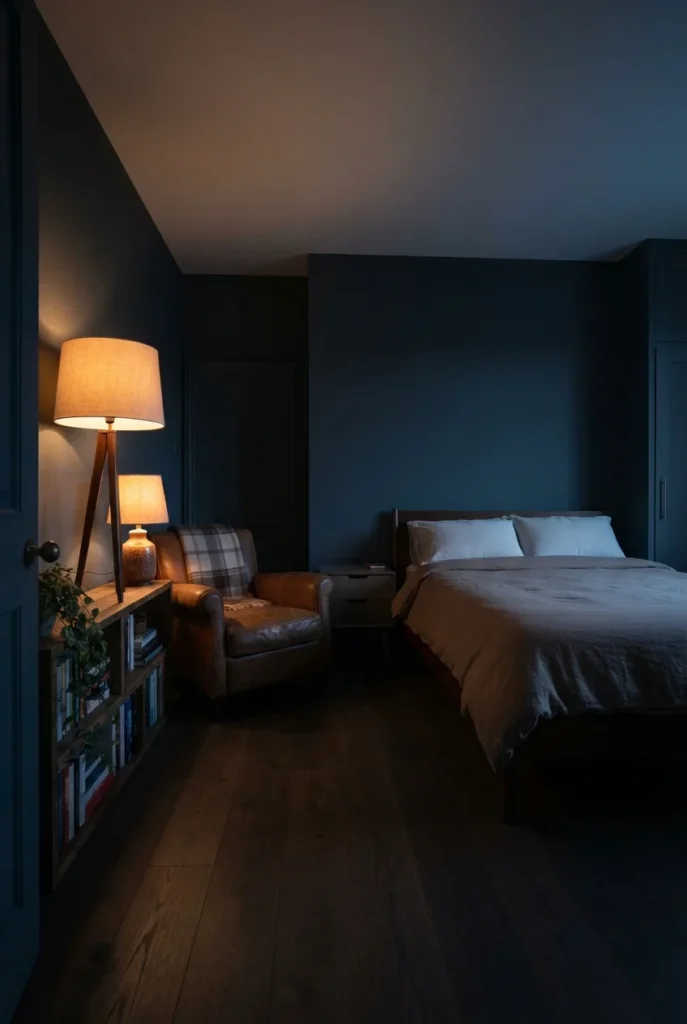
For the light, put a floor lamp at 55 to 65 inches tall in the corner behind the chair shoulder, so the glow arrives at the same angle daylight would. Add a second, lower source at 20 to 30 inches. Two sources at different heights read as daylight to your eye. One overhead never does.
For the sightline, hang a large mirror opposite whatever real light the room has, or mount a single oversized print at 24 by 36 inches with its center at 57 inches off the floor. Sheer curtains hung on a rod across a blank wall also work, and they cost less than most people expect.
If you do have a window, the geometry changes completely and you should build a bench into it. We covered that build in detail in our window seat reading nook designs, including storage depth and cushion specs.
Style It to One Mood, Not Three
Pick a lane and commit. Mixing three aesthetics is how a corner ends up looking accidental.
Poetcore. Pinterest’s own 2026 trend report clocked “the poet aesthetic” up 175 percent, and it fits a reading corner better than anything else on that list. Ink-stained neutrals, a leather satchel hung on the chair back, one candlestick, paper everywhere, nothing matching on purpose.
Dark academia. Deep green or oxblood wall behind the chair only, brass picture light, leather-bound spines turned outward, a wool blanket in charcoal. Keep the bulb at 2200K to 2700K or the whole thing goes flat.
Japandi. Pale oak, one linen cushion, a paper lantern, nothing on the side table but a mug. This is the mood for anyone whose bedroom is already busy.
Whichever you choose, the bulb decides more than the paint. We broke the full warm-light setup down in our cozy living room lighting fixes, and the same Kelvin logic carries straight over to a bedroom corner.
The Sleep Trade-Off Nobody Mentions in Bedroom Nook Posts
Here is the thing five popular guides on this topic left out entirely: you are putting a light source in the room where you sleep.
Researchers at Brigham and Women’s Hospital measured what ordinary room lighting does to melatonin in the hours before bed. In their study, published in the Journal of Clinical Endocrinology and Metabolism, participants under room light (under 200 lux) started producing melatonin only 23 minutes before sleep. Under dim light (under 3 lux), onset came 1 hour and 57 minutes before sleep. Room light also shortened melatonin duration by 1 hour 32 minutes and suppressed melatonin concentration by 71.4 percent, and 103 of the 104 participants showed the effect. You can read the full room light and melatonin timing research on the NIH archive.
What that means for your corner, practically:
- Kill the overhead. One task light aimed at the page, nothing lighting the ceiling.
- Put it on a dimmer and step it down after 9pm. The click of a dimmer becomes its own wind-down cue faster than you would guess.
- Keep the bulb at 2700K or warmer for evening reading, and save any 4000K work light for daytime.
- Aim the shade so the light falls on the book, not toward your face.
A quick honesty note: none of this makes a lit bedroom corner bad. It means a bright one is a worse idea than a dim one, and the fix costs about nine dollars in the form of a dimmer.
Please note: we style rooms, we are not clinicians. If you have an ongoing sleep problem, talk to a licensed US physician or a board-certified sleep specialist rather than rearranging a lamp and hoping.
What a Bedroom Reading Corner Actually Costs
Not one of the five top-ranking guides on this topic lists a single price. So here are three real budgets, with verified prices marked and estimates labeled as estimates.
| Build | What is in it | Cost |
|---|---|---|
| Lean, about $150 | Floor pouf (est. $45), HEKTAR clamp spotlight ($24.99 verified), 2×3 washable rug (est. $35), wool throw (est. $30), Command strips (est. $15) | ~$150 |
| Standard, about $260 | POÄNG armchair ($149.00 verified), HEKTAR clamp spotlight ($24.99 verified), 3×5 washable rug (est. $50), linen throw and lumbar pillow (est. $35) | ~$259 |
| Full, about $415 | POÄNG armchair ($149.00 verified), HEKTAR floor lamp ($89.99 verified), 3×5 rug (est. $60), 17-inch round side table (est. $60), throw plus lumbar pillow (est. $55) | ~$414 |
Verified prices were checked directly on IKEA’s US site on August 13, 2026. Estimates are honest ranges, not quotes, because rug and textile pricing moves constantly and a fake precise number helps nobody.
Where the money actually goes: the chair and the light. A $30 rug under a good chair looks intentional. A $200 rug under a folding chair does not.
Frequently Asked Questions
How do I make a reading nook in a really small bedroom? Shrink the footprint before you shrink the ambition. A pouf plus a wall-leaning sheepskin needs roughly 18 by 18 inches, versus about 33 by 38 inches for a POÄNG. Tape the rectangle on the floor first, add one light below eye level, and stop there. A small corner that gets used beats a large one that does not.
What is the best chair for a small reading nook? One with a back tall enough to support your head and a seat depth around 19 to 20 inches, so you can pull your knees up. High-back armchairs and bent-wood frames like the POÄNG work in corners that swallow bulkier club chairs. Recliners almost never fit a bedroom corner once you account for the tilt clearance.
Do I need a window for a reading nook? No. You need light at a believable height and something for your eye to rest on. Two lamps at different heights (one around 55 to 65 inches, one around 20 to 30 inches) plus a large mirror or a 24 by 36 inch print replicates both. Overhead-only lighting is what actually makes a corner feel windowless.
How much space do you need for a reading corner in a bedroom? About 3 by 3 feet is a workable minimum for a chair setup, and roughly 33 by 38 inches for a POÄNG once you allow six inches of flex behind the frame. Floor-cushion setups go down to about 18 inches square. Always check door and closet swing before you buy.
How do I create a reading corner without drilling into the walls? Adhesive strips, tension rods, leaning shelves, and plug-in lighting cover almost everything. 3M rates four pairs of large Command strips at 15 pounds for frames up to 24 by 36 inches, and explicitly excludes wallpaper, fabric, textured walls, and brick. Clean the wall with alcohol, let the strips cure an hour, then load them.
What lighting is best for reading in bed at night? One task light at 2700K or warmer, positioned below your seated eye line and aimed at the page, on a dimmer. The Department of Energy files 2,700K as friendly and personal, and notes an 800-lumen output covers what a 60-watt incandescent used to give you. Skip 5000K daylight bulbs after dark.
How can I make a reading corner feel warmer without buying more stuff? Change the bulb and move the lamp. Swapping a cool bulb for a 2700K one and dropping the light source to below eye level changes a corner more than any pillow will, and it costs under ten dollars. After that, add one wool layer. Wool at an exterior-wall corner in winter earns its place in a way a fourth cushion never does.
Start With the Test, Not the Shopping List
Everything above is reversible. That is the point.
Run the Bed-Blindness Test tonight with a chair you already own, tape the rectangle on the floor, and see whether the corner survives two minutes of honest sitting. If it does, the chair and the 2700K bulb are the only two purchases that really move the needle, and you can add the rug, the throw, and the ladder shelf across the next few paychecks.
If your bedroom has a window in play, build a bench into it instead. Different geometry, better payoff, and the storage underneath solves a problem a chair never will.
Keep reading
More cozy nook ideas
 Bedroom
Read →
Bedroom
Read →
English Cottage Bedroom Checklist: Everything to Decide Before You Start
You saved forty pins of floral quilts and sloped ceilings, then looked up at your own bedroom: beige walls, one window, a…
 Bedroom
Read →
Bedroom
Read →
21 Small Bedroom Ideas for Couples
Sixty-two and a quarter inches. That’s the width of a common IKEA queen storage frame, and in a 10 by 10 foot…
 Bedroom
Read →
Bedroom
Read →
Floral Bedding Ideas for a Cottagecore Bedroom That Still Looks Right in Daylight
No painting. No drilling. No conversation with your landlord. Floral Bedding Cottagecore is the one cottagecore move you can make in an…
One Comment