
14 Modern Apartment Decor Ideas That Make a Small Room Feel Bigger

Four hundred and sixty square feet. That is the average size of a new US studio apartment, according to RentCafe’s 2025 numbers, and one-bedrooms only reach about 735. So if your place feels tight, it is not your imagination and it is not your fault.
Here is the part nobody tells you. Most modern apartment decor advice online is written for people who can knock out a wall. You cannot. You rent, or you bought your first place and the budget went to closing costs, and you have one awkward corner and a landlord who mentions the security deposit a lot.
Every idea below works inside those rules. No drilling required for most of them, nothing structural, nothing you cannot undo on move-out day.
What makes this list different from the other fourteen you have read: numbers. Real clearances, real rug sizes, real bulb specs. A room does not read bigger because you wished it would. It reads bigger when the spacing is right, and spacing is measurable.
Start with the first one. It takes twenty minutes and it changes the whole room.
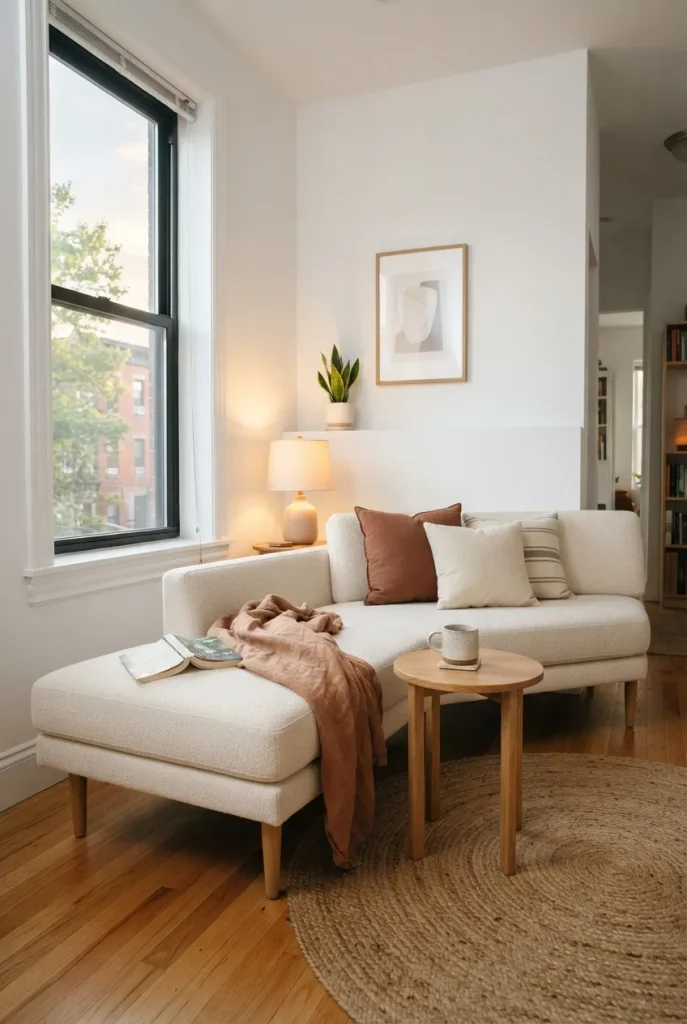
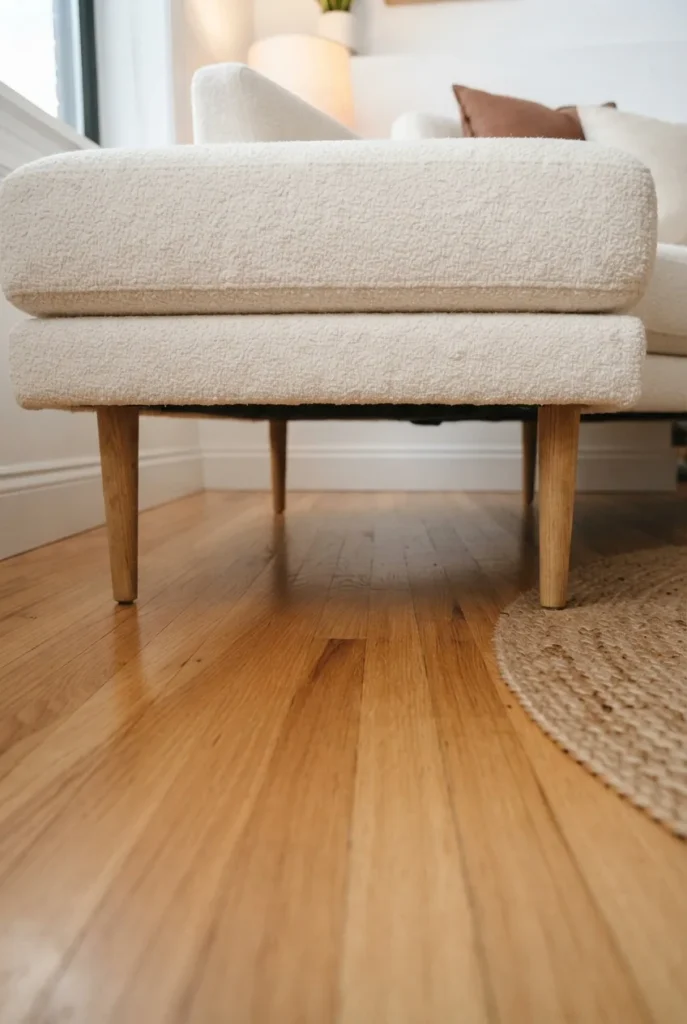
1. Put Every Big Piece Up on Visible Legs
Legs are the smallest change on this whole list, and they cost nothing at all if your furniture already has them and you never noticed.
A sofa that sits flat on the floor reads as one solid block. Raise that same sofa onto four slim legs and suddenly you can see floor running underneath it. Your eye follows that floor to the wall, decides the room continues back there, and reports the space as larger. Nothing moved. You just gave the light somewhere to travel.
Apply it to the heavy stuff first, because the heavy stuff is doing the damage.
One honest trade-off. Legs only work if the floor under them stays visible, which means no storage bins shoved underneath. Fill that gap and you have rebuilt the solid block you just got rid of.
2. Follow the One Third Floor Rule
Count your floor. Not your square footage, your visible floor, the part you can actually see standing in the doorway.
Our rule at Little Nook Home is simple, and it is the one thing we would keep if we had to throw out the other thirteen ideas on this list.
Keep about a third of your visible floor free of furniture footprints. Below a third, no amount of white paint or clever styling will make the room read bigger.
How to check it without a tape measure: stand in the doorway, take a photo on your phone, and look at the bottom half of the shot. If furniture covers nearly all of it, one piece has to leave. Usually it is the thing you kept because it was free.
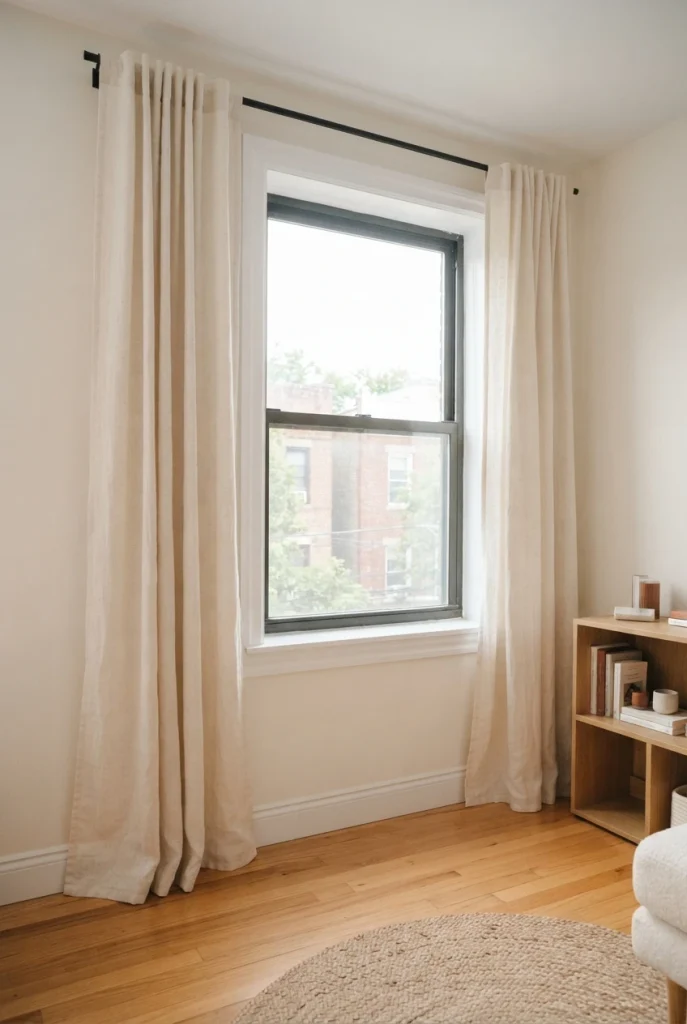
3. Hang Curtains Higher and Wider Than the Window
Curtain rods almost always go up too low and too narrow, screwed tight to the window frame, which tells everyone exactly how small the window is.
Move the rod and you fake height for the price of two brackets. The measurements designers use are consistent:
Set the rod 4 to 6 inches above the top of the window frame, or higher if your ceiling allows it.
Run it 8 to 12 inches past the frame on each side, so open panels stack on wall instead of on glass.
Buy panels long enough to just touch the floor. Short curtains read like high-water pants and cut the wall in half.
The payoff is the biggest in this article relative to effort. Two brackets, thirty minutes, and the window looks like it belongs in a taller room.
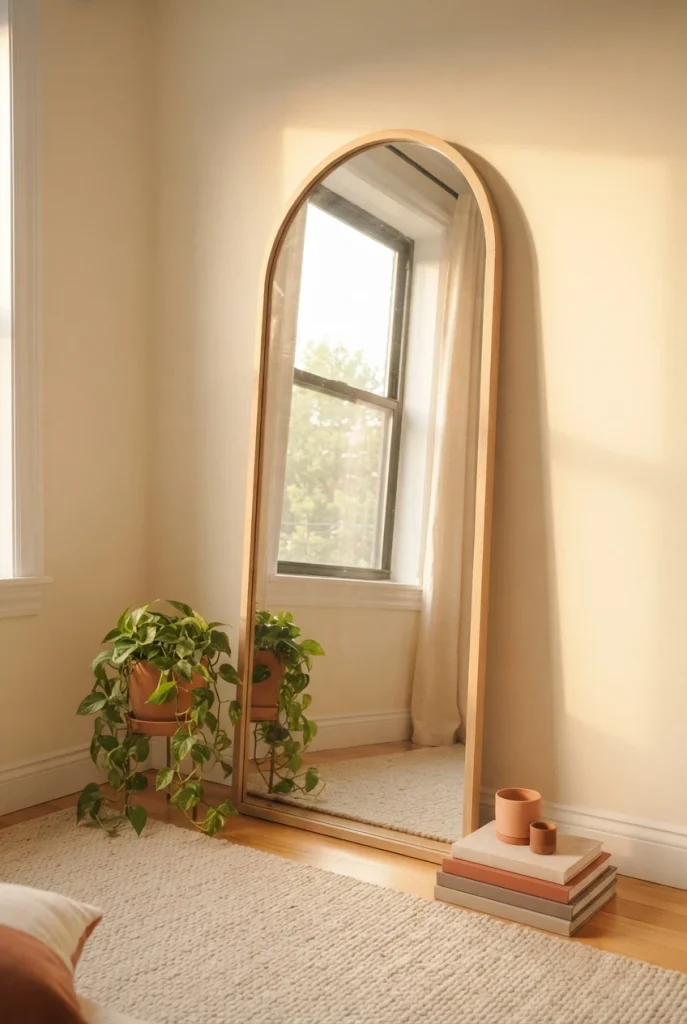
4. Place One Mirror by Math, Not by Feel
Most mirrors in small apartments are hung wherever there was a free nail, which is why most of them do nothing.
A mirror does one job. It doubles whatever is in front of it. Point it at a window and you double your daylight and your view. Point it at a blank wall and congratulations, you now have two blank walls.
| Mirror earns its wall | Mirror is wasted |
|---|---|
| Directly facing your only window | Facing an interior wall or a closed door |
| At the end of a narrow hallway or galley | Above a sofa back, reflecting the ceiling |
| Leaning full-length where two walls meet | Small and high, reflecting nothing but paint |
One large mirror beats a cluster of small ones every time, because a cluster reflects fragments and reads as wall decor rather than as depth. We went deeper on placement angles in our guide to mirror placement in a small reading corner, and the geometry is identical in a living room.
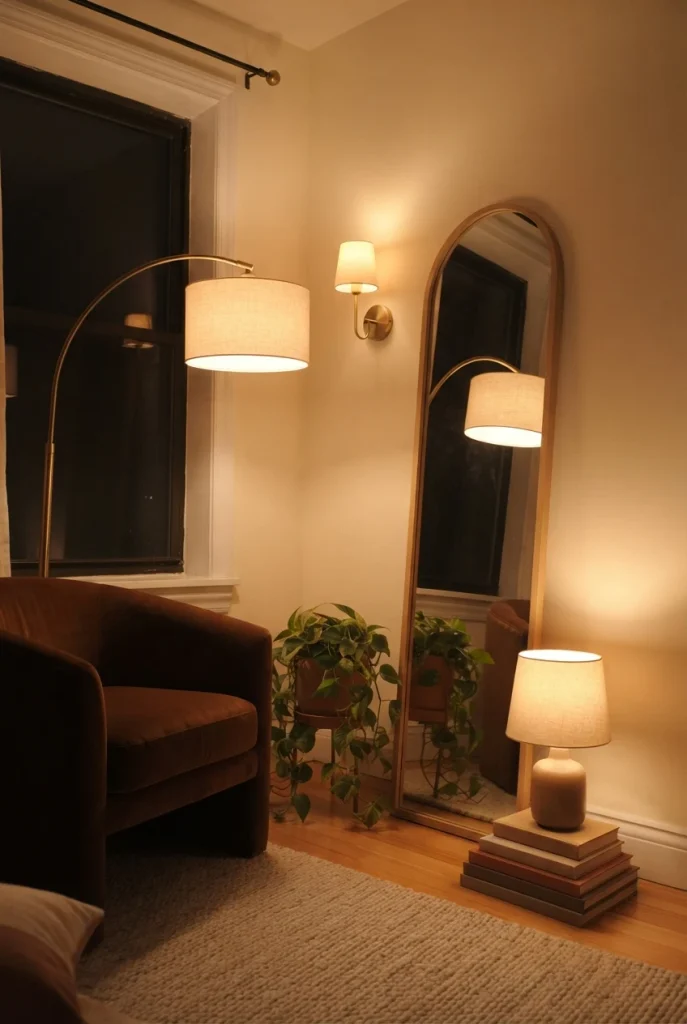
5. Match Every Bulb in the Room to One Color Temperature
Mixed bulbs are the reason your apartment looks patchy at night no matter how much you spend on lamps. One fixture glows amber, one runs blue-white, and your eye reads that as three separate small rooms instead of one continuous space.
Check the Kelvin number printed on every box you own and commit to a single one.
Switching to LED while you are at it costs you nothing in light quality. The Department of Energy reports that residential LED lighting uses at least 75% less energy and lasts up to 25 times longer than incandescent, which releases 90% of its energy as heat. In a small apartment that heat matters in August.
6. Size the Rug Up, Not Down
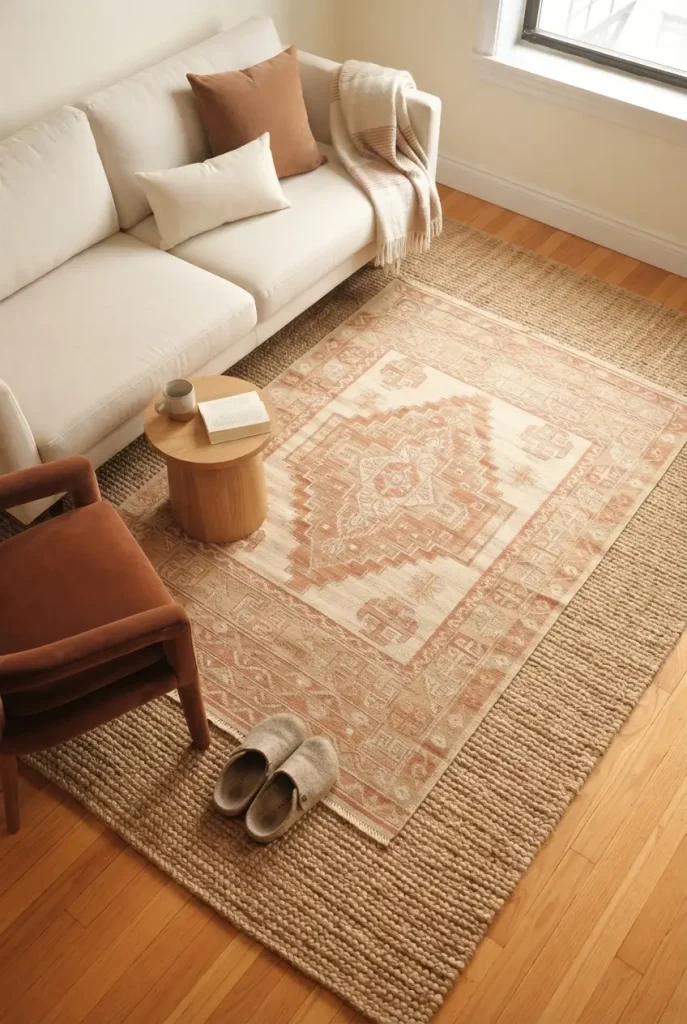
Small rugs shrink rooms. That sentence is doing a lot of work, so here is what it looks like in practice.
A 4 by 6 rug floating in the middle of the floor, furniture legs all sitting on bare boards around it. The rug becomes an island and the eye measures the room by that island.
A rug wide enough that at least the front legs of every seat sit on it, with 12 to 18 inches of bare floor left around the edges. One zone, read as one room.
For most small apartment living rooms that means stepping up to a 5 by 8 or an 8 by 10 rather than the 4 by 6 that felt proportional in the store. Layering a flatweave over a jute base gets you there for less if the size you need is out of budget.
The honest downside: a bigger rug is harder to clean and heavier to move on your own. Worth it anyway.
7. Keep One Diagonal View Wide Open
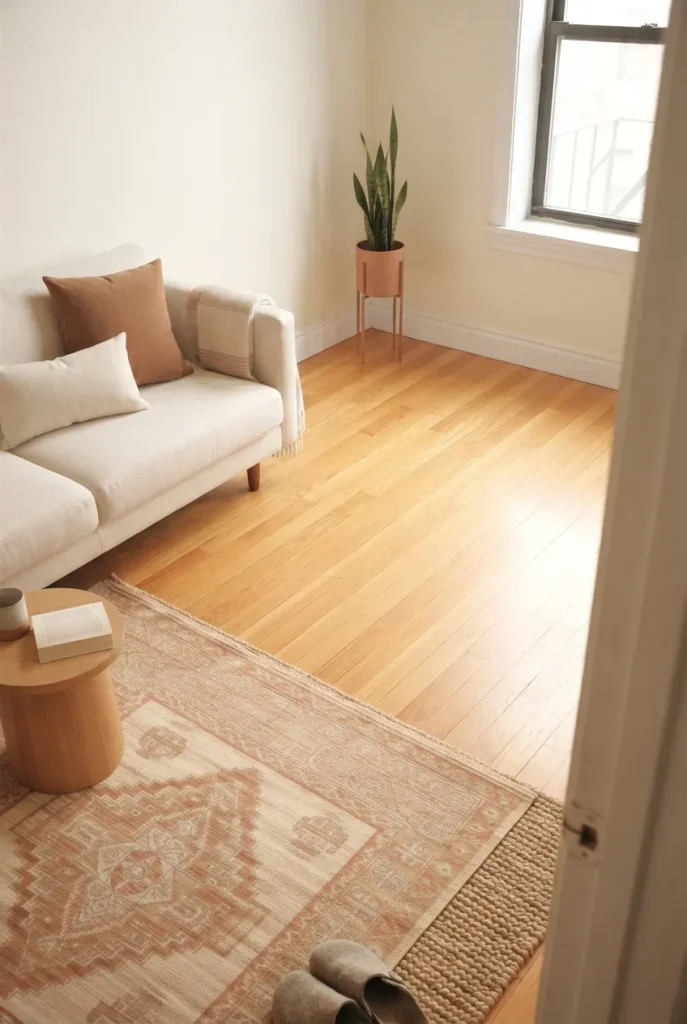
Stand in your doorway and look for the longest line of sight in the room. It is almost never straight ahead. It runs corner to corner, on the diagonal, and that line is what your brain uses to judge depth.
Protect it and the room grows. Block it with a tall shelf or a chair back and the room stops at the obstacle.
Clear the diagonal
This is the one idea on the list none of the big apartment roundups mention, and it is the one that costs nothing at all.
8. Float Your Surfaces Off the Floor Without Drilling
Nightstands, entry tables, and little shelves eat floor you do not have. Put them on the wall and you get the surface back without paying for it in square footage.
You do not need a drill for most of this. You need to know what the adhesive is actually rated for, which is printed on the pack and which almost nobody reads.
| Command strip tier | Rated for | Sensible use |
|---|---|---|
| Small | 5 lb | Framed prints, light mirrors |
| Medium | 10 lb | Small gallery frames, a wall planter |
| Large | 15 lb | A large framed piece, a light pinboard |
| X-Large | 20 lb | Oversize art, still not a shelf you load |
Adhesive strips are rated for hanging, not for weight that sits on top of a surface, so a genuine floating shelf still wants a bracket and a stud. Our full list of no damage upgrades for rental apartments sorts which jobs need hardware and which do not.
9. Anchor Anything Tall Before You Style It
Tall and narrow beats short and wide in a small apartment, every time. A 71 inch bookcase occupies the same floor as a 30 inch one and holds twice the books, and the vertical line pulls the eye up.
Going tall comes with one obligation, and it is not optional if a child or a pet lives with you. A loaded bookcase is heavy and top-weighted, and the federal safety rule for clothing storage units took effect on September 1, 2023 precisely because units tip. CPSC’s method is a wall bracket, a bracket on the furniture, a strap connecting the two, tightened, then a firm tug to test it. You need a stud finder, an anchoring kit, and about fifteen minutes. Renting does not exempt you; two small screw holes patch for pennies, and the CPSC Anchor It guidance walks through the install.
⚠️ Watch Out
Safety note: anchor tall furniture to the wall, keep candles and cords away from fabric, and use a licensed electrician or contractor for hardwired lighting, ceiling mounts, or anything structural.
Load the bottom third with the heaviest books. It lowers the center of gravity and it looks better anyway.
10. Swap Solid for See Through in the Middle of the Room
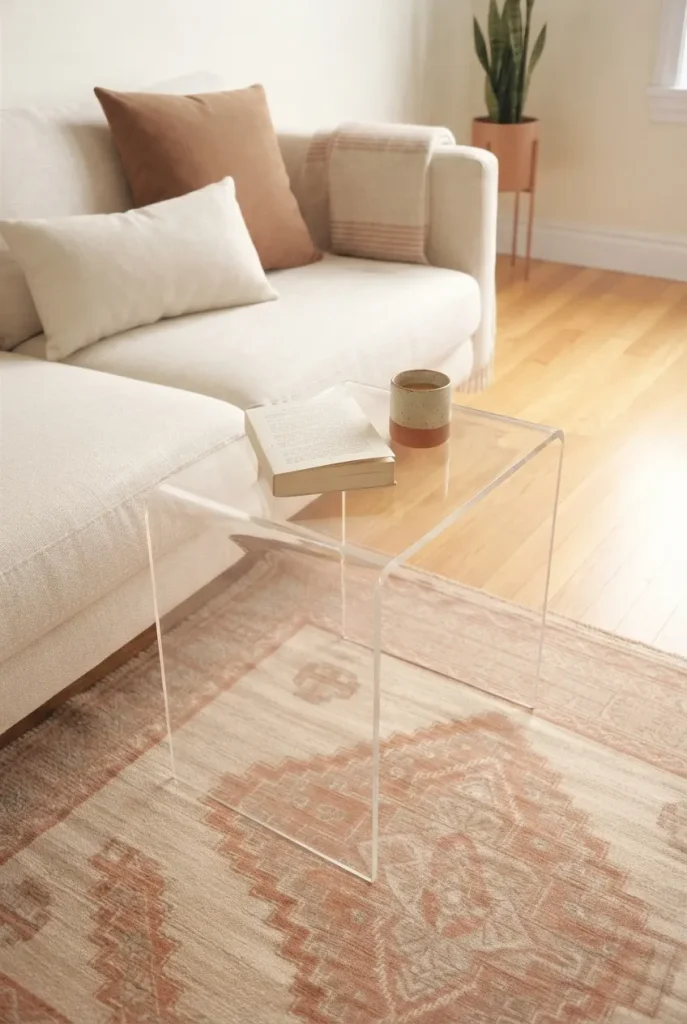
Acrylic, glass, and open cane all take up physical space without taking up visual space. Put them where you look most, which is the middle of the room, and keep the solid pieces pushed to the perimeter.
Acrylic C-table beside the sofa, where it disappears against the rug.
Glass-top coffee table so the rug pattern reads straight through.
Cane or spindle-back chairs instead of upholstered dining seats.
A solid wood trunk as your coffee table in a room under 12 feet wide.
Chunky upholstered ottomans parked in the main walkway.
Every single piece see-through, which reads cold and unfinished.
Keep it to two or three transparent pieces. Past that the room loses anything for the eye to rest on.
11. Give One Color Three Different Finishes
Monochrome gets a bad name because people hear it and picture a flat beige box. The version that works in modern apartment decor keeps the color steady and changes the texture, so the room stays calm but never dull.
- ▸Matte on the walls, so light lands softly and corners stay quiet.
- ▸Nubby and woven in the soft goods, boucle, wool, raw linen.
- ▸One low-sheen surface to catch the lamp, glazed ceramic or brushed brass.
- ▸Nothing high-gloss, which shows every fingerprint in a room you live in daily.
Fewer color changes means fewer visual stopping points, and fewer stopping points means the eye travels further before it lands. That is the whole mechanism.
12. Protect the Lane From Your Door to Your Window
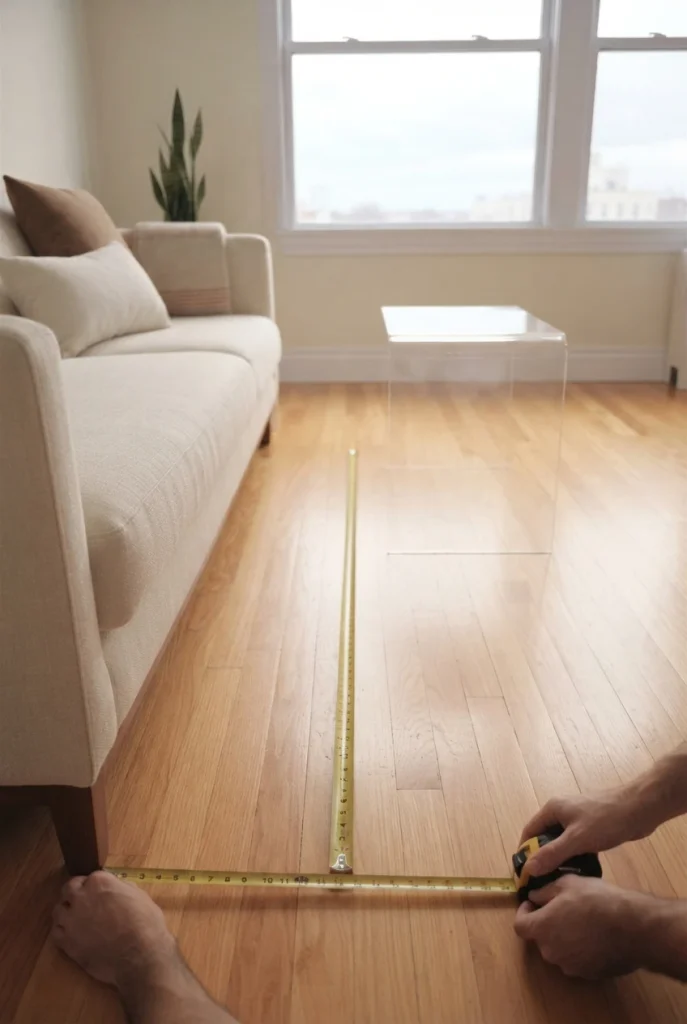
Walk it. Front door to window, or door to sofa, whichever path you take twenty times a day. If you turn your shoulders or step sideways at any point, the room is fighting you, and a room that makes you shuffle will always feel small no matter how it photographs.
These are the clearances furniture and layout guides keep landing on:
If you cannot hit 30 inches, take 26 and accept it, but never let the lane narrow more than once along its length. A single pinch point reads as a doorway. Two reads as a maze.
13. Let One Wall Fold Away
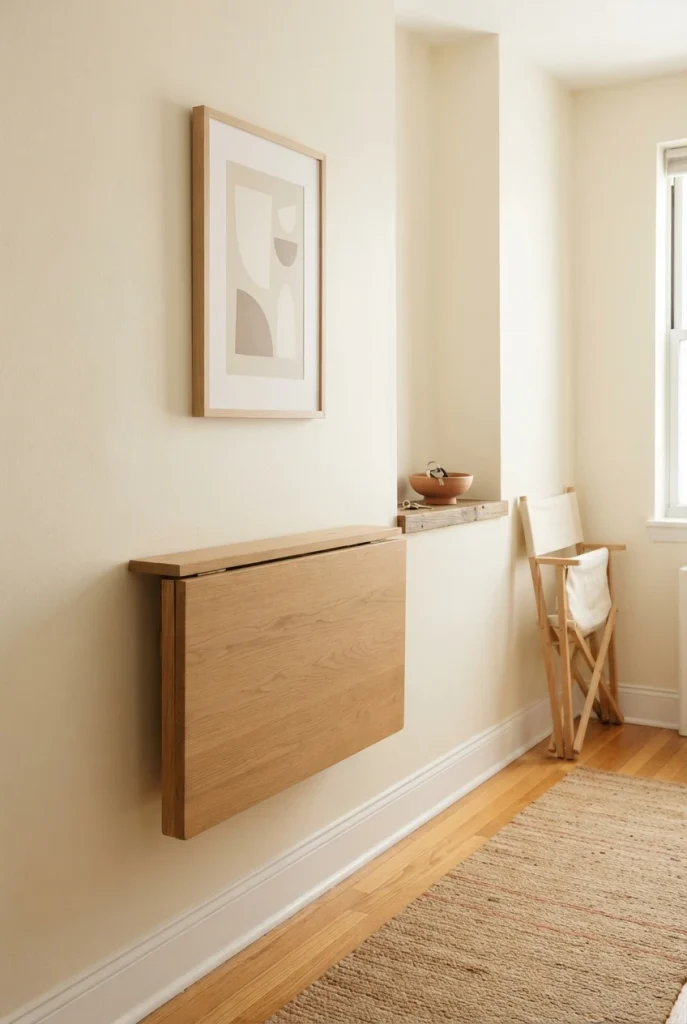
Drop leaf tables and wall-mounted folding desks earn their keep in a way almost nothing else does, because they are only furniture when you need them to be.
Recreate this setup
A folded table that stays folded for three months is a shelf, and you should be honest with yourself about which one you actually want. Our space saving furniture picks for a small apartment covers the double duty pieces that pull this off without looking like office equipment.
14. Leave One Corner Deliberately Empty
Empty corners feel wasteful, and that feeling is what ruins small rooms. You fill the last corner with a basket, a spare chair, a plant stand, and the room quietly closes in.
Pick the corner along the diagonal you cleared in idea seven. Leave the floor bare, or give it one slim floor lamp and nothing else. It will feel wrong for about a week, and then it will feel like the room finally has air in it.
Frequently Asked Questions
What colors make a small room look bigger?
Light, warm neutrals reflect the most light and hide shadows in corners, which is why cream, soft white, and pale clay read as roomy. The color matters less than the contrast between surfaces though. Keeping walls, trim, and curtains within a couple of shades of each other removes the visual lines that tell your eye where the room stops.
Should furniture touch the walls in a small apartment?
Not all of it. Pull your largest piece two to four inches off the wall and the gap reads as breathing room rather than as cramming. Keep tall storage flat against the wall for stability and anchoring, and keep the middle of the room as open as you can manage. Perimeter for the solid pieces, air in the center.
How do I decorate a rental without damaging the walls?
Lean mirrors and art instead of hanging them, use tension rods for curtains in window recesses, and check the weight rating on adhesive strips before trusting them. Peel and stick wallpaper handles one accent wall. For anything that carries load on top of it, like a real shelf, use hardware and patch the two holes on move-out.
How many light sources does a small living room need?
Three is the working minimum, at different heights: something overhead or tall, something at table height, and something low or wall-mounted. Put every one of them on the same color temperature. Three matched warm sources will make a room feel larger and calmer than one bright ceiling fixture ever will.
What size rug should I use in a small apartment living room?
Bigger than instinct says. Aim for a rug wide enough that at least the front legs of every seat rest on it, which usually means a 5 by 8 at minimum and often an 8 by 10. Leave roughly 12 to 18 inches of bare floor showing around the edges so the rug frames the zone instead of wallpapering the floor.
Does dark paint make a small room look smaller?
Not necessarily. A dark room with consistent finishes and good layered lighting can read as deep rather than tight, because the corners disappear instead of announcing themselves. What does shrink a room is high contrast: dark walls with bright white trim draws a hard box around the space. Commit fully or stay light.
How do I make an apartment look modern without buying new furniture?
Change the spacing before you change the pieces. Raise what you can onto legs, move the curtain rod higher and wider, size up the rug, match every bulb, and clear one diagonal. Five changes, no purchases beyond brackets and bulbs, and the room will read as intentional, which is most of what “modern” actually means.
Where to start this weekend
Pick three. Not fourteen. The curtain rod, the bulbs, and one corner cleared will do more for how your place feels than a shopping trip will, and you can finish all three before dinner on Saturday.
Small apartments do not need more stuff. They need better spacing, and spacing is free. Measure your walkway, take the doorway photo, and check your floor against the one third rule before you buy anything at all.
Save this to your apartment board so the numbers are there when you are standing in the aisle wondering which rug size to grab.
Keep reading
More cozy nook ideas
 Small Spaces
Read →
Small Spaces
Read →
10 Small Space Ideas for Tiny Apartments and Awkward Corners
No bay window. No landlord who answers texts. No drill. Those three facts kill most corner projects before they start, and they…
 Small Spaces
Read →
Small Spaces
Read →
Small Bathroom Storage Ideas for Renters Who Can’t Drill a Single Hole
Most small bathroom storage ideas quietly assume you own the walls. You don’t. So here’s the version that works when your only…
 Small Spaces
Read →
Small Spaces
Read →
Cottagecore Dorm Room Ideas That Work Around a Twin XL, a Roommate, and an RA
No drilling. No painting. Half a room, one Twin XL, and a wall in a color somebody else picked in 1997. A…