
Balcony Garden Ideas for a Cottagecore Retreat You Can Build in a Rental

No yard. No raised beds. No landlord who answers emails about drilling.
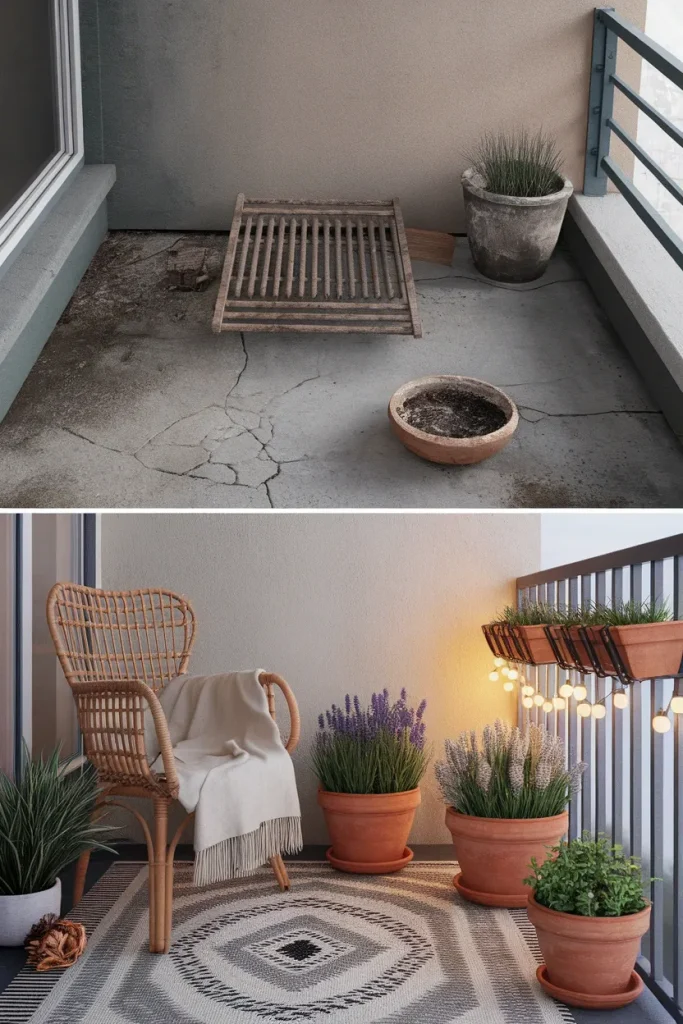
Most balcony garden ideas quietly assume you own the building. This one doesn’t. You’re working with a slab that’s maybe four feet deep, a metal rail you’re not allowed to touch, and a security deposit you’d like back in full.
Here’s the thing that actually changes your outcome: choose plants for wind before you choose them for looks, and keep your heaviest pots against the building wall instead of out at the rail. Almost nobody mentions that second part. It’s the difference between a cottage garden in pots and a pile of tipped terracotta after the first real gust.
Everything below is renter safe, tool light, and measured in inches.
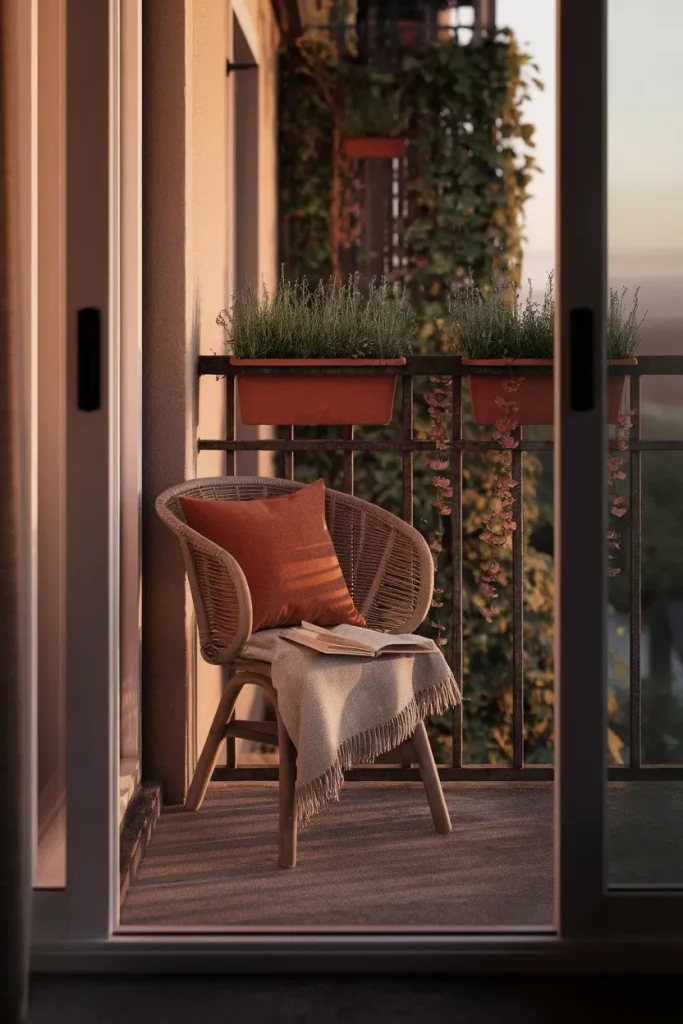
Start With the Zero Drill Build Order
Before a single plant, get the structure right. In order, because the order is what saves you a return trip:
1. Measure your railing first. This is the highest value ten seconds in this entire article. Over-rail planters are sold to fit a specific rail width, and every listing states its range. Put a tape across the top of your rail, save the number in your phone, and check it against every planter before you buy. Wrong number, wrong planter, and a rail planter that doesn’t seat properly is the one most likely to go over the edge.
2. Clamp, don’t anchor. Over-rail planters saddle the rail and tighten with a bracket or a screw clamp. No holes, no adhesive, no conversation with anyone.
3. Go vertical against the wall, freestanding. A narrow ladder shelf or a three-tier plant stand leaned against the building wall gives you three levels of planting and leaves your floor open. It carries its own weight, so nothing touches the structure.
4. Use the door frame, not the ceiling. A spring-loaded tension rod inside the sliding door recess holds lightweight hanging pots or an outdoor curtain. Tension rods are also how you hang almost anything else later.
5. Protect the floor before you finish. Pot feet and saucers under every container. Balcony floors stain where terracotta sits wet against concrete, and stains come out of deposits.
That entire list works in a rental with zero permanent changes, which is the same logic behind these cottagecore ideas for a rented room if you want the indoor version
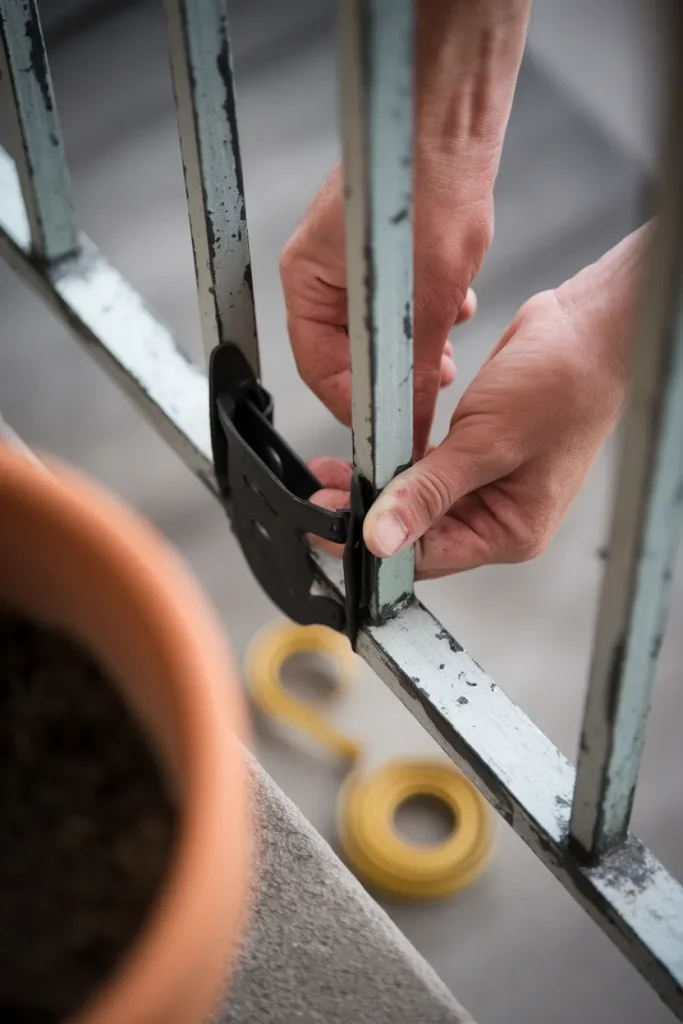
The Perimeter Rule: Heavy Pots Hug the Wall
Here’s a named rule worth stealing, and the reason it exists.
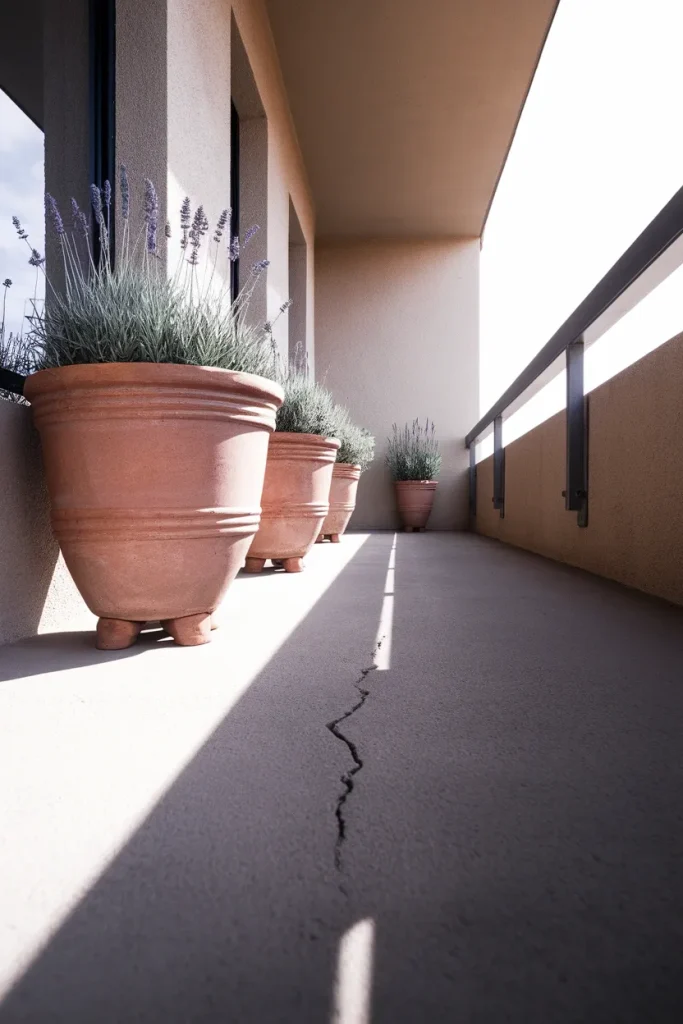
The Perimeter Rule. Heaviest containers go against the building wall. Lightest containers go at the rail. Everything else fills the middle.
Two facts sit behind it. First, weight adds up faster than people expect. University of Maryland Extension’s container size and weight guidance notes that a 20-inch container of moist mix and plants can weigh around 100 pounds. Three of those is roughly a person standing on your balcony permanently.
Second, balconies are engineered with real limits. IBC Table 1607.1, as adopted by state codes, requires balconies and decks to carry 1.5 times the live load of the area they serve, capped at 100 psf. For a typical residential space rated at 40 psf, that lands around 60 psf of design load. Your building’s actual adopted code may differ, so check locally or ask your management office rather than guessing.
Now the tension nobody resolves for you. Chicago Botanic Garden’s rooftop guidance says exposed containers need to be extra heavy or the wind takes them. Your structure says keep it light. Both are right, and the Perimeter Rule is how they coexist: mass sits over the supported edge near the wall, and the exposed rail carries only what’s small, low, and clamped down.
Skip this and the failure isn’t dramatic. It’s slow. Pots creep, one tips in a storm, and suddenly you’re the reason your building bans balcony planters.
Choose Plants for Wind First, Looks Second
A balcony is not a small garden. It’s a wind tunnel with a view.
Chicago Botanic Garden calls rooftops hostile environments and gives a selection rule that transfers perfectly: look for short habit, small leaves, sun and wind tolerance. Tall and broad-leaved gets shredded. Short and fine-leaved shrugs.
Plants their wind tolerant rooftop plant list actually names, all of which happen to read cottagecore:
- Lesser catmint (Calamintha nepeta). Clouds of tiny pale flowers, and when you brush past it going through the door it smells faintly of mint and pine. That’s a real reason to plant it by the threshold rather than the far corner.
- Harebell (Campanula rotundifolia). Nodding blue bells on wiry stems that move instead of snapping.
- ‘Firewitch’ dianthus (Dianthus gratianopolitanus). Blue-gray mats, hot pink flowers, built for exposure.
- Sedums (‘John Creech’, Sedum acre ‘Aureum’). Nearly unkillable, and they spill over pot edges the way cottage gardens want.
Now the honest part, because the pretty answer isn’t always the right one.
Cosmos and hollyhock are the most cottagecore flowers alive, and both are tall and top-heavy. On an exposed rail they’ll lean, then lodge, then flop. Grow them only if you have a sheltered wall corner. Sweet alyssum gets recommended everywhere for spilling over pot edges, but UW-Madison Horticulture is blunt about it: growth slows in heat and the plants look ragged through midsummer before reviving in fall. On a south or west facing balcony with concrete throwing heat back at them, that’s most of your season.
Sun matters as much as wind. University of Illinois Extension puts real numbers on the labels: full sun is 6 to 8 hours of direct light, part sun is 4 to 6, part shade is 2 to 4, and full shade is under 2. Stand on your balcony at 9am, 1pm, and 5pm on the same day and write down which hours are actually sunny. Most people guess a full tier too high.
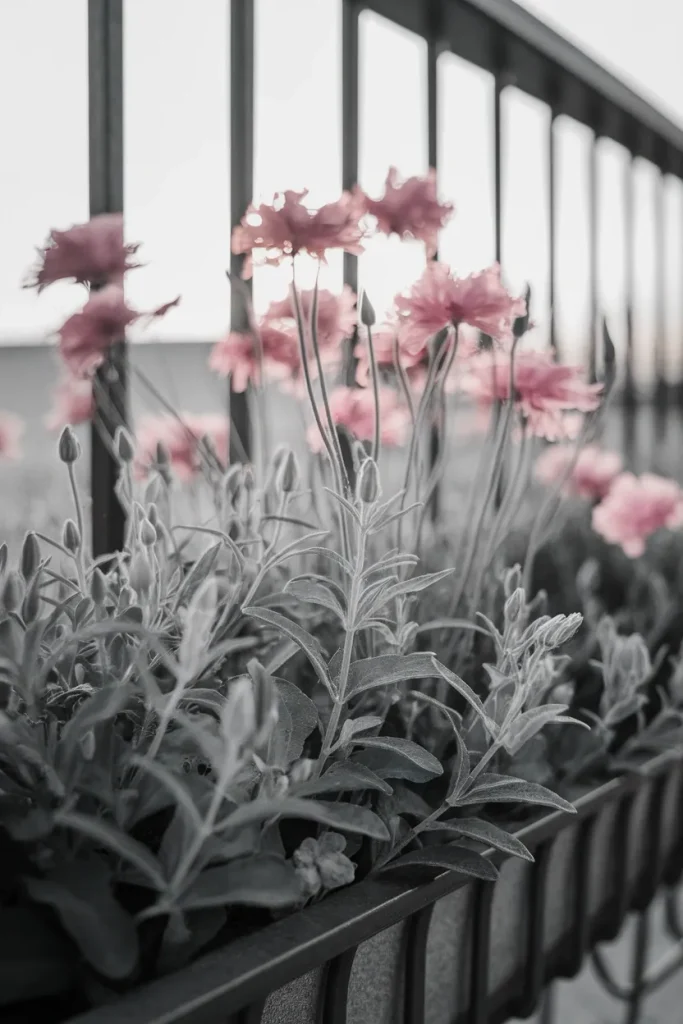
The Cottage Garden in Pots Formula
Cottage gardens look effortless and are actually a structure: something tall, something mounding, something spilling. On a balcony you run that formula three times in three pots instead of once across a border.
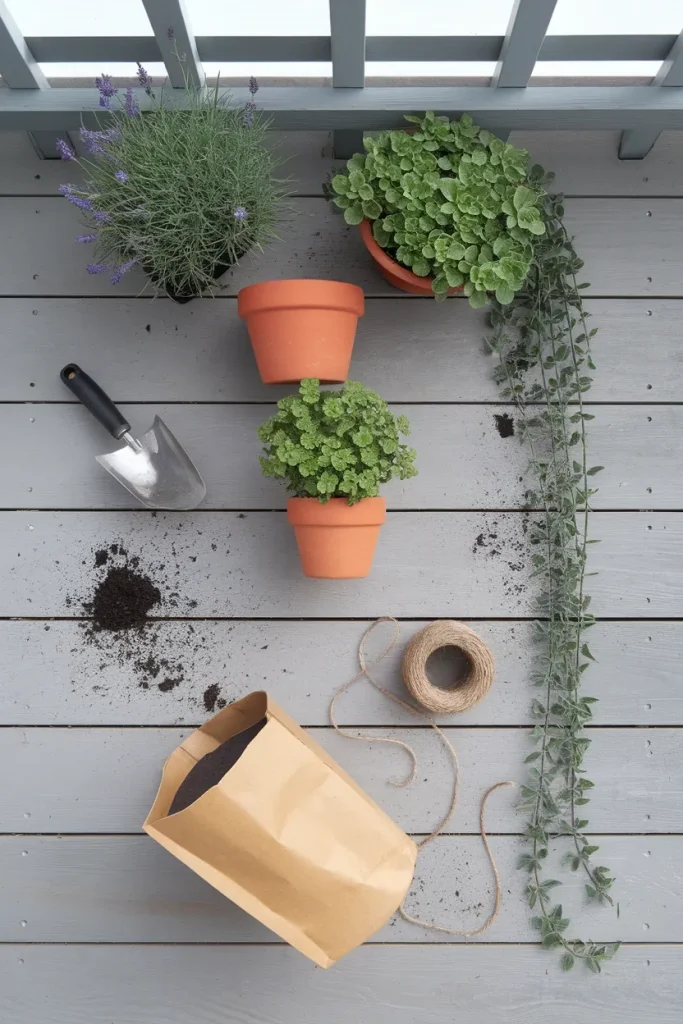
Pot A, the wall anchor. Your biggest, heaviest container, against the building. Lavender or a compact shrub in the center, dianthus mounding around it, sedum spilling over the front lip.
Pot B, the middle layer. A mid-size pot on a plant stand at knee to hip height. Catmint does the heavy lifting here, and it flowers for months.
Pot C, the rail line. Clamped, shallow, low. Herbs, harebell, trailing sedum. Nothing tall enough to catch wind like a sail.
Then get the sizes right, because undersized pots are the most common reason a balcony garden dies in July. These are the published extension minimums, not rules of thumb:
| What you’re growing | Minimum container | Minimum depth | Source |
|---|---|---|---|
| Any plant, absolute floor | 6 to 8 in deep | 6 to 8 in | Clemson HGIC |
| Leaf lettuce | 1/2 gallon | 6 to 8 in | UMD Extension, NC State |
| Small herbs | 4 to 6 in diameter pot | 6 in | NC State Extension |
| Large or taprooted herbs | 2 to 5 gallon | 12 in | UMD Extension, NC State |
| Cherry tomato | 2 gallon | 12 to 24 in | UMD Extension, NC State |
| Strawberries | 12 in diameter round | 8 in | UW-Madison, NC State |
| Pepper | 2 gallon | 12 to 16 in | NC State Extension |
Worth knowing: extension sources genuinely disagree on herbs, from a 4-inch pot up to a 5-gallon container, because “herb” covers everything from thyme to a taprooted lovage. Size for the specific plant, and when unsure go one size up. Nobody has ever lost a plant to too much root room.
If you want anything to survive winter in a pot, Illinois Extension gives the trick: pick plants rated for two zones colder than yours, because potting mix freezes far harder than ground soil. Check yours against the current USDA hardiness zone map, updated in 2023 on 1991 to 2020 temperature data, which replaced the older 2012 version.
Build the Seat Before You Buy More Plants
Plants make a balcony pretty. A seat makes it a place you actually go.
This is where most balcony builds stall, because it’s tempting to spend the whole budget on greenery and then discover there’s nowhere to sit and read. Reverse it. Put the chair in first, live with it for a week, and let the pots fill in around where your feet naturally land.
For a slab four feet deep or less, a folding bistro chair beats an armchair every time, because you can fold it flat when you need floor space. Add a floor cushion or a weather resistant pouf for a second seat that stores indoors. One washable outdoor rug covers ugly concrete without adhesive and instantly reads as a room rather than a ledge.
Keep a side surface within arm’s reach of the seat, roughly 18 inches, and make it big enough for a mug and a paperback. A 12-inch round stool works. So does an upturned crate.
Then the soft layer, which is what separates a balcony from a fire escape: a linen throw for shoulders, one lumbar pillow at the small of your back, and something with texture you’ll want to touch. Bring the textiles in when it rains, or buy outdoor-rated fabric and stop thinking about it.
If your balcony is one of several outdoor spots you’re weighing up, these outdoor reading nook setups cover benches, sheds, and shaded corners with the same measured approach.

Water Like a Balcony, Not Like a Yard
Container plants on a balcony dry out at a speed that shocks people coming from a yard.
Three forces stack up. Containers hold limited soil, so there’s no reservoir. Hard surfaces around them, brick, concrete, decking, metal railings, reflect and re-radiate solar heat back at the pots, which University of Maryland Extension names directly as a cause of heat stress. And dark containers absorb more of it, drying the mix faster still, per NC State Extension.
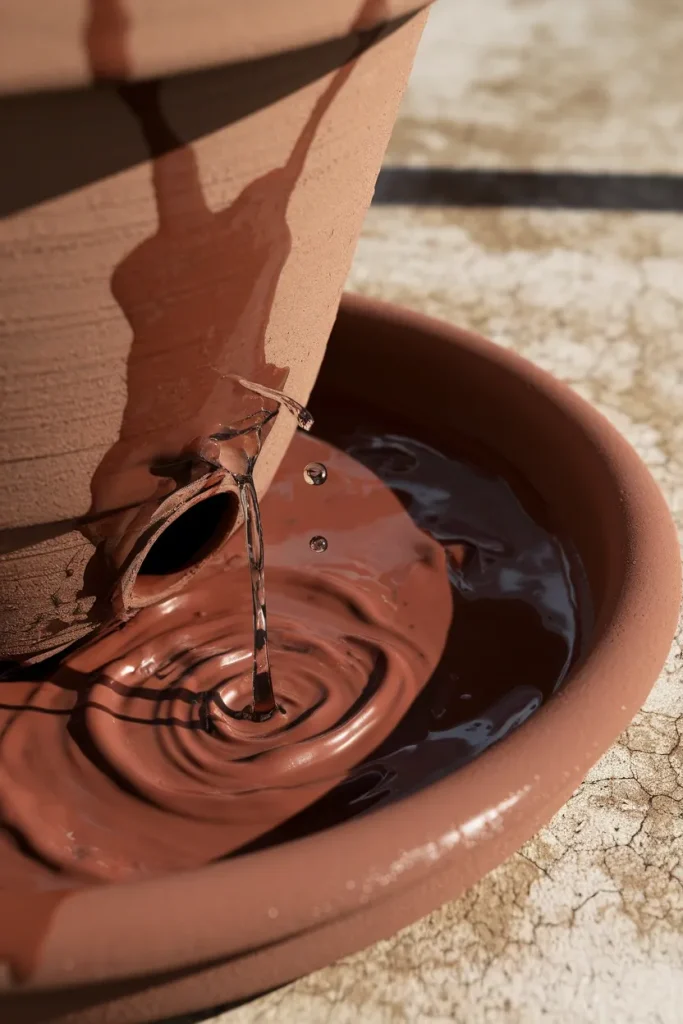
So the schedule is not weekly. Clemson’s container watering and drainage guidance says daily or even twice-daily watering may be necessary, and gives the rule that matters most: apply water until it runs out the drainage holes. Anything less and you’re wetting the top inch while the roots stay dry.
Which means every single container needs drainage holes. Not a decorative pot with a saucer of standing water in the bottom. Actual holes. Roots sitting in water rot, and rot looks exactly like underwatering, which is how people kill a plant by watering it more.
Two things that buy you slack: pick light-colored pots over dark ones on a hot exposure, and group containers together so they shade each other’s sides. Clustering also looks more like a cottage garden than pots spaced evenly like soldiers.
The Evening Layer: Wet Rated vs Damp Rated
Almost every balcony garden article stops at plants. That’s why so many balconies get used for about forty minutes a day.
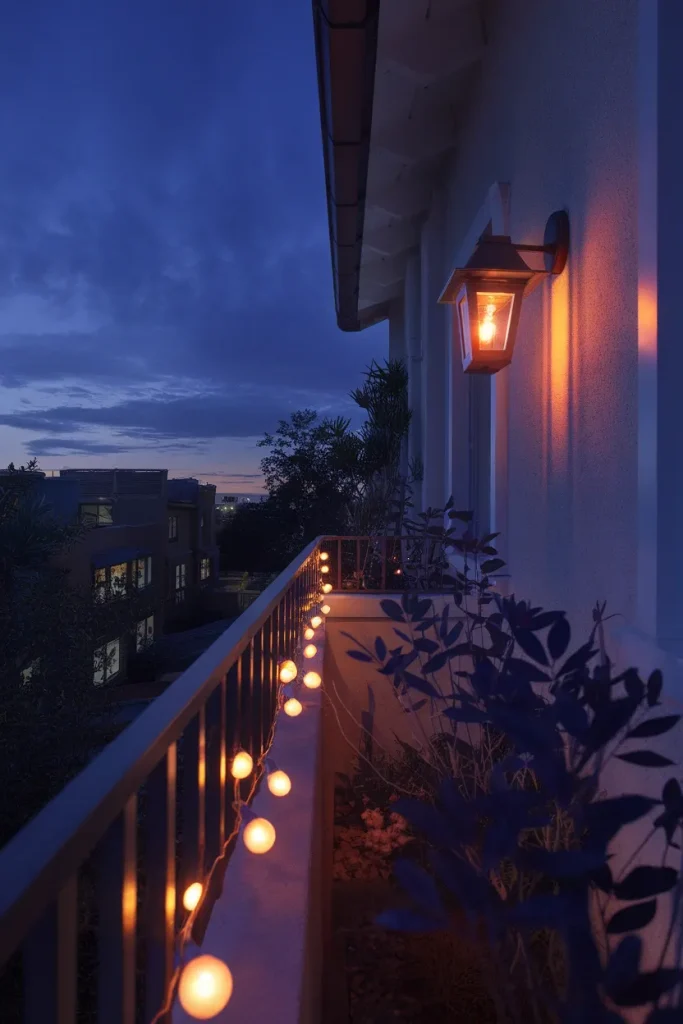
Light is what extends it, and there’s one specification that decides whether your fixture survives the season. UL Solutions draws the line clearly. A damp location is partially protected and subject to condensation. A wet location is one where water may drip, splash, or flow directly onto the fixture. Only a luminaire marked “Suitable for Wet Locations” belongs somewhere rain reaches it, and a wet-rated fixture can go anywhere a damp-rated one can, but never the reverse.
Translated to your balcony: uncovered rail or open floor needs wet rated. Fully roofed balcony with a solid floor above you can take damp rated. Marked for neither means indoor only, and indoor string lights on an open balcony is how you get a dead strand by October and a genuine hazard before that.
Color temperature does the rest of the work. The US Department of Energy puts the warm range at 2700K to 3000K, which is the candlelit end. Anything at 4000K and up reads like a parking garage and will undo every other choice you’ve made out there.
Three layers is plenty: a wet-rated string along the rail or overhead, one plug-in path or wall light, and a clip-on reading light on the chair for when you’re actually reading. Skip hardwiring entirely as a renter. Plug-in and battery only.
For the indoor version of the same glow, these soft glow fairy light layouts cover the no-drill hanging methods and the color temperature cheat sheet in more detail.
Privacy Without Drilling a Single Hole
Privacy is the sleeper request in this whole topic. People search for balcony plants and what they actually want is to not be watched while they read.
Four methods, none of them permanent:
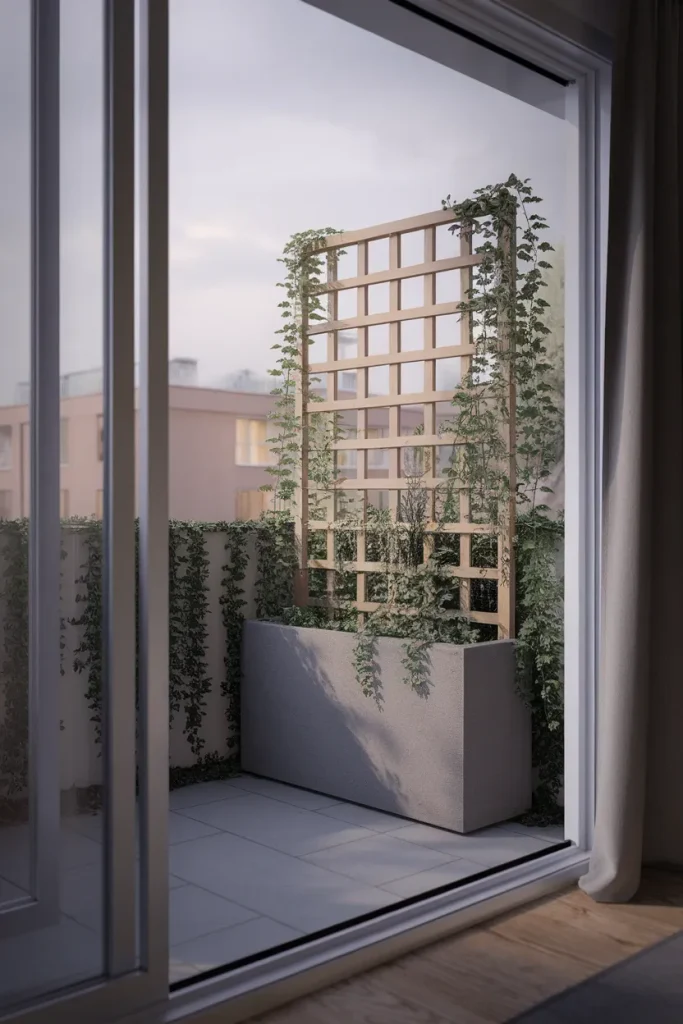
- Weighted trellis panels. A freestanding trellis with its feet buried in a heavy planter is self-supporting and screens at eye level. Plant a climber at the base and it fills in over a season.
- Tall grasses in heavy pots. Faster than a climber, moves in the wind instead of fighting it, and reads soft rather than defensive.
- Outdoor curtains on tension rods. Best on a balcony with side walls. Draw them when you want the corner closed and push them back the rest of the time.
- Reed or bamboo roll fastened to the railing. Cheap and instant. Check your lease and your building’s rules first, because plenty of buildings restrict what can be attached to a railing, and some restrict it on fire grounds.
On that note, one safety line that belongs in every balcony article and appears in almost none. International Fire Code 308.1.4, adopted widely across US jurisdictions, prohibits charcoal burners and other open-flame cooking devices on combustible balconies or within 10 feet of combustible construction, with narrow exceptions for sprinklered buildings, one and two family dwellings, and small LP-gas containers under 2.5 pounds. The US Fire Administration puts it more simply: don’t store or use a grill on a balcony. Keep your egress path clear too. A screened corner is lovely right up until it’s the thing between you and the door.
A Real Weekend Build Order
Sequence beats shopping. Do it in this order and nothing gets bought twice.
Saturday morning. Measure. Rail width, floor depth, floor width, and the door swing. Track your sun hours across the day and write them down. Buy nothing yet.
Saturday afternoon. Structure only. Rug down, chair in, plant stand or ladder shelf against the wall, rail planters clamped and checked for movement. Sit in the chair for ten minutes. Move things. Sit again.
Sunday morning. Soil and plants. Fill Pot A at the wall first since it’s heaviest and hardest to move once it’s full. Then B, then the rail line. Water everything until it runs out the bottom.
Sunday evening. Lights and textiles. String, plug-in light, throw, pillow. Sit out there after dark, because that’s the test of whether the light temperature is right.
On budget, an honest note rather than a made-up total. A three-pot cottage setup with a folding chair, a rug, and lights sits in the low-to-mid hundreds at US big-box garden centers, and it swings widely on whether you buy terracotta or resin, and whether the chair is new or thrifted. Prices move every season, so price your own list before committing. Two real ways to cut it: buy plants in 4-inch nursery pots rather than gallon sizes and let them fill in, and thrift the chair and side table, which are the two things nobody can tell are secondhand once a throw is on them.
Balcony Garden Ideas FAQs
How do I start a small balcony garden? Measure before you buy anything: rail width, floor depth, and your actual sun hours at 9am, 1pm, and 5pm. Then set structure before greenery, meaning rug, chair, and plant stand first. Plant your heaviest pot against the building wall and work outward toward the rail.
What plants grow well on a balcony? Short plants with small leaves that tolerate sun and wind. Chicago Botanic Garden specifically names lesser catmint, harebell, ‘Firewitch’ dianthus, and sedums for exposed sites. Lavender does well in containers with a lean, well-drained mix. Avoid tall top-heavy flowers like hollyhock and cosmos unless you have a sheltered corner.
How do you water a balcony garden? Far more often than a yard. Clemson HGIC says daily or even twice-daily watering may be necessary for containers, and to apply water until it runs out the drainage holes. Every pot needs real drainage holes, and grouping pots together slows how fast they dry.
How much weight can a balcony hold? IBC Table 1607.1 requires balconies and decks to be designed for 1.5 times the live load of the area served, capped at 100 psf, which for a typical 40 psf residential space works out around 60 psf. Local codes vary, so confirm with your building. For scale, University of Maryland Extension notes a 20-inch container of moist mix and plants can weigh about 100 pounds.
What containers are best for a balcony garden? Light-colored and lightweight for the rail, heavier for the wall. Six to eight inches deep is the absolute minimum for anything, per Clemson. Light colors stay cooler than dark ones, and dark pots dry out faster in sun. Every container needs drainage holes and a saucer or pot feet to protect the floor.
How do you make a small balcony private? Weighted freestanding trellis panels, tall grasses in heavy pots, outdoor curtains on tension rods, or a reed roll fastened to the railing. All four are removable. Check your lease and building rules before attaching anything to a railing.
How do you arrange a small balcony? Heaviest pots against the building wall, seating next to them, lightest planters clamped at the rail, and the middle kept clear enough to walk through. Keep a side surface within about 18 inches of the chair, and never let plants or screening block the path back to the door.
Your Next Step
Go measure your railing. That single number decides which planters are even an option, and it takes less time than reading this paragraph did.
Then pick one thing to buy this week. Not five. If your balcony gets full sun, make it the catmint, because it flowers for months and asks for almost nothing. If it’s shaded, start with the chair and the rug, and let the seating prove the space is worth planting before you spend on greenery.
The corner you’ll actually use is the one that exists by Sunday night, not the one that stays on a board.
Once it’s built, the natural next read on this site is the guide to outdoor reading nooks, which covers what to do when you graduate from a balcony to a bench, a shed, or a shaded garden corner.
Keep reading
More cozy nook ideas
 Cottage Garden & Balcony
Read →
Cottage Garden & Balcony
Read →
20 Backyard Oasis Ideas on a Budget, Starting With a $152 Corner
Two folding chairs, a small outdoor rug, 24 battery globe lights, and two planters. At IKEA this October, that adds up to…
 Reading Sheds
Read →
Reading Sheds
Read →
12 She Shed Ideas for Small Yards
No acre, no contractor, no giant budget. You need about 64 square feet, a flat patch of ground, and a plan for…
 Garden Nooks
Read →
Garden Nooks
Read →
Container Gardening Ideas for Small Cottage Gardens That Fit a Rental Patio
One anchor pot, two mid-size pots, three little ones. That’s the whole cottage garden, and it fits on a patio smaller than…
One Comment