
Attic Reading Nook Ideas: 10 Dreamy Slanted Ceiling Setups
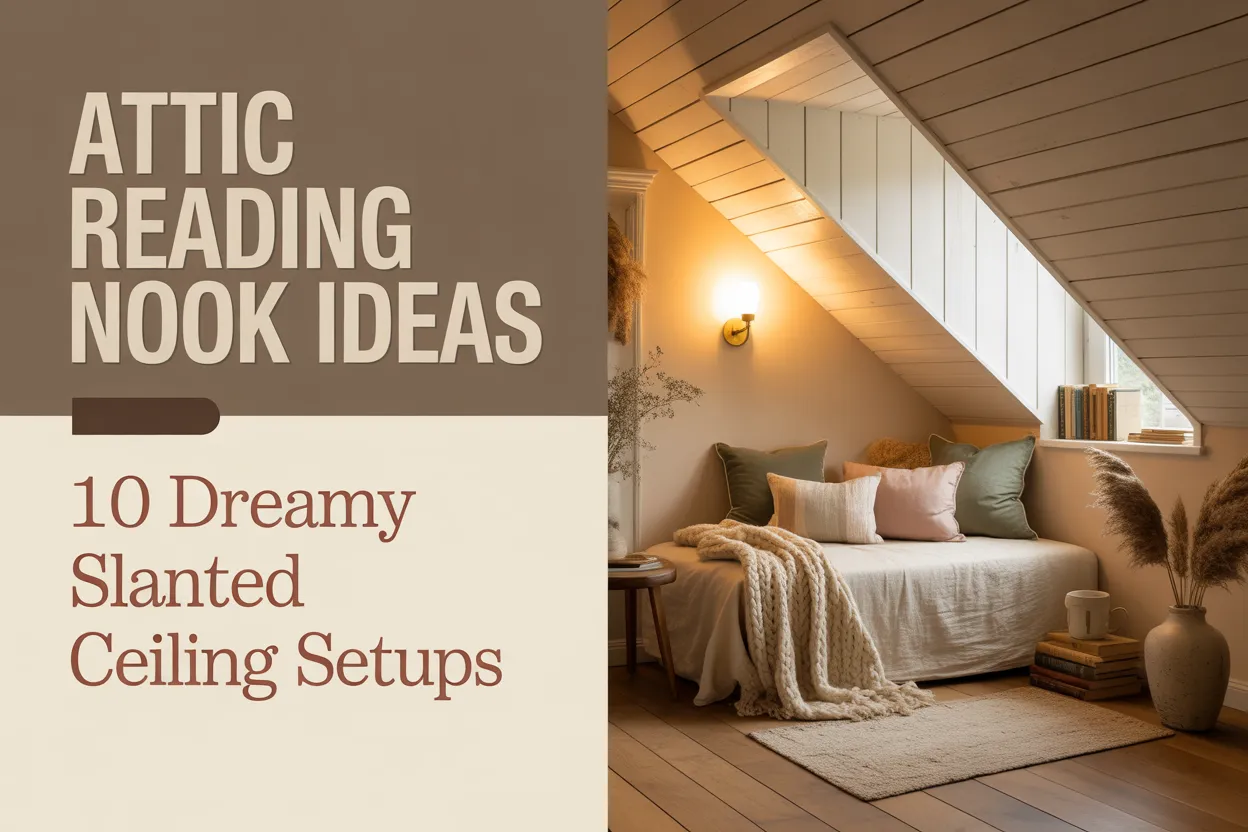
Quick answer: the best attic reading nook works with the slope instead of fighting it. Put low-profile seating (a daybed, chaise, floor cushion or short-backed chair) where you can lean back without hitting the ceiling, and measure from the floor to the lowest point you will sit under before you buy anything. Light it with at least two warm 2700K sources, one over your shoulder (swing-arm wall sconces suit sloped ceilings best), and check insulation, ventilation and flooring first. A floor cushion and fairy lights setup can cost under $100; a built-in knee wall bench runs from a few hundred dollars to the low thousands. The ten ideas below show each approach.
There is something about an attic that already feels like a secret. You climb the last set of stairs, the air gets a little warmer, the ceiling dips in that funny way old houses love, and suddenly you are somewhere the rest of the house cannot quite reach. I think that is why attic reading nooks have this quiet magic to them. They are not a corner of a room. They are their own little world.
If you have been scrolling Pinterest late at night saving pin after pin of sloped ceilings and fairy lights, this one is for you. I pulled together ten attic reading nook ideas that actually work with slanted ceilings instead of fighting them, because the awkward angles are honestly the best part. Grab a cup of tea. Let us turn those dusty eaves into your favorite spot in the house.
Related read: Reading Nook Under Eaves: 9 Smart Setups for Low Ceilings
What you need for this nook: low seating and light that does not need a ceiling fixture. A 22-inch round floor cushion or two fits under the slope where a chair will not, a plug-in swing-arm wall sconce puts reading light on the page from the knee wall, battery fairy lights run along the rafters with no cords, and for the kids’ fort a pop-up play tent tucks into the lowest corner.
This post contains affiliate links. If you buy through them, Little Nook Home may earn a small commission at no extra cost to you. As an Amazon Associate, we earn from qualifying purchases.
Updated 11 November 2026 with the headroom and knee-wall measurements table.
Why an Attic Reading Nook Just Hits Different
Before we get into the setups, let us talk about why the attic is secretly the best place in your home to read. The sloped ceiling creates an instant sense of enclosure, which is exactly what your nervous system wants when you are trying to disappear into a book. The height forces the space to feel intimate whether you want it to or not. Add in the muffled sound from being above the rest of the house, a little natural light from a dormer or skylight, and you have conditions that no open plan living room can compete with.
And because attics are often underused, you rarely have to fight anyone for the space. No one is going to come set up a laptop on your reading chair when your reading chair lives under the eaves. That alone is reason enough. Still choosing the seat itself? Start with our guide to the reading nook chair guide.
If you want to go deeper on what makes any reading corner actually comfortable, my reading nook decor ideas guide breaks down the styling rules I use in every single setup below.
1. The Cottagecore Dormer Window Seat
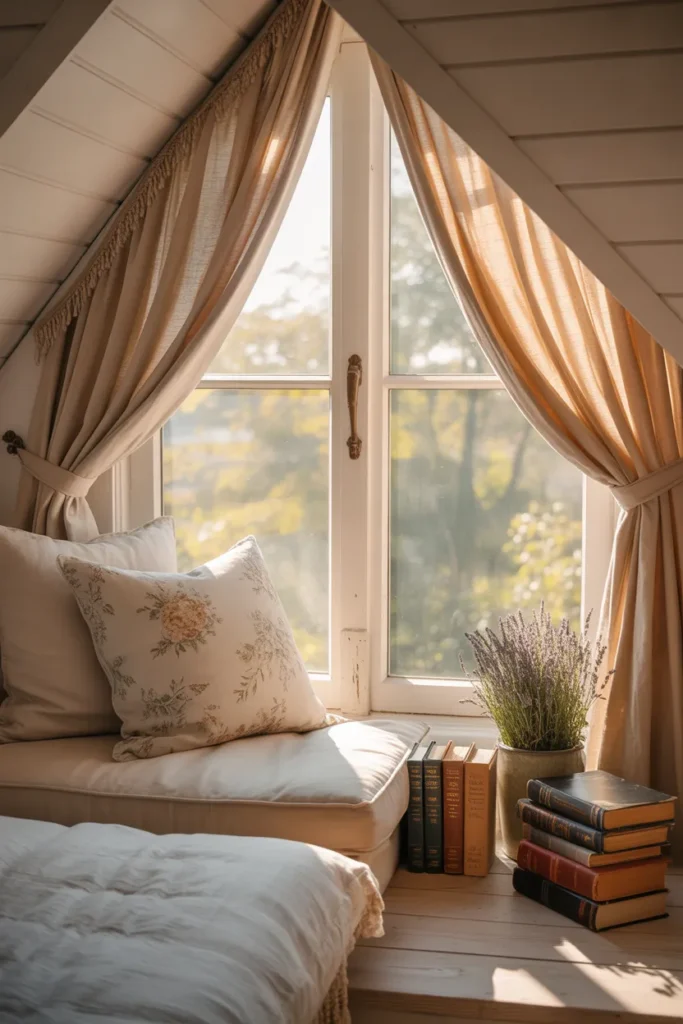
A dormer window is basically a love letter from your house to your reading life. That little bump out of wall space under the slanted roof is already the shape of a built in bench, so all you really need is a custom cushion, a pile of pillows in linen and floral prints, and a small stack of poetry books on the sill. Paint the interior of the dormer a soft cream or pale sage and hang gauzy curtains you can pull shut when the afternoon sun gets too bright.
This one is pure cottagecore, and it photographs beautifully because the window frames the composition for you. If your dormer is deep enough, a twin mattress turned into a daybed works even better than a bench.
2. Dark Academia Attic Library Under the Eaves
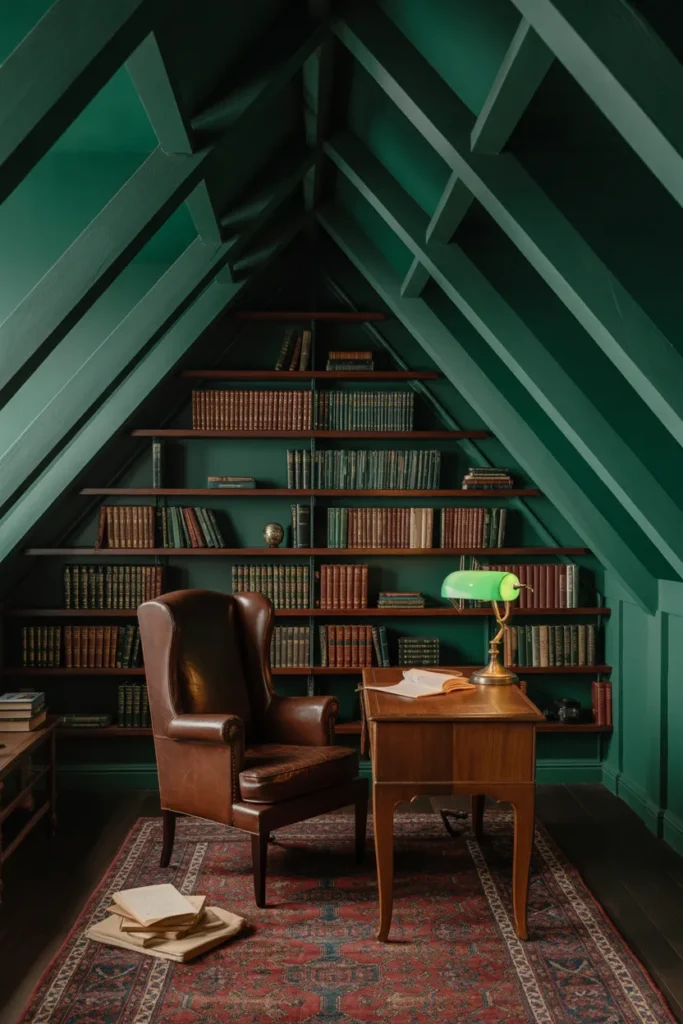
For the moody reader. Think deep forest green or inky navy walls, floor to slanted ceiling bookshelves built right into the low side of the room where you cannot stand up anyway, a vintage leather wingback chair, and a brass library lamp on a small writing desk. The genius move here is using the low eaves for your shelves, because books do not care how tall the ceiling is. You basically double your usable wall space.
Add a small oriental rug, a bust of someone mildly pretentious, and a green banker’s lamp and you have the attic of a literature professor who keeps interesting secrets.
3. Skylight Daybed Nook for Slow Sunday Mornings
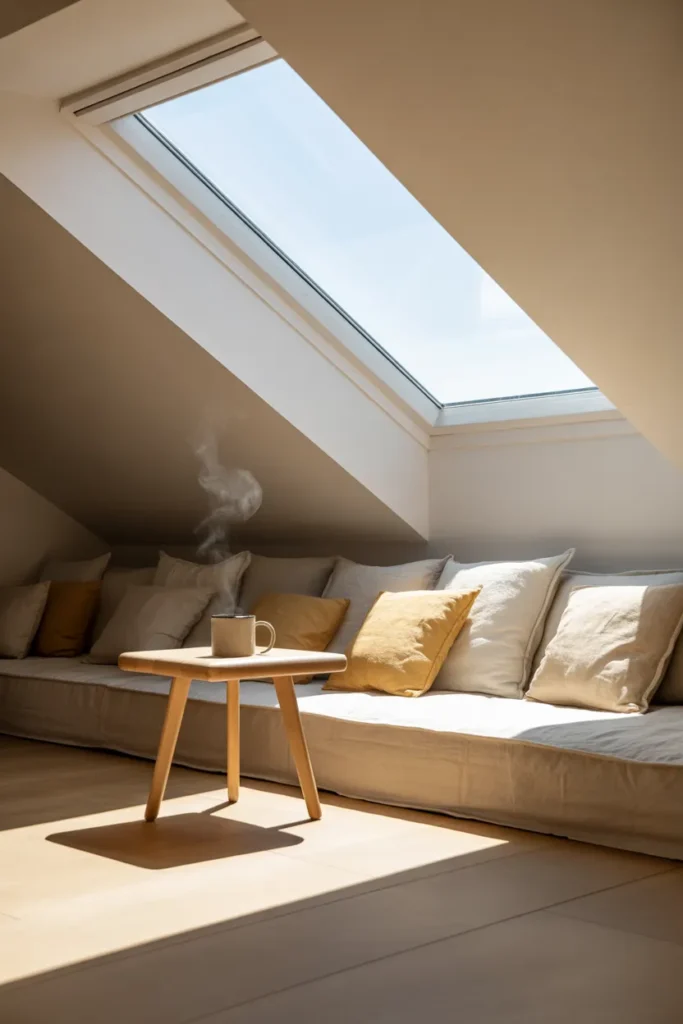
If your attic has a skylight, build the whole nook around it. Position a low daybed or a generous floor mattress directly under the opening so the light lands on the page while you read. Keep the palette soft and neutral, think oatmeal linen, bone white, pale wood, because the sky itself becomes the ceiling decor and you do not want to compete with it.
Pairing a skylight reading corner with a low chaise or a pile of oversized floor cushions lets the changing sky act as a living ceiling that shifts the mood of the room throughout the day. On rainy afternoons it is honestly the best seat in the house.
4. Boho Floor Cushion Hideaway
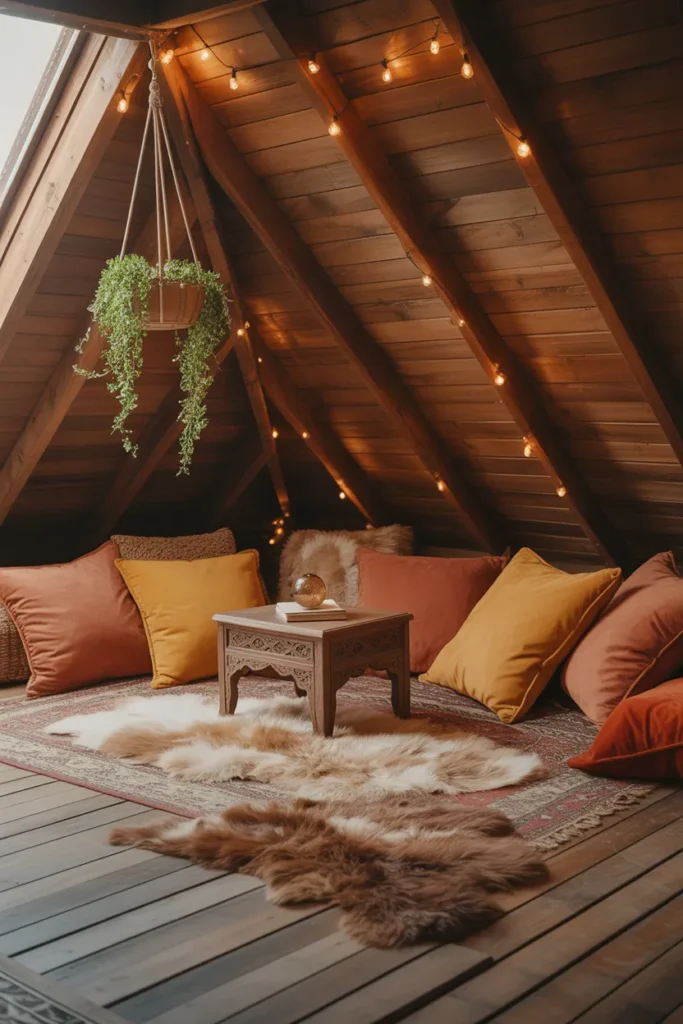
Not every nook needs a chair. Sometimes the lowest part of the attic, where even sitting up straight is questionable, becomes the best possible reading pit if you just commit to it. Layer a thick sheepskin rug over a woven jute base, pile on oversized floor cushions in mustard, rust and terracotta, and string up warm fairy lights along the rafters. Add a low Moroccan style side table for tea and a hanging macrame plant holder.
This is the setup your teenager will beg to steal. It is also brilliantly cheap because you are basically skipping the furniture.
5. Scandi Minimalist Nook with Pale Wood
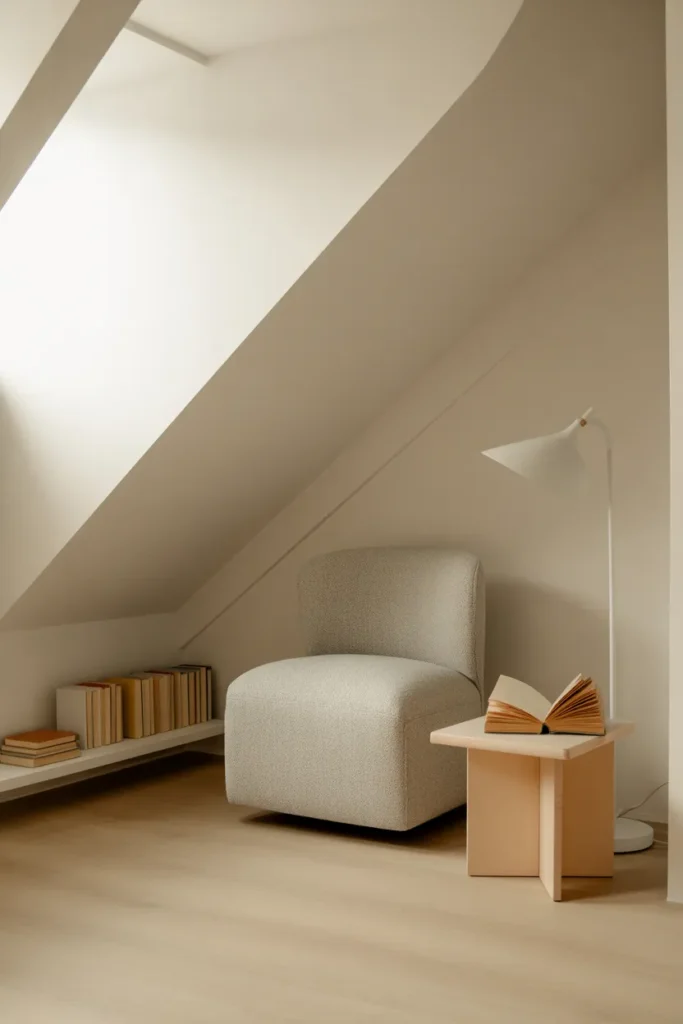
The Scandi approach is the cure if your attic feels cramped or dark. Paint everything, and I mean the sloped ceiling too, in the same warm white. Lay pale oak flooring or a large natural wool rug. Add a single light gray boucle chair, a slim white floor lamp with a warm bulb, and a birch wood side table. Keep the books on one low floating shelf along the short wall.
The trick is restraint. One chair, one lamp, one shelf, one throw. The sloped ceiling becomes architecture instead of an obstacle because nothing else is competing for your attention.]
6. Kids Attic Reading Fort
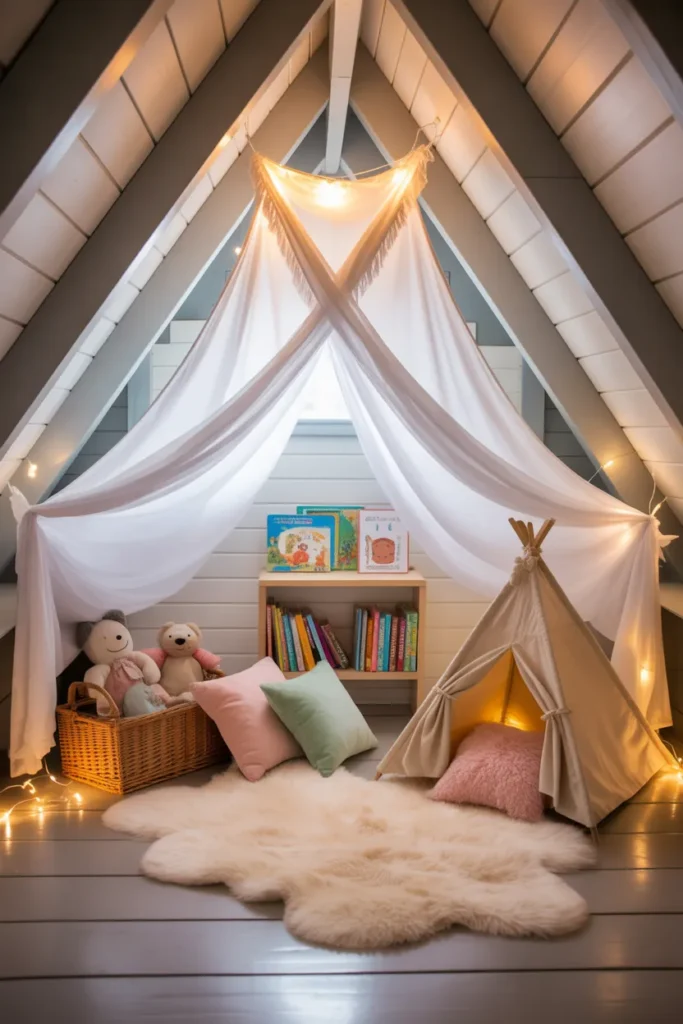
If you have little readers, the attic is basically a gift. The low ceiling that annoys adults is the perfect scale for a five year old. Frame off a section under the slant with a simple wooden arch or a canopy of fabric draped from a hook in the rafters, add a small teepee or reading tent, scatter soft cushions in every pastel you can find, and lean a tiny bookshelf against the knee wall so all the book covers face out.
Keep the lighting soft and battery operated for safety, and add a small basket for stuffed animals. This is the nook they will remember when they are thirty. For more styling tricks that keep kids books tidy without killing the magic, my kids reading nook with storage guide is full of ideas.
7. Built In Bench Nook Along the Knee Wall
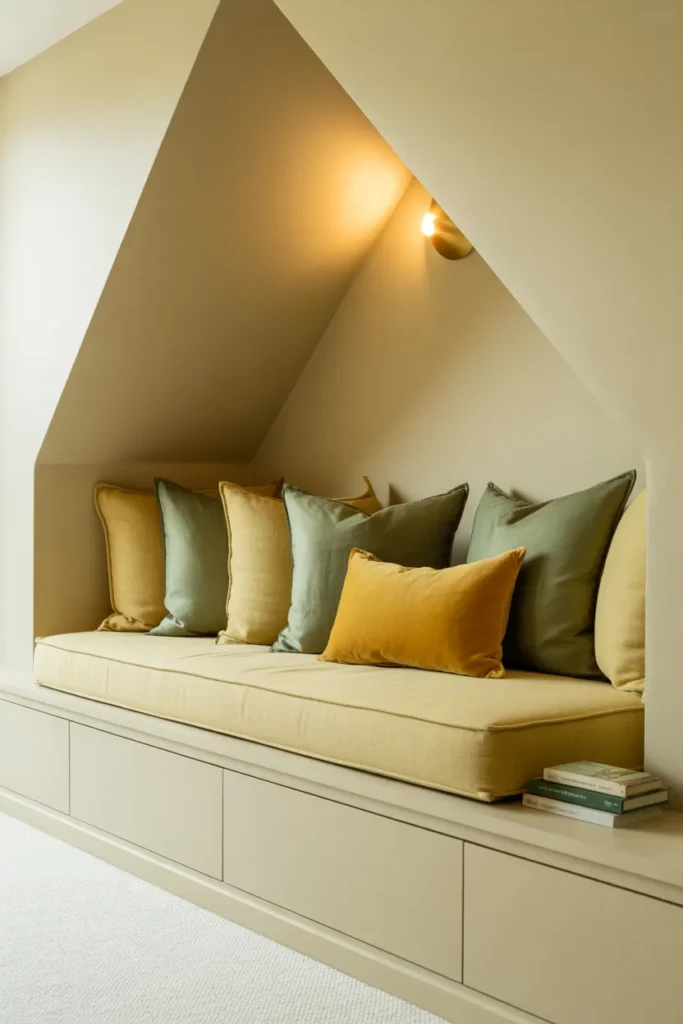
The knee wall, that short vertical wall where your slanted ceiling meets the floor, is the most wasted space in most attics. Build a simple bench along it with storage drawers or cubbies underneath, top it with a long custom cushion, and throw pillows along the full length. You now have seating for three, storage for blankets and books, and a perfectly framed reading spot that feels architectural instead of thrown together.
Paint the knee wall bench the same color as the walls so it reads as built in rather than added on. This is the single highest impact attic upgrade if you have the budget for a small carpentry project. Designers often recommend low shelves and a built in bench along the knee wall because you turn otherwise dead space into both storage and seating in one move.
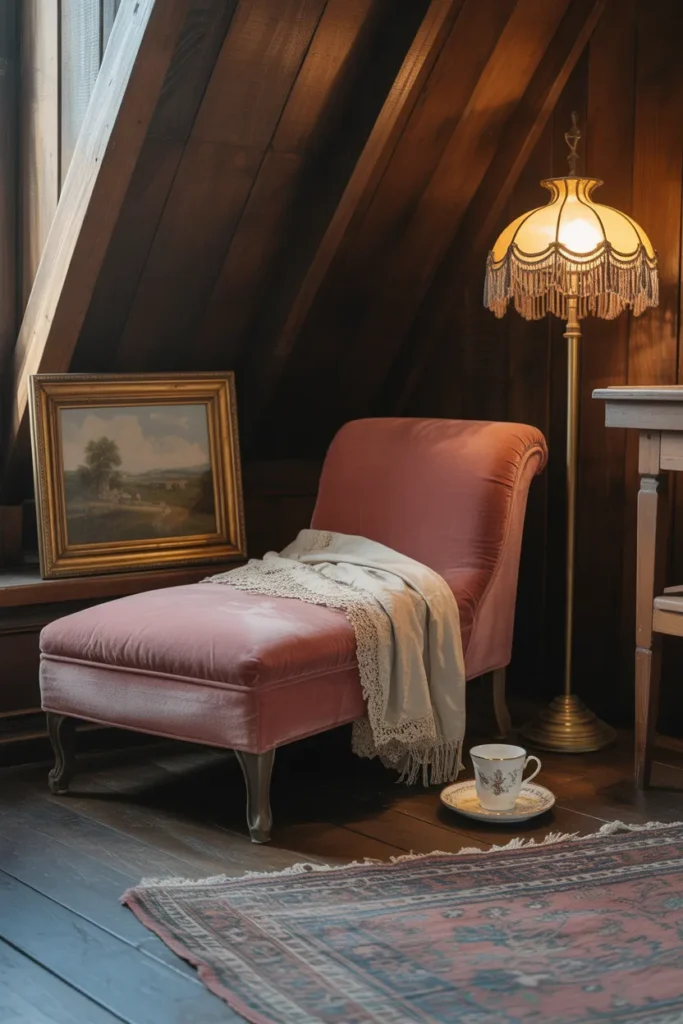
8. Romantic Vintage Nook with a Chaise Longue
For the readers whose aesthetic is basically “widowed Victorian novelist.” Place a vintage velvet chaise longue in dusty rose or deep teal along the longest slanted wall, lay a faded persian rug underneath, hang a small oil painting on the short wall, and add a beaded lampshade on a slim brass floor lamp. A lace trimmed throw and a teacup on a saucer complete the mood.
This works especially well in older homes where the attic already has original wood floors or exposed brick. Lean into the drama instead of trying to modernize it.
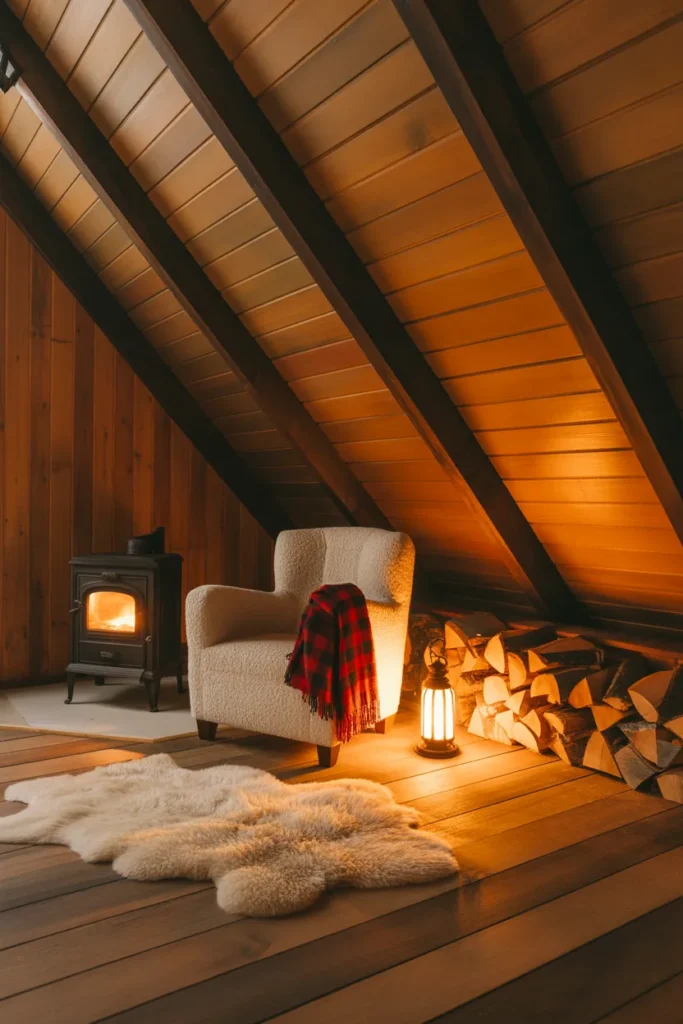
9. Rustic Cabin Nook with Exposed Beams
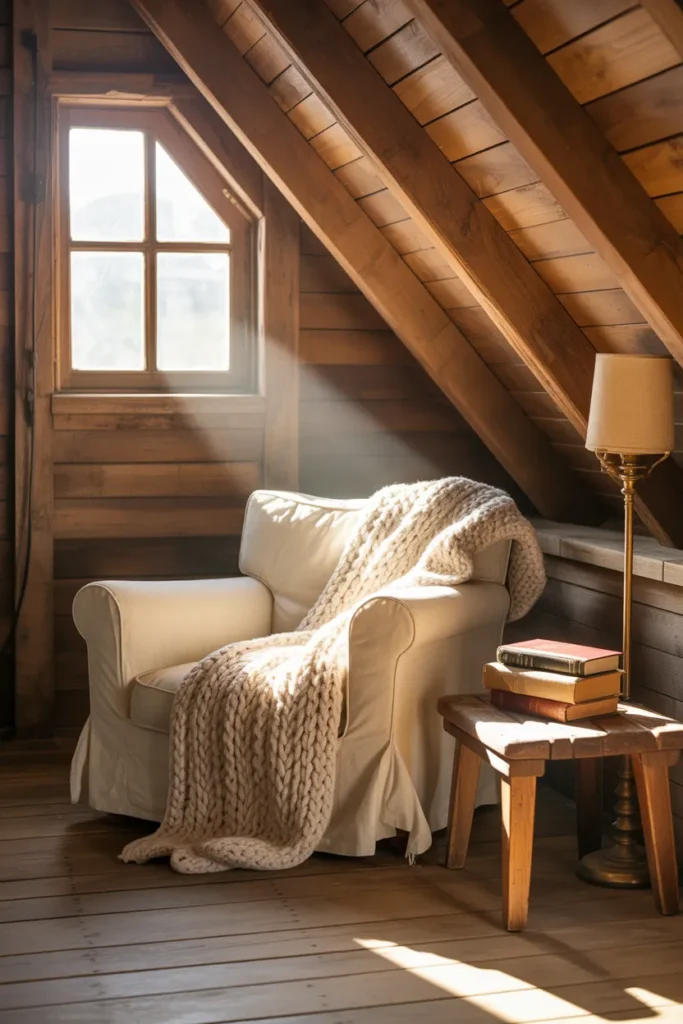
If your attic already has exposed wooden beams and rough pine walls, do not fight it. Lean into the cabin energy. A chunky oatmeal wool armchair, a red and black plaid throw, a small cast iron wood stove or a convincing electric version, a sheepskin underfoot, and a vintage lantern style lamp. Stack firewood decoratively along the low wall even if you never burn it.
Add a small shelf of classic adventure novels and a pair of slippers nearby. This is the nook for reading Jack London while it snows, and honestly nothing beats it in winter.
10. The Tiny Attic Closet Nook
Finally, for the attic that is really more of a crawlspace with ambition. If you only have a few square feet of usable height, convert the tallest corner into a closet style nook. A small daybed mattress on the floor, curtain rod across the ceiling with heavy curtains you can pull shut, a single wall sconce, and one narrow shelf for books. That is it.
When the curtains close it becomes the closest thing to a blanket fort you can get as an adult, and I say that with absolutely no shame. If you love this contained feeling and want to recreate it elsewhere in your home, my full reading nook closet conversion walkthrough shows how to apply the same concept to a hallway or bedroom closet.
How to Light Your Attic Reading Nook Properly
Lighting is where most attic nooks quietly fail, and slanted ceilings make it trickier because you cannot just stick a pendant anywhere you want. You need warm bulbs in the 2700K range, at least two sources of light, and one of them positioned over your shoulder rather than in your face while you read. Wall mounted swing arm sconces are usually the best answer for sloped ceilings because they free up floor space and tuck neatly under the slope.
For deeper styling help on small space lighting in general, both House Beautiful and Apartment Therapy cover it in ways that translate really well to attic conditions.
A Few Practical Things Before You Start
Attics have real constraints that are worth thinking about before you drag a chair up the stairs. Check your insulation, because a poorly insulated attic is freezing in January and unbearable in July, and no one reads in either of those conditions. Make sure your flooring is finished and stable. If your ceiling is very low, measure from the floor to the lowest point you will actually be sitting under, because a slanted ceiling that clears your head when you stand can still clip your skull when you lean back in a chair. Ask me how I know.
Ventilation matters too. A small oscillating fan or a cracked dormer window does wonders. And if the space feels damp or musty, sort that first before you invest in any fabric at all. Beautiful cushions are not worth it if the room smells like an old book in a bad way.
Attic Reading Nook Measurements: Headroom, Knee Walls and Where the Seat Goes
Every attic nook that works was measured before it was styled. The slope decides where you can sit, so start with a tape measure and these four numbers, then pick the look from the ideas above.
| Measure this | What you want | If you have less |
|---|---|---|
| Floor to slope where the back of your head will be when you lean back | At least 54 inches for an adult in a standard chair (about 36 inches of clearance above a 17 to 18 inch seat); closer to 60 inches for a tall wingback | Switch to a daybed, floor cushions or a low bench and read lying back; the low side is for reclining, not sitting upright |
| Knee wall height | 36 to 48 inches makes a natural backrest for a built-in bench | Below 36 inches, run the bench along the wall with a thick bolster instead of a fixed back |
| Bench depth and height | 18 to 22 inches deep, 16 to 18 inches high, plus a 2 to 3 inch firm cushion | Deeper feels like a bed and pulls you away from the lamp; shallower and you perch |
| Headroom where you stand up | Enough to stand straight directly in front of the seat, which usually means putting the chair with its back to the low side and its front toward the ridge | Angle the seat so you rise toward the high side of the room |
The triangle behind a knee wall is the best book storage in the house: cubbies or drawers cut into the wall put the shelves where you cannot stand anyway and leave the headroom for you. Keep the lamp on the high side of the seat so the shade does not meet the slope, and if the attic floor is unfinished, have a contractor confirm the joists are rated for furniture and people before you carry anything up the stairs.
Making the Most of the Eaves and Knee Walls
The low walls under a sloped roof are the hardest part of an attic to use well, and the most rewarding. Here is how to shelve them, which seat suits a low ceiling, and how to choose the right setup for your space.
Shelving the Knee Wall: Your Vertical Space Is Doing Nothing Right Now
The knee wall is typically 36 to 60 inches tall, depending on your attic. That’s 3 to 5 feet of usable vertical surface that most eaves nooks leave completely bare.
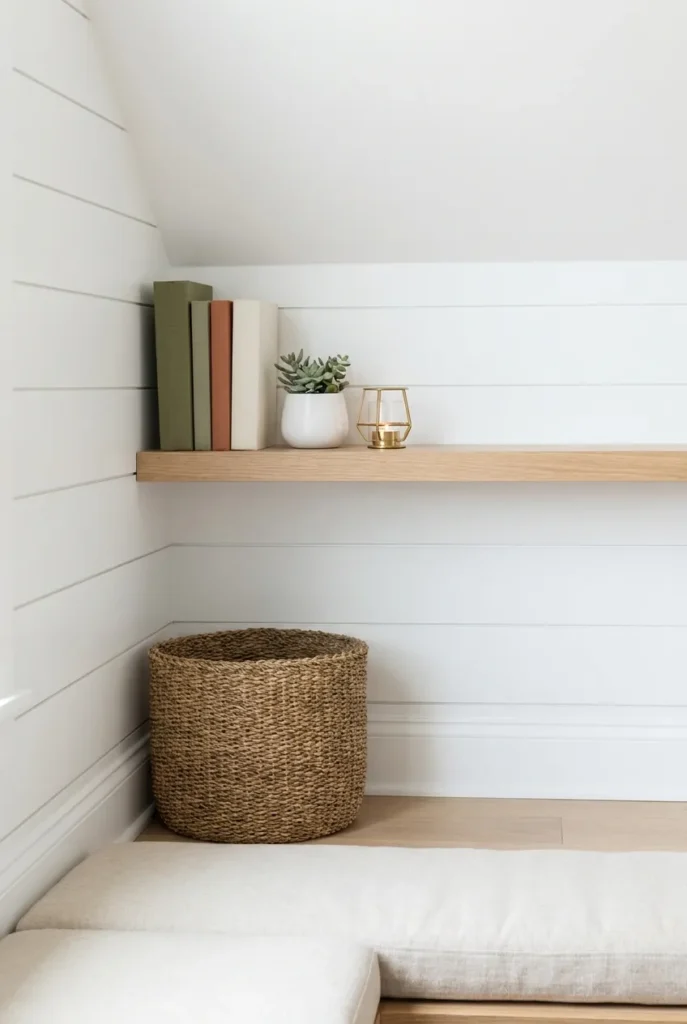
A single floating shelf at seated eye level (roughly 36 to 42 inches from the floor) runs the full length of the knee wall and holds your current read, one small ceramic pot, and a candle. Three objects. That’s the whole shelf. It reads as intentional and takes about 30 minutes to install with a level and two wall brackets.
For more capacity, a low ladder shelf at the wide end of the eaves (where the peak clearance is highest) works well. A 5-tier KALLAX-style unit from IKEA sits at 58 inches tall and clears a 60-inch peak without contact. It holds a full season of your TBR pile and frees up the knee wall for the sconce and the cushion.
One rule worth following: anything below seat height (under 18 inches) goes into closed storage tucked into the dead zone under the lowest part of the slope. Woven seagrass baskets or lidded canvas bins keep that zone tidy and invisible. Anything above seat height is display. Books, one small object, one plant. Not all three at once.
Don’t crowd the knee wall with too many shelves. Four linear feet of open display shelf is generous for most eaves nooks. More than that and the retreat starts to feel like a stockroom.
Failure mode: Installing shelves before you’ve placed your lighting. A shelf that sits directly in the swing arc of your sconce arm forces you to choose between the light and the shelf on move-in day. Sconce placement locks in first. Everything else works around it.
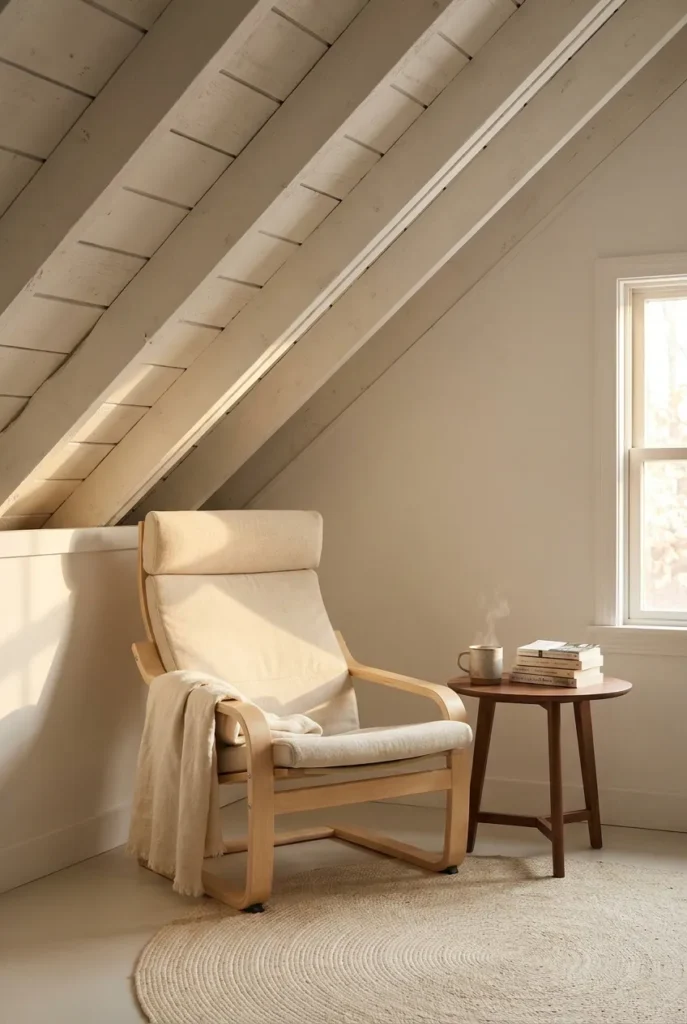
The Low-Profile Armchair Setup: When Your Peak Hits 66 to 78 Inches
A lot of people with a 66 to 78-inch peak assume they can fit a standard armchair under the eaves. Most can’t, not comfortably. A standard armchair sits 40 to 42 inches tall at the back. Add your seated height (roughly 33 to 38 inches for most adults) and you’re right at the rafter line if the chair is pushed back against the slope.
The solution is a low-profile armchair with a seat height of 15 to 16 inches and a back height under 33 inches. The IKEA Poäng is the most widely available archetype at $149 to $229. The Article Sven Chair is a step up in quality at around $499. Both clear a 66-inch peak comfortably when the chair is angled slightly away from the slope rather than pushed flat against the knee wall.
That angling decision (facing outward from the knee wall rather than backed against it) gives you 6 to 8 extra inches of clearance overhead and opens the knee wall behind the chair for a shelf at arm height.
A round side table at 20 to 22 inches tall sits flush with the armrest of a low-profile chair. The 18-inch reach rule: the center of your side table should be within 18 inches of your seated elbow. Any farther and you’re putting your mug down at full arm extension. Any closer and it crowds the armrest and the throw blanket you’ll definitely drape over the side.
Failure mode: Choosing a low armchair with a deeply reclined back angle. Reclined backs feel incredible in a showroom and ache after 40 minutes of actual reading. Look for an armchair with a 95 to 100-degree back angle (nearly upright), not the 110-degree lounge position most accent chairs default to.
The Eaves Nook Decision Matrix: Which Setup Fits Your Exact Space
Use this before you add anything to your cart. Find your situation in the left column, confirm your peak height, and match to the setup row. The budget ranges reflect real 2025 to 2026 pricing.
| Your Situation | Peak Height | Best Setup | Primary Products | Est. Budget |
|---|---|---|---|---|
| Renter, no tools at all | Any | Floor cushion + clip-on light | Large floor cushion, clip-on light | $60 to $130 |
| Peak under 54 in | Under 54 in | Recline setup: mattress topper slab on plywood | Twin XL topper, plywood platform | $80 to $160 |
| Peak 54 to 66 in, casual reader | 54 to 66 in | Floor cushion with bolster and pouf | Floor cushion (4 in+ foam), sherpa bolster | $90 to $180 |
| Peak 66 to 78 in, prefers sitting upright | 66 to 78 in | Low armchair + plug-in swing-arm sconce | IKEA Poäng style, swing-arm sconce | $150 to $320 |
| Peak 78 in+, wants storage | 78 in+ | Freestanding bench + knee-wall shelf + sconce | Plywood bench, foam cushion, floating shelf | $180 to $380 |
| Homeowner, wants a full permanent build | 78 in+ | Built-in bench + hardwired sconce + floating shelves | Plywood built-in, licensed electrician for sconce | $280 to $600+ |
| Maximum cozy, minimum spend | Any | Floor cushion + fairy lights + one throw | Floor cushion, fairy lights, boucle throw | Under $90 |
The bottom row is the one I tell most people to start with. Spend under $90. Sit in the space for two weeks. Read there four or five real evenings before you commit to anything permanent. Every eaves nook that became a genuine sanctuary started exactly this way. Every one that felt disappointing after six months was built too fast, too finished, before the person knew how they’d actually use it.
Frequently Asked Questions
How do I make a slanted ceiling attic feel bigger for a reading nook? Paint the walls and the sloped ceiling the same light color so the eye cannot tell where one ends and the other begins. Keep furniture low profile, use one or two mirrors to bounce daylight around, and skip heavy patterns. The illusion of continuous surface is what opens the room up.
What is the best seating for a reading nook under a sloped ceiling? Low profile seating wins every time. A daybed, a chaise longue, a wide floor cushion, or a short backed boucle chair will all sit comfortably under the slant without your head hitting wood every time you lean back. Save the tall wingback for the hallway.
Do I need a window for an attic reading nook? It helps a lot, but it is not required. If your attic has no window, lean on warm layered lighting, a skylight if you can add one, and soft reflective surfaces to stretch whatever light you do have. A nook lit only by sconces and fairy lights can actually be more cozy than one flooded with daylight.
How much does an attic reading nook cost to build? You can genuinely do a floor cushion and fairy lights setup for under a hundred dollars. A built in knee wall bench with storage is usually somewhere in the few hundred to low thousand range depending on who builds it. The cost is almost entirely about how much carpentry you want done.
Your Attic Is Waiting
Here is the thing about attic reading nooks. You do not need to do all ten. You probably only need one corner, one chair, one soft light and a reason to climb the stairs. The slanted ceiling is not in your way. It is the whole point.
Start with whichever of these ten setups made you stop scrolling, pick the piece you already own that could be the anchor, and build out from there. Your attic has been waiting for you to notice it. Go notice it.
Keep reading
More cozy nook ideas
 Kids Room
Read →
15 Waldorf Playroom Ideas With Natural Materials and Calm Colors
No spare bonus room, no custom carpentry, and no landlord permission required. You can build a calm waldorf playroom in an ordinary…
 Kids Room
Read →
Baby Playroom Ideas: 15 Safe Setups for the First Year
No spare guest room, no renovation budget, and no permission to drill into apartment drywall. You can still build a calm, padded…
 Bathroom
Read →
Dark Academia Bathroom: How to Get the Look in a Small Rental
No dark wood paneling, no renovation budget, and no friendly landlord required. You can build a moody, library-inspired dark academia bathroom in…