
Tiny Bedroom Ideas That Actually Fit: 12 Measured Fixes for a Room Under 120 Sq Ft

Your bed touches three walls. The door only opens partway before it hits the dresser. There’s a pile of laundry on the one chair, because the chair was always going to become a laundry pile.
Most tiny bedroom ideas online skip the part that decides everything: the math. You scroll 45 pretty photos, none of them list a single dimension, and then you order a nightstand that blocks your closet door by two inches.
We’re doing this differently. Every fix below comes with a real measurement, a real price we checked on August 18, 2026, or a real weight limit, so you can measure tonight and order this weekend. Renting? Nearly all of it comes off the wall clean.
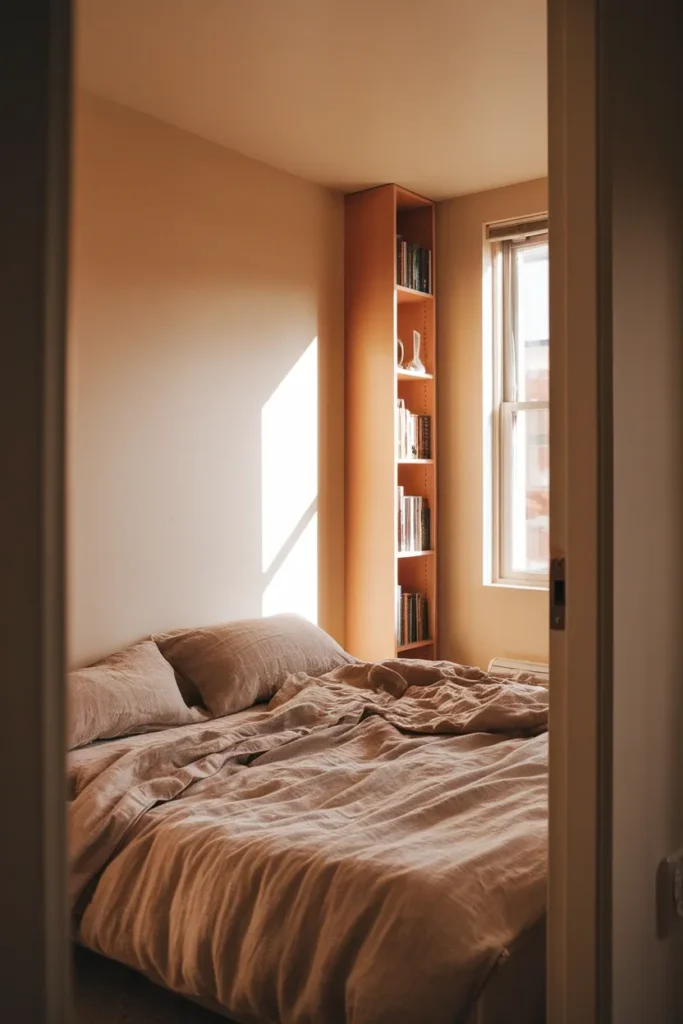
Start With the 24 Inch Lane Test, Before You Buy Anything
Here’s the rule that saves you a return shipping label: you need a 24 inch clear lane on every side of the bed you actually walk on. Not every side. Every side you use.
Twenty four inches is roughly the width of your shoulders plus the swing of one arm. Go narrower and you’ll turn sideways to get into bed every night for the next two years. You’ll stop noticing it consciously. Your shins won’t.
So the real question isn’t “will a queen fit.” It’s “will a queen plus its lanes fit.”
Run the arithmetic against your actual wall-to-wall measurement:
| Mattress | Real footprint | Wall to wall needed, 1 lane | Wall to wall needed, 2 lanes |
|---|---|---|---|
| Twin | 38 x 75 in | 62 in (5 ft 2 in) | 86 in (7 ft 2 in) |
| Twin XL | 38 x 80 in | 62 in (5 ft 2 in) | 86 in (7 ft 2 in) |
| Full | 53 x 75 in | 77 in (6 ft 5 in) | 101 in (8 ft 5 in) |
| Queen | 60 x 80 in | 84 in (7 ft) | 108 in (9 ft) |
| King | 76 x 80 in | 100 in (8 ft 4 in) | 124 in (10 ft 4 in) |
Mattress footprints are US standard sizes. The lane math is ours: bed width plus 24 inches per walking side.
If your room is under 9 feet across, a queen with lanes on both sides is not happening. Push the bed to one wall, accept a single lane, and stop fighting it. One good lane beats two cramped ones.
The One Wall Rule (ours, and it does more work than it looks like): pick a single wall to run floor to ceiling. Every other wall stays under 40 inches tall. Your eye reads the tall wall as the room’s height and the low walls as open air. Break this and put tall furniture on two walls, and a small room turns into a hallway with a bed in it.
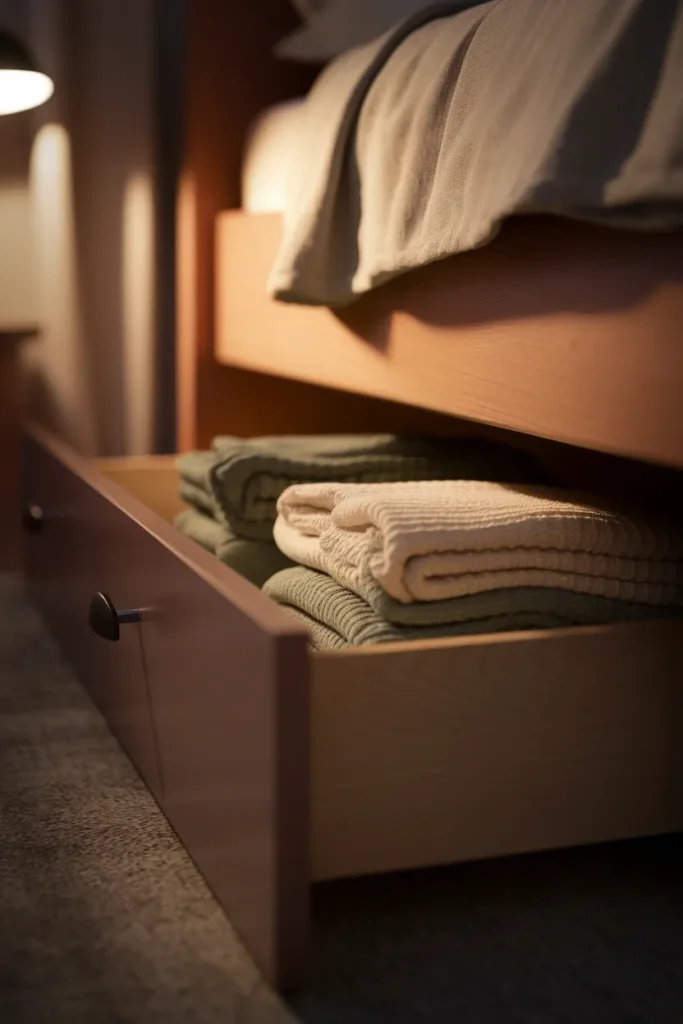
Move Your Storage Under the Bed, Not Around It
In a tiny bedroom, the floor is the resource. Every dresser you add eats it. The space under your mattress is already paid for and doing nothing.
Two paths, and they cost wildly different amounts.
The built-in path. IKEA’s NORDLI queen bed frame with storage runs $499.00 and gives you six drawers built into the base. Frame is 63 inches wide by 79 1/2 inches long by 11 3/4 inches tall. Each drawer measures 22 7/8 inches wide, 20 1/8 inches deep, and 6 1/4 inches tall inside.
Read that drawer height again. Six and a quarter inches. Folded jeans and sweaters fit fine. A packed winter comforter does not, and nobody tells you that before you assemble the thing.
The cheap path. Four SKUBB storage cases at $9.99 each, 25 1/2 by 20 3/4 by 7 1/2 inches, slid under whatever frame you already own. Total: $39.96. That’s a $459 difference for storage that works nearly as well.
The failure mode here is real and it’s boring: you shove the bins under, drop the bed skirt, and never open them again. Fix it by giving each bin one category and writing it on the end that faces out. Out of season only. Extra bedding only. Everything else stays where you can reach it.
There’s a sound cue that tells you it’s working. When your closet stops making that scraping noise of hangers being forced apart, you’ve moved enough out.
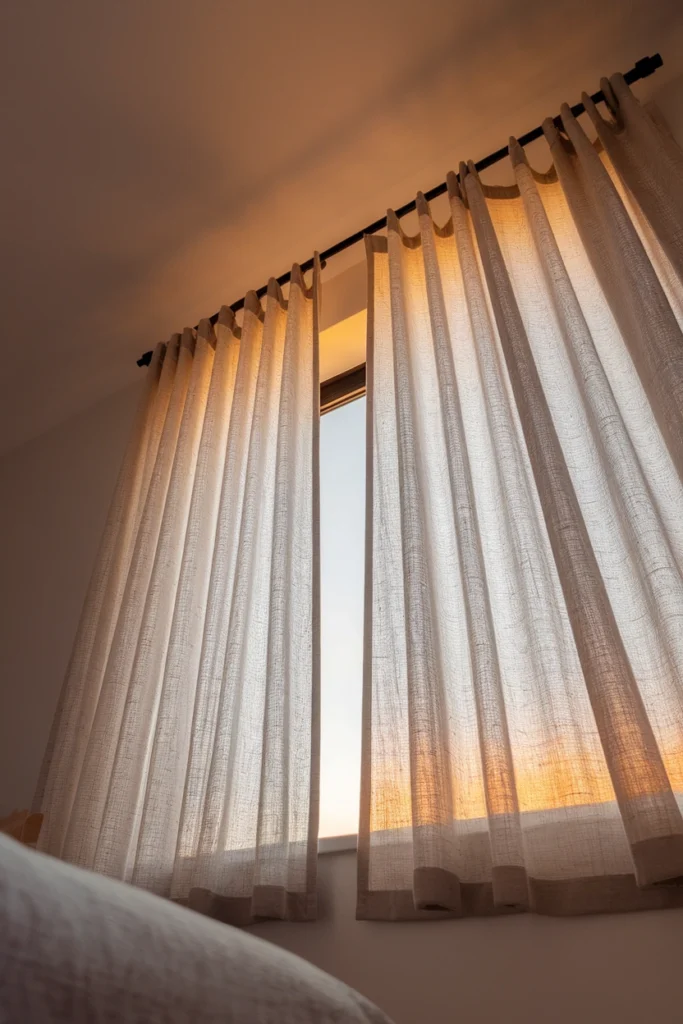
Hang the Curtain Rod Near the Ceiling, Not at the Window
This is the cheapest square footage you’ll ever fake.
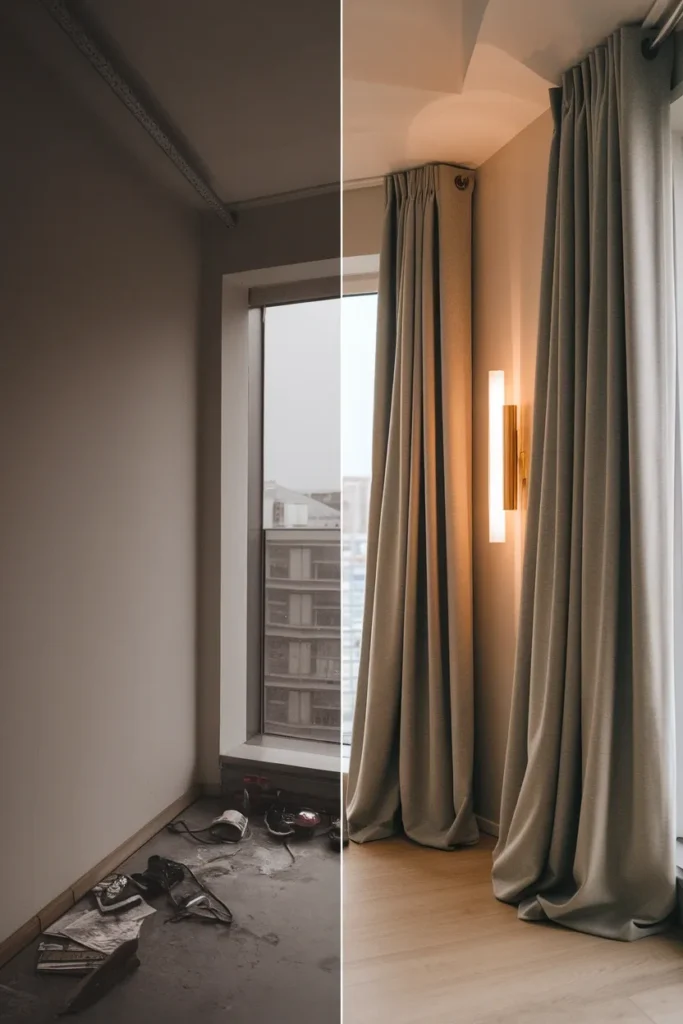
Mount the rod 4 to 6 inches below the ceiling line instead of just above the window frame, and extend it 6 to 10 inches past the window on each side. Hang panels that reach the floor or hover a half inch above it.
Your eye follows the fabric from ceiling to floor and reads the whole wall as window. The actual glass didn’t move. The room reads taller anyway.
IKEA’s MAJGULL blackout pair runs $49.99 for two 57 by 98 inch panels, and that 98 inch length is what makes near-ceiling mounting possible in a standard 8 foot room. Standard 84 inch panels will leave you with a floating hem and a rod that looks like a mistake.
One honest trade-off: blackout panels in a north-facing room with one small window will make a dim room dimmer. If you’re already fighting for light, hang sheers on the same high rod and skip the blackout layer, or run a cafe curtain on the lower half of the glass for privacy and let the top half stay clear.
Swap the Nightstand for Something 12 Inches Deep
Standard nightstands run 16 to 20 inches deep. In a room where you’re counting inches, that’s an entire walking lane’s worth of depth for a lamp and a phone.
Use the 18 inch reach rule to size it instead: whatever you put beside the bed only has to sit within 18 inches of your pillow, which is about how far you can reach lying down without lifting your shoulder off the mattress. Depth beyond that is storage you’ll never use from the bed.
Three archetypes that clear the lane:
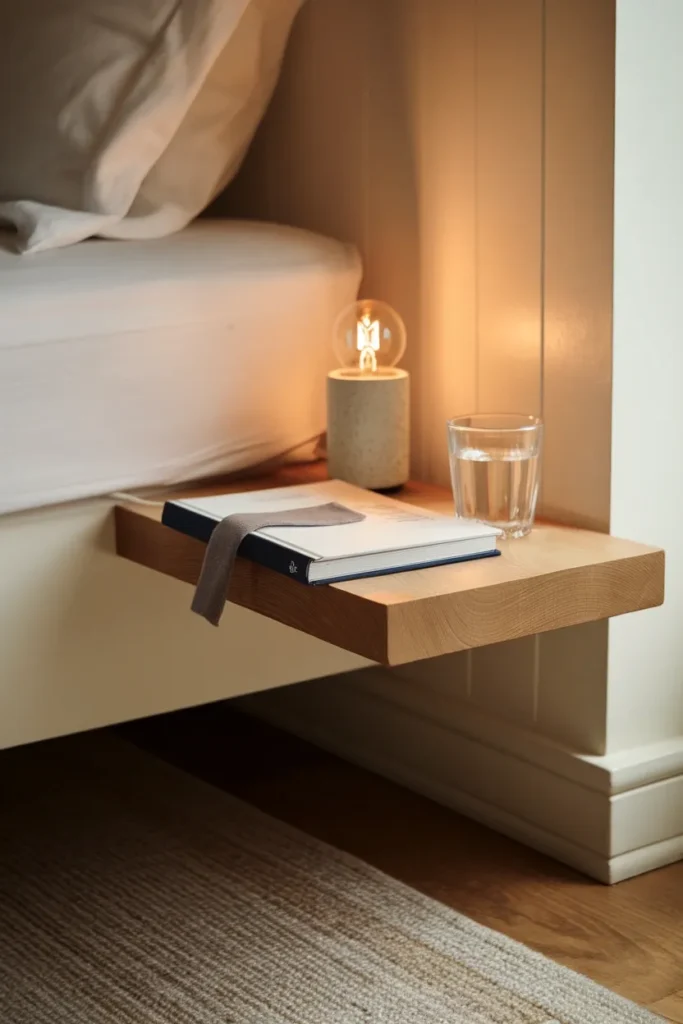
- A 12 inch deep floating shelf mounted at mattress height. Zero floor contact, which means the rug runs unbroken underneath and the room reads wider.
- Any 14 to 16 inch round side table. Round beats square in tight rooms because you clip a curve instead of a corner when you walk past.
- A picture ledge, 3 to 4 inches deep, for the book you’re currently reading and nothing else.
Front-load this one if you only do a single thing from this list. Depth at the bedside is where tiny bedrooms lose the most usable floor for the least benefit.
Renter Safe Hanging Starts With Knowing the 15 Pound Ceiling
Half the tiny bedroom advice online quietly assumes you can drill. If your lease says otherwise, here are the actual limits you’re working inside.
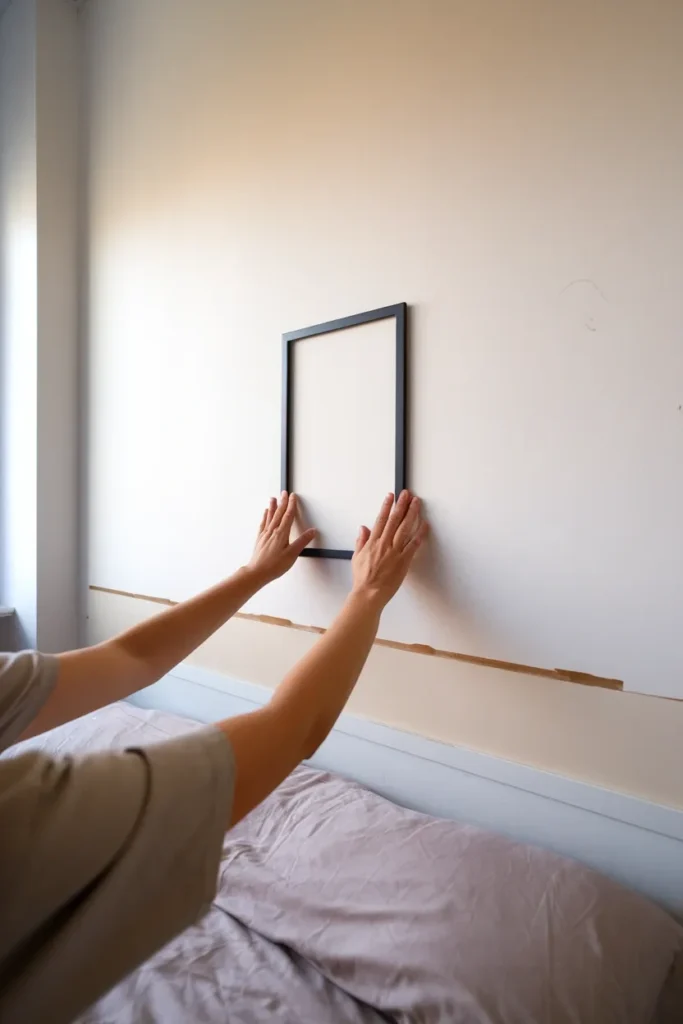
Four pairs (eight strips) of Command’s 15 pound picture hanging strips hold a frame up to 15 pounds and up to 24 by 36 inches. That covers most of what you’d hang over a bed, including a decent mirror. To remove, you peel the frame off and stretch each strip slowly toward the floor at least 12 inches until it releases.
Now the part that causes the 2 a.m. crash, and it’s in the manufacturer’s own guidance: they do not work on wallpaper, fabric, textured walls, brick, or any rough surface.
That last one takes out a lot of US rentals. If your walls have that sprayed orange-peel or knockdown texture, adhesive strips will hold for about a week and then let go, usually taking a chip of paint with them. Run your palm across the wall first. If it isn’t smooth like a painted door, you need a different plan.
What to do instead on textured walls:
- Lean it. A framed mirror or art piece resting on a dresser or on the floor against the wall needs zero hardware and reads intentional.
- Use the existing hardware. Most rentals already have picture hooks or anchor holes somewhere. Reuse them and patch nothing.
- Go tension based. A tension rod inside a window recess or between two close walls holds curtains, a hanging plant, or a small shelf with no adhesive at all.
Layer Three Light Sources Instead of One Ceiling Fixture
A single overhead fixture flattens a small room. It lights the middle of the floor, throws every corner into shadow, and makes a 10 by 10 space read like exactly one box.
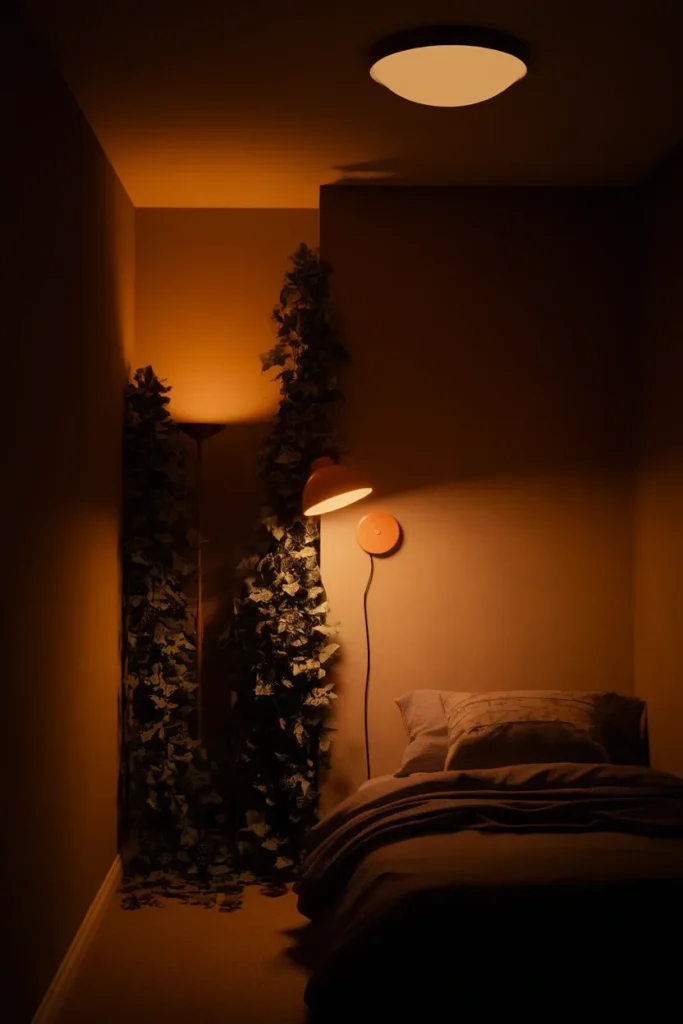
Three sources at three different heights break that up:
- Low: an LED puck inside the closet or a small lamp on the floor behind a plant. Light coming from below eye level reads as depth.
- Mid: a plug-in swing-arm sconce beside the bed. Mount it so the shade bottom lands around 48 to 52 inches from the floor for a standard bed height, which puts the light just above your shoulder when you’re sitting up reading. IKEA’s plug-in and swing-arm wall lamps run roughly $34.99 to $44.99.
- High: the overhead, on a dimmer, used at maybe 30 percent. It’s a fill light now, not the main event.
Skip the sconce and you’ll end up reading by phone flashlight or leaving the overhead on, which is the single fastest way to make a small bedroom feel like a rented room instead of yours.
Fairy lights belong in this stack too, but the difference between charming and freshman dorm is entirely in the placement and the warmth of the bulb. We broke down the setups that read as intentional in our guide to cottagecore bedroom fairy light setups.
Fit a Reading Corner Without Adding a Chair
Everyone’s instinct in a tiny bedroom is an armchair. Then the armchair becomes the laundry pile, and now you’ve spent $300 to lose 6 square feet.
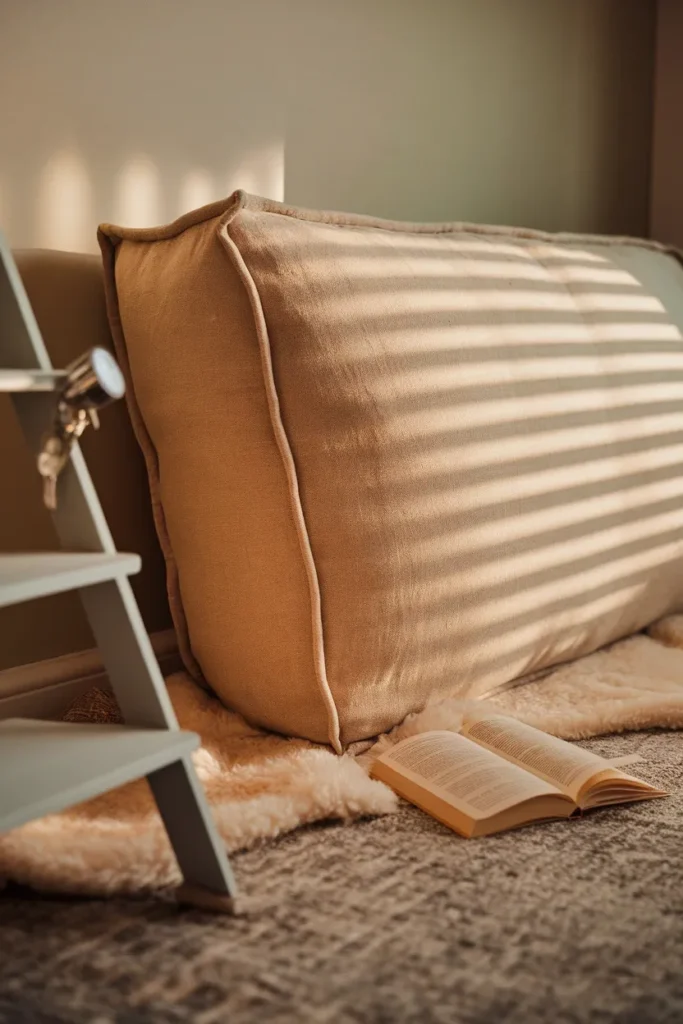
Build the corner at floor level instead. A large floor cushion or a firm pouf, a sheepskin or a small jute rug under it, a bolster propped against the wall for your lower back, and a clip-on reading light on the nearest shelf. It tucks into the one awkward corner every small bedroom has, and when you’re not using it the cushion slides under the bed or doubles as extra seating.
The honest downside, because nobody on Pinterest will tell you: floor cushions photograph beautifully and after about 40 minutes your lower back files a complaint. The bolster is not optional, it’s structural. Get one firm enough that it doesn’t compress flat, and put it in the crease where the wall meets your lumbar curve, not behind your shoulders.
If your bedroom has enough room for a proper setup, we walked through the full range in bedroom reading corner setups worth sitting in.
Getting the TBR pile out of your bed and into an actual corner also does something for sleep that no amount of decor will: it gives your brain one spot for reading and one spot for sleeping.
Pick the Bulb Spec Before You Pick the Lamp
You can buy the right lamp and still get the wrong room, because the bulb does more work than the fixture.
Go for 2700K in a bedroom. That’s warm white, close to old incandescent light, and it’s the number that makes a small room read soft instead of clinical. Step up to 4000K and your bedroom starts to feel like a dentist’s waiting area at 9 p.m.
Buy on lumens, not watts. For a bedside lamp you’re reading by, somewhere around 450 lumens is comfortable. For the overhead in a room this size, look for something dimmable rather than something bright.
The efficiency case is worth knowing since you’ll run these lamps every evening. Per ENERGY STAR certified light bulb guidance, certified bulbs use up to 90 percent less energy than standard bulbs, last at least 15 times longer, and save around $55 in electricity costs over the bulb’s lifetime, with a service life running past 13 years.
Buy all your bedroom bulbs at the same Kelvin in one order. Mixing 2700K and 3000K across three lamps in one small room produces a subtle color clash you’ll feel without being able to name.
Color Drench the Walls and Take the Ceiling With Them
Painting a small room white to “open it up” is the most repeated tip in this category, and it’s the one we’d argue with.
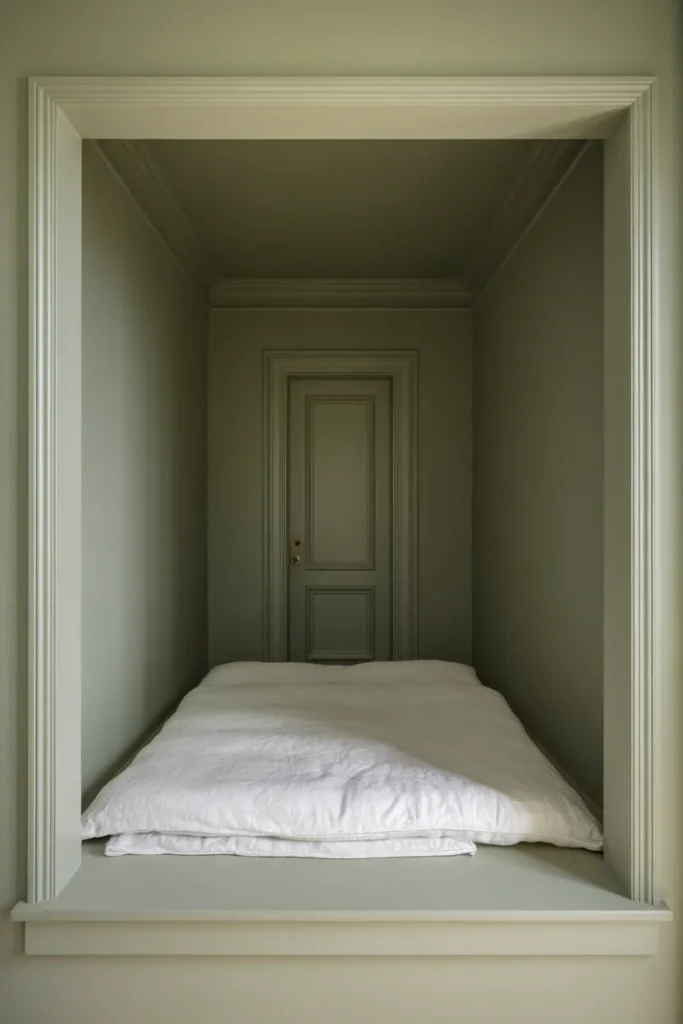
White walls with white trim and a white ceiling still have corners, and your eye finds every one of them. What actually dissolves the boundaries is running one single color across walls, trim, and ceiling together. With no contrast line at the ceiling, your brain loses the exact spot where the room stops.
It works in a soft clay, a muted sage, a deep ink blue, or a warm oat. Sheen matters more than shade: keep it flat or matte on the ceiling so it doesn’t bounce a hard highlight back at you.
Renting and can’t paint? Removable wallpaper on a single wall achieves maybe 60 percent of the effect. Be straight with yourself about the surface though, since peel-and-stick behaves the same way adhesive strips do, and textured walls will fight you.
One caution. A dark drench in a north-facing room with a single small window will read moody at noon, not just at night. If that’s your room and you want the effect anyway, run the dark color on three walls and the ceiling, and leave the window wall a few shades lighter to bounce what daylight you get.
Five Mistakes That Make a Tiny Bedroom Look Smaller
Quick audit. Most small rooms are guilty of at least two.
- The rug that’s too small. A rug that stops short under the bed cuts the floor into pieces and shrinks it visually. Run it at least 18 to 24 inches past the sides of the bed, or skip the rug and leave the floor whole.
- The chair. Covered above. It becomes laundry. It always becomes laundry.
- The eight-piece gallery wall. Lots of small frames create visual noise that reads as clutter. One large piece above the bed does the same job and lets the wall breathe.
- Tall furniture on two walls. The One Wall Rule again. Pick one wall to go tall, keep the rest low.
- Living on the overhead light alone. A single ceiling source flattens the room every single night, which is a lot of nights to spend in a room that looks worse than it is.
A Real Build Order Under $400
If you’re starting from scratch and don’t know what to buy first, this is the sequence. Prices checked on ikea.com US on August 18, 2026.
| Order | Buy | Real spec | Price |
|---|---|---|---|
| 1 | Blackout or room darkening curtains, 1 pair (MAJGULL) | 57 x 98 in panels | $49.99 |
| 2 | Plug-in swing-arm wall lamp x 2 | wall mount with cord | about $44.99 each, $89.98 |
| 3 | Under-bed storage cases x 4 (SKUBB) | 25 1/2 x 20 3/4 x 7 1/2 in | $9.99 each, $39.96 |
| 4 | Adhesive picture hanging strips, smooth walls only | up to 15 lb, 24 x 36 in max | varies by retailer |
| Running subtotal | $179.93 |
That leaves roughly $220 of a $400 budget for a rug sized to run past the bed, a set of matching 2700K bulbs, one large piece of art, and a floor cushion for the corner.
The order matters more than the list. Curtains first because they change the room’s proportions and cost the least per unit of effect. Lighting second because it changes how the room feels after dark, which is when you’re actually in it. Storage third because clearing the floor is what makes everything else visible.
If your whole apartment needs this treatment and not just the bedroom, the same buy-order logic carries over in our guide to renter friendly apartment decor on a budget.
Tiny Bedroom Questions, Answered
How do you make a tiny bedroom look bigger? Three moves do most of the work: mount curtains 4 to 6 inches below the ceiling with floor-length panels, keep tall furniture on one wall only, and light the room from three heights instead of one overhead fixture. Paint color matters less than people think. Sight lines matter more.
Where should the bed go in a small bedroom? Against the longest uninterrupted wall, positioned so you keep at least one 24 inch walking lane. If two people share it, you need lanes on both sides, which means 84 inches wall to wall minimum for a queen. Corner-placing the bed frees floor but costs you one side of access, so only do it if one person sleeps there.
How much space do you need around a bed? Twenty four inches of clear lane on any side you walk on. You can survive 18 inches at the foot of the bed if it’s just a pass-through, but 24 is the number where the room stops feeling like an obstacle course.
Can you fit a desk in a tiny bedroom? Yes, if you go narrow and wall-mounted. A 12 to 16 inch deep floating desk clears the walking lane a freestanding desk would eat. A drop-leaf or fold-down wall desk is better still, since it disappears when you’re not working. What doesn’t work is a standard 24 to 30 inch deep desk, which will cost you a lane.
What color makes a small bedroom look bigger? No single color does it. Continuity does. Running one color across walls, trim, and ceiling removes the contrast lines your eye uses to measure a room, and it works in a deep ink blue as well as a pale oat. If your room gets very little natural light, keep the window wall a few shades lighter.
How do you add storage to a tiny bedroom with no closet? Start under the bed, since that space is free. Four storage cases at $9.99 each hold what a small dresser holds for a fraction of the floor space. After that, go vertical on your one designated tall wall with a narrow bookcase or a ladder shelf, and use over-door hooks, which need no hardware and no landlord conversation.
What size rug works in a tiny bedroom? Big enough to extend 18 to 24 inches past the sides of the bed. A small rug floating in the middle of the floor chops the room into sections and makes it read smaller. If a rug that size doesn’t fit or isn’t in budget, leave the floor bare. An unbroken floor beats a badly sized rug.
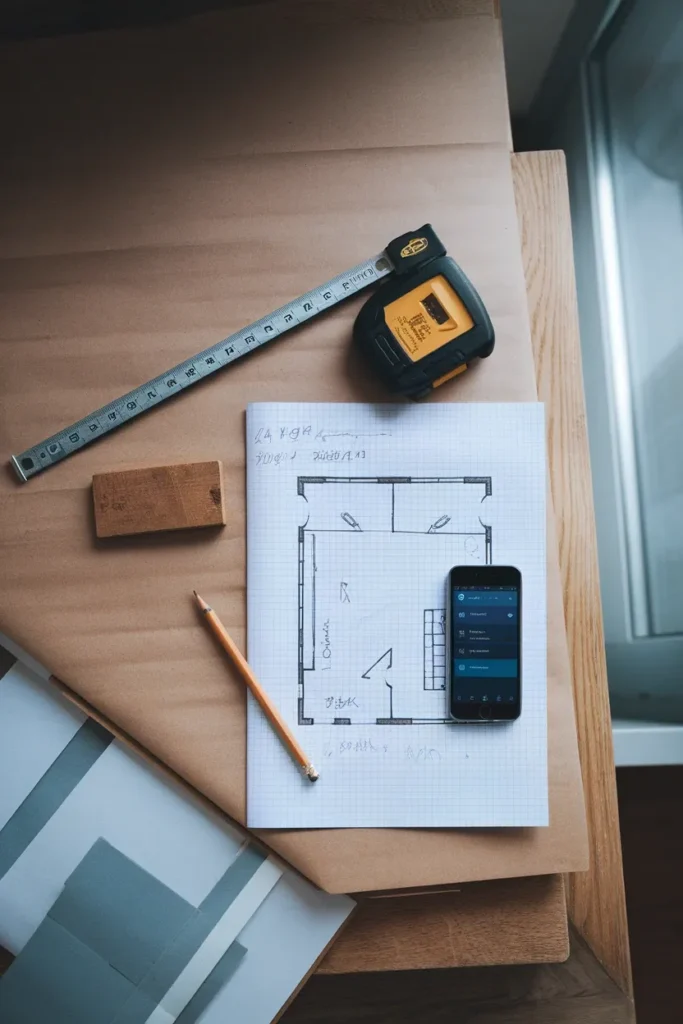
Start With the Tape Measure Tonight
You don’t need a bigger bedroom. You need to know your wall-to-wall number, your bed’s real footprint, and where your one 24 inch lane is going to run. Everything on this list gets easier once those three numbers are written down.
So do that part tonight, before you add a single thing to a cart. Then start with the curtains.
Once your floor is clear and your lighting is layered, the next thing most people want is that one corner to actually sit and read in. That’s the piece that turns a small bedroom from somewhere you sleep into somewhere you’d choose to be, and we’ve mapped out setups for rooms of every size in our bedroom reading corner guide.
Keep reading
More cozy nook ideas
 Small Spaces
Read →
Small Spaces
Read →
10 Small Reading Nook Ideas for Adults
One high-back chair, one clamp-on lamp, one $19.99 tray table. At IKEA US prices this month, that’s a full reading corner for…
 Small Spaces
Read →
Small Spaces
Read →
18 Twin Bed Ideas for a Small Room
A twin bed in a small room can look like a leftover dorm setup or like the best seat in the house.…
 Small Spaces
Read →
Small Spaces
Read →
14 Modern Apartment Decor Ideas That Make a Small Room Feel Bigger
Four hundred and sixty square feet. That is the average size of a new US studio apartment, according to RentCafe’s 2025 numbers,…