
Reading Nook Curtains: How to Hang, What to Pick, and 12 Real-Room Ideas

If your reading corner is currently a slumped pillow on the floor and a curtain rod three inches too short, this fixes it. Reading nook curtains are the cheapest, fastest way to turn any awkward corner into a cocoon you actually want to disappear into. No drill required for most of these. No bay window required either. Just the right curtain, the right rod, and three decisions you’ll make in the next eight minutes.
Here’s the thing. Most articles about nook curtains tell you to “embrace softness” and call it a strategy. We’re going to do better. You’ll get exact rod heights, fabric weights, a renter-safe hanging method that won’t cost your deposit, and twelve real-room examples sorted by the type of nook you actually have.
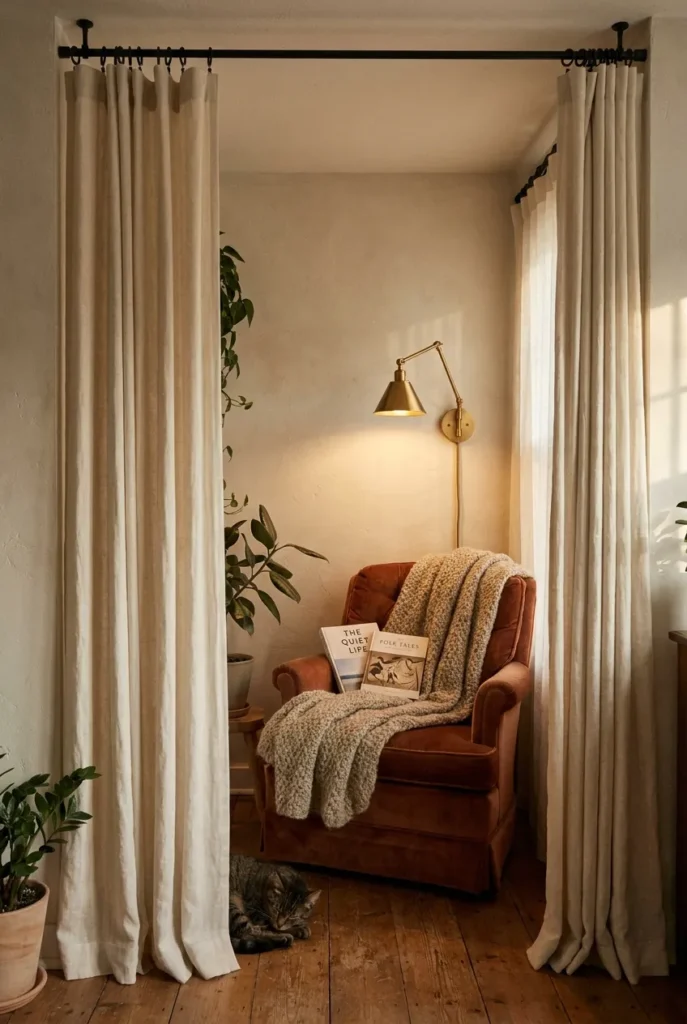
The 4-Nook-Curtain Map (Find Your Type Before You Buy Anything)
Before you click “add to cart” on any panel, figure out which of the four nook types you’re working with. Each type uses curtains differently. Buying the wrong setup is how readers end up with a $90 pile of fabric that never gets hung.
Type 1: Window Nook. You have a window, a sill, and maybe a built-in bench or a chair pushed close to the glass. Curtains here do two jobs: filter the light and frame the seat.
Type 2: Alcove or Built-In Nook. A recessed space in the wall, an under-eave dormer, or a custom bench wedged between two cabinets. Curtains here act like soft walls, closing off the alcove when you want privacy.
Type 3: Closet Conversion Nook. You removed the closet doors and turned the cavity into a reading seat. Curtains replace the doors and pull all the way across.
Type 4: No-Window Canopy Nook. Just a chair in a corner. No alcove. No window. You’re building a soft enclosure from scratch using a ceiling track, a four-poster frame, or a hanging hoop.
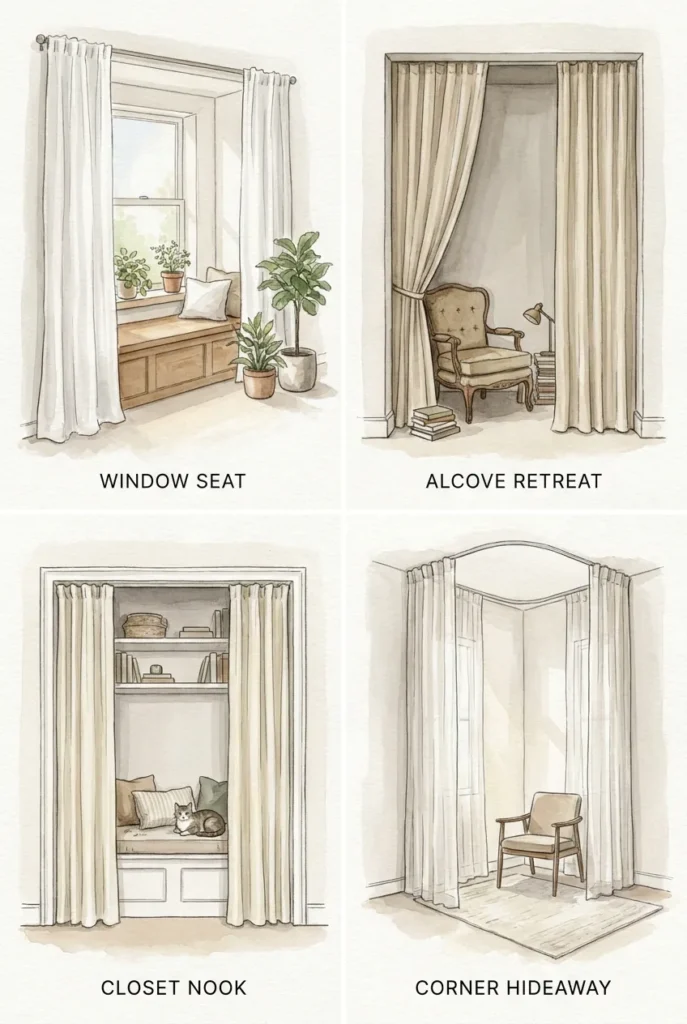
Knowing your type tells you everything else. Rod position, panel length, fabric weight, fullness ratio, all of it follows from this one decision. If you’re a renter, every type below has a no-drill version, which we’ll get to next.
How to Hang Reading Nook Curtains (Renter-Safe and Otherwise)
Most readers ask the wrong question first. They ask what curtains to buy. The right question is where they’ll hang from. Get the mount wrong and the prettiest panels in the world will sag, gap, or tear out a chunk of drywall.
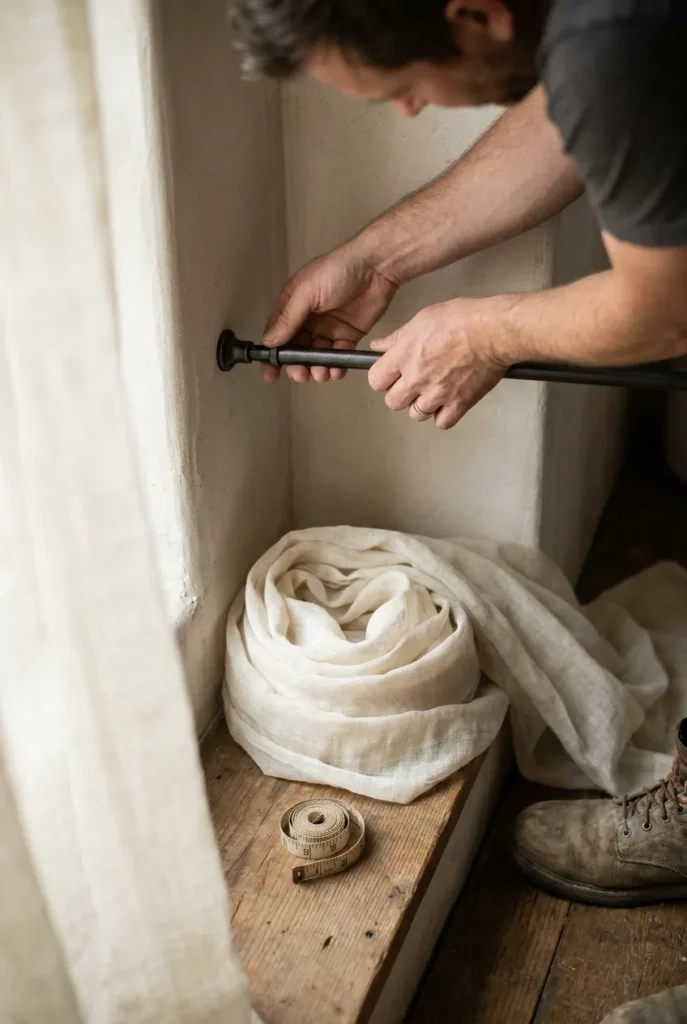
Option A: Tension rod inside the opening. Best for alcoves, closet conversions, and any nook with two parallel walls 18 to 96 inches apart. Use a heavy-duty spring rod rated for at least 20 pounds. The cheap $6 ones from the bath aisle will collapse under a linen panel within a week. I learned this the hard way with a green velvet curtain that ended up on the dog.
Option B: Adhesive ceiling-mount track. Best for canopy nooks where you need the curtain to follow a curved or U-shaped path around a chair. Look for 3M Command large picture-hanging strips rated 16 pounds each, or a peel-and-stick aluminum track sold for shower enclosures. Distribute the weight across at least four anchor points. Per 3M Command’s official adhesion guidance, surfaces must be cleaned with rubbing alcohol (never household cleaners) before mounting, or the bond fails within 48 hours.
Option C: Drilled rod or ceiling track. Best for permanent installs in homes you own. Mount the rod 4 to 6 inches above the window or alcove top edge, and extend it 6 to 12 inches past each side so the panels can stack off the opening when open.
Option D: Suspended hoop or hanging ring. Best for canopy nooks above a single chair. A 36-inch embroidery hoop wrapped with cotton, hung from a single ceiling anchor, holds two to four sheer panels in a circular drape. Charming. Light. Renter-friendly if you use a swag hook with a removable adhesive base.
If you’re renting, the no-drill stack (tension rod + adhesive track + suspended hoop) handles every nook type without a single hole in the wall. For more on protecting your security deposit while still styling a real nook, our renter-safe reading nook setup guide walks through the full damage-free toolkit.
What to Pick: The Reading Nook Curtain Quick-Spec Table
Curtain shopping breaks people because Pinterest shows you the look but not the numbers. Here are the numbers. Screenshot this and take it shopping.
| Spec | Window Nook | Alcove or Built-In | Closet Conversion | Canopy / No-Window |
|---|---|---|---|---|
| Rod height above opening | 4 to 6 inches | At ceiling line | At ceiling line | Ceiling-mount only |
| Panel length | Sill, apron, or floor | Floor + 0.5 inch puddle | Floor + 0.5 inch puddle | Floor or chair-height |
| Fullness ratio | 2x rod width | 2.5x rod width | 2x rod width | 1.5x to 2x |
| Fabric weight | Light to medium linen | Medium linen or cotton | Medium linen | Sheer or light linen |
| Light control | Sheer + blackout layer | Single medium panel | Single medium panel | Sheer only |
| Lining | Optional blackout | Optional thermal | None | None |
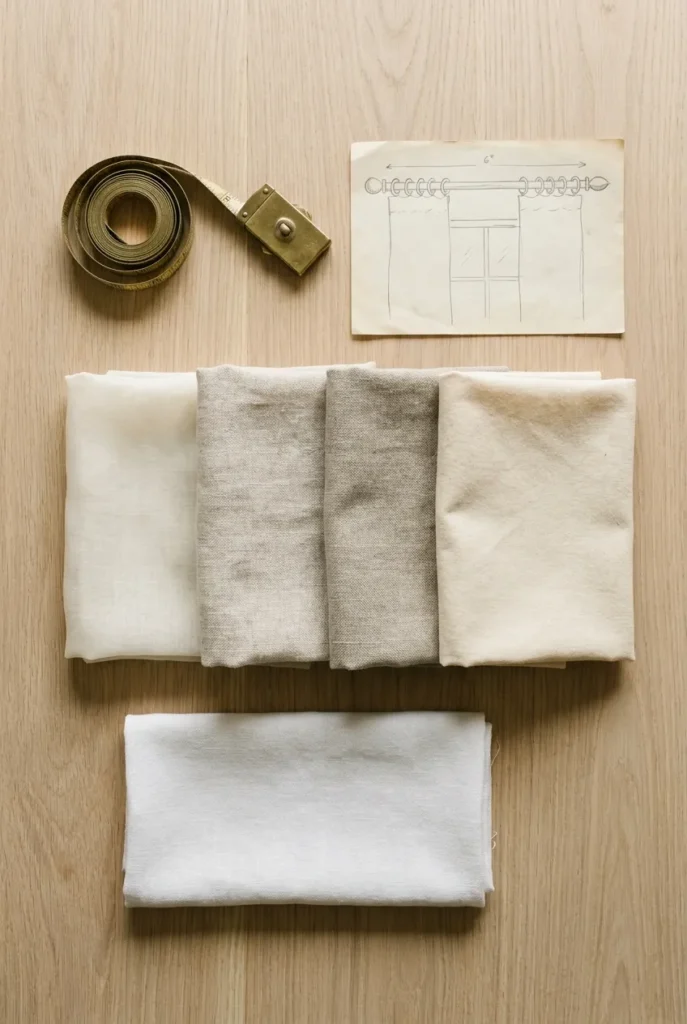
A few rules behind the table. Fullness ratio means the total panel width should be roughly double your rod length so the curtain reads as drapery, not as a flat shower curtain. Light linen reads soft and breezy. Medium linen reads architectural. Sheer reads dreamy and is the right choice for canopies because it lets the chair underneath stay visible.
On energy and insulation, this is where curtains earn their keep beyond looks. According to the U.S. Department of Energy guidance on window treatments, draperies with a tight seal at the top and sides can reduce heat loss by up to 10 percent in winter. For a window nook where your chair sits inches from cold glass, that matters more than the aesthetic does in February.
12 Real-Room Reading Nook Curtain Ideas
These twelve are organized by nook type. Find yours, jump to that block, copy the setup.
1. The Sheer Linen Bay Window (Window Nook)
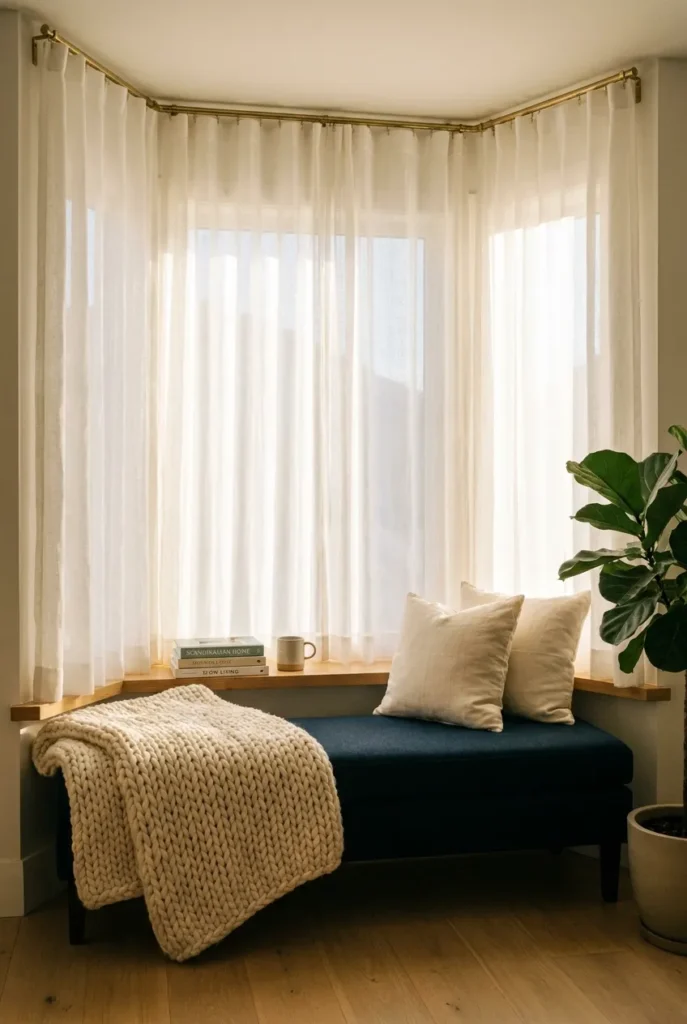
White sheer linen panels mounted on a ceiling-track rod that follows the three sides of a bay. The sheers stay closed during the day so the morning light goes diffuse and warm instead of harsh. Pair with a deep navy bench cushion and one chunky cream throw. Total cost if you shop IKEA and Amazon: around $140. If your bay is the centerpiece of your living space, the full setup with bench dimensions lives in our bay window seat reading nook ideas roundup.
2. The Layered Café Curtain (Window Nook)
A two-tier system for windows facing a street or a neighbor. Bottom tier is a café curtain at sill height for privacy. Top tier is a long sheer that frames the whole window. You read with the bottom closed and the top open. Light comes in, the street stays out.
3. The Velvet-Lined Alcove (Alcove or Built-In)
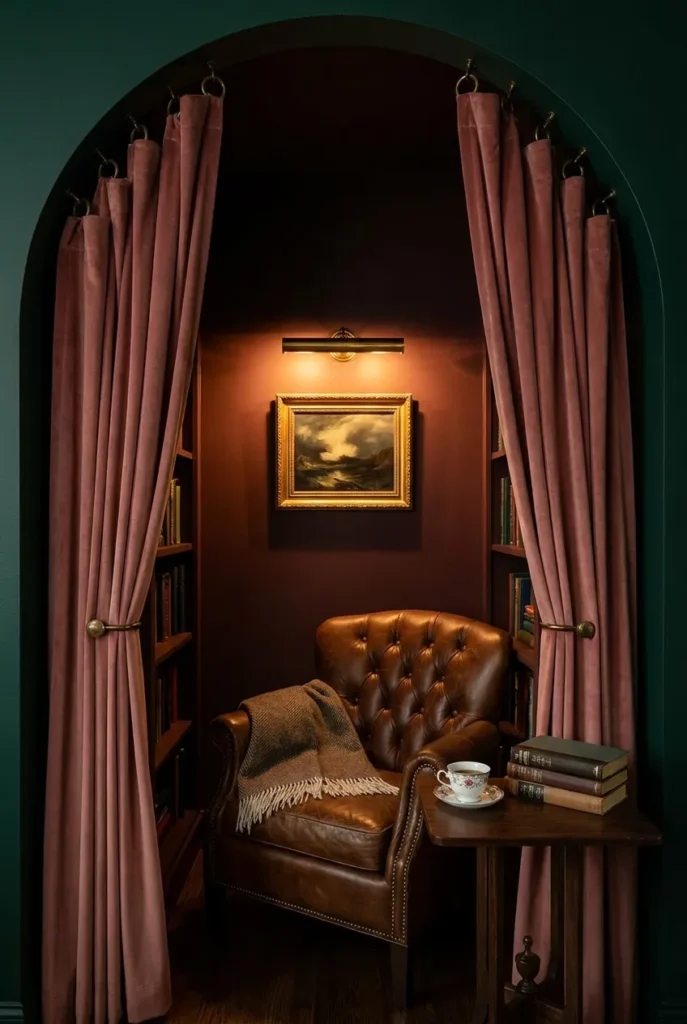
Heavy dusty-rose velvet panels mounted at the ceiling line of a 4-foot-deep alcove. Pull them shut and the alcove disappears from the room. Dark academia readers, this one’s yours.
4. The Oat Linen Built-In Bench (Alcove or Built-In)
Floor-to-ceiling oat linen on a thin black iron rod, framing a built-in bench between two bookcases. The curtains stack off to either side during the day. At night you pull them across and the whole nook reads as a cabinet.
5. The Closet-Door Replacement (Closet Conversion)
Remove the closet doors. Add a tension rod near the top of the frame. Hang two panels of medium-weight cream linen. You just turned a 30-inch-wide closet into a reading hideaway with a door that whispers instead of slams.
6. The Tasteful Cupboard-Under-Stairs (Closet Conversion)
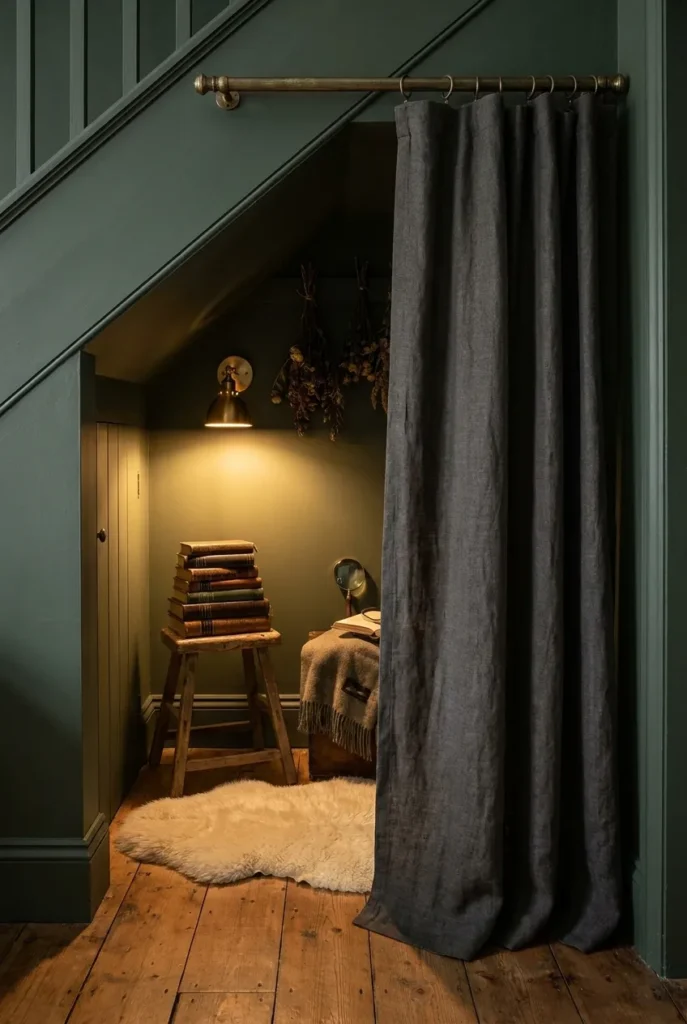
This is the grown-up version of the Harry Potter trope. Skip the painted-on stars. Use a single panel of charcoal linen on a brass rod, a sheepskin on the floor, and one wall sconce with a 2700K bulb. The tasteful version of this build, with full dimensions for the cupboard cavity and how to hide the rod end, is broken down in our Harry Potter cupboard-under-stairs nook guide.
7. The Bohemian Bead Curtain (Closet Conversion)
For a kid’s or tween’s room. Wooden bead strands replace fabric. You get the soft enclosure without the privacy. Sound is the bonus: the gentle clatter when someone walks through reads as ambient music.
8. The Suspended Hoop Canopy (No-Window Canopy)
A 36-inch wooden embroidery hoop hung from a single ceiling hook with four sheer linen panels stitched around the inside edge. Drop the panels to chair-height. The whole thing weighs under 4 pounds. Renter-safe with a Command swag hook.
9. The Four-Poster Reading Throne (No-Window Canopy)
Build a freestanding wooden frame around an armchair using four 7-foot dowels and four floor flanges. Drape lightweight muslin from corner to corner. You have a four-poster bed feel without the bed.
10. The Ceiling-Track U-Frame (No-Window Canopy)
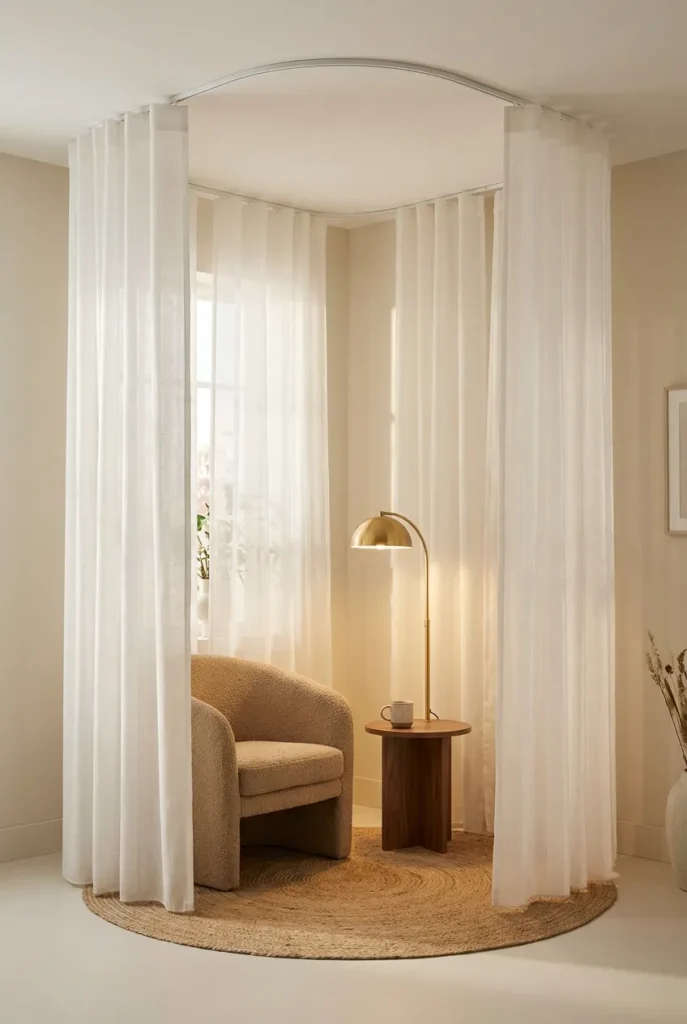
A flexible aluminum curtain track (the kind sold for shower stalls) mounted to the ceiling in a U-shape around the back and sides of a chair. Sheer panels run along the entire track. Open them when guests come. Close them when you don’t want to be found.
11. The Bookshelf-as-Wall Curtain (Hybrid)
If your nook backs onto an open bookshelf, hang a thin linen panel on a track across the bookshelf face. You get the cozy enclosure without giving up your books. Pull the curtain back during the day to display the shelves.
12. The Cottagecore Floral Tieback (Window Nook)
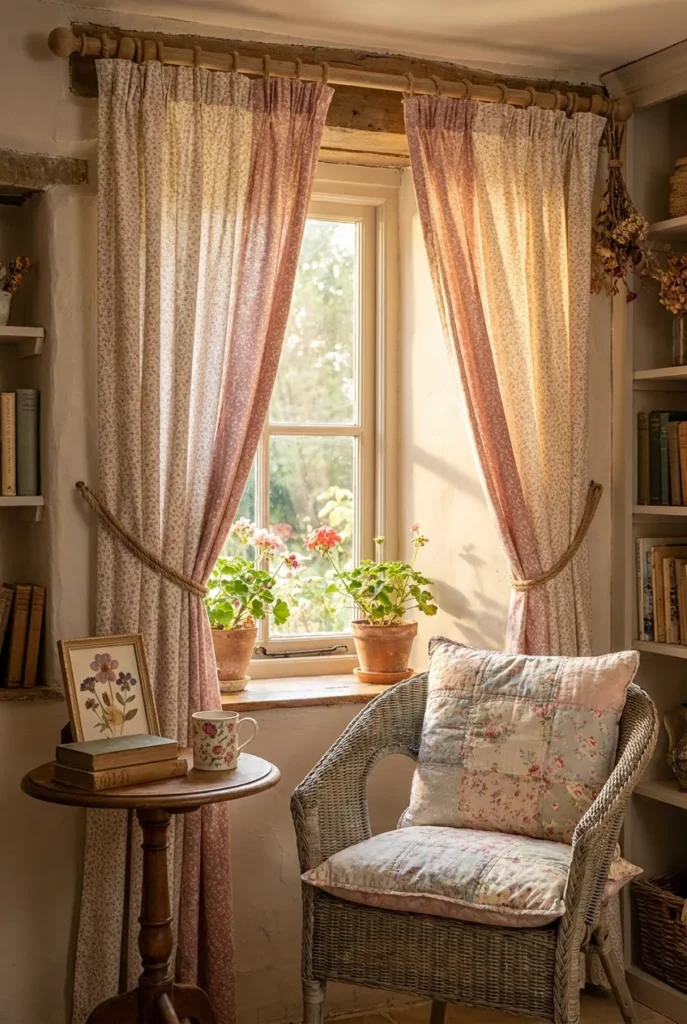
Light floral cotton panels with rope tiebacks at chair-shoulder height. The tiebacks shape the curtain into a soft hourglass that frames the seat below. One sensory beat that sells this look: the smell of clean cotton in afternoon sun.
Common Mistakes That Wreck the Look
A few quick fails to avoid. Hanging the rod at window-frame height instead of 4 to 6 inches above it makes the ceiling feel lower and the window feel smaller. Buying panels exactly the width of the rod gives you a flat, sad curtain instead of a draped one (you need double the width). Mixing fabric weights in the same nook (a heavy velvet next to a flimsy sheer with no transition layer) reads cluttered. Skipping the dimmer on your reading lamp so your warm 2700K bulb still reads like a dentist’s office at night. Choosing pure white curtains in a warm-toned room makes the white feel blue and clinical instead of soft.
Honest trade-off worth naming. Floor cushions and canopy curtains photograph beautifully. After 40 minutes of reading, your back will disagree with the floor cushion. Pair a canopy curtain setup with a real chair, not a cushion alone, if you plan to sit there for more than a podcast episode.
FAQ
How do you furnish a reading nook?
Start with the seat. A single accent chair, a built-in bench, or a window seat with cushions. Add one soft layer (throw blanket plus lumbar pillow), one focused light source at 2700K, a small side table within an 18-inch arm reach, and curtains or a canopy to enclose the space. Five elements maximum. More than that and the nook reads as a tiny living room.
How do you cover a bookshelf with a curtain?
Mount a thin tension rod inside the top of the bookshelf frame, or attach a slim curtain track to the underside of the top shelf using small L-brackets. Hang a single panel of light linen, sized to the shelf width plus 30 percent for fullness. Pull the curtain across when you want a clean visual and back when you want to see the books.
What’s it called when you have curtains around your bed or chair?
A bed canopy if it’s over a bed. Four-poster drapes if the curtains hang from a four-corner frame. A reading canopy if it surrounds a reading chair specifically. Bed curtains, baldachin, and bed drapery are also correct historical terms.
What are the essential reading nook items?
A seat, a light source at 2700K with a dimmer, a small side table within 18 inches of your reading arm, one soft throw, one lumbar pillow, and a way to enclose or soften the space (curtains, a canopy, a rug, or a wall behind you). That’s the full kit.
Can I hang reading nook curtains without drilling holes?
Yes. Use a heavy-duty tension rod rated 20+ pounds for openings between two walls, adhesive ceiling-track mounts with 3M Command strips for canopies, or a single swag hook with a removable adhesive base for hanging-hoop styles. All three protect a renter’s deposit.
What fabric is best for reading nook curtains?
Medium-weight linen for most nooks (soft, drapes well, light-filtering). Sheer linen or muslin for canopy setups (lets the chair underneath stay visible). Velvet for dark academia or moody alcoves (heavy, sound-dampening, jewel-toned).
How long should reading nook curtains be?
Window nook curtains land at the sill, the apron, or the floor depending on the window. Alcove and closet curtains land at floor + 0.5 inch (a slight kiss, no puddle). Canopy curtains land at floor or chair-height depending on whether you want a full enclosure or a floating frame.
Pull This Together
You don’t need a bay window or a renovation budget for any of this. Pick your nook type from the 4-Nook-Curtain Map, choose your hanging method (most renters land on tension rod or adhesive track), match your fabric weight to the Quick-Spec Table, and copy the closest of the twelve real-room examples. Three decisions. One afternoon. A corner you actually want to disappear into.
Which of the four nook types is yours? Start there and the rest of the choices stop feeling overwhelming.
Keep reading
More cozy nook ideas
 Fall Decor
Read →
Fall Decor
Read →
Holiday Decor on a Budget: Where to Spend and Where to Save
If last December’s holiday decor money went to plastic picks, a glitter sign, and a box of red balls you were tired…
 Fall Decor
Read →
Fall Decor
Read →
21 Vintage Pumpkin Ideas for Small Apartments, No Porch or Nails Needed
No porch, no mantel, and a lease that frowns on nail holes. You still get a fall corner. You need one shelf,…
 Fall Decor
Read →
Fall Decor
Read →
14 Witchy Backyard Ideas for a Whimsical, Storybook Halloween
No old oak grove, no permission to dig, no money for a garden cottage. A witchy backyard still fits. You need one…
One Comment