
Bay Window Seat Reading Nook: 14 Ideas That Use the Full Bay

If your bay window is currently storing a dying spider plant, a stack of unopened mail, and a curtain rod three inches too short, this fixes it. You have a three-sided pocket of light most people leave dead. We are going to wake up every inch of it. The bench, the two side walls, the cushion depth, the lighting, the curtains. All of it. Fourteen ideas you can copy this weekend, with the measurements that actually matter and the rental-safe versions for the renters reading this in bed.
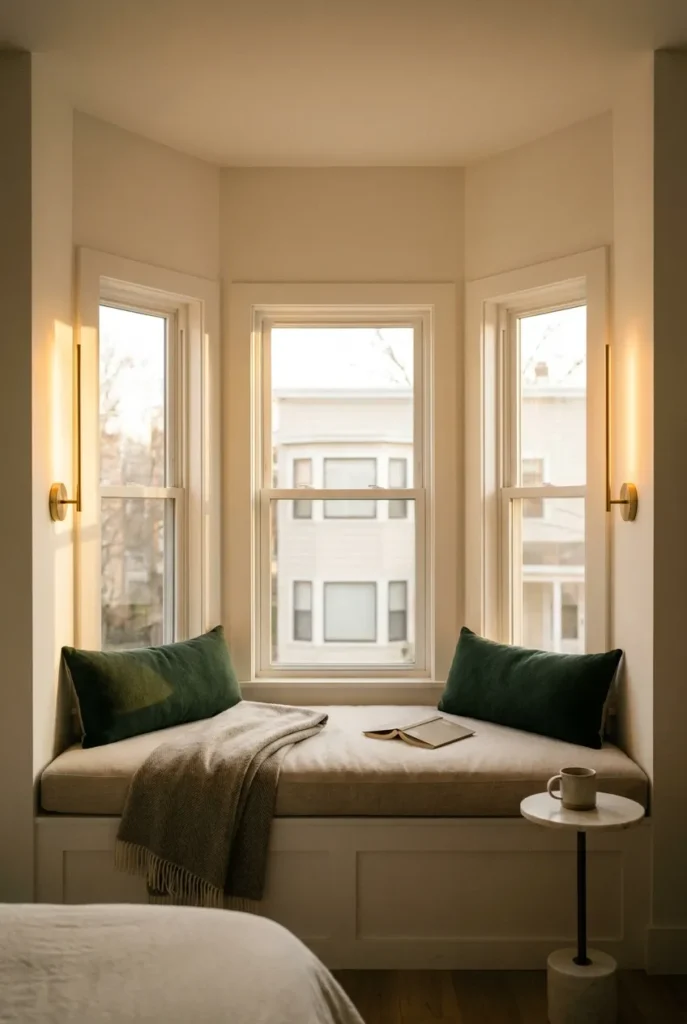
Use the Full Bay: The Three-Surface Rule
Here is the mistake almost every bay window reading nook makes. The bench gets a cushion. Done. Two big blank side walls stay empty. The ceiling pocket above stays empty. And the whole thing reads like a windowsill with a pad, not a nook.
The fix is what I call the Three-Surface Rule. Every working bay window reading nook activates three surfaces, not one.
- Surface 1, the seat. A bench or banquette, 18 to 22 inches deep, with a 4-inch cushion minimum so your sit bones do not bottom out after twenty minutes.
- Surface 2, the two side walls. Plug-in sconces, a slim picture light, a 6-inch ledge shelf for your mug, a small framed print. Not empty drywall.
- Surface 3, the ceiling. A curtain rod or café rod across the front of the bay so you can close out the cold at night, plus optional fairy lights or a slim picture light wired up high.
Read those three again. Most pins you save break one or two of them. The ones that feel finished hit all three. You can apply this rule to a $120 renter setup or a $2,400 custom build. The framework does not change.
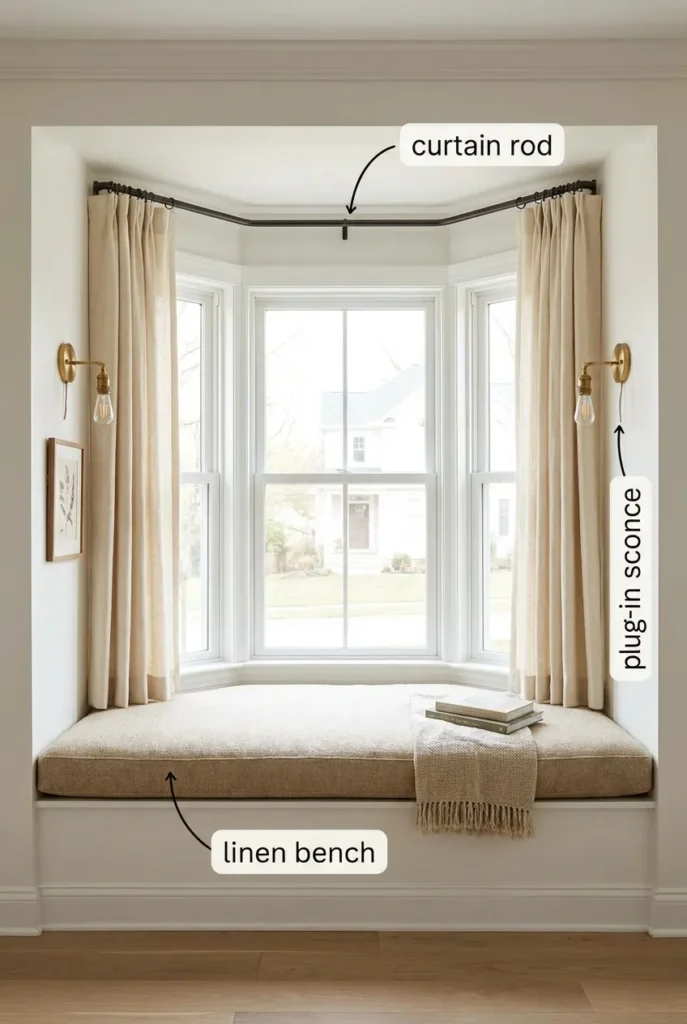
1. The Built-In Bench With Hidden Storage
This is the upgrade most people picture first, and it earns the hype if you do it right. A bench built flush to the three sides of the bay with a lift-up lid or front drawers underneath. Inside: a queen-size duvet you only pull out in October, a basket of paperbacks, your winter throws.
Real numbers: 18 inches tall to the cushion top so your knees sit at roughly 90 degrees. Add 4 inches for the cushion and you land at 22 inches finished — the standard sitting height. Build the box from 3/4-inch plywood, face it with shaker panels, paint it the wall color so the bay reads taller. The longer write-up with cushion math and the cut list lives in our full step-by-step window seat reading nook build guide if you want the deeper version.
Failure mode: build it 20 inches tall, add the cushion, and now you are perched at 24 inches with your feet dangling. Measure twice.
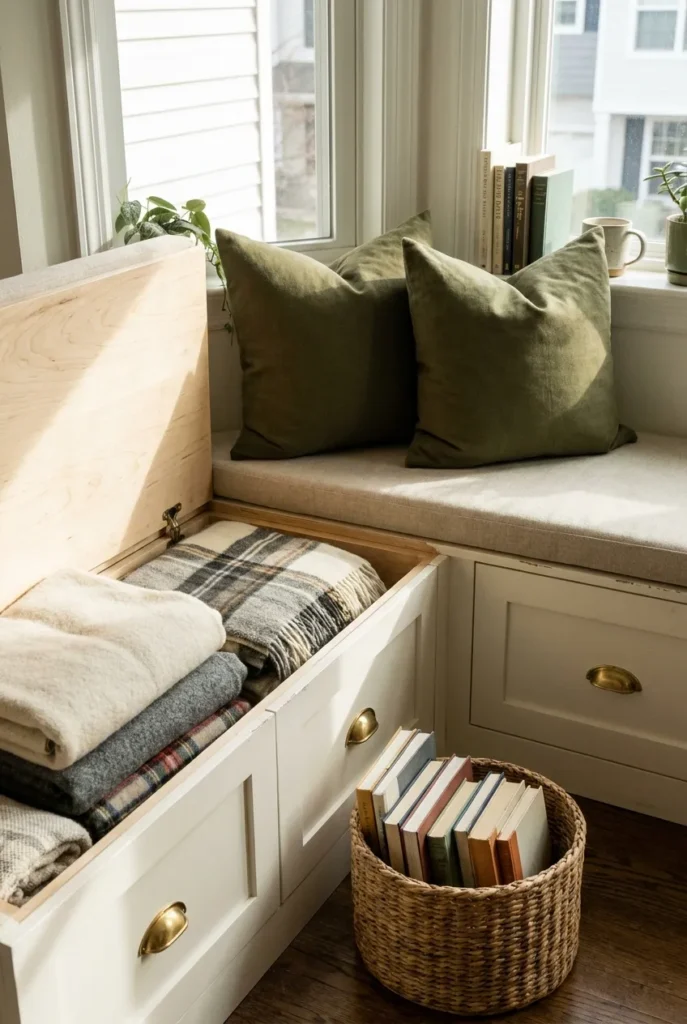
2. The Renter-Safe Drop-In Bench (No Drilling)
For anyone whose lease says “no anchors, no holes,” here is the workaround. A freestanding storage bench (IKEA Pinnig, the Article Helmer storage bench, or any 60 to 72-inch upholstered ottoman bench) sized to the front opening of the bay. Push it in. Done. No drill. No screws. Deposit safe.
You lose the three-sided wrap-around feel you get with a custom build, but you gain a piece you can take when you move. Add a 4-inch foam topper cut to the bay shape (any local foam shop will cut it for $30 to $80) and you get the wrap effect without the carpentry. We cover ten more no-drill setups like this one in the reading nook for renters no-drill setups guide.
Failure mode: skipping the foam topper. The bench is 16 inches deep, the bay is 22 inches deep, and that 6-inch gap behind your back will eat every pillow you try to stuff into it.
3. The Daybed-Style Bay (Long Bays Only)
If your bay window is 70 inches wide or wider, skip the bench and drop in an Article Sven daybed, a West Elm Eddy daybed, or an IKEA HEMNES day-bed frame. Now you are reading reclined, full leg extension, the way you actually read on a Sunday.
The trick is the headboard side. Push the headboard end toward the wall the morning light hits last so the page does not glare at noon. Layer a fitted sheet, two euro shams stacked against the wall, two standard pillows, and one bolster at the foot. Total textile budget: $180 to $260 if you shop HomeGoods and Target.
Failure mode: a daybed in a bay shorter than 65 inches. You will block half the window with the headboard and the room loses its best light source.

4. The Cushion Formula That Stops Numb Legs
Most bay window reading nook fails come down to the cushion. Too thin, your tailbone hates you in 15 minutes. Too thick, your knees ride up and your lower back rounds.
The formula that works: high-density foam, 4 inches minimum, density rating 1.8 lb or higher (this is on the foam supplier’s spec sheet, ask before you buy). Wrap it in 1/2 inch of polyester batting so the edges stay soft. Cover in a linen-cotton blend, not pure linen — pure linen wrinkles into a sad raisin within a week.
For a 60-inch by 22-inch bay seat, expect to pay $120 to $220 for a custom-cut foam-plus-cover combo from a local upholsterer in 2026. Pottery Barn and Crate & Barrel sell window seat cushions in stock sizes for $189 to $349 if your bay matches a standard footprint.
Failure mode: buying a cheap 2-inch chair pad and calling it done. You will not sit there.
5. Layer the Pillows Using the 60/40 Rule
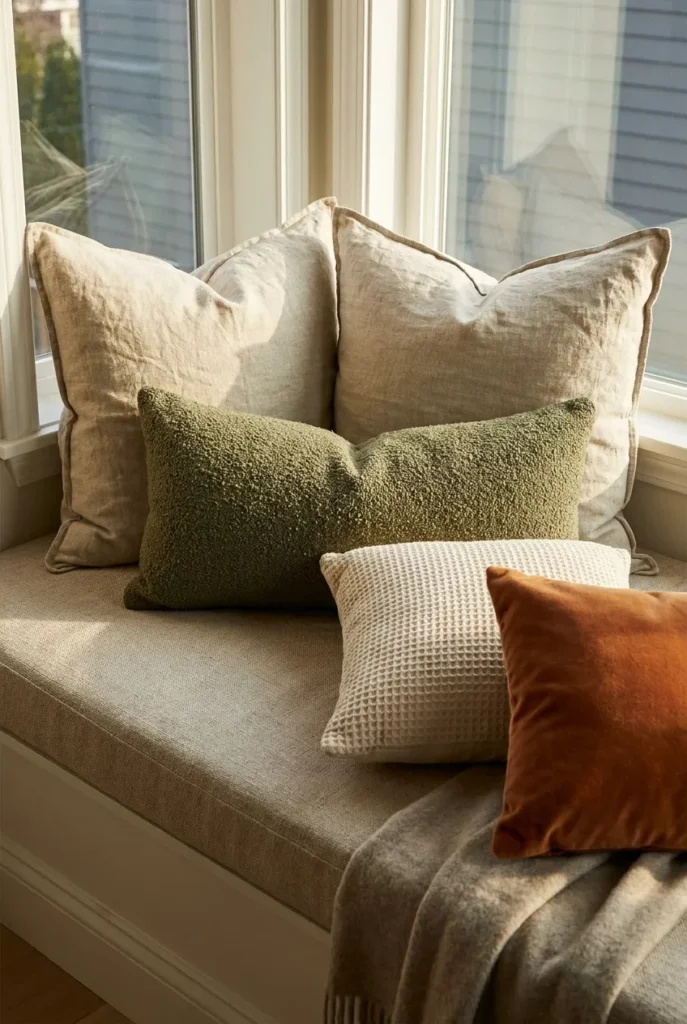
Once the cushion is right, the pillow stack makes or breaks the look. The 60/40 rule: 60 percent of your visible pillow real estate is back support (large, structured), 40 percent is decorative (lumbar, small squares).
For a standard bay, this works out to: two 20-inch euro squares at the back corners, one 12 by 22-inch lumbar centered, two 18-inch decorative squares in front. Five pillows, three roles. Anything more and you are excavating to sit down.
Texture mix matters more than color matching. One boucle, one linen, one velvet, one knit, one washed cotton. The eye reads richness, not chaos. The right reading nook accent chair styling guide breaks down the same texture-layering logic for chair-based nooks if your bay setup ends up using a chair instead of a bench.
6. Plug-In Sconces for the Side Walls (No Electrician)
The two side walls of a bay window are prime sconce real estate, and almost every nook on Pinterest leaves them naked. Here is why that matters: an overhead bedroom light leaves a shadow on the page right where your hand crosses the book. A side-wall sconce hits the page from the angle a reading light should.
Hard-wired sconces require an electrician and $300 to $600 in labor. Plug-in sconces (Pottery Barn, Lamps Plus, Schoolhouse, or any Amazon swing-arm plug-in) install with two drywall anchors and a hidden cord channel. Mount the bottom of the shade at 52 to 56 inches off the floor so the light hits the page when you are sitting upright with a hardcover in your lap.
Bulb spec: 2700K, 60-watt equivalent, on a dimmer. Skip the dimmer and your warm bulb still reads like a dentist’s office at full power. We covered the full bulb-and-fixture math in our lighting-focused pieces, but the headline is: 2700K, dimmable, plug-in, side wall.
7. The Curtain Move Most People Skip
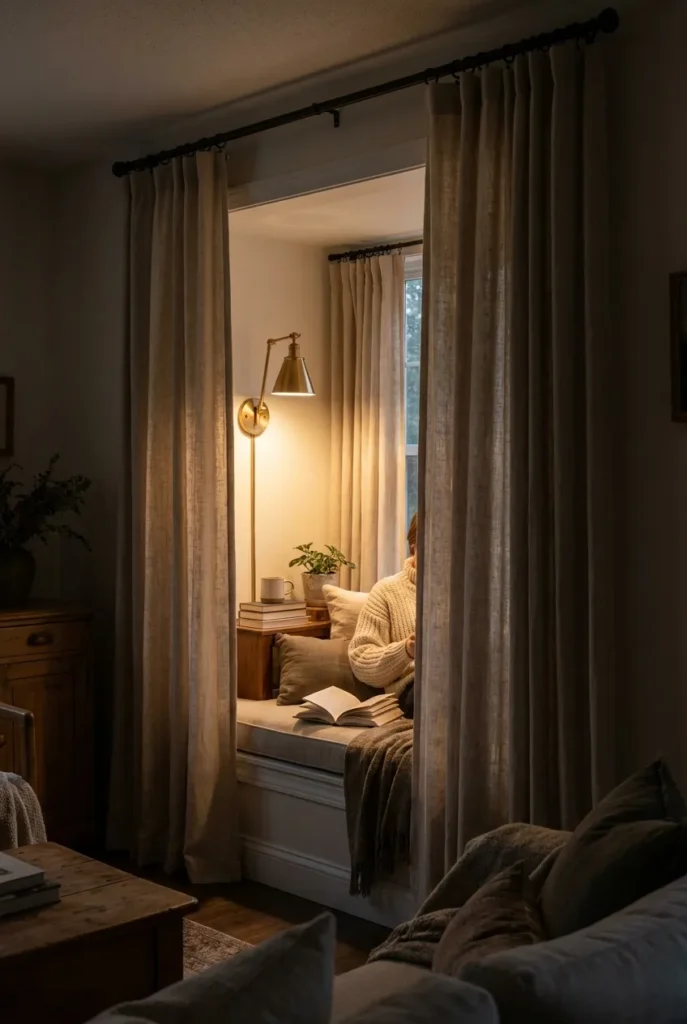
A bay window reading nook with no curtain across the front is just a windowsill with a cushion. The curtain is what turns it into a nook. It cocoons the seat at night, softens the cold radiating off the glass, and signals to your brain that this is a separate room within a room.
Two options. Inside the bay: run a curved or hinged curtain rod that follows the three sides, hanging sheers or café curtains close to the glass. Across the front of the bay: hang a single straight rod with full-length linen curtains that can be pulled completely closed, creating a literal curtained-off pocket. The second option is the cozier one. Tension rods make it renter-safe.
Failure mode: curtains that puddle on a dusty floor inside the bay. You will hate dusting them. Hem them to kiss the floor, not pool.
8. Fix the Cold-Glass Problem Before October
This is the topic every styled pin pretends does not exist. Bay windows are colder than the rest of the room. You have three glass surfaces, often older single-pane or basic double-pane, and your shoulder is pressed against one of them while you read.
What works: pair an interior storm window panel with a heavy lined curtain. Energy Star data shows that low-e storm windows installed over single-pane clear glass can save homeowners around $350 per year on heating and cooling, and they cut the cold radiant chill in a bay dramatically. For the cushion itself, swap your linen cover for a wool felt or sherpa cover from November through March. The fabric does the work the glass cannot. ENERGY STAR
For the technical nerds, the Building America Solution Center’s guide to high-performance windows covers U-factor, low-e coatings, and argon-filled glazing if you are weighing a full replacement. For the rest of us, a $40 thermal liner behind the curtain and a thicker cushion cover gets you 80 percent of the way there.
Failure mode: ignoring this and abandoning the nook every December. The cold will win and the corner becomes storage again.
9. The Victorian Bay Window Reading Nook
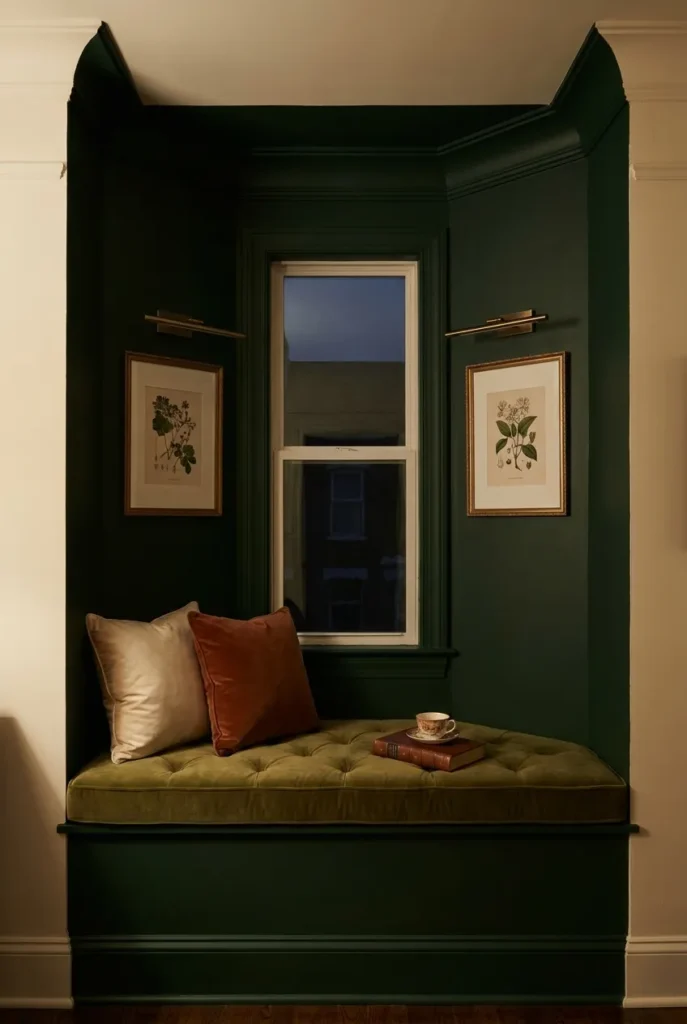
Older homes — Queen Annes, Italianates, classic Victorians — often have splayed bay windows with deeper sills and taller ceilings. Lean into the architecture. Paint the inside of the bay a deeper shade than the surrounding wall (forest green, ink blue, oxblood). Hang a small framed print on each splayed side wall. Use a tufted velvet bench cushion in a moody color. Add a single brass picture light up top.
This is the bay window reading nook aesthetic that performs hardest on Pinterest right now under the “Victorian” pill. It also happens to suit how Victorian bays were originally used: as a separate sitting pocket, slightly removed from the main room.
Failure mode: pairing a tufted velvet cushion with bright modern sconces. The styles fight. Match the metals, match the era.
10. The Bay Window Reading Nook for Kids
Two changes from the adult version. First, drop the bench height to 14 inches so a 6-year-old can climb on and off without help. Second, replace the structured cushion with a stack of washable floor cushions — kids will not sit flat for an hour, they will sprawl and flip and use the bench as a base.
Add a clip-on book light to one side of the bay so they control their own reading light. Hang fairy lights along the curtain rod for the bedtime-story magic. Keep the curtain on a tension rod so it survives the inevitable tug.
Storage upgrade: forward-facing book ledges on the side walls. The covers face out, the kid can see what they own, they pull a book instead of forgetting they have it.
Failure mode: matching adult bay window reading nook proportions for a kid. The cushion will be too tall, the pillows will swallow them, the books will be out of reach.
11. The Mini Side Table Inside the Bay
Within reach is everything. A reading nook where you have to get up to set down your mug is a nook you will use twice. Inside the bay or right beside it, you need a 16 to 20-inch tall side surface. Anything taller than the cushion top plus 6 inches and you will be reaching up.
Options that work inside a bay footprint: a 12-inch round drum table (Target, $40 to $70), a stack of two hardcover art books with a coaster on top (free if you own the books), a small C-table that slides under the cushion edge (Article, Wayfair, $90 to $160).
This is also where the 18-inch reach rule applies. From your seated position, your mug, your phone, your reading light switch, and your book all need to be within an 18-inch radius of your shoulder. Anything outside that radius will go unused.
Failure mode: a coffee-table-height side table next to a 22-inch finished seat. Your mug is now at chest height. You will spill.
12. The Bay Window Reading Nook With a View
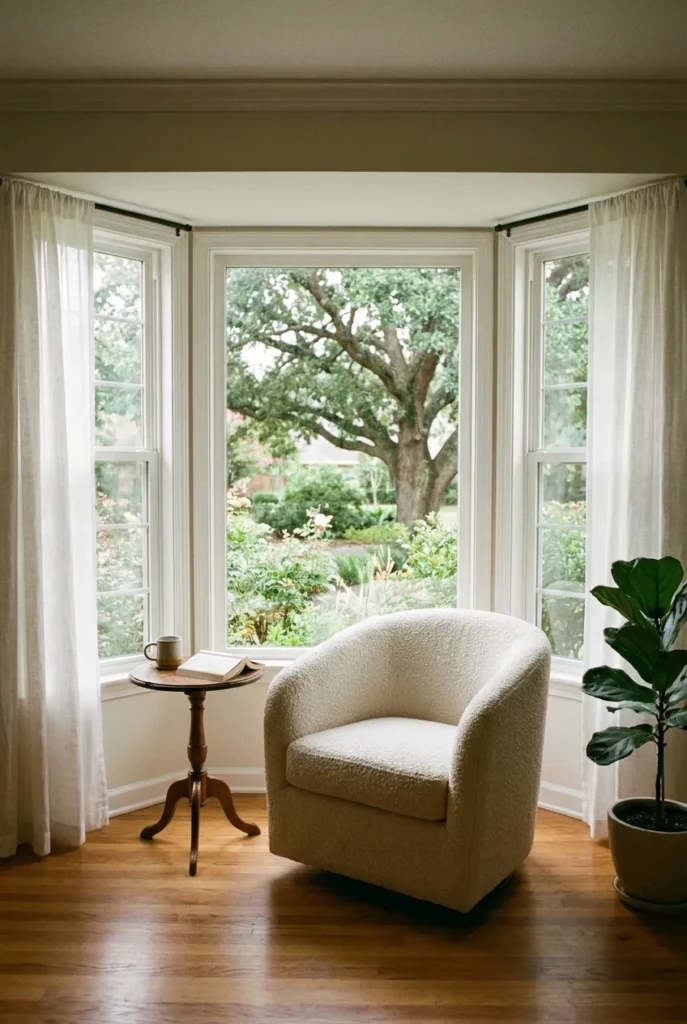
If your bay overlooks a garden, a tree line, or a street with character, orient the nook to use the view. This means facing your seat toward the center pane, not parallel to it. A built-in bench naturally does this. A daybed does not — the daybed has you facing the side wall.
For a chair-based bay setup, place a single accent chair (any IKEA Strandmon, an Article Sven chair, or a swivel armchair around the $300 mark) at the front-center of the bay, angled 15 to 20 degrees off the center pane so you get the view but the chair does not block sightlines from the room.
Add sheer curtains, not blackout. You bought the view, do not block it.
13. Add Wallpaper Inside the Bay Only
A trick interior designers use that almost no DIY blog covers: wallpaper only the inside of the bay (the three walls behind and beside the bench), not the surrounding room. The bay becomes a framed picture. The eye reads it as intentional, not maximalist.
Peel-and-stick wallpaper from Tempaper, Spoonflower, or Chasing Paper makes this renter-safe and a single-afternoon job. Pick a pattern with a small repeat — toile, William Morris-style botanical, or a tonal stripe. Avoid huge geometric prints in this small enclosed space; the scale fights the bay.
Pair with a solid bench cushion in a color pulled from the wallpaper. Now the whole bay looks designed.
Failure mode: wallpapering the inside of the bay AND the adjacent wall. The bay loses its picture-frame effect and the room reads cluttered.
14. The Lighting Layer Most People Get Wrong
Final idea, and the one that takes a good bay window reading nook from “nice” to “I never want to leave.” Three layers of light, not one.
- Ambient: the daylight from the bay itself plus the room’s overhead. Daytime only.
- Task: the sconce or swing-arm lamp on the side wall, 2700K, dimmable. Evening reading.
- Accent: a string of warm fairy lights along the inside top of the bay or a slim picture light over a piece of art. Mood layer.
Wire them on separate switches if you can. At 8 p.m. you want only the task light on for reading. At 10 p.m. you want only the accent light on for winding down. One switch killing everything at once breaks the room.
A real wattage note: do not exceed 60-watt equivalents in any fixture inside the bay. The space is small and reflective. You will overlight it and lose the cocoon.
Frequently Asked Questions
Are bay windows out of date?
No. Bay windows are tied to architectural style, not trend cycles. They appear in homes built from the 1880s through 2026, and the demand for natural light and added square footage keeps them in current new-build floor plans. They date themselves only when the surrounding finishes (vinyl trim, mauve carpet) do.
How do you make a reading nook in a bay window?
Start with the Three-Surface Rule. Add a bench or daybed sized to your bay’s footprint, a 4-inch high-density foam cushion at minimum, two plug-in sconces on the side walls at 52 to 56 inches off the floor, a curtain rod across the front of the bay, and a side table within an 18-inch reach of your shoulder. That is the working spine. Style and color come last.
Do bay windows increase home value?
They often do, especially in older homes where the bay is original architecture. They add usable square footage, natural light, and a feature buyers list as “must-have” in listing searches. The exact dollar bump depends on local market and condition, so talk to a local real estate agent for your area’s number.
How much does a 10-foot bay window cost?
In 2026, a 10-foot bay window replacement runs roughly $2,500 to $6,500 installed, depending on glazing (single, double, low-e, argon-filled), frame material (vinyl, fiberglass, wood), and labor rates in your zip code. Custom historic-match wood frames can push past $9,000.
Can I build a bay window reading nook if I rent?
Yes. Skip the built-in bench. Use a freestanding storage bench sized to the bay footprint, plug-in sconces (no hardwired electrical), tension-rod curtains, peel-and-stick wallpaper, and a removable foam topper for the wrap-around feel. Everything packs up when your lease ends.
What size cushion do I need for a bay window seat?
Measure the seat width at its widest point, the seat depth from the back wall to the front edge of the bench, and add a 4-inch minimum foam height. For a standard 60 by 22-inch bay seat, expect a custom cushion to cost $120 to $220 from a local upholsterer or $189 to $349 from Pottery Barn and Crate & Barrel in 2026.
Why is my bay window reading nook so cold in winter?
Three glass surfaces means three times the heat loss compared to a single window. Pair an interior storm panel or thermal curtain liner with a wool or sherpa cushion cover from November through March. A long-term fix is replacing the glazing with low-e double or triple pane, but the curtain-plus-cover combo gets you most of the way for under $80.
The Quiet Reward
A bay window reading nook is not a renovation project. It is three surfaces you already own, one cushion that fits your body, two sconces aimed at your page, and a curtain you can pull at 9 p.m. The math is small. The reward is sitting down on a Saturday afternoon, hearing the rain on three sides of glass, and reading for two hours without standing up once.
Which of the 14 ideas above fits your bay? If you only steal one, make it the Three-Surface Rule. Everything else flows from there.
Keep reading
More cozy nook ideas
 Small Spaces
Read →
Small Spaces
Read →
10 Small Reading Nook Ideas for Adults
One high-back chair, one clamp-on lamp, one $19.99 tray table. At IKEA US prices this month, that’s a full reading corner for…
 Home Library & Bookshelves
Read →
Home Library & Bookshelves
Read →
14 Ideas for a Fireplace with Bookshelves on Each Side on a Budget
Two bookcases, two plug-in lamps, two wall straps. At IKEA US list prices this month, that adds up to $237.98 before tax,…
 Study & Craft Nooks
Read →
Study & Craft Nooks
Read →
16 Kids Homework Station Ideas Little Ones Will Love
Two IKEA pieces, one empty corner, $109.98 before tax. That’s the first kids homework station on this list, and it fits in…