
10 Library Wall Ideas for Book Lovers With One Blank Wall

No custom millwork, no contractor, no awkward conversation with a landlord. A library wall comes down to three decisions: how deep the shelves run, where the light lands, and what you sit in once the books are up. Two of the ten ideas below need no wall anchors at all, and the rest need screws small enough to patch with a $3 tube of spackle.
Most library wall ideas online were photographed in houses with ten foot ceilings and a five figure joinery budget. Beautiful work. Not much help when your blank wall is nine feet of rental drywall with a radiator in front of it.
So this list runs the other direction. Ten ideas sized for rooms between 600 and 1,400 square feet, with real shelf loads in pounds so nothing sags by spring, and one two-bookcase build that puts $158 of shelving around a chair you already own.
A few of these finish in an afternoon. A couple are weekend projects. All of them assume the point is reading, not photographing an empty shelf.
Start at number one if your lease has opinions about holes.
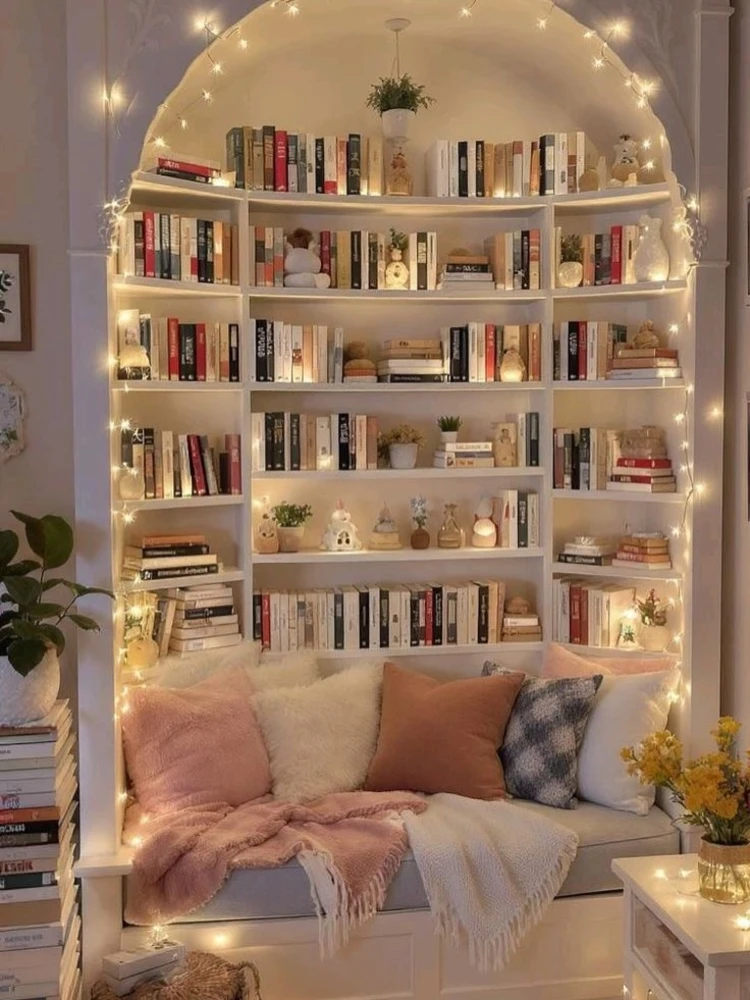
1. The Ledge Wall That Takes Six Screws and Shows Every Cover
Four and three quarter inches deep. That is all a picture ledge needs to hold a book face out, and it is why this sits at number one instead of number five. Three IKEA MOSSLANDA ledges at 45 1/4 inches run $19.99 each, mount with two screws apiece, and leave six holes you can fill with spackle on your last day in the apartment.
Space them roughly 14 inches apart so a hardcover clears the shelf above. Books sit one row deep with covers out, which turns a hallway or a stair wall into something closer to a bookstore display than storage.
Load is the real limit. Each ledge is rated to 16.53 pounds, roughly eight average hardcovers, so treat it as a rotating shelf for what you are reading now.

2. Two Billy Bookcases, One Chair, One Saturday
Built-ins are the fantasy. Two flat-pack bookcases pushed together are the version that actually happens in a rental, and from six feet away almost nobody can tell.
An IKEA BILLY in white runs $79 and measures 31 1/2 inches wide, 11 inches deep, 79 1/2 inches tall, with five shelves. Stand two of them with a gap between and you get a 63 inch run of shelving for $158. Leave 30 to 34 inches of that gap for a chair, and the negative space in the middle is what sells the built-in look.
Anything approaching 80 inches tall gets anchored to a stud, no exceptions, no matter how solid it feels while it is empty.
Safety note: anchor tall furniture to the wall, keep candles and cords away from fabric, and use a licensed electrician or contractor for hardwired lighting, ceiling mounts, or anything structural. The CPSC furniture anchoring guidance covers bracket types and explains why children climb open shelving in the first place.
⚠️ Watch Out
Renters skip anchoring because they picture drywall damage. The real trade is two #8 screws into a stud per bookcase, hidden behind the top shelf, patchable in five minutes with spackle and a putty knife. An anti-tip strap kit runs $10 to $15. That is the entire cost of not having a loaded 80 inch bookcase come down.
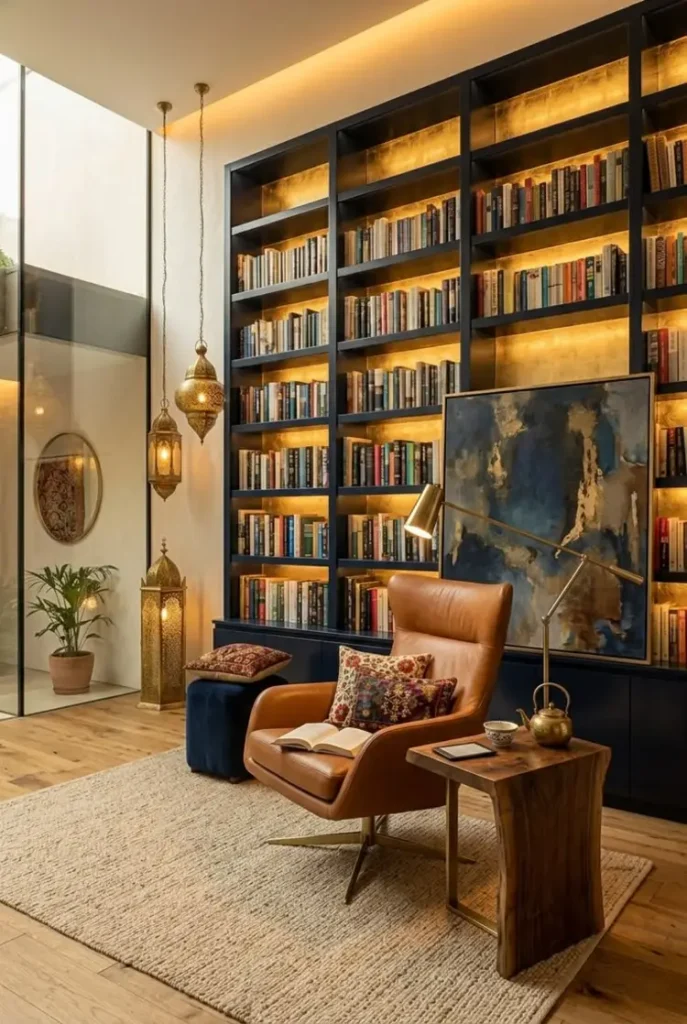
3. Stagger the Depths So the Heavy Books Sit Low
Sagging shelves are why most homemade library walls look tired by their second winter. Weight is usually the culprit rather than span, and almost nobody checks it before buying.
Run the deep shelves along the bottom, 11 to 12 inches for atlases and art books, then taper toward 8 inches near the ceiling where paperbacks live. Fiction and standard hardcovers only need about 8 inches of depth. The wall gets visually lighter as it climbs and the mass sits low, which is also how it should sit for stability.
Here is the number worth writing on your hand before you shop.
The 6/20/32 Load Rule: measure your shelf run in feet, multiply by the number above, then check it against the rating on the box.
Run that math on a BILLY and it gets interesting. A full 31 1/2 inch shelf of paperbacks weighs about 16 pounds. The same shelf packed with 9 by 11 art books lands near 84 pounds, past the 66 pound per shelf rating IKEA prints on the box. Our weekend Billy bookcase build with real measurements works through the same numbers around a daybed.
[NO IMAGE PROMPT: the 6/20/32 Load Rule card carries this entry.]
4. Bridge the Doorway and Steal the Wall Above It
Above a doorway sits 12 to 18 inches of wall that nobody uses. One shelf spanning that gap links two separate bookcases into a single continuous run, and a $15 board is the whole cost of making flat-pack furniture read as joinery.
Measure between the two bookcases at the top, then take off 1/4 inch so the board drops in without a fight.
Have the store cut a 3/4 inch pine or plywood board to length, then paint all six faces to match the cases.
Rest it across both bookcase tops and drive two screws down through the board into each cabinet top.
Keep the loaded bridge under 30 pounds and leave at least 80 inches of clear head height underneath.
Paperbacks only up there, and nothing you reach for daily. A doorway bridge is display height, not working height, and a stack of hardcovers over a door is a bad idea in an old building where the frame is already doing structural work.
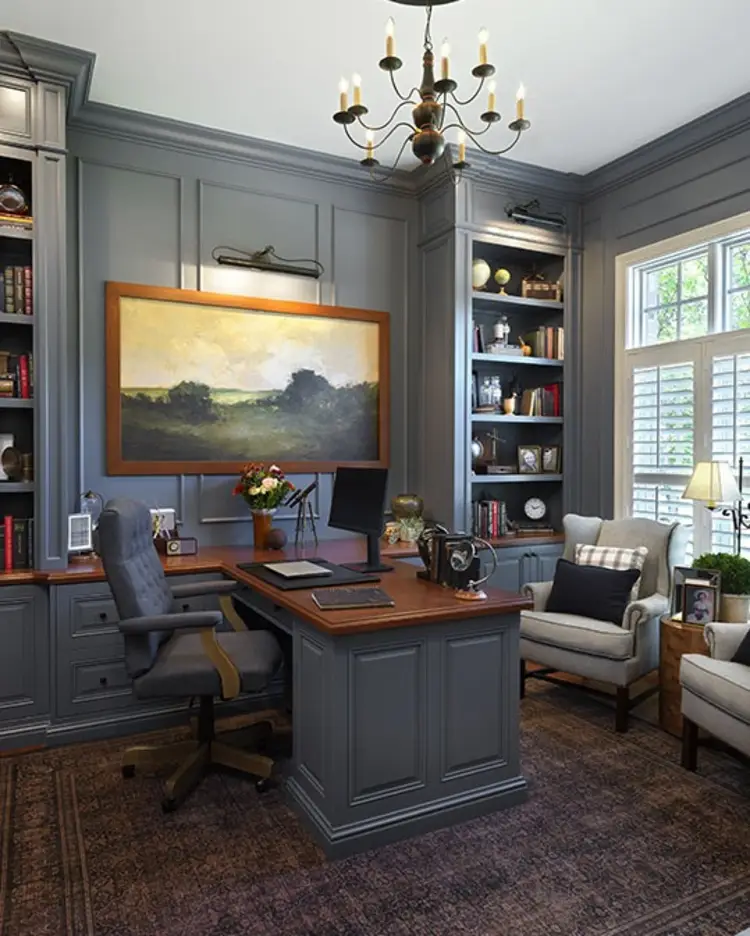
5. Paint the Back Panel Dark and Let the Spines Do the Talking
Designers spent 2026 wrapping whole rooms in bookcases, a look Homes and Gardens has been calling the library wrap. The full version needs joinery and a quote. The rental version needs a quart of paint and one Saturday.
Paint the back panel only, and leave the frames and shelf edges light. White shelves against a deep plum, forest, or oxblood back push the books forward and give a $79 bookcase visual depth it did not come with. Painting the entire unit dark does the reverse, swallowing the spines into one flat mass.
Plum Noir turned up in Pinterest’s 2026 color list, and it happens to sit exactly right behind cream and tan paperback spines.
White shelves against a white back panel on a white wall. The books float in a pale blur and the unit reads as office storage, whatever is on it.
One quart of deep plum on the back panel. Spines snap into focus, the shelves look twice as deep, and the frames stay light enough that the wall does not close in.
Dark backs eat light, so plan the lamp in the same afternoon you pick the color. Our reading nook lighting setups for 2026 covers what a plug-in fixture can do without an electrician.
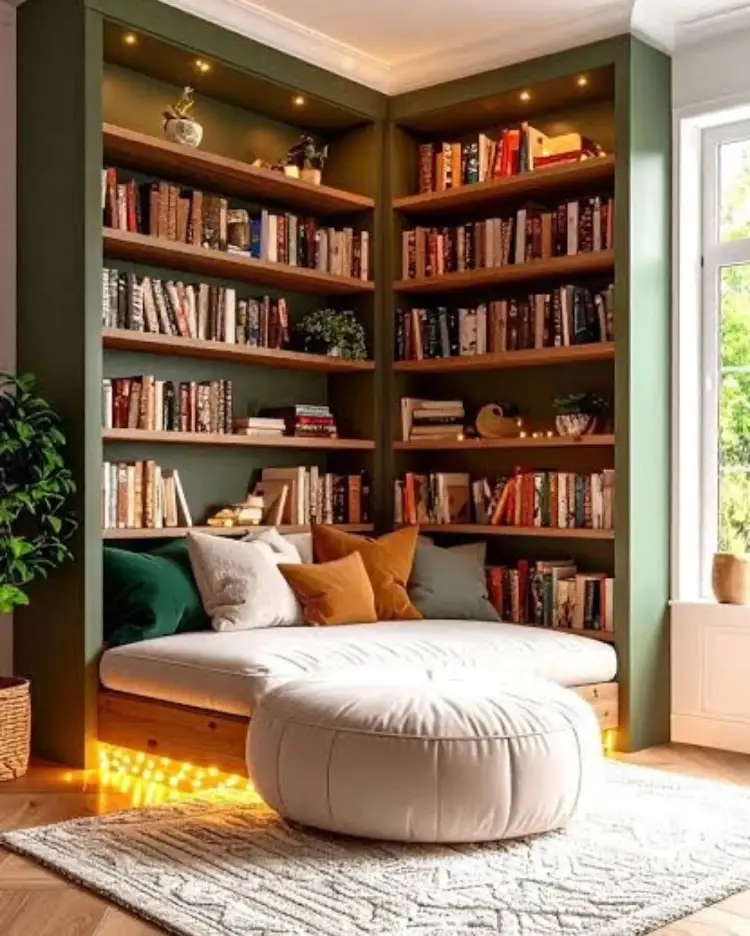
6. Light It at 2700K Before You Add Another Book
2700K is the number to buy, and it is worth knowing why. The Department of Energy puts 2700 to 3000 Kelvin in the warm range and recommends 2700 to 3600 Kelvin for indoor general and task lighting, noting that warm light flatters skin and fabric while cool light wins on contrast for close work. A library wall wants the first kind. A 5000K bulb over books makes an apartment feel like a pharmacy aisle.
| Warm 2700K | Cool 4000K and up |
|---|---|
| Wood and cream shelves read warm and settled. | Wood reads gray, white paint reads blue. |
| Right for evening reading and long sits. | Right for a desk, sewing, or detailed work. |
| Photographs golden, which is why pins glow. | Photographs flat and clinical. |
| Pair with a dimmer for a second setting. | Keep it out of the reading corner entirely. |
A plug-in swing arm sconce mounted 48 to 52 inches off the floor, just beside the chair, does more for a library wall than three more shelves would. Picture lights clipped to the top of a bookcase work too, and LED puck lights stuck under each shelf will wash the spines. None of these need an electrician, which is the whole point.
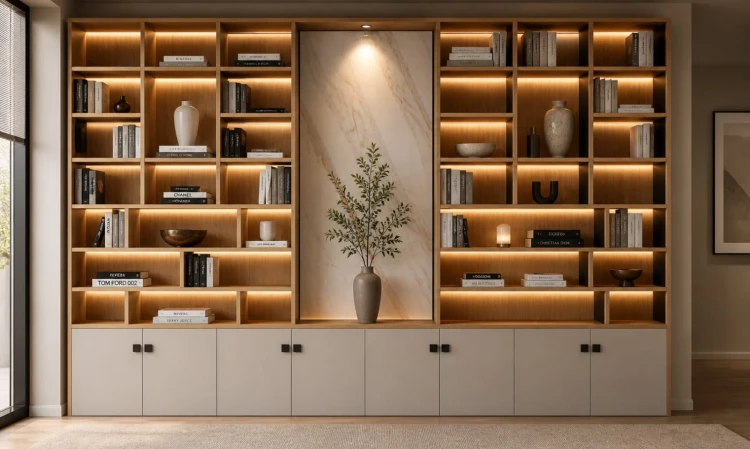
7. Leave One Shelf Half Empty on Purpose
Cram every inch and the wall reads as a storage unit. Stylists have a fix that costs nothing at all: pick one shelf at eye level and fill it to roughly 60 percent, then pack everything above and below as tight as you like.
Eye level lands near 55 to 60 inches for most adults standing, and that is the shelf a visitor looks at first. Give it air and the whole wall reads as deliberate. Give it three more paperbacks and the wall reads as a backlog.
What earns a spot on the breathing shelf
Color-sorting the rest of the wall is a matter of taste, and worth knowing the trade: rainbow shelves photograph well and make finding a specific title genuinely harder. Sort by color where the books are decoration, by subject where they are working tools.
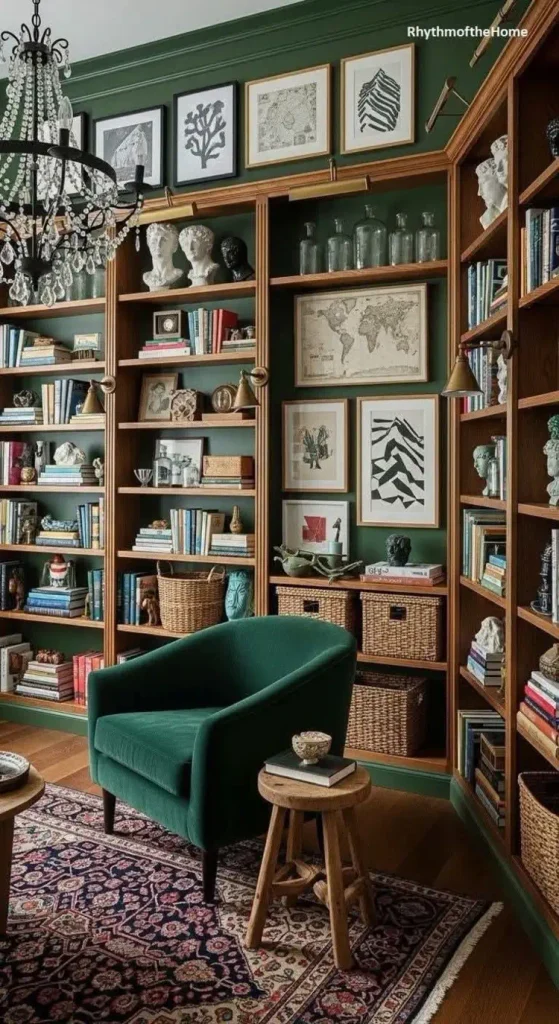
8. Build the Wall Around the Chair, Not the Other Way
Plenty of library walls get built, admired, and then read in from the couch across the room. Shelving went up first, the seat became an afterthought, and now the light comes from behind your shoulder and there is nowhere to put a mug.
Place the chair first. Tape its footprint onto the floor, sit down in it, and notice where your book lands, where your feet go, and which side your mug wants to be on. Then build shelving around that footprint.
| Piece | What to look for | Price |
|---|---|---|
| 📚 Shelving | Two IKEA BILLY bookcases, 31 1/2 x 11 x 79 1/2 in | $158 |
| 💡 Light | Plug-in swing arm sconce, no wiring | $30 to $60 |
| 🔆 Bulb | Warm 2700K LED, dimmable | $5 to $12 |
| 🔩 Safety | Anti-tip strap kit, one per bookcase | $10 to $15 |
| 🧶 Soft layer | Lumbar pillow and a wool or linen throw | $25 to $50 |
| Total | Using a chair you already own | $228 to $295 |
Thirty to thirty four inches of gap fits most armchairs with room to swing your legs out. Go under 30 and you will feel the shelf edges at your shoulders every time you sit, which is the quiet reason a nook goes unused. Our full guide to a reading nook with bookshelves walks through corner, window seat and rental versions of the same layout.
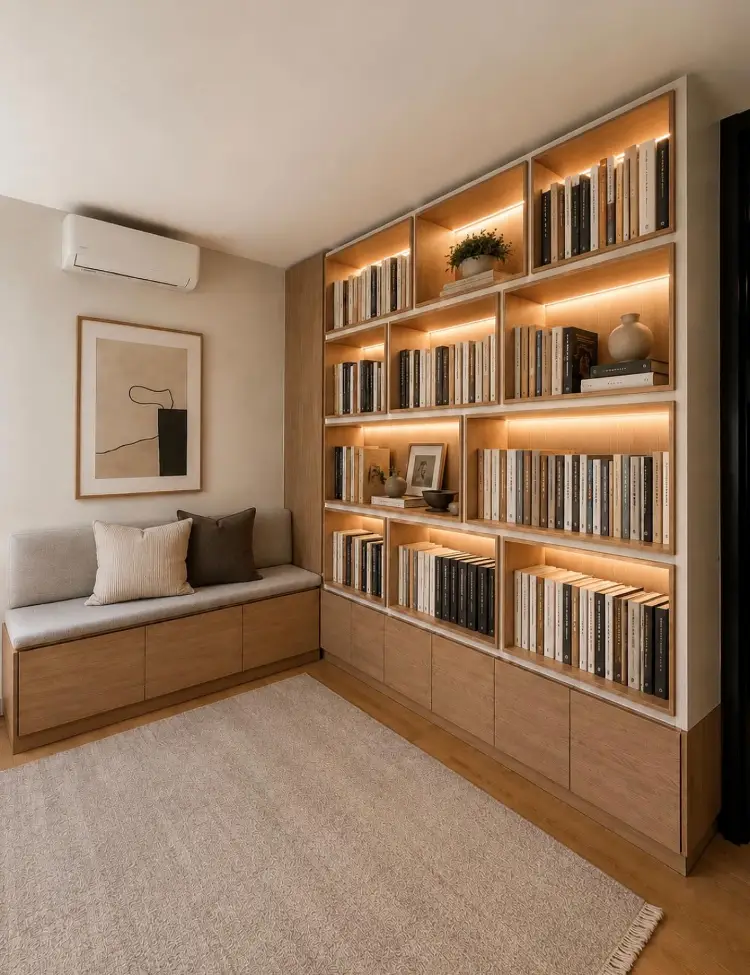
9. Lean a Ladder Shelf Where a Bookcase Will Not Fit
Eighteen months left on a lease and a wall you would rather not touch. A five tier leaning ladder shelf answers both, runs roughly $35 to $80 at Target and Walmart, and holds itself up by resting against the wall at an angle.
- ▸Narrow footprint, usually 20 to 24 inches wide, so it slides in beside a radiator or a closet door swing.
- ▸Shelves get shallower toward the top, which matches how books should be loaded anyway.
- ▸Lifts away from the wall in one motion on move-out day, leaving nothing behind.
- ▸Two of them flanking a window read as a library wall for under $160 all in.
- ▸Wrong choice in a home with climbing toddlers, because the angle that makes it stable also makes it a ladder.
Check the wall it leans against before you load it. Leaning shelves need a flat run with no baseboard heater, no thick trim, and no outlet where the top rail lands, and a carpeted floor lets the feet sink and shift the angle over a few months.
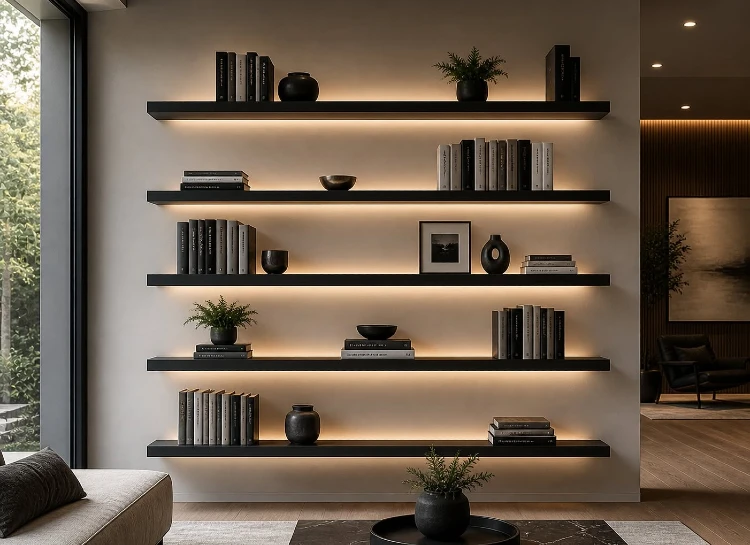
10. Turn the Corner and Wrap a Second Wall
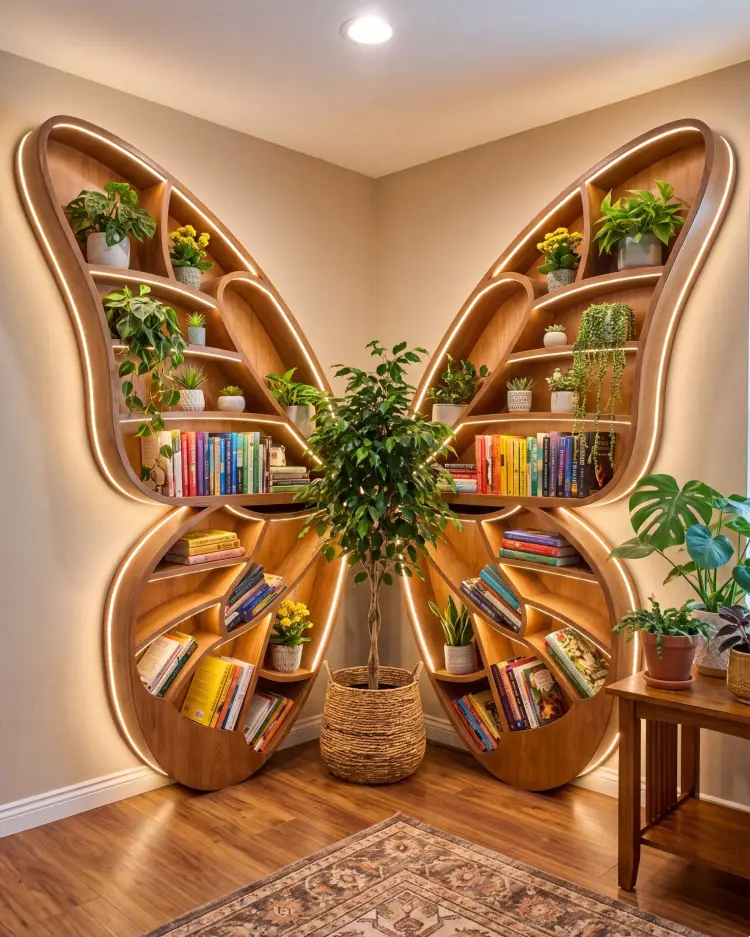
One wall of books looks like furniture. Two walls meeting at a corner look like a room built around reading, and the second wall usually costs exactly one more bookcase.
Most people stop at the corner because the inside joint is awkward. Where two units meet at ninety degrees, roughly 11 inches of shelf disappears behind the adjoining case. Give that dead depth a job that does not require reaching, folded blankets or a speaker, and keep the books out on the runs where you can actually pull them.
Match the shelf heights around the corner so the horizontal lines run unbroken. That single detail is what makes separate units read as one wall.
Paint or wrap the corner filler strip the same color as the frames.
Pushing both cases hard into the corner so the doors and drawers of one block the other.
Filing books you actually read into the dead corner depth, where you will need to unload a shelf to reach them.
Corner wraps are also where floor to ceiling starts making sense. Once shelving turns a corner, running it to the ceiling stops feeling top heavy and starts feeling architectural, and a crown molding board across the top of both runs finishes the illusion for the price of one piece of trim.
Frequently Asked Questions
What is a library wall?
A library wall is one wall of a room given over almost entirely to books, whether that is custom joinery, a run of flat-pack bookcases, or a set of picture ledges. What separates it from a bookcase is coverage: the shelving reads as part of the architecture rather than as furniture standing in front of a wall.
How much does a library wall cost?
It splits into two very different worlds. Custom millwork with a rolling ladder and integrated lighting climbs into the thousands once labor is included. A flat-pack version using two IKEA BILLY bookcases at $79 each totals $158 for the shelving, and a picture ledge wall of three MOSSLANDA ledges costs about $60.
How deep should library wall shelves be?
Eight inches handles paperbacks and standard hardcovers. Ten to twelve inches is what oversized and art books need, and eleven inches is the depth of a standard BILLY bookcase, which is why it fits almost everything. Picture ledges run about 4 3/4 inches, enough for one row of books facing forward.
Can you build a library wall without drilling into the wall?
Yes, with limits. Leaning ladder shelves and low freestanding bookcases need no anchors at all. Adhesive strips will not hold a shelf of books, so anything mounted takes screws. The honest renter version is small screws you patch at move-out rather than no holes whatsoever.
How do you style a library wall so it does not look cluttered?
Leave one shelf at eye level filled to about 60 percent and pack the rest tight. That single pocket of air is what stops a full wall from reading as backlog. Vary the rhythm too: mix upright rows with a few flat stacks, and let one or two covers face forward.
Will a library wall work in a small living room?
It often works better in a small room than a large one, because a wall of books gives a boxy space a focal point and depth it otherwise lacks. Keep the shelving shallow, eight to eleven inches, run it floor to ceiling to draw the eye up, and paint the frames to match the wall.
How do you light a library wall?
Aim for warm bulbs around 2700K, mounted so the light falls across the spines rather than behind you. A plug-in swing arm sconce at 48 to 52 inches beside the chair is the simplest fix. Picture lights on top of the case and LED puck lights under each shelf both work without wiring.
Where to Start
Pick the idea that matches your lease, not the one that matches the prettiest photo. If you rent, number one puts books on the wall this weekend for around $60. If you own the place and have a corner to spare, number ten is where a library wall stops looking like furniture and starts looking like architecture. Everything between those two is a question of how many Saturdays you want to spend.
One thing worth doing before you buy anything: sit in the chair you actually plan to read in and look at the blank wall for a full minute. Wherever your eye lands is where the good books go.
A library wall is not a shelving problem. It is a seat, a light, and a depth, and the shelves are just what holds the books while those three do the work.
Save this one to your reading nook board so the measurements are with you when you are standing in the aisle deciding between two bookcases.
Keep reading
More cozy nook ideas
 Home Library & Bookshelves
Read →
Home Library & Bookshelves
Read →
21 Modern Bookshelf Ideas for Small Spaces That Actually Fit
Your books are in three stacks on the floor and every bookcase you like is 32 inches wide. That is the whole…
 Home Library & Bookshelves
Read →
Home Library & Bookshelves
Read →
16 Dark Academia Library Ideas That Nail the Look Without Overdoing It
The fastest way to wreck a dark academia library is to buy one of everything. Skulls, fake cobwebs, five candle holders, a…
3 Comments