
How to Decorate Your Porch for Fall Without Drilling a Single Hole

No drill. No paint. No email to the landlord about the front door. Those three rules end most porch plans before the first pumpkin ever comes home.
They should not. Every idea below holds with adhesive, weight or plain gravity, and every one of them comes off clean in November. That is the whole promise of renter-friendly fall porch decor. Your deposit stays where it is, and your entry still looks like somebody lives there on purpose.
Here is the pattern I keep seeing on small porches. People spend the entire budget at floor level, then wonder why the whole thing reads flat from the sidewalk. The fix is not more stuff. It is putting the weight in the right three places.
You will get the no-drill hardware ratings straight from the manufacturer, a rule for where things go, price bands I checked this month, and a plan that carries one display from September all the way to Thanksgiving without a second trip to the store.
1. Start Here: The No-Drill Rules That Decide Everything Else
Before a single pumpkin, settle the hardware. Almost every renter problem on a porch is a hanging problem, and it has a published answer.
3M’s Command Outdoor line is rated for temperature extremes from -20°F to 125°F, is water and UV resistant, and is built to come off leaving no holes, marks or sticky residue. That last part is the whole reason it belongs in a renter’s toolkit.
The holding weights are published too, and they are lower than most people assume:
- Outdoor Large Bronze Hook: 5 lb
- Outdoor Large Clear Wall Hook: 4 lb
- Outdoor Terrace Hooks: 3 lb
Match the hook to the object, not to your optimism. A dense faux-foliage wreath can push past 4 lb once it soaks up a rainy week, and wind adds load that a static weight rating never accounts for.
Two rules that save you a reapplication. Adhesive needs a smooth, non-porous surface, so painted wood, vinyl, fiberglass, metal and glass are in, and rough brick, stucco and raw stone are out. And it needs the full set time printed on the pack before you hang anything, which is the step everyone skips at 9 p.m. on a Friday.
2. The Three-Zone Rule: Where Fall Porch Decor Actually Goes
Most small porches fail for one reason. Everything lands on the floor, so the display reads as a pile from twenty feet away.
Split the space into three bands and give each one job.
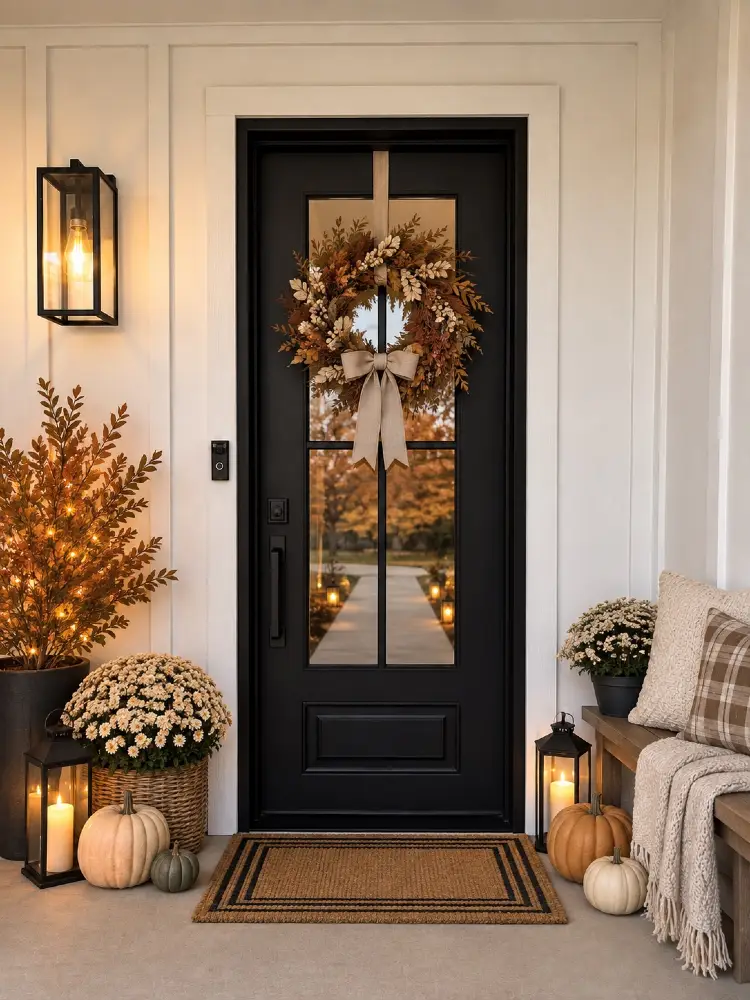
Door zone, roughly eye level and above. One object only. This is the thing a driver registers before they register anything else.
Step zone, knee height down to the boards. Groupings and mass live here, always in odd numbers and always at three different heights.
Sit zone, the corner nobody styles. Covered in section 8, and the reason your porch gets used instead of just photographed.
Fill the door zone first. One wreath finishes it, and it does the most work of the three, because it is the only band still visible once a delivery box, a pair of muddy boots and a folded umbrella colonize the floor by mid-October.
One object in the door zone. Three heights in the step zone. One seat you would actually use in the sit zone. Fill them in that order and a $60 porch reads finished.
3. Hang the Wreath With No Nail and No Hook At All
The wreath is the single highest-return piece of fall front porch decor, and it is also the one people damage a door over. Three ways around that, in order of how little they ask of you.
Hook the wreath over the top of the door on a slim over-door hanger. Zero adhesive, zero hardware. It rattles when the door slams, so pad the back of the hanger with a strip of felt.
Use a rated outdoor adhesive hook on the door face. Weigh the wreath on a kitchen scale first, then pick a hook rated above that number, not equal to it.
Skip the door entirely. Lean an oversized wreath against the wall beside the frame, resting on the floor. It reads intentional, and on rough brick it is the only option that works.
One sizing note that fixes most sad wreaths: a wreath should span roughly half to two thirds of your door width. A 22-inch wreath on a standard 36-inch door looks correct. An 18-inch wreath on the same door looks like it shrank in the wash.
Hang it at the vertical center of the upper half of the door, not dead center. Doors read taller that way, and the wreath clears a delivery knock.
4. Buy Three Pumpkins, Not Fifteen
Fifteen matching orange pumpkins is a photograph, not a plan. It also costs four times what a better-looking group costs.
Three works because three lets you vary every axis that matters: size, height and color. One large on the boards, one medium raised on an overturned pot or a crate, one small tucked in front. Different varieties beat different sizes of the same variety, so pull one classic orange, one white, and one of the blue-gray or green heirloom types.
Timing decides how long the group survives. A carved pumpkin lasts roughly 8 to 11 days even with a bleach-soak and daily-spray routine, while an uncarved one keeps for months in the right conditions. So carve nothing until the last week of October. Before that, paint or draw on them if you want decoration, because surface treatment outlasts a knife by weeks.
If your porch is a landing rather than a porch, the same grouping logic scales down to a windowsill or one shelf, which is exactly what these small-apartment pumpkin arrangements are built around.
Three pumpkins, three sizes, three varieties.
Raise the middle one on a crate or an upturned pot.
Set them on wood or stone, never straight on soaked boards.
Lining identical pumpkins up like bowling pins.
Carving in September and hoping.
Stacking anything a gust could roll into the stairs.
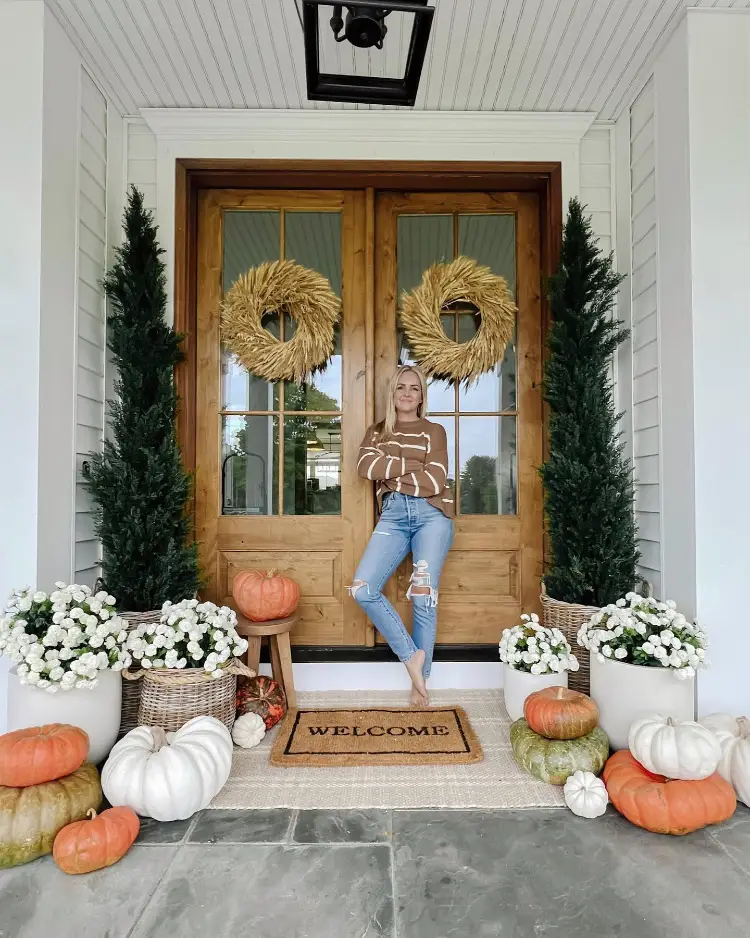
5. Treat Mums Like a Ten-Week Object, Not a Plant You Are Saving
This is the honest part nobody puts in a porch roundup. The mum you buy in September is very unlikely to come back next year, and knowing that changes how you shop.
Iowa State Extension’s guidance is blunt: fall-planted mums usually do not survive the winter even with winter protection, because the plant has too little time to root before the ground freezes. Spring is the planting season. A September mum is a seasonal object with about a ten-week display life.
That is freeing. Buy for looks, and do not pay more than $6.
Pricing this month is genuinely low. Home Depot ran pint mums at 98¢ against a regular $1.98 in its Labor Day sale, and the standard 8-inch pot sits around $5.98 MSRP, with $3.99 to $5.99 common at grocery and regional chains.
Two care moves that buy you the full ten weeks. Buy the plant with the most unopened buds, not the one in full bloom. And leave it in its plastic nursery pot, dropped inside a decorative one, so you can lift it to check weight. A root-bound nursery pot in wind can go bone dry in a single day, and light means water now.

6. Layer the Floor: Rug, Mat, One Heavy Thing
Floor level is where small front porch fall decor either looks styled or looks scattered. Three elements, and no more.
A larger outdoor rug goes down first, then a seasonal doormat layered on top of it, offset slightly rather than centered. The size gap is what makes the trick read. If the mat and the rug are close in size, it looks like a mistake.
Then one heavy object to anchor a corner, which on a porch means a weighted planter rather than anything hollow. Wind on an exposed landing moves more than you expect, and a hollow resin pot is a projectile by the second week of October. Fill the base with a few inches of gravel before soil if the pot is light.
Keep roughly 36 inches of clear walking width at the door. That is the working guideline among small-porch stylists, and it exists because decor that blocks a delivery or catches a stroller wheel stops being decor.
If you want the planter side of this done properly rather than guessed, the three-pot sizing approach in this rental patio container garden guide transfers straight onto a porch.
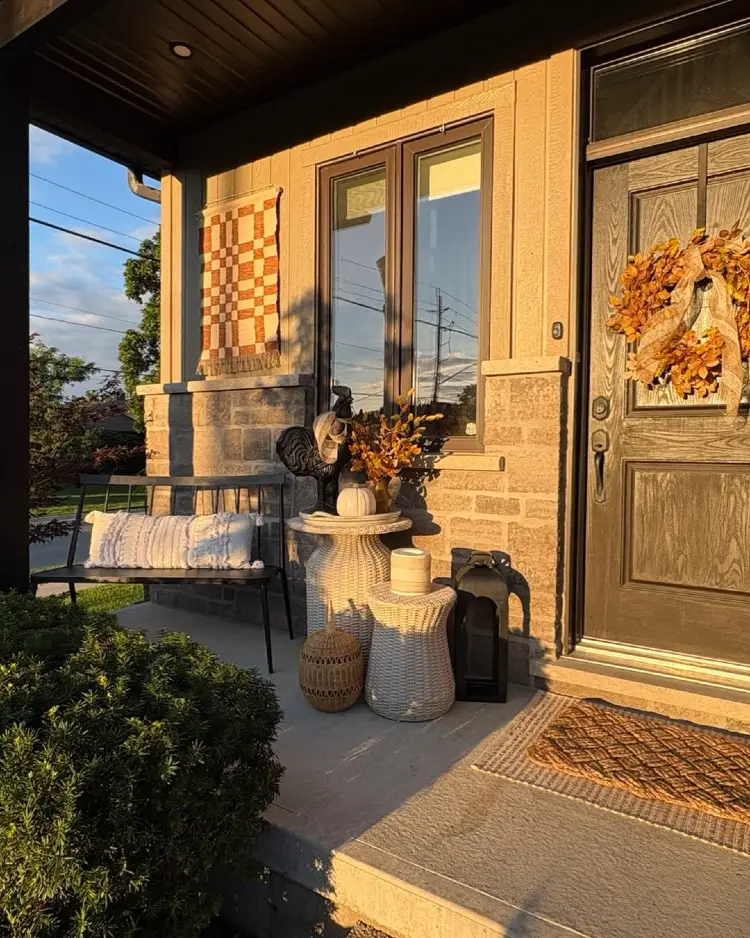
and
secondchancedecorinc
7. Light It for 7 P.M., Because That Is When Anyone Sees It
Daylight photos sell porches. Evenings are when neighbors, delivery drivers and you actually experience one. Light for the evening and the whole thing changes.
Warm bulbs only. A 2700K bulb reads amber and makes wood, jute and rust look right, while anything cooler turns a fall palette gray and faintly clinical. Swap the existing porch bulb before buying anything new, because it is a two-dollar change that fixes more than another pumpkin ever will.
Add one low light source at ground or step level. A battery lantern with a flameless pillar, or a solar lantern on the step edge, gives you a second glow point and depth after dark. Two light heights beat one bright light every single time.
Skip real candles out here. Between wind, dry cornstalks and fabric, an open flame out here is the one genuinely risky part of fall decorating. NFPA’s home candle safety guidance is to keep a candle at least a foot from anything that can burn, and to use a flameless one instead.
There is a sound payoff too. A porch with one warm lamp and a lantern gets used, and used means you hear the street go quiet around nine instead of only seeing it through a window.
⚠️ Watch Out
Safety note: anchor tall furniture to the wall, keep candles and cords away from fabric, and use a licensed electrician or contractor for hardwired lighting, ceiling mounts, or anything structural.
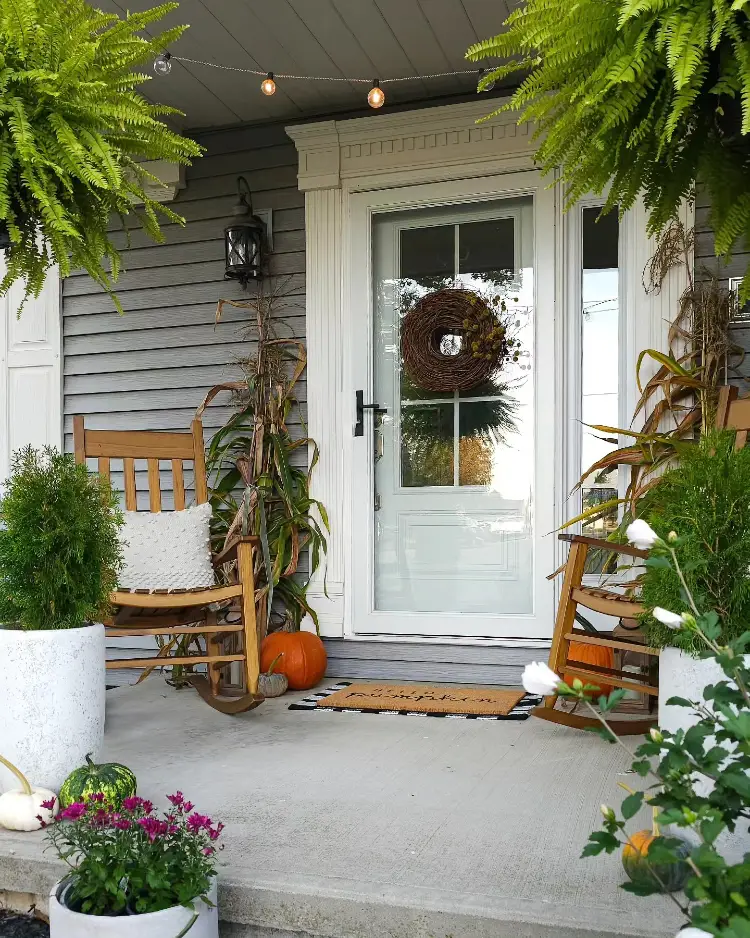
8. Style the Sit Zone, Not Just the Sidewalk View
Here is the thing almost every porch guide leaves out. They all style the approach. Almost nobody styles the chair.
A sit zone needs three things and they are not decorative. A seat at a height you can get out of easily. A surface within reach of that seat. A light you can turn on from the seat without standing up.
The reach part has a number. Keep the side table within about 18 inches of the chair arm, and roughly level with it. Further than that and you stand up every time you set down a mug, which is precisely how a porch chair becomes a place where the mail lands.
Then one soft layer. A washable throw over the arm does more for a cozy porch than another three pumpkins, because texture is what the eye reads as warmth. Store it inside and bring it out, or it will smell like a wet dog by week three.
Point the chair along the porch rather than straight out at the street. Angled seating feels private even when it is six feet from a sidewalk, and it gives you somewhere the TBR pile can migrate to on a cool afternoon. The three-piece logic behind this setup is the same one in our outdoor cottagecore patio styling guide, just scaled to a smaller footprint.
One chair squared up to the street, nothing within reach, no light after six. It photographs fine and nobody has sat in it since May.
Chair angled along the porch, a small table 18 inches from the arm, a lantern you can reach, a throw over the back. Now it gets used on a Tuesday.
9. What a No-Drill Fall Porch Actually Costs
Numbers, because fall porch decor on a budget is a real constraint and not a style. These are US price bands I checked in September 2026, so treat them as current rather than eternal.
| Piece | Archetype | Price band |
|---|---|---|
| 🚪 Door zone | Fall wreath, 22 inch | $20 to $80 |
| 🔩 Hardware | Outdoor adhesive hook, 5 lb | $8 to $12 |
| 🎃 Step zone | Three pumpkins, mixed sizes | $12 to $30 |
| 🌼 Plant | One 8 inch mum | $1 to $6 |
| 💡 Light | 2700K bulb plus battery lantern | $12 to $30 |
| 🧶 Soft layer | Seasonal doormat | $15 to $35 |
| Total | six pieces, one afternoon | $68 to $193 |
Where the money goes matters more than the total. Put the biggest share in the door zone, because that band is visible from the street, survives clutter, and stores flat for next year. The lowest line on that table, the mum, is also the only one you replace every year. That is the correct way round.
Two ways to cut the low end further. Buy pumpkins at a farm stand rather than a seasonal aisle, and wait for the garden-center markdowns that start once October turns.
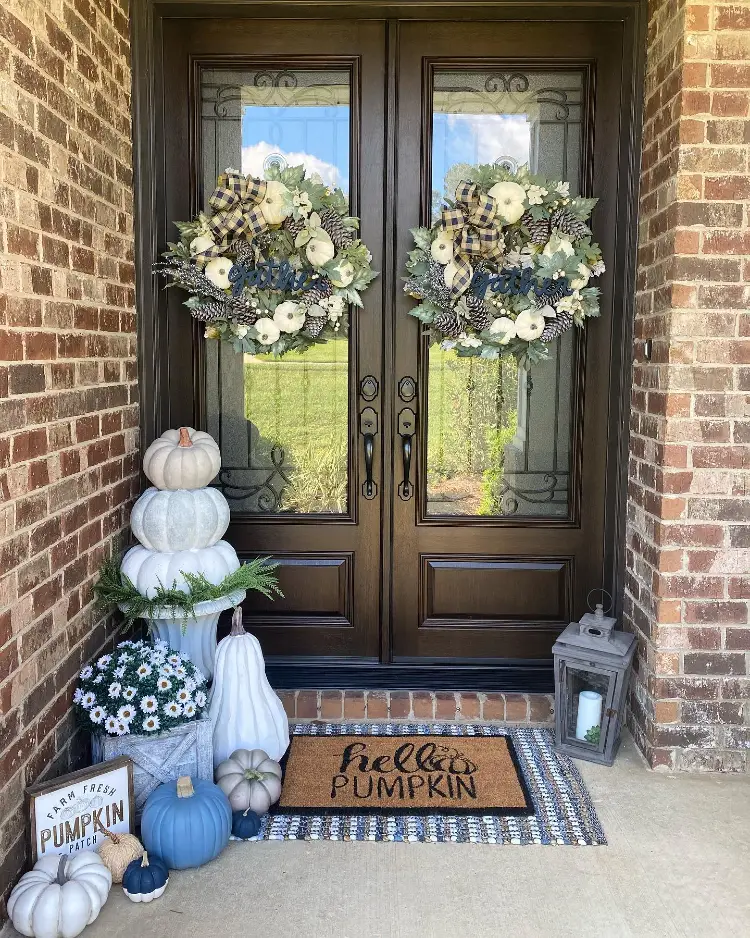
10. The November Strip: One Display, Three Months, No Second Shopping Trip
The reason porches look tired by mid-November is that people decorate for October and then leave it up. One base display can carry all three months if you plan two swaps from the start.
Early September to mid-October, the base runs as built. Uncarved pumpkins, mum, wreath, warm light.
Mid-October to Halloween, add and only add. Carve now if you are carving. A few flameless lights along the step edge. Nothing gets removed, so nothing needs replacing.
November 1, strip the orange. Pull the carved pumpkin, pull the spent mum, keep the wreath, the rug, the lantern and the chair. What is left is wood, jute, brass and warm light, which is a neutral November porch and also, by the first week of December, a base you only have to add evergreen to.
The November strip, in order
[NO IMAGE PROMPT: the visual element carries this section.]
Frequently Asked Questions
When should you put out fall porch decor?
The first or second week of September works for most of the country, and garden centers have the best mum selection then. Hold off on real pumpkins until late September if you want them looking good at Thanksgiving, since a pumpkin sitting in early September sun goes soft fast. Faux pumpkins cover the early weeks without the rot.
How long do real pumpkins last on a porch?
A carved pumpkin runs roughly 8 to 11 days, and that is with a full preservation routine of a bleach soak after carving and a daily bleach spray. An uncarved pumpkin keeps for months in cool, dry, shaded conditions. Heat and humidity cut both numbers hard, so southern porches should plan on the short end.
Can you decorate a rental porch without drilling anything?
Yes, and every piece on this list does exactly that. Outdoor adhesive hooks are rated from -20°F to 125°F and remove without holes or residue, over-door hangers need no hardware at all, and weight handles the rest. The one limit is surface: adhesive needs smooth material, so brick and stucco call for leaning and freestanding pieces instead.
Do porch mums come back the next year?
Usually not. Iowa State Extension reports that fall-planted mums typically do not survive the winter even with protection, because they have too little time to establish roots before the ground freezes. Spring is the planting season for mums you want to keep. A September mum is a seasonal object, so pay $6 or less and enjoy the ten weeks.
How do you decorate a tiny porch or a stoop without it looking crowded?
Go vertical instead of wide. A wreath at eye level and one tall element do more on a small landing than five things spread across the floor. Keep about 36 inches of clear walking space at the door, pick two of the three zones rather than all three, and let the door carry the display.
Real or faux pumpkins: which one costs less?
Real wins if you are decorating for one season only, especially bought from a farm stand. Faux costs more up front and then costs nothing again, so it balances out across a few years. The practical answer for most renters is a mix: faux for the September stretch, one or two real ones added late for the texture no resin pumpkin gets right.
Your Porch, This Weekend
Everything here comes down to a short sequence. Settle the hardware, fill the door zone, group three things at three heights, get one warm light going, and give yourself somewhere to sit. That is the whole of renter-friendly fall porch decor, and it holds without a single hole in anything you do not own.
Start with the door. One piece, and you will see the difference from the sidewalk tonight.
Save this to your fall porch board so it is there when the mums hit the garden center, and come back in November for the strip.
Keep reading
More cozy nook ideas
 Fall Decor
Read →
Fall Decor
Read →
How to Decorate Your Entryway for Fall (Even If You’re Not Handy)
No drill, no ladder, no awkward email to your landlord. This fall entryway decor goes up with an over-the-door hanger, a tape…
 Fall Decor
Read →
Fall Decor
Read →
Fall Coffee Table Decor: The Complete Guide for Small Apartments
No mantel, no entry console, no spare shelf. In a small apartment, the coffee table is the one surface everyone sees, and…
 Fall Decor
Read →
Fall Decor
Read →
The Fall Kitchen Checklist: Everything to Decide Before You Start
Most fall kitchen regret starts the same way. You buy the pumpkins first, carry them in, and discover the counters were never…