
25 Fall Window Box Ideas for Small Spaces
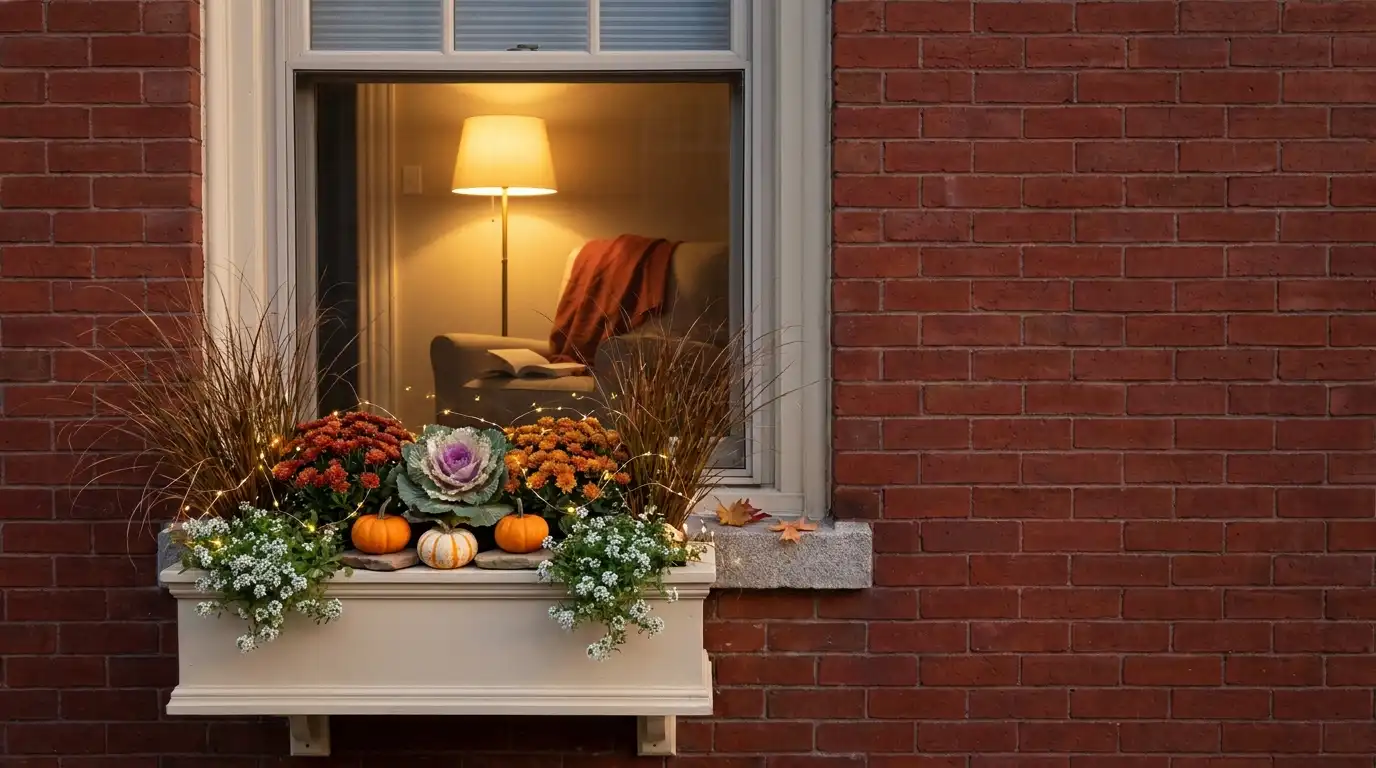
No porch, no yard, and a lease that frowns at new screw holes. You can still have Fall Window Box Ideas that look full from the street and feel good from your favorite chair inside. These 25 ideas are built for small spaces: one apartment window, a balcony railing, a narrow sill, even a window that doesn’t open.
Every idea gives you something to act on today. Real prices listed at Home Depot, Lowe’s, Walmart and Trader Joe’s. Plants matched to the cold you’ll actually get. Measurements that keep a small box from looking skimpy or crowding the glass.
You’ll find no-drill rail planters, a starter box totaled at $44.68, a shade box for north-facing windows, and the Frost Swap Map, a one-glance chart of what to pull and what to keep as nights drop into the 20s. You’ll see the box from inside more than anyone walking by, so idea 5 shows how to plant for the view from your chair.
Planting late is fine, too. Several of these ideas were made for November.
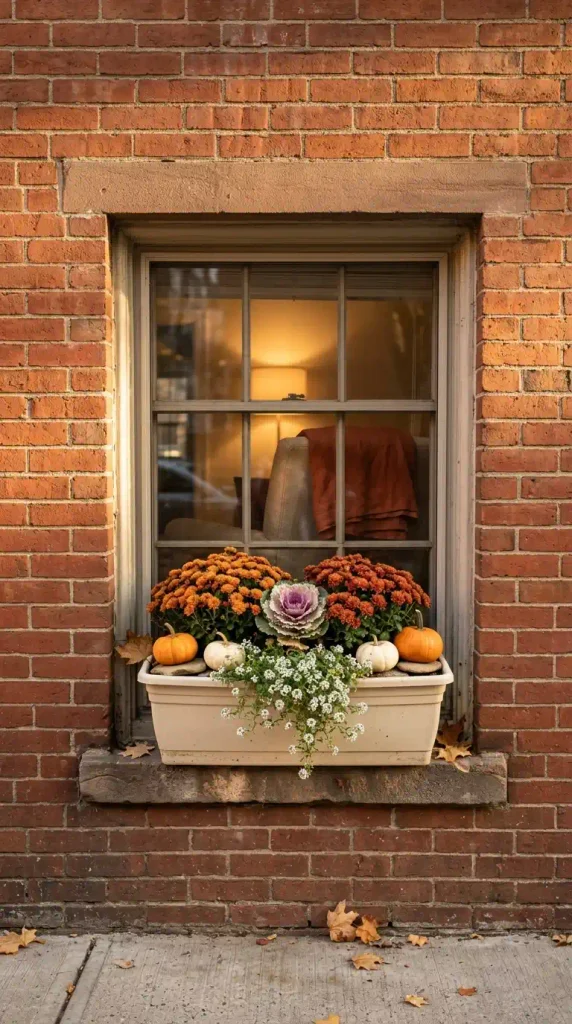
1. A 24-Inch Box Sized to One Apartment Window
Measure the window before you buy anything.
Small boxes look skimpy when they’re shorter than the glass and clumsy when they run long. Let the trim set the size:
- Make the box at least as long as the window itself.
- Let it run no more than 3 inches past the trim on each side.
- Check the depth against your tallest nursery pot. A 6-inch grower pot needs sides at least that tall.
Plastic is the easy entry point. A 24-inch Novelty Countryside box was listed at $22.79 at Lowe’s, and Bloem’s 30-inch Dura Cotta sat at $22.30. Wood looks warmer, and it costs about three times as much.
Write the window width in your phone’s notes before you leave for the store.
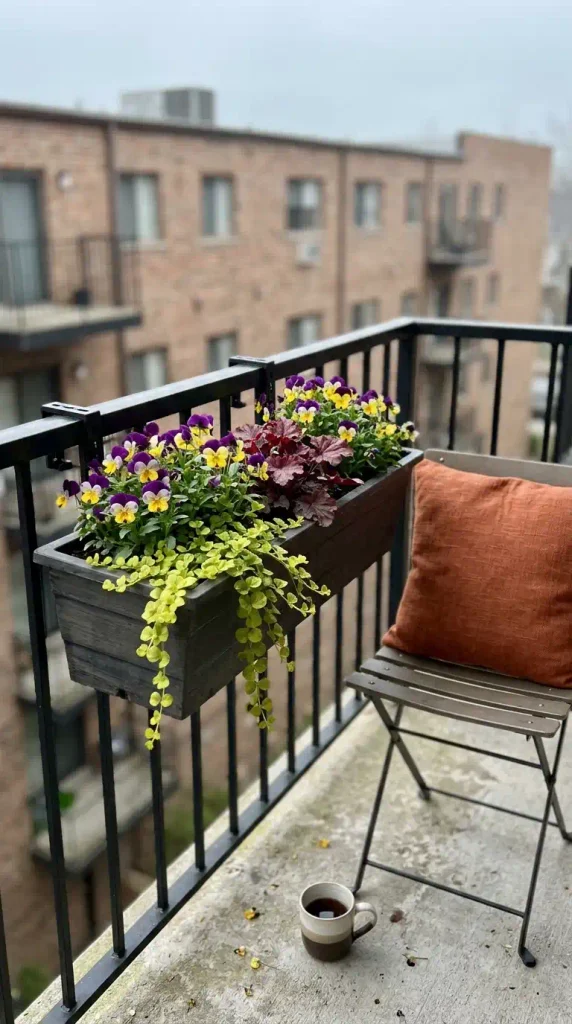
2. An Over-the-Rail Planter for a Balcony With No Ledge
Balcony railings are the small-space window box most people overlook.
The problem: lots of apartments have no exterior sill wide enough for a box, and your lease probably bans new holes in the siding.
The fix: an over-the-rail planter hooks onto the railing with its own brackets. Measure your rail first, because fixed-fit models are picky. Bloem’s 24-inch deck rail planter, from $16.97 at Walmart, fits rails only 4.75 to 5.75 inches wide. Adjustable-bracket styles stretch across roughly 3 to 6 inches and often include zip ties for odd shapes.
The payoff: a full box at eye level from your sofa, and nothing to patch when you move out.
Watch the weight. Fully watered potting mix runs roughly 40 to 60 pounds per cubic foot, so hang the box on the inside of the rail, never over a sidewalk. And leave the fire escape alone. New York state law bars putting anything on one, and wherever you live, a fire escape is an exit, not a shelf.
Safety note: secure every box so wind can’t lift it, keep candles and cords away from dry leaves and moss, and use a licensed contractor for anything bolted to the building or hung above a walkway.
3. Pint Mums Left in Their Nursery Pots
Pint pots fit a narrow box. Giant mums don’t.
Those big 3-quart mums look like a deal, but Home Depot’s own listing puts their mature size at 18 inches tall and 22 inches wide. That’s most of a 24-inch box gone. Pint mums run $1.98 there at regular price, and the Labor Day sale in September 2026 dropped them to 98 cents.
Skip the potting soil entirely:
Set the mums in the box still in their plastic pots, packed shoulder to shoulder.
Stuff sheet moss or a strip of burlap over the rims so no plastic shows.
Water at soil level, under the blooms. Wet mum flowers turn mushy.
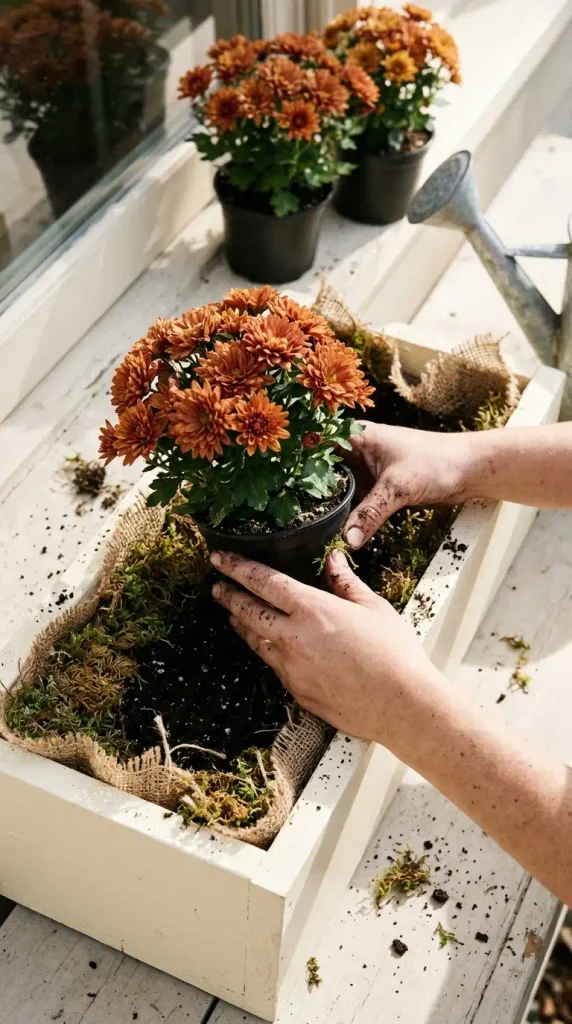
When the blooms fade, lift one pot out and drop a fresh one in. No digging, no dirt on the sill.
4. One Ornamental Cabbage (or Kale) as the Centerpiece
Cabbage is having a moment. Pinterest named “Cabbage Crush” one of its 2026 trends, with searches for cabbage dumplings up 110 percent. That’s a food trend, but the ornamental kind rides the same wave on porches, and it’s made for cold.
Pick one, not both, in a small box:
| 🥬 Ornamental cabbage | 🌿 Ornamental kale |
|---|---|
| Low, round rosette | Taller, ruffled, more upright |
| Best in the center of a short box | Best at the ends of a longer box |
| 6-inch pot about $9.99 at Home Depot, matures near 15 in tall by 12 in wide | 2.5-quart pots about $16 each at Home Depot |
| Handles light frost, cover in a hard freeze | Handles light frost, cover in a hard freeze |
Both color up in the center as nights get cooler, so the plant you buy in October looks richer by Thanksgiving.
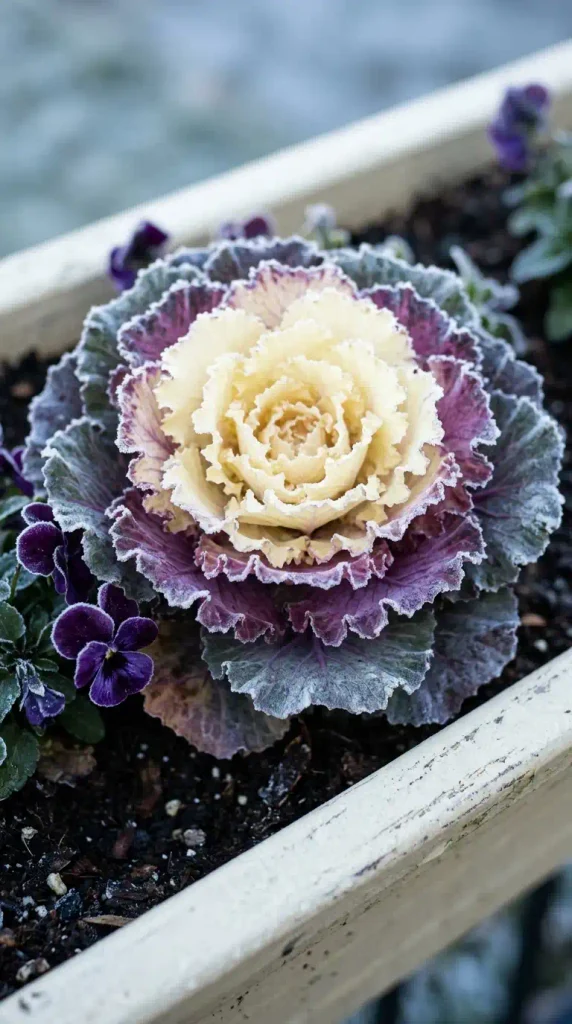
One rosette. That’s the whole centerpiece.
5. Plant Your Fall Window Box for the Reading Chair, Not the Curb
Most fall window boxes are designed for people walking by. You see yours from the other side, from a chair or the kitchen table, looking down through the glass.
Flowers tend to face the brighter side, which is usually the street, so from inside you see more leaves than petals. Foliage plants like heuchera and ornamental cabbage look the same from every angle. If the window already has a seat in front of it, pair the box with one of these 51 reading nook ideas for every room.
Keep everything in the middle of the box below the bottom edge of the glass. Let height happen only at the two ends, so the box frames your view instead of blocking it.
From the street, the ends still read tall and full. From your chair, the middle stays open to light.
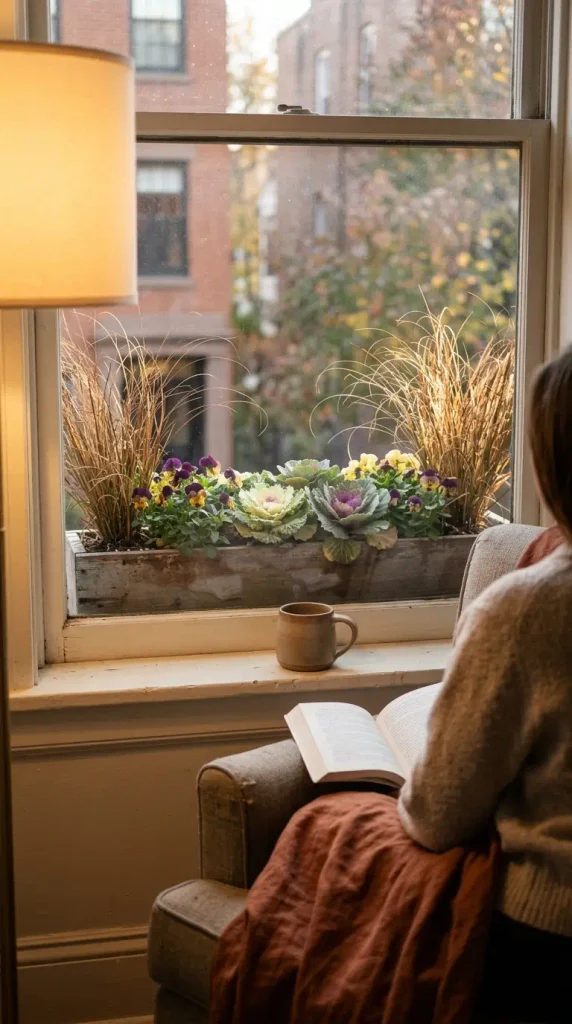
Before you plant the tallest piece, sit where you’ll actually look out.
6. Pansies and Violas for a Box That Blooms Into the 20s
Cold nights don’t scare pansies.
Pansies and violas handle dips into the 20s and keep blooming, according to Home Depot’s garden guides, and Clemson Extension notes they flower best whenever it’s above freezing. Violas give you more flowers per plant and need less deadheading. That matters in a box you can only reach by leaning out a window.
Pansy or viola: quick picks
In milder zones, they carry right on into spring for a second show.
7. Mini Pumpkins on Stones for a Ten-Minute Refresh
Pumpkins rot from the bottom first.
The usual mistake is setting them straight onto wet soil, where the underside softens long before the top looks tired. Rest each mini on a flat stone, the rim of a nursery pot or an old jar lid so air reaches underneath. Gourds and pumpkins last a long time once the weather cools, as long as they stay dry.
Tuck three or four between the plants, in two colors at most. Trader Joe’s minis have run from 89 cents to about $1.49 each in recent seasons.
A tired summer box with leggy stems and bare gaps between plants.
Same plants, trimmed back, with four mini pumpkins on stones filling every gap.
Ten minutes, under $6, and the box reads fall from across the street.
8. A North-Facing Shade Box With Heuchera and Autumn Fern
Heuchera, autumn fern, creeping Jenny.
Those three carry a window that never sees direct sun. Mums want about six hours of sunlight a day, per the grower’s own label, so they sulk on a north wall. Clemson Extension lists coral bells (another name for heuchera), creeping Jenny and evergreen ferns like autumn fern as container plants that hold their looks through fall and winter.
Autumn fern’s new fronds come up coppery, so the box reads fall without a single flower.
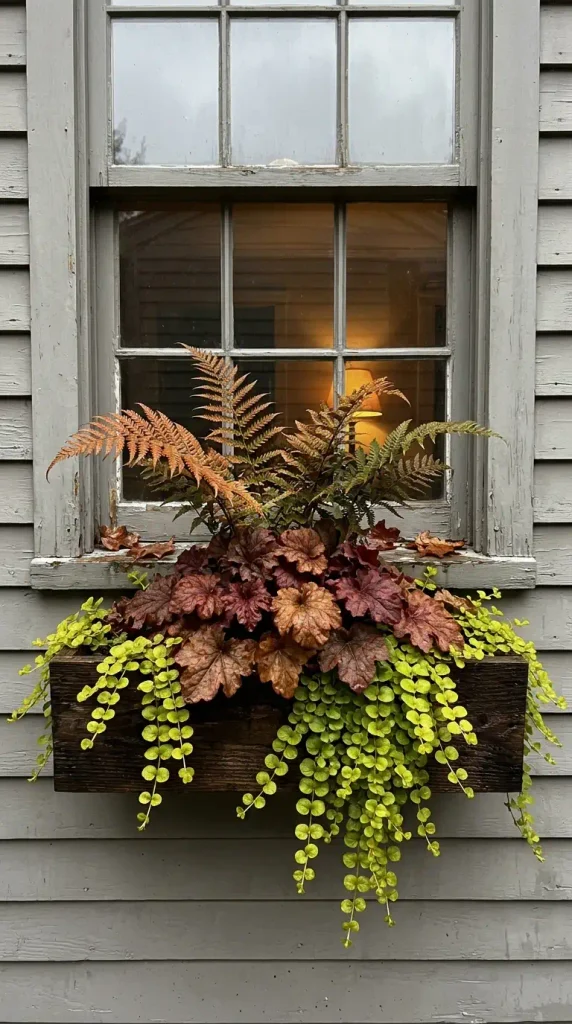
Keep creeping Jenny in the box. Planted in the ground, it spreads fast.
9. A Kitchen-Window Herb Box That Still Works in November
Herbs earn their spot twice: once for looks, once for dinner.
- ▸Rosemary: evergreen, sold in trailing and upright forms. Put the trailing type at the front edge.
- ▸Tricolor sage: gray, purple and white leaves on an evergreen culinary plant.
- ▸Lemon thyme: spills over the rim and smells bright when you brush it.
- ▸Flat parsley: a deep green backdrop that likes cool weather.
Open the window, run your hand over the rosemary, and the kitchen smells like a Sunday roast before the oven is even on.
Leave basil out of a fall box. It sulks at the first cold night, while parsley and thyme keep going. Set the herbs in their nursery pots, the same way as idea 3, so a tired plant swaps out in seconds.
Snip from the back so the front stays full.
10. A Faux Insert You Can Reuse Every Fall
Faux gets a bad rap, and sometimes it earns it. Here’s the honest split.
Live plants change week to week, smell like something, and end at a hard freeze. Faux looks the same every year and never needs water, but low-grade stems fade fast in strong sun.
A reusable insert works like this: glue floral foam bricks end to end until they fit your box, push faux pumpkins on wire picks into the foam, then cover it with ivy garland held down by greening pins. Faux mums labeled for outdoor use start around $3.39 at Walmart. Check the tag for “outdoor” or “UV,” because indoor silk fades quickly in direct sun.
Buy stems marked for outdoor or UV use.
Build on foam so the whole insert lifts out in one piece.
Mix in one real element, like cut evergreens, to fool the eye.
Indoor silk flowers in full afternoon sun.
Loose stems that blow off in the first windy night.
Glossy plastic pumpkins that shine in photos.
Store the insert in a bin in the closet. Next September it’s back in place before your coffee cools.
11. The Burgundy Box With an Edible Backbone
Burgundy reads richer than orange against brick and dark trim, and you can build it out of food.
Start with ‘Red Giant’ mustard at the back. Clemson’s horticulture team uses its deep burgundy leaves as a tall backdrop in fall containers. Add a dark-leaved heuchera and one burgundy mum in front, then a red-veined sorrel for fine lines of color.
💡 Quick Tip
Harvest the outer mustard leaves for a stir-fry. The plant keeps pushing new ones from the center, so the box stays full while you eat from it.
Pretty in the box. Peppery in the pan.
12. Thriller, Filler, Spiller Shrunk to Fit 24 Inches
Every container guide repeats the thriller, filler, spiller formula, and in a small box it needs editing. Three to five plants is plenty for a 24-inch box. Any more and the fillers smother each other by Halloween.
Here’s the scaled-down version:
- Thriller: one Swiss chard with bright stems in the center, or two at the ends if you’re following the Glass Line Rule from idea 5.
- Fillers: two pint mums or a pair of pansies on either side.
- Spiller: sweet alyssum or creeping Jenny along the front edge so it drapes over the rim.
Five pots, one tidy box, nothing fighting for room.
13. An Indoor Sill Box for Windows That Don’t Open
Sealed windows and high-rise rules don’t cancel fall.
The usual workaround is one lonely potted mum on the sill, and it gets lost against the glass. A trough that runs the length of the sill reads like a real window box from inside. Bloem’s 19-inch Lucca self-watering box, $17.99 at Home Depot, comes with a saucer that keeps water off the paint.
Fill it with things that handle indoor light. Rooted coleus cuttings work well, since Home Depot’s guide notes the stems root in a vase of water on a sunny windowsill. Add two mini pumpkins and a short bundle of dried wheat. The same minis and wheat pull double duty on a coffee table, like these fall dough bowl ideas on a budget.
A bare sill with one mum still in its plastic grower pot.
A 19-inch trough with rooted coleus, two mini pumpkins and a bundle of wheat.
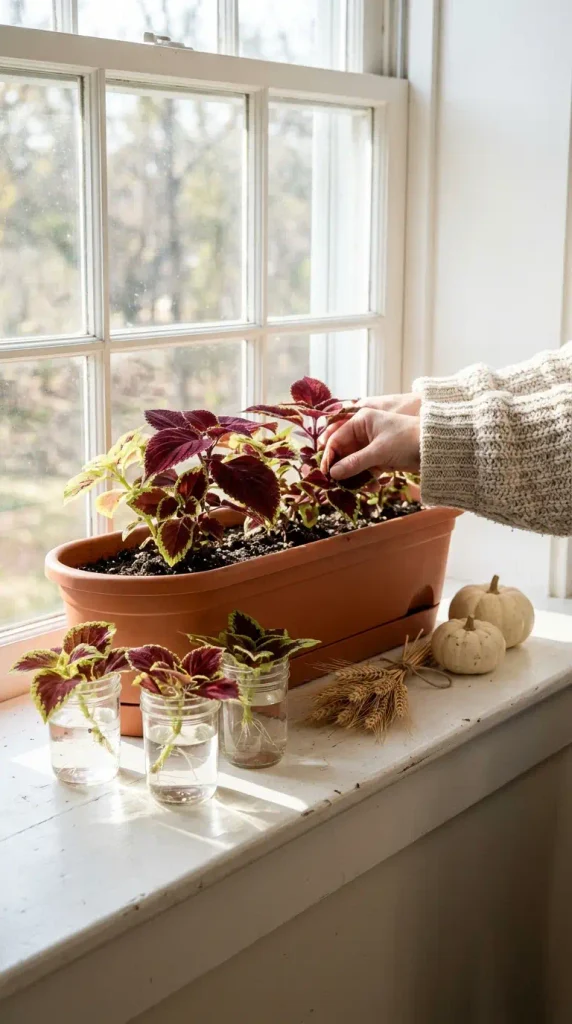
Give the trough a half turn each week so nothing leans toward the glass.
14. Solar Fairy Lights Woven Between the Plants
Fall evenings get dark early, and a window box disappears by 5 p.m.
The fix: wrap a strand of solar copper-wire lights between the plants. You don’t need an outlet, and no cord runs through the window. Walmart’s Mainstays solar 200-count warm white string was listed at $13.74, and Target’s battery dewdrop strands start at $5. Battery sets with a built-in timer that runs 6 hours on and 18 off mean you never have to remember them.
The payoff: from inside, the box glows in the glass like a second lamp.
Pick lights labeled for outdoor use.
Tuck the solar panel where it catches afternoon sun.
Real candles in a box full of dry leaves and moss.
An indoor extension cord run through a window that can’t close.
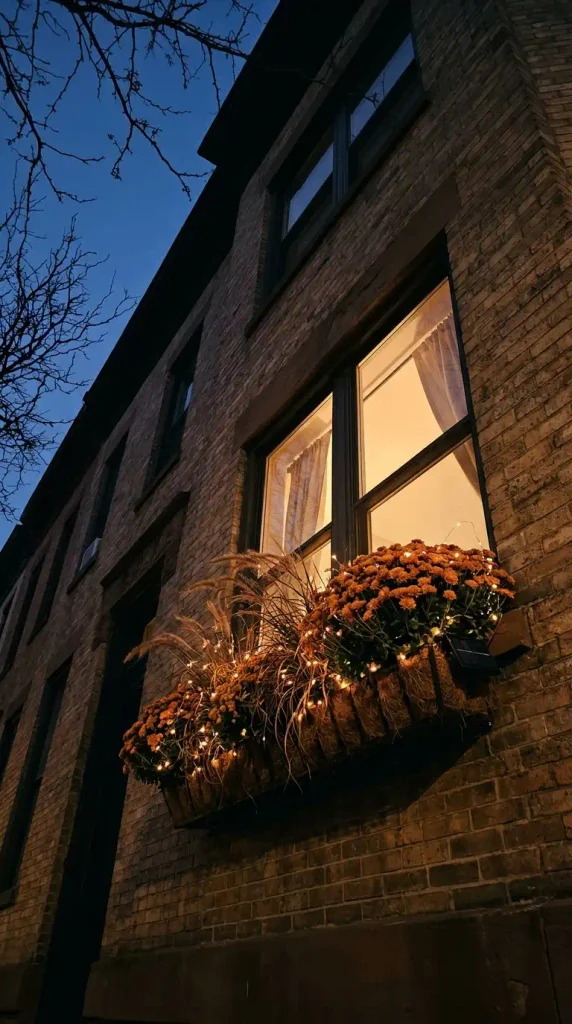
Warm white looks like lamplight. Cool white looks like a parking lot.
15. The $45 Starter Box, Totaled Line by Line
Forty-four dollars and sixty-eight cents.
That’s a complete small-space box with no soil to buy, because every plant stays in its nursery pot, as in idea 3. These prices were listed online in fall 2026 and will shift by store and week.
| Piece | What to buy | Price |
|---|---|---|
| 🪴 Box | Novelty Countryside 24-inch plastic, Lowe’s | $22.79 |
| 🌼 Fillers | 3 pint mums at $1.98 regular price, Home Depot | $5.94 |
| 🥬 Center | 1 ornamental cabbage, 6-inch pot, Home Depot | $9.99 |
| 🎃 Accents | 4 mini pumpkins at about $1.49, Trader Joe’s | $5.96 |
| 🧺 Cover | Burlap scrap or moss you already have | $0.00 |
| Total | $44.68 |
Shop the mums during an early September sale and the same list drops by about $3.
16. Ornamental Peppers for Hot Color (Not for Snacking)
Red, orange, purple and yellow fruit, all on one small plant.
- They’re bred for looks, not flavor.
- They grow as perennials only in USDA zones 9 to 11, so most of the country treats them as one-season plants.
- Frost ends them, so plan to pull them at the first cold forecast.
⚠️ Watch Out
Home Depot’s own advice is to keep ornamental peppers on the plant and away from kids and pets. If a dog or a toddler can reach your box, choose a different plant for color.
17. Snapdragons and Dusty Miller for a Silver-and-White Box
White and silver look crisp against red brick and almost glow at dusk.
Dwarf snapdragons paired with silver dusty miller is a combination that Clemson Extension’s fall and winter container guide recommends for color across fall, winter and spring. Snapdragons bloom hardest in fall and early spring, then rest during the coldest stretch.
Two white mini pumpkins at the base finish it. No orange required.
18. Purple Fountain Grass at Both Ends for Sound and Movement
Grass is the only plant in the box you’ll hear.
Annual purple fountain grass sways in every breeze and rustles softly against the siding. It’s a tall thriller, which makes it a natural fit for the two ends of a Glass Line box. It’s hardy only in warm zones, so in most of the country it’s a one-season plant.
Set one grass at each end, angled slightly outward so it arches away from the glass.
Fill the middle with low plants that stay under the bottom edge of the window.
Trim any blade that slaps the glass in wind, cutting it at the base.
Leave the faded plumes on. They catch frost on cold mornings.
19. Dried Hydrangea and Wheat for a Box You Never Water
Dried stems don’t care about frost.
Hydrangea heads you cut and dried in late summer, wheat stalks, dried corn husks and a few seed heads make a box that only needs dusting. The catch is wind. Light stems lift right out of loose moss on the first gusty night, so anchor everything.
No-water box kit
Bonus: the whole arrangement lifts out in one piece when it’s time for winter greens.
20. The Frost Swap Map for Fall Window Box Plants
Frost doesn’t end a window box. It changes the cast.
Plant about 6 to 8 weeks before your first expected frost when you can. Running late is fine. Use this map to see what stays, what goes, and what to add as nights fall.
Hardiness depends on your winter lows, so check your zone on the USDA Plant Hardiness Zone Map before trusting a perennial to ride out winter in a box. Roots in a narrow box get colder than roots in the ground.
Screenshot the map. You’ll want it again next fall.
21. Coir Liner or Plastic Liner, Picked by Your Watering Habits
Liners decide your watering schedule more than plants do. Here’s how the two common choices compare.
Breathes and drains fast. Looks natural in a metal rack. Dries out quickest on sunny or windy ledges.
Holds moisture longer and protects a wood box from rot. Needs open drainage holes to work.
As a rule of thumb, use coir for shady, sheltered spots and plastic for sunny or windy ones. Lowe’s planting tips spell out the risk on the plastic side: when drainage holes get blocked, water collects inside and the roots rot.
Poke a pencil through every drainage hole before you plant. Packed holes are the quiet box killer.
22. Cut Evergreen Tips to Carry the Box Into December
Empty boxes in December look sadder than no boxes at all.
The common mistake is buying live dwarf evergreens for the box. Small shrubs in a narrow box rarely make it through winter, and most end up needing to go into the ground anyway.
Cut greens work better. Once the mums brown, push fir, cedar and boxwood tips straight into the soil they leave behind, and add two or three pinecones. Leftover fir and cedar from making a fresh Christmas wreath in a small space is exactly the right material.
Cut greens don’t need to root. They stay fresh longest in cold air and damp soil, and a December window box gives them both for free.
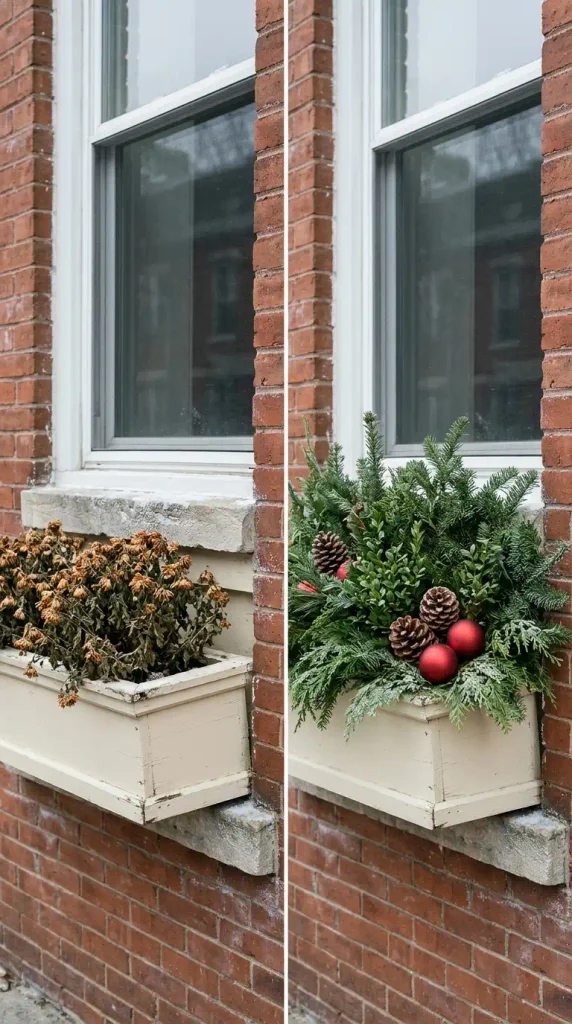
Add two red ornaments, and the fall box becomes the holiday box without another store run.
23. A Hollowed Mini Pumpkin Planter for One Succulent
Small pumpkins make small planters.
A hens and chicks rosette or a sprig of ‘Lemon Coral’ sedum fits inside a scooped-out mini, and it looks sweet on an indoor sill or at the end of a box. Treat it as a short-lived accent. A cut pumpkin softens much faster than a whole one, so plan it for Thanksgiving week, then move the succulent to a real pot.
Slice off the top with a serrated knife and scoop out the seeds.
Poke one drainage hole through the bottom with a wooden skewer.
Fill with cactus mix, plant the succulent and water lightly.
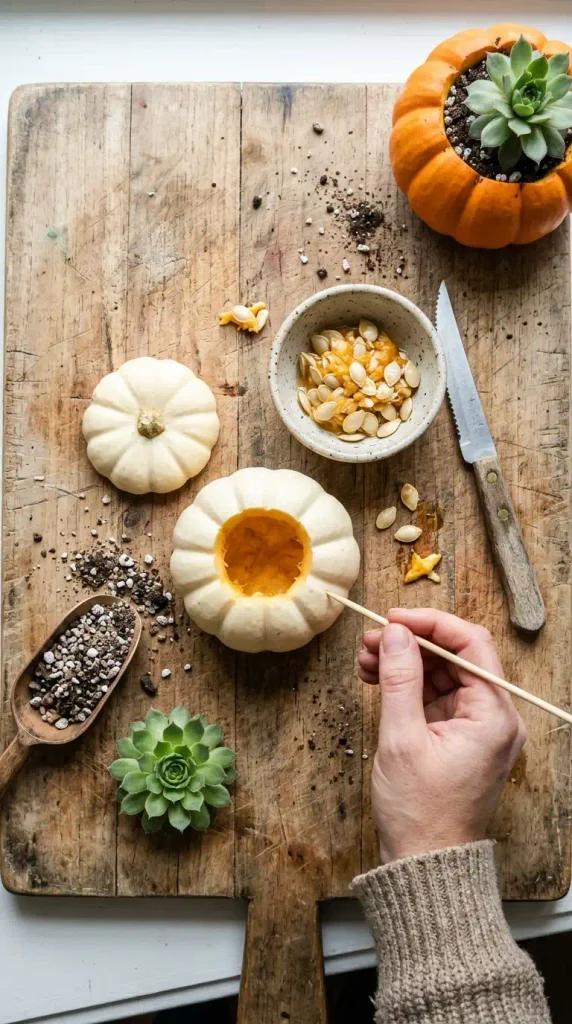
Keep the succulent’s original nursery pot. You’ll need it again soon.
24. A Self-Watering Box for a Windy Upper Floor
Wind dries a window box faster than sun does.
The problem: high up, a long, narrow box can go dry between your morning and evening checks, and its shape leaves roots exposed to every swing in the weather.
The fix: a self-watering box keeps a reservoir under the soil and wicks moisture up as the mix dries. Bloem’s 19-inch Lucca is $17.99 at Home Depot, and Mayne’s larger self-watering boxes run about $76 to $155 at Lowe’s.
The payoff: fewer watering trips through the window and fewer wilted mums.
Empty the reservoir before a hard freeze so the water inside can’t crack it.
25. Spring Bulbs Tucked Under the Fall Plants
Late fall is bulb time, and your window box has room underneath.
- Set small bulbs like crocus and grape hyacinth below the fall plants.
- Leave the pansies on top. They share the box all winter.
- In very cold areas, a narrow box freezes harder than garden soil, so give it shelter during the coldest weeks.
📌 Good To Know
Spring bulbs need a cold spell before they bloom, so a winter outdoors is part of the plan, not a risk to avoid.
Plant once in November. Get flowers twice.
Fall Window Box Ideas FAQ
What do you put in fall window boxes?
Start with cold-tolerant plants: pint-size mums, pansies or violas, and one ornamental cabbage or kale for the center. Add a trailing plant like sweet alyssum or creeping Jenny at the front edge. Finish with accents that handle weather, such as mini pumpkins resting on small stones, dried wheat, or cut evergreen tips later in the season. Three to five plants are plenty for a box 24 to 30 inches long.
When should you plant fall window boxes?
Aim for about 6 to 8 weeks before your first expected frost. That gives roots time to settle before the cold arrives. Planting later still works if you choose frost-tolerant plants such as pansies, violas, ornamental cabbage and kale, and keep tender plants like coleus, crotons and ornamental peppers out of the mix. In a late box, pack plants tightly, since there’s little new growth left in the season.
How long do fall window boxes last?
It depends on the plants. Mum blooms usually finish by December. Pansies and violas keep going through dips into the 20s, and ornamental cabbage and kale handle light frosts. Tender plants such as coleus, crotons and ornamental peppers end at the first frost. Swapping in cut evergreen tips after the mums fade can carry a small box well into the holidays.
Can you leave plants in their nursery pots in a window box?
Yes, and in a small box it’s often the smarter move. Set the pots shoulder to shoulder, then hide the rims with sheet moss or burlap. You skip buying soil, and you can lift out a tired plant and drop in a fresh one in seconds. Just check that the box is at least as deep as your tallest nursery pot.
Do mums survive frost in a window box?
Mums usually come through the first couple of light frosts, though the open blooms can brown. A hard freeze ends the flowers. Mums are perennials, so if you want to keep one, plant it in the ground before the soil freezes and it may come back next fall. Left in a narrow box over winter, the roots are far more exposed to cold.
What can you plant in a fall window box that gets no sun?
Lean on foliage. Heuchera, also called coral bells, brings color through its leaves. Autumn fern adds height with coppery new fronds, and creeping Jenny trails lime green over the front. Skip mums in deep shade, since they want about six hours of sun a day to bloom well. Pansies and violas tolerate partial shade if the box gets a few bright hours.
What do you do with window boxes in winter?
Pull the spent annuals and fill the gaps with cut evergreen tips like fir, cedar and boxwood, plus pinecones or berries. Cold air and damp soil keep cuttings fresh. If you have a self-watering box, empty the reservoir before a hard freeze. You can also tuck crocus or grape hyacinth bulbs under the surface now for flowers in spring.
Your Small-Space Box, Start to Finish
Small spaces don’t need big boxes. One well-fitted planter, a handful of pint pots and a plan for the first frost go further than an overstuffed trough that blocks your light.
Start with the fit in idea 1, choose how you’ll hang it, then build from the Frost Swap Map so your fall window boxes still look alive after the leaves come down. Swap to cut greens in December, tuck bulbs underneath, and the same box keeps working until spring.
Save this pin to your fall board so the Frost Swap Map and the $45 build list are waiting for you next September.
Keep reading
More cozy nook ideas
 Fall Decor
Read →
How to Make Your Own Thanksgiving Decor (Even in a Rental)
Three spots, one Saturday, zero nail holes. That’s the whole plan for your DIY Thanksgiving decorations this year, and it works in…
 Fall Decor
Read →
16 Fall Dough Bowl Ideas on a Budget
Ten dollars and fifty cents, one pass through the seasonal aisle, and a plastic container from your kitchen cabinet. That’s the whole…
 Fall Decor
Read →
Fall Office Decor for Small Apartments: One Corner, No Drilling, One Afternoon
If your work corner is a laptop, a dead pothos, and a ceiling light that makes 4 p.m. look like a dentist’s…