
Cozy Living Room Ideas: The Three-Layer Rule That Warms Up Any Room

Three layers, one corner, one afternoon. About $150 if you thrift the chair, about $240 if you don’t.
If your living room is a gray sofa shoved flat against the wall, one overhead light you’ve never liked, and a corner that mostly collects laundry, you aren’t short on furniture. You’re short on warmth, and warmth is a stack, not a purchase.
Most cozy living room ideas hand you a shopping list. This one hands you an order of operations: light first, seat second, soft goods third. Follow that order and a 700 square foot rental starts feeling like somewhere you’d choose to sit. Reverse it and you’ll own four new throw pillows and the same cold room.
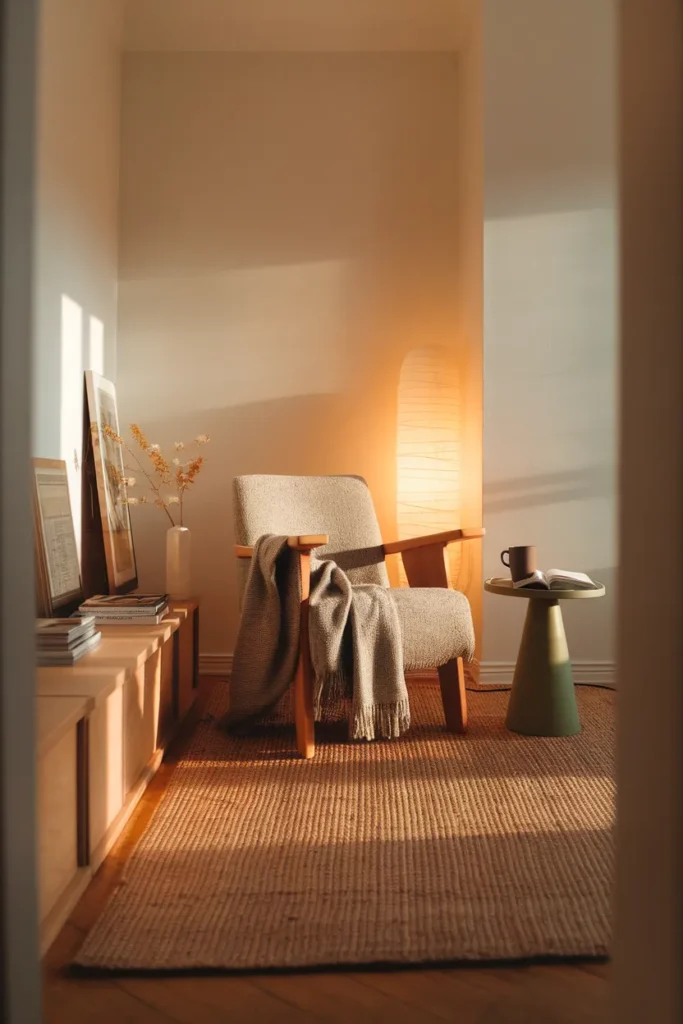
The Three-Layer Rule (Start Here Before You Buy Anything)
Warmth in a living room comes from three layers, added in this order:
- Light. One warm bulb at seated eye level or lower. On a dimmer if your fixture allows it.
- A seat with a back and an arm. Something you can stay in for forty minutes without shifting.
- Soft goods that touch skin. A rug under the front legs, one throw with real weight, one lumbar pillow.
That’s the whole system. Everything after this is decoration on a room that already works.
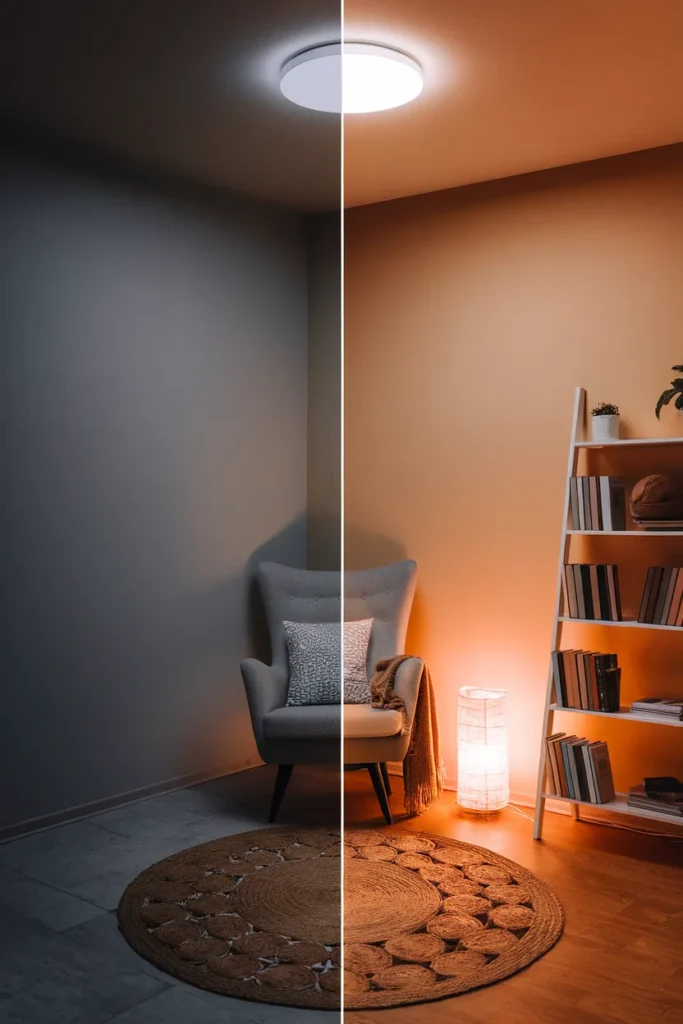
The order matters more than the budget. Light changes how every other object in the room reads, so it goes first. Skip straight to soft goods and you get the most common failure in small-space decorating: a carefully layered sofa sitting under a ceiling fixture that makes the whole thing look like a waiting room at 9 pm.
Give each layer a week if you need to. One bulb Saturday, a chair off Facebook Marketplace the following weekend, soft goods last once you know where you actually sit.
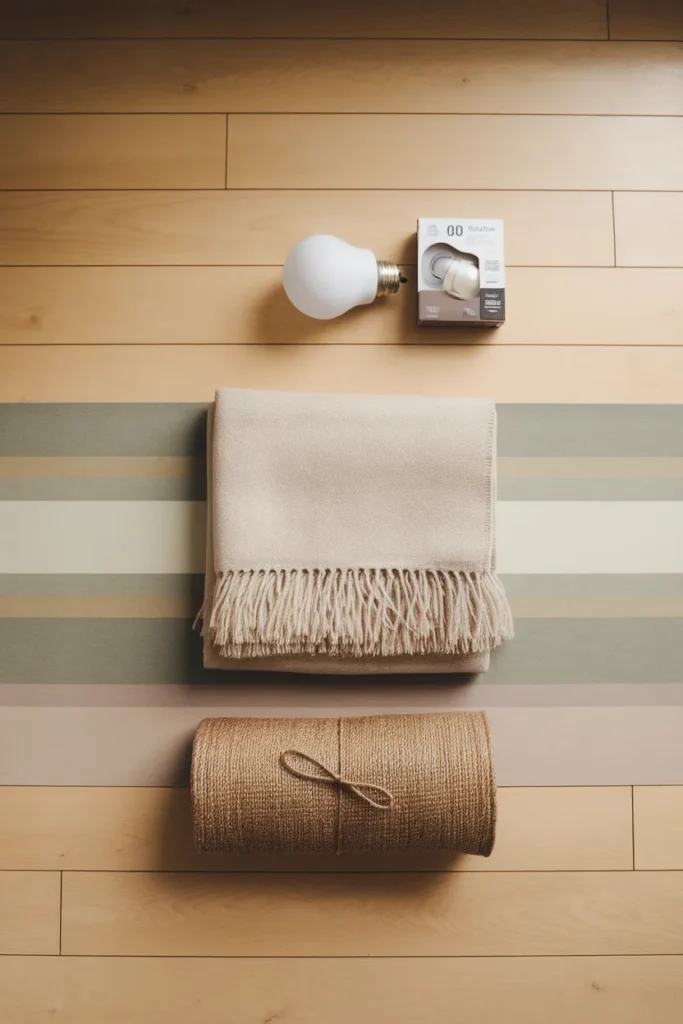
Change the Light Before You Change the Furniture
One bulb does more for a room than a new sofa. It’s also the cheapest thing on this list.
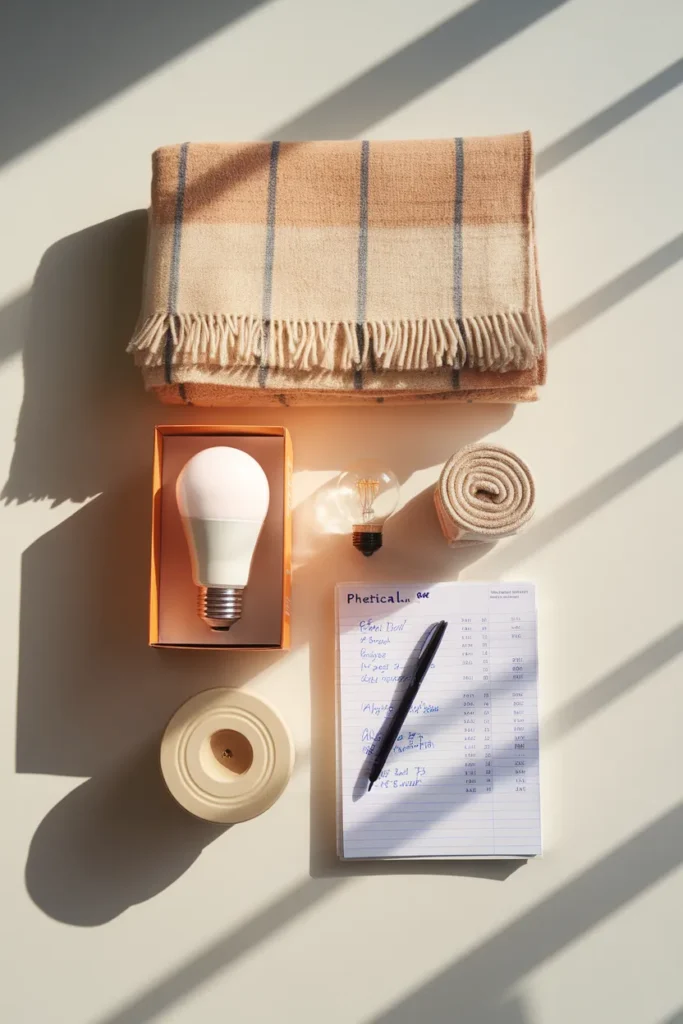
Swap whatever’s in your main lamp for a 2700K bulb. That number is the color temperature, and 2700K lands in warm amber territory, close to the old incandescent glow most people are actually chasing when they say a room feels cold. Anything at 4000K and above pushes blue, and blue at night reads clinical no matter how nice your throw pillows are.
Then get the light lower. Ceiling fixtures flatten everything below them. A floor lamp beside a chair, a table lamp on a bookcase, a clip-on reading light on a shelf edge: any of these put light at the height where people actually sit, which is where warmth happens.
Add a dimmer if you can. The Department of Energy’s home lighting guidance notes that dimmers lower light levels and cut electricity use, but flags something worth knowing before you buy: the dimmer has to be compatible with the bulb you’re using, and not every LED is dimmable. Check the box. A non-dimmable LED on a dimmer switch will buzz, flicker, or simply refuse to dim, and you’ll blame the wrong component.
Honest trade-off: warm bulbs make skin tones and wood look wonderful and make cool grays look slightly muddy. If your sofa is a cool-toned gray, 2700K will read a little green against it. Live with it, or shift to 3000K as a compromise.
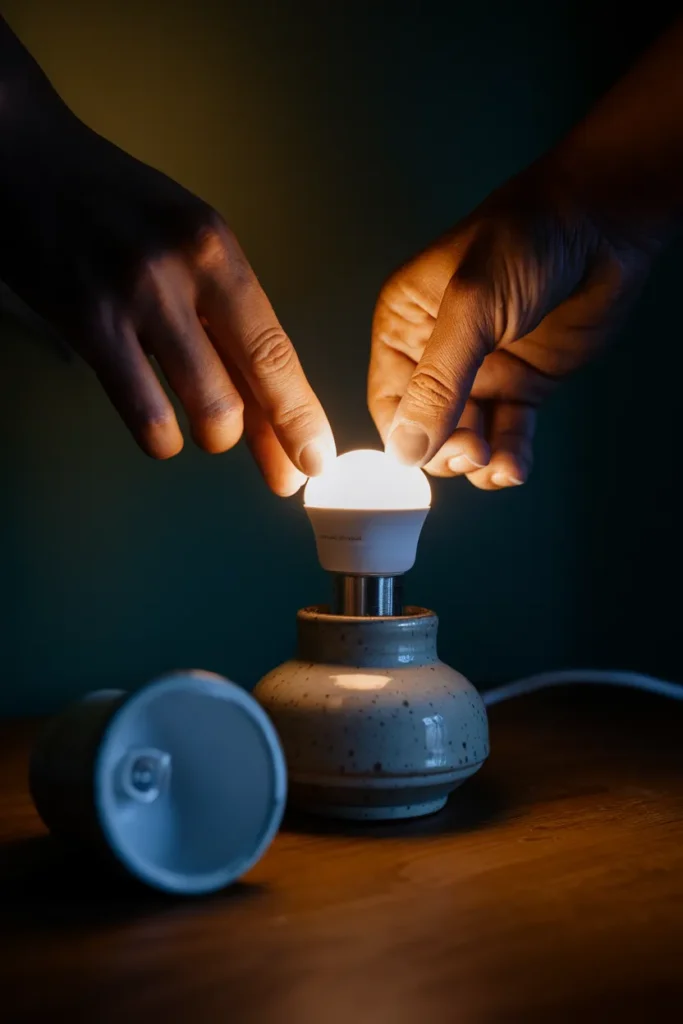
The 18-Inch Reach Rule for a Chair Corner
Here’s the rule that decides whether you sit in a corner or just look at it: anything you need while reading has to sit within 18 inches of where your shoulder lands.
Beyond 18 inches you lean. Leaning breaks the position. Breaking the position ends the session, usually around minute fifteen, and you go back to the sofa. Reading corners don’t fail because they look wrong. They fail because reaching for the mug is annoying.
Below are working numbers, not published standards. Check them with a tape measure against your own body and your own chair.
| Element | Working number | Why it matters |
|---|---|---|
| Side table height | Within 2 inches of your chair’s arm height (most armchair arms land at 24 to 26 inches) | A mug at arm height doesn’t get elbowed |
| Reach to the table | 18 inches or less from your seated shoulder | Past this you lean forward, and leaning ends the session |
| Walkway behind the chair | 30 inches minimum | Below this, people brush the chair back on their way past |
| Rug placement | Front legs on, back legs off, at least 3 feet of rug in front of the chair | Anchors the corner without buying a room-size rug |
| Bottom of the lamp shade | At or just below seated eye level, roughly 40 to 42 inches from the floor | Light on the page instead of in your eyes |
| Bulb output | 2700K, 450 to 800 lumens | Warm enough for the room, bright enough for small print |
Most awkward corners in a 600 to 1,400 square foot apartment can hold this setup in about 30 by 40 inches of floor. That’s smaller than most people assume, which is why the corner sits empty for two years. If you want the corner treatment broken down chair by chair, we cover reading nook corners that stay small in more detail.
Failure mode: skip the table entirely and you’ll set your mug on the floor. Then you’ll knock it over. Then the rug goes.
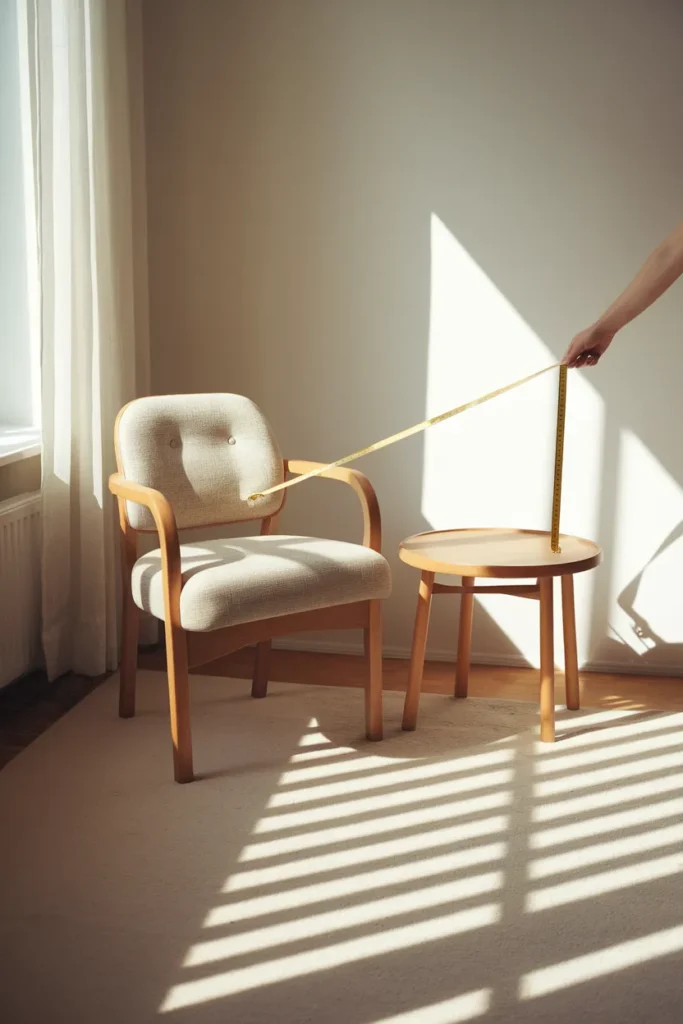
Renter-Safe Warmth: No Drill, No Paint, No Conversation With Your Landlord
Renting kills most of the advice in the top search results. You can’t rewire for sconces, you can’t paint the walls a warm clay, and you’d rather keep your deposit. Fine. Warmth is still available.
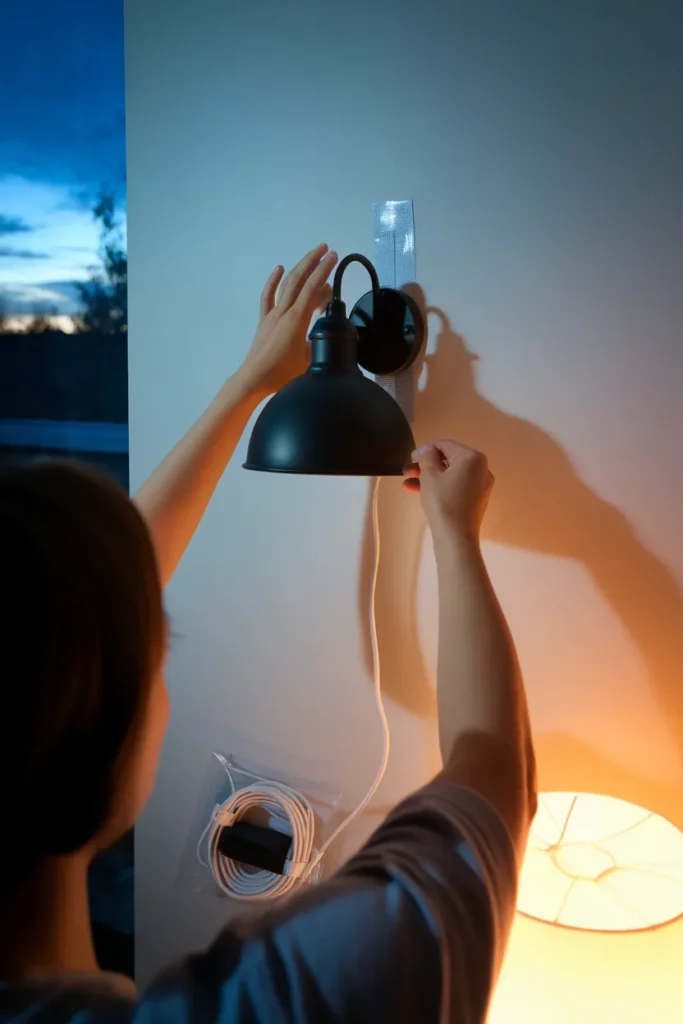
Light without wiring. Plug-in sconces mount with adhesive strips or two small screws and run a cord down to an outlet. Cord covers in a matching wall color hide the run for under $15. If you’d rather compare the mounting styles first, we broke down plug-in wall sconces that need no wiring by weight and cord length.
Color without paint. A blackout curtain in a warm clay or deep olive, hung on a tension rod inside the window frame, drops more color into a room than an accent wall and comes down in ten seconds. Peel-and-stick wallpaper works on one wall behind a bookcase, where the seams stay hidden.
Texture without hardware. A washable rug over builder-grade beige carpet is the single biggest visual change most renters can make. A ladder shelf leans against the wall and carries books without a single anchor.
The honest limit: adhesive strips have real weight ratings, and they fail in humidity and on textured or freshly painted walls. Don’t hang anything above a chair you sit in unless you’ve tested it with double the weight for a week. A sconce landing on your head at 11 pm is a bad way to learn about surface prep.
Build the Corner Everyone Is Actually Searching For
Here’s the thing the big publishers keep burying: the reading corner isn’t a nice extra at the end of the list. It’s the change people are hunting for.
Pinterest’s 2026 spring trend report puts numbers on it. Searches for “comfy reading chair small spaces” climbed 455%. “Reading nook ideas” rose 245%. “Closet reading nook for adults” and “sunroom reading nook” both grew. Pinterest’s own framing for the season is micro-makeovers over renovations, where a splash of paint or a reading nook becomes the statement. Alongside that, “vibey apartment living room aesthetic” jumped 380%, which tells you the people searching are in apartments, not remodels.
So build the corner deliberately instead of letting it happen by accident.
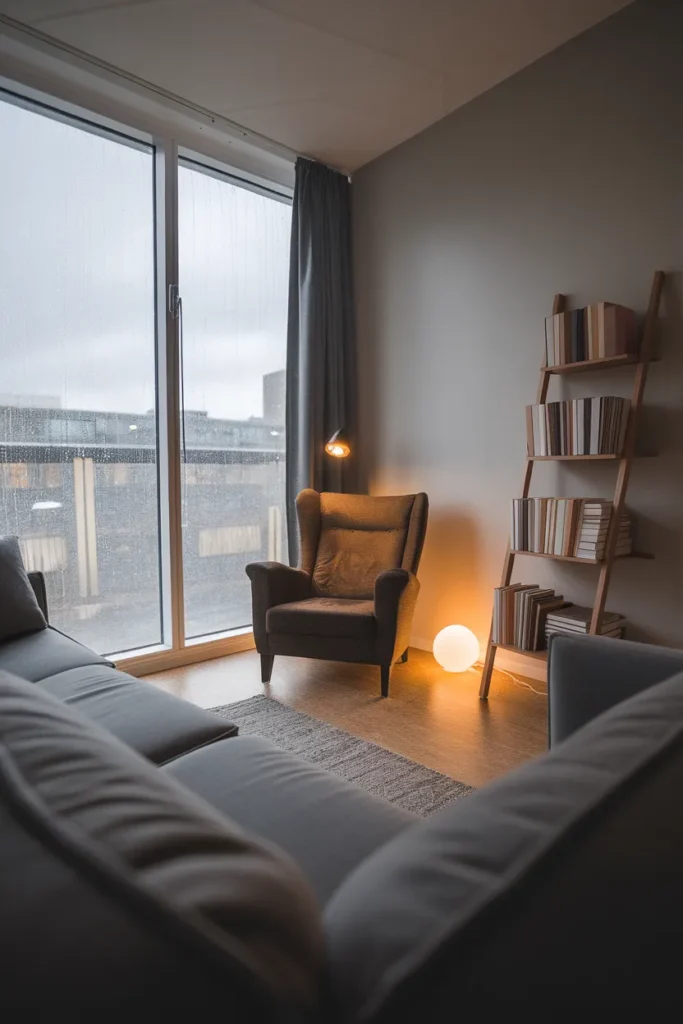
Pick the spot with the least traffic through it, ideally one where two walls meet so you get a natural cocoon on two sides. Angle the chair about 15 degrees off the wall rather than parking it flat. That small rotation is what separates a corner that reads tucked-away from a corner that reads like leftover furniture.
Put a low bookcase or a ladder shelf on the wall behind the chair. Your TBR pile becomes the backdrop, which means the corner looks intentional even before you add anything soft.
Soft Layers, In the Right Order
Rug, then throw, then pillows. Adding them in the other direction is how rooms end up cluttered instead of layered.
The rug goes first because it fixes something you can hear as well as see. Hard floors bounce sound, and a room with an echo never quite feels settled no matter how it’s styled. A jute or wool rug with the front chair legs on it deadens that bounce immediately. Washable versions have gotten good, and if you have a dog or a toddler they’re the only sensible choice.
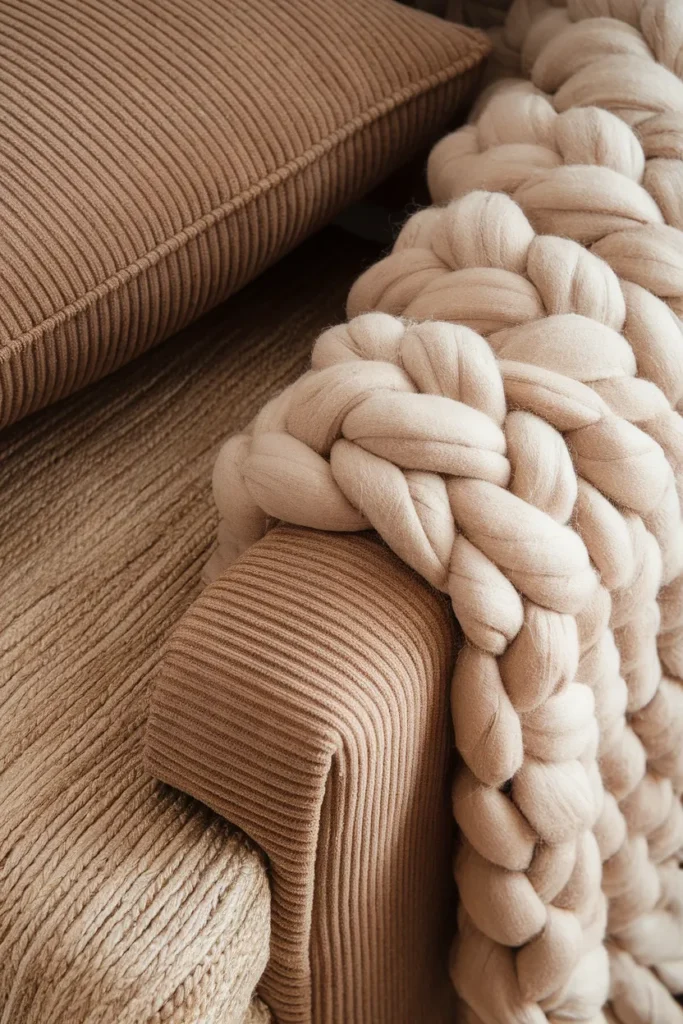
One throw with weight, not three folded decoratively. Wool, sherpa, or a heavy cotton waffle weave. The test is simple: does it stay put when you pull it over your knees, or does it slide off? Thin decorative throws slide off. They photograph well and do nothing.
One lumbar pillow, positioned, not stacked. A lumbar pillow at the small of your back is the difference between a chair you leave after twenty minutes and one you stay in.
Honest trade-off on floor cushions and poufs: they look wonderful in photos and they’re genuinely useful as a footrest or extra seating when someone visits. As a primary reading seat, most adults last about forty minutes before their lower back files a complaint. Use them as a second layer, not the main event.
The Corner, Totaled: Two Real Budgets
Nobody in the search results totals anything. Here are current US prices, checked July 2026.
| Item | Thrifted route | New route |
|---|---|---|
| Armchair | $40 to $80 secondhand | IKEA POÄNG armchair, walnut effect, $139 |
| Side table | $10 to $25 secondhand | $25 to $45 |
| Lamp | $12 to $25 secondhand | $25 to $40 |
| 2700K dimmable LED bulb | $6 to $12 | $6 to $12 |
| Washable accent rug (3×5) | $30 to $50 | $35 to $60 |
| Wool-blend throw | $18 to $35 | $25 to $50 |
| Running total | $116 to $227 | $255 to $346 |
Two notes so this stays honest. IKEA’s POÄNG runs $139 for the walnut-effect frame as of July 2026, and other fabric and frame combinations price higher, so treat that as a floor rather than a fixed number. And the thrifted route only lands at the bottom of its range if you’re patient, because the chair is the piece that takes weeks to find at $40.
If your corner is part of an open-plan room rather than a defined one, the boundary work matters more than the shopping list, and we walk through carving a reading area from an open-plan room separately.
The Warmth You Can’t Photograph
Every article on this topic stops at what a room looks like. Half of what makes a space feel warm never shows up in a photo.
Sound. Soft goods absorb, hard surfaces reflect. A rug, a lined curtain, and a wall of books will drop the echo in a small living room noticeably. You won’t consciously notice the change. You’ll just find yourself staying in the room longer.
Temperature. A corner against an exterior wall runs cooler than the middle of the room, sometimes by several degrees in winter. That’s why the chair against the outside wall never quite works in January. Move it one wall over, or put a lined curtain behind it.
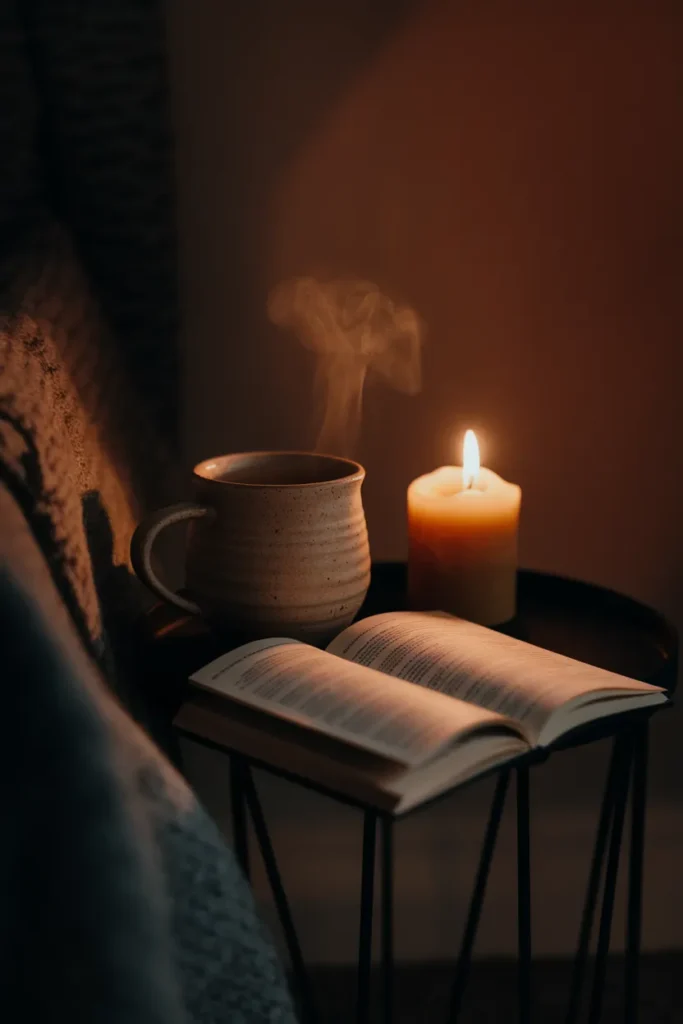
Scent. Not a candle you light for guests. Something the room smells like at baseline: cedar in the bookcase, a beeswax candle you actually burn down, coffee at 7 am. Scent is the fastest route to a room feeling inhabited rather than staged.
Texture at skin level. Anything your forearms rest on matters more than anything on the wall. Chair arm, throw, book cover. Those three surfaces are what your body reports back to you about whether a room is comfortable.
Five Things That Make a Living Room Read Cold
A quick diagnostic. If your room feels off and you can’t name why, it’s usually on this list.
- Everything is pushed against the walls. Floating the sofa even 8 inches off the wall creates depth. Pushed flat, a room reads like a waiting area.
- One light source, and it’s on the ceiling. Overhead-only lighting flattens texture and kills shadow, and shadow is where warmth lives.
- The rug is too small. A rug that floats in the middle with no furniture legs on it shrinks a room instead of anchoring it.
- Nothing is at eye level. Bare walls above 5 feet make a ceiling feel higher and colder. Art, a shelf, or a sconce fixes it.
- Nothing in the room shows evidence of a person. A stack of books you’re actually reading beats a styled tray every time. Rooms feel warm when they look used.
Fix these in order and most rooms turn around without a single new furniture purchase.
Frequently Asked Questions
What actually makes a living room feel cozy? Three things stacked in order: warm low-level light, a seat that supports you for more than twenty minutes, and soft materials your skin touches. Color and decor sit on top of those and can’t replace them.
How do I make a small living room feel cozy without making it feel cramped? Keep the floor visible and go vertical. A ladder shelf, a wall-mounted or plug-in sconce, and one rug that the front furniture legs sit on will warm a small room without eating square footage. Avoid adding a second large piece of furniture.
How can I make a large living room feel cozy? Break it into zones rather than treating it as one room. A rug plus a chair plus a lamp in one corner creates a defined pocket, and a second grouping elsewhere keeps the space from feeling like a lobby. Seating that’s spread too far apart is the usual culprit in a big room.
How do I make my living room cozy for guests? Give every seat its own light source and its own surface to set a drink on. A guest sitting in the one chair with no lamp and no table beside it will never fully relax, no matter how nice the chair is.
How can I make my living room cozy on a budget? Start with a 2700K bulb, which runs $6 to $12 and changes the whole room. Then add a rug, then a throw. A full corner build lands around $116 to $227 thrifted based on current US prices.
Is there a way to get a fireplace feel without renovating? Not really the heat, but the light, yes. A cluster of pillar candles on a tray at floor or low-table height gives you flicker at the same height a hearth would. Freestanding electric units are the renter-friendly option if you want warmth too, and they need no chimney or venting.
How do I choose colors for a warm corner? Work with what your light is doing. Warm bulbs push everything amber, so earthy tones like clay, olive, camel, and warm cream will sing while cool grays and stark whites go slightly muddy. Choose one deep color for the largest soft surface and keep everything else within two shades of it.
Where to Start This Weekend
Buy the bulb. That’s it, that’s the whole first step.
Swap it into whatever lamp is closest to where you already sit, turn off the overhead, and spend one evening in the room before you buy anything else. You’ll know within a night whether the corner you were planning is in the right place, and you’ll have spent under $12 finding out.
Once the light is right, the chair tells you where it wants to go.
If your corner turns out to be tucked into an open-plan room, or up against a fireplace, or in a rental where absolutely nothing can be mounted, we’ve got a guide for each of those.
Keep reading
More cozy nook ideas
 Living Room
Read →
Living Room
Read →
15 Modern Farmhouse Living Room Ideas for Small Apartments
Two rolls of peel-and-stick shiplap, a 5 by 8 jute rug, and one plug-in wall lamp. At listed US prices this month,…
 Living Room
Read →
Living Room
Read →
Cabin Living Room Checklist: Everything to Decide Before You Start
No log walls, no stone hearth, no lake outside the window. You can still build a cabin living room in a regular…
 Living Room
Read →
Living Room
Read →
How to Make a DIY Coffee Table That Feels Cozy, Not Cluttered
Most DIY coffee table plans hand you a cut list on line one. That is why so many finished tables end up…