
Cozy Christmas Living Room Ideas That Work in a Small Rental

If your idea of a cozy Christmas living room is a giant stone fireplace and a mantel you can pile garland on, and what you actually have is a 12 by 14 rental with a radiator and a landlord who counts nail holes, this one is for you.
Here is the promise. No drilling. No fireplace required. Around $150, and you can do it across one Saturday.
Most Christmas decorating advice quietly assumes you own your walls. We are going to work with the room you actually rent, and we are going to start with the layer that does the most work for the least money.
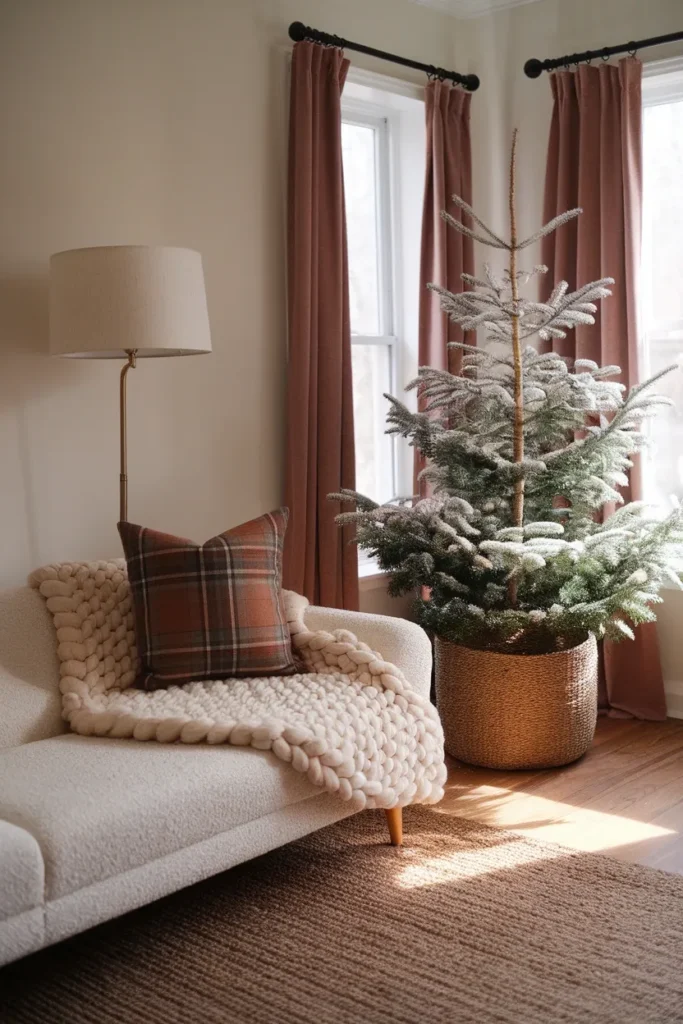
Start Here: The Three Layer Rule (and Why Nothing Gets Drilled)
Before a single thing goes on a wall, know this: you do not need to hang anything permanent to make this room work. Every method in this article uses adhesive strips, tension rods, existing curtain rods, furniture surfaces, or the floor. Your security deposit survives.
Now the rule. A room reads as festive when it has three layers, and it reads as flat when it has only one.
The Three Layer Rule:
- Light. At least three separate warm light sources below eye level.
- Texture. At least two soft goods you can physically touch from where you sit.
- Green. One real or faux evergreen element, at any size.
That is it. Miss any one of the three and the room reads as decorated rather than warm. Most people over-invest in layer three (they buy ornaments) and skip layer one entirely, which is why their living room looks like Christmas but does not feel like it.
Work in that order: light, then texture, then green. It is also cheapest to most expensive, so if you run out of money you still end up with the layer that matters most.
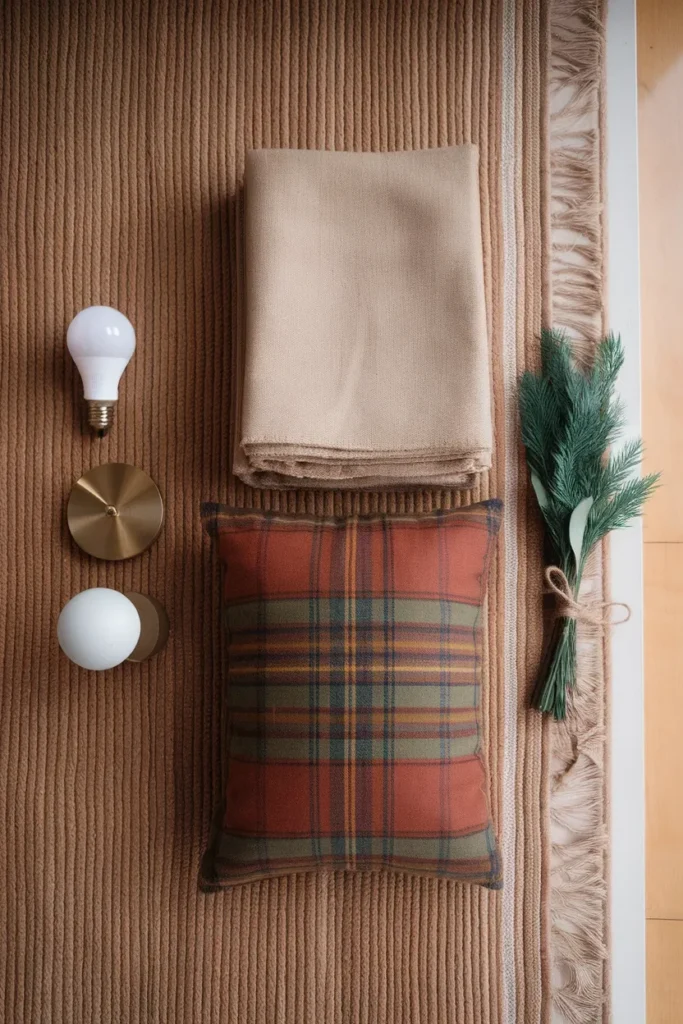
Fix the Light First (It Is Most of the Feeling)
Overhead lighting is what makes a rental living room feel like a waiting room. A single ceiling fixture throws hard light down from one point, flattens every texture you just paid for, and puts the whole room at one brightness. Switch it off in December and leave it off.
Replace it with three or more light sources positioned below eye level, meaning below roughly 60 inches when you are sitting on the sofa. A floor lamp in the corner, a table lamp on a side table, and a string of warm white fairy lights on the tree already gets you there.
Then get the color temperature right, because this is the part almost nobody specifies.
| Bulb rating | What it actually looks like | Use it for |
|---|---|---|
| 2200K | Deep amber, candle-like | Accent only, string lights, sconce bulbs |
| 2700K | Soft warm white, slightly golden | Your default for every living room lamp |
| 3000K | Warm but cleaner, less gold | Task reading if 2700K feels too dim |
| 4000K and up | Blue-white, office light | Never in a living room in December |
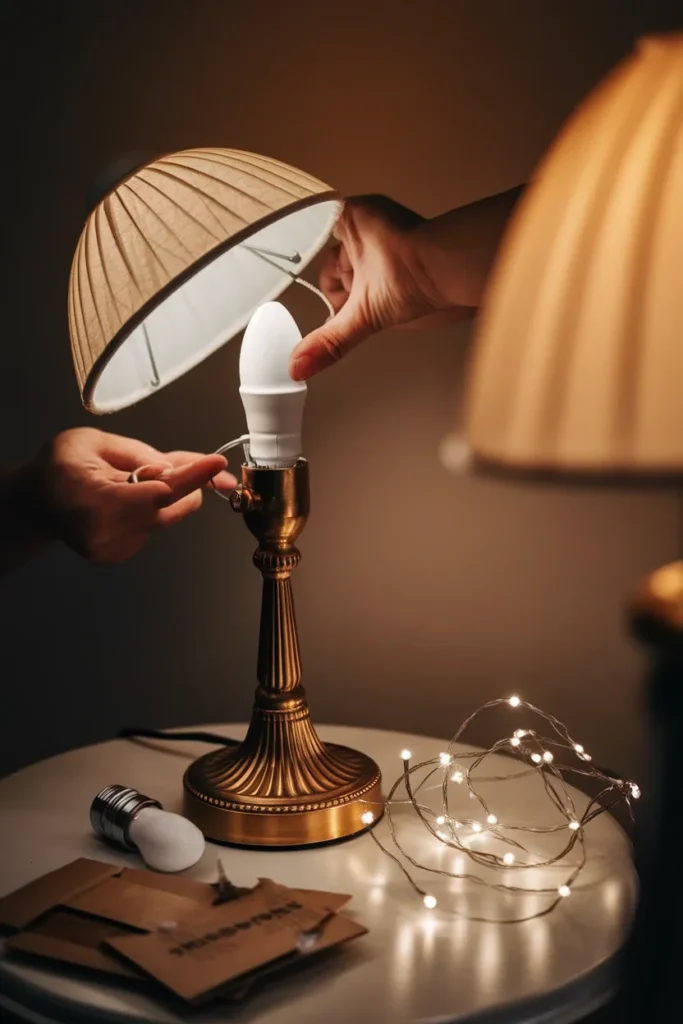
Buy 2700K. If your lamps currently have anything at 4000K or 5000K in them, swapping those bulbs alone changes the room more than $100 of ornaments will, and a four-pack usually runs $8 to $15.
Aim for roughly 800 lumens per lamp, which is what a standard 60-watt-equivalent bulb produces. Three lamps at 800 lumens gives a small living room plenty of light to read by while keeping the ceiling dark, and dark ceilings are what make a room feel like it is holding you.
There is a practical bonus here. According to the Department of Energy’s LED lighting guide, residential LEDs use at least 75% less energy and last up to 25 times longer than incandescent bulbs, while incandescents release about 90% of their energy as heat. Running four lamps and two strings of lights all December costs very little if everything is LED.
One more thing: put a $10 plug-in dimmer or a smart plug on your main lamp. Being able to drop the room to about 30% at 8pm is the difference between a living room and a living room you do not want to leave.
Failure mode: if you skip the bulb swap and just add more lights at 4000K, you get a brighter room that still feels cold. Temperature beats quantity every time.
No Mantel? Put the Focal Point Somewhere Else
Every Christmas living room article on the internet styles a mantel. If you rent, there is a decent chance you are looking at a blank wall, a radiator, or a TV.
A focal point is just the place your eye lands first, and you can build one anywhere. Pick whichever of these you already own:
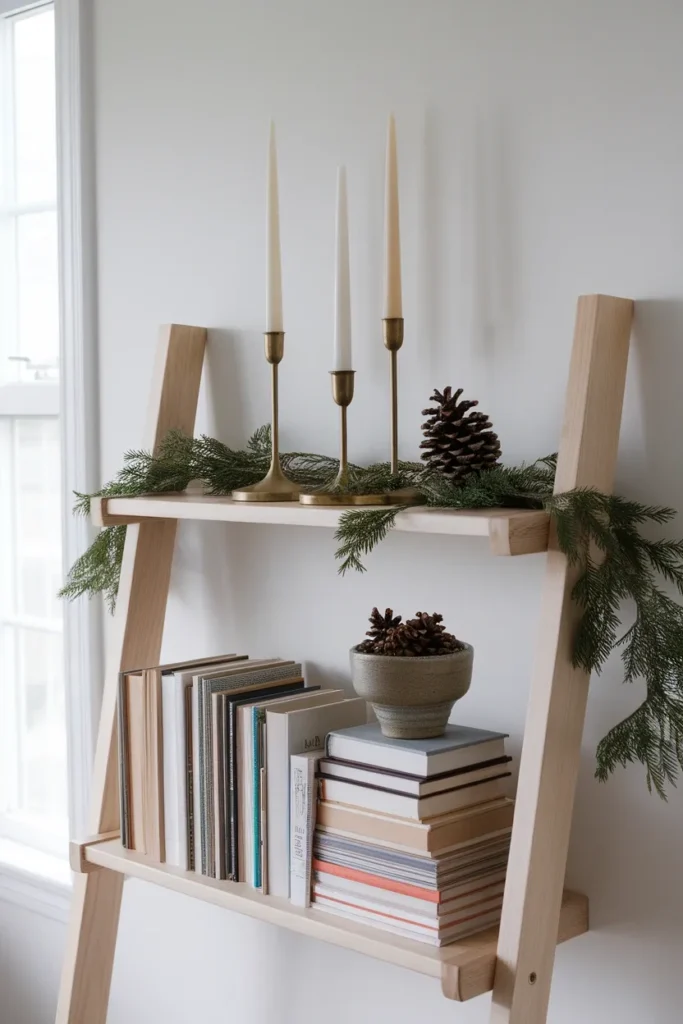
- A bookcase or ladder shelf. Clear the top two shelves entirely, then restyle with a short garland draped along the front edge, three brass candlesticks at staggered heights, and your books turned spine-in for a neutral backdrop. Turning books spine-in is free, takes four minutes, and instantly reads as intentional.
- A console or sideboard. Run a linen runner, add one large object (a lantern, a bowl of pinecones, a small potted spruce), then two small ones. Odd numbers, varied heights, one third of the surface left empty.
- The TV wall. Do not fight the TV. Flank it: a slim tree on one side, a floor lamp on the other, and a low basket of throws underneath. The TV stops being the focal point when it stops being the only thing on that wall.
- A window. A garland swagged over an existing curtain rod plus a string of warm lights turns a plain rental window into the best feature in the room, and no hardware goes into the wall.
The window option is the one to try first if you are unsure. It uses hardware you already have, it is visible from the street, and it reads best at dusk when the lights come on. For more on building glow into a corner that has no ceiling fixture at all, our soft-glow reading nook lighting ideas covers the plug-in and clip-on options in detail.
Layer Texture Until You Want to Sit Down
Texture is what separates a room that looks warm in a photo from one that feels warm at 9pm on a Tuesday.
The test is physical: from wherever you normally sit, can you reach at least two different soft materials without standing up? If not, you are short a layer.
What actually works, in order of impact per dollar:
- One oversized throw, not a folded decorative one. Look for something at least 50 by 70 inches so it covers an adult on a sofa. Chunky knit wool, sherpa, or heavy cotton waffle. A throw that is too small to actually use is decor. A throw that is big enough to sleep under is an invitation. Expect $20 to $40.
- Swap pillow covers, not pillows. Buy covers in 20 by 20 for standard inserts. Two covers run $15 to $30 and store flat in a shoebox in January, which matters more than you think.
- Add a lumbar pillow. A 12 by 20 lumbar in a contrasting texture (boucle against linen, velvet against knit) does more for a sofa than two more square pillows.
- Put something under your feet. A washable jute or wool runner in front of the sofa, even a small 2 by 6, changes how the room sounds. Soft floors absorb echo, and a room that echoes never feels enclosed.
- A basket for the throws. Not for storage, for the visual. A woven basket spilling one blanket reads as a room people use.
Mix at least two textures that behave differently under your hand: something with pile (sherpa, velvet, sheepskin) against something flat and woven (linen, cotton, jute). Two smooth things next to each other read as one thing.
Most of these swaps carry straight through winter, which is the real argument for buying neutral. If you want the non-Christmas version of this same approach, our seasonal living room layering ideas walks through the fall setup you can just add green to in December.
The honest trade-off: heavily layered sofas look incredible and they get messy within about two days of actual use. If you have kids, a dog, or a partner who does not refold things, buy washable and accept that the neatly arranged version exists for about ten minutes.

The Renter Rules: Hanging Everything Without a Single Nail
This is the section the other articles skip, and it is the one that decides whether you decorate at all.
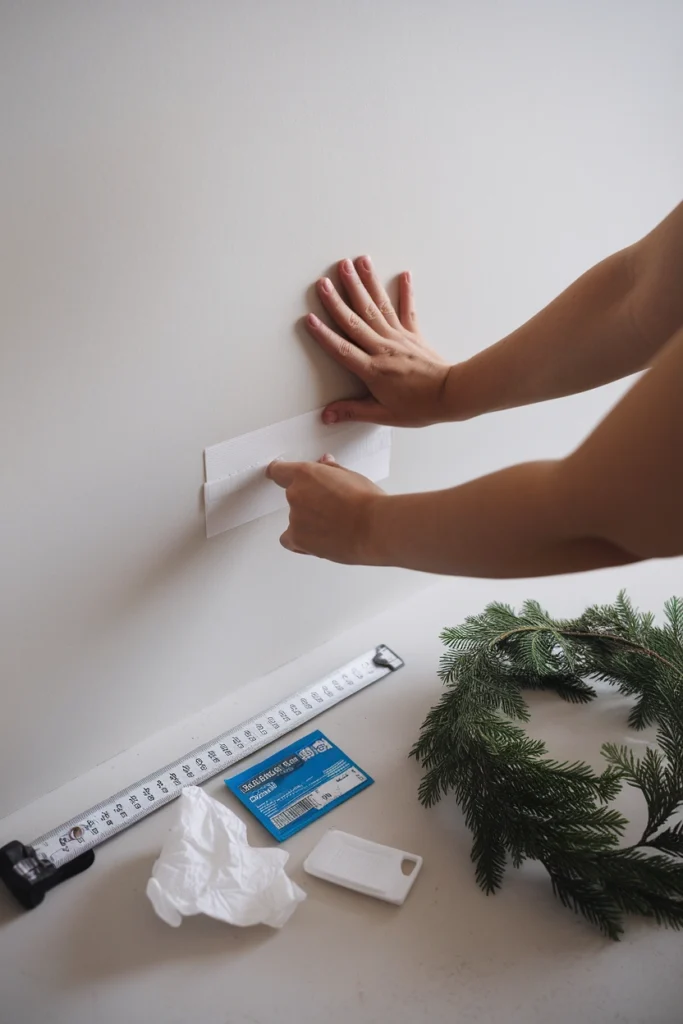
Adhesive strips and hooks. Check the weight rating on the package before you buy, because the range is wide: small utility hooks typically hold around half a pound, medium around three pounds, and large picture-hanging strip sets go up to roughly sixteen pounds. A 6-foot faux garland weighs about a pound, so medium hooks are plenty. Three rules make them work:
- Wipe the wall with rubbing alcohol first, not a household cleaner. Cleaner residue is the single most common reason strips fail.
- Wait one hour after mounting before hanging any weight.
- Remove by pulling the tab straight down, slowly, parallel to the wall. Pulling outward is what takes the paint with it.
Tension rods. A tension rod inside a window frame or an alcove gives you a hanging line with zero hardware. Hang lightweight stockings, a small garland, or a row of ornaments on ribbon.
Existing curtain rods. Already load-bearing, already installed. Swag a garland across the top, or tie ribbon bows at each end.
Furniture instead of walls. Bookcase tops, console surfaces, the back of an accent chair, the floor beside the sofa. A basket of pinecones on the floor next to a floor lamp does the same work as a wall wreath and costs nothing to install.
Command-free wreath trick. Hang a wreath on the inside of a window using a length of wide ribbon looped over the top of the curtain rod, with the wreath sitting at the vertical center of the glass. Visible from the street, invisible to your landlord.
Skip these entirely: nails, screws, wall anchors, hot glue, tacks, mounting putty on painted drywall, and any hook rated below the actual weight of what you are hanging. Also skip adhesive strips on textured or freshly painted walls, since paint needs about 30 days to fully cure before anything adhesive should touch it.
If you want the year-round version of decorating without touching the walls, our renter-safe small apartment decor ideas covers the same constraints outside of December.
Put the Tree Where It Actually Fits
In a small living room, tree placement is a floor-plan problem, not a decorating one.
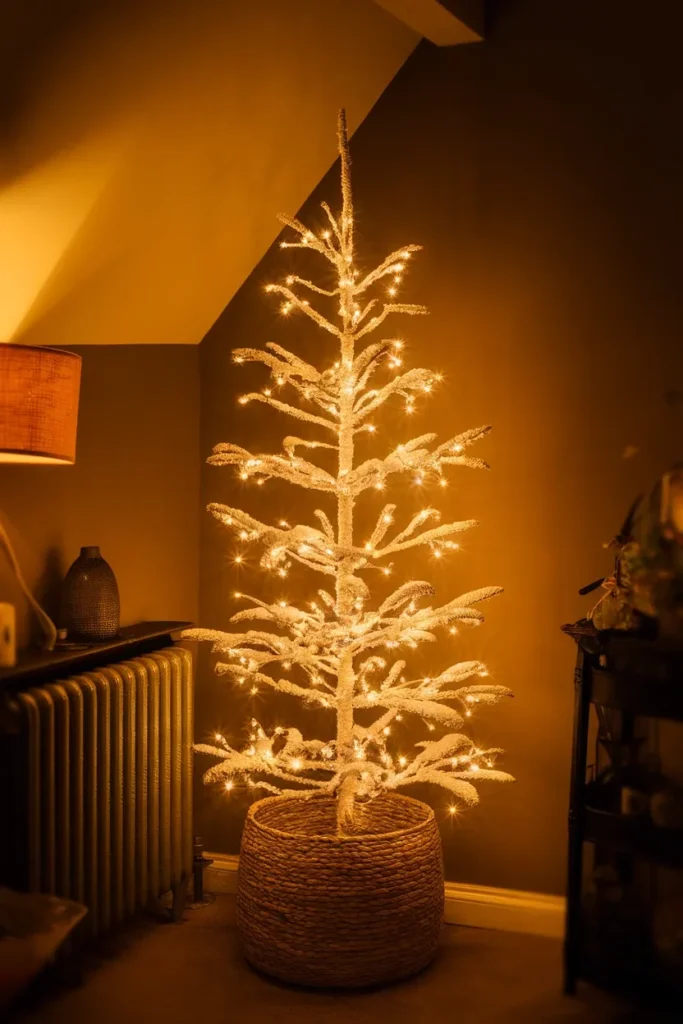
Walk the room first and find the spot that is already dead space. Usually it is a corner, the gap beside a bookcase, or the space in front of a window you never open in winter. That is where the tree goes, because a tree that blocks a walking path will annoy you by December 3rd.
Sizing, honestly:
- Under 8-foot ceilings: a 6 or 6.5-foot slim or pencil tree. Slim trees are typically 26 to 32 inches in diameter versus 45 to 50 for a full tree, which is the entire difference between a tree that fits and one that eats the room.
- Very tight rooms: a 4-foot tree on a side table. Raising it puts the lights at eye level where they read as glow rather than as furniture.
- Genuinely no floor space: a 2 to 3-foot tabletop tree on the console, or two of them flanking the TV.
Drop any tree into a woven seagrass or wicker basket instead of using a stand skirt. It hides the stand, adds texture, and costs $15 to $30. This is why tree in basket is its own Pinterest topic page.
Then the part that is not optional. Per federal holiday fire safety guidance from the US Fire Administration, keep your tree at least 3 feet from any heat source, including radiators, space heaters, fireplaces, candles, and heat vents, and never let a tree block an exit. Almost one third of home Christmas tree fires are caused by electrical problems, so check every light strand for frayed or pinched wire before it goes on the tree and follow the manufacturer’s limit on how many strands you connect together. If you have a live tree, water it daily.
In a small apartment this matters more, not less, because the radiator is usually in exactly the corner the tree wants.
Choose a Palette, Then Stop Buying
The fastest way to make a small living room look cluttered is to decorate in four color stories at once.
Pick a base and one accent. That is the whole system.
- Neutral base plus green. Cream, oatmeal, and greige with cedar, spruce, and eucalyptus. Reads calm, works with almost any existing sofa, and stays up through February without looking like you forgot.
- Neutral base plus muted red. Not fire-engine red. Brick, rust, cranberry, or faded plaid. Warmer than green-only, still restrained.
- Neutral base plus brass and amber. No true “Christmas colors” at all. Candlelight, brass, wood, and warm white. This is the one that photographs best under lamp light.
Here is the trick that keeps you honest: let your ribbon and gift wrap set the palette, and buy them first. Wrapping paper is the cheapest way to test a color story, and once the gifts are under the tree they become a large block of color in the room whether you planned it or not. Choose the wrap in November, then match everything else to it.
Whatever you pick, repeat each color at least three times around the room. One rust pillow is an accident. Three rust things (a pillow, a candle, a ribbon on the garland) is a palette.

Add the Layer You Cannot See
Everything so far has been visual. The reason some living rooms feel like Christmas and others just look like it comes down to the three senses nobody photographs.
Smell. Real cedar or fir clippings on a console beat any candle, and most tree lots and garden centers give away offcuts for free in early December. If you want a candle too, keep it simple: balsam, or clove and orange. Burn it for the first twenty minutes after you sit down, then blow it out. The scent stays, the room stops smelling synthetic. Keep any lit candle at least 12 inches from anything that can burn, and use battery-operated flameless candles anywhere near greenery or fabric.
Sound. A room with a jute rug, heavy curtains, and a loaded bookcase absorbs sound. A room with bare floors and empty walls bounces it. If your living room echoes, add the rug before you add anything else, because that echo is a large part of why the space feels unfinished.
Temperature. Cold feet ruin a room. A small rug in front of the sofa, closed curtains after dark, and a throw within arm’s reach do more for how long you stay in a room than any decoration will. Sheer curtains during the day for light, heavier ones drawn at dusk to hold the heat in.
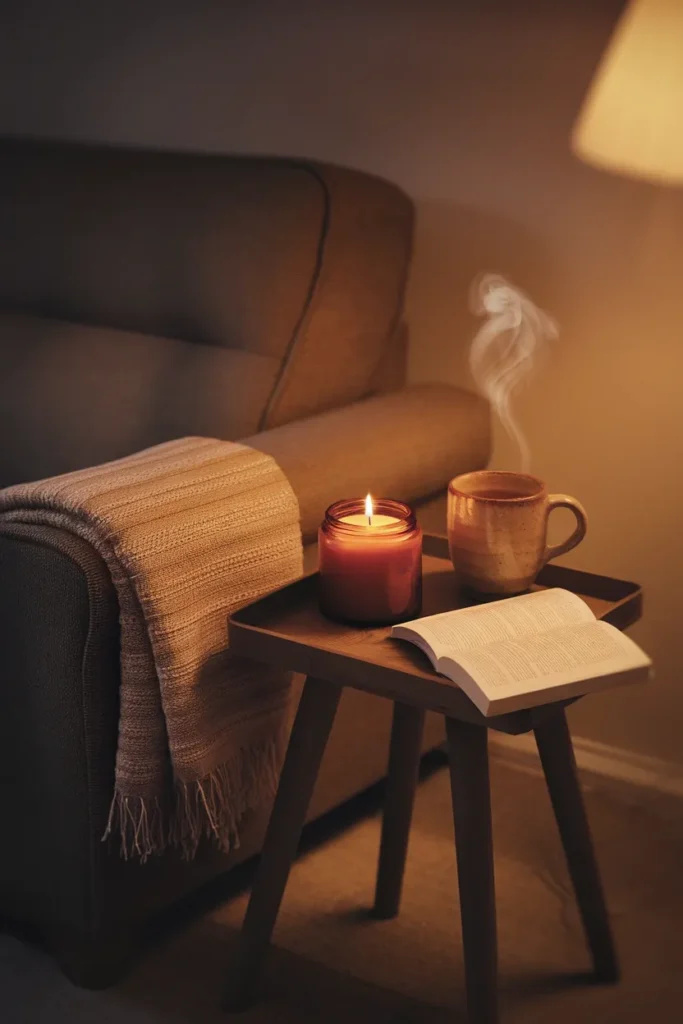
The whole point of a room like this is that you actually sit in it: a lamp on, the ceiling light off, and whatever is on top of your TBR pile
A Real $150 Cozy Christmas Living Room, In Buying Order
This is the build order, cheapest and highest impact first. If you stop at any line, you still have a room that works.
| # | Buy this | Typical price range | Layer |
|---|---|---|---|
| 1 | 2700K LED bulbs, 4-pack | $8 to $15 | Light |
| 2 | Plug-in dimmer or smart plug | $10 to $20 | Light |
| 3 | Warm white fairy lights, 2 strands | $15 to $30 | Light |
| 4 | Oversized knit or sherpa throw, 50×70 | $20 to $40 | Texture |
| 5 | Two pillow covers, 20×20 | $15 to $30 | Texture |
| 6 | Adhesive hooks and strips, variety pack | $8 to $15 | Renter kit |
| 7 | Faux cedar garland, 6 ft | $15 to $30 | Green |
| 8 | Woven basket for the tree or throws | $15 to $30 | Texture |
| Running total | $106 to $210 |
Free additions that punch above their weight: real cedar and pine offcuts from a tree lot, pinecones, books turned spine-in, moving one lamp to a different corner, and turning the overhead light off.
Note on the price ranges: these are typical US ranges across mass retailers, not quoted prices from any one store, and holiday pricing moves a lot between early November and mid-December. Check before you buy.
If you have closer to $80, buy lines 1, 2, 4, and 6, then use free greenery. Light plus one great throw plus real cedar beats a full set of coordinated ornaments in a room this size, every time.
What Makes a Small Living Room Look Cluttered Instead of Warm
Worth saying plainly, since this is where most small-space Christmas decorating goes wrong.
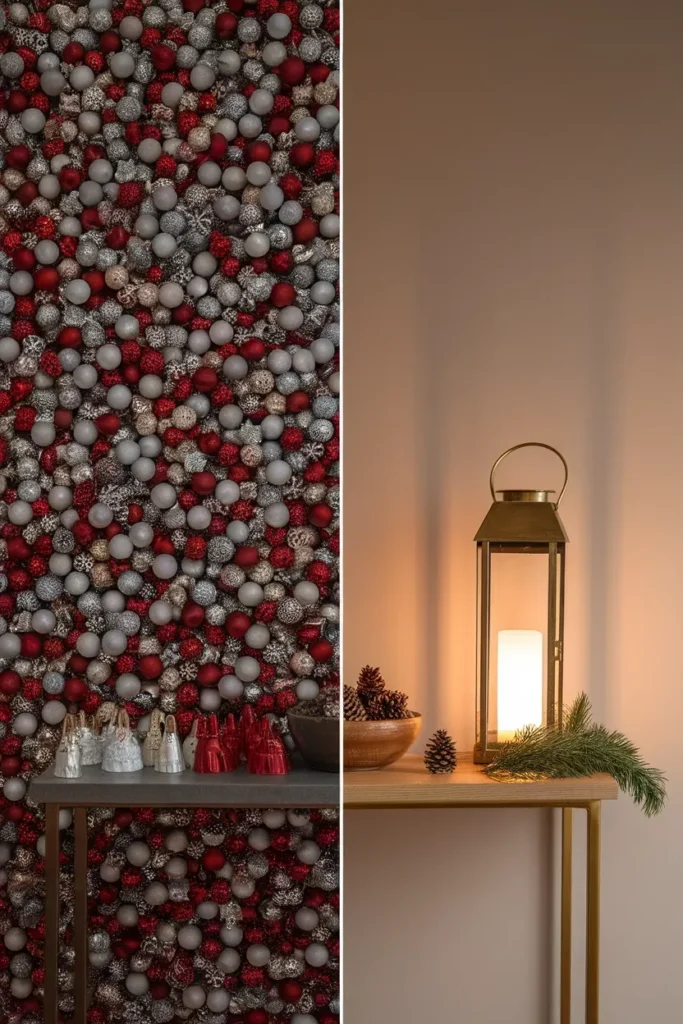
- Decorating every surface. Leave a third of every horizontal surface empty. The coffee table needs room for an actual mug.
- Too many small objects. Five tiny things read as clutter. One large object plus two small ones reads as styled. Group in odd numbers at varied heights.
- Everything at the same height. If your coffee table, console, and side table are all styled at 6 inches tall, the room flattens. Something needs to be tall.
- Full-size tree in a room under 150 square feet. A 45-inch diameter tree in a 12 by 12 room takes the walking path. Go slim.
- Buying a matched ornament set. It photographs well and feels like nothing. Mix in handmade, thrifted, and inherited pieces, even mismatched ones. Especially mismatched ones.
- Leaving the ceiling light on. Undoes everything above it.
Write Down the Takedown Plan Now
Nobody writes about January, which is why January is miserable.
Do this in December while everything is still up, and it takes about fifteen minutes:
- Photograph the room from three angles once it is fully decorated. Next November you will not remember which corner the garland went on. Save the photos to an album called Christmas Setup.
- Keep one bin, labeled by layer, not by room. Lights in one bag, soft goods in another, green in a third. That matches the order you will set it up in next year.
- Wind each light strand around a piece of cardboard. Tangled lights are the reason people buy new ones every single year.
- Note what you did not use. If a box of ornaments never came out, it goes to donation in January, not back in the closet.
- Keep the neutral layers up. The throw, the pillow covers, the basket, the lamps, and the rug are not Christmas. They are winter. Take down the green and the red, leave everything else until March, and the room stays warm through the worst months of the year.
That last one is the whole strategy, honestly. The green comes down. The glow stays.
Cozy Christmas Living Room FAQs
Where should I put the Christmas tree in a small living room? In whatever corner is already dead space, and never in a walking path. Check that the spot is at least 3 feet from any radiator, vent, or heater. If no corner works, use a 4-foot tree raised on a side table so the lights sit at eye level.
What colors make a living room feel cozy at Christmas? A neutral base (cream, oatmeal, greige) plus exactly one accent. Muted red, deep green, or brass and amber all work. Repeat each accent color at least three times around the room so it reads as deliberate.
How do I decorate for Christmas without damaging rental walls? Use adhesive strips rated above the weight of what you are hanging, wipe the wall with rubbing alcohol first, wait an hour before loading them, and remove by pulling the tab straight down. Tension rods, existing curtain rods, and furniture surfaces let you skip walls entirely. Avoid adhesives on paint that is less than 30 days old.
What lighting makes the biggest difference? Switching from overhead light to three or more warm sources below eye level, all at 2700K. It is the single highest-impact change on this list and usually costs under $25.
How do I decorate on a budget without buying all new Christmas decor? Start with bulbs and a dimmer, not ornaments. Add free greenery from tree lot offcuts. Turn books spine-in for a neutral backdrop. Swap pillow covers rather than pillows, and let wrapping paper carry the color story.
How do I keep a small living room from looking cluttered? Leave a third of every surface empty, group objects in odd numbers at varied heights, and choose one large object over five small ones. Then stop.
When should I start decorating? Whenever you want, but if you are photographing the room for Pinterest, set it up in early November. Seasonal saves start climbing in August and peak well before December, so anything published or pinned late arrives after the audience already decided.
Your Next Saturday
Start with the bulbs. Turn off the overhead light, put 2700K in every lamp you own, move one lamp to the corner that has always felt dark, and sit down in the room at 7pm before you buy anything else.
That is layer one, it costs about $12, and it will tell you exactly how much of layers two and three you actually need.
If your living room has an awkward corner that has never worked, that corner is usually the answer to two problems at once. Christmas is a good excuse to finally deal with it.
Keep reading
More cozy nook ideas
 Living Room
Read →
Living Room
Read →
Cabin Living Room Checklist: Everything to Decide Before You Start
No log walls, no stone hearth, no lake outside the window. You can still build a cabin living room in a regular…
 Living Room
Read →
Living Room
Read →
How to Make a DIY Coffee Table That Feels Cozy, Not Cluttered
Most DIY coffee table plans hand you a cut list on line one. That is why so many finished tables end up…
 Living Room
Read →
Living Room
Read →
20 Coffee Table Ideas That Make a Small Living Room Feel Warmer
Your coffee table is probably holding two remotes, a charging cable, yesterday’s mug, and a candle nobody has lit since spring. That…