
Fall Living Room Decor: 11 Ideas You Can Actually Copy This Weekend

Most fall living room decor advice assumes you have a mantel. You probably don’t. You have a rental with beige walls, one awkward corner, and a landlord who counts nail holes at move-out.
So here’s the version that fits your room. Eleven ideas, a real receipt totaling $131.93, the exact bulb temperature that makes a room feel like October, and a corner setup that needs zero drilling. Start at the top and you’ll have a different room by Sunday night.
The first idea is the one that saves you the most money, so read that one even if you skip everything else.
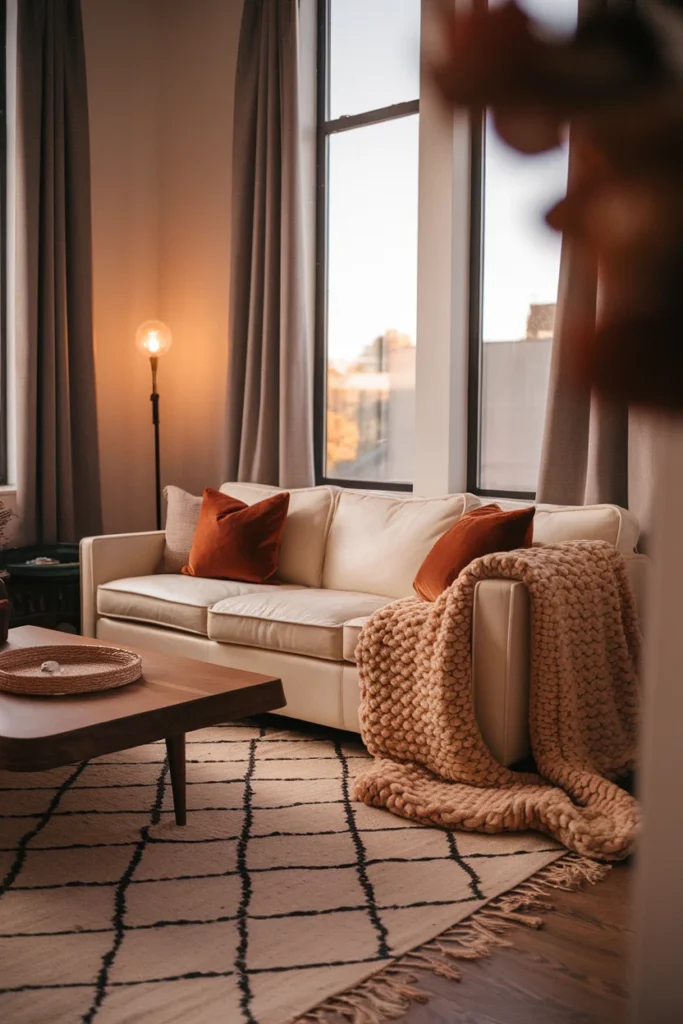
1. Run Every Purchase Through the Warm-Dark-Rough Rule
Before you buy one pumpkin, learn this filter. It’s the reason some rooms look like autumn and others look like a craft store exploded.
Every fall swap has to add at least one of three things: warmth, darkness, or roughness.
- Warm means the color temperature drops. Cream instead of white, camel instead of gray, amber light instead of blue-white light.
- Dark means the value drops. A deeper rust pillow against a light sofa. A charcoal throw where a pastel one was.
- Rough means the texture gets coarser. Boucle, chunky knit, jute, nubby linen, unglazed stoneware.
If an object adds none of the three, it isn’t fall decor. It’s clutter with a leaf printed on it.
Try it on a decorative sign that says HARVEST in script. Warm? No, it’s white. Dark? No. Rough? No, it’s smooth MDF. It fails all three, and that’s exactly why it will look cheap on your shelf in a way you can’t quite explain.
Now try it on a $4.99 fleece throw in oatmeal. Warm yes, rough yes. Two out of three, for five dollars.
Front-load your budget on things that hit two or three. Skip everything that hits zero.
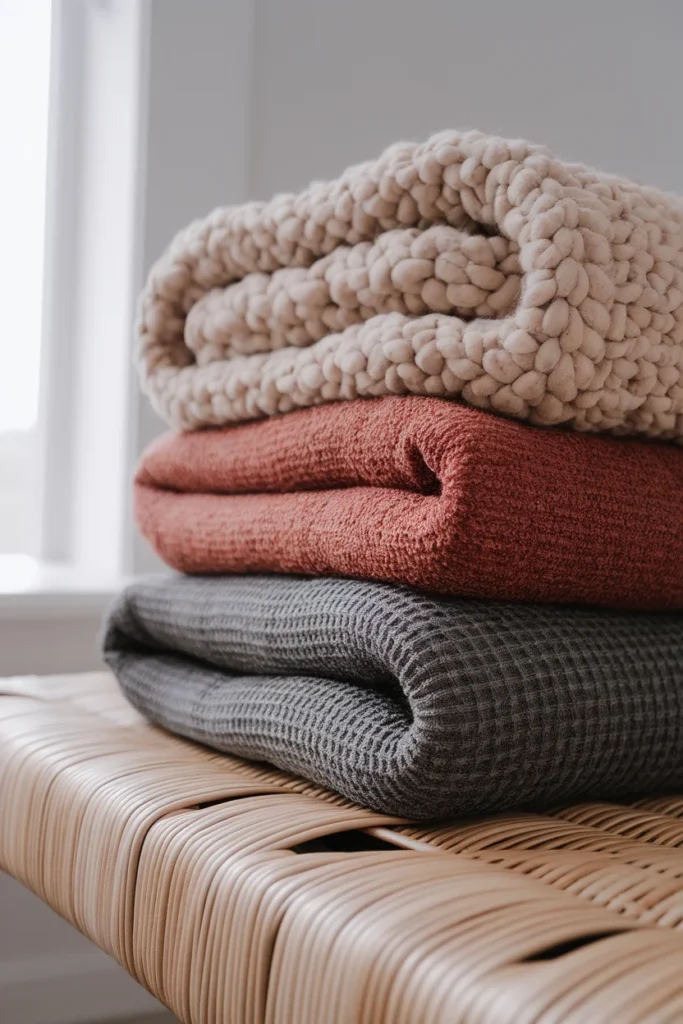
2. Swap Three Soft Layers Before You Buy a Single Pumpkin
Soft goods carry most of the seasonal read, and they’re the only category you can fully reverse in April. If you only change three things about your fall living room decor, change these, in this order.
The sofa-back throw. Go big or it looks like a napkin. A 59 by 79 inch throw (the IKEA VALLKRASSING runs $19.99) actually drapes over a three-seat sofa and reads from across the room. Anything smaller than about 50 by 60 disappears.
Two accent pillows, not six. Six pillows means you move six pillows every time you sit down, and after four days they live on the floor. Two is the number people maintain. Target’s Threshold shaped velvet pumpkin pillow is 13 by 13 inches with a 6 inch loft and costs $20, which is the cheapest way to get a real dimensional shape rather than a printed one.
A layered rug. Not a replacement rug, a layer. A $29.99 cotton flatweave in 5’1″ by 7’3″ thrown over an existing larger rug adds a texture line for the price of two lattes.
Here’s the placement rule people skip: leave 16 to 18 inches between the sofa edge and the coffee table, and keep the rug at least 18 inches off the walls in a small room, 24 inches in a large one. A rug shoved to the baseboard makes a room read smaller, which is the opposite of what a layered rug is for.
If you want the whole-house version of this soft-layer sequence rather than just the living room, our room-by-room fall decor swap guide covers what to change everywhere else and, more usefully, what to leave alone.
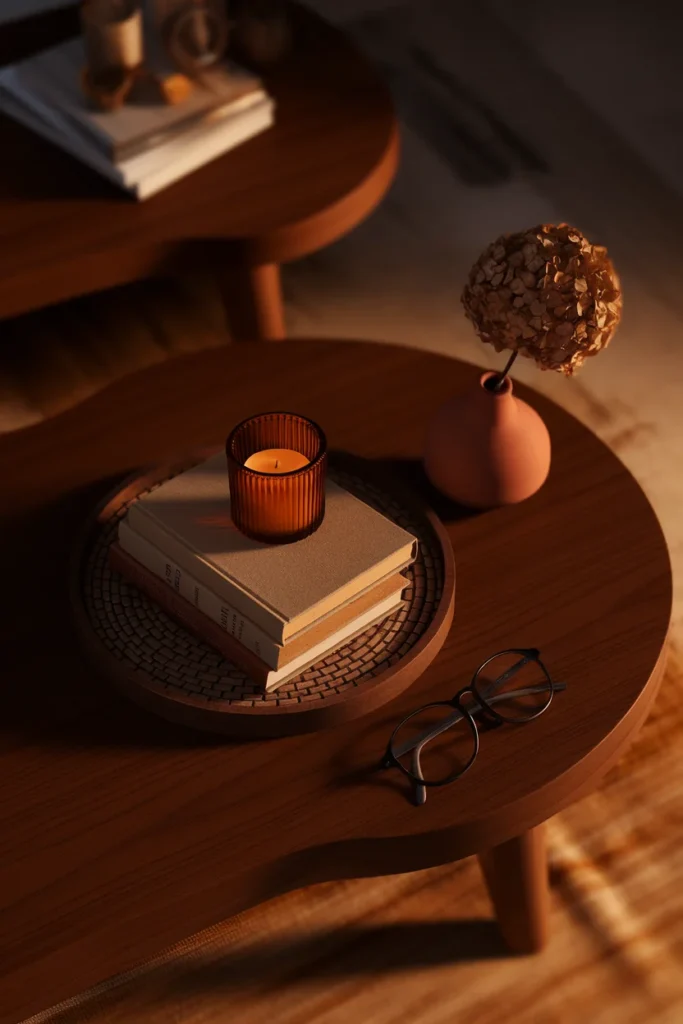
3. Drop Your Bulbs to 2700K, the Cheapest Upgrade in This Whole Article
Nothing else on this list changes a room as fast or as cheaply as swapping light bulbs, and almost nobody does it.
Overhead lights in rentals are usually 3500K to 5000K, which reads as office. Fall reads as fire. That difference is measured in Kelvin, and the Department of Energy publishes the bands, so you don’t have to guess.
| Kelvin | Label | How the room actually feels |
|---|---|---|
| 2700K | Warm | Lamplight, late October, candle-adjacent. Use this. |
| 3000K | Soft | Warm but slightly crisper. Fine for a kitchen. |
| 3500K | Neutral | Reads as “clean.” Kills autumn instantly. |
| 4100K | Cool | Office. Never for a living room. |
A four-pack of 2700K A19 bulbs at 1000 lumens runs $8.98 at Home Depot right now, about $2.25 a bulb. Buy them, put them in your two lamps, and leave the ceiling fixture off entirely from October through February. Two warm lamps at knee-to-shoulder height beat one bright ceiling light every single time.
Two specs worth checking on the box before you buy, both from the Department of Energy’s bulb purchasing guidance: a color rendering index of 80 or higher, so your rust pillow still looks rust and not brown, and a rated life of 10,000 hours or more. For reference, 800 lumens takes 60 watts from an incandescent bulb and only 5.9 to 10.5 watts from an LED, so running two lamps all evening costs almost nothing.
One honest downside: at 2700K, reading small print gets harder. If you read in that room, add a directional task light rather than brightening the ambient bulbs. Warm ambient plus focused task light is the combination that works. Bright everything is the combination that doesn’t.

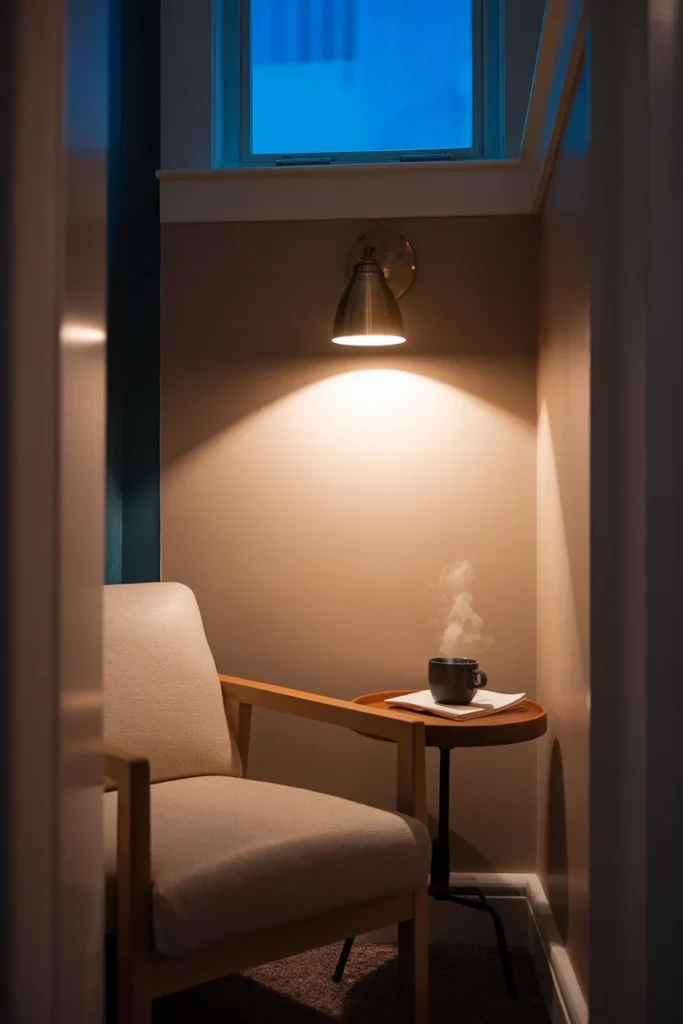
4. Carve a Reading Corner Inside the Living Room
This is the idea the big sites don’t cover, and it’s the one that turns a decorated room into a used room.
Pinterest’s own data put searches for “cozy reading room” up 140 percent in its fall comfort report, and “cozy lighting” up 200 percent. People aren’t looking for a styled living room. They’re looking for a spot inside it that belongs to them.
You need roughly a 30 by 36 inch footprint. That’s it. Measure it in the corner you currently use for nothing.
Three pieces fill it:
- A chair with a real seat depth. The IKEA POÄNG is $149 and measures 26¾ inches wide by 32¼ inches deep, with a 19⅝ inch seat depth and a 16½ inch seat height. That seat depth is the number that matters, because anything under about 18 inches means you perch instead of sink.
- A surface within 18 inches of your elbow. Any 32 inch round side table works. Call it the 18-inch reach rule: if you have to stand up to set down a mug, you’ll stop using the corner within a week.
- One light source at shoulder height. Not overhead. A plug-in sconce or a swing-arm floor lamp, aimed at the page.
The trade-off nobody mentions: floor cushions photograph beautifully and are miserable after forty minutes. If the corner is for scrolling Pinterest, a pouf is fine. If it’s for actually finishing your TBR pile, you need a back.
For the softest, least invasive way to light that corner, the nine setups in our renter-friendly fairy light nook ideas all work with adhesive hooks and warm 2700K strands, no ceiling anchors involved.
5. Fall Decor for Renters: No Drilling, No Paint, No Lost Deposit
Every ranking article in this category assumes you can put a hole in a wall. Here’s what to do when you can’t.
Hang art on adhesive strips, sized correctly. Command’s Large picture hanging strips are rated to 15 pounds and the X-Large to 20 pounds. Weigh the frame on a kitchen scale first, then use the next rating up. Most people fail here by guessing, not by using the wrong product.
Lean, don’t hang. A large framed print leaning on a console or on the floor against the wall reads intentional and weighs nothing on your deposit. Overlap two frames slightly so it looks composed rather than temporary.
Use tension, not screws. A tension rod inside a window recess holds a linen curtain panel with no hardware. Two curtains flanking a window make the window look 30 percent wider, which is the cheapest architectural trick in this article.
Change the floor instead of the walls. Walls are the landlord’s. Floors are yours. A layered rug, a floor cushion, and a basket of throws deliver seasonal change without touching a single vertical surface.
Swap the shades, not the fixtures. You cannot rewire a rental. You can absolutely put a $20 linen drum shade on the ugly builder-grade floor lamp and put the original in the closet until you move.
Nine more damage-free approaches, including adhesive weight ratings and a move-out reversal checklist, are collected in our no-damage rental decorating ideas if your whole apartment needs the same treatment.
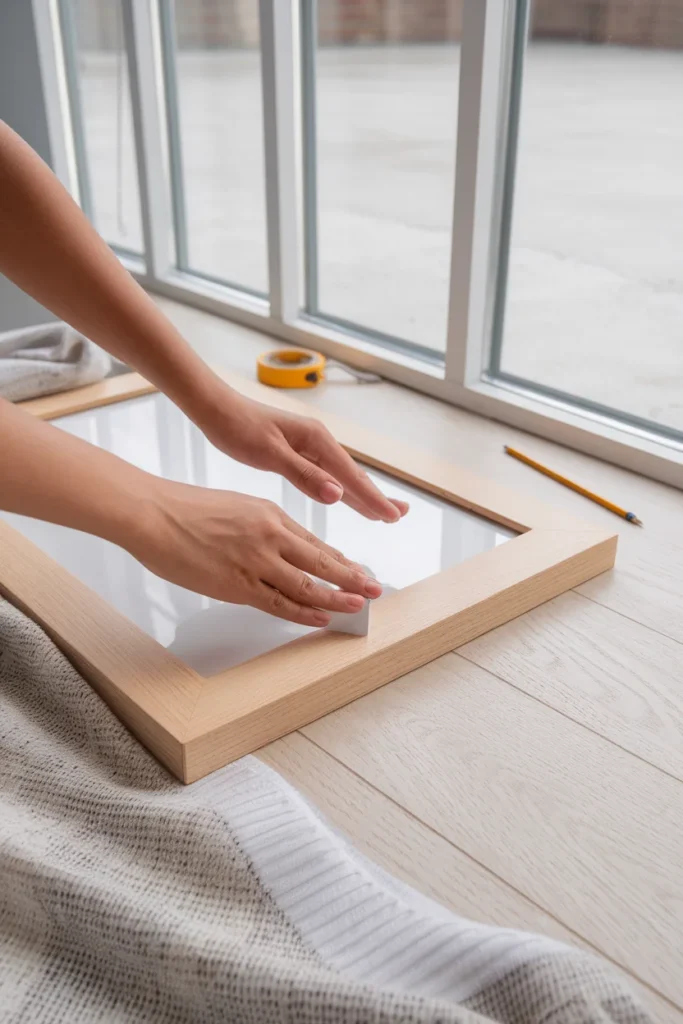
6. Do Fall Without a Fireplace, a Mantel, or a Staircase
If you’ve read three of these articles today, you’ve seen “style your mantel” three times. Roughly a third of US apartment renters have no fireplace at all. Here is the substitute list.
Instead of a mantel, use a console or the top of a low bookcase. You need one horizontal surface at eye level. That’s the whole function a mantel serves. A 30 to 36 inch high console behind a sofa or against a blank wall does the same job.
Instead of a hearth, build a floor vignette. A large basket, a rolled jute runner, two pumpkins of different heights, and a pair of boots. Grounded weight in a corner reads as warm the same way a hearth does.
Instead of a fire, use a cluster of three candles at different heights. Height variation is what makes it read as flame rather than as three candles on a shelf.
Instead of a chimney breast, create a false focal point with a leaning mirror. A 30 by 60 inch floor mirror leaned against a wall bounces your warm lamplight and doubles the perceived glow for one purchase.
The failure mode here is scattering. Six small fall objects spread across four surfaces reads as clutter. The same six objects grouped on one surface reads as a vignette. Group, don’t sprinkle.
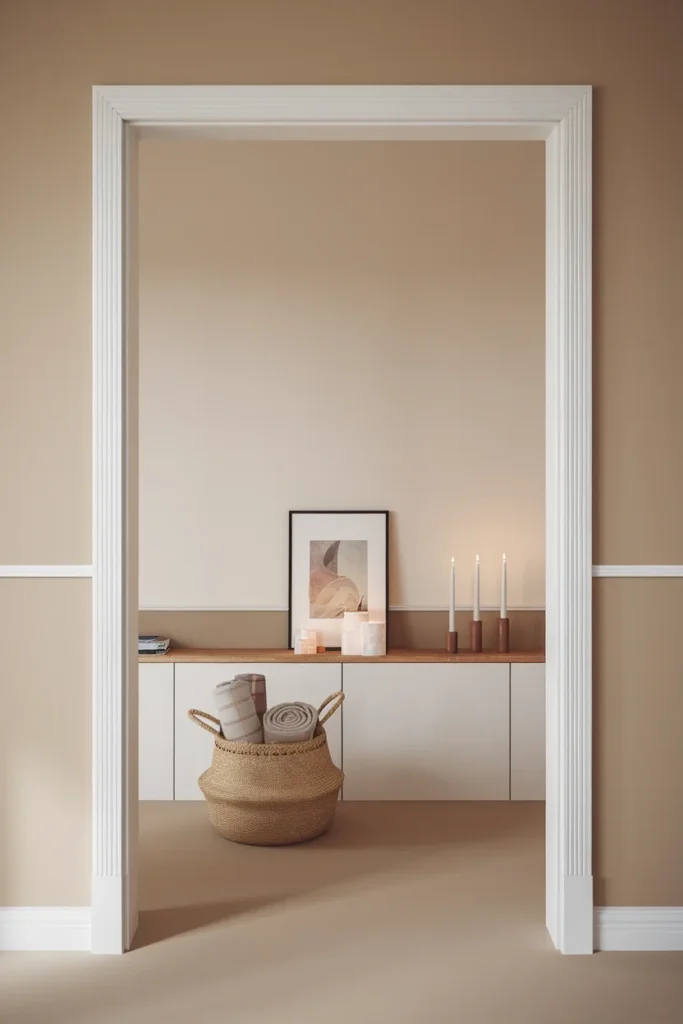
7. The Real $131.93 Fall Living Room Refresh
Nobody in the top search results adds up their receipt. Here’s ours: a complete fall living room decor build with real SKUs at real prices, checked in early August 2026.
| Item | Real product | Size | Price |
|---|---|---|---|
| Sofa-back throw | IKEA VALLKRASSING, off-white | 59×79″ | $19.99 |
| Armchair throw | IKEA HUMLEMOTT, off-white | 51×67″ | $24.99 |
| Two accent pillows | Target Threshold shaped velvet pumpkin | 13×13″, 6″ loft | $40.00 |
| Layering rug | IKEA TIPHEDE, cotton flatweave | 5’1″×7’3″ | $29.99 |
| Warm bulbs | Philips A19 2700K, 1000 lm, 4-pack | 75W equivalent | $8.98 |
| Texture stack | IKEA VITMOSSA + THORGUN throws | 47×63″ each | $7.98 |
| Total | $131.93 |
Add the POÄNG armchair at $149 and you have the full reading corner from section 4 for $280.93, which lands inside a normal $80 to $400 seasonal budget with room left over.
Buy in this order if you’re spacing it out: bulbs first ($8.98 changes the most per dollar), then the big throw, then the pillows, then the rug last. The rug is the one purchase you can genuinely skip if the room already has texture on the floor.
Prices shift, especially in September. Check before you check out.
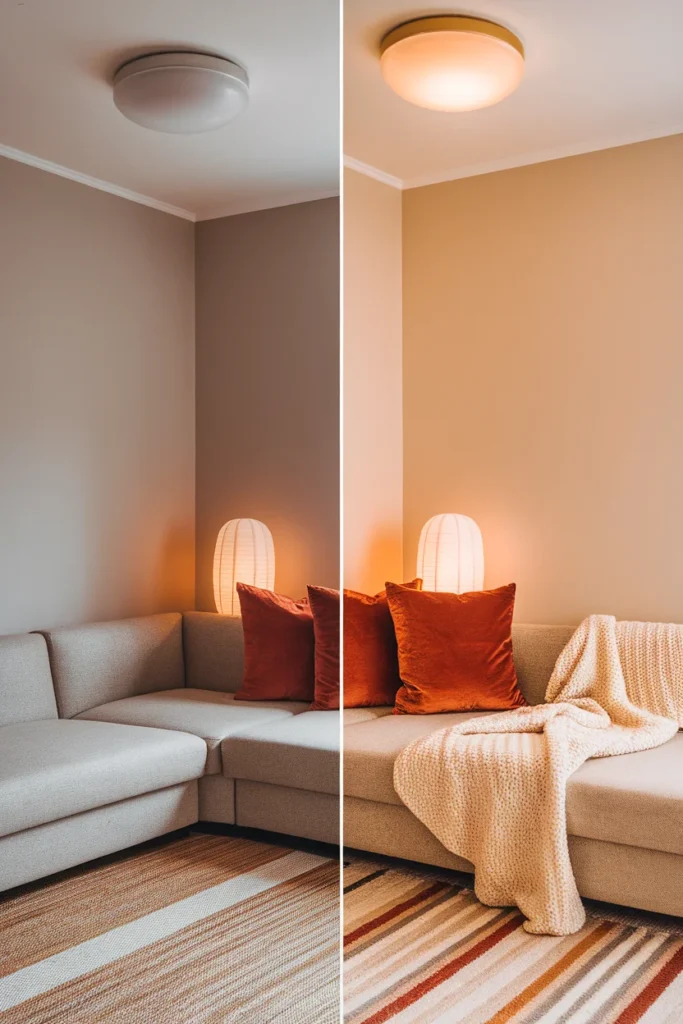
8. Candles, Scent, and the 12-Inch Rule
Scent is the layer people forget, and it’s the one that makes a room feel seasonal before you’ve looked at anything.
Skip the pumpkin spice candles that smell like a syrup pump. Look for a single-note base instead: cedar, tobacco leaf, fig, black tea, or plain beeswax. One good candle beats four novelty ones, and it’s the difference between a room that smells warm and a room that smells like a mall.
Now the safety part, because this is the one section of a decorating article where getting it wrong actually costs you something. The US Fire Administration reports an average of 20 home candle fires per day, and its core clearance guidance is blunt: keep a lit candle at least 12 inches from anything that can burn. Twelve inches from your throw blanket. Twelve inches from your dried stems. Twelve inches from the paper leaves you just draped on the console.
Measure it once with a tape so you know what 12 inches looks like on your own coffee table, then you’ll never have to measure again. The full list of placement and extinguishing rules is worth two minutes on the US Fire Administration candle safety page before you light anything near textiles.
If you have pets, a toddler, or a habit of falling asleep mid-chapter, use flameless LED candles with a warm amber flicker instead. Nobody can tell from four feet away, and the lit-candle look survives.
Non-flame scent options that work just as well: a small simmer pot with orange peel and two cinnamon sticks, cedar reed diffusers, or a bundle of dried eucalyptus hung where warm air moves past it.

9. Pick a Palette That Survives a Small Room
Small rooms punish busy palettes. Three colors is the working limit, and one of them should be whatever your sofa already is.
Pinterest’s Palette 2026 named five colors: Cool Blue, Jade, Plum Noir, Wasabi, and Persimmon. Only two of them read as autumn in a US living room. Persimmon is the warm orange-red that does what rust used to do but reads fresher. Plum Noir is the deep near-black purple that works as your dark anchor.
Three combinations that hold up in under 400 square feet:
- Persimmon, oatmeal, walnut. Warmest option. Safest.
- Plum Noir, camel, brass. Moodier, better for north-facing rooms with weak light.
- Olive, cream, black. The one that transitions into winter without needing a second swap in December.
The broader fall 2026 direction is earth tones (sand, mushroom, camel, terracotta, copper, oatmeal, muted greens), warm wood, woven elements, and tonal schemes using no more than three colors in a space. Which is a longer way of saying: pick three, repeat them at least twice each, stop.
Repetition is the part people miss. One rust pillow is an accident. One rust pillow, a rust-toned book spine on the coffee table, and a terracotta pot on the shelf is a palette.
10. Add One Non-Visual Layer
Every idea above is something you look at. Rooms register through more than sight, and this is the fastest way to make yours feel finished.
Sound. A heavy stoneware mug lands on a wood table with a low thunk instead of a click. Swap the thin ceramic for something with weight. You’ll notice it every single evening.
Texture underfoot. If you take your shoes off in that room, the floor is doing more work than the walls. A wool or thick cotton rug where your feet actually land beats a prettier rug three feet away.
Temperature. A throw that’s been folded on a sunny windowsill all afternoon is warm when you pick it up at six. Move your throw basket into the light. It costs nothing.
Weight. Heavier curtains muffle a room slightly and make it feel more enclosed. Lined panels do this. Sheers don’t.
That’s the layer that separates a room that photographs well from a room you don’t want to leave.
11. Plan the November Teardown Before You Decorate
Here’s what no fall decor article tells you: everything you’re about to buy has to go somewhere on November 1st, and if it doesn’t have a home, next year you’ll buy it all again.
Two rules make this painless.
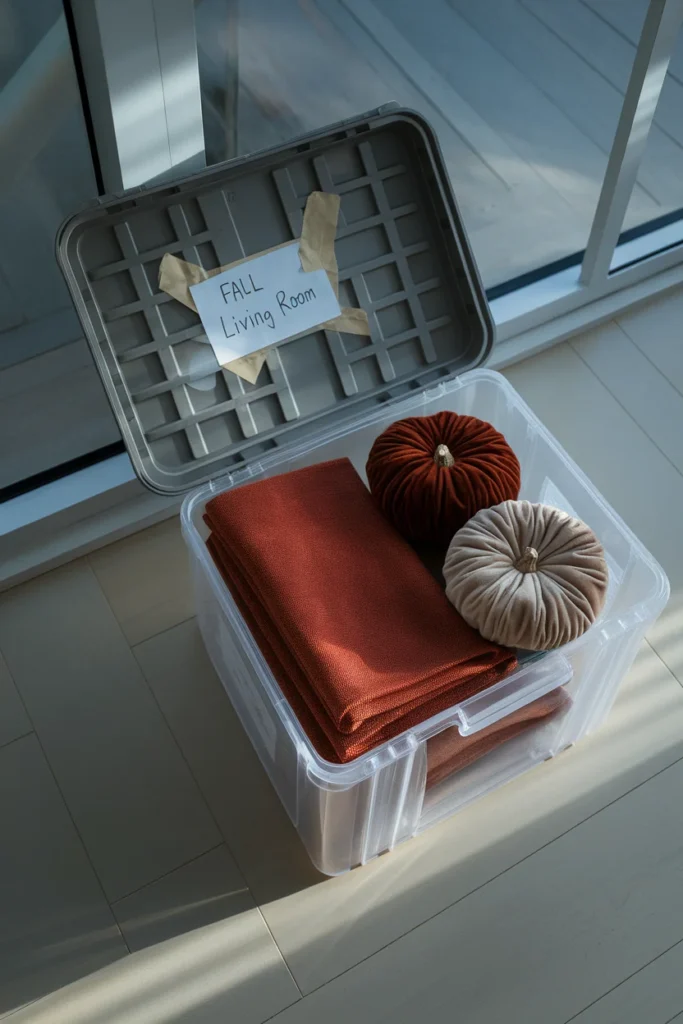
One bin, and it has to close. Buy a single clear 20 gallon tote before you buy any decor. If your fall haul doesn’t fit in it with the lid on, you bought too much. That constraint is worth more than any styling tip in this article.
Photograph the finished room before you take it down. Three photos from three angles on your phone, dropped into an album called “Fall Living Room.” Next September you’ll rebuild the whole thing in twenty minutes instead of starting from a blank room and a bin of confusing objects.
Store textiles folded, not stuffed. Store candles somewhere under 75°F or they warp. Keep the dried stems in the box they came in, because loose dried stems shed everywhere and you’ll throw them out in frustration.
Doing this once means your second fall costs about $30 instead of $130.
Frequently Asked Questions
When should I start decorating for fall? Most people start between mid-September and the first week of October in the US. A useful trigger that isn’t a date: swap when you first reach for a blanket on the sofa without thinking about it. If you’re decorating for photos, early September is fine. If you’re decorating for how the room feels, wait until the evenings actually cool off, or the room will feel costumed.
What colors are trending for fall home decor? Earth tones lead: sand, mushroom, camel, terracotta, copper, oatmeal, and muted greens, paired with warm wood and woven texture. From Pinterest’s Palette 2026, Persimmon (a fresh orange-red) and Plum Noir (a deep near-black purple) are the two that translate to fall. Tonal schemes using no more than three colors in a room are the dominant direction.
What can you decorate for fall other than pumpkins? Plenty, and honestly the pumpkin-free version ages better. Dried hydrangea and eucalyptus, wheat bundles, branch stems in a tall vase, woven baskets, stoneware and terracotta vessels, plaid or windowpane throws, amber and smoked glass, brass candlesticks, vintage books with faded cloth spines, and a bowl of pears or pomegranates that you can eat later.
How do I transition my house from summer to fall? Work in one pass: remove all light and bright textiles first, so the room goes neutral. Then add back three warm layers (throw, two pillows, layered rug). Then change the light to 2700K. Doing removal and addition as separate steps stops you from ending up with summer and fall stacked on top of each other, which is the most common way a room ends up looking cluttered.
How can I decorate my living room for fall on a budget? Spend on soft goods and light, not on objects. Budget fall living room decor works when you buy few, large, and textural: a $8.98 four-pack of 2700K bulbs plus one large $19.99 throw changes a room more than $80 of small decorative pieces. Our full build above comes to $131.93 with real SKUs. Shop your own house first: books, baskets, and blankets you already own count.
Do lots of people decorate for fall? Yes, and it’s grown steadily. Fall is now the second-biggest decorating season in the US after winter holidays, driven heavily by Pinterest and short-form video. Pinterest’s own fall reporting has shown large jumps in comfort-focused searches, including cozy lighting up 200 percent and cozy reading room up 140 percent in its fall comfort report.
How do I make my living room feel like fall if I rent and can’t drill? Change the floor and the light, not the walls. Layer a rug, add a floor basket of throws, swap to 2700K bulbs, and lean framed art instead of hanging it. If you do hang, use adhesive picture strips rated above your frame’s actual weighed weight (Large holds 15 pounds, X-Large holds 20). Everything in this article except the sconce works with zero holes.
Start With the Bulbs
If you do one thing this week, spend $8.98 on 2700K bulbs and turn your ceiling light off. It takes four minutes and you’ll notice it the second the sun goes down.
Then work down the list: throw, pillows, rug, corner. Good fall living room decor is really just four purchases made in the right order, and by the time you get to the corner, you’ll already know exactly where you want to sit.
Once that corner exists, it tends to become the most-used four square feet in the apartment. If you want to take it further, the reading nook build guides on the site go deeper on seat depth, sconce placement, and how to fit a real chair into a space you thought was too small.
Little Nook Home participates in affiliate programs. Prices listed were accurate as of August 6, 2026 and change frequently.
Keep reading
More cozy nook ideas
 Living Room
Read →
Living Room
Read →
Cabin Living Room Checklist: Everything to Decide Before You Start
No log walls, no stone hearth, no lake outside the window. You can still build a cabin living room in a regular…
 Living Room
Read →
Living Room
Read →
How to Make a DIY Coffee Table That Feels Cozy, Not Cluttered
Most DIY coffee table plans hand you a cut list on line one. That is why so many finished tables end up…
 Living Room
Read →
Living Room
Read →
20 Coffee Table Ideas That Make a Small Living Room Feel Warmer
Your coffee table is probably holding two remotes, a charging cable, yesterday’s mug, and a candle nobody has lit since spring. That…