
Coffee Nook Reading Corner: 10 Cozy Ideas for Small Spaces

Picture: 4 p.m. light, a linen throw, a 2700K bulb on a swing-arm, and your coffee within reach without standing up. That’s the corner we’re building. Not a kitchen coffee bar shoved into an awkward spot. Not a reading chair where you have to walk to the kitchen every time your mug cools. One small zone, two rituals, one footprint.
Most of what’s ranking on Google right now is a coffee station decor gallery or a reading nook mood board. This is the merged build, sized for a 600 to 1,400 square foot apartment, with real measurements and a renter-safe path. You’ll get 10 ideas, a hybrid footprint that fits in 20 square feet, and a price band you can actually budget around this month.
The 3-Piece Hybrid Footprint (Cash the Pin Promise First)
Here’s the build order that makes the whole thing work in a corner you already own. Three pieces, that’s it. A reading seat, a side surface that holds your brew kit and your mug at the same time, and a light source angled at your page. Skip any of these and you’ve built a coffee bar with a chair near it, not a coffee nook reading corner.
The seat goes first because everything else clusters around the angle of your hips. A 30 to 32-inch wide armchair (IKEA Strandmon archetype, or any small accent chair under 33 inches) tucks into a corner without crowding the walls. The side table sits 18 inches from the chair arm at elbow height, roughly 24 to 26 inches off the floor.
That’s the reach rule: your mug should land in your hand without a stretch, because stretching is what spills a French press on day three. The light comes last, a swing-arm wall sconce or a plug-in arc floor lamp positioned so the bulb sits 12 to 18 inches above your shoulder when seated.
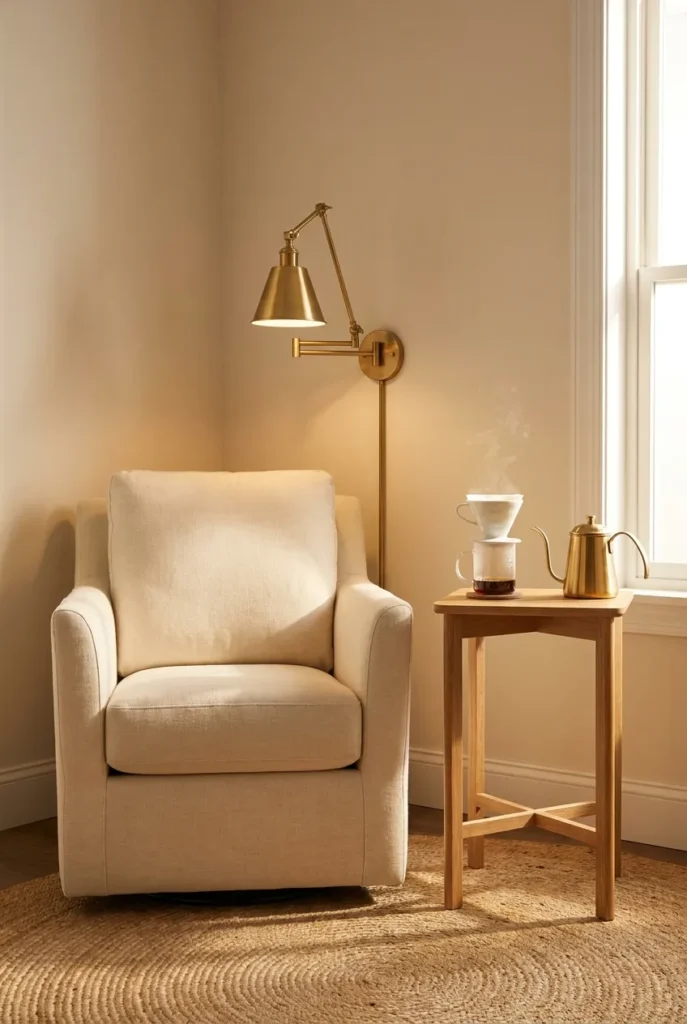
Failure mode: skip the reach rule and your side table ends up across the room, your coffee gets cold in 11 minutes, and you stop using the nook by week two.
A Real Corner Build for Renters (No Drilling, Under $400)
If you rent, the entire build has to be plug-in, hang-with-Command-strips, or freestanding. Good news: every piece you need exists in that format. A freestanding accent chair, a slim parsons-style side table, a plug-in wall sconce (Hudson Valley and Mitzi both make landlord-safe versions), and a small wooden tray that doubles as your brew station and your mug parking spot. No anchor holes, no plumbing, no built-ins.
Here’s the rough 2026 price band I’ve seen this year. Accent chair from Target or Wayfair: $180 to $260. Slim oak or walnut side table: $60 to $120. Plug-in brass sconce: $45 to $90. Wool or linen throw from HomeGoods: $20 to $35. Jute rug, 3×5 ft from IKEA or Target: $40 to $70.
Wooden tray to corral the brew kit: $15 to $25. You can land at $360 if you watch sales and skip the rug, or hit $560 if you go nicer on the chair. Most readers we hear from spend $300 to $400 total. For more layouts that work in tight footprints, our guide to corner reading nook ideas walks through 15 specific corner setups, several of which adapt cleanly into a coffee-and-book zone.
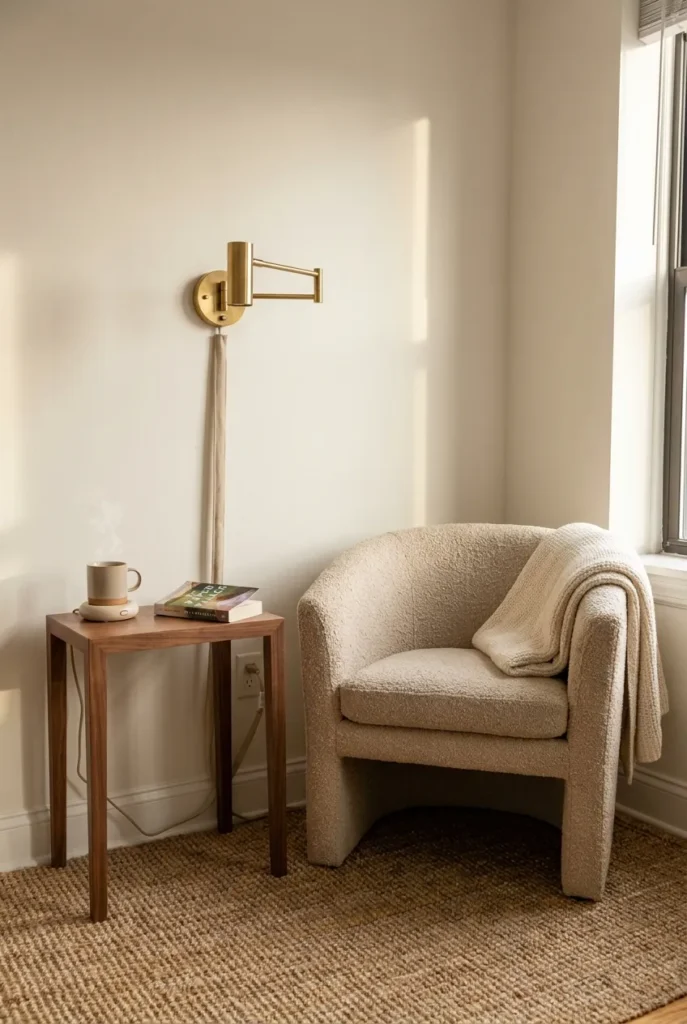
Failure mode: buy the chair before measuring. A 36-inch armchair that looked small in the showroom eats the entire corner and your side table ends up parked in the walkway.
The Brew Kit That Fits on One Tray
Most coffee bar Pinterest setups assume you have a 4-foot countertop. You don’t. You have a 14-inch round wooden tray, and that’s plenty. Here’s the kit that actually fits. A small pour-over dripper (Hario V60 size 02 or any ceramic dripper under 5 inches wide), a 1-liter gooseneck kettle (electric or stovetop, doesn’t matter, but electric kills the kitchen trip), a small canister for beans, a single mug, and a folded linen napkin to catch drips. That’s it.
If you’re an espresso person, swap the pour-over kit for a manual lever machine (Flair Neo archetype, around $100 to $200) or a small Nespresso Essenza Mini. Both fit on the same 14-inch tray. Skip the bean grinder on the tray itself, grind in the kitchen and bring 20 grams in a small jar. Trying to grind, brew, and read in the same 20 square feet means a coffee-dust ring on your throw by week three.
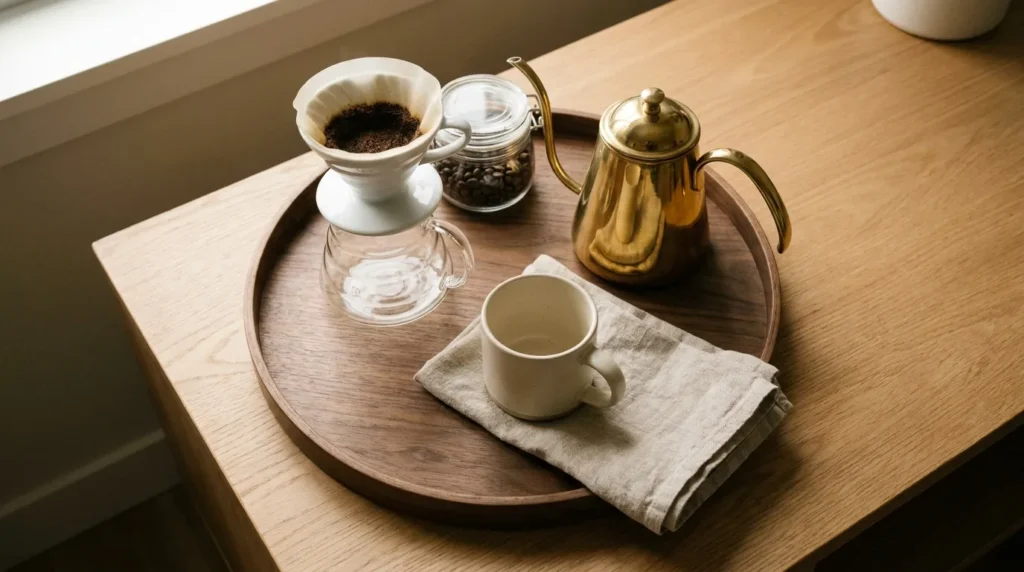
Failure mode: too many gadgets, no surface left for your book. Pick one brew method and commit.
Lighting Rules That Make or Break the Mood
The biggest reason a coffee nook reading corner photographs well on Pinterest but feels wrong in person is the bulb. Cool white light is the enemy of slow mornings. Aim for 2700K, sometimes called soft white or warm white, with a CRI of 90 or higher so book pages and coffee crema both read the way your eyes expect. The US Department of Energy’s guide to choosing the right light bulb breaks down the temperature scale clearly if you want the technical version.
Two fixtures, not one. A swing-arm wall sconce for direct page light, plus a small table lamp for ambient glow on the side table or shelf. The sconce sits about 60 inches off the floor (around shoulder height when seated) and the arm extends 15 to 22 inches so the bulb floats over your page.
The table lamp stays low and warm, 12 to 18 inches tall, just enough to throw a pool of light on your mug. Add a dimmer if the sconce supports one. Your morning brain and your 9 p.m. wind-down brain want very different brightness levels in the same chair. For specific fixture picks that hit these specs without overspending, our roundup of reading nook floor lamps covers ten models that pass the 2700K test.
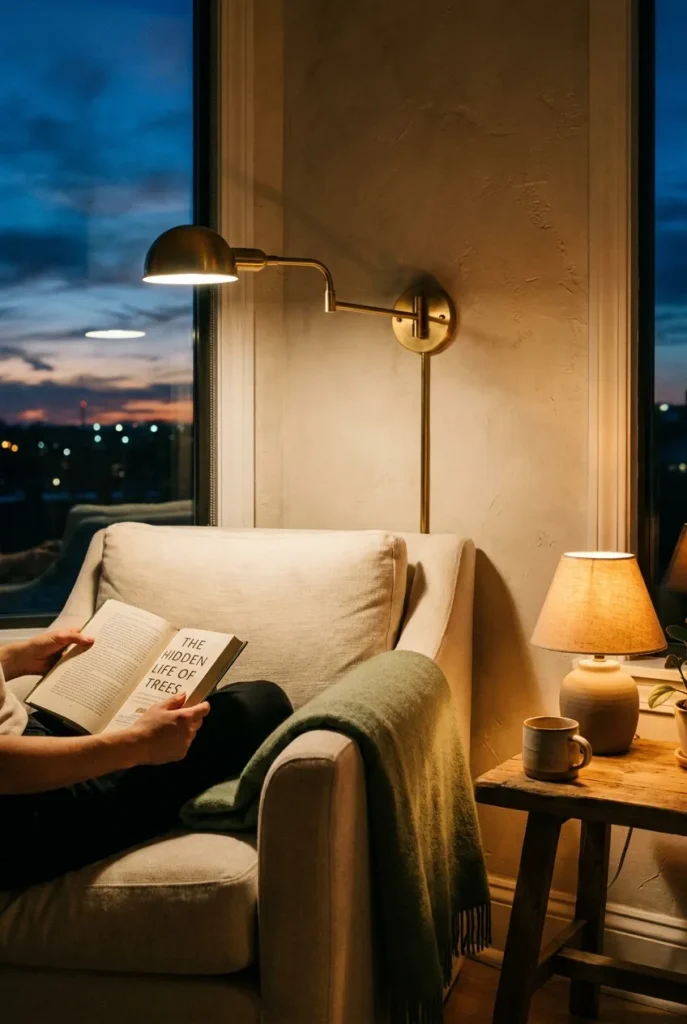
Failure mode: skip the dimmer and your 2700K bulb still reads like a dentist’s office at night.
Cottagecore: Linen, Florals, and a Stoneware Mug
If your Pinterest board leans warm and storybook, the cottagecore coffee nook reading corner is your lane. Think soft cream linen slipcovered chair, a small wooden side table with a tea-stained finish, dried lavender in a clay pot, a stoneware mug with a hand-glazed rim, and a vintage botanical print framed above the chair. Café curtains in a muted floral let in light without flattening the mood. Layer a sherpa throw and a small lumbar pillow in dusty rose or sage.
The drink that fits: a small French press, full-bodied medium roast, served in stoneware. Add a tiny ceramic creamer if you take milk. The sensory beat that nobody talks about? Smell. Cottagecore lives or dies on scent. A small soy candle in vanilla, honey, or fig keeps the corner inviting even when you’re not brewing. Light it five minutes before you sit down. That habit alone changes how the space feels.
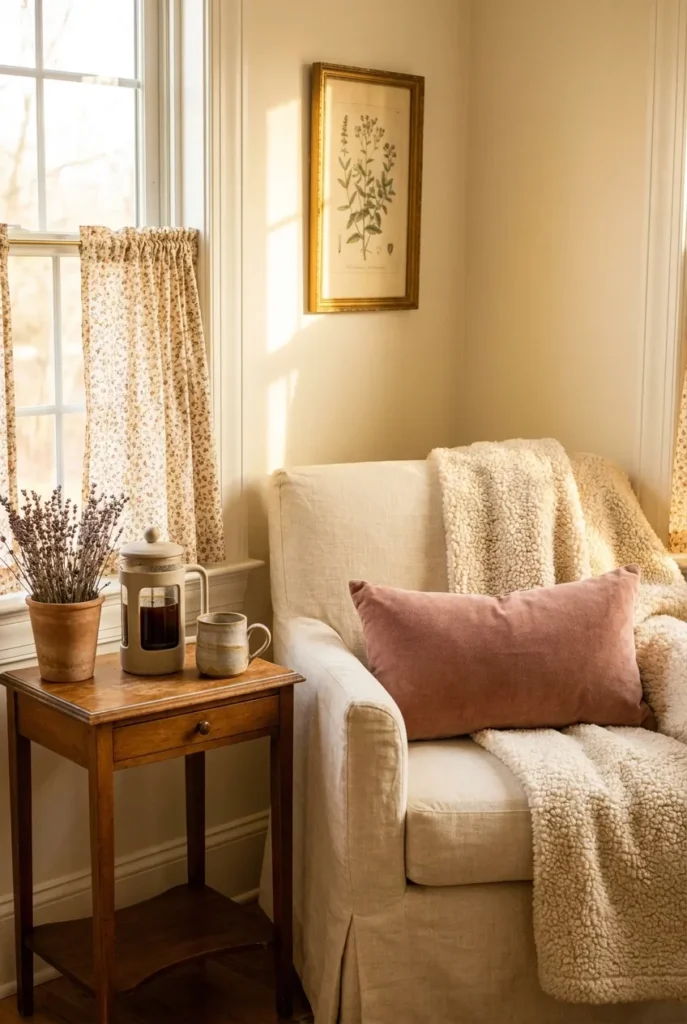
Failure mode: too many floral patterns competing. Pick one print, keep everything else solid.
Dark Academia: Moody Library Meets Espresso Bar
Dark academia is the easiest style for this hybrid because the aesthetic already assumes books, candles, and a strong drink. Deep green or oxblood walls (or a peel-and-stick wallpaper for renters), a leather club chair or a deep velvet armchair, a small walnut side table, a brass picture light angled at a small framed map or vintage book cover, and a clip-on reading lamp for the chair itself.
The drink that fits: espresso, ideally pulled from a small manual lever machine, served in a heavy ceramic demitasse. A bottle of sparkling water on the side, a small dish of dark chocolate squares. Soundtrack: rain track or a single piano playlist at low volume. Sensory texture: leather under your forearm, the weight of a hardcover, the heat of a small cup.
The Specialty Coffee Association’s coffee storage and freshness guidelines are worth a skim if you want your espresso shots to taste right two weeks into a bag. If you want the full palette breakdown for this mood, our reading nook color palette guide has a dedicated dark academia section with exact paint codes.
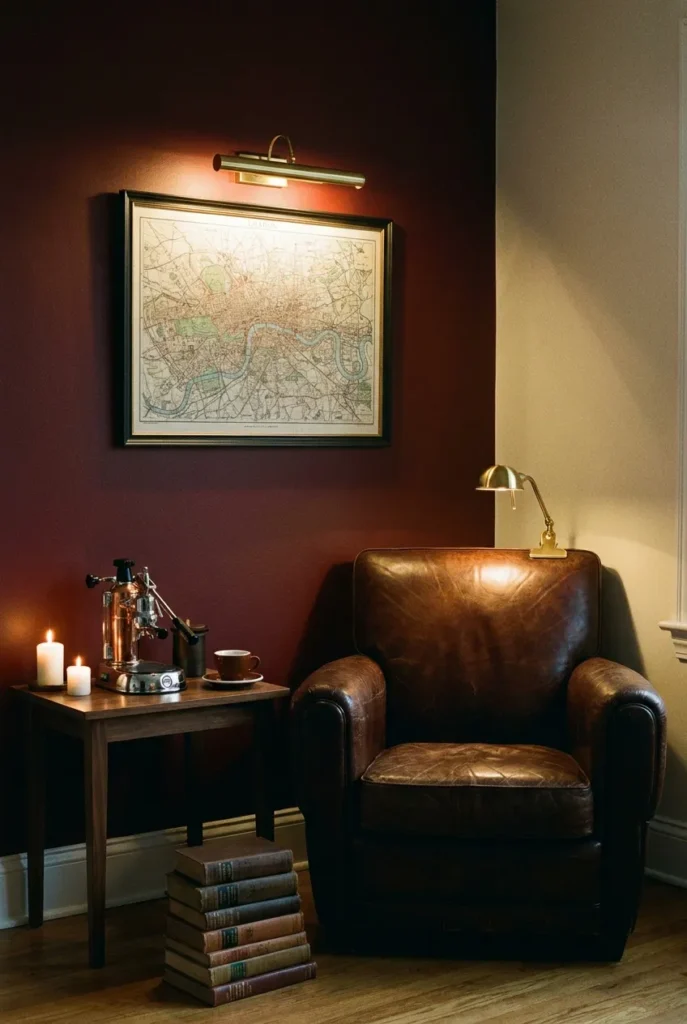
Failure mode: a too-dark room with no task light. Moody walls need brighter focal lighting, not less.
Japandi: One Wood Tone, One Ceramic, One Linen
Japandi works for the coffee + reading hybrid because it’s built on restraint. One wood tone (white oak or light walnut, not both), one ceramic finish (matte off-white), one fiber (oatmeal linen). A low-slung lounge chair, a small round side table no bigger than 16 inches across, a ceramic dripper, a small cast iron kettle in matte black, and a single tatami-style floor cushion if you want a second seat for a friend.
Keep the wall behind the chair completely bare except for one small woven hanging or a single framed sumi-e print. The drink that fits: matcha or a clean medium roast pour-over. The trade-off you should know: Japandi looks effortless in photos and feels like it requires constant tidying in real life. Anything you leave out, you see. If you can’t commit to that, lean Scandi instead, which forgives a little more clutter.
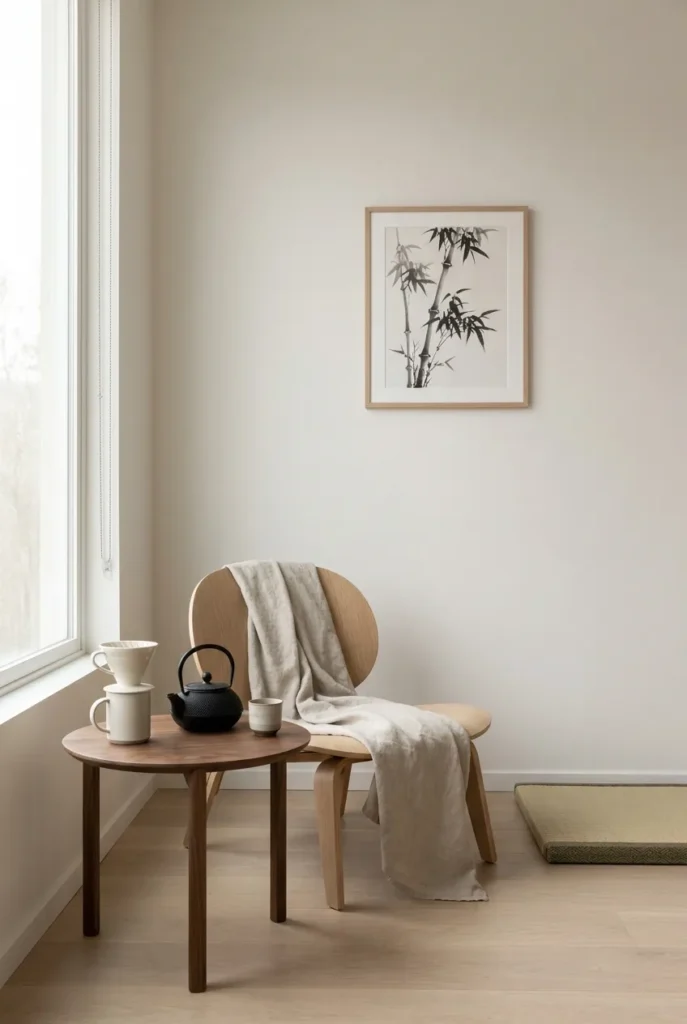
Failure mode: too many objects on the side table. Japandi breaks at four items, hard cap.
Window Seat Coffee Corner (If You Have the Bay)
If you do have a bay window, banquette, or built-in bench, the coffee nook reading corner gets easier. The seat is already there. What you need: a deep bench cushion (3 to 4 inches thick minimum, foam wrapped in feather), two lumbar pillows, a small wall-mounted shelf at elbow height for the mug and the book, and either a plug-in sconce or a small clip-on light on the window frame.
The deep cushion matters more than people think. A 2-inch cushion on a hard bench wears you out by chapter three. Aim for 3 to 4 inches with a firm core, slipcovered in linen or cotton so you can wash it. Add a wool throw for ankle warmth in winter, and pull a small woven basket under the bench to hold a thermos so you don’t have to leave for refills. The thermos move is small and it changes everything about a Saturday morning.
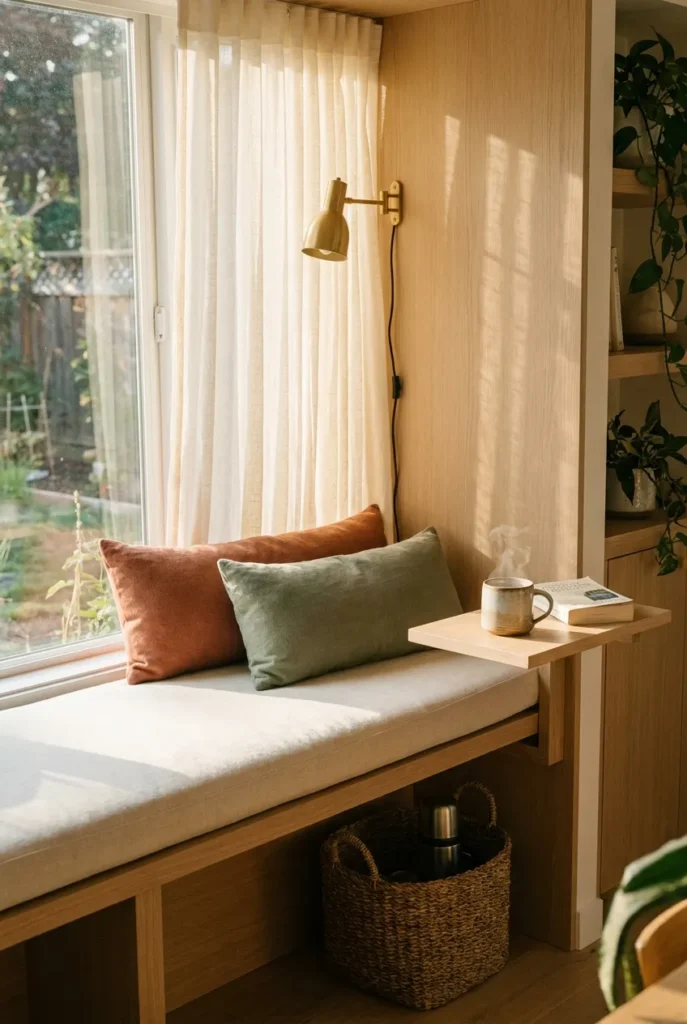
Failure mode: skimping on cushion thickness. You will not sit there for an hour on a 2-inch pad.
The Sensory Ritual That Most Articles Skip
Every coffee bar Pinterest article tells you what to buy. None of them tell you what the corner should feel like in motion. Here’s the layered ritual: light the candle five minutes before you brew, so the scent settles. Boil water (a 1-liter kettle takes about 3 minutes), grind the beans during the boil so the smell hits you while the water finishes. Pour, wait the bloom (30 seconds), finish the pour. Total brew: roughly 4 minutes.
While the coffee cools, dim the sconce two notches, pull the throw across your lap, and put your phone face-down on the side table. The drink lands at drinkable temperature (around 140°F, the published sweet spot for tasting) right when you’ve opened your book. That’s the loop. Build the corner so this whole sequence happens without standing up except to refill the kettle. If you can’t pull off the loop without leaving the zone, the layout is wrong.

Failure mode: phone left face-up. The ritual collapses inside 90 seconds.
Quick-Spec Table: The 2026 Build at a Glance
Here’s the cheat sheet you can screenshot for the next time you’re standing in Target.
| Piece | Spec | Price band (USD) | Why it matters |
|---|---|---|---|
| Accent chair | 28-32 in wide | $180-$260 | Fits a corner, holds an adult comfortably |
| Side table | 24-26 in tall, 14-18 in round | $60-$120 | Hits the 18-inch reach rule |
| Wall sconce | Plug-in, 2700K, 60 in mount height | $45-$90 | Page light, renter-safe |
| Wool/linen throw | 50×60 in | $20-$35 | Ankle warmth and softness |
| Jute rug | 3×5 ft | $40-$70 | Grounds the zone, dampens echo |
| Brew tray | 14-in round wood | $15-$25 | Corrals the kit, defines the bar |
| Pour-over kit | V60 size 02 + 1L kettle | $40-$80 | Compact, no plumbing |
| Soy candle | 7-9 oz, vanilla/fig | $12-$22 | Sensory layer most setups skip |
| Total | $412-$702 | Most readers land $400-$500 |
Failure mode: buy everything at once. Start with chair + side table + sconce. Add the rest over a month so you learn what you actually use.
Frequently Asked Questions
What is the 80/20 rule for coffee?
The 80/20 rule comes from third-wave coffee culture and roughly says 80% of your cup quality comes from 20% of the variables: fresh beans, the right grind, and water temperature in the 195°F to 205°F range. For a small corner setup, that means investing in a decent grinder and a kettle with temperature control matters more than a fancy machine. The rest is forgiving.
What type of seating is best for a coffee nook reading corner?
An upholstered accent chair with arms and a seat depth of 20 to 22 inches is the most versatile pick. Arms hold your book and your mug elbow at the right height, seat depth supports a full afternoon read without leg numbness, and upholstery dampens the room so the corner feels quieter. Leather works for a dark academia look but runs warmer in summer. Avoid bean bags as the primary seat because they sit too low to use the 18-inch reach rule with a normal side table.
How do I create a cozy coffee nook?
Start with the seat, anchor a 14-inch tray as your brew bar at elbow height, install one warm 2700K sconce above the chair, and layer in one wool throw and one rug. Add a candle for scent. That’s the base. Everything else, framed art, plants, mug shelf, is decoration. The cozy feeling comes from warm light + tactile fabric + scent, not from the number of objects.
What are the essential items for a coffee nook?
Six items: a chair, a side surface, a light source, a brew tool (pour-over or small espresso), a kettle, and a mug you actually like holding. Optional but high-leverage: a tray to define the bar, a small canister for beans, and a candle. Skip the espresso machine for setup one. You can upgrade once you know your habits.
Can I build a coffee nook reading corner if I rent?
Yes, and it’s actually easier because you skip the millwork. Everything you need exists in freestanding, plug-in, or Command-strip form. Use a parsons-style side table instead of a built-in shelf, a plug-in sconce with a cord cover, and a 3×5 area rug to define the zone without modifying floors. Total damage to the wall: zero.
How small a corner can this work in?
Twenty square feet is comfortable, 15 is tight but doable. Measure the chair’s footprint plus 18 inches to the right (or left, whichever your dominant hand prefers) plus 18 inches of walking room in front of the chair. If you can carve out a 4 ft by 5 ft zone, you can build the corner. Anything smaller, lean toward a window seat or a banquette instead.
Where should the coffee corner live in my apartment?
The best room is wherever you already drink your morning coffee. For most apartments, that’s a corner of the living room near a window, or the bedroom if you read before bed. Avoid the kitchen unless the kitchen has a corner you can give over to seating, because kitchens are work zones and the brain doesn’t relax there. Sunrooms and bay windows are the dream, but a 4×5 corner of any room will do.
Pull It All Together This Weekend
You don’t need a renovation, a built-in, or a bigger apartment. You need a chair, a tray, a sconce, and one ritual you’ll actually run. The hybrid works because it folds two slow rituals into one zone instead of forcing you to commute between the kitchen and the couch. Start with the seat this weekend, add the tray and the sconce next paycheck, and let the rest assemble around your habits. Which corner are you eyeing right now? Measure it tonight, save this page, and start with the seat.
Keep reading
More cozy nook ideas
 Fall Decor
Read →
Fall Decor
Read →
Fall Door Decor on a Budget: Where to Spend and Where to Save
If your fall door every year is a wreath that sheds on the mat, two mums that are crispy by Halloween, and…
 Fall Decor
Read →
Fall Decor
Read →
12 Thanksgiving Tablescape Ideas for Small Spaces (That Still Leave Room for the Food)
Twenty-four inches. That’s how much table edge one person needs to eat without bumping elbows, and it’s the number most Thanksgiving tablescape…
 Fall Decor
Read →
Fall Decor
Read →
18 Fall Coffee Bar Ideas for Sweater-Weather Evenings
No counter space to spare, no espresso machine, no landlord permission needed. This fall coffee bar runs on three pieces: a slim…