
Reading Nook Gallery Wall Ideas for a Small, Cozy Corner

No bay window, no reno budget, no drill-friendly landlord required. You need a handful of frames, one blank patch of wall, and an afternoon. A reading nook gallery wall is the fastest way to turn a slumped chair in the corner into the spot everyone fights over. This is your build order, your height math, and the renter-safe tricks the big list posts skip. Let’s get your corner looking finished, not accidental.
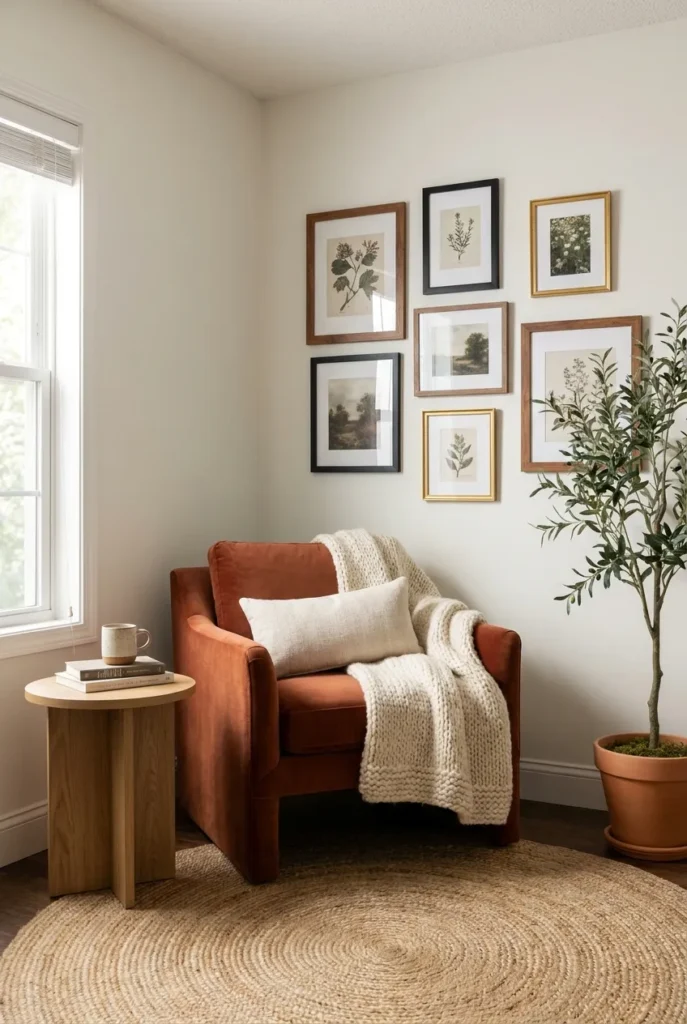
Most “reading nook” roundups treat art as an afterthought. We flipped that. Here the gallery wall is the nook, wrapping your chair in framed prints, book spines, and warm light so the whole corner reads as one intentional scene.
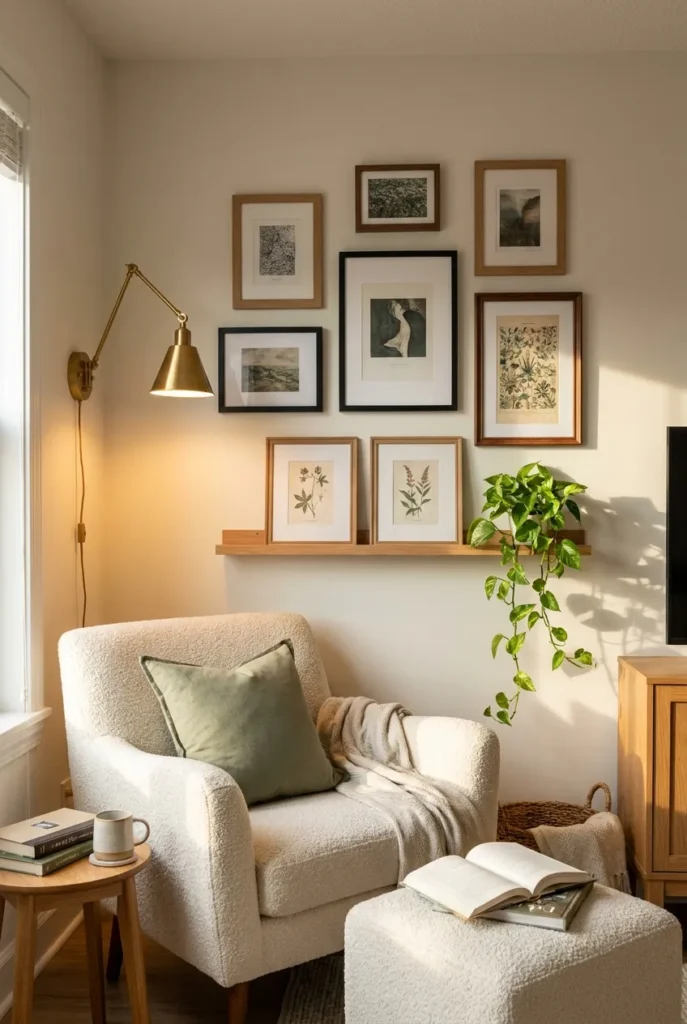
Cash the promise: the 3-piece gallery wall that finishes a nook
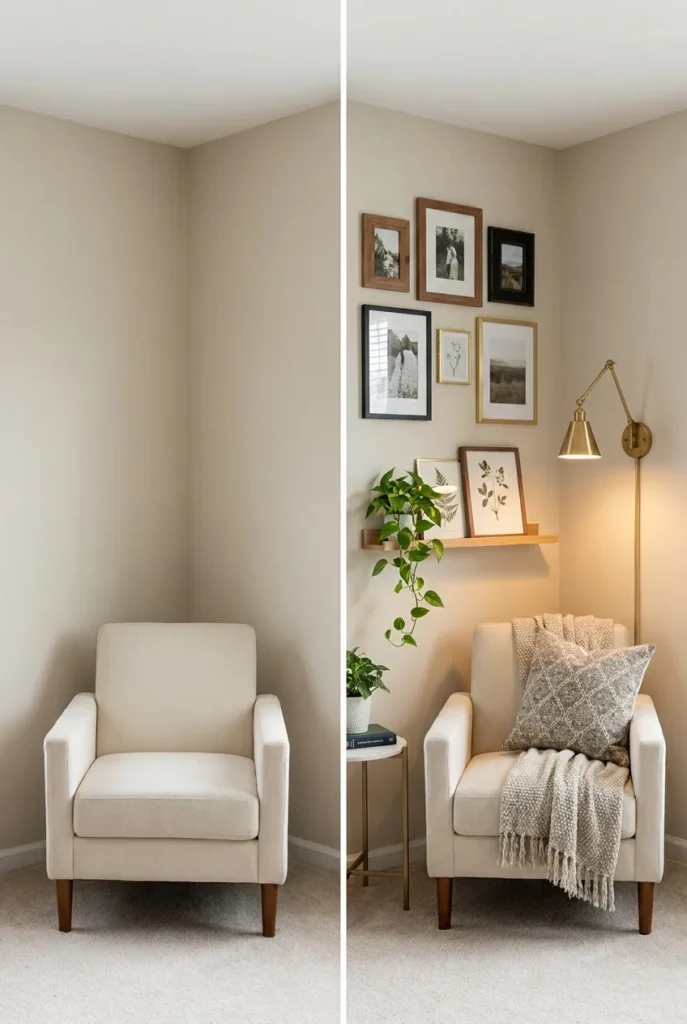
Here is the whole formula before anything else, all visible on your first scroll: one anchor piece, a cluster of smaller frames, and a light source. That’s the reading nook gallery wall in three moves.
Start with the anchor. Pick your largest frame (think 24 by 36 inches) and treat it as the visual center. Build everything else around it. Skip this and your wall looks like scattered confetti instead of a composition.
Add the cluster next. Five to seven smaller frames in mixed sizes, orientations, and finishes. Then add light: a plug-in sconce or a swing-arm lamp so the art actually reads after sunset.
Failure mode: people hang the small stuff first, run out of wall, and shove the big piece into a corner where it fights the chair.
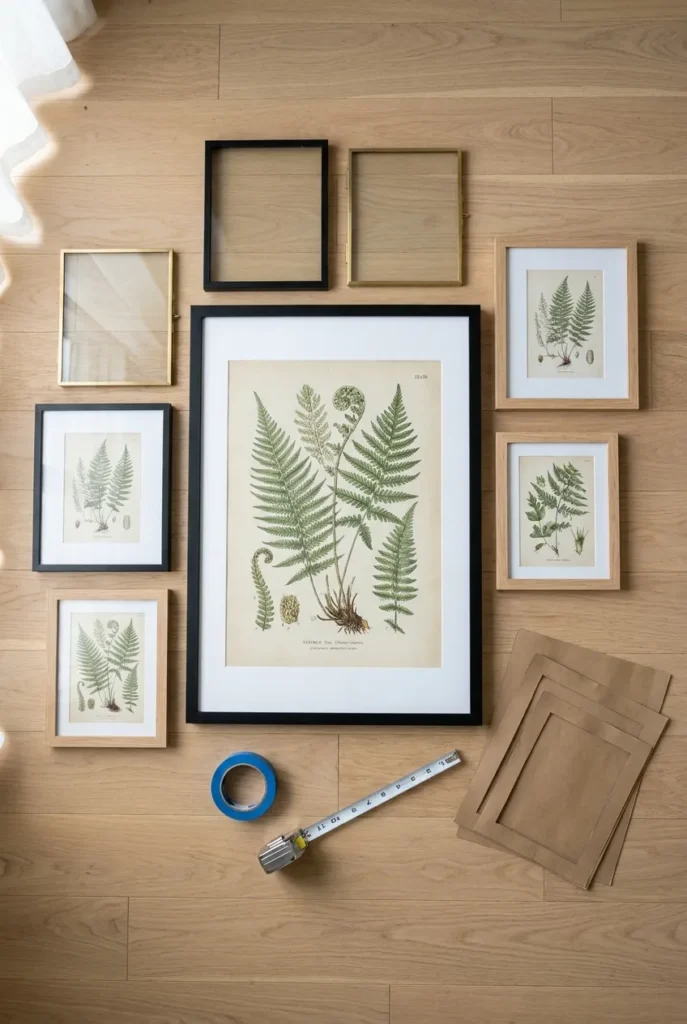
Plan the layout on the floor first (paper templates save the wall)
Before a single nail, build the whole arrangement on the floor. Lay your frames out below the empty wall and shuffle them until the spacing feels right. This is where a corner gallery wall reading nook is won or lost.
Then trace each frame onto kraft paper or a grocery bag, cut it out, and tape the paper shapes to the wall with painters tape. Step back. Live with it for a day. Move the paper, not the holes.
Keep frames 2 to 3 inches apart, with 2.5 inches as the safe default. Tighter than that looks cramped. Wider than about 4 inches and the eye stops reading the group as one piece.
One quiet win: in a nook, let the gallery wall wrap the corner slightly instead of stopping dead at the edge. It hugs the chair and makes the seat feel tucked in.
Failure mode: you eyeball it, hang three frames, hate the fourth, and now there are seven holes for four frames.
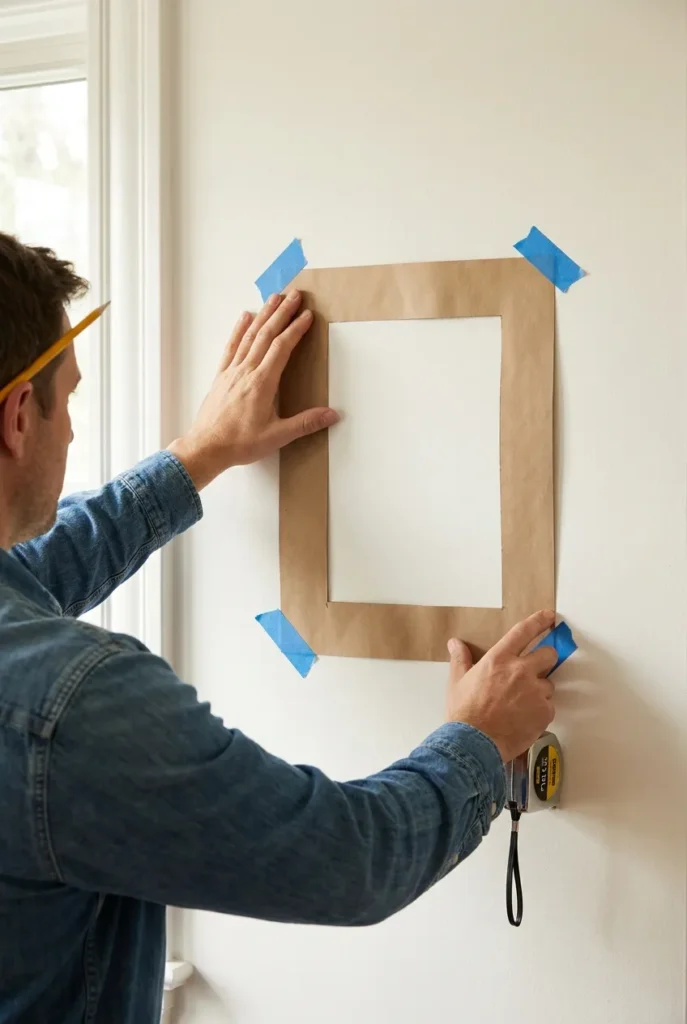
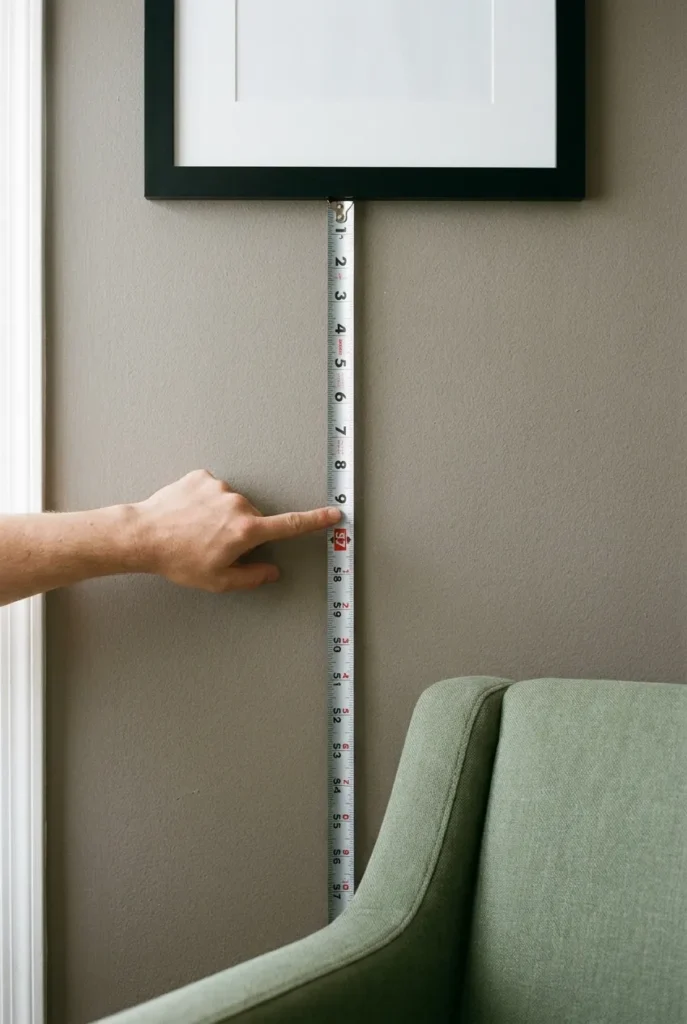
Get the height right with the 57-inch rule
Here’s the number that separates a pro-looking wall from a “why does this feel off” wall. Hang your gallery so the center of the whole grouping sits 57 inches from the floor. That’s average human eye level, and it’s the standard galleries and museums use. You can read more in Park West Gallery’s three simple rules for hanging art.
Treat the whole cluster as one big rectangle. Find that rectangle’s center, mark 57 inches, and build out from there. In a reading nook there’s a twist: if you’re always seated, you can drop the center a few inches lower so the art meets your eyes from the chair, not from standing.
There’s also the 2/3 rule. Your gallery should span roughly two-thirds the width of the chair or bench below it. Narrower looks stingy. Wider tips off balance.
Failure mode: hanging everything too high, the classic mistake, which leaves a lonely gap over the chair and floating art near the ceiling.
The renter fix: a no-drill gallery wall that holds
Renting? You can still get the look with zero holes. Adhesive strips (the hook-and-loop kind) hold most lightweight frames, and they peel off clean when you move. Check the package weight limit, usually around 1 to 3 pounds per strip pair, and double up for anything heavier.
Better yet, lean into leaning. A slim picture ledge like the IKEA MOSSLANDA (it comes in 21¾-inch and 45¼-inch widths) mounts with just two screws, or sits on a bookshelf, and lets you prop and swap prints with no commitment. Stack two ledges for a layered, no-drill-heavy look.
For frames, cheap and cheerful works: IKEA RIBBA and FISKBO are the classic gallery archetypes because they come in matching sizes you can grid or mix.
Same shrink-the-footprint logic applies to mirrors, which bounce light into a dark corner. Our guide to reading nook mirror tricks for a small corner pairs well with a gallery wall when you want the space to feel wider.
Failure mode: trusting one adhesive strip with a heavy wood frame over your favorite chair. Gravity always collects.
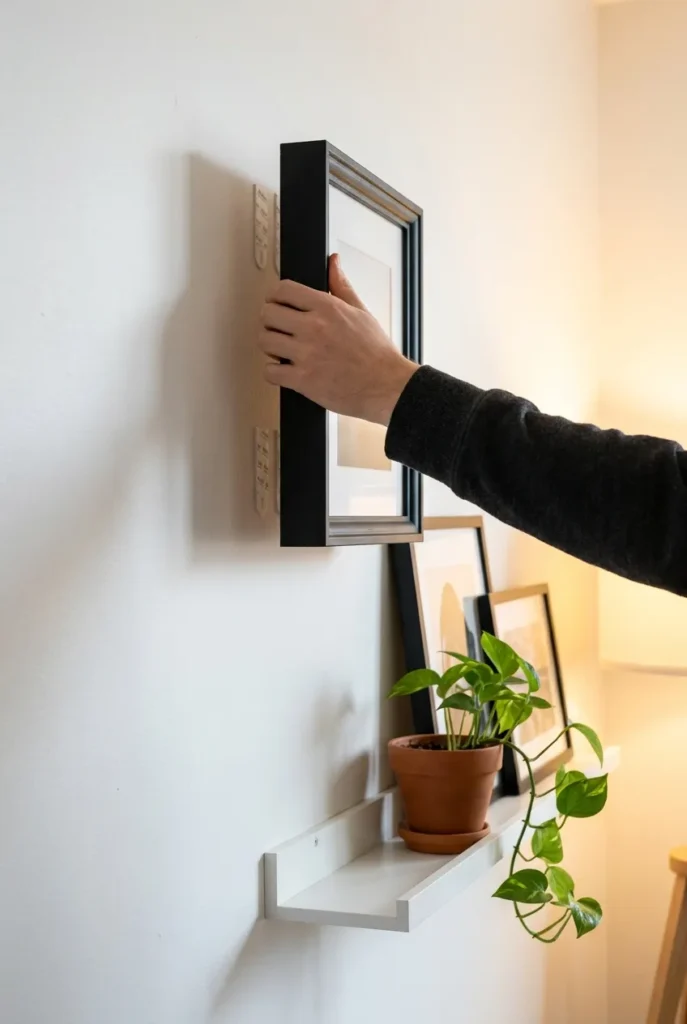
Mix art and book spines into one composition
This is the angle the big list posts miss. In a reading corner, your books are part of the art. Don’t wall them off in a separate zone. Blend framed prints, a few face-out book covers, and open shelf brackets so the gallery and the bookshelf become one wrapping composition around the chair.
Try this: run floating shelves up one side of the corner, load them with spines and a couple of propped frames, then let framed art spill onto the adjacent wall. The eye travels the corner instead of stopping at a hard line.
Texture matters here too. A stack of well-loved paperbacks, cracked spines and dog-eared corners, gives the wall a warmth no matte print can fake. Run your hand along them and you feel the difference between a set and a scene.
For color, the top-performing corners lean warm and neutral. If you want that soft, magazine-calm palette, our neutral reading nook color guide shows how to keep cream and oat from going flat.
Failure mode: matching every frame and every book cover to the same tone. It reads like a showroom, not a reader’s corner.
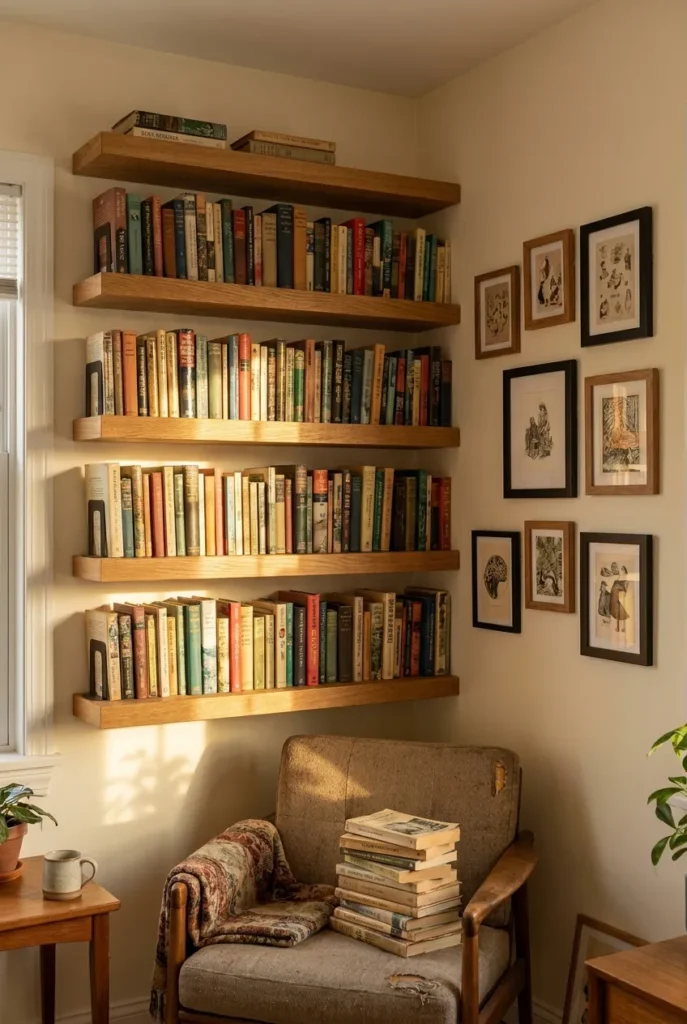
Pick a theme so it looks collected, not random
A gallery wall needs a thread. Pick one and repeat it: a color (all sage and rust), a subject (botanicals, book quotes, vintage maps), or a frame finish (all black, all warm wood). The frames can differ in size; the thread keeps them family.
Bookish reader corners love a quote-print trio, three matching frames with typographic prints, hung in a tight row above the chair. It’s the single most-pinned reading nook gallery wall look, and it’s beginner-proof because the alignment is obvious.
Prefer character over polish? A vintage gallery wall mixes thrifted oil paintings, old botanical plates, and mismatched gilt frames. It looks like you collected it over years, even if it was one good Saturday at the flea market. Our vintage reading nook ideas go deeper on sourcing that lived-in look.
Failure mode: three unrelated themes on one wall. Pick a lane, or it reads as clutter.
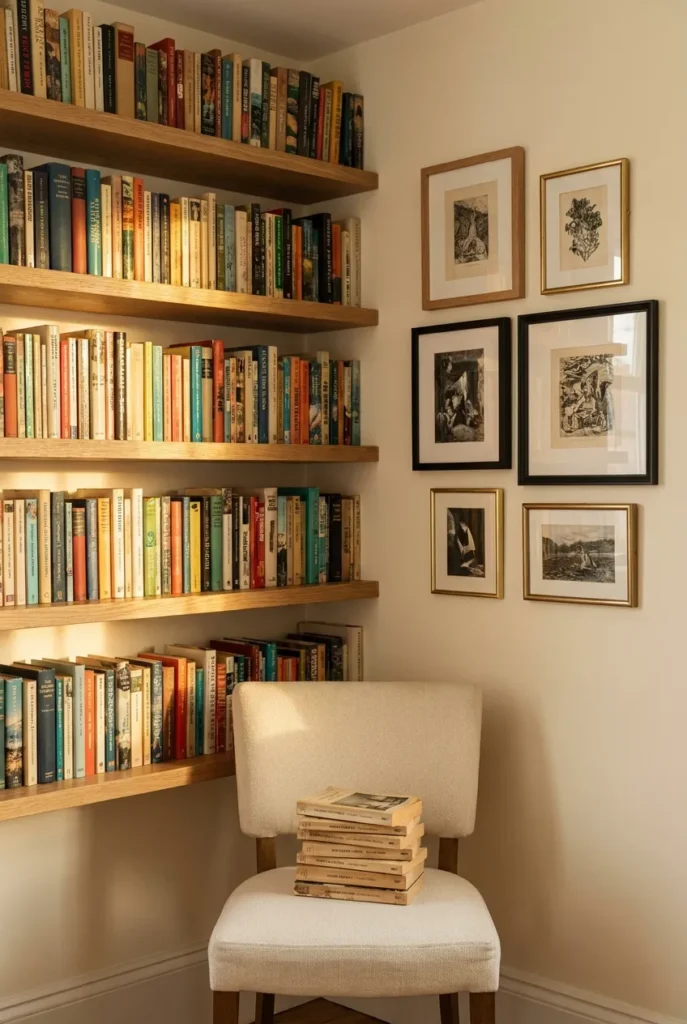
Light the wall so it works at night
A gallery wall you can’t see after dark is just wall. Reading corners get used in the evening, so lighting is not optional. Add a warm light source aimed at or near the art.
Go warm, not white. A 2700K bulb gives that soft, yellowish “warm white” glow that reads as cozy; cooler bulbs make art look clinical. Energy Star classifies 2700 to 3000K as warm white and recommends it for relaxed living spaces, and you can confirm the ranges in the Energy Star light-fixture criteria.
A plug-in swing-arm sconce mounted beside the gallery does double duty: it lights the art and gives you a reading light, no ceiling wiring or electrician needed. A slim picture light clipped to the top of your anchor frame is the second-best move.
There’s a sensory payoff here. Warm light plus paper plus a quiet corner is the whole point; it’s the difference between a wall you photograph and a wall you actually sit under with tea going cold beside you.
Failure mode: one harsh overhead bulb that flattens the frames and throws glare across the glass.
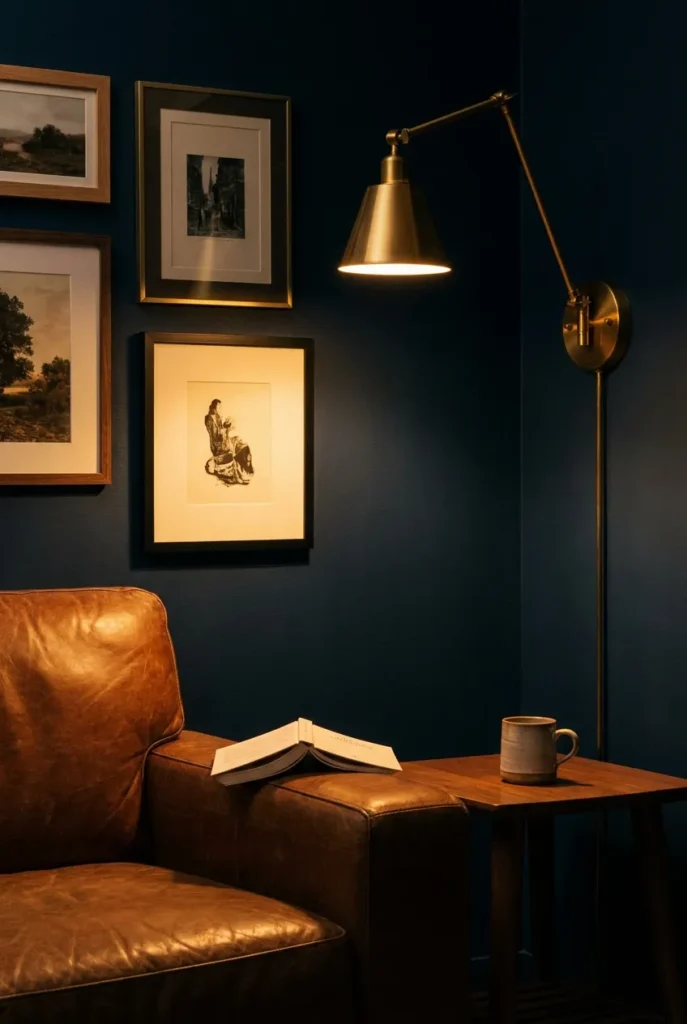
Style the corner below so the wall has a base
A gallery wall floats awkwardly without a grounded corner beneath it. Anchor it: a chair or bench, a small side table within an 18-inch reach for your mug, a rug to define the footprint, and one soft layer like a lumbar pillow or a wool throw.
Keep the furniture footprint tight. In 600 to 1,400 square feet, a single armchair plus a slim floor lamp beats a bulky loveseat every time. Let the wall be the star; the seat is the supporting act.
A small plant or a trailing vine off the shelf softens all those hard frame edges. One is enough. This is a reading corner, not a greenhouse.
Failure mode: a gorgeous wall over a bare, cold corner with nowhere to actually sit and read.
Frame sizes and spacing at a glance
Here’s the cheat sheet to screenshot before you shop. These are the archetype sizes and gaps that keep a corner gallery balanced.
| Element | Reliable spec | Why it works |
|---|---|---|
| Anchor frame | 24 x 36 in | Gives the cluster a clear center |
| Supporting frames | 8 x 10 to 16 x 20 in | Enough size mix to feel collected |
| Gap between frames | 2 to 3 in (2.5 default) | Reads as one composition |
| Grouping center height | 57 in from floor | Museum-standard eye level |
| Wall width used | ~2/3 of chair width | Balanced, not stingy |
| Picture ledge | 21¾ or 45¼ in (MOSSLANDA) | No-commitment, prop-and-swap |
Frequently asked questions
How do I make my own reading nook gallery wall?
Pick one large anchor frame, cluster five to seven smaller ones around it, plan the layout with paper templates on the floor, then hang the grouping so its center sits 57 inches from the floor with 2 to 3 inches between frames. Add a warm light source so it works at night.
How do you create a gallery wall layout?
Lay all frames on the floor below the wall and rearrange until the spacing feels balanced. Trace each frame onto paper, tape the shapes to the wall, and adjust the paper before you make any holes. Keep gaps consistent at about 2.5 inches.
How do I make a book wall easily?
The fastest route is a picture ledge or floating shelf loaded with book spines and a couple of propped prints. It needs only two screws (or none, if it rests on an existing shelf) and lets you rearrange anytime without patching holes.
How high should a gallery wall be above a reading chair?
Center the whole grouping at 57 inches from the floor, the standard eye-level height. If you’ll mostly view it seated, drop the center a few inches so the art meets your eyes from the chair.
Can I do a gallery wall in a rental without drilling?
Yes. Use adhesive hook-and-loop strips rated for your frame weight (roughly 1 to 3 pounds per pair), or a picture ledge that props art without hanging it. Both peel off or unscrew clean when you move.
How many frames do I need for a small corner?
For a single-chair nook, five to seven frames is plenty. One large anchor plus four to six supporting pieces fills a corner wall without crowding the seat below.
What color prints work best in a reading nook?
Warm neutrals and one repeated accent color photograph and live best in a cozy corner. Pick a single thread (a color, a subject, or a frame finish) and repeat it so the wall looks collected instead of random.
Your next step
Start with the floor layout tonight. Pull your frames, cut paper templates, and tape them to the wall before you commit to a single hole. Once the shapes feel right, the hanging takes an afternoon. When you’re ready to warm the whole corner up, our neutral reading nook color guide will help you pick a palette your gallery wall can sit against for years.
Keep reading
More cozy nook ideas
 Fall Decor
Read →
Fall Decor
Read →
Fall Door Decor on a Budget: Where to Spend and Where to Save
If your fall door every year is a wreath that sheds on the mat, two mums that are crispy by Halloween, and…
 Fall Decor
Read →
Fall Decor
Read →
12 Thanksgiving Tablescape Ideas for Small Spaces (That Still Leave Room for the Food)
Twenty-four inches. That’s how much table edge one person needs to eat without bumping elbows, and it’s the number most Thanksgiving tablescape…
 Fall Decor
Read →
Fall Decor
Read →
18 Fall Coffee Bar Ideas for Sweater-Weather Evenings
No counter space to spare, no espresso machine, no landlord permission needed. This fall coffee bar runs on three pieces: a slim…