
15 Corner Reading Nook Ideas That Turn Awkward Corners Into Cozy Hideaways

There’s a corner in your home that’s been letting you down. Maybe it’s collecting a stack of Amazon boxes, a lamp you keep meaning to rewire, and a plant that’s barely hanging on. You walk past it five times a day and think, “I should do something with that,” and then you don’t. Same corner, same Saturday, same feeling.
Here’s the good news. That awkward 3 by 3 foot patch of floor is the easiest, fastest, cheapest spot in your home to turn into a real corner reading nook. You don’t need a built-in window seat or a renovation budget. You need a seat, a light, a soft surface, and one styled detail that makes you want to actually sit down with a book.
In this guide, you’ll get 15 corner reading nook ideas organized by style and price tier, plus a no-drill rental playbook, a small-space cheat sheet for corners under 30 inches wide, and the 3-5-7 styling rule that pulls the whole thing together. I’ve tested most of these in my own apartment (I rent, and my “library” is technically the corner next to my dining table), so the advice is what actually works, not what just photographs well.
Who This Guide Is For
This article is for you if you fall into any of these buckets:
- Renters who can’t drill, paint, or install built-ins
- Small-space dwellers working with studios, apartments, or rooms under 120 square feet
- Budget decorators who want a nook for under $100 total
- Style hunters matching a Boho, Japandi, Modern Farmhouse, Grandmillennial, or Dark Academia room
- Bedroom readers who want a quiet corner that doesn’t fight the bed
- Living room readers who need a nook that disappears into the existing layout
I’m organizing the ideas by style category and price tier, so you can jump to the section that matches your room and your budget. Every idea answers three questions: what it is, why it works, and how to actually pull it off this weekend.
How to Read This List
Each nook idea includes a price tier tag so you can plan fast:
- Under $25: Dollar Tree, thrift stores, IKEA marketplace, Amazon basics
- $25 to $100: Target, IKEA, HomeGoods, TJ Maxx, Walmart
- $100+: West Elm, Crate & Barrel, CB2, Anthropologie Home, Pottery Barn
And where it matters, you’ll see a renter-friendly flag (no drilling, command-strip safe, removable).
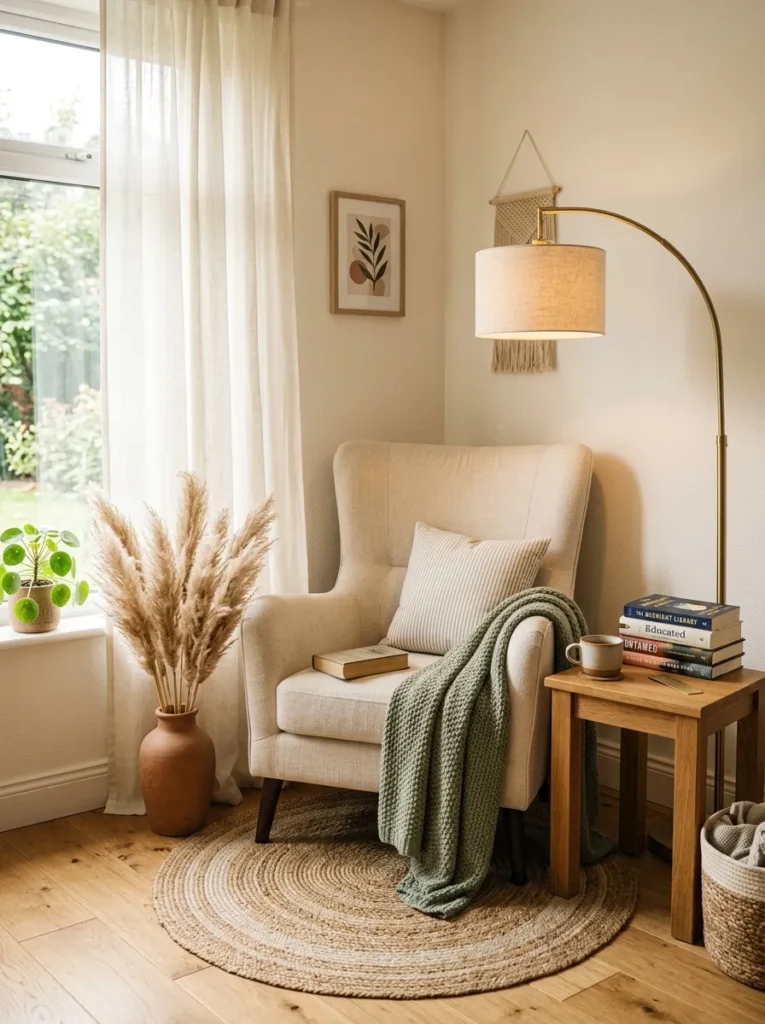
1. The Anchor Chair Nook (Boho, $100+)
What it is: One statement armchair tucked at a 45-degree angle into the corner, pointed slightly into the room. A cream boucle accent chair, a sage linen slipcover armchair, or a rattan papasan all work.
Why it works: A diagonal placement breaks the rigid right angle of the corner and instantly makes the space feel intentional. Your eye reads “reading spot,” not “leftover floor.”
How to do it: Pick a chair with arms wide enough to rest a mug on (most accent chairs run 28 to 32 inches wide). Float it 6 inches off both walls so you don’t trap dust and cords. Add a small round side table (the IKEA Kragsta runs about $30) on the open side and you’re done.
Pinterest-friendly tip: Layer a 3 by 5 foot jute rug under the chair so only the front legs sit on it. This trick photographs beautifully and visually anchors the nook.
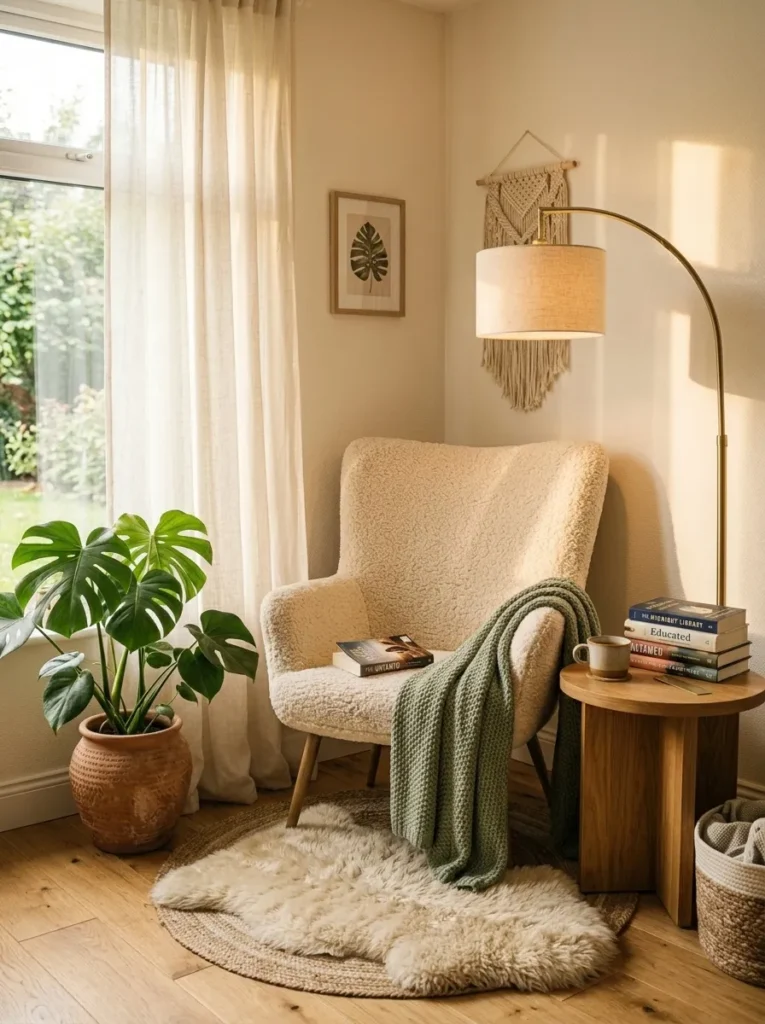
2. The Floor Cushion Nook (Japandi, Under $25 to $100)
What it is: A low, grounded reading spot built around a floor cushion, meditation pillow, or thick sheepskin instead of a chair. Japandi loves this one because it keeps the corner visually quiet and low to the ground.
Why it works: When you sink down, the ceiling feels higher and the corner feels bigger. Perfect for rooms under 100 square feet where a full chair would eat the space.
How to do it: Start with one 24-inch square floor cushion (IKEA’s HAVTAG or a $20 Amazon find). Stack a folded linen throw on top. Lean a small lumbar pillow against the wall behind it. Add a low wood stool as your side table.
Renter flag: Zero drilling. Zero damage. Pick it up and move it in 10 seconds.
If you love this minimalist approach, my deep dive on reading nook bean bag setups walks through 15 floor-level seating ideas with exact dimensions.
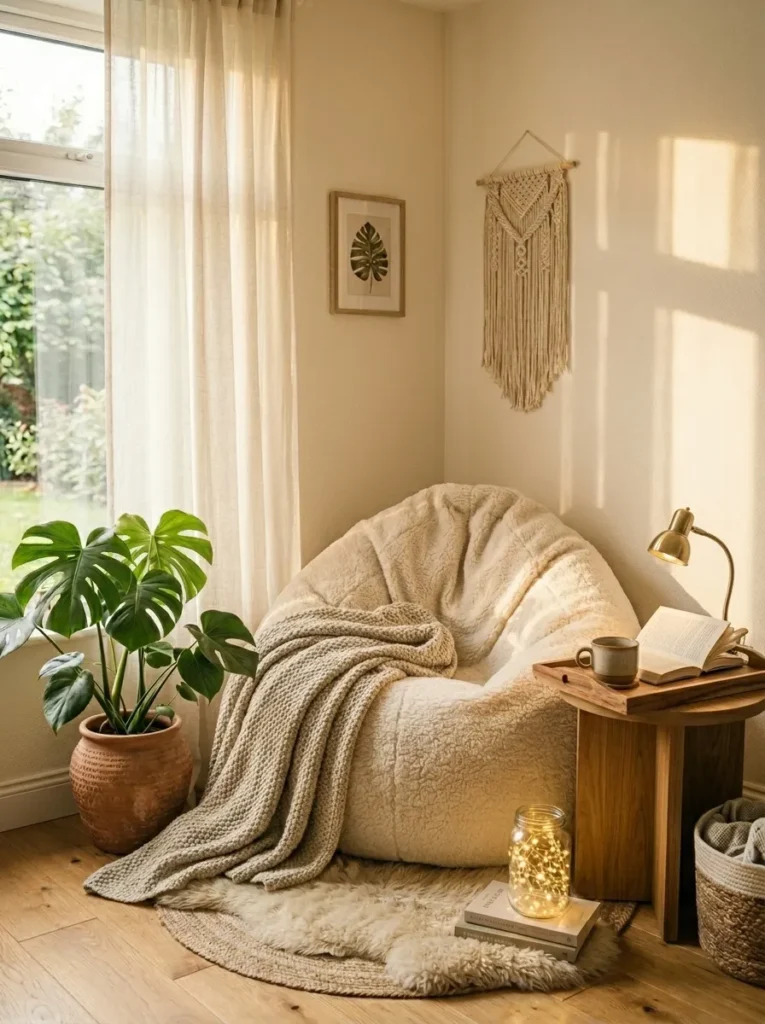
3. The Bean Bag Hug Nook (Boho, $25 to $100)
What it is: A pillow-shaped bean bag (not the 90s kind, the sculptural cream Sherpa or linen kind) tucked into the corner with a small footprint of around 32 inches.
Why it works: Bean bags conform to your body, so they read “cozy” the second you see them. They also weigh almost nothing, which makes them rental gold.
How to do it: Choose a neutral color (cream, oatmeal, dusty pink) and one accent texture like a chunky knit throw. Skip the side table, use a small acacia wood tray on the floor for your tea instead.
4. The Built-In Bench Lookalike (Modern Farmhouse, $25 to $100)
What it is: A backless storage bench pushed flush into the corner, dressed up with cushions and a lumbar pillow against each wall, so it reads like a custom built-in.
Why it works: You get hidden storage for blankets and books, plus seating, without paying a carpenter. The cushions on both walls give it that bench-seat look from Pinterest.
How to do it: Use a $50 to $80 storage bench from Target or Walmart (look for ones that are 36 to 42 inches long). Top it with a 2-inch foam cushion in cream or oatmeal linen. Lean two 18-inch lumbar pillows against the corner walls in an L-shape. Throw a sage or rust-colored blanket over one corner.
Splurge swap: A West Elm storage bench in oak runs around $400 and gives you a built-in feel for under $500 total once you add cushions.
5. The Vintage Wingback Nook (Grandmillennial, $100+ or thrift)
What it is: A wingback chair, ideally thrifted or scored from Facebook Marketplace, tucked into the corner with a floor lamp arched over it.
Why it works: Wingbacks shelter you from the room. The high sides create a literal nook within the corner, which is why every classic library photo features one.
How to do it: Watch estate sales and Facebook Marketplace for wingbacks in the $40 to $150 range. Slipcover it in white linen if the upholstery is rough. Pair with a small mahogany or oak side table and a stack of vintage hardcovers tied with twine.
Pinterest hook: Add a brass library lamp with a green glass shade. This single detail signals “Dark Academia” or “Grandmillennial” instantly.
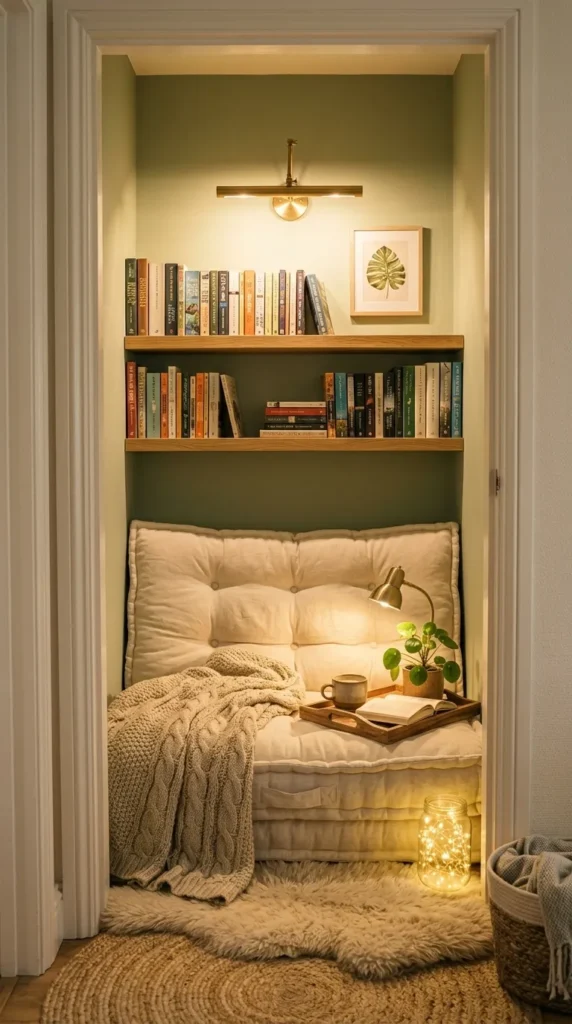
6. The Closet Conversion Nook (Any Style, $25 to $100)
What it is: Take the doors off a 30-inch-wide reach-in closet and turn it into a built-in nook with a cushion across the bottom and shelves above.
Why it works: You get an enclosed, womb-like reading space without building anything new. The closet walls do the architecture for you.
How to do it: Remove the closet rod. Add a 2-inch foam cushion cut to fit the floor (Joann Fabrics sells the foam, or Amazon has pre-cut bench cushions for around $60). Install two floating shelves above (a 24-inch shelf at HomeGoods or Target runs $20 to $30). Paint the inside of the closet a moody color like Farrow & Ball Hague Blue or a budget dupe from Behr.
Renter flag: If you can’t paint, use peel-and-stick wallpaper inside the closet. Spoonflower has matte options that come off clean.
7. The Window-Adjacent Corner Nook (Coastal or Scandi, $100+)
What it is: A chair placed at the corner where two walls meet a window, so you get cross-light from two directions.
Why it works: Reading needs light. A corner that catches morning OR afternoon sun does the work of three lamps for free.
How to do it: Test the corner at 9 a.m. and 4 p.m. before you commit. The winning corner gets at least 90 minutes of natural light. Add a sheer linen curtain panel (IKEA’s LILL panels run $5 a pair) to soften any harsh glare without blocking the view.
Pro tip: Mount the curtain rod 4 to 6 inches above the window frame and extend it 6 inches past each side. This makes the window look bigger and pulls the nook into the architecture.
8. The Behind-the-Door Nook (Small Space, Under $25)
What it is: The 18 to 24-inch wide strip of wall behind your bedroom or living room door, where most people stash nothing. Turn it into a vertical mini nook.
Why it works: It uses dead space you’ve never even noticed. Even a 20-inch-wide gap fits a slim floor cushion, a wall-mounted book ledge, and a clip-on light.
How to do it: Add a single 24-inch picture ledge ($15 at IKEA, the MOSSLANDA) at chest height for books. Drop a slim floor cushion below. Attach a battery-powered clip-on reading light to the ledge. Total cost under $40.
Renter flag: Use Command picture-hanging strips rated for 5 pounds. The MOSSLANDA loaded with paperbacks comes in well under that limit.
9. The Plant-Heavy Jungle Nook (Boho, $25 to $100)
What it is: A reading corner framed by 3 to 5 plants of varying heights, with seating tucked in the middle.
Why it works: Plants visually soften the hard right angle of the corner and create a leafy “wall” that makes the nook feel separate from the rest of the room.
How to do it: Pick one tall plant (5 to 6 foot fiddle leaf, bird of paradise, or olive tree from The Sill or Home Depot, $60 to $120), one medium hanging plant (pothos or string of pearls in a macrame hanger), and one floor-level plant (snake plant or ZZ in a textured pot). Cluster them so the seating is framed but not crowded.
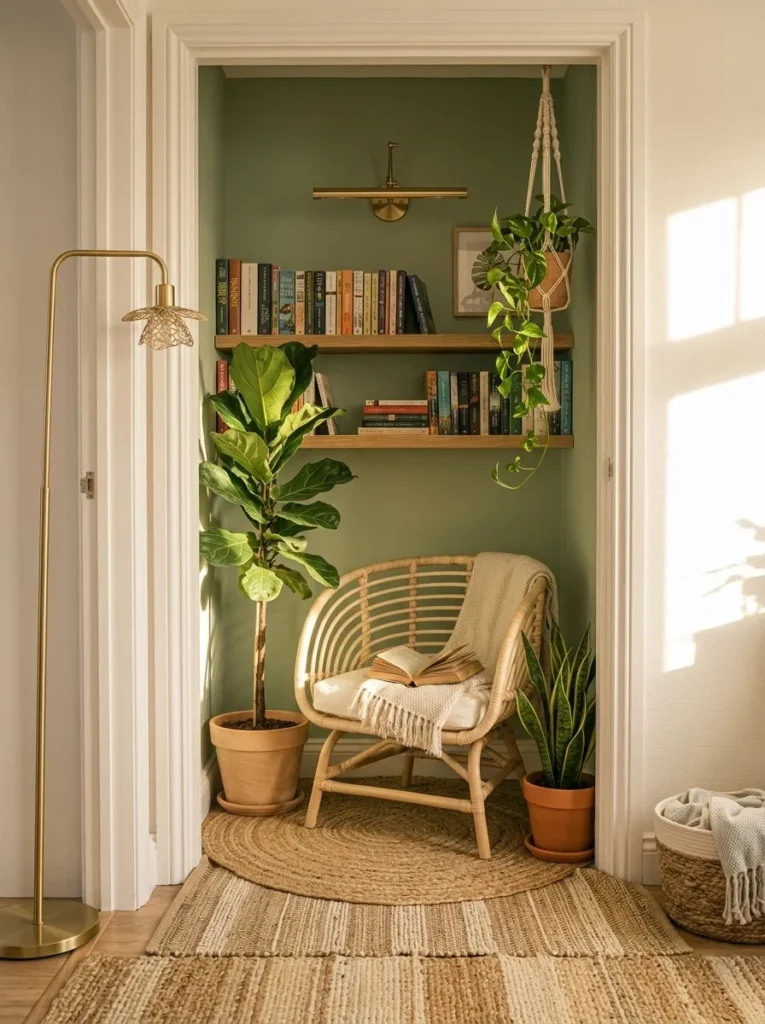
10. The Floating Shelf Library Wall (Dark Academia, $25 to $100)
What it is: Two or three floating shelves stacked above a single chair to create the look of a private library in a corner.
Why it works: Books are decor. A wall of vertical book spines behind your reading chair signals “this is a serious reading spot” without needing a full bookcase.
How to do it: Install three 24 to 36-inch floating shelves stacked 12 inches apart, starting 18 inches above the back of the chair. Fill them with a mix of vertical books, horizontal stacks, one small framed art piece, and one ceramic object (a vase, a small bust, a brass candlestick).
Renter swap: Use the IKEA MOSSLANDA picture ledges and Command strips for a no-drill version, or invest in a single freestanding bookcase angled across the corner.
For 16 more variations on this corner-plus-shelf setup, I broke it down in my reading nook with bookshelves guide.
11. The Layered-Rug Floor Nook (Boho, $25 to $100)
What it is: Two rugs stacked at the corner, one large jute or sisal base and a smaller vintage-style or shag rug on top, with a floor cushion or low chair on top.
Why it works: Layered rugs scream “designed corner” in every Pinterest pin. They define the nook as its own zone, even without walls or built-ins.
How to do it: Start with a 5 by 7 foot jute rug from Target or IKEA ($60 to $100). Layer a 3 by 5 foot vintage-style runner or shag rug on top, set at a 45-degree angle for visual interest. Place your seating so the back legs sit on the jute and front legs on the top rug.
12. The Tension-Rod Curtain Nook (Renter Gold, Under $25)
What it is: A tension rod hung corner-to-corner across the room corner, with a sheer or linen curtain pulled across to enclose the nook.
Why it works: You build a private “room” out of nothing. The curtain blocks visual chaos from the rest of the space and gives the nook its own atmosphere.
How to do it: Buy a curved or angled tension rod (Amazon has L-shaped shower rods for around $20). Mount it 6 to 8 feet off the floor at a diagonal across the corner. Hang two linen panels (IKEA’s MERETE panels are $25 a pair). When you want privacy, pull them closed. When you want the room open, push them to one side.
Renter flag: Tension rods leave zero marks. The curtain panels are 100% removable.
13. The Low Bookshelf Bench Nook (Japandi, $25 to $100)
What it is: A long, low bookshelf (around 18 inches tall) placed flush against the corner wall, topped with a cushion to double as a bench.
Why it works: You get storage, seating, and a built-in look in one piece of furniture. Japandi loves this because the lines stay low and clean.
How to do it: The IKEA KALLAX 2×4 horizontal (about $80) works perfectly. Top it with a 60-inch bench cushion in oatmeal or cream linen. Style the cubbies with vertical books, woven baskets, and one or two ceramic objects. Push the whole piece into the corner so it L-shapes against the wall.
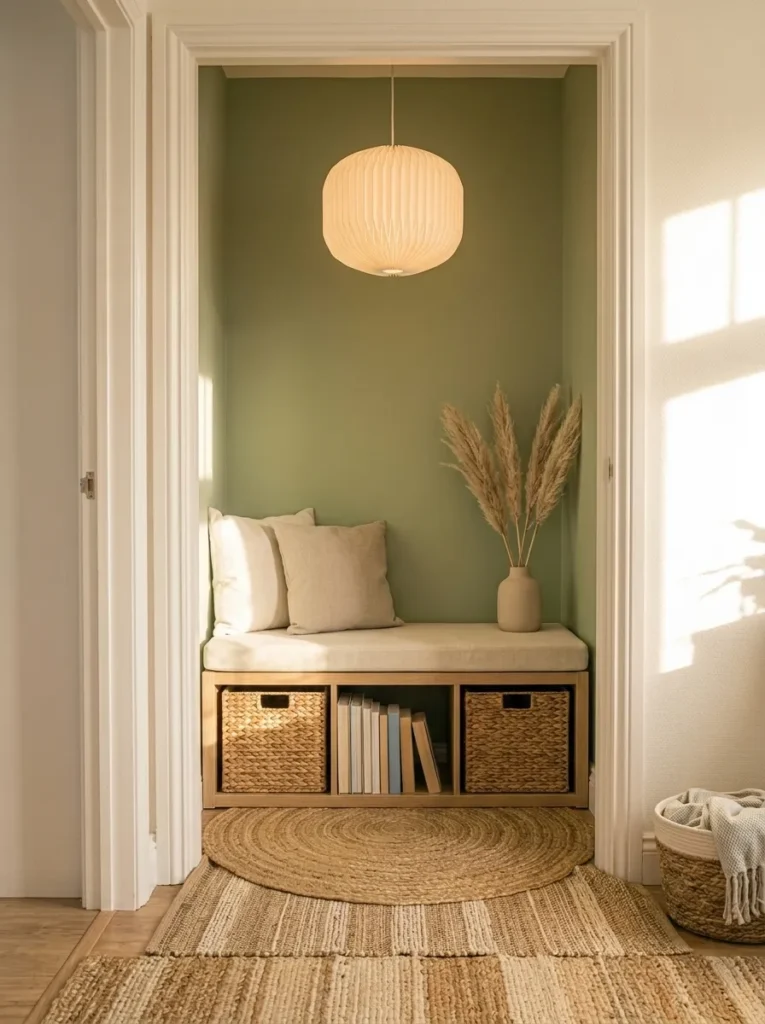
14. The Hanging Hammock Chair Nook (Boho, $100+)
What it is: A hanging rope or rattan chair suspended from the ceiling or a heavy-duty stand, tucked into the corner.
Why it works: The chair floats, which preserves your floor space and adds an unexpected vertical element that makes the corner feel taller.
How to do it: If you can drill, install a ceiling hook into a stud rated for 250 pounds. If you can’t, get a freestanding hammock chair stand (around $150 on Amazon). Layer a sheepskin throw across the seat and add one small lumbar pillow.
Renter note: Skip the ceiling install. The stand alone gives you the same vibe.
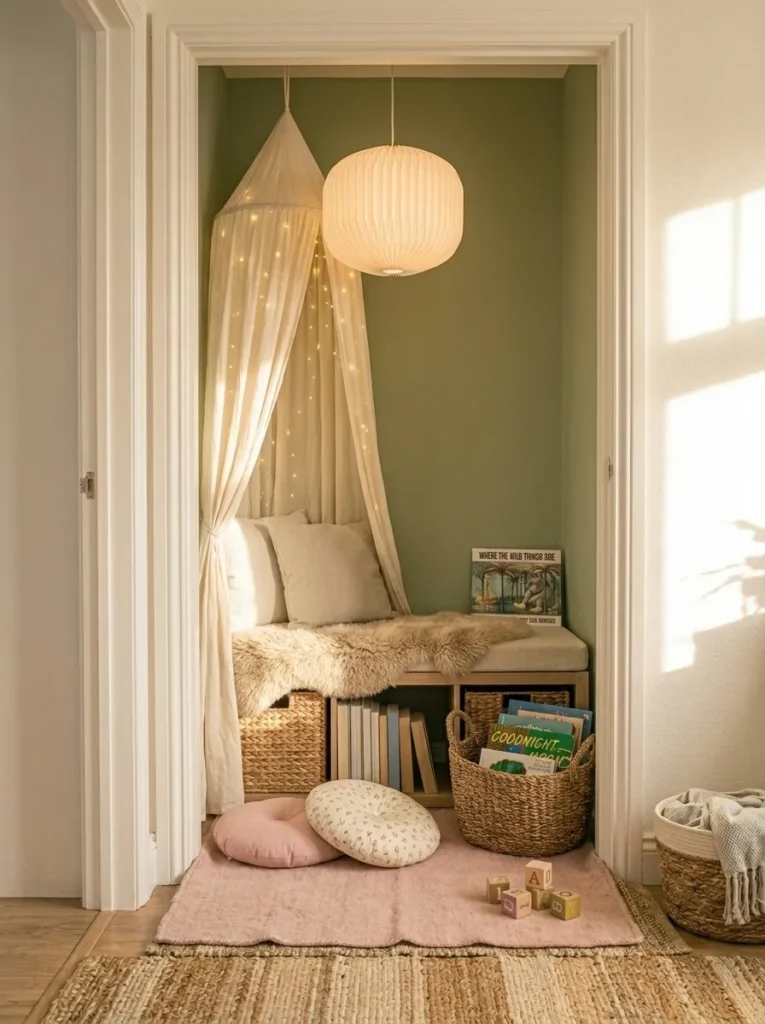
15. The Kid Reading Tent Corner (Any Style, Under $25 to $100)
What it is: A teepee, canopy, or hooped bed canopy hung over a corner with floor cushions and a soft rug underneath, designed for kids ages 3 to 10.
Why it works: Kids actually use enclosed reading spaces. The “hidden” feeling triggers focused, quiet play in a way an open chair doesn’t.
How to do it: Mount a bed canopy hoop ($20 to $40 on Amazon) to the ceiling above the corner. Drape it with a soft cotton or muslin canopy. Layer two or three floor cushions and a sheepskin rug below. Add a battery-powered fairy light string inside for evening reading.
Budget vs Splurge: Building Your Corner Reading Nook
Here’s the head-to-head breakdown so you can build a complete nook at any price point. Screenshot this one.
| Component | Budget (Under $25 each) | Mid-Range ($25 to $100) | Splurge ($100+) |
|---|---|---|---|
| Seating | Floor cushion (Amazon, $20) | Storage bench (Target, $80) | Boucle accent chair (West Elm, $599) |
| Lighting | Clip-on book light (Amazon, $15) | Arc floor lamp (IKEA, $50) | Brass arc lamp (Pottery Barn, $299) |
| Side Table | Wood stool (Walmart, $20) | Round side table (Target, $60) | Marble pedestal (Crate & Barrel, $249) |
| Throw | Acrylic knit (Walmart, $15) | Linen blend (HomeGoods, $35) | Pure wool (Anthropologie, $148) |
| Rug | 3×5 jute (IKEA, $25) | 5×7 jute (Target, $90) | Hand-knotted wool (West Elm, $499) |
| Total | ~$95 | ~$315 | ~$1,894 |
The mid-range build is the sweet spot for most readers. It looks expensive in photos and lasts five-plus years if you pick neutral materials.
The 3-5-7 Rule for Corner Nook Styling
This is one of the most-asked decorating questions on Google, and almost no corner nook article actually explains it. Here’s the version that applies directly to your reading corner.
The 3-5-7 rule says you should style decor objects in odd-numbered groupings (3, 5, or 7) because odd numbers feel more dynamic and visually balanced than even ones. Even groupings feel posed. Odd groupings feel collected.
For your corner nook, apply it like this:
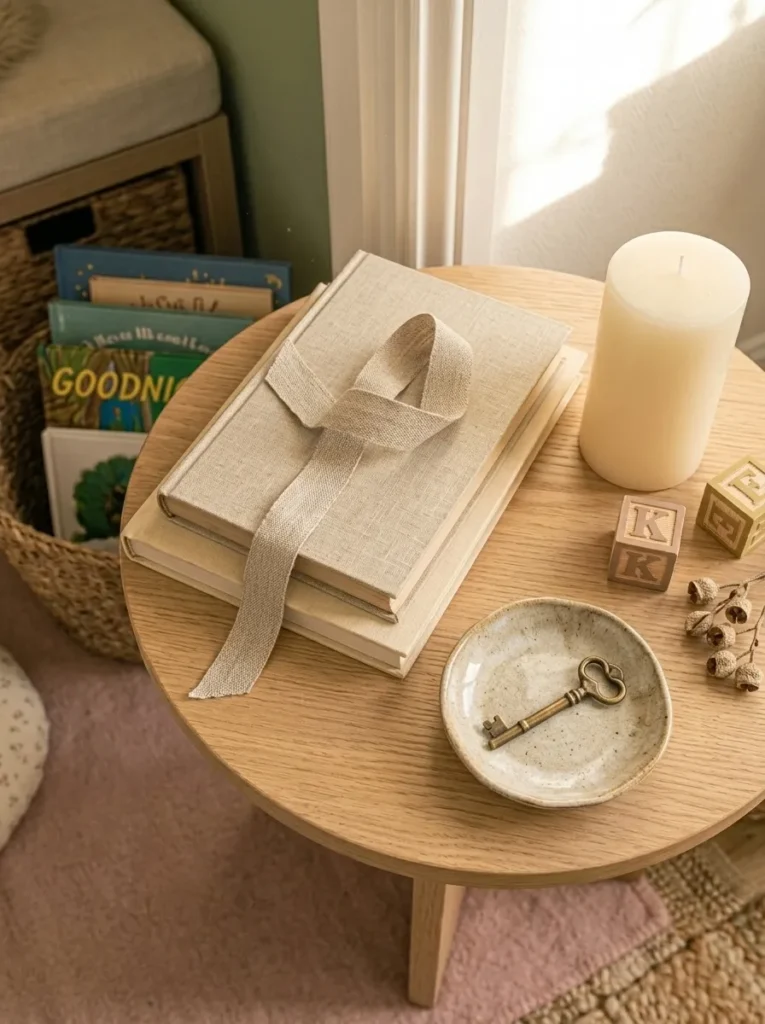
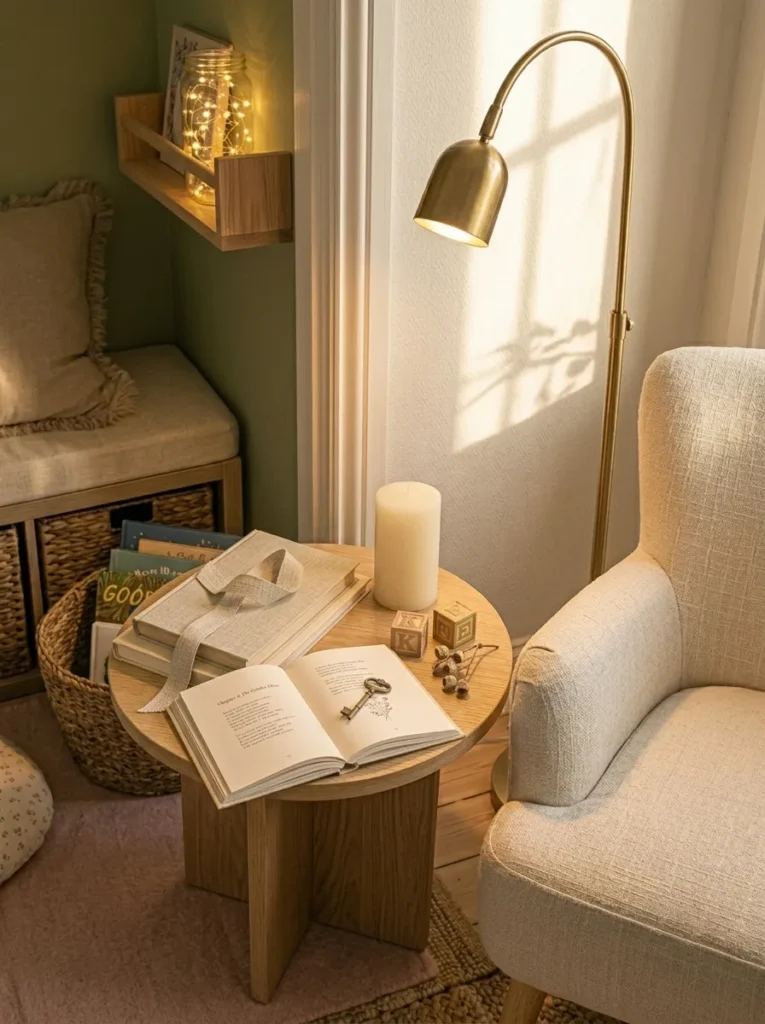
- Side table styling: 3 objects. A candle, a stack of 2 books (counts as one object), and a small ceramic dish.
- Shelf styling: 5 objects per shelf. Vertical books, a horizontal book stack, a small framed art, a ceramic vase, and one organic object like a piece of coral or a brass figurine.
- Floor styling: 7 layered elements total in the whole nook. Rug, chair, throw, pillow, side table, lamp, art piece. That’s your full styling formula.
You’ll also see the 3-4-5 rule referenced in the same searches. That’s a separate rule about furniture proportions: pieces should relate to each other in roughly 3-4-5 ratios (a chair that’s 3 feet wide pairs well with a side table that’s about 18 inches across, which is roughly that 3-to-1 ratio). It’s a designer shortcut, not a strict math rule.
Lighting: The One Detail That Makes or Breaks Your Nook
You can have the prettiest corner in the house, but if the light is wrong, you won’t sit there. I learned this the hard way after building three different nooks before I figured out the lighting.
Here are the three light layers every corner reading nook needs:
- Task light for reading. A focused, warm-white (2700K to 3000K) light source pointed directly at your book. An arc floor lamp, an adjustable wall sconce, or a clip-on book light all work.
- Ambient mood light. A soft glow from a separate source. A small table lamp, fairy lights in a glass jar, or a salt lamp.
- Natural light backup. Position the nook so a window contributes at least 90 minutes of daylight per day, or use a warm-white floor lamp on a smart plug timer.
Skip overhead ceiling lights. They flatten the whole nook and kill the cozy factor instantly.
For the full lamp breakdown by style and budget, I wrote a guide on the best reading nook floor lamps that covers exactly which bulbs and arm lengths work for corner placement.
Rental-Friendly Playbook for Renters
Every idea in this article has a renter-safe version, but here’s the cheat sheet if you can’t drill, paint, or modify the space.
- Hanging anything: Command picture-hanging strips (rated up to 16 pounds), 3M velcro strips, tension rods.
- Curtains and canopies: Tension rods corner-to-corner, ceiling hooks with adhesive backings (Command makes them).
- Wall color: Peel-and-stick wallpaper from Spoonflower, Tempaper, or Chasing Paper. All come off clean if installed correctly.
- Built-in feel: Use freestanding furniture like the IKEA KALLAX or BILLY bookcases to mimic built-ins without drilling.
- Lighting: Plug-in wall sconces (no hardwiring needed) and battery-powered picture lights for shelves.
I’ve used every single one of these in my own rental, and the deposit came back in full.
Common Mistakes to Avoid
After building (and rebuilding) my own corner nook five times, here are the mistakes I see most often.
- Pushing furniture flat against both walls. A chair shoved into the literal corner looks lonely and squared off. Angle it 45 degrees or pull it 6 inches off each wall.
- Skipping the rug. Without a rug, the nook reads as “furniture floating in space” instead of a defined zone. Even a $25 jute rug fixes this.
- Using overhead lighting only. Ceiling lights flatten the corner. Always add at least one warm-white floor or table lamp.
- Going monochrome. A corner of all cream or all gray looks flat in photos. Add one accent color pulled from the room (sage, terracotta, mustard, dusty blue).
- Not styling vertically. The corner has two walls. Use them. Add shelves, art, or a tall plant to draw the eye upward.
- Buying for the photo, not your body. That tiny rattan chair photographs beautifully but kills your back after 20 minutes. Sit in it before you commit, even if you’re shopping online (most retailers offer free returns).
- Forgetting a place to put your cup. Every reader needs a tea spot. A stool, a small side table, or even a wall-mounted ledge counts.
FAQ
What do I do with a weird corner in a room?
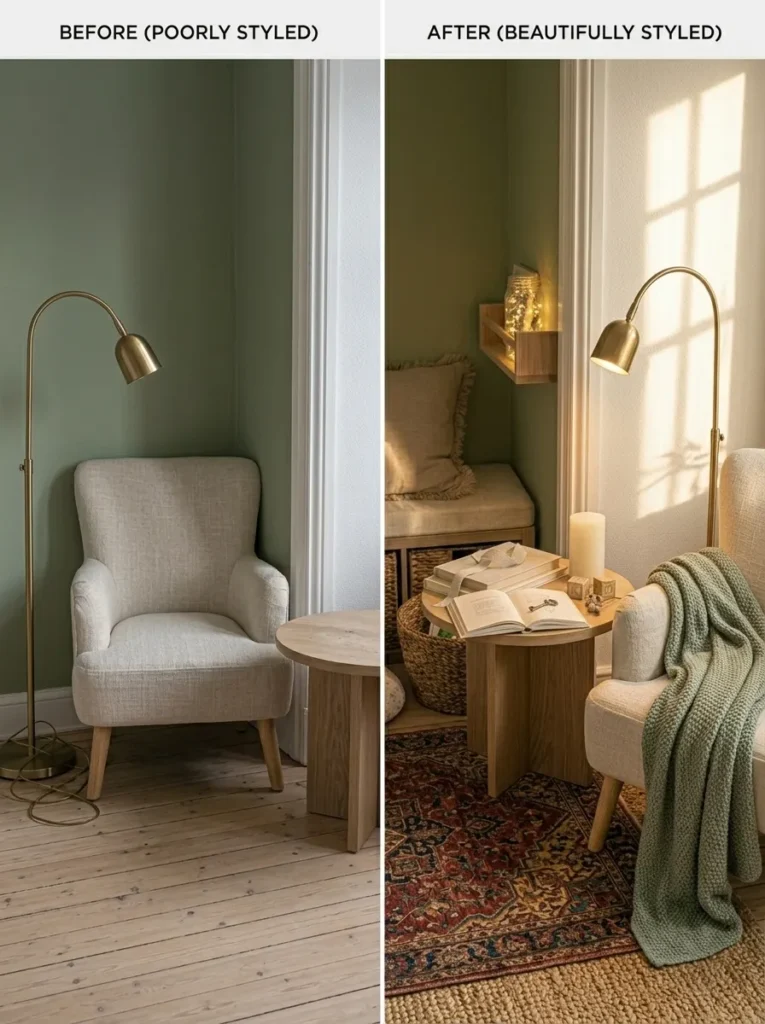
Turn it into a reading nook. A single accent chair angled at 45 degrees, a small side table, a floor lamp, and a rug is enough to make any awkward corner look intentional. If the corner is too narrow for a chair (under 30 inches), use a floor cushion or a slim bookshelf bench instead.
What is the 3-5-7 rule of decorating?
The 3-5-7 rule says decor objects should be grouped in odd numbers (3, 5, or 7) because odd groupings feel more visually balanced and collected than even ones. For a reading nook, apply it to your side table (3 items), your shelves (5 items per shelf), and your overall styled elements (7 layered pieces total).
What is the 3-4-5 rule in decoration?
The 3-4-5 rule is a proportion shortcut for furniture sizing. Pieces should relate to each other in roughly 3-to-4-to-5 ratios so they look balanced together. A 3-foot-wide chair pairs well with an 18-inch side table (about a 3-to-1 ratio). It’s a designer guideline, not a strict math rule.
What do you put in a random corner?
For a reading-focused fill, use a chair or bean bag, a floor lamp or arc lamp, a small side table, a layered rug, and one vertical element like a tall plant or floating shelves. If reading isn’t the goal, a bar cart, a tall plant, or a leaning floor mirror are the next-best filler ideas.
How do I create a corner reading nook in a small space or rental?
Use a floor cushion or a slim bean bag instead of a chair (saves 12 to 18 inches of depth). Hang a tension rod across the corner with a linen curtain for instant enclosure. Use Command strips for shelves and peel-and-stick wallpaper for color. Total footprint can be as small as 24 by 24 inches.
What is the budget version of a corner reading nook?
A complete corner nook for under $100: a $20 floor cushion from Amazon, a $25 jute rug from IKEA, a $15 clip-on book light, a $20 wood stool side table, and a $15 throw blanket from Walmart. Total: $95.
What if I don’t have a window in the corner?
Layer your lighting. Use one warm-white floor lamp (2700K to 3000K bulb) as your main reading light, plus one small table lamp or fairy lights for ambient glow. A round mirror on the wall behind the chair bounces what light you do have around the corner.
How long does it take to build a corner reading nook?
A no-build, no-drill nook with pre-bought pieces takes 30 to 60 minutes once you have everything home. A closet conversion or built-in lookalike with shelves and paint takes a weekend (roughly 6 to 10 hours of active work, plus paint drying time).
Your Corner, Your Cozy
The corner has been sitting there waiting. Now you have 15 ways to make it actually work for you, whether you’re decorating a 90 square foot bedroom, a rented studio, or a corner of your living room that’s been a dumping ground since you moved in.
Pick one idea. Start this weekend. The Boho bean bag setup takes one afternoon and under $100. The closet conversion takes a weekend and gives you a Pinterest-worthy hideaway you’ll use every single day.
Save this post to your “Cozy Reading Nook” Pinterest board so you can pull it up when you’re shopping. And if you want to keep going, my bean bag reading nook guide walks through 15 floor-level seating ideas with exact dimensions and rental-safe picks.
Keep reading
More cozy nook ideas
 Small Spaces
Read →
Small Spaces
Read →
10 Small Reading Nook Ideas for Adults
One high-back chair, one clamp-on lamp, one $19.99 tray table. At IKEA US prices this month, that’s a full reading corner for…
 Home Library & Bookshelves
Read →
Home Library & Bookshelves
Read →
14 Ideas for a Fireplace with Bookshelves on Each Side on a Budget
Two bookcases, two plug-in lamps, two wall straps. At IKEA US list prices this month, that adds up to $237.98 before tax,…
 Study & Craft Nooks
Read →
Study & Craft Nooks
Read →
16 Kids Homework Station Ideas Little Ones Will Love
Two IKEA pieces, one empty corner, $109.98 before tax. That’s the first kids homework station on this list, and it fits in…