
12 Vintage Fall Decor Ideas for Sweater-Weather Evenings

Five o’clock and already dark. The overhead light makes your living room feel like a waiting room, and the big-box fall aisle is selling the same plaid pumpkin as everyone else’s feed.
There’s a better way to make one small corner feel like October, and it costs a few weekend stops at thrift stores and estate sales. Vintage fall decor has something new pieces can’t fake. Brass that has darkened unevenly, amber glass that turns lamplight to honey, a wool blanket thick enough to make a draft irrelevant.
This list is built for real apartments and small houses, not New England farmhouses with wraparound porches. Every idea works after sunset, most need zero drilling, and a few come with honest warnings that the glossy roundups skip, like which old dishes should never hold food.
You’ll find the pieces to hunt for and how to clean what comes home smelling like a basement. You’ll also get one simple rule for putting fall decor with vintage items together without the corner turning into a cluttered antique booth.
Start with the light. Everything else looks better once it’s on.
1. Brass Candlesticks With Flicker LED Tapers for 5 P.M. Dark
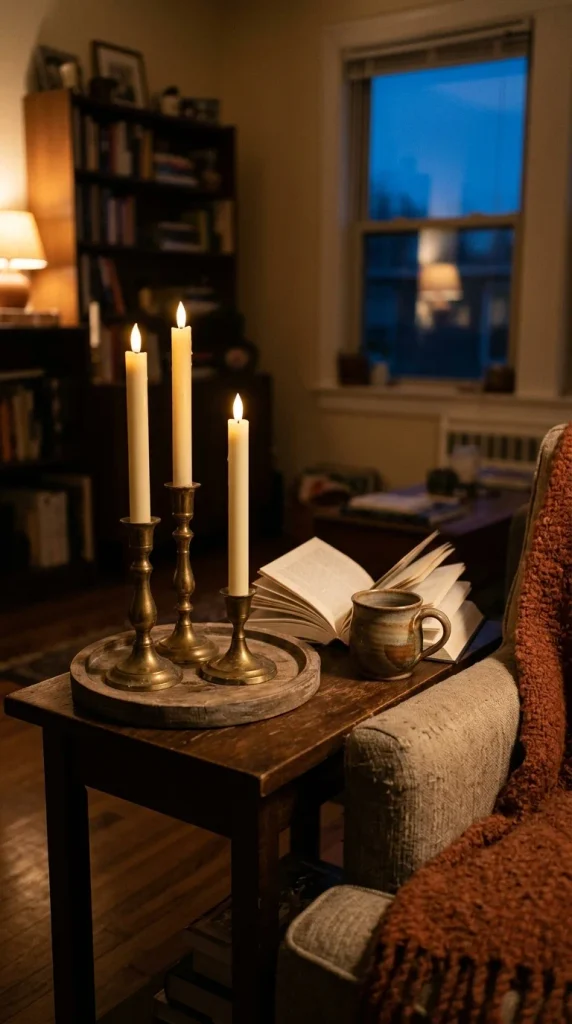
Sunset comes early once the clocks fall back, and harsh overhead light flattens a room. A cluster of thrifted brass candlesticks fixes that faster than any new lamp.
Solid brass is heavy for its size, and a fridge magnet won’t stick to it. If the magnet grabs, it’s brass-plated steel. That’s still fine for decor, just lighter and more likely to show wear. Group three sticks of different heights on a small tray beside your reading chair.
The renter-safe part is that most vintage candlesticks take a standard 7/8-inch taper, so battery LED tapers with a flicker setting drop right in. No soot on the ceiling and no flame near your throw. If you do burn real wax, the candle safety tips from the NFPA start with keeping candles at least 12 inches from anything that can burn.
Safety note: anchor tall furniture to the wall, keep candles and cords away from fabric, and use a licensed electrician or contractor for hardwired lighting, ceiling mounts, or anything structural.
2. Amber Glass Bottles That Glow When the Lamp Comes On
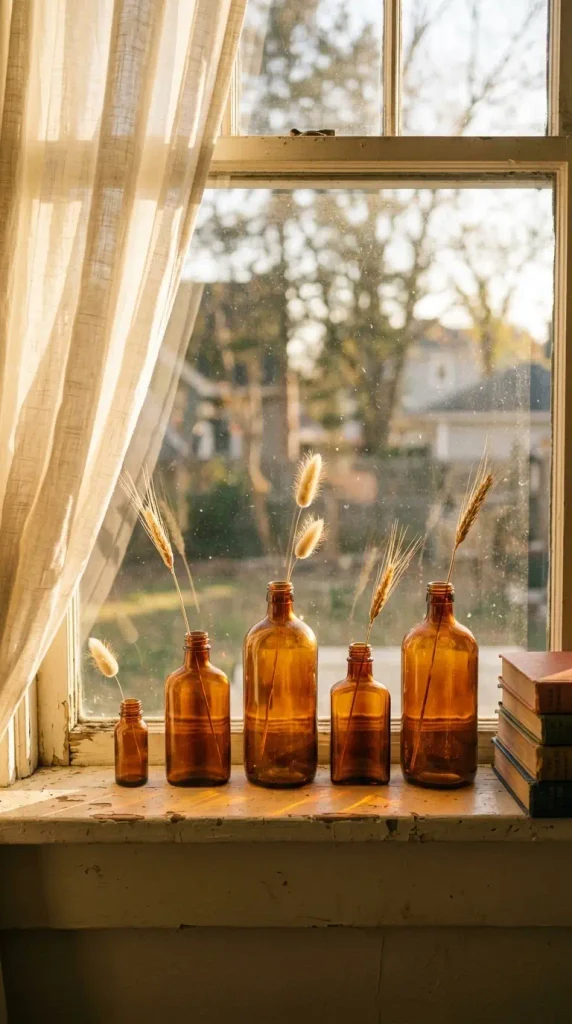
Clear glass disappears at night. Amber glass catches the light and holds it.
Old brown apothecary bottles, embossed medicine bottles, and amber bud vases turn up at nearly every antique mall. Line three to five along a windowsill or the shelf closest to your reading lamp, then fill them lightly:
- a single stem of dried wheat or bunny tail grass
- a sprig of dried eucalyptus, which keeps a faint green smell for weeks
- nothing at all, if the bottle has raised lettering worth showing off
Placement matters more than the bottles. Pushed against a wall, amber reads as plain brown. With a lamp behind or beside it, the whole row lights up like weak tea held to a window.
💡 Quick Tip
Cloudy inside? Fill the bottle with warm water, a drop of dish soap, and a spoonful of uncooked rice. Shake hard for a minute. The rice scrubs the corners a brush can’t reach.
3. Brown Transferware on Display, Not at Dinner
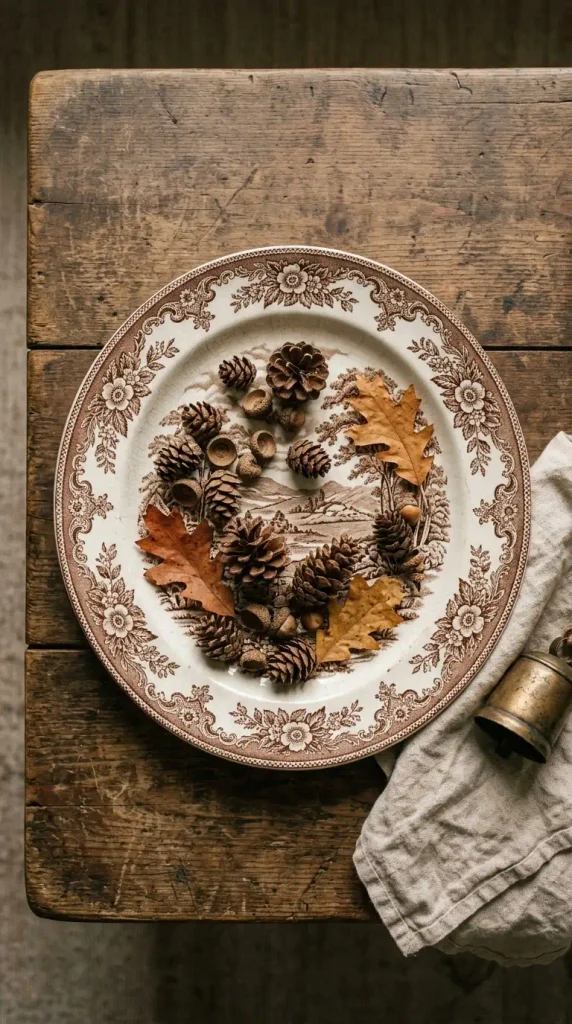
Brown and white transferware is the quiet star of thrifted fall decor. Turkeys, harvest fields, and country cottages are all printed in rusty brown on cream, and they look made for October.
Plenty of roundups tell you to set the Thanksgiving table with it. Pause there. Lead showed up in many older glazes, and the FDA guidance on lead in foodware states plainly that there’s no known safe level of lead exposure. You can’t see lead in a glaze, so for unmarked old pieces the safe default is simple. They’re for looking, not eating.
That still leaves plenty to do with them. Lean two or three plates on a plate stand on your bookshelf, or use a platter as a tray for pinecones and acorn caps.
Stand plates upright on a shelf or picture ledge.
Use platters as trays for pinecones, candles, or keys.
Check the maker’s mark on the back to look up a pattern’s age.
Serving acidic food like cranberry sauce on old glazes.
Eating off chipped or fine-cracked (crazed) pieces.
Microwaving anything with an unknown glaze.
4. A Wool Camp Blanket Folded Over the Arm of Your Chair
Sweater weather starts at your lap.
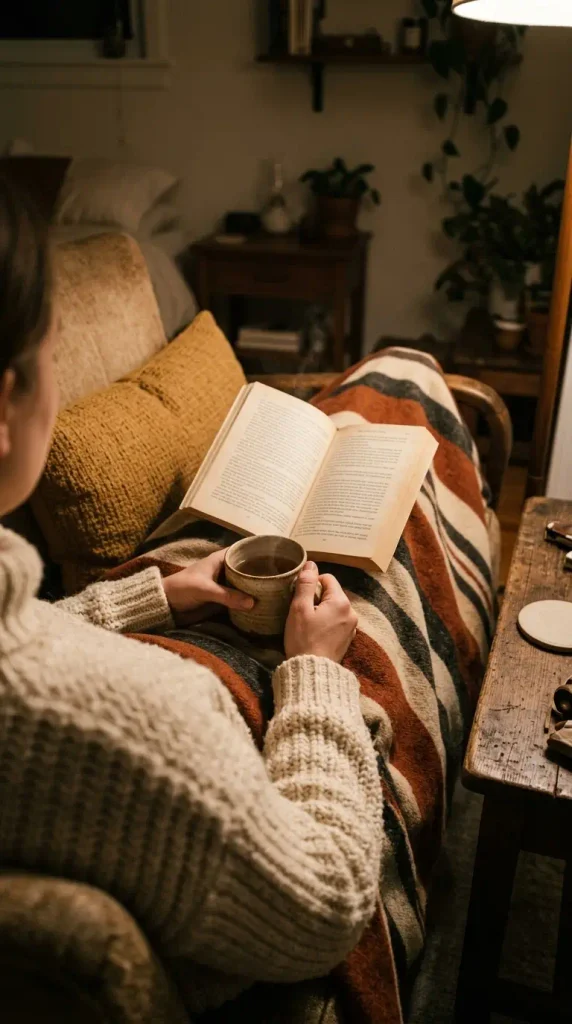
Striped wool camp blankets, point-style trade blankets, and crocheted granny-square afghans all turn up in thrift bins every fall. They were built to last decades, which is exactly why so many survive. A thick wool blanket also changes how a corner sounds. It softens the chair, muffles the room, and makes a drafty window matter less.
Before one comes inside, shake it out on the porch or balcony and look for small, uneven holes or fine webbing. Those are signs of clothes moths. A week sealed in a bag in the freezer is a common fix before it ever touches your sofa.
Recreate this look
Got a spare corner that could hold more than a chair? A daybed lets the blanket do double duty as decor and nap cover, and these daybed reading nook ideas for one spare corner show how to fit one in.
5. A Stack of Old Hardcovers Sorted by Fall Color
Old books are the easiest vintage fall decor to find. They’re also the most likely to come home smelling like a damp basement.
Pull hardcovers with rust, mustard, olive, and oxblood cloth spines. Take off any torn dust jackets, since the cloth underneath is usually prettier, and stack them in two short piles. Top one with a small gourd or a brass bell. Fix the smell before they go anywhere near your shelf:
Wipe the covers with a barely damp cloth, then stand each book open like a fan until fully dry.
Set them in a lidded plastic bin next to an open box of baking soda. Keep the powder off the pages.
Close the lid for several days, sniff, and repeat if the smell lingers. Any book with visible mold stays out.
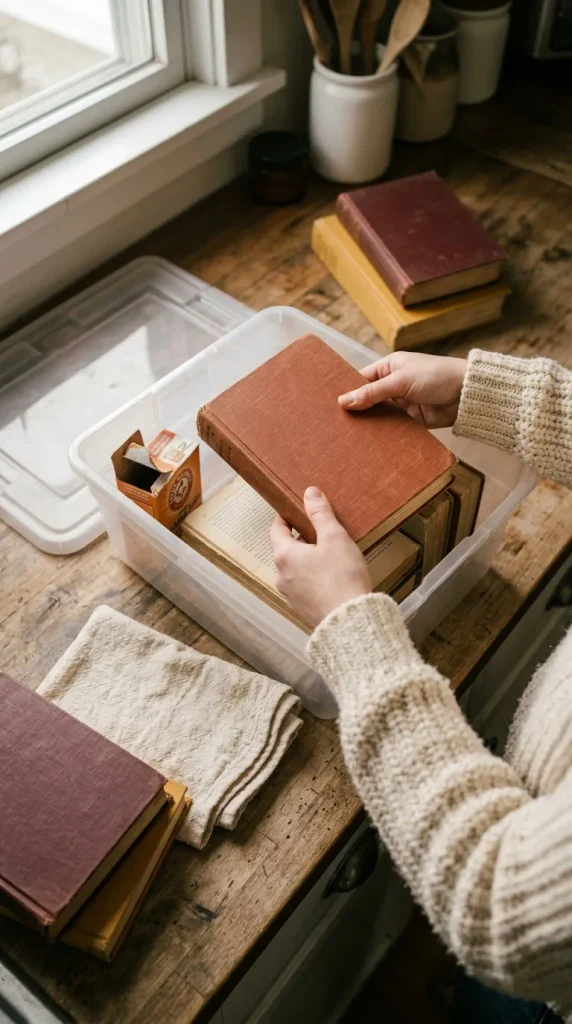
Once the books smell like paper again, they deserve better than a pile on the floor. These ideas for a reading nook with bookshelves that puts books first give a growing collection a real home.
6. Frame a Vintage Embroidered Linen as Fall Wall Art
Designers are hanging old textiles as art this season. Homes & Gardens lists “vintage layers” among its fall 2026 trends. You don’t need a museum quilt to join in.
A thrifted tea towel embroidered with acorns, a feed-sack fabric remnant, or a single quilt block all work. Slip the fabric into a thrifted frame with the glass removed, which makes it lighter, and smooth it over the backing board with a few pins along the back edge.
A blank wall above the reading chair, or a mass-market print that could hang in any hotel.
Hand-stitched linen in a worn wood frame, hung with removable strips, that looks like it came with the house.
Hang it with removable adhesive picture strips rated above the frame’s weight, and your deposit stays safe. One warning: keep it out of direct sun. Old dyes fade quickly on a bright south-facing wall.
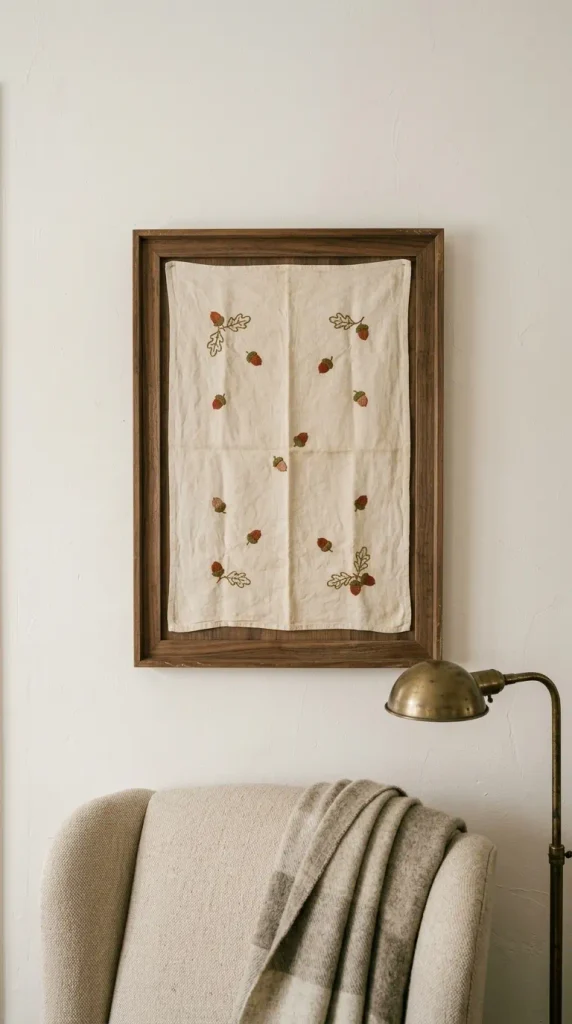
7. Copper Molds and Pots That Hold Mini Mums
Copper darkens as it ages, and the brown-orange it settles into happens to be the color of October.
Old copper jelly molds, small saucepans, and watering cans work on a wall hook, a shelf, or the floor beside a chair. For plants, drop a 4-inch nursery pot of mums straight inside so the roots never touch the metal and water never pools in the copper.
| Copper piece | How to use it for fall |
|---|---|
| 🍮 Jelly molds | Hang three in a row on removable hooks above a doorway or shelf. |
| 🍳 Small saucepan | Holds a 4-inch pot of mums on a side table. |
| 🚿 Watering can | Becomes a floor vase for dried grasses beside a chair. |
| 🍂 Flat tray | Serves as a base that groups candles and small gourds. |
Like the brown patina? Leave it. If you’d rather have the shine back, the FAQ below covers cleaning.
8. A Stoneware Crock Full of Gathered Branches
The branches are free. The crock does the heavy lifting.
Salt-glazed stoneware crocks were kitchen workhorses for pickling and butter. You’ll see gray ones with a painted cobalt number or bird, and two-tone ones with a brown top. Today their weight is the point, because a crock can hold tall, top-heavy branches without tipping.
Cut oak, maple, or dried hydrangea heads from your own yard or a friend’s. Strip the leaves below the rim and go taller than feels right. Branches about twice the crock’s height look balanced in a corner.
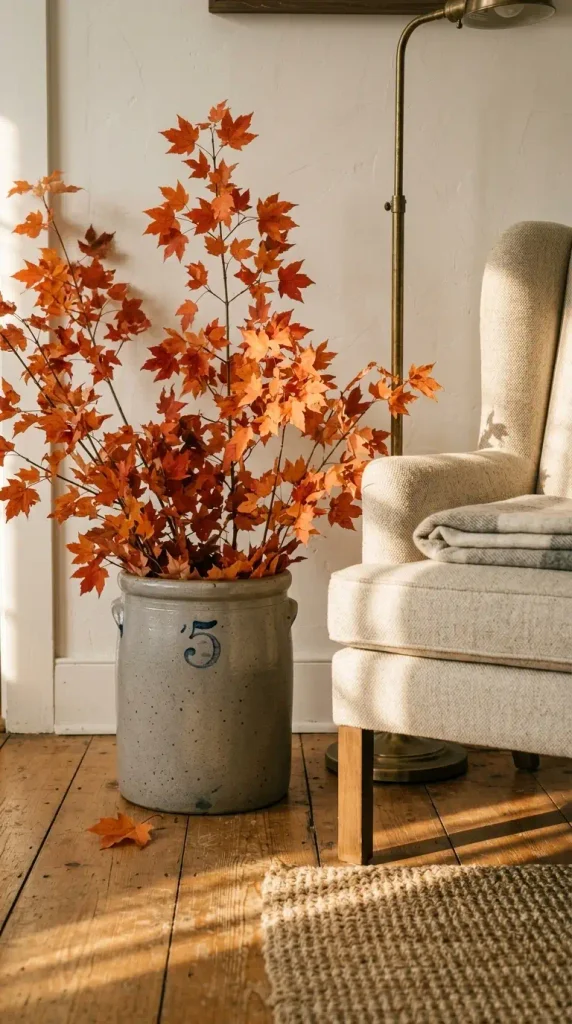
⚠️ Watch Out
A big crock filled with branches can weigh more than a floating shelf is built for. Keep it on the floor or a sturdy table, and run a finger along the base for hairline cracks before you ever add water.
9. Harvest-Color Pyrex as a Gourd Bowl
Mustard, burnt orange, and deep brown were Pyrex kitchen colors in the 1970s, and a stack of nesting bowls on an open shelf still reads warm today.
Fill the biggest bowl with small gourds, pinecones, or a few apples, then set it where your lamp hits it. Two trade-offs are worth knowing:
- ▸Patterns to hunt: Butterfly Gold, Autumn Harvest, and Woodland all lean warm and fall-toned.
- ▸Dishwasher damage: a chalky, faded exterior lowers resale value, but for decor it simply looks lived-in.
- ▸Collector pricing: check a few sold listings online before paying an antique-mall price tag.
Follow the same rule as the transferware: when the paint history is unknown, gourds go in the bowl and dinner goes on new dishes.
10. A Wicker Picnic Basket Beside the Chair for Throws and Books
Small corners get cluttered fast. A spare blanket, two library books, a phone charger, and suddenly the nook looks like a lost-and-found bin.
You have two vintage choices:
- A lidded picnic basket hides everything and doubles as a tiny side table for a mug.
- An open apple or market basket shows off the folded throw, but you’ll see whatever gets tossed in.
For a corner of under 30 square feet, the lid usually wins. Check the hinges and the leather or wood clasp before buying, since a broken lid is harder to fix than a loose handle.
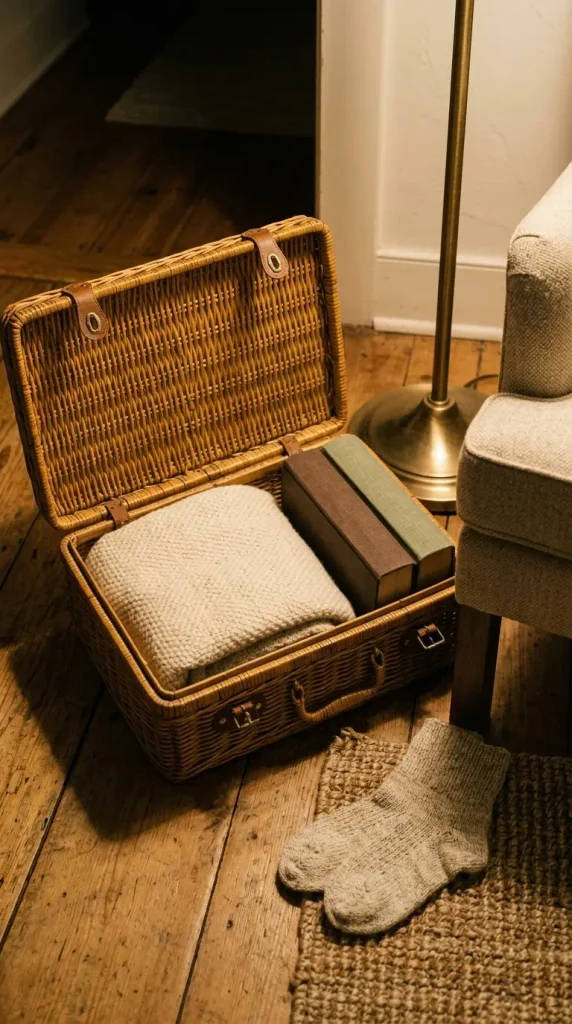
It hides the clutter that wrecks a small corner, and it still looks like fall decor while it does the job.
Building the whole corner from scratch? These budget reading nook builds for small spaces pair well with thrifted storage like this.
11. Mix a Plaid, a Floral, and a Stripe the Way Old Houses Did
Old farmhouses never matched. Curtains, quilts, and pillow covers arrived decades apart, and that collected mix is the heart of fall cottage decor. It’s also why “print-maxxing” made the fall 2026 trend lists.
The trick is keeping the colors tight while the patterns vary. Pick two or three shades, like rust, cream, and olive, and let one large print lead.
| Lead print (one, largest) | Supporting prints (two, smaller) |
|---|---|
| Wool plaid blanket | Small calico pillow plus a ticking-stripe lumbar |
| Faded floral curtain panel | Gingham check pillow plus a striped wool throw |
| Patchwork quilt | Solid linen pillow plus one narrow striped runner |
Thrift stores sell old pillow covers and curtain panels for far less than new fabric. Wash them on cold before they go anywhere near your chair.
12. The Glow, Grain, Gathered, Old Rule for One Small Corner
Twelve ideas don’t belong on one table.
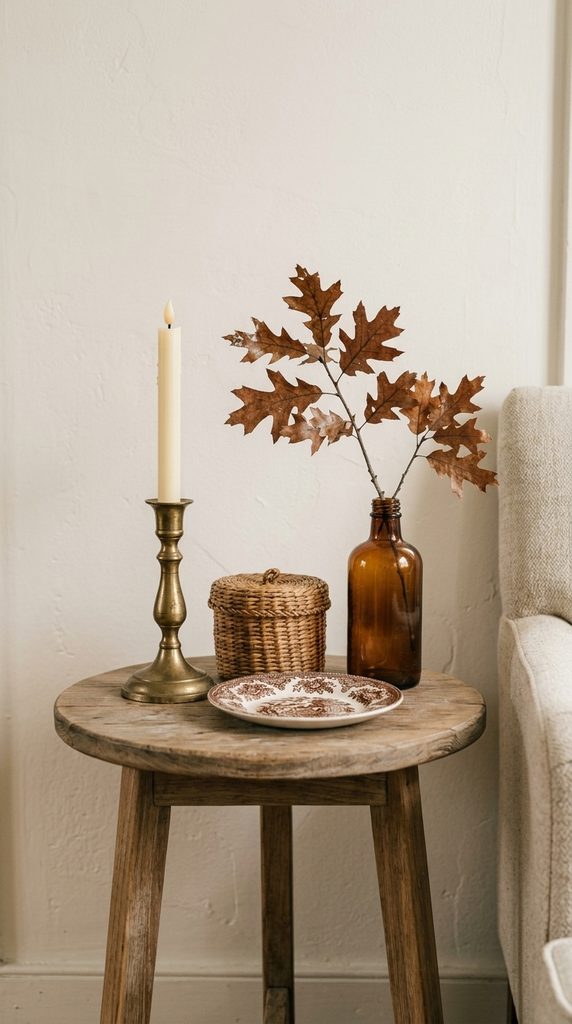
The best vintage fall decor in a small space comes from editing. Give each surface, whether a 2-foot side table, a single shelf, or a windowsill, exactly four things, one from each group below. That’s enough to feel layered without tipping into antique-booth clutter.
The Glow, Grain, Gathered, Old Rule
Swap only the gathered piece as the season moves. Green apples in September, maple leaves in October, pinecones by Thanksgiving. The corner changes every few weeks, and you never buy a thing.
Frequently Asked Questions
How do I make my fall decor look vintage?
Swap a few new pieces for things with real wear: brass that has darkened, books with cloth spines, a wool blanket, stoneware, or transferware. Keep the colors warm and muted, like rust, mustard, cream, and brown, and mix in natural pieces such as branches and acorns. Uneven, collected-over-time groupings look older than matched sets bought together.
What colors work best with vintage fall decor?
Warm, slightly faded shades work best. Think rust, caramel, mustard, olive, oxblood, and cream, with brass and copper as the metal tones. Cinnamon and tobacco browns are big this fall, and deep plum makes a good accent if you want something less expected. Skip bright pumpkin orange, which tends to read new.
Where can I buy vintage fall decor?
Thrift stores like Goodwill and The Salvation Army, estate sales, flea markets, and antique malls carry the most variety. Facebook Marketplace and local buy-nothing groups are good for crocks and baskets, which are heavy to ship. Etsy and eBay are easiest for specific items like Pyrex patterns or transferware, though prices run higher than in-person hunting.
Do vintage decor pieces have to be genuinely old?
No. Many people mix true vintage with new pieces made in an older style, like reproduction crocks or new brass candlesticks. The look comes from materials and wear, not from a date stamp. One real piece per grouping, such as an old book or a transferware plate, is often enough to make the newer pieces around it feel collected.
How do you decorate for fall on a small budget?
Start with what’s free. Branches, acorns, pinecones, and dried hydrangeas cost nothing and change the room right away. Then buy one or two thrifted anchors, like a brass candlestick or a stack of old hardcovers, rather than a cart full of new seasonal decor. Rotating the natural pieces through the season keeps things fresh without more shopping.
How do you clean vintage copper?
For light tarnish, rub the surface with half a lemon dipped in salt, then rinse and dry right away. A paste of white vinegar, salt, and flour works for heavier spots. Skip abrasive pads, which scratch. Some pieces are lacquered, and scrubbing strips the coating, so test a hidden spot first. Many people simply leave the brown patina.
Make One Corner Feel Like October
You don’t need a farmhouse or a full weekend of shopping to bring vintage fall decor home. Start with one light source, add a blanket you want to sink into, and build out with the four-piece rule until the corner feels finished.
Clean what smells, check what’s chipped, and keep old glazes on the shelf instead of the dinner table. Then turn on the lamp, pull the blanket over your knees, and let the season do the rest.
Save this list to your fall board so it’s ready for your next thrift run.
Keep reading
More cozy nook ideas
 Fall Decor
Read →
Fall Decor
Read →
12 Thanksgiving Tablescape Ideas for Small Spaces (That Still Leave Room for the Food)
Twenty-four inches. That’s how much table edge one person needs to eat without bumping elbows, and it’s the number most Thanksgiving tablescape…
 Fall Decor
Read →
Fall Decor
Read →
18 Fall Coffee Bar Ideas for Sweater-Weather Evenings
No counter space to spare, no espresso machine, no landlord permission needed. This fall coffee bar runs on three pieces: a slim…
 Fall Decor
Read →
Fall Decor
Read →
15 DIY Outdoor Halloween Decor Ideas That Stay Cozy, Not Creepy
If your porch every October is one lonely pumpkin and a doormat, and every store aisle is full of bloody hands, this…