
The Vintage Cottagecore Living Room: Floral Sofas, Real Antiques, and Rooms That Feel Inherited

A vintage cottagecore living room comes down to three moves: one floral sofa with a solid frame, a short list of true antiques, and warm light that stays below eye level. You don’t need an actual cottage. You don’t need a landlord’s blessing, a paint sprayer, or a four figure budget either. If your room is currently a gray couch facing a blank wall, this guide walks you from that to a space that looks inherited, with real secondhand prices, a lead safety check nobody else mentions, and a fully totaled corner build at the end.
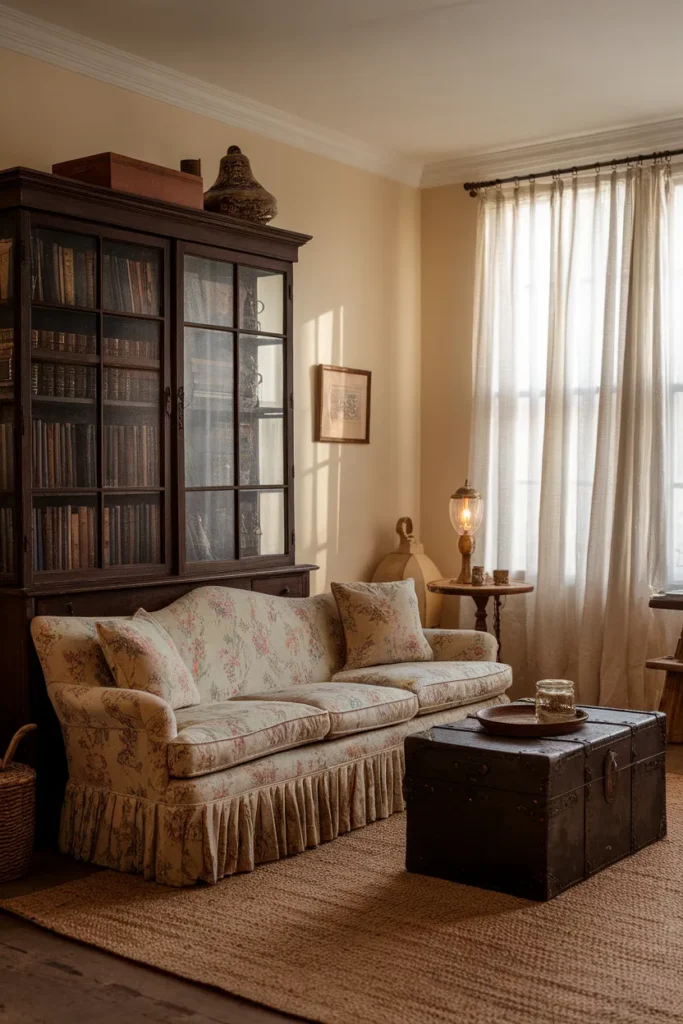
Start With the Floral Sofa (the Whole Room Follows It)
The sofa is the biggest pattern in the room, so it gets chosen first and everything else calibrates to it. Hunt in this order: estate sales, Facebook Marketplace, Habitat for Humanity ReStore, local vintage shops, then eBay. Right now the secondhand market breaks into three honest tiers.
Project pieces sit under $150. Most solid, ready to live with finds land between roughly $150 and $600 (a Midwest vintage shop was asking $238 for a flocked floral piece during my research, and a clean English two seater listed at $550). Dealer grade pieces on sites like 1stDibs jump past $1,500 fast. You do not need dealer grade.
Before money changes hands, run two checks. First, the frame test: lift one front corner about six inches. The whole side should rise as one piece, no groan, no flex. Peek underneath for a hardwood frame, and press the seat deck down hard; it should push back instead of crunching. Second, the smell test. Sit down, lean in, and inhale near the seam. Musty foam rarely un-musts, and sun plus baking soda only treats the surface. Skip either check and you’re the person whose bargain lists to one side by month two.
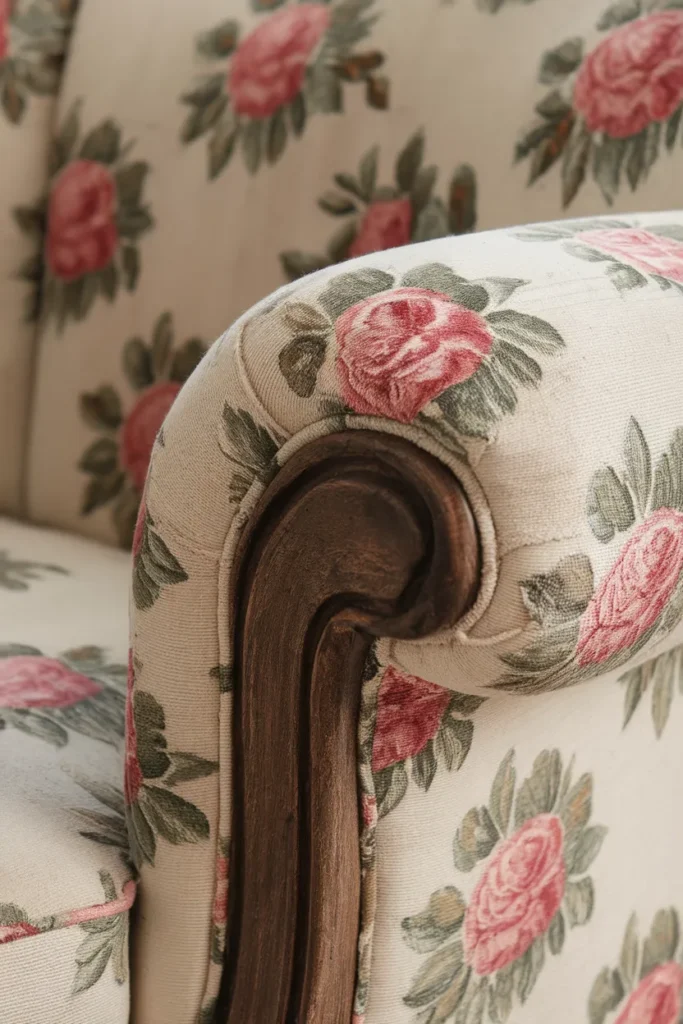
Old chintz has one more trap: flip the loose cushions. The hidden side shows you the true original color, and a big gap between the two means years of sun damage. If a full floral sofa feels like too much commitment, a plain slipcovered sofa plus two ruffled floral lumbar pillows gets you 70 percent of the vintage cottage living room look with an exit ramp.
Sizing numbers worth screenshotting:
| Piece | Typical size | Placement rule |
|---|---|---|
| Vintage loveseat | 52 to 64 in wide | Small rooms under 150 sq ft |
| Full sofa | 72 to 84 in wide | Leave 18 in to the coffee table |
| Main walkway | n/a | Keep 30 to 36 in clear |
| Side table | 20 to 24 in tall | Within an 18 in reach of the seat |
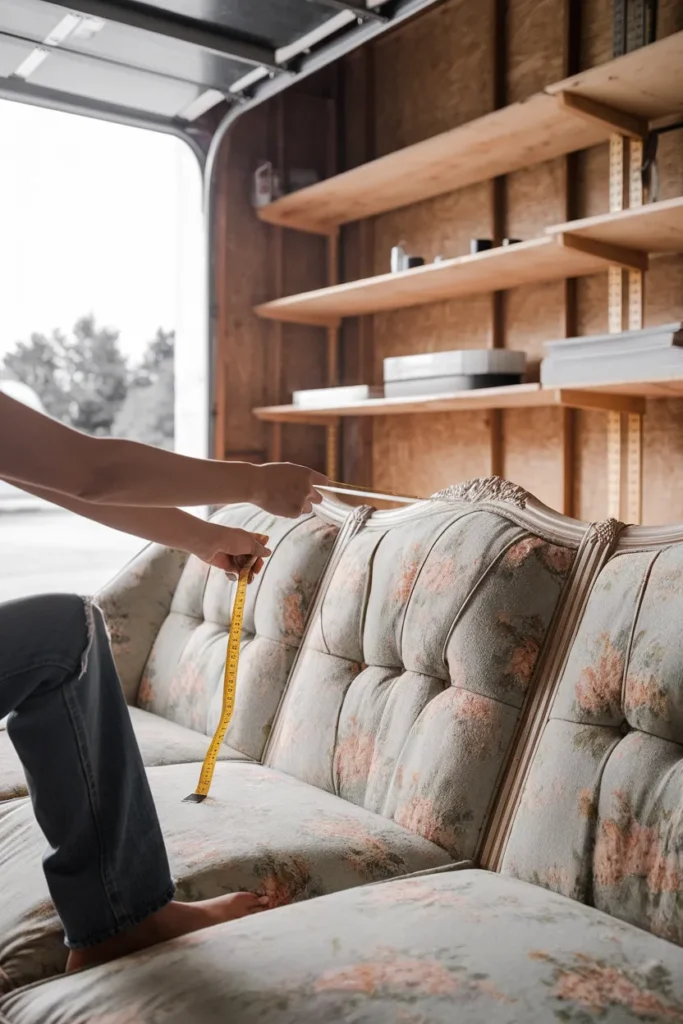
Hunt Antiques Like a Granny Chic Regular
Here’s the rule that keeps a room from looking like a set: The Three Era Rule. Every seating zone should hold pieces from at least three different decades. Two eras reads like a theme party. Three reads like a family. A 1980s sofa, a 1940s side table, and a 2020s rug pass. A room bought in one afternoon never does.
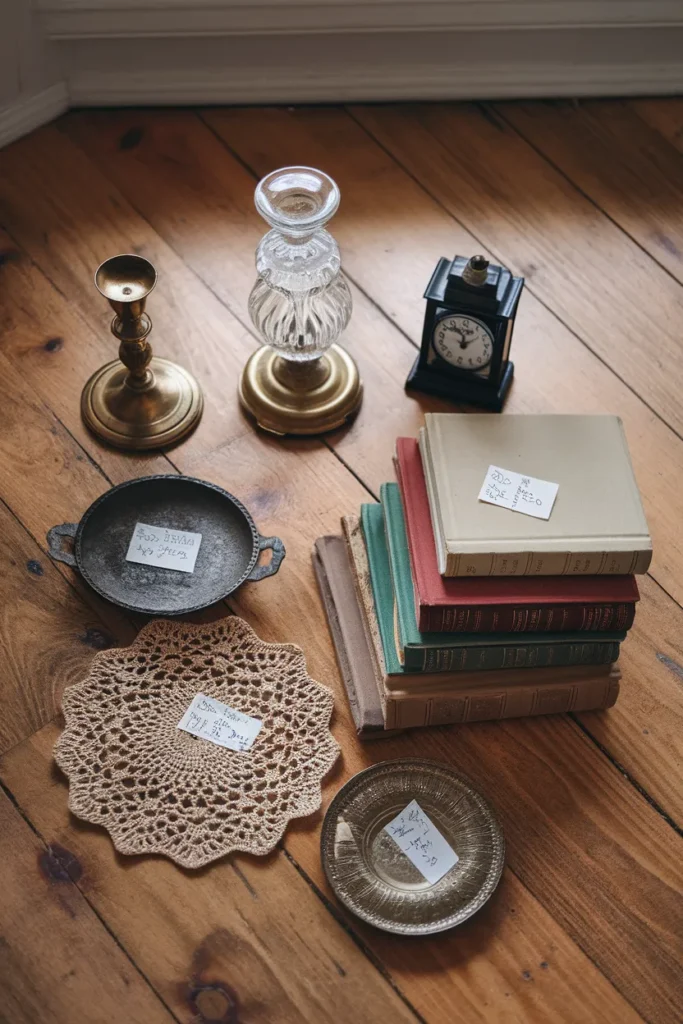
Granny chic decor is the fastest way to stock those eras, and estate sales are where the prices live. Typical tags I found across current listings and thrift tier shops: brass candlesticks $5 to $15, glass oil lamps $15 to $40, mantel clocks $20 to $60, clothbound hardcovers $1 to $3 apiece, ironstone platters and teacups a few dollars each (all of that varies by region, so treat it as a range, not a promise). Go on the final day. Most estate companies cut prices 25 to 50 percent in the last hours because everything left is a problem they have to haul.
One safety step the pretty roundups skip: paint. The US banned lead containing paint on furniture and in homes in 1978, so that charming chippy green dresser may predate the ban, and deteriorating or sanded lead paint is exactly the hazard, especially with kids or pets around. An instant swab kit from the hardware store runs about $15 and settles it in five minutes. Before you refinish anything painted and older than you are, read the EPA’s guide to household lead sources and test first, sand never (until it passes).
Fade the Palette (and Let 2026 Get a Little Moody)
Cottagecore walls should look like they were painted a generation ago. That means chalky and muted: soft creams, faded light blues, soft grays, muted greens. Two real anchors if you can paint: Sherwin Williams Accessible Beige SW 7036 for a warm chalky neutral, and Evergreen Fog SW 9130 when you want a gray washed sage. Keep the walls quiet and let textiles carry the pattern; saturated color reads freshly bought, and freshly bought is the opposite of the point.
The 2026 shift is worth knowing before you commit. Trend coverage this year keeps landing on the same words: moodier, heavier on history, mossy forest palettes, grandma chic textures instead of bright white farmhouse. So a deep green accent moment is no longer a risk, it’s the direction. If you want to take that all the way to charcoal walls and amber lamplight, the dark cottagecore living room system walks the whole moody version step by step.
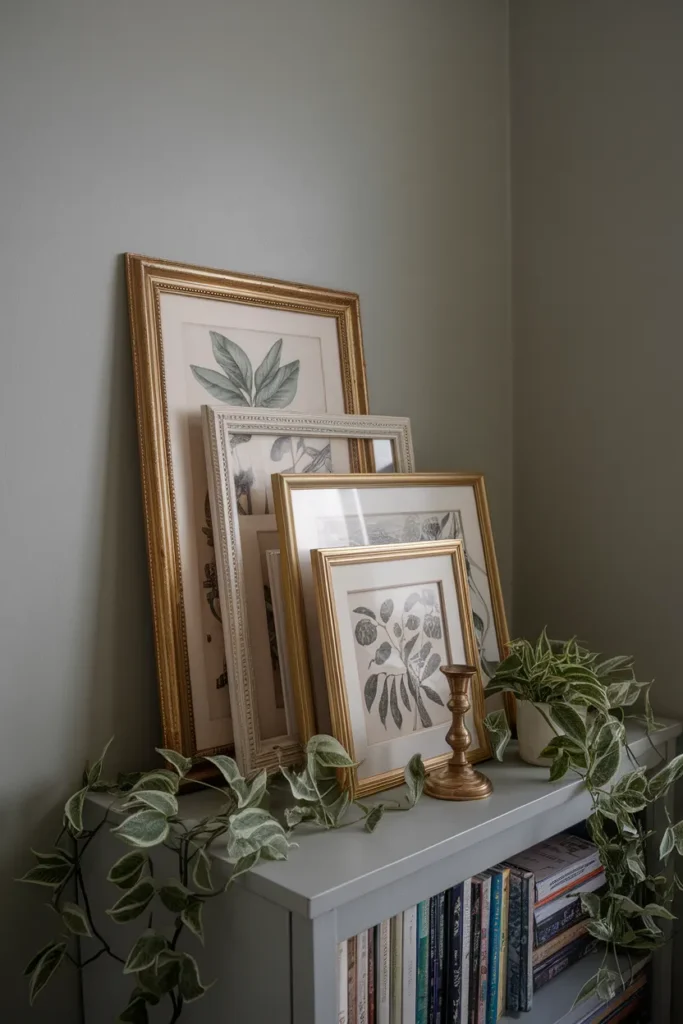
Renting with a no paint clause? Color still gets in through the side doors: sage curtains, a faded floral rug, cream matted botanical prints leaned on a shelf, and one panel of peel and stick wallpaper behind the sofa that comes down in an afternoon when you move.
Layer Textiles Like They Were Inherited
Layering has an order, and the order is what separates collected from cluttered. Floor first: a flat woven jute rug as the base, then a smaller faded floral or Persian style rug or runner on top, front sofa legs on, 8×10 under most full sized seating areas.
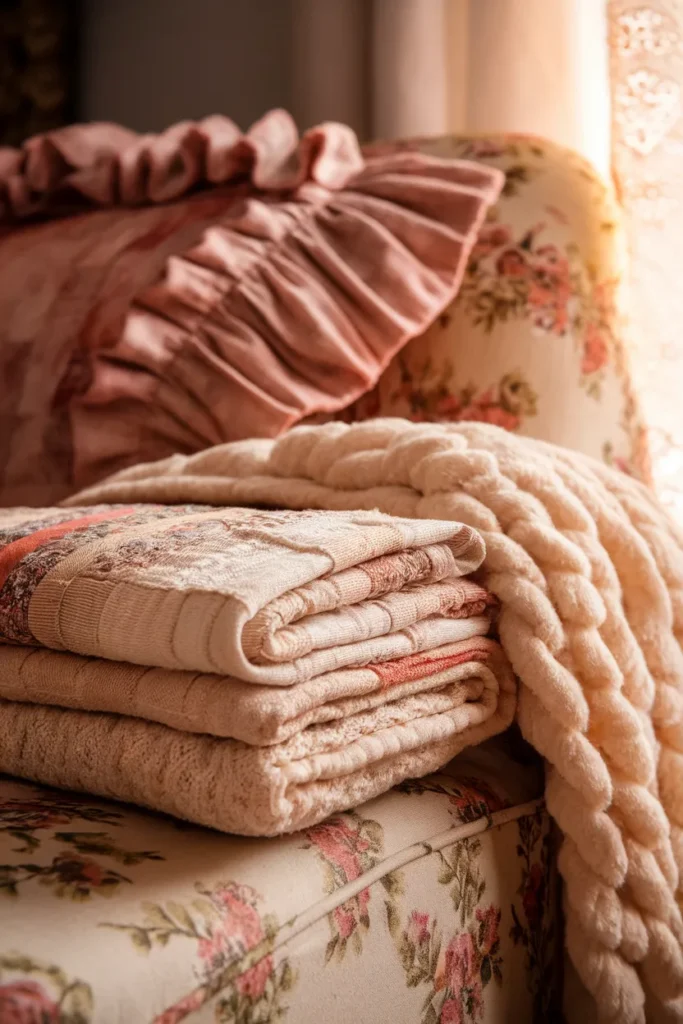
Seating second: a quilt folded in thirds over one sofa arm, a wool throw within reach, one ruffled lumbar pillow against the seat back. Edges last: sheer or cafe curtains that let light through, and a crocheted runner or doily under the side table lamp. Wool should feel a little scratchy and cotton should smell faintly of sunshine; that texture contrast is the whole trick.
Now the honest part about real heirlooms. Light is the enemy of old cloth. Cotton, linen, silk and wool all break down under sun and even indoor fixture light, which is why the Smithsonian’s antique textile storage advice keeps stored pieces dark and rolled rather than folded.
Translation for your living room: the true 1940s quilt gets the shaded arm away from the window, gets rotated monthly, and never lives draped in a sunbeam. Let a $25 secondhand quilt take the sunny seat and save the heirloom for winter. And if you share the room with a dog, a toddler, or red wine, make the top rug a washable one and thank yourself later.
Light It Like It’s 1948
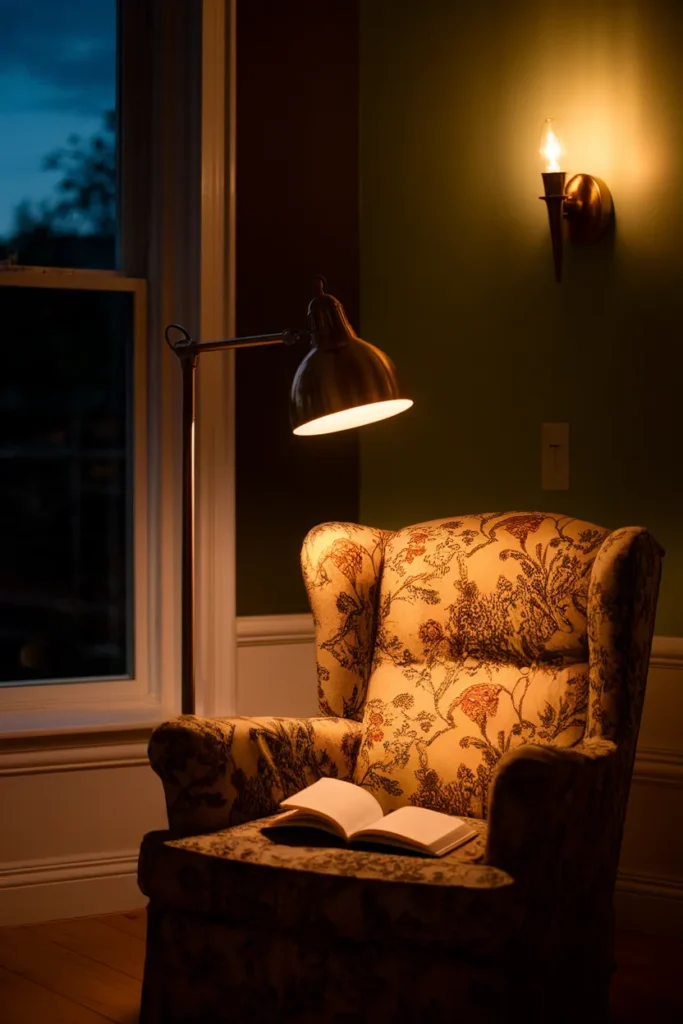
Turn the overhead light off and leave it off. A vintage cottagecore living room glows from three or more low points instead: a swing-arm lamp or floor lamp beside the main seat, a small lamp with a fabric or amber glass shade on the hutch, and a plug-in sconce on the wall, which needs zero hardwiring and zero landlord conversations. Screw warm 2700K bulbs into all of them; anything cooler turns your careful faded palette the color of a waiting room. A plug-in dimmer, usually $12 to $20, takes the evening from reading bright to firelight low with one dial.
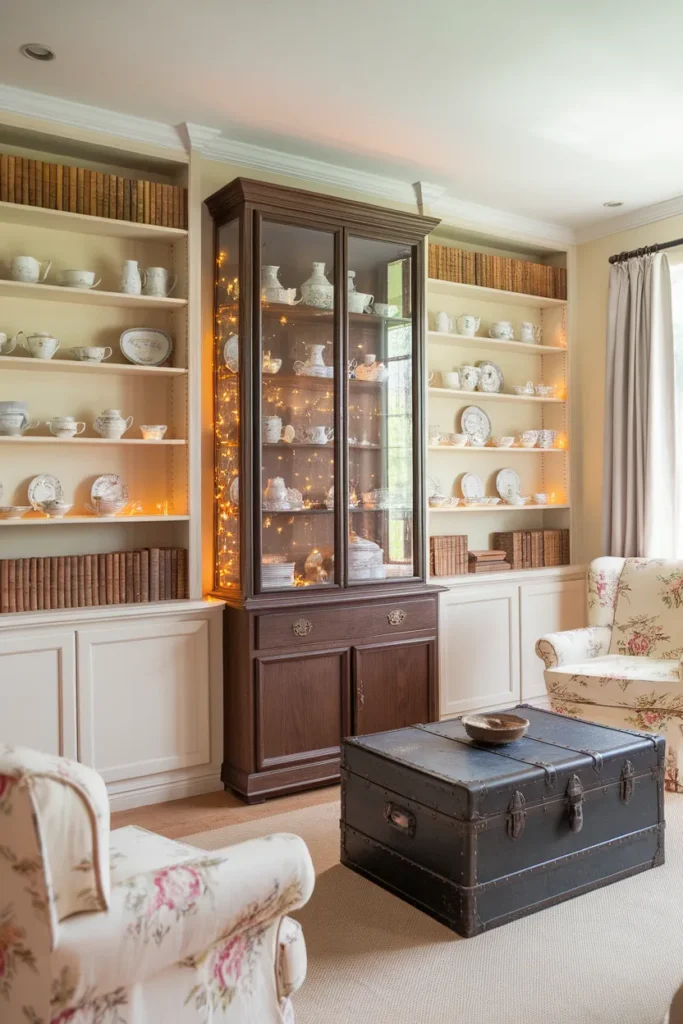
Small touches finish it. A short string of warm fairy lights inside a glass front cabinet reads like candlelight without the open flame. An oil lamp on the mantel earns its spot even unlit. The goal is pools of honeyed light with soft shadow between them, the kind of room where the loudest sound after nine is the click of the lamp switch and a page turning.
Carve Out the Reading Corner
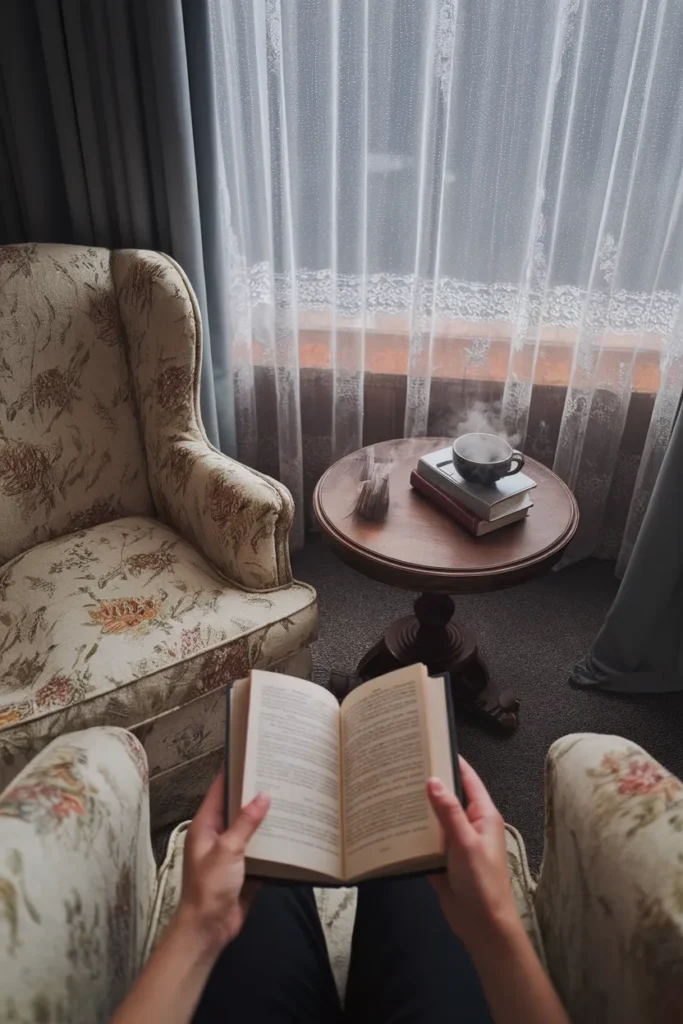
Every storybook living room hides a smaller room inside it, and that corner is the part you’ll actually use on a rainy day. The formula is four freestanding pieces, which makes it fully renter proof. Angle one armchair about 45 degrees toward the window instead of the TV. Park a side table within the 18 inch reach rule, close enough that a mug lands without your eyes leaving the page. Aim a swing-arm lamp over your book shoulder. Finish with an ottoman or a floor cushion for your feet and the TBR pile stacked spine out on the table.
Give the corner one boundary marker so it reads as its own zone: the edge of the top rug, a small bookcase set perpendicular to the wall, or the sconce glow itself. Then let it collect the good sensory clutter, rain on the glass, the radiator tick, that dusty vanilla smell old paperbacks give off as the lignin in their pages breaks down. This is where you curl up and the room stops being decor and starts being cozy. For deeper versions of this exact corner, from worn leather to lamp lit amber, these vintage reading nook ideas pick up where this section ends.
Three Antique Archetypes Worth Hunting First
If you only chase three pieces of antique living room decor this year, chase these, in this order.
The glass front hutch or barrister bookcase. One piece that stores books, displays china, and gives the fairy lights a home. Typical estate range: $100 to $350 depending on wood and condition. Failure mode: buying it before measuring your doorways and stairwell. Measure twice, cry never.
The trunk or blanket chest coffee table. Storage for throws inside, patina on top, and nearly indestructible under feet and mugs. Typical range: $60 to $200. Failure mode: skipping the open lid sniff. A musty interior will share that opinion with your blankets forever.
The spool leg or piecrust side table. The small sculptural piece that makes the reading corner look intentional. Typical range: $25 to $80. Failure mode: no wobble test. Press two fingers on the top edge and rock it; a wobble on the shop floor is a spilled tea at home.
Stagger the wood tones on purpose, honey oak next to walnut next to something painted, so the trio obeys the Three Era Rule on its own. To see how pieces like these get staged across whole rooms, wall by wall, these 18 cottagecore living room ideas show the full range from soft cream to storybook.
The $268 Weekend Corner (Every Price Listed)
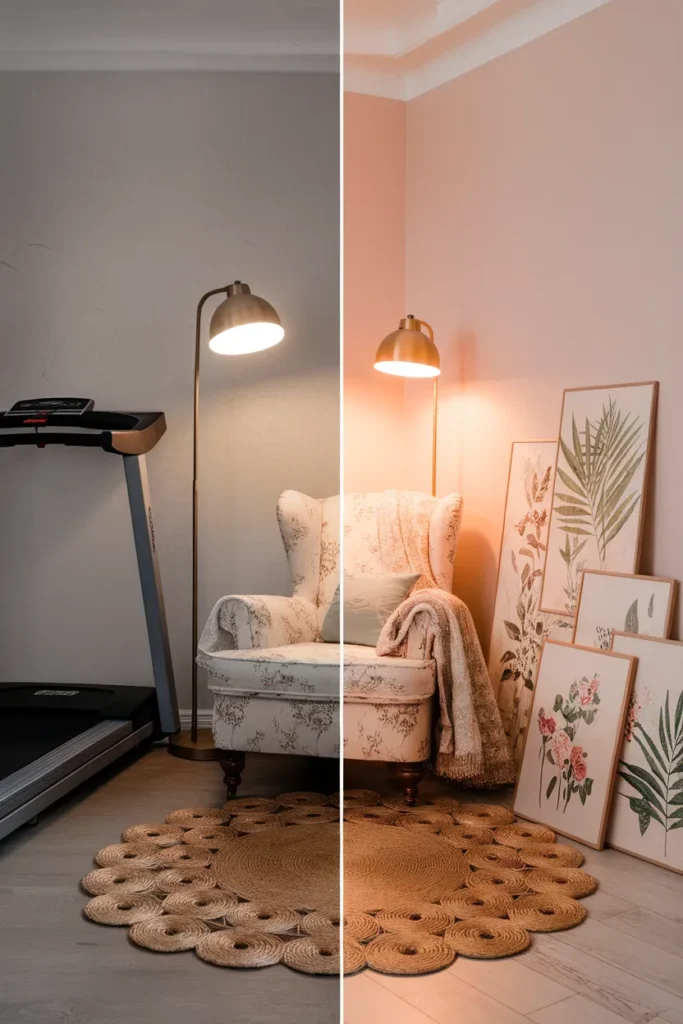
Affordable is a claim; a total is a plan. Here’s a full vintage cottagecore corner at typical current asking prices across Marketplace, thrift tier stores and estate tags (expect your town to wobble any line by $20 or so):
| Piece | Source | Typical price |
|---|---|---|
| Floral or slipcovered armchair | Thrift or estate sale | $60 |
| Wood side table | Thrift | $20 |
| Vintage brass or ceramic lamp | Estate sale | $18 |
| Two 2700K warm bulbs | Hardware store | $10 |
| Secondhand quilt or floral throw | Estate sale | $25 |
| Sheer or cafe curtain panels | Big box or secondhand | $20 |
| Thrifted frames + free public domain botanical prints | Thrift + print at home | $15 |
| 5×7 jute rug | New | $70 |
| Styling haul (hardcovers, candlesticks, oil lamp) | Estate sale, final day | $30 |
| Total | $268 |
Build in this order over one weekend: rug down, chair placed and angled, lamp beside it, table within reach, textiles layered, styling last. Nothing on the list requires a drill, a paintbrush, or a lease violation. The only way to blow the budget is skipping the checks from earlier: an armchair that fails the smell test is $60 you’ll pay twice.
FAQ
What makes a living room vintage cottagecore instead of just cottagecore?
The vintage part means true old pieces, not reproductions: real estate sale furniture, real quilts, real wear. Run it through the Three Era Rule above; if every piece was made in the last five years, it’s cottagecore styled, not vintage cottagecore.
Is cottagecore still in style in 2026?
Yes, and it’s deepening rather than fading. This year’s trend coverage points the look moodier: mossy greens, heavier history, grandma chic texture over bright white. Buying secondhand also means the room never depended on a trend cycle to begin with.
What colors work in a vintage cottagecore living room?
Chalky cream, faded light blue, soft gray and muted sage on the big surfaces, with deep green or dusty rose in small doses. The test: every color should look like it faded into that shade, not like it shipped that way.
What’s the difference between cottagecore and farmhouse style?
Farmhouse leans cleaner and matchier, with high contrast black, white and new looking wood. Cottagecore is layered, floral, slightly mismatched and collected over time. If the room could survive a magazine shoot untouched, it’s farmhouse; if it looks better with the quilt slightly crooked, it’s cottagecore.
How do I get the look on a small budget?
Start with the $268 corner table above and expand outward as pieces appear. Thrift and estate channels first, final day discounts always, and spend the biggest single line on the rug or the chair, the two things you touch daily.
Where should I buy vintage furniture in the US?
Estate sales for the best prices, Facebook Marketplace for volume, Goodwill and Habitat for Humanity ReStore for surprises, then eBay, Etsy and Chairish when you’re hunting something specific and can pay for shipping.
Bring It Home
Pick your first move tonight: the sofa hunt or the $268 corner. Either one turns the room in a single weekend, and both start with the same step, opening the estate sale listings for Saturday morning. Save the sizing table and the price list before you go, pin this so it’s in your pocket at the sale, and let the room grow one true old piece at a time. Slow-living rooms are built exactly that way: slowly, and on purpose.
Keep reading
More cozy nook ideas
 Living Room
Read →
Living Room
Read →
15 Modern Farmhouse Living Room Ideas for Small Apartments
Two rolls of peel-and-stick shiplap, a 5 by 8 jute rug, and one plug-in wall lamp. At listed US prices this month,…
 Living Room
Read →
Living Room
Read →
Cabin Living Room Checklist: Everything to Decide Before You Start
No log walls, no stone hearth, no lake outside the window. You can still build a cabin living room in a regular…
 Living Room
Read →
Living Room
Read →
How to Make a DIY Coffee Table That Feels Cozy, Not Cluttered
Most DIY coffee table plans hand you a cut list on line one. That is why so many finished tables end up…