
Small Home Library Ideas: Build One in a Hallway, Landing, or Spare Wall

You don’t need a dedicated room, a renovation budget, or a floor plan that came with a spare square footage. You need one wall. The right shelf depth. And an afternoon. That’s the entire brief for a small home library.
Most of what shows up when you search “home library ideas” assumes you have a whole room to give over. A wood-paneled study. A rolling ladder. A leather armchair with a price tag that rivals a car payment. That’s not what this is. This is the version for the person with a hallway that leads nowhere and 200 books in cardboard boxes. The version where a 4-foot landing wall becomes the most-used corner in your apartment.
These nine small home library ideas work in real spaces, for real readers, with TBR piles that have genuinely gotten out of hand. Each one has a real measurement, a product you can actually buy, and an honest note on what goes wrong when you skip a step.
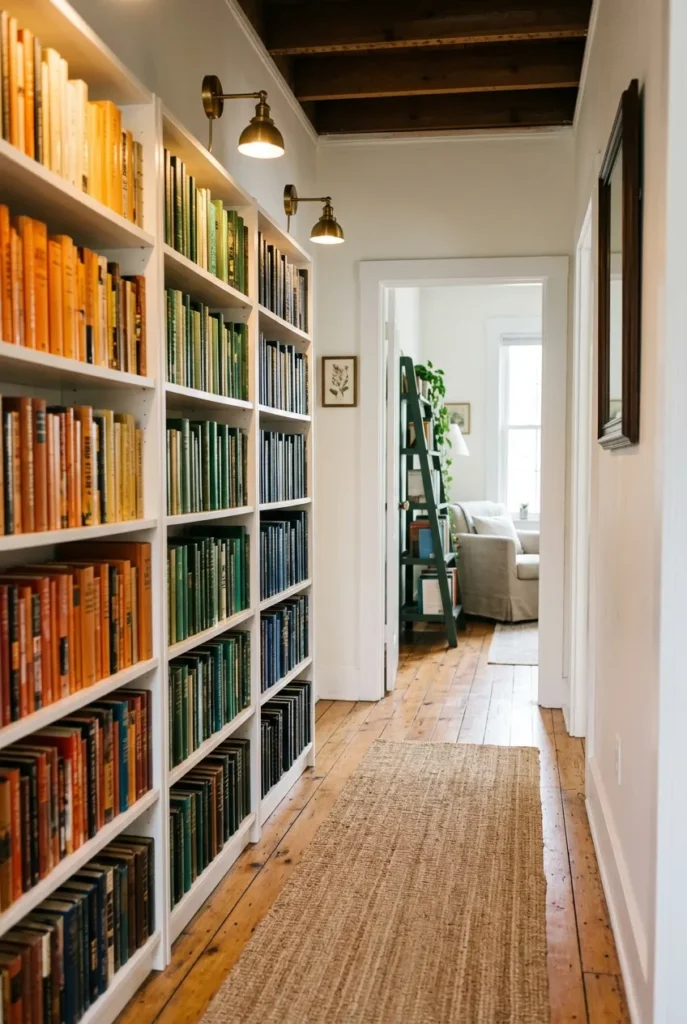
The Hallway Home Library: Books Where You Walk Past Them Every Day
Here’s the case for the hallway: you’re already there a dozen times a day. Every trip to the kitchen, the bathroom, the front door, you walk past those spines. You’re reminded of what you haven’t read. You reach for something on the way to the couch. That’s not accidental. That’s a library doing its job.
The critical measurement for a hallway library is shelf depth. Standard hallways in US homes run 36 to 42 inches wide. Your shelves must stay at 10 to 12 inches deep maximum so two people can pass without brushing the books. The IKEA Billy bookcase at its standard 11-inch depth sits right inside that limit. That is not a coincidence. I measured my own hallway after jamming in a 14-inch-deep unit and spent the next week watching my partner knock a paperback off the shelf every single morning on the way to the bathroom.
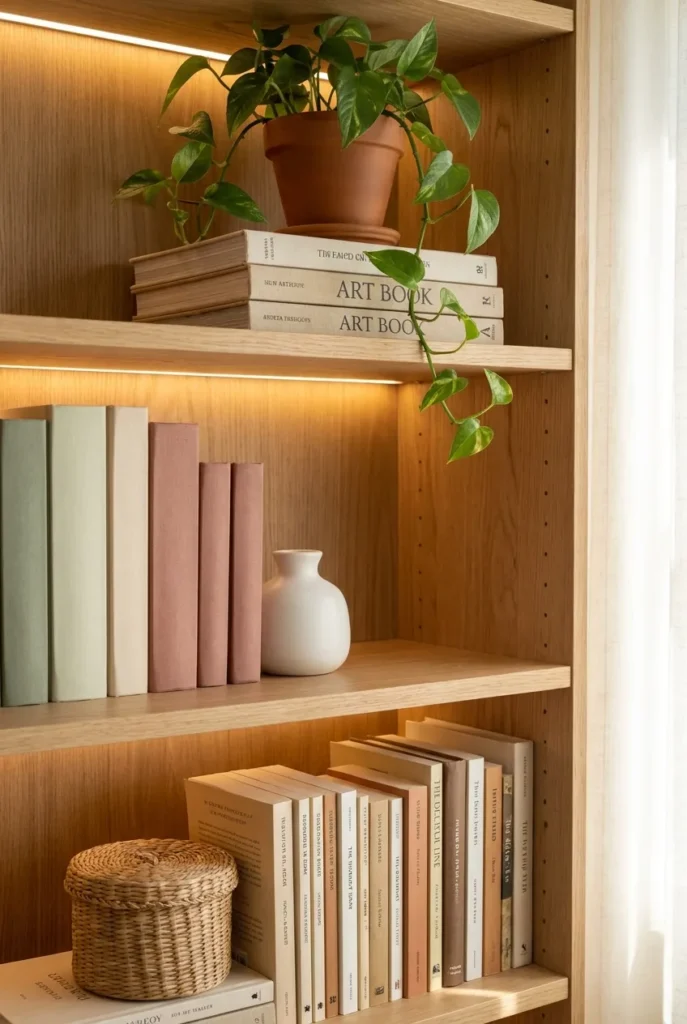
Line two or three Billy units end-to-end for a full gallery-hall effect. Paint them the same color as your walls and they read as built-in millwork rather than furniture. Keep the top shelf for display only: a small brass plug-in sconce (mounted to the unit’s side panel with a Command strip), a trailing pothos, a stack of oversized art books placed horizontally and spine-out.
The rule to remember here: never run shelves all the way to the front door. Leave at least 18 inches of clear wall at each end so the space reads as intentional rather than overstuffed.
Failure mode: buying bookcases with adjustable shelves and never adjusting them. Standard Billy shelf spacing is 11 inches. Most trade paperbacks are 8.5 inches tall and look lost on an 11-inch shelf with 2.5 inches of dead air above them. Spend 10 minutes regapping your shelves so books sit with about 1 inch of clearance above the spine. It looks completely different.
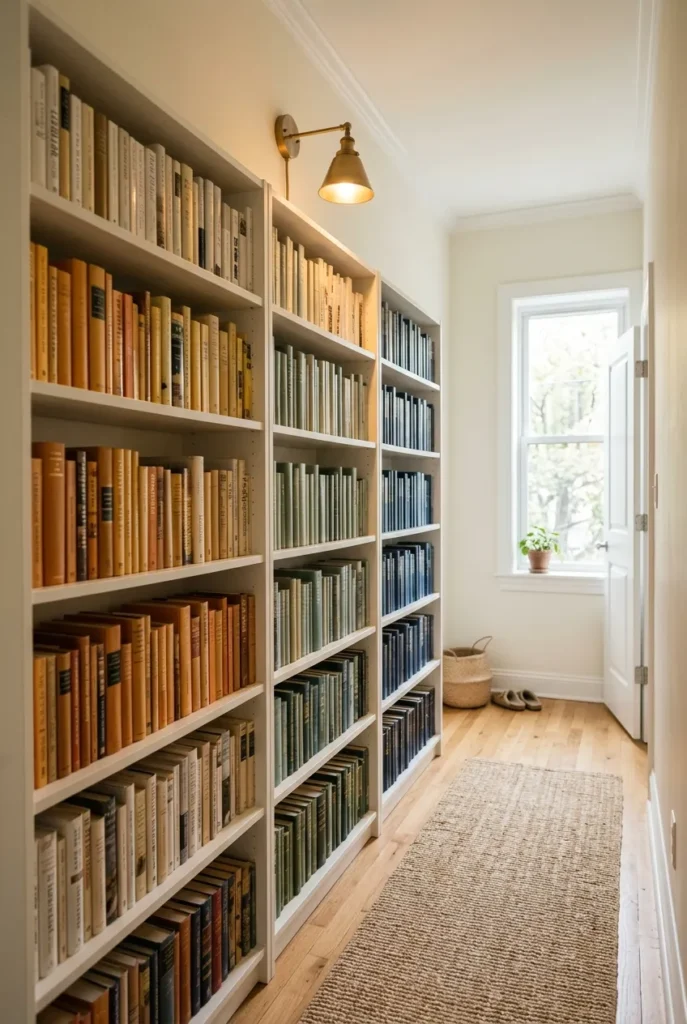
The Landing Library: Floor-to-Ceiling Shelves on a Spare 4 Feet of Wall
Landings are the forgotten real estate of any two-story home or apartment. The space between the top of the staircase and the first bedroom door is almost always wasted. A blank wall. Maybe a framed print from the previous tenant that nobody has touched since move-in day.
That wall is your library.
A standard US landing typically gives you 8 to 9 feet of ceiling height and anywhere from 3 to 8 feet of horizontal wall width. Floor-to-ceiling open shelving in that space holds between 200 and 400 books depending on configuration. For renters, use a freestanding five-tier ladder shelf for the top two rows instead of anchoring directly into the ceiling. A quality leaning bookcase, like the Threshold Windham five-shelf unit at Target (around $75 to $95 in 2025 and 2026), handles upper-reach storage without a single drill hole.
Arrange your most-reached books at eye level, roughly 54 to 66 inches off the floor. Use the high shelves for finished series, reference books, or anything you’re keeping for decoration more than re-reads. Paperback spines face out everywhere else. Hardcovers get the prime real estate.
The sensory detail about a landing library that nobody mentions: the smell. Old paperbacks release a faint vanilla and almond scent as the paper oxidizes, especially on warm afternoons. Catching that smell at the top of your stairs every morning is a very specific and very good thing.
Failure mode: leaving the top two shelves empty while you “build your collection.” Empty shelves on a landing feel abandoned. Fill them from Day 1 with stacked horizontals, small plants, or wicker baskets. The look is intentional either way. The empty look is not.
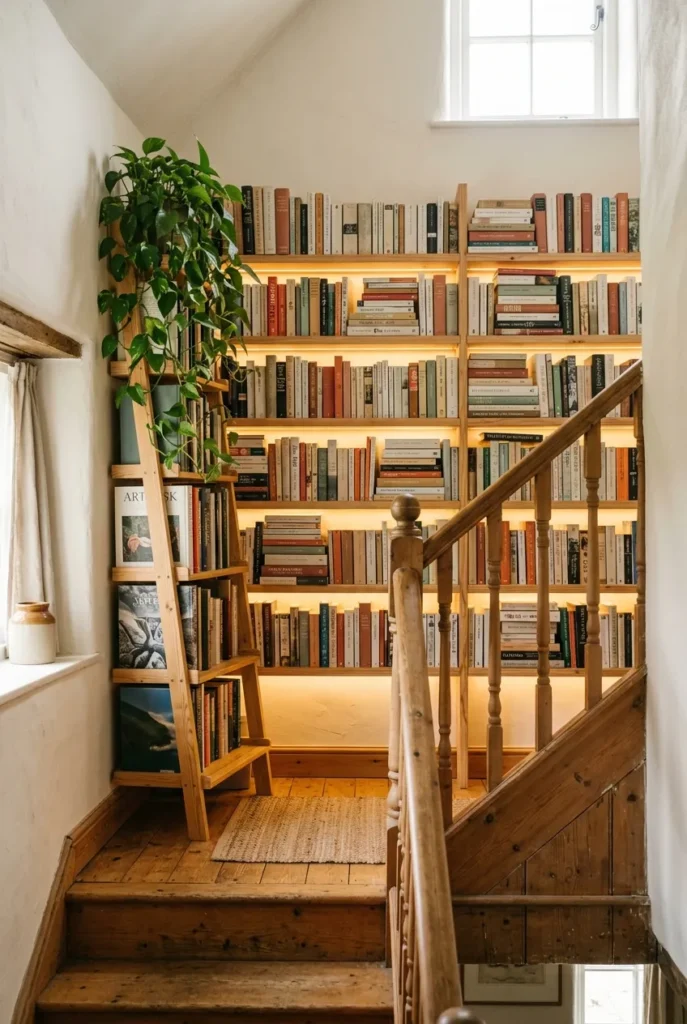
The Spare Wall Library: One Flat Wall, Two Hours, 300 Books
You have a wall somewhere in your home. Living room. Bedroom. The end of a corridor. It probably has a sad piece of art on it that you stopped actually seeing about three months after you moved in. That wall is your simplest path to a small home library.
The spare wall approach is commitment-light. No built-ins. No major purchases. A set of freestanding bookcases placed side by side, anchored with a single anti-tip strap per unit (which passes through one small screw hole that most landlords won’t even flag), creates a full bookcase wall in a Saturday afternoon.
For renters specifically: two IKEA Billy bookcases (79 inches tall, 31.5 inches wide each) placed side by side give you 63 inches of reading wall. Add the Billy extension unit (13.5 inches tall, sold separately for $20 per piece) on top of each for a combined height of about 93 inches. That stops 3 to 4 inches short of a standard 8-foot ceiling. Close enough to read as floor-to-ceiling. Far enough to stay freestanding and safe.
If you want to extend the wall into a full seating setup with a daybed tucked between two units, the billy bookcase daybed reading nook build guide covers the exact dimensions and sequence to make that work without a contractor.
One plug-in brass picture light mounted on the wall above the top row of books adds that genuine amber library glow. Globe Electric and Poseur Lighting both make plug-in picture lights for $35 to $65 that need zero hardwiring. Just a cord routed along the top of the unit and down the side to the nearest outlet.
Failure mode: buying cheap particleboard shelves and loading them with hardcovers. For any shelf holding more than 20 average books, you need at least 0.75-inch-thick shelving material. The Billy manages with 0.63-inch panels because of its internal box structure. Budget alternatives thinner than that will bow noticeably within six months under hardcover weight.
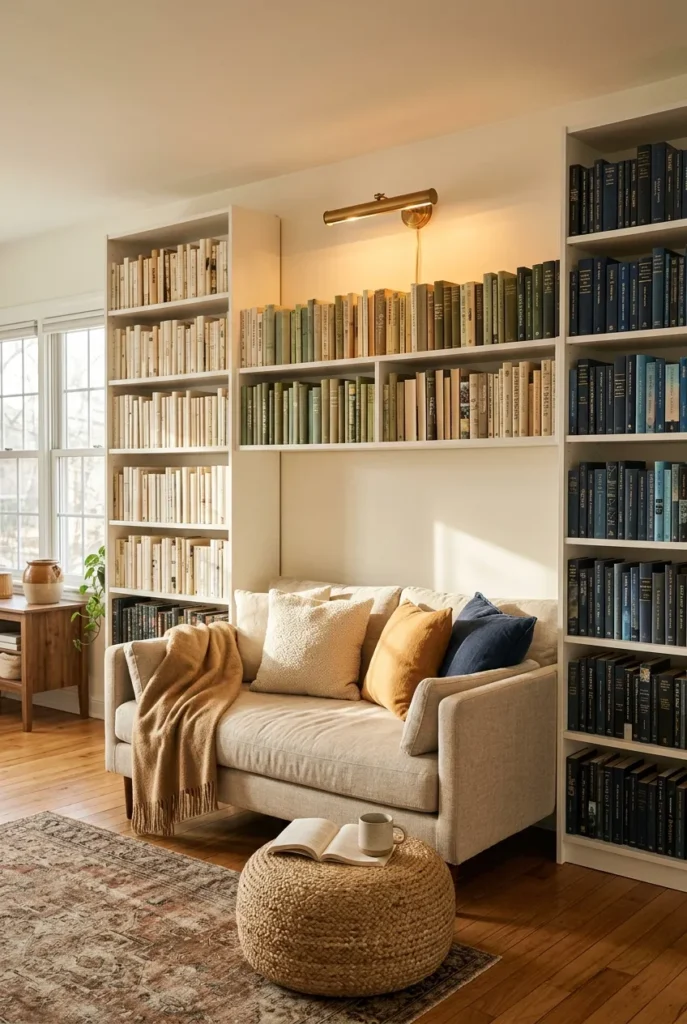
The Billy Bookcase Grid: No-Carpenter Built-In Look in a Weekend
If you want the look of a custom built-in library at roughly 10 to 15 percent of the cost, the Billy grid is your method. This is not a new idea. But most tutorials overcomplicate it, so here is the stripped-down version.
Buy three IKEA Billy units (each 31.5 inches wide) and place them side by side for a combined width of about 94 inches. Add the Billy height extension on top of each for floor-to-almost-ceiling coverage. Fill the gaps between the units and the side walls with quarter-round molding from Home Depot ($3 to $4 per 8-foot length). Paint the units, the molding, and the 2-inch wall sections between units all the same color in semi-gloss. Every seam disappears.
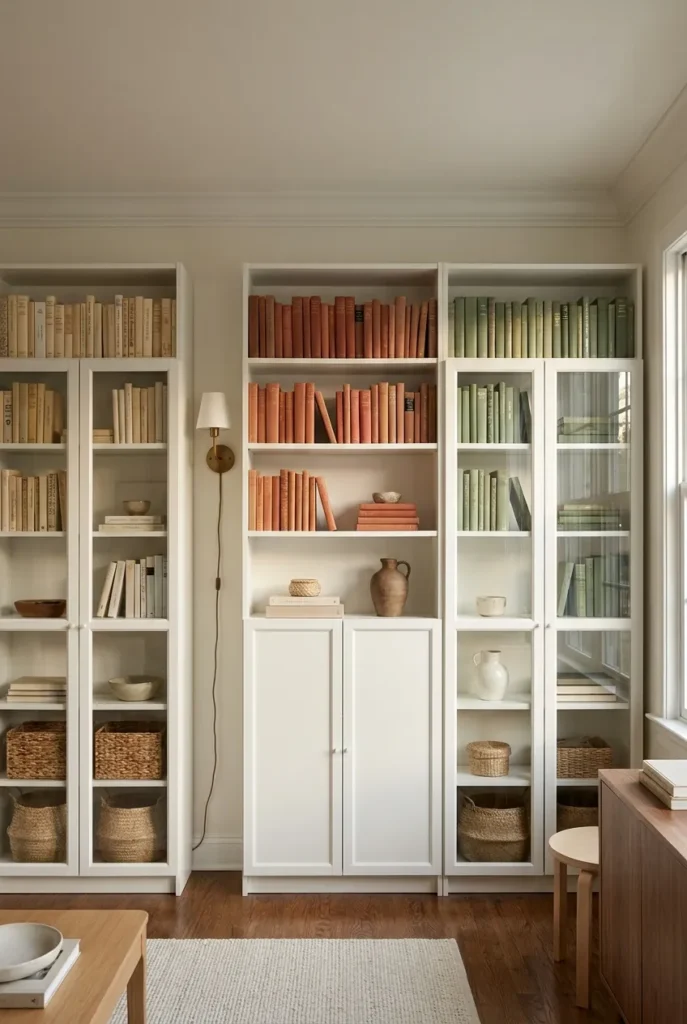
For a genuinely built-in result, run a simple crown molding shelf across the full top of all three units. The IKEA OXBERG glass-front doors (Billy-compatible, around $40 per pair) on the lower shelves of the outer two units give you closed storage for the books you want protected or hidden. Upper shelves stay open for display.
For nine variations on the no-carpenter bookcase wall approach, including the corner-return and the full alcove-fill, the no-carpenter bookcase wall builds for small spaces guide breaks down the sequencing with real measurements.
The full dimension spec for the Billy bookcase (31.5 x 11 x 79.5 inches) plus the complete list of compatible accessories are on the IKEA US Billy series page so you can plan your grid before buying.
Failure mode: not accounting for baseboard height. Billy units sit flat on the floor, which means your baseboard either gets removed (fine if you own) or the back of the unit needs to be scribed to sit over it. Skip this step and the unit rocks forward by half an inch. That half-inch matters when you have 300 books on the shelf above your head.
Corner Bookshelves for the Awkward Angle Nobody Knows What to Do With
Every apartment has at least one dead corner. Two walls meet at 90 degrees and there is nothing there. A suitcase from last spring. A floor lamp from a previous apartment that no longer matches anything. A corner bookshelf converts that exact space into 60 to 80 books of organized storage plus a reading seat.
The L-shaped shelving approach uses two narrow units (each 9 to 10 inches deep) angled into the corner. For the cleanest result, a triangular corner shelf bridge at the back fills the actual corner joint so no book face is turned sideways and nothing falls behind the unit. The IKEA KALLAX 2×2 unit works well in this configuration: two boxes placed at 90 degrees in a corner, each acting as a low-profile bookcase and surface. For taller coverage, the Prepac Elite Corner Bookcase (around $140 to $180) is purpose-built for this.
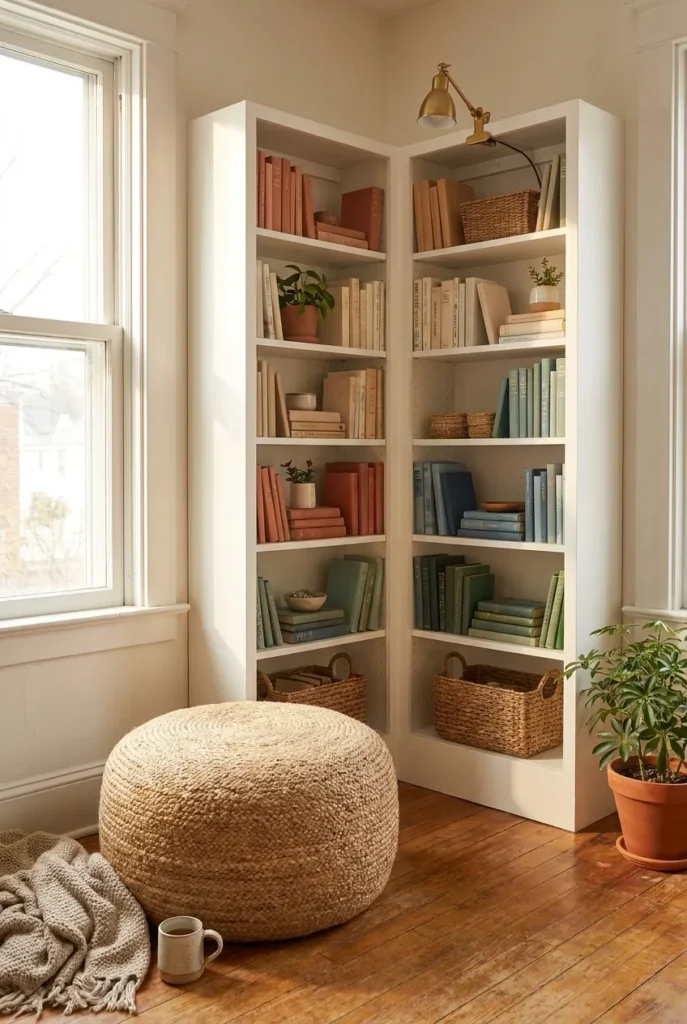
Drop a round floor cushion or a 24-inch diameter jute pouf in front of the corner unit at ottoman height (17 to 18 inches off the floor). That footprint fits neatly without blocking either wing of the L. You now have a seating area and a library in the one corner of your home that was previously contributing nothing.
Truth about corner reading setups: the reading angle is actually better than a wall-facing chair. Your back is to the corner. Both walls are peripheral. You face the room. It feels surprisingly secure. Like a high-backed chair in a restaurant where you can see the whole room from your seat.
Failure mode: corner shelves that jut too far into the room. Keep total corner depth at 18 inches maximum, so 9 inches per unit from each wall. Go deeper and you’re ducking around the unit every time you cross the room. A corner is not an alcove. The depth limit matters.
Floating Shelf Rows: The Renter Option That Actually Holds Real Books
Some apartments are not bookcase-friendly. Plaster walls over old lath. Landlords who photograph every wall at move-out with the energy of a crime scene investigator. For this situation, floating shelves above a low piece of furniture are the answer.
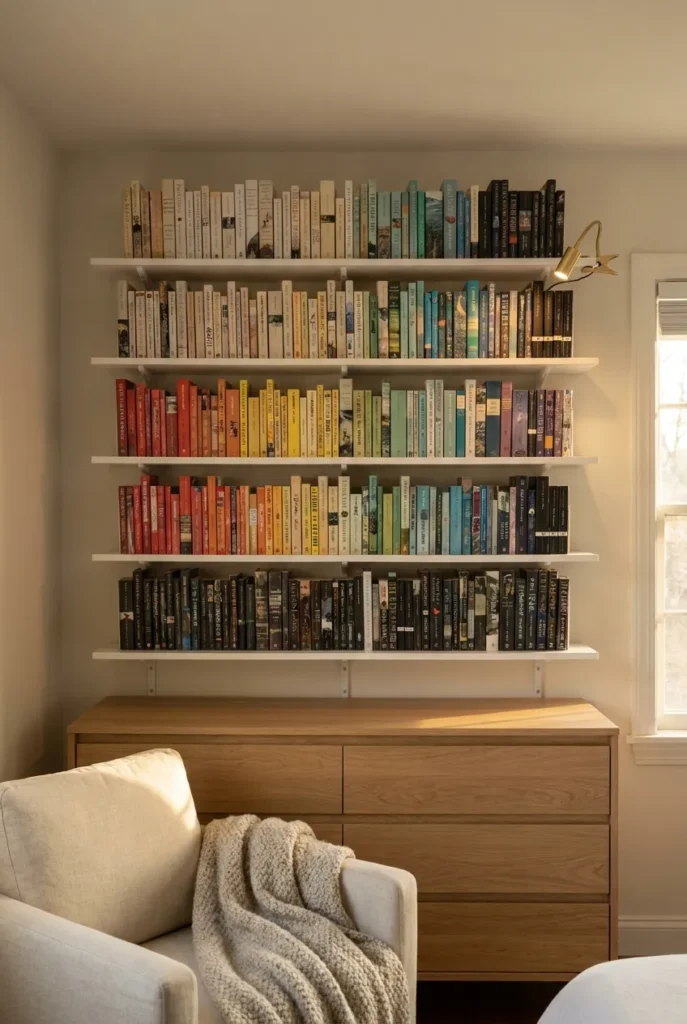
The setup is straightforward: a low dresser, console table, or sideboard against a wall. Above it, three to five rows of floating shelves spaced 10 to 12 inches apart, anchored into studs or with heavy-duty toggle bolts rated for at least 50 pounds each. The furniture catches your eye-level current reads and most-grabbed books. The floating rows above handle the archive.
Here is where most people get this wrong: they use cheap bracket-mount floating shelves and load them with hardcovers. After six months, the bracket pulls slightly forward and the shelf develops a 3-degree tilt. Every book starts migrating toward the edge in slow motion. Use solid-wood floating shelves on concealed hardware (French cleat or steel-rod-into-shelf-body design). These do not tip. They also hold 30 to 50 pounds per shelf, which covers a full row of mixed hardcovers and paperbacks.
For a completely no-drill version: use a leaning bookcase against the wall. The Threshold Windham five-shelf leaning bookcase at Target runs $75 to $95 and leans by gravity. No anchor required. Keep it away from doors that could knock it. Add a linen throw draped over the top shelf edge and a lumbar pillow on the floor below and the whole setup reads as intentional rather than temporary.
Failure mode: shelf spacing that is too tight. Books that are 8 to 9 inches tall (standard paperback) need 10 inches of vertical clearance per row. Go smaller and you are forcing books in sideways or leaving every other row empty. Measure before you mount. This is the most common floating shelf mistake I see.
The Dark Academia Home Library: Moody Shelves That Actually Feel Warm
Not every small home library has to be white shelves and pale wood. The dark academia version is just as achievable in a small space, and it often reads better in tight rooms. Dark paint absorbs visual noise. It makes a narrow hallway or a short spare wall feel intentional rather than cramped.
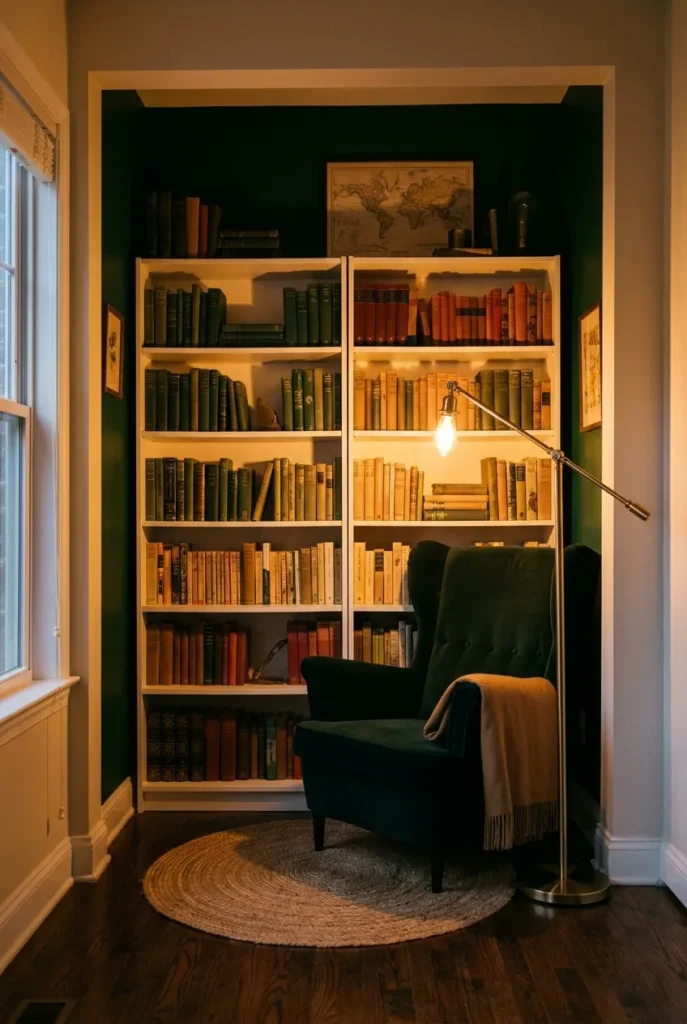
The method: paint the wall behind your bookcase a deep color. Forest green, navy, charcoal, oxblood. The bookcase itself stays white or ivory, which creates contrast and lets book spines pop against the dark field. Or go monolithic: match the shelves to the wall and let the books be the only variation in tone. Both work. The monolithic version photographs especially well.
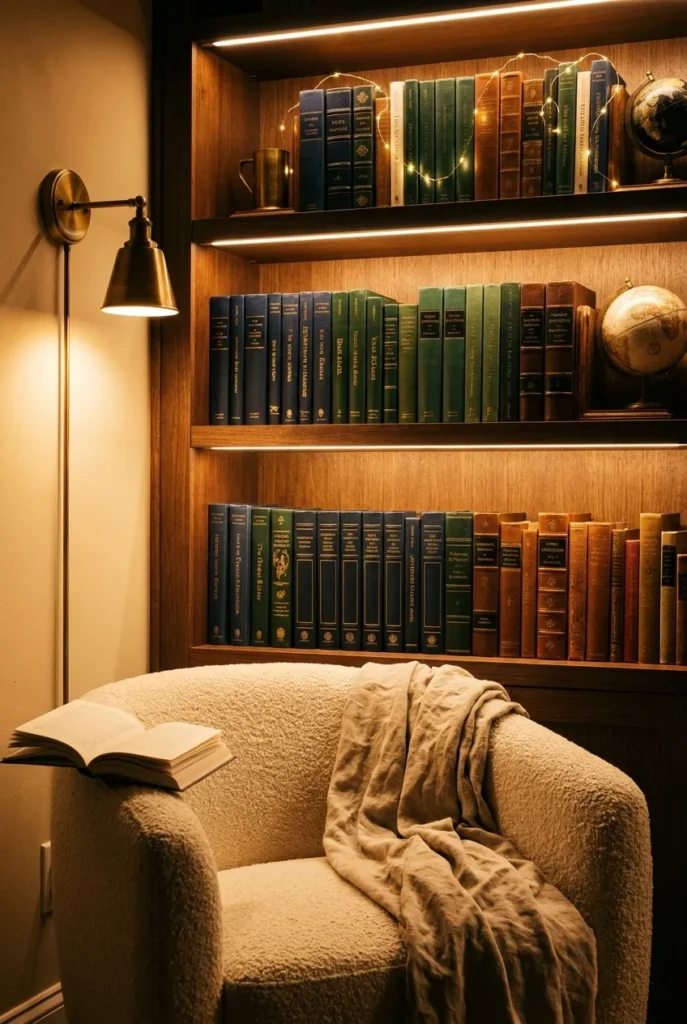
Add a swing-arm floor lamp in aged brass positioned to one side of an accent chair. Use a 2700K warm white bulb at 800 lumens. That specific combination makes a home library corner feel like a Victorian reading room rather than a dental office. The difference between 2700K and 4000K in a moody room is not subtle. It’s the difference between amber candlelight and a fluorescent tube.
The texture layer: a lumbar pillow in dark velvet on the chair seat, a wool throw in camel or hunter green over the armrest, a sheepskin at your feet. These are not decorative choices. They change how long you sit there. A chair without texture holds you for 20 minutes. Add a wool throw and you’re there for two hours.
For the full dark-wall treatment including step-by-step shelf arrangement in low light and lamp placement that keeps the room readable after dark, the dark academia reading nook with warm layered lighting guide covers the whole setup.
Failure mode: going dark on all four walls in a room smaller than 120 square feet with no natural light. One dark accent wall behind the shelves is sophisticated. Four dark walls in a windowless small room without compensation is a sensory box. Paint one wall. Keep the ceiling and the opposite wall light.
Small Home Library Lighting Without Hardwiring a Single Fixture
Lighting is where most small home libraries fall apart. Not because of bad shelves or wrong furniture. Because of the overhead ceiling fixture that was already in the room before you moved in. A 4000K daylight bulb in a flat white ceiling dome makes a library feel like a break room no matter how good your bookcase is.
The fix is three layers of plug-in and battery light. None of it requires an electrician or a landlord’s permission.
Layer 1: Shelf glow. LED strip lights or LED puck lights (warm white, 2700K only, not “daylight” or “cool white”) mounted on the underside of each shelf edge illuminate book spines from below. A 6-foot adhesive LED strip costs $12 to $18 at Target or Amazon. The effect is dramatically out of proportion to the cost. Every book looks like it belongs in a private library.
Layer 2: Task light. A plug-in wall sconce with a 5-foot cord draping behind the bookcase to a nearby outlet gives you the reading lamp look without any wiring. West Elm, CB2, and Rejuvenation all sell plug-in sconces in brass or matte black starting at $65 to $95. The shade should direct light downward toward your reading chair, not outward into the room. A downward-facing shade means the light lands where your book is, not where your neighbor can see it from across the room.
Layer 3: Ambient fairy lights. Warm white copper-wire fairy lights tucked along the top shelf edge, routed behind a row of books, add the candlelit softness that turns a bookcase into a sanctuary. Use copper wire specifically because it bends around curved shelf edges without kinking or breaking the LED contact points. Cool white fairy lights ruin this effect entirely. Buy warm white (2700K) or don’t bother.
According to the U.S. Department of Energy, LEDs use roughly 75 percent less energy than equivalent incandescent bulbs and last about 25 times longer. For a library corner you use several hours every evening, that adds up meaningfully. The DOE LED lighting resource has a full breakdown by bulb type if you want to calculate your actual annual savings.
Failure mode: mixing color temperatures in the same space. A 2700K plug-in sconce next to a 4000K ceiling light creates a color clash your eye registers as “something feels wrong” without knowing why. Buy all your light sources from the same Kelvin rating. 2700K throughout. No exceptions.
How to Style Small Home Library Shelves So They Look Curated
Here is the honest thing about real-reader bookshelves that no interior magazine will tell you: most of them look chaotic because they are. Books accumulate faster than organization keeps up. The goal is not to make your shelves look like a photo shoot. It is to make them look intentional enough that the chaos reads as curated.
Three rules that actually work for small home library shelves, in order of impact.
Rule 1: The one-third rule. Keep roughly one-third of every shelf clear of standing vertical books. Use that space for a horizontal stack of three books with a small plant on top, a single ceramic object, or just breathing room. A shelf packed spine-to-spine from left edge to right edge looks like storage. A shelf with one moment of pause reads like a collection.
Rule 2: Vary the height rhythm. Line up five short paperbacks, then one tall hardcover, then three mediums. Your eye moves across the shelf in a wave instead of getting stuck on a flat line. I started doing this after staring at a shelf I’d arranged three different ways that still looked flat. The height rhythm fix took four minutes and fixed it entirely.
Rule 3: Anchor one end. The left end of every shelf needs something that grounds the row: a bookend, a horizontal stack of three books with a small object on top, or a slightly oversized item that gives the row a starting weight. Without an anchor, a row of vertical books looks like it could slide left at any moment. Because it can.
The framework below is based on about two dozen shelf setups over the past few years. Print it, screenshot it, or just pull it up when you’re standing in front of an empty shelf wondering where anything goes.
The Small Home Library Shelf Styling Matrix
| Shelf position | Primary function | Styling approach | Concrete example |
|---|---|---|---|
| Top shelf (above eye level) | Archive and display | 1 horizontal stack plus 1 plant | 3 art books stacked plus trailing pothos |
| Eye-level shelf | Current reads | Vertical books with one deliberate gap | Bookend on left plus small reading candle in gap |
| Mid shelf | Organized by subject or series | Mix of vertical and one horizontal stack | 5-3-1 height rhythm across the row |
| Lower mid shelf | Overflow and doubles | Horizontal stacks only | Color-coordinated by spine hue |
| Bottom shelf | Heavy reference and storage | Mostly baskets with one tall book | Wicker basket plus oversized atlas upright |
This works in a single Billy unit, a three-wide bookcase grid, or a floating shelf row above a dresser. The positions and ratios scale to any width.
Failure mode: over-organizing on Day 1 and then giving up by Month 2. Start loose. Put your books out. Then spend 20 minutes doing just the eye-level shelf. Do the rest shelf by shelf over a few weeks. A shelf that is 70 percent organized and being actively read is better than a shelf that was perfect for one day and hasn’t been touched since.
Small Home Library Ideas FAQs
How do you arrange a small home library?
Start with your heaviest and largest books on the lowest shelves where they stabilize the unit. Work up by size, series, or subject. Keep your most-reached books at eye level, roughly 54 to 66 inches off the floor. Leave one-third of each shelf for breathing room, a small plant, or an object. Arrange by spine color if you don’t have a strict subject system. A color-coded shelf is visually cohesive and far easier to maintain than a rigid alphabetical organization system most readers quietly abandon by month two.
How do you create a library in a small space?
Pick your location first: hallway, landing, corner, or a single spare wall. Measure the wall width and ceiling height. Buy shelving that reaches as close to your ceiling as possible without pressure-fitting (leave 2 to 3 inches of clearance at the top). Add one layer of warm lighting, specifically 2700K, not daylight. Add one comfortable seat within arm’s reach of the shelves, even if it’s just a large floor cushion. Those four elements are a library.
How do you build a tiny home library?
The quickest no-skill build: one IKEA Billy bookcase (79.5 inches tall, 31.5 inches wide, $69 to $129 depending on finish), one plug-in picture light mounted above it on the wall, one accent chair or floor cushion beside it. Total cost: $100 to $260. Total time: one Saturday afternoon. That is a library.
What should a home library have?
Four things at minimum: books you actually read (not a display collection you’ve never opened), adequate lighting for reading without eye strain (800 lumens at 2700K), one comfortable seat within reach of the shelves, and a surface for your drink. Everything else is a bonus you add later.
How can I make a home library affordably?
Two IKEA Billy bookcases side by side run $138 to $258 total depending on finish. Add a leaning ladder shelf for the upper wall for $75 to $95, a plug-in picture light for $35 to $65, and a floor cushion for $30 to $60. Total for a full wall library setup: $278 to $478. That range sits inside most primary readers’ $80 to $400 budgets if you phase the purchases over a few weeks.
Can I build a home library in a rented apartment?
Yes. Use freestanding bookcases anchored with one anti-tip strap per unit. Most anti-tip straps pass through a single screw hole that nearly all landlords accept as normal wall use. Use plug-in picture lights and plug-in sconces instead of hardwired fixtures. Use adhesive LED strips on shelf undersides with removable Command adhesive backing. The full setup can be installed in an afternoon and undone in under two hours at move-out.
How deep should home library shelves be?
For hallways and narrow spaces: 10 to 12 inches maximum. Standard paperbacks are 6.75 inches deep and hardcovers run up to 9 inches deep. Oversized art books and coffee table books reach 11 to 12 inches. Anything deeper than 12 inches in a passable hallway will feel tight to walk past and will collect things that don’t belong there (mail, chargers, one sneaker).
Conclusion
A small home library does not start with a room. It starts with one wall, one shelf, and one decision. Build the hallway version first. Or the landing. Or the corner. Get comfortable with your books being out and visible and part of your daily movement through the apartment. The lighting layer comes next. Then the second bookcase. Then the chair. They always come in that order, one Saturday at a time.
If you’re reading this near a blank wall and a stack of books you keep moving from floor to floor, that is your starting point. The library is already there. It just needs the shelves around it.
Which location are you working with? Drop a question or show me your corner on Pinterest. I’m there most days and I read every single one.
Keep reading
More cozy nook ideas
 Small Spaces
Read →
Small Spaces
Read →
10 Small Reading Nook Ideas for Adults
One high-back chair, one clamp-on lamp, one $19.99 tray table. At IKEA US prices this month, that’s a full reading corner for…
 Home Library & Bookshelves
Read →
Home Library & Bookshelves
Read →
14 Ideas for a Fireplace with Bookshelves on Each Side on a Budget
Two bookcases, two plug-in lamps, two wall straps. At IKEA US list prices this month, that adds up to $237.98 before tax,…
 Study & Craft Nooks
Read →
Study & Craft Nooks
Read →
16 Kids Homework Station Ideas Little Ones Will Love
Two IKEA pieces, one empty corner, $109.98 before tax. That’s the first kids homework station on this list, and it fits in…