
Small Apartment Decor Ideas: Smart Style for Tiny Homes

Your place is 600 square feet and every small apartment decor idea you have saved so far assumes a bay window, a garage full of tools, and a landlord who shrugs at drilling. Here is the version that works in a real rental. Three pieces, one corner, under $300 at today’s prices, finished in a weekend.
We are going to fix one corner completely before touching anything else. That sounds backwards. It is the fastest way to make a small place stop feeling temporary, and by the end of this you will know exactly what to buy first, what it costs, and which step wrecks a security deposit if you skip it.
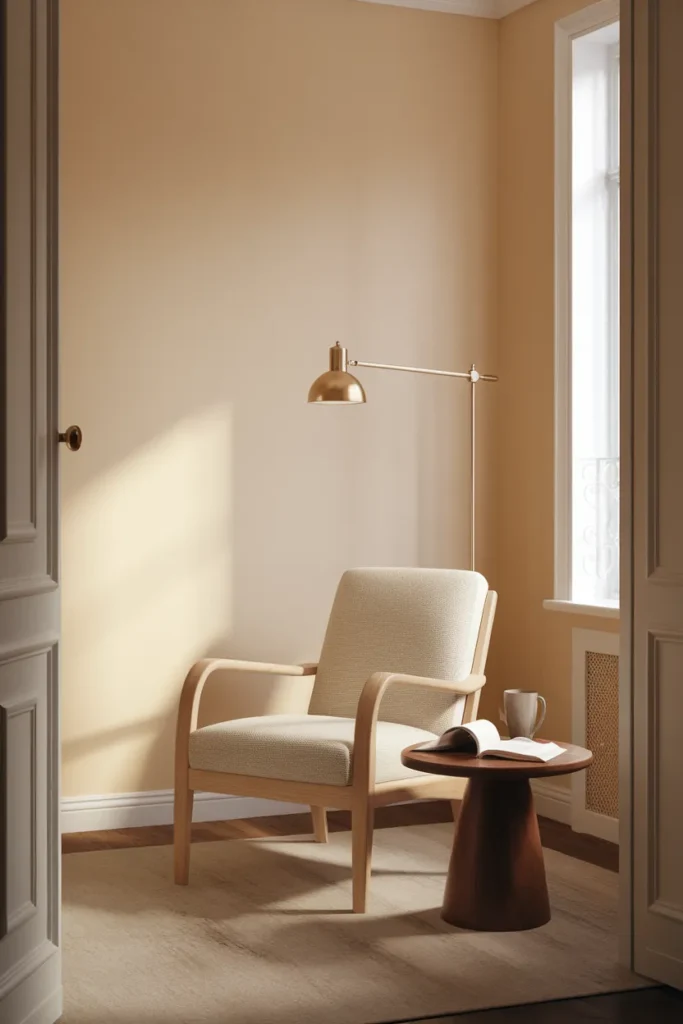
Start With One Corner, Not the Whole Apartment
Here is the mistake almost everyone makes in a small place. You spread $400 across five rooms, buy a little art here and a little basket there, and end up with an apartment that looks equally half-done everywhere.
Flip it. Pick the one corner you actually sit in, and finish that corner properly. A single complete corner reads as intention. Five half-finished rooms read as a place you are about to move out of.
The order matters more than the budget. Buy the seat first, the light second, the surface third. Anything else is decoration you add once those three are locked.
The One-Corner Build Order
| Order | What you buy | Real example and price (checked July 2026) | Why it goes in this slot |
|---|---|---|---|
| 1 | The seat | IKEA POÄNG armchair, birch veneer, $149.00 | Nothing else matters if there is nowhere good to sit. A corner without a seat is a display. |
| 2 | The light | Plug-in wall sconce or swing-arm lamp with a 2700K bulb, typically $30 to $70 | Light is what makes a corner read as its own room instead of leftover floor. |
| 3 | The surface | Any side table 22 to 26 inches tall, typically $25 to $60 | Mug, phone, book. Without a surface you stand up every ten minutes and the corner stops getting used. |
Real total: roughly $204 to $279. That is the whole corner. Not “affordable,” not “budget-friendly.” An actual number you can compare against your actual bank balance.
Everything after those three is optional: a lumbar pillow, a wool throw over the arm, a small jute rug to define the footprint. Optional means optional. The corner works at $204.
If you want the full catalog of corner setups sized for tight rooms, our reading nook ideas for small spaces collection breaks them down by square footage, including hallway and closet builds.
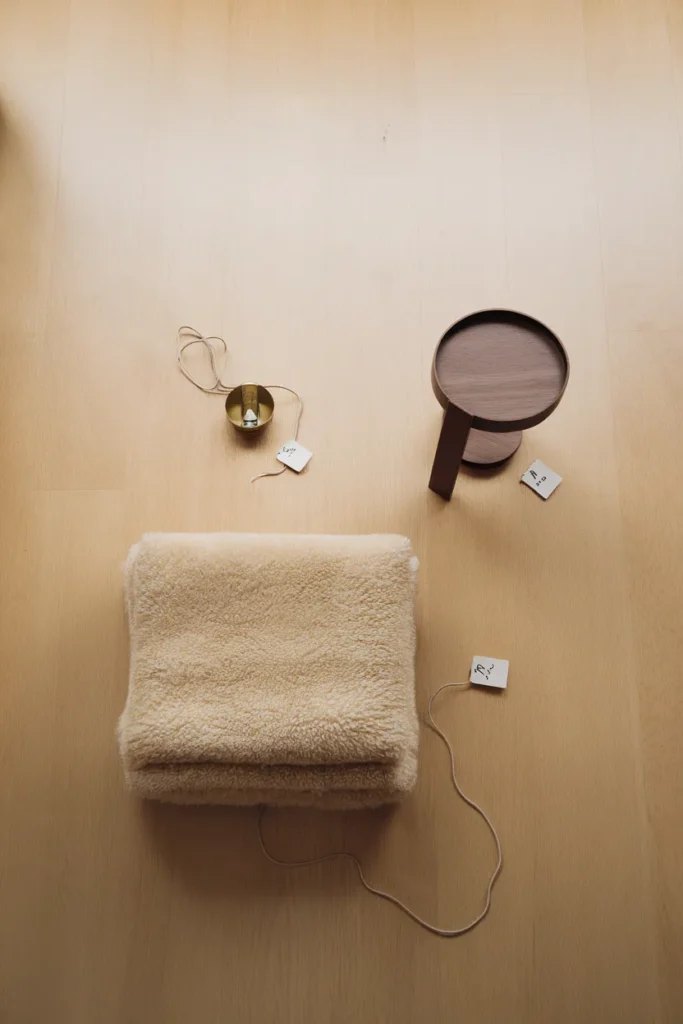
Measure Your Real Square Footage Before You Buy Anything
The average American apartment is 908 square feet, and the average studio is just 457 square feet, according to RentCafe’s national size data. If you live in a studio, you have roughly a 20 by 22 foot box, minus the bathroom, minus the kitchen wall, minus the swing of your front door.
That number changes how you shop. A chair listing that says “compact” means nothing. A chair that is 26¾ inches wide means something.
The 36-Inch Chair Rule
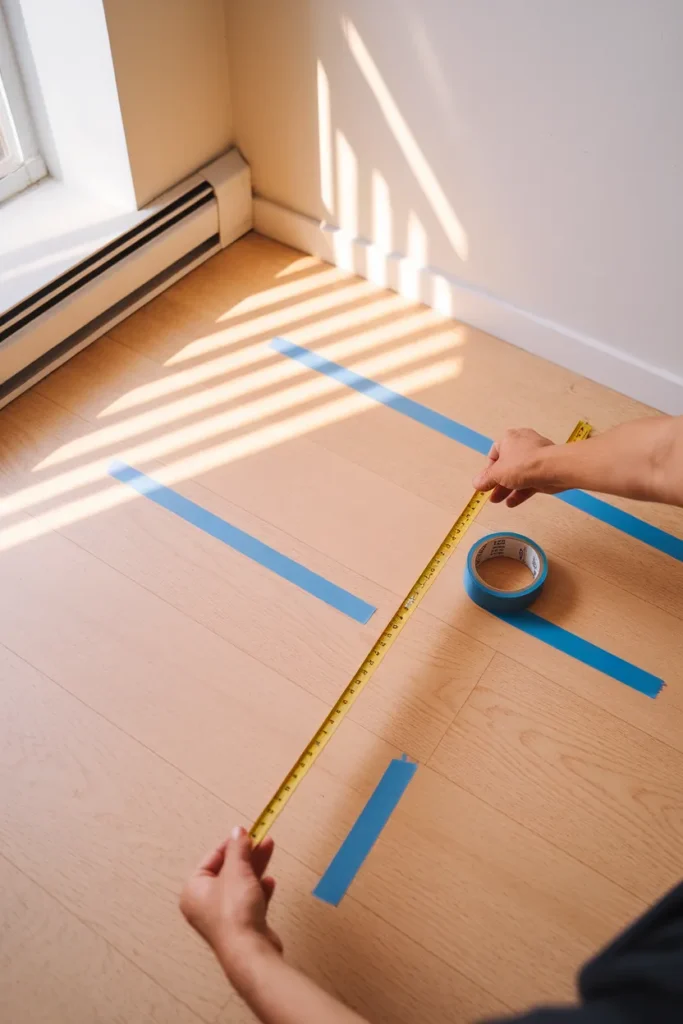
An armchair needs about nine more inches of wall than its own width to stop looking wedged in. The IKEA POÄNG measures 26¾ inches across, so give it 36 inches of wall. Below that, the chair reads as crammed. Above 42 inches, the corner starts to feel unanchored.
Chalk the number on your floor with painter’s tape before you order anything. Sit inside the tape for two minutes. You will know immediately.
| Piece | Real footprint | Wall and floor you need |
|---|---|---|
| IKEA POÄNG armchair | 26¾ in wide, 32¼ in deep | 36 in of wall, 40 in of floor depth for legroom |
| Floor cushion setup | 24 to 30 in round | 36 in square, plus standing room to get back up |
| Slim ladder shelf | 16 to 20 in wide | 24 in of wall, nothing parked in front of it |
| Pouf or ottoman | 16 to 20 in round | 24 in clear, doubles as a footrest so it can overlap the chair zone |
One honest warning about floor cushions, since every list recommends them. They photograph beautifully and cost almost nothing. Forty minutes in, your lower back files a formal complaint. Use them as secondary seating, not as the seat you build the corner around.
Hang Wall Decor Without Losing Your Deposit
Renting is the constraint that breaks most small apartment decor advice, so let us handle it with real numbers instead of a vague “try removable hooks.”
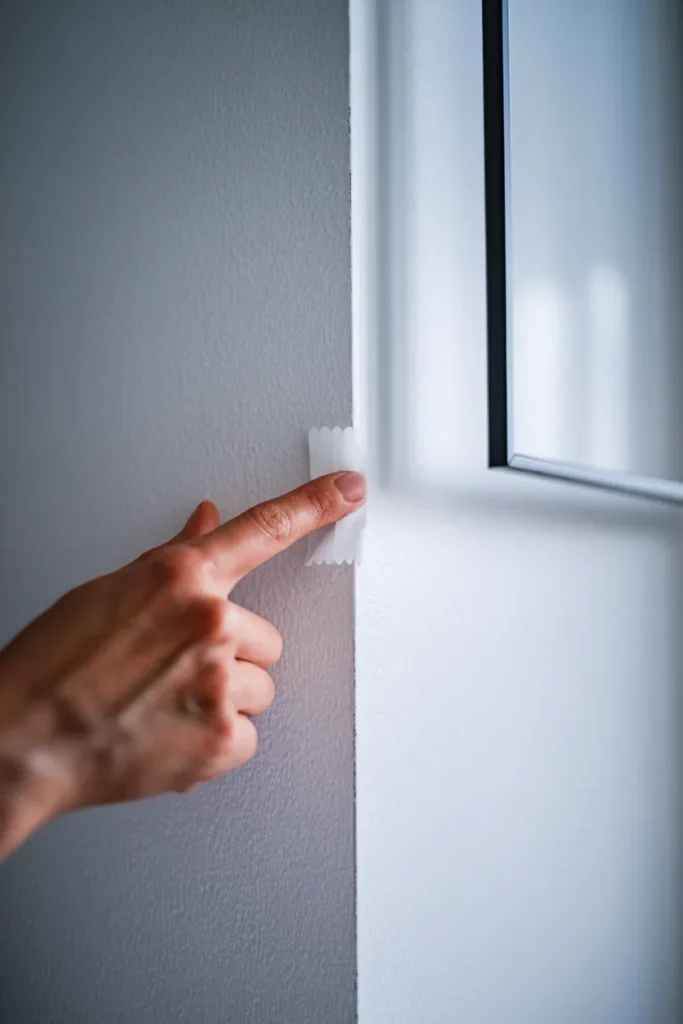
3M’s Command 15 lb Large Picture Hanging Strips are rated to hold damage-free picture hanging strips rated to 15 pounds on painted walls, tile, glass, laminate, finished wood, and painted concrete. That rating covers most framed art, a lightweight mirror, and a small floating shelf with nothing heavy on it.
Two things go wrong, and both are avoidable.
Failure one: the surface. These strips do not hold on textured or flat-finish paint, unfinished brick, or wallpaper. Press one onto a knockdown-texture wall and you will hear it let go at 3 a.m. Test one strip in an inconspicuous spot and leave it a full day before you trust it with glass.
Failure two: removal. Do not pull the tab outward. 3M’s instruction is to stretch the strip slowly straight down toward the floor at least 12 inches. Yanking it away from the wall is what takes a paint chip with it, and a paint chip is what a landlord notices.
For anything heavier than 15 pounds, stop hanging and start leaning. A large mirror propped against the wall behind a chair, or an art print resting on a picture ledge, gives you the same visual weight with zero wall contact and zero risk.
Fix the Bulb Before You Buy Another Lamp
Most small apartments do not have a lighting problem. They have a bulb problem, and it costs nothing to solve.
Look up. If your ceiling fixture is throwing out cold blue-white light at 4000K or higher, no amount of throw pillows will make the room feel settled. Swap that bulb for a 2700K soft white LED and the entire room warms up for the price of one bulb.
Kelvin is the number to shop by, not wattage. Here is the working scale:
- 2000K to 2200K: candle and amber. Deep gold, best for a low lamp you use at night.
- 2700K: soft white. The default for any room you relax in. This is the one to buy.
- 3000K: warm white but crisper. Fine for a kitchen counter, too clinical for a reading corner.
- 4000K and up: office light. It flattens skin tones and makes a small room feel like a waiting area.
The efficiency case is settled too. Residential LEDs use at least 75% less energy and last up to 25 times longer than incandescent bulbs, per the Department of Energy guidance on LED lighting, and incandescents dump 90% of their energy out as heat. In a 457 square foot studio in August, that heat is not theoretical. You feel it.
One rule that pulls a room together instantly: match the Kelvin on every bulb you can see at once. Mixed color temperatures in a single sightline are the reason a room can look busy even when it is tidy.
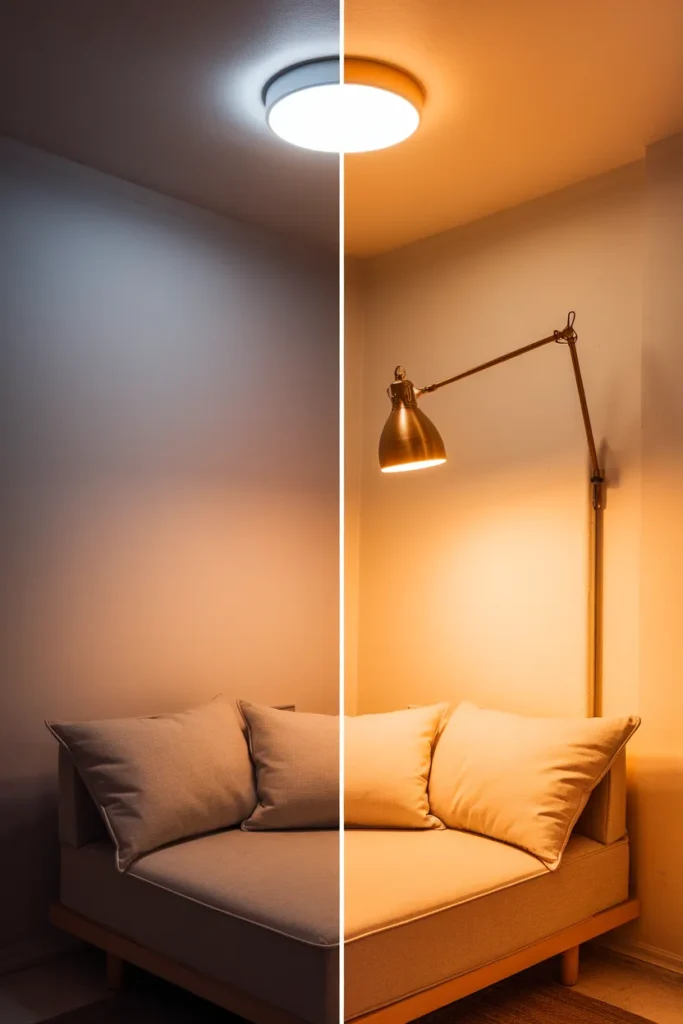
Layer Light at Three Heights, Not One Bulb Overhead
A single ceiling fixture lights a room the way a flashlight lights a face. Everything gets the same flat treatment and nothing feels intimate.
Small rooms need light at three heights. Overhead for function, eye level for warmth, floor level for depth.
Eye level is the layer almost everyone skips, and it does the most work. A plug-in wall sconce mounted beside your chair puts light exactly where your book is, and the plug-in version needs no electrician and no junction box. Run the cord down and tuck it behind the chair leg.
Floor level is the cheap trick that makes a room look designed. One small lamp low to the ground, or a string of warm fairy lights behind a plant, throws light upward and gives the room a second dimension after dark.
Overhead you can mostly ignore once the other two exist. Put it on a dimmer if you can, or just leave it off in the evening.
A clip-on reading light is the smallest useful version of all three: about $15, clamps to a shelf or a headboard, and gives a renter directional light with no mounting at all. Our guide to warm lighting ideas for small rooms goes deeper on dimmers, dim-to-warm bulbs, and the mistakes that keep a room feeling cold.
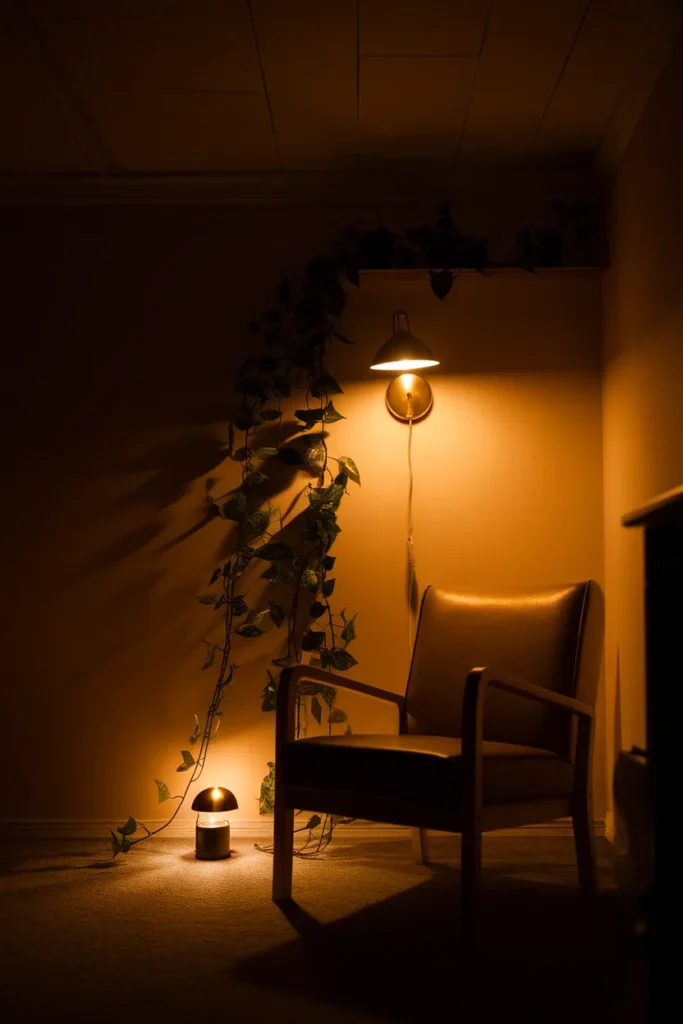
Buy Vertical Inches, Not Floor Space
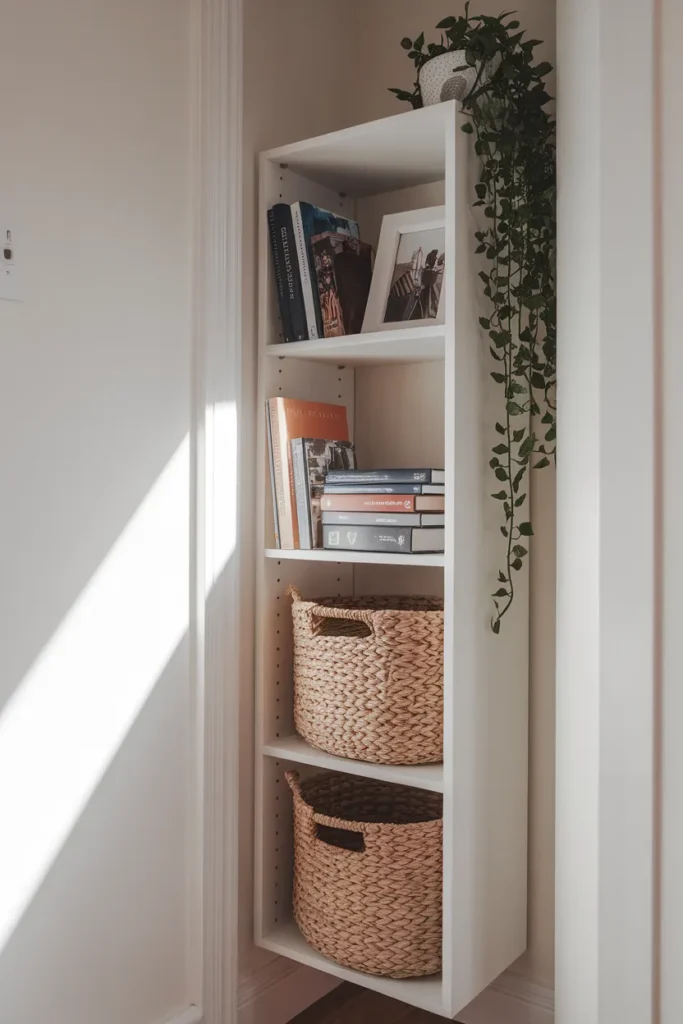
Floor space is what you are short of. Wall height is what you have and are not using.
Most apartment walls give you eight or nine feet, and most renters stop decorating at about five. Everything above that line is free storage and free visual height, and drawing the eye upward is what makes a low-ceilinged room breathe.
KALLAX is the workhorse here because it stands vertically or lies horizontally, and the same unit does a different job in each orientation. Real current sizes and prices:
| KALLAX size | Dimensions | Price (July 2026) | Best job in a small apartment |
|---|---|---|---|
| 1×1 | 16⅜ x 16 in | $24.99 | Nightstand or a side table with a book cubby |
| 1×4 | 16⅜ x 57⅝ in | $49.99 | Vertical tower that fits a 17 inch dead gap beside a doorway |
| 2×2 | 30⅛ x 30⅛ in | $44.99 | Low bench under a window, cushion on top, baskets below |
| 2×4 | 30⅛ x 57⅝ in | $79.99 | Standing room divider in a studio |
| 4×4 | 71⅝ x 71⅝ in | $249.99 | Full storage wall in a shared room |
Each shelf holds up to 29 pounds, which is roughly 20 hardcovers. Load the heavy cubbies at the bottom and keep the top ones light, especially on the vertical 1×4, which is the tippiest of the set and the one to anchor to the wall.
A slim ladder shelf is the lighter-weight alternative. It leans instead of mounting, takes 16 to 20 inches of wall, and can be carried out on moving day by one person.
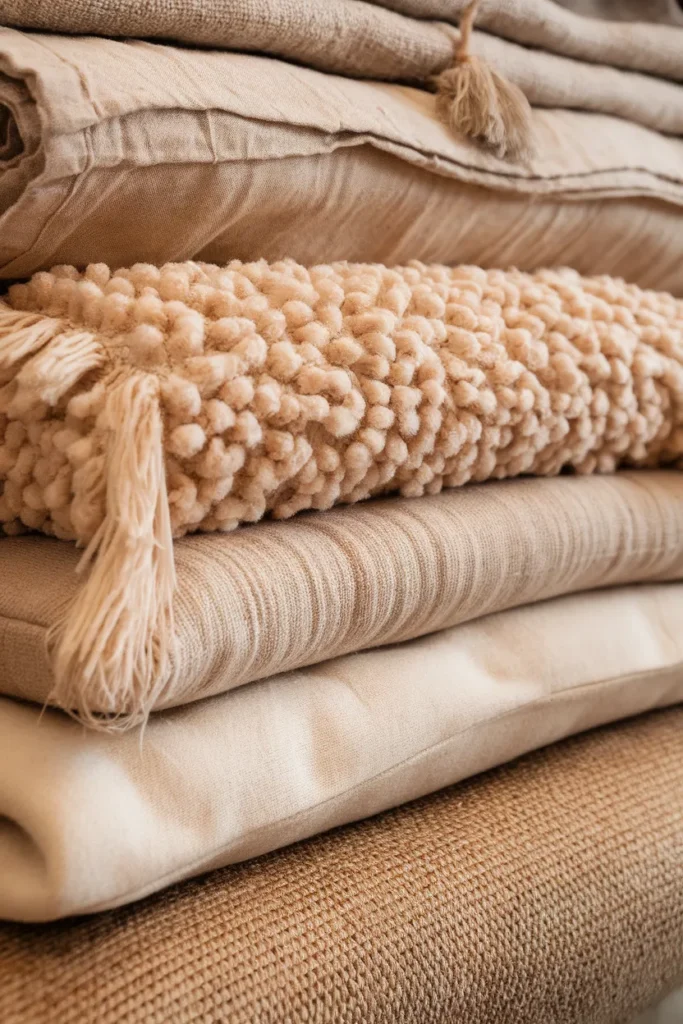
Soft Layers Do More Than Furniture in a Small Room
You cannot add square footage. You can absolutely add texture, and texture is what separates a room that looks furnished from a room that feels lived in.
The trick is contrast, not quantity. Three different textures beat six matching ones every time. Pair something smooth with something nubby with something that has real pile: a washed linen throw, a boucle lumbar pillow, a sheepskin over the chair arm.
Then get the non-visual part right. A wool throw is warm but scratchy against bare arms in July, so keep a washed cotton or linen one within reach for summer and save the wool for October. That single swap is the difference between a throw that gets used and one that stays folded as decoration.
Underfoot, a jute rug adds coarse natural texture and hides a lot of rental carpet, though it sheds for the first month and is rough on bare feet. A low-pile washable rug is the better call if you eat in the same room you sit in.
Curtains do more for a small room than art does. Hang the rod four to six inches above the window frame and let the panels run nearly to the floor, and a standard rental window suddenly reads as a tall one. Sheers by day, blackout or lined panels at night if the room doubles as a bedroom.
For a full room-by-room approach to warmth that stays deposit-safe, our room-by-room hygge decor for renters walks through the layering order and a real corner build with a totaled cost.
Zone an Open Room Without Building a Wall
A studio is not one room. It is three or four rooms that have not been told where their edges are.
You define an edge with a rug, not a wall. Anchor a rug under the front legs of your seating and that patch of floor becomes the living area, regardless of what happens two feet away. Get the size right: a 5 by 7 is the smallest that works under a small sofa, and anything smaller floats and makes the room look more scattered, not less.
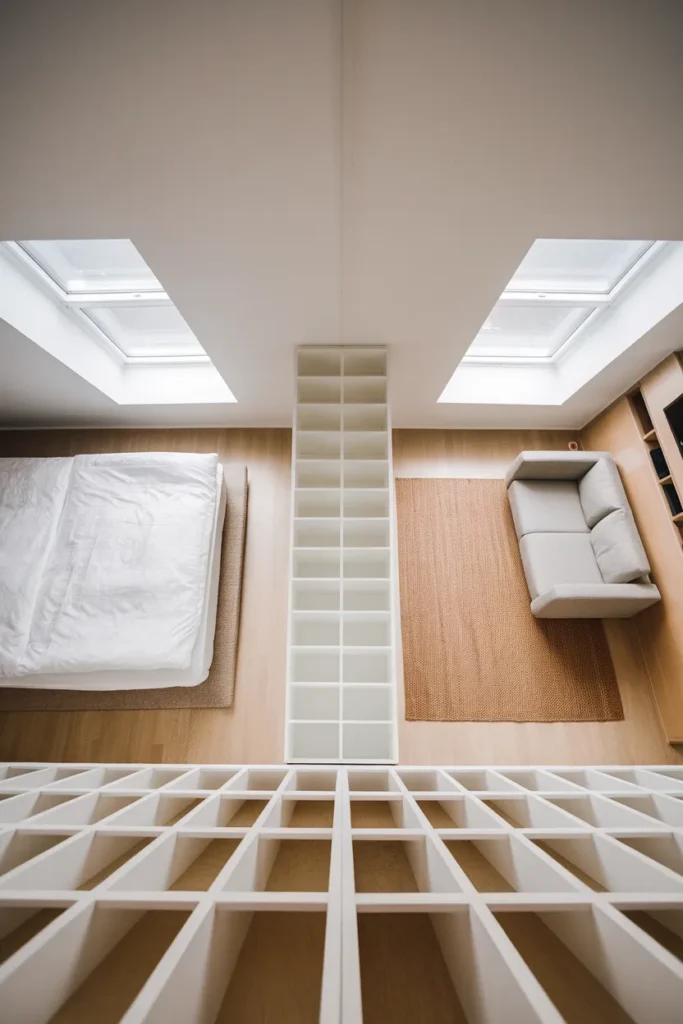
An open-backed bookcase is the second tool. Stand a 2×4 KALLAX perpendicular to the wall and it separates the sleeping side from the sitting side while light still passes through both. A solid divider would darken the room. An open one splits it without shrinking it.
A ceiling-mounted curtain track is the renter’s version of a wall. Bendable tracks mount with a handful of small screws, and a lined curtain pulled across at night gives you a genuine bedroom with a genuine door-closed feeling. Patch three screw holes on move-out and you are done.
Then there is the zoning trick nobody sells you: change the flooring feel. A small runner in the “kitchen” zone and a jute rug in the “living” zone tells your feet where one room ends, and your body registers that boundary faster than your eyes do.
Place Mirrors With Intent, Not Just Anywhere
“Add a mirror” is the most repeated small-apartment tip in existence and the least useful, because placement is the entire thing.
A mirror does not make a room bigger. It doubles whatever is in front of it. Hang one facing a blank wall and you get twice the blank wall.
Hang it perpendicular to your window instead, on the wall at a right angle to the light source. That angle bounces daylight deeper into the room and reflects the view rather than the interior. It is the difference between a mirror that brightens a room and one that just hangs there.
Two more placement notes. A full-length mirror leaned against the wall behind a chair reads as intentional and needs no anchors beyond a small anti-tip strap. And a mirror directly opposite your front door reflects the door, which is the least interesting surface in your apartment.
Pick Three Colors and Stop
Small rooms punish variety. Every additional color adds a visual boundary, and boundaries chop up a space that is already short on continuity.
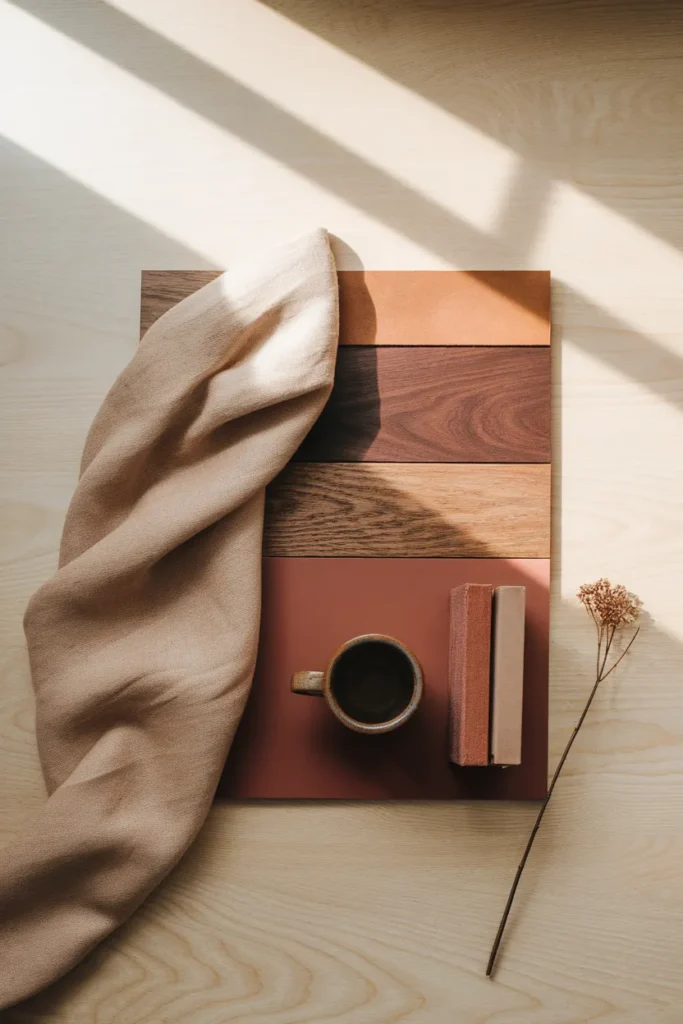
Run three: one warm neutral across roughly 70% (walls, curtains, the big soft goods), one grounding mid-tone for about 20% (wood, leather, a darker rug), and one accent for the last 10% (cushions, a stack of book spines, one ceramic).
Light walls do help, and every competitor says so, but the reason usually gets skipped. Pale walls bounce more of the light you already have, which matters far more in a north-facing rental with one window than the color itself does.
If you cannot paint, run your neutral through textiles instead. Curtains, rug, and throw in the same warm off-white will pull a room together even over a landlord beige wall you are not allowed to touch.
For what it is worth, Pinterest’s own Spring 2026 trend data shows “vibey apartment living room aesthetic” up 380% and “my room, my rules” up 415%, which tracks with what the top-performing small-space pins look like right now: warm neutrals with one strong personal accent, not showroom minimalism.
The Small-Apartment Mistakes That Quietly Shrink a Room
Everything above is what to do. Here is what undoes it.
Pushing every piece of furniture against the walls. It feels like it opens the floor. It actually creates a bald patch in the middle and makes the room read as a corridor. Pull the seating forward four to six inches and the room gains depth.
Buying storage before decluttering. A new set of bins holds the same clutter in a tidier shape. Clear first, then buy the container that fits what remains.
Too many small objects. Nine tiny things on a shelf create nine visual stops. One larger object plus a plant creates one. Small rooms want fewer, bigger pieces.
Hanging art too high. Center it at 57 to 60 inches from the floor, which is standard eye level. Art hung at 66 inches makes a ceiling look lower, which is the exact opposite of the goal.
Skipping the side table. It seems like the most cuttable item on the list. Skip it and you will find yourself getting up constantly, and a corner that interrupts you is a corner you stop using. Your TBR pile stays exactly where it is.
Small Apartment Decor FAQs
How do you decorate a small apartment on a budget? Finish one corner instead of touching every room. A seat, a light, and a surface run roughly $204 to $279 using an IKEA POÄNG at $149 plus a plug-in lamp and a small side table. Add soft layers later, one piece at a time. Spreading the same money across a whole apartment gets you five unfinished rooms.
What colors make a small apartment look bigger? Light warm neutrals bounce the most available light, which is what actually matters in a rental with one window. Use a 70-20-10 split: a warm neutral base, a grounding mid-tone in wood or leather, and one accent. Continuity across surfaces matters more than the specific shade.
How can I decorate an apartment without losing my security deposit? Use adhesive picture hanging strips rated for the weight, test one on your wall texture first, and remove them by stretching straight down at least 12 inches rather than pulling outward. Lean large mirrors and art instead of hanging them. Choose plug-in sconces over hardwired fixtures, and a bendable ceiling curtain track over any permanent divider.
How do you make a studio apartment feel like separate rooms? Define zones with rugs, an open-backed shelf standing perpendicular to the wall, and a ceiling-mounted curtain track. Keep dividers open rather than solid so light still travels. Changing the floor texture between zones does more than most people expect.
Should I use big or small furniture in a small apartment? Fewer, larger pieces beat many small ones. One properly sized armchair reads as calm; three little chairs read as clutter. Measure first: a 26¾ inch wide armchair wants about 36 inches of wall and 40 inches of floor depth.
What size rug works in a small apartment living room? A 5 by 7 is usually the minimum that anchors a seating group, with the front legs of your seating resting on it. Smaller rugs float and make a room feel more fragmented, not roomier.
How much does it cost to decorate a small apartment? The one-corner build runs about $204 to $279 at July 2026 prices. A full small living room with a rug, curtains, lighting, and soft layers realistically lands between $600 and $1,200 depending on how much you thrift. Prices shift, so treat these as current bands rather than fixed figures.
Start This Weekend, With One Corner
You do not need a bigger apartment. You need one corner that is genuinely finished, and roughly $200 plus an afternoon to get there.
Pick the spot you already sit in. Tape 36 inches on the floor. Buy the seat, then the light, then the surface, in that order. Add a throw when you feel like it.
Once that corner works, the rest of the apartment stops feeling like a problem to solve and starts feeling like a place you actually live. Then you can go find the second corner.
Keep reading
More cozy nook ideas
 Nook Ideas
Read →
Nook Ideas
Read →
18 Library Reading Nook Ideas for Renters (No Drilling Required)
No drill, no paint, no awkward email to your landlord. You can still build a library reading nook with full shelves, a…
 Small Spaces
Read →
Small Spaces
Read →
14 Modern Apartment Decor Ideas That Make a Small Room Feel Bigger
Four hundred and sixty square feet. That is the average size of a new US studio apartment, according to RentCafe’s 2025 numbers,…
 Home Library & Bookshelves
Read →
Home Library & Bookshelves
Read →
21 Modern Bookshelf Ideas for Small Spaces That Actually Fit
Your books are in three stacks on the floor and every bookcase you like is 32 inches wide. That is the whole…