
Reading Nook With a Canopy: Dreamy Draped Setups You Can Actually Hang

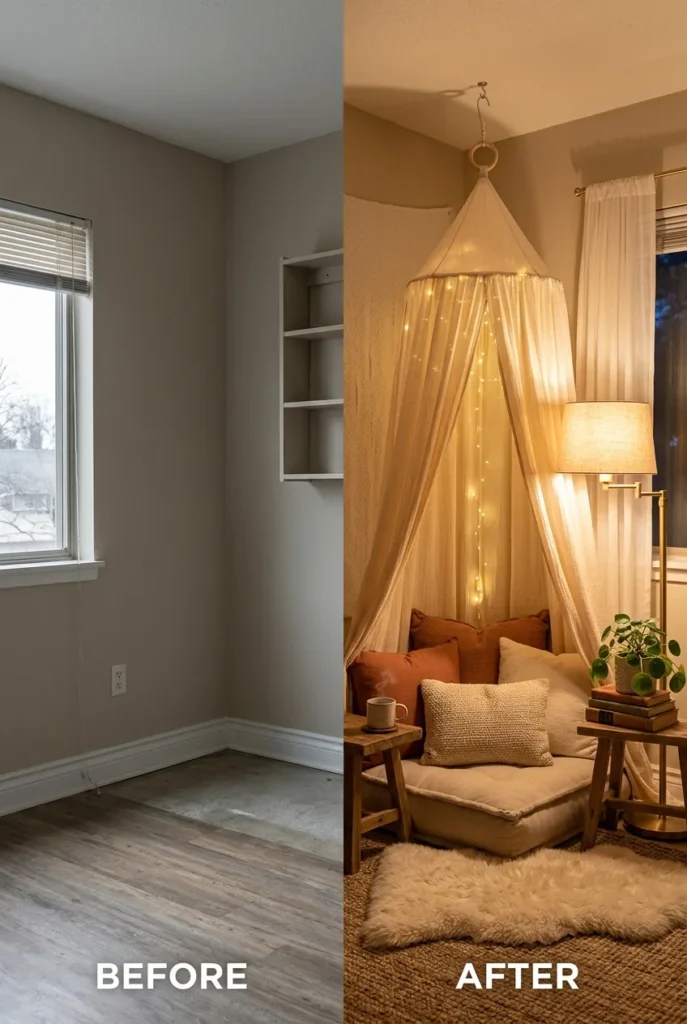
No bay window, no reno budget, no friendly landlord required. You need a hanging canopy, one soft corner, and about an afternoon. That dreamy draped reading nook canopy you keep re-pinning at 11 pm in bed? It’s more reachable than the pin makes it look, and you do not have to drill a single hole to get there.
Here’s the honest part most pages skip. The prettiest canopy setups fall down constantly, because people hang a heavy fabric drape off a flimsy corner rod and hope. We’re going to fix that first, then make it beautiful. You’ll get the real hanging methods, the specs that matter, and a build order that works whether you rent a 700 square foot apartment or you’re setting up a corner for a book-obsessed seven-year-old.
Let’s get the drape up.
First Scroll Payoff: The 3-Piece Canopy Nook, No Drill Required
Cashing the pin promise right away, here’s the whole thing in three pieces:
- The canopy itself (a round hanging bed canopy, roughly 39 inches across at the ring [ measure your actual canopy diameter], or a set of drape panels).
- The anchor (one ceiling-rated adhesive hook or swag hook, more on which below).
- The floor (a plush floor cushion or bean bag plus a soft rug so the drape has something cozy to fall around).
That’s the skeleton. Everything after this is styling and safety. If you build only those three, you already have the corner. A round canopy hung over a floor cushion is the single most re-pinned version on Pinterest right now, and it’s also the easiest to pull off in a rental because the whole thing hangs from one point.
The One-Hook Rule: a fabric canopy should hang from a single ceiling anchor rated for at least 5 lb, centered over the seat, never off a corner curtain rod as the sole support. That one rule prevents about 90 percent of the sagging failures you’ll read about in old DIY comment sections.
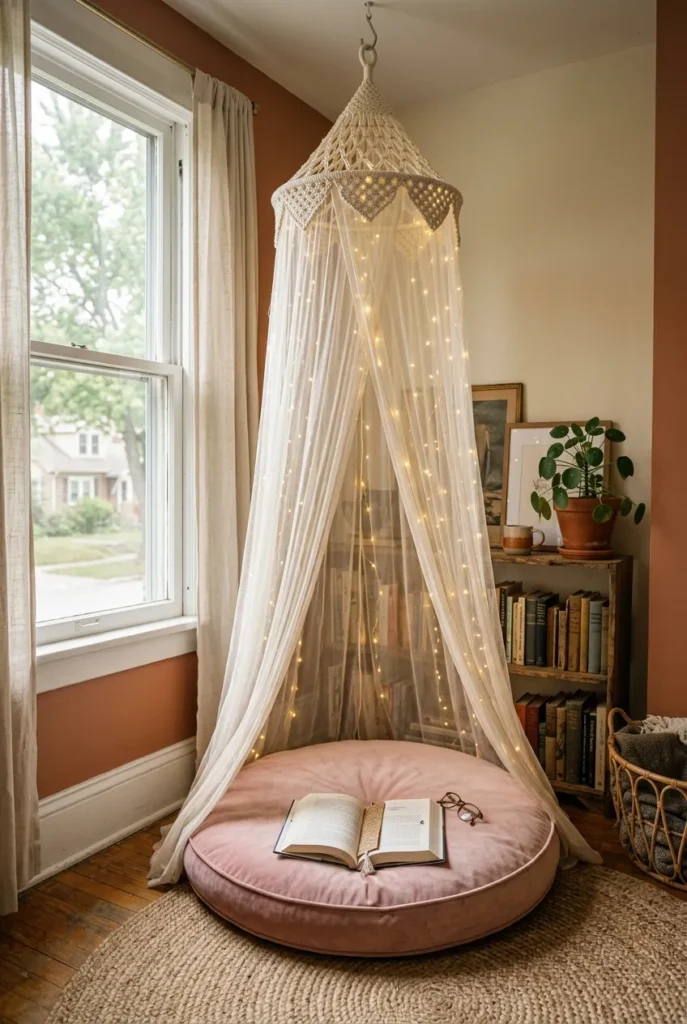
What “Canopy” Actually Means Here (Bed Canopy vs. Corner Drape vs. Teepee)
Quick definition, because the word gets used three ways and it changes what you buy. A bed canopy is the round or dome-shaped net that hangs from one overhead point and flares out like a bell. A corner drape uses a curved rod mounted into two walls with fabric panels hung across it. A teepee or tent frame stands on the floor with fabric over poles, no ceiling contact at all.
For a reading corner, the round hanging canopy wins for most renters because it needs one anchor and reads instantly cozy. If you literally cannot touch the ceiling, the freestanding teepee is your move. For a bigger sitting-two situation, the corner drape covers more width. We map all three to real setups below.
If you want to go deeper on the standalone tent-style version for kids, this walkthrough of reading tent and teepee setups for kids covers the freestanding frames that never touch a wall.
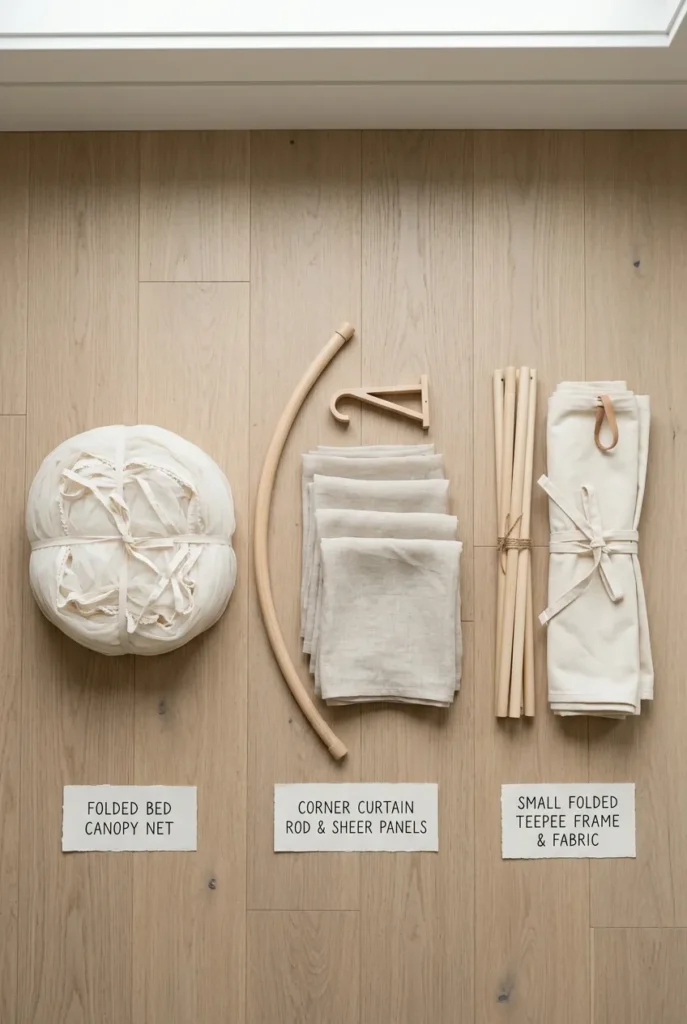
The No-Drill Anchoring Method, Compared Honestly
This is the section the top-ranking pages don’t have, and it’s the one that decides whether your canopy is still up next month. Renting means no anchors sunk into a joist, so your choice is about grip and weight, not power tools.
Here’s the real trade-off, method by method.
| Method | Holds | Renter-safe? | Watch out for |
|---|---|---|---|
| Ceiling adhesive hook | Light net + lights | Yes, peels off clean | Needs a smooth painted ceiling, not textured |
| Swag/screw ceiling hook | Heavier drapes | Leaves one small hole | Fine if you spackle at move-out |
| Tension-mounted corner rod | Panel drapes | Yes | Sags under weight, the classic failure |
| Freestanding teepee frame | Its own fabric | Yes, zero contact | Takes floor space |
The adhesive ceiling hook is the renter hero here. Look for one rated around 5 lb and rounded so the cord doesn’t cut into the adhesive (note the exact brand and price you used, roughly $6 to $12 for a pack]. Press it for 30 seconds, then wait a full hour before you hang anything, and honestly wait longer if your ceiling is cool.
Failure mode, straight up: if you skip the cure time or stick it to a textured “popcorn” ceiling, it will let go at 2 am and scare the daylights out of you. [your real “it fell down once because I rushed the adhesive” story goes here, if true.] Textured ceiling? Use the freestanding teepee instead and don’t fight physics.
For fire safety with any string lights you thread through the fabric, the U.S. Consumer Product Safety Commission’s guidance on choosing and using string lights is worth a two-minute read, especially the note about not draping lit strands against fabric for hours unattended. Stick with cool-running LED strands and you sidestep most of it.
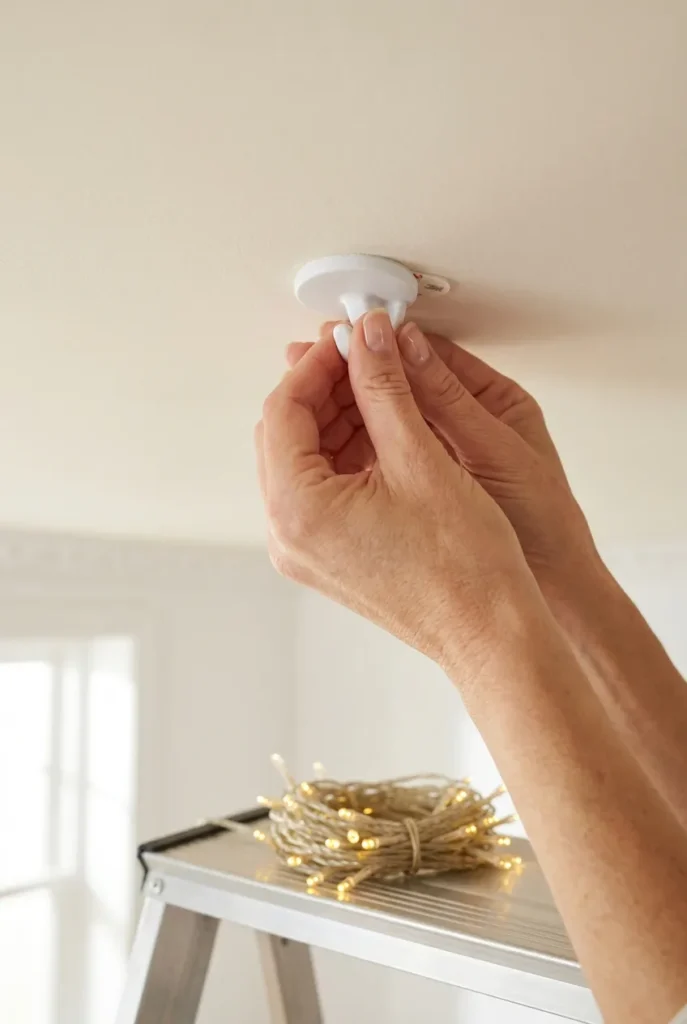
Pick Your Fabric: Sheer, Muslin, or Blackout
The drape you choose sets the whole mood, and it also changes the light. Sheer voile or lace glows when the sun hits it and keeps the corner airy, great if the nook sits near a window. Cotton muslin is heavier, more opaque, and gives you that soft boho tent feel that dominates the cozy Pinterest pins. Blackout panels are overkill for a canopy but useful if you’re layering them behind for a genuine hideaway.
Texture matters more than you’d think. Muslin has a slight nubby weave you can feel between your fingers, and it holds a gentle fold instead of hanging stiff, which is why lived-in canopy shots always seem to use it. A round net canopy usually comes with its own sheer skirt, so if you buy the ready-made ring you’re mostly choosing color, not fabric weight.
The whole art of hanging and choosing drape fabric gets its own deep treatment in our guide to reading nook curtains, including how many panels you actually need for full coverage.
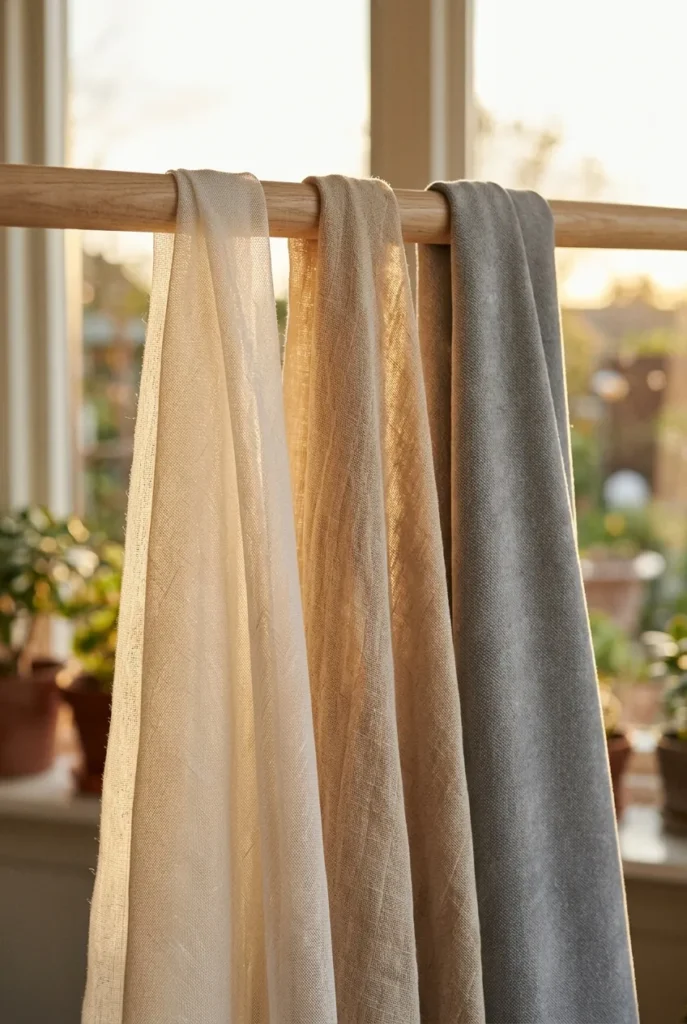
Light It Like the Pins (Warm, Low, and Safe)
Every high-performing canopy pin has one thing in common: warm, low light glowing through the fabric. Skip the cool white. You want 2700K bulbs or LED fairy lights in that soft amber range, because 2700K is the color temperature that reads “candlelit,” not “office” [ confirm the Kelvin printed on the strand you bought]. A battery or plug-in strand woven loosely through the canopy ring does the heavy lifting.
Add one real light source you can read by, because fairy lights are mood, not lumens. A plug-in swing-arm sconce or a small clip-on reading light gives you actual page brightness without another ceiling hole. Put the fairy lights on a little timer so the corner greets you already glowing at dusk.
There’s a smell-and-sound layer people forget: a warm bulb, a soft rug, and fabric on three sides quiets a room noticeably, so the corner feels hushed the second you step in. That muffled quiet is half of why these nooks feel like a retreat.
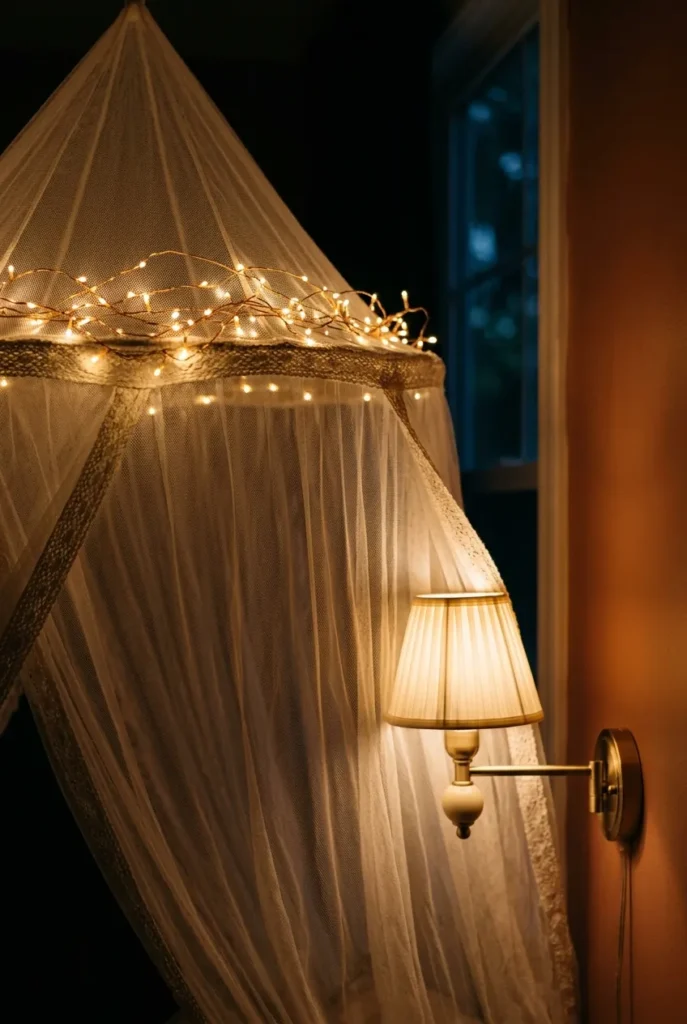
The Grown-Up Canopy Nook (Not a Nursery)
Most canopy content assumes you’re building for a five-year-old. If you’re an adult who wants the draped look without the toddler-tent energy, a few small swaps change everything. Go monochrome: a single oatmeal or charcoal muslin instead of rainbow tulle. Drop the pom-poms. Choose a low wooden stool or a real armchair over a character floor cushion.
Scale up the fabric too. Longer panels that puddle slightly on the floor read expensive and calm, where short ruffled ones read playroom. Add a linen throw, a boucle lumbar pillow, and one ceramic mug’s worth of coffee-nook energy, and the same $100-ish build [your real totaled cost] suddenly looks like a slow-living corner instead of a kid’s fort.
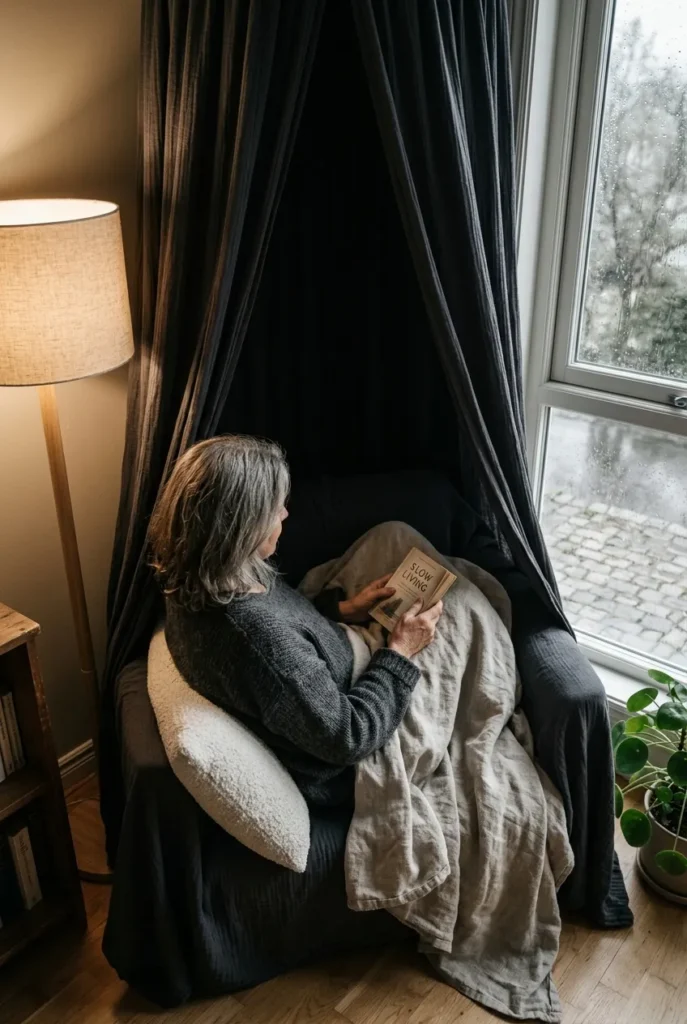
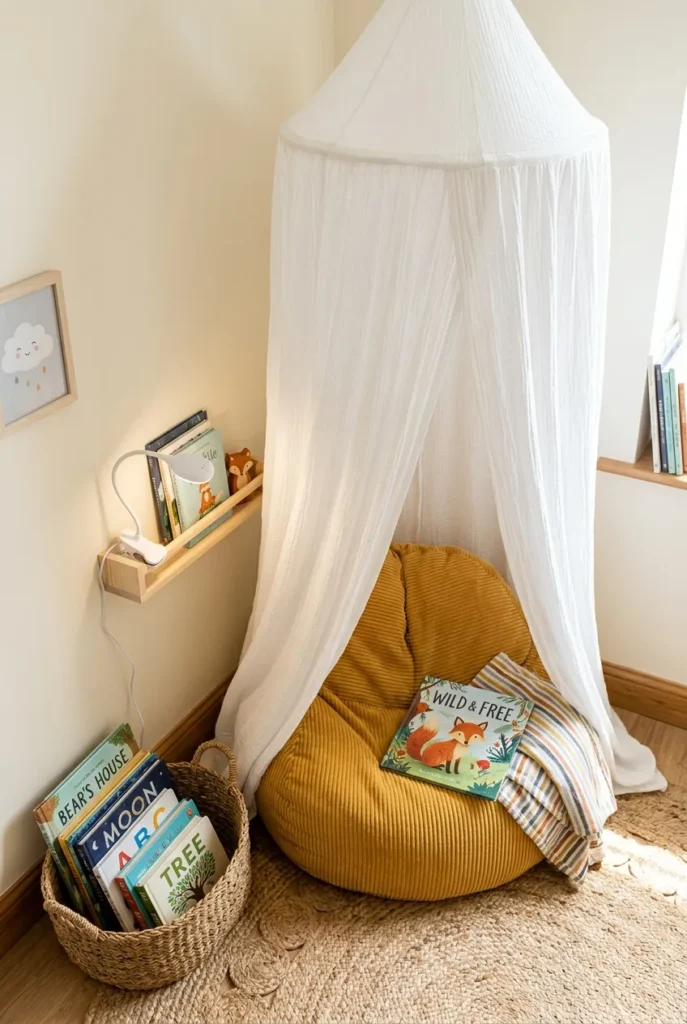
The Kids’ and Tween Canopy Corner
For the parents here, the canopy corner is one of the easiest wins in a shared or small kids’ room, and it grows with them. For little ones, a round net over a bean bag with a basket of picture books within arm’s reach keeps everything reachable and soft-cornered. For a tween, lean into their aesthetic: fairy lights, a couple of posters just outside the drape, and a real clip-on reading light so they can actually finish a chapter.
Keep the safety non-negotiables tight for kids. Nothing heavy hangs overhead, the anchor is rated and tested with a firm tug before they climb in, and the fairy lights are cool-running LEDs, never hot incandescent. The American Academy of Pediatrics’ home safety guidance for children’s spaces is a solid gut-check for anchoring and cord placement around kids.
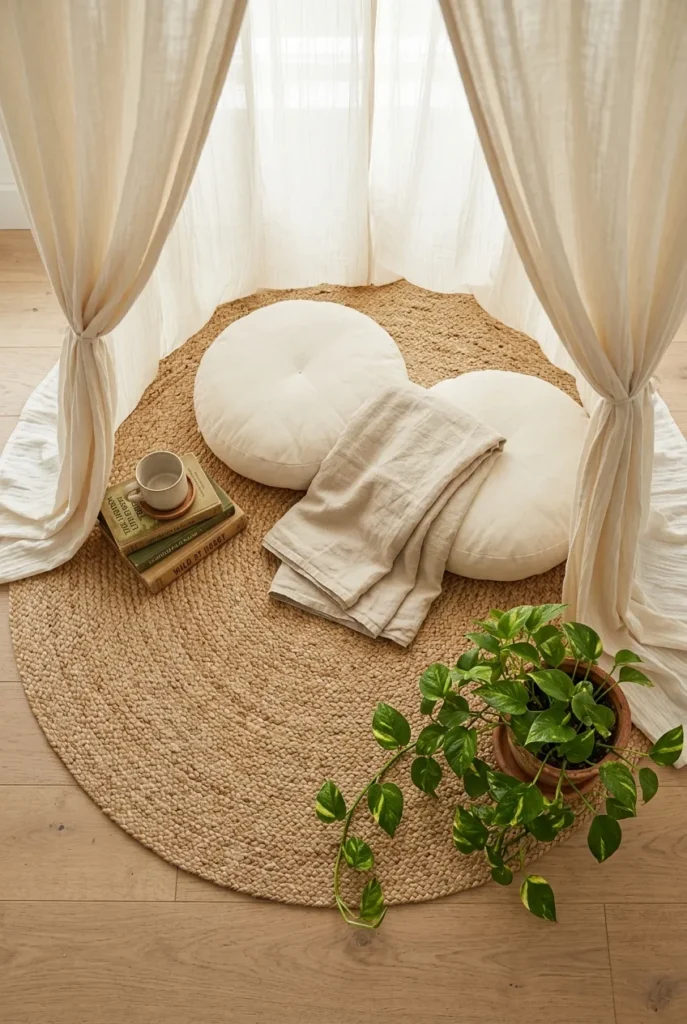
Style It: Rug, Cushions, and One Focal Object
The floor makes or breaks the whole corner. A round washable rug under a round canopy echoes the shape and photographs beautifully, which is exactly why the top pins use them. Layer a couple of floor pillows plus one lumbar pillow for your lower back, because a floor cushion alone flattens out fast.
Then add a single focal object so the corner has a heartbeat: a tiny stack of your current reads, one trailing plant just outside the drape, or a small side table for a mug. Resist the urge to fill it. The magic of a canopy nook is that it’s a small, contained pocket, and one too many baskets kills the tucked-away feeling.
Renter Move-Out Plan (So You Get Your Deposit Back)
Because this is built for renters, here’s the part nobody plans for until the last day. Adhesive hooks peel off cleanest when you warm them with a hairdryer for 20 seconds and pull the tab straight down, slowly, along the ceiling rather than out. A swag-hook hole takes about five minutes to fill with lightweight spackle and a dab of matching paint.
Photograph the ceiling before you hang anything, so you have a before shot if a landlord ever quibbles. Keep the canopy’s original packaging if you can, since these fold back down small and move to the next apartment easily. A canopy nook is one of the few “big impact” decor moves that leaves basically no trace, which is the whole reason it’s perfect for the no-drill renter reading nook crowd.
FAQ
What should I include in a canopy reading nook?
At minimum: the canopy, one rated ceiling anchor, a floor cushion or chair, a soft rug, warm 2700K light, and a spot for books within arm’s reach. Everything else is styling.
What is a bed canopy, exactly?
It’s a fabric net or drape suspended over a sleeping or seating spot, historically for warmth and bug protection, now mostly for that soft, enclosed, cocoon look.
How do you hang canopy curtains without drilling?
Use a ceiling-rated adhesive hook on a smooth painted ceiling for a round net, or a tension-mounted curved rod for corner panels. Cure the adhesive a full hour before hanging.
How do you make a homemade canopy cheaply?
Thread a hula hoop or large embroidery hoop through two curtain panels, hang the hoop from one ceiling hook with even lengths of ribbon, and the panels fall into a canopy. It’s the classic budget build, just anchor from the ceiling, not a corner rod.
Will a canopy work if I have a textured or popcorn ceiling?
Adhesive hooks won’t grip textured ceilings reliably. Go with a freestanding teepee frame or a tension corner rod instead.
How much does a reading nook canopy cost to build?
A simple round-canopy-plus-cushion setup lands in the budget-friendly range [your real totaled price, e.g., around $90 to $150], with the canopy and a good cushion being the biggest line items.
Is a canopy nook safe for kids?
Yes, if the anchor is rated and tug-tested, nothing heavy hangs overhead, and you use cool LED lights. Check the anchor periodically as they use it.
Your Next Step
Start with the anchor, not the pretty stuff. Pick your one hanging method, test it with a firm tug before anything precious goes underneath, then build up the cushion, the light, and the drape. Give it a weekend and you’ll have the corner you keep saving to your boards.
If your ceiling situation is tricky, read the freestanding options next so you can skip the anchor question entirely and still get the draped look.
Keep reading
More cozy nook ideas
 Boho
Read →
Boho
Read →
Boho Bathroom Checklist: Everything to Decide Before You Start
No gut job, no new tile, no landlord permission slip. A boho bathroom mostly comes down to eight decisions made in the…
 Cozy Home
Read →
Cozy Home
Read →
25 Cozy Bedding Ideas for a Cozier Home
If your bed right now is one flat comforter, two pillows that fold in half, and a throw that ends up on…
 Farmhouse & Country
Read →
Farmhouse & Country
Read →
Modern Farmhouse Bedroom Checklist: Everything to Decide Before You Start
Ten decisions, made in the right order, and a modern farmhouse bedroom stops being a pile of saved pins and starts being…