
Loft Reading Nook Ideas: How to Turn a Mezzanine Into a Book Hideaway

You don’t need a renovation budget, a landlord who likes you, or a bay window the size of a car. You need one loft corner, the right seat height, and an afternoon. A loft reading nook is the easiest cozy win in the whole house, because the awkward sloped ceiling that annoys you every day is the exact thing that makes a book hideaway feel tucked-away and safe. We’re going to set yours up so your head clears the rafters, your lamp lands in the right spot, and you actually want to curl up there at 4 pm.
Most loft nook galleries skip the part that matters: the numbers. So before the pretty stuff, here’s the one check that saves you from building a corner you bang your head in.
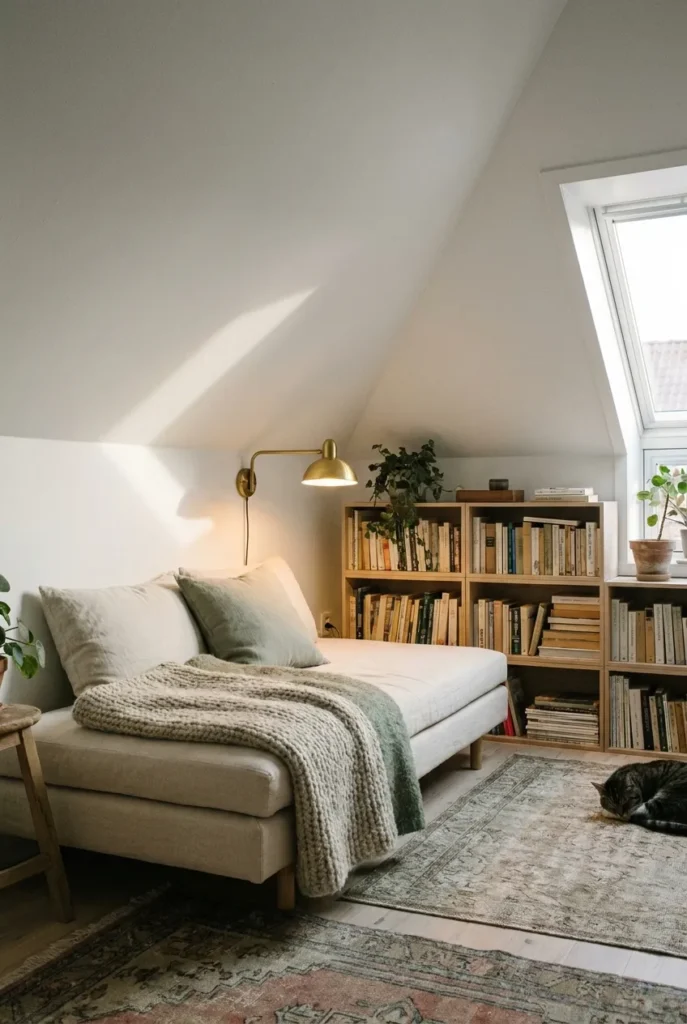
Start With the Loft Nook Clearance Check (the 4 numbers that matter)
Cash this promise first, because everything else rides on it. Lofts have sloped ceilings, and a sloped ceiling is wonderful for cocooning and terrible for sitting up fast. The fix is four measurements. Screenshot this list and walk up to your loft with a tape measure.
Here’s the Loft Nook Clearance Check:
- Seated head height. Sit where the nook will go. Measure floor to the top of your head. Most adults land near 50 to 54 inches seated. Your ceiling at that exact spot needs to clear it by at least 4 inches so you’re not hunched.
- Kneewall height. That short wall where the slope meets the floor. US code lets sloped-ceiling rooms drop to 5 feet at the low side as long as half the required floor area still hits 7 feet, per the 2021 International Residential Code ceiling-height rule. Translation: park your seat where the ceiling is lowest, and stand up where it’s tall.
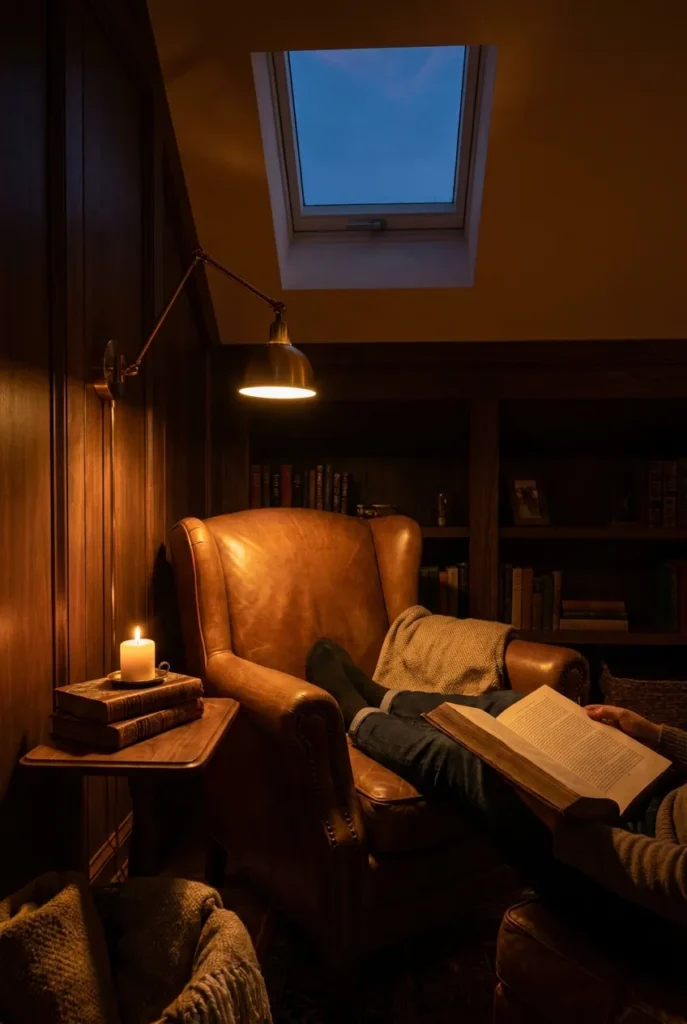
- Lamp reach. A swing-arm lamp needs about 18 to 24 inches of arm to land light over your shoulder without crowding your head against the slope.
- Walkway width. Leave at least 24 inches to get in and out without crab-walking past the shelf.
If you’re working with a tiny footprint, the same measure-first logic carries over from our guide to tiny reading nook ideas under one square meter, where every inch has to earn its place.
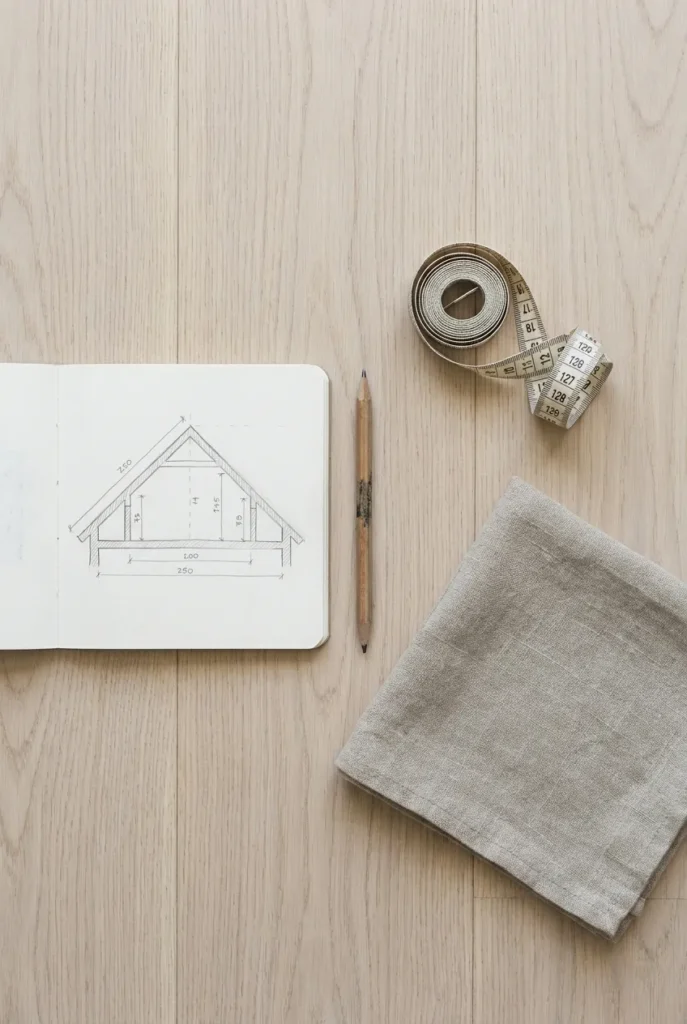
Truth is, this five-minute check is the difference between a nook you use daily and one you photograph once. Now the fun part.
Tuck a Daybed Against the Kneewall
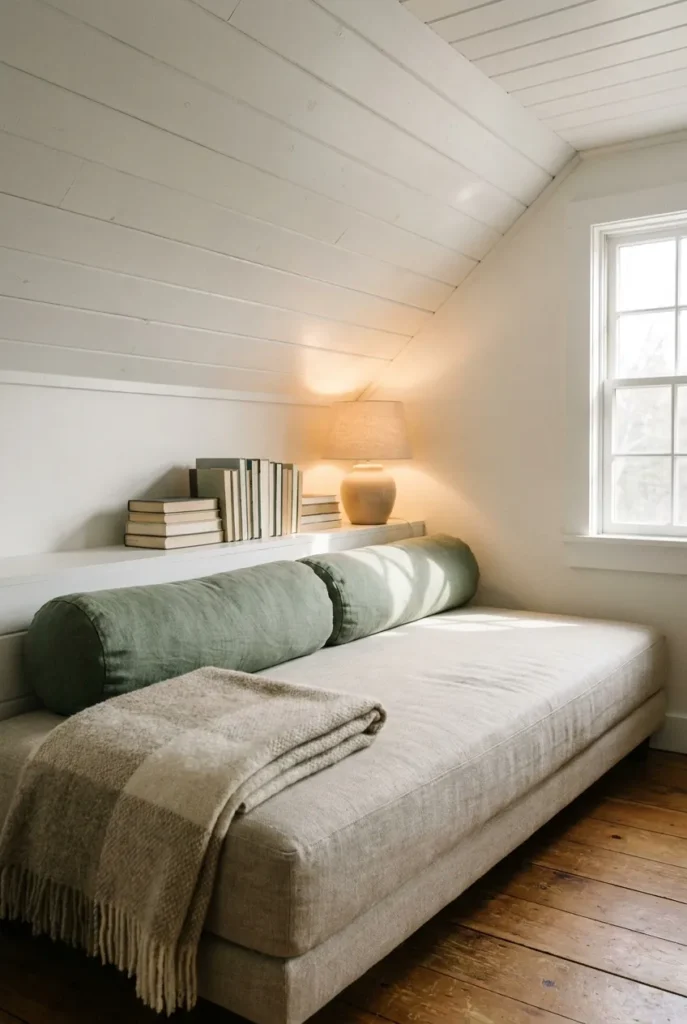
The kneewall is the lowest wall in the loft, and it’s the best seat in the house. Push a daybed or a low platform mattress flat against it so your body sits under the slope while your head stays in the taller zone. You get a back wall to lean on and a built-in feeling without building anything.
Add a bolster at each end and two lumbar pillows. Layer a wool throw for the texture, the slightly scratchy weight that says “stay a while.” A washable low-pile rug underneath keeps the whole thing renter-safe, no nailing required.
Watch the one failure mode here: people shove the daybed where the ceiling is tallest because it looks roomier, then waste the cozy low zone on a plant. Flip it. Body low, head high.
Use a Beanbag or Floor Cushion Where the Ceiling Dips Lowest
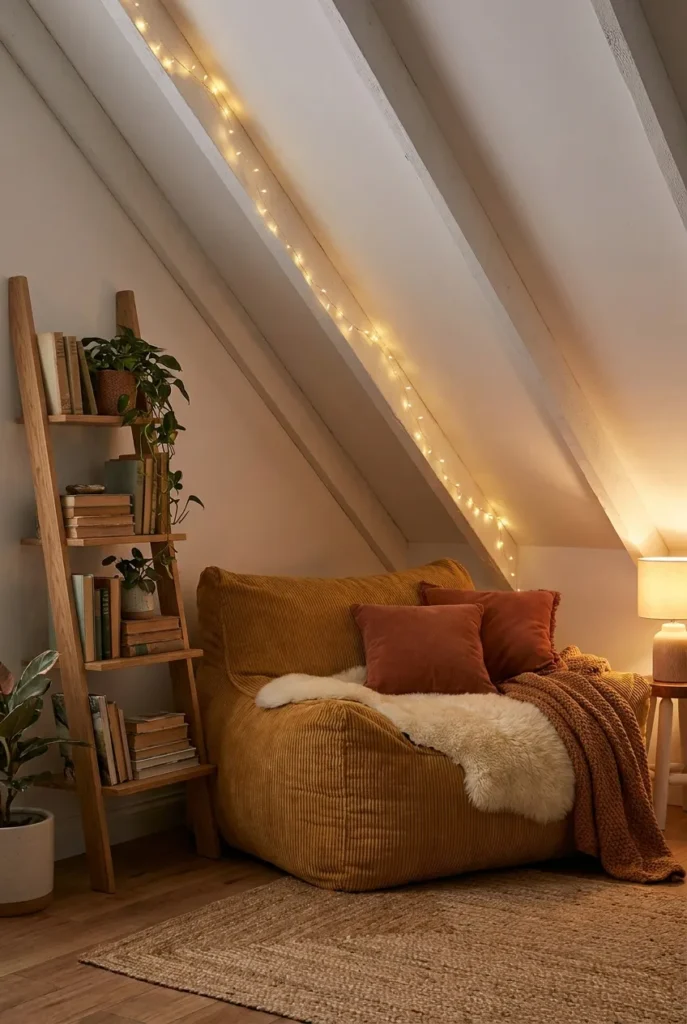
No room for a daybed? Go lower. A structured beanbag or a stack of firm floor cushions slides right under the steepest part of the slope, the spot furniture can’t use. This is the move for a loft reading nook cozy corner on a small footprint, and it’s the one the top Pinterest pins keep showing for a reason: a beanbag and a bookshelf read as instantly inviting.
One honest trade-off: floor cushions photograph like a dream and ache after 40 minutes. Buy firm, not squishy. A 4-inch foam base holds your spine better than a cloud of polyfill ever will. Set your books in a low ladder shelf within arm’s reach so you’re not crawling out every chapter.
Light It Right (lofts almost never have overhead wiring where you need it)
Here’s the loft problem nobody warns you about: the light fixture is usually in the center of the room, not over your corner. So your nook sits in shadow. The fix is to bring light to you, not the other way around.
Reach for a plug-in swing-arm lamp or a plug-in wall sconce. No electrician, no drilling into a rafter, fully renter-safe. For the bulb, you’ve got a choice worth understanding. Warm 2700K light reads candlelit and cozy for relaxed evening reading, while a cooler 4000K to 5000K bulb keeps text crisp and cuts eye strain on long sessions, which the lighting guidance from Lumens on Kelvin color temperature lays out clearly. My pick for a loft nook: a 2700K bulb on a dimmer so you can warm it down at night.
Skip the dimmer and your nook either glares like a dentist’s office or goes too dim to read. A $12 plug-in dimmer fixes both. For more lamp and sconce pairings, our reading nook lighting ideas break down which fixtures suit which corner.
Make It Renter-Safe (zero drill, zero damage)
You rent. You still get the nook. Every structural-feeling element here clamps, leans, or sits without a single hole.
A few zero-damage moves that actually hold:
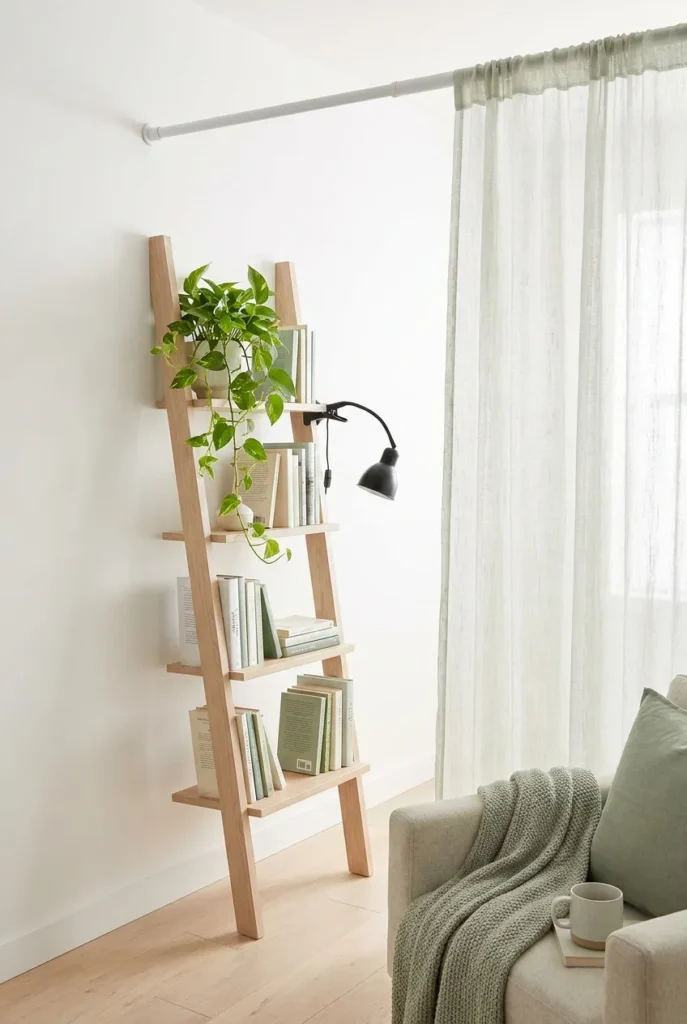
- Leaning ladder shelf instead of wall-mounted bookcases. It rests against the kneewall and stores your TBR pile.
- Tension-rod curtain across an open loft edge for a tucked-away feel, no brackets.
- Clamp-on reading light on the shelf edge, the kind that grips a 2-inch board.
- Freestanding room divider or a tall plant to wall off the corner without construction.
I learned the leaning-shelf lesson the hard way. My first loft setup used adhesive shelf strips that peeled off in a July heatwave and took a chunk of paint with them. Lean, don’t stick.
Mind the Railing Line if Your Loft Is Open to Below
If your loft is a true mezzanine, open to the floor below, the edge matters. This is the angle the pretty galleries skip entirely, and it’s the one that keeps your nook from feeling precarious.
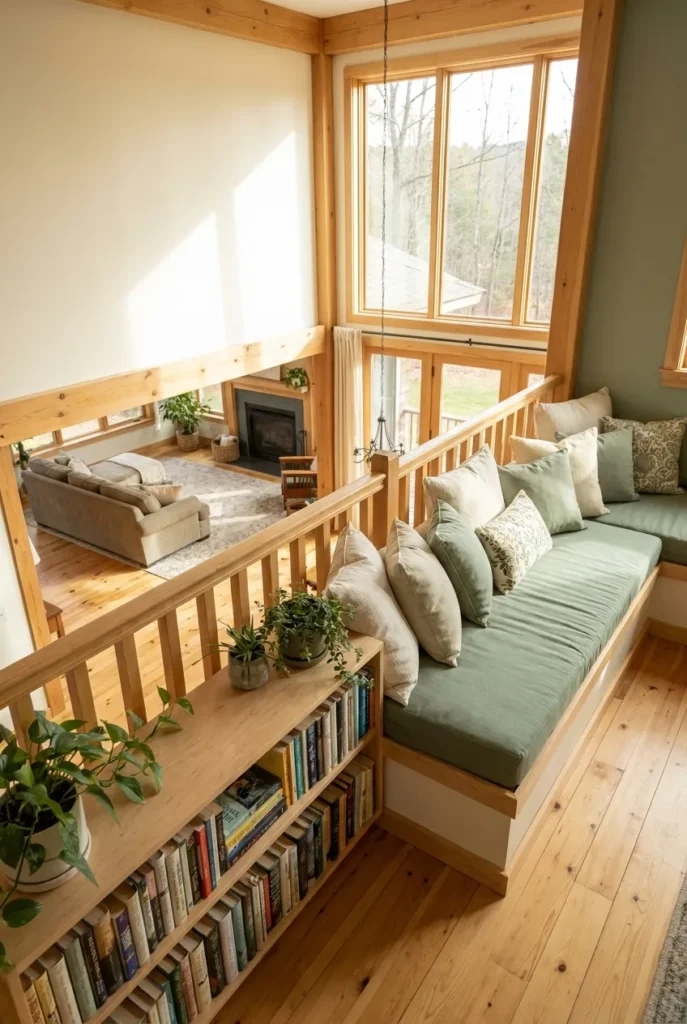
Set your seat at least 12 inches back from the balustrade so you’re not reading with your shoulder over a drop. If you’ve got kids or pets up there, that buffer matters even more. A low bookcase run along the railing line doubles as a soft barrier and storage, which is the kind of double-duty a loft rewards.
Parents building a loft reading nook for kids: keep the cushions back from the edge and skip anything climbable right next to the rail.
Style It by Mood: Cottagecore, Dark Academia, or Scandi
Once the bones are right, the loft becomes a blank mood board. Pick one direction and commit, because a sloped-ceiling corner reads best with a tight palette.
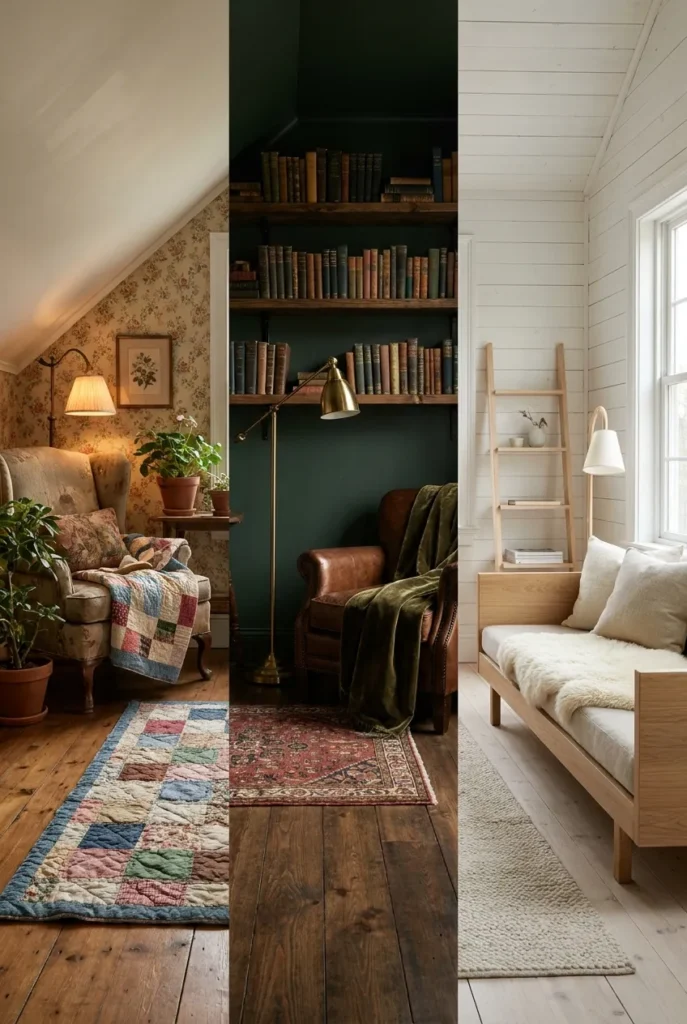
- Cottagecore loft: floral wallpaper on the kneewall, a vintage quilt, a jug of dried stems. Soft, sun-warmed, a little fairy-tale.
- Dark academia loft: deep green or charcoal kneewall, brass picture light, leather-bound stacks. Candlelit and moody under the rafters.
- Scandi loft: white slope, pale oak, one wool throw, nothing extra. Calm and bright, the slope itself as the feature.
A loft’s exposed beams and angles do half the styling for you. Lean into them instead of fighting them.
Add Storage That Fits the Slope
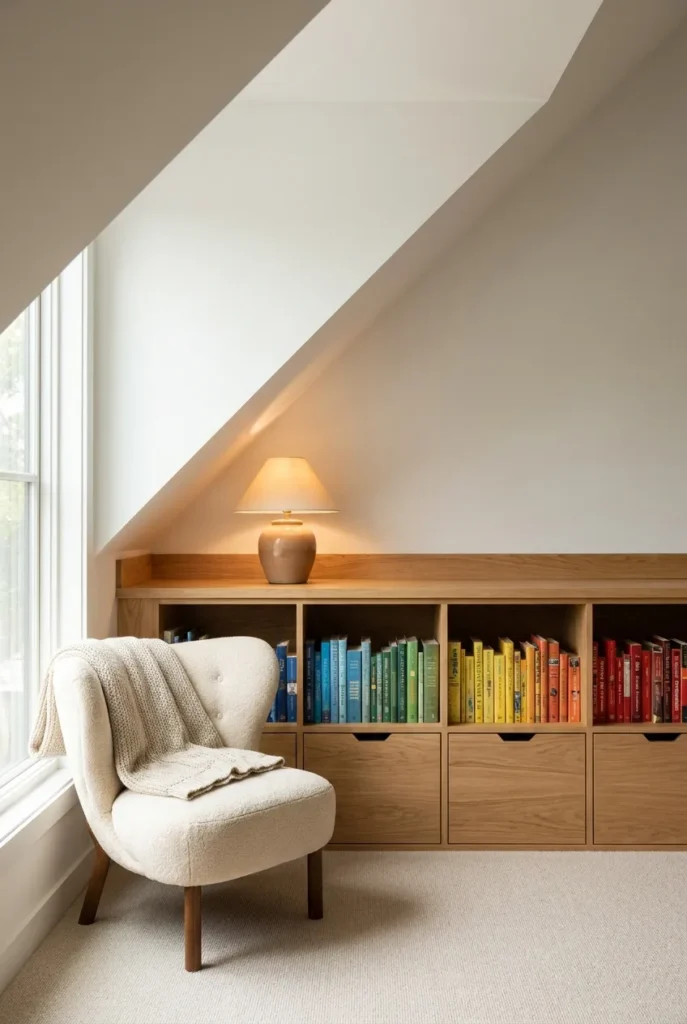
The wedge of space under a sloped ceiling is where storage usually goes to die. Use it. Low cubbies, a row of cube shelves, or under-eave drawers fit the exact triangle a tall bookcase can’t.
Keep the tall storage where you stand and the low storage where the ceiling dips. A 30-inch-high bookcase run along the kneewall turns dead space into a home for 200-plus books and gives you a ledge for a lamp and a mug.
If your loft is really an attic conversion, the storage and insulation tricks in our attic reading nook ideas carry straight over to a loft with the same sloped-ceiling shape.
Soften the Sound (lofts echo more than you think)
A hard-surfaced loft bounces sound. The slope, the wood floor, the open edge all turn page-turning quiet into a faint echo. Soft goods fix it and add warmth at the same time.
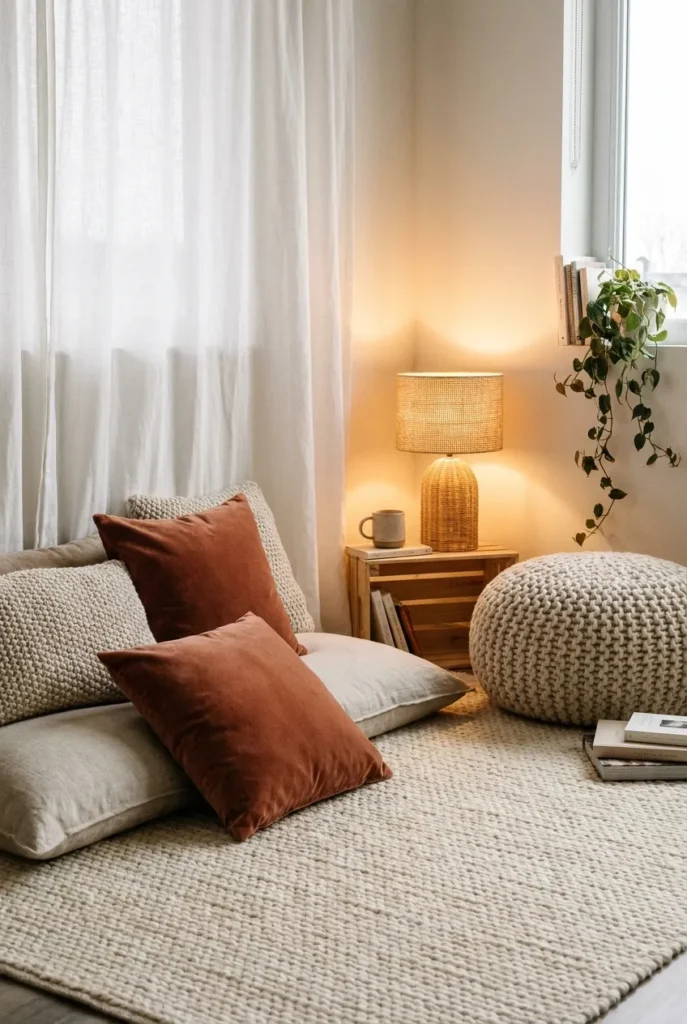
Layer a thick washable rug, a couple of floor pillows, and a fabric curtain. You’ll feel the room go quieter the moment the textiles go in, the same way a recording booth hushes when you hang a blanket. This is the sensory layer that makes a loft nook feel like a real retreat instead of a furnished corner.
Build a Reading Nook Under a Loft Bed
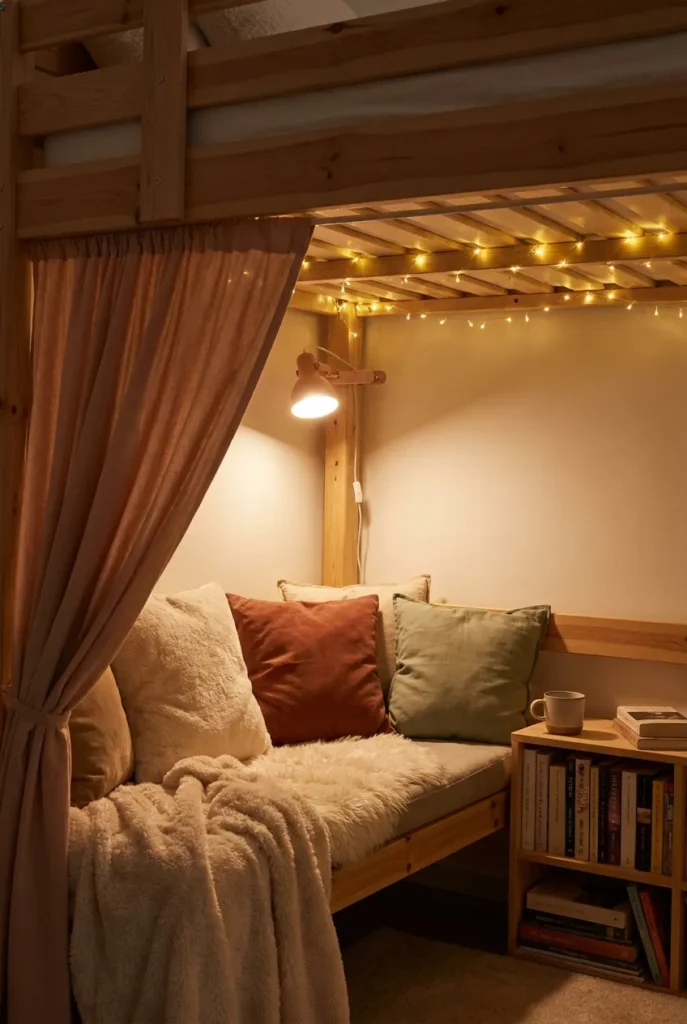
If your loft is actually a loft bed, the gold mine is the space underneath. Clear the floor below the platform and you’ve got a pre-framed, ceiling-capped nook, basically a fort with good lighting potential. This is one of the most-searched loft setups for a reason: it stacks sleeping and reading into one footprint.
Slide a floor cushion or a narrow bench under there, clip a reading light to the bed frame, and hang a curtain across the open side for that hideaway seal. Tween readers love this one, and it keeps a small bedroom doing double duty.
Frequently Asked Questions
How do I create a cozy book corner in a loft?
Start with the four-number clearance check so your head clears the slope, then layer a low seat against the kneewall, a plug-in warm lamp, a washable rug, and a leaning shelf within arm’s reach. Soft textiles do the rest.
What are popular themes for a loft book nook?
Cottagecore (florals, quilts, dried stems), dark academia (deep walls, brass light, leather books), and Scandi (white slope, pale oak, one throw) are the three that suit sloped ceilings best. Pick one and keep the palette tight.
Can I make a reading nook in a loft alcove or under the eaves?
Yes, and the eave wedge is ideal. Low storage and a floor cushion fit the triangle where a tall bookcase can’t, so the awkward low zone becomes the cozy zone instead of dead space.
What are the must-have items for a loft reading nook?
A comfortable low seat, a plug-in swing-arm lamp with a 2700K bulb on a dimmer, a washable low-pile rug, two or three pillows plus a throw, and a within-reach shelf for your books and a mug.
What’s the minimum ceiling height for a loft reading nook?
For sloped-ceiling rooms, US code allows the low side to drop to 5 feet. For comfort while seated, aim for at least 4 inches of clearance above your seated head height at the exact spot you’ll sit.
Is a loft reading nook doable for renters?
Completely. Use a leaning ladder shelf, a tension-rod curtain, clip-on lights, and freestanding dividers. Nothing drills, nothing sticks, nothing damages the walls.
How do I light a loft nook with no overhead outlet nearby?
Plug-in swing-arm sconces and floor lamps bring light to your corner without wiring. Run the cord along the kneewall and a 2700K bulb on a plug-in dimmer gives you warm, adjustable reading light.
Your Loft Corner Is Waiting
The hardest part of a loft reading nook isn’t the building. It’s believing the awkward sloped corner is an asset instead of a flaw. Run the four-number check this weekend, park a low seat against the kneewall, bring your own light, and you’ll have a hideaway you sink into by Sunday afternoon. Which corner of your loft are you eyeing first, and what’s the first book going on the shelf?
Keep reading
More cozy nook ideas
 Living Room
Read →
Living Room
Read →
Cabin Living Room Checklist: Everything to Decide Before You Start
No log walls, no stone hearth, no lake outside the window. You can still build a cabin living room in a regular…
 Bedroom
Read →
Bedroom
Read →
English Cottage Bedroom Checklist: Everything to Decide Before You Start
You saved forty pins of floral quilts and sloped ceilings, then looked up at your own bedroom: beige walls, one window, a…
 Nursery & Teen Rooms
Read →
Nursery & Teen Rooms
Read →
25 Teen Boy Bedroom Ideas That Feel Grown-Up, Not Childish
If his room still has the race car lamp and the glow-in-the-dark stars, and the door has started staying shut, he’s telling…