
Dark Academia Home Decor That Works in a Small, Bright, Rented Room

Most dark academia home decor fails for one reason, and it has nothing to do with your budget or your landlord. It is the ceiling light.
You can paint a wall forest green, stack every hardcover you own, and hunt down the brass candlestick. Flip on a 4000K flush mount above it all and the room goes flat and faintly sad, like a waiting area.
So we are building this backwards. Light first. Then color, then objects, then the books. Renters included, because nothing in the first three sections needs a drill, a paint deposit, or a conversation with your leasing office.
Three lamps. Zero ceiling. That is the whole opening move.
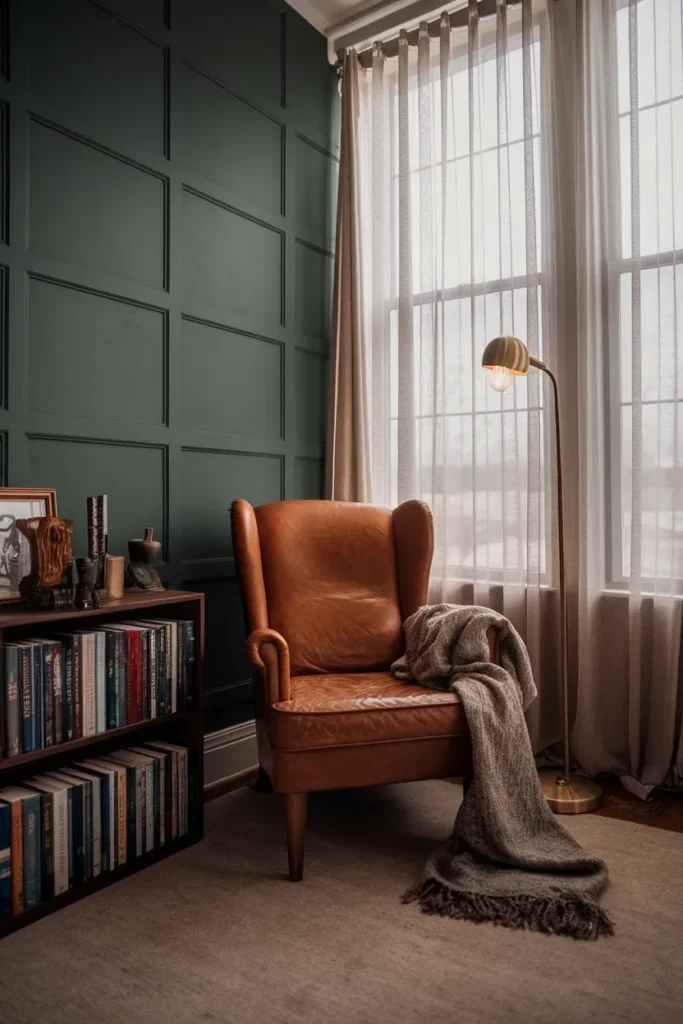
Three Lights, No Ceiling
Here is the rule the whole aesthetic hangs on. Turn the overhead off permanently, then put three separate warm light sources in the room, all of them below standing eye level.
Three, not one. One lamp makes a spotlight and a lot of gloom. Three lamps at different heights make the pools of light overlap, and overlapping pools are what your brain reads as depth.
The bulb spec matters more than the fixture. You want 2700K, sometimes labeled soft white or warm white. Anything at 4000K or above pushes blue and instantly turns dark green walls into something municipal. For the lamp you actually read under, look for roughly 450 to 800 lumens. Below that you are squinting. Above it you have made a kitchen.
Swapping to LED is the cheap part of the whole project. The Department of Energy notes that residential LEDs use at least 75 percent less energy and last up to 25 times longer than incandescent bulbs, and that they emit very little heat, which matters when the lamp is 18 inches from your face and a stack of paperbacks. See the Department of Energy LED lighting guide for the full efficiency numbers.
Placement, in order of impact:
- A floor lamp beside the chair. Shade bottom edge at 40 to 42 inches from the floor when you are seated, so light lands on the page instead of your eyes.
- A small table lamp across the room, low, on a shelf or console. This one is atmosphere, not reading light.
- A plug-in wall sconce or a clip-on picture light aimed at the bookcase spines or a framed print. No wiring, no drilling, just a cord you tuck behind furniture.
Add a plug-in dimmer to at least one of the three. Twelve dollars, and it turns 7 p.m. into a different room than 3 p.m.
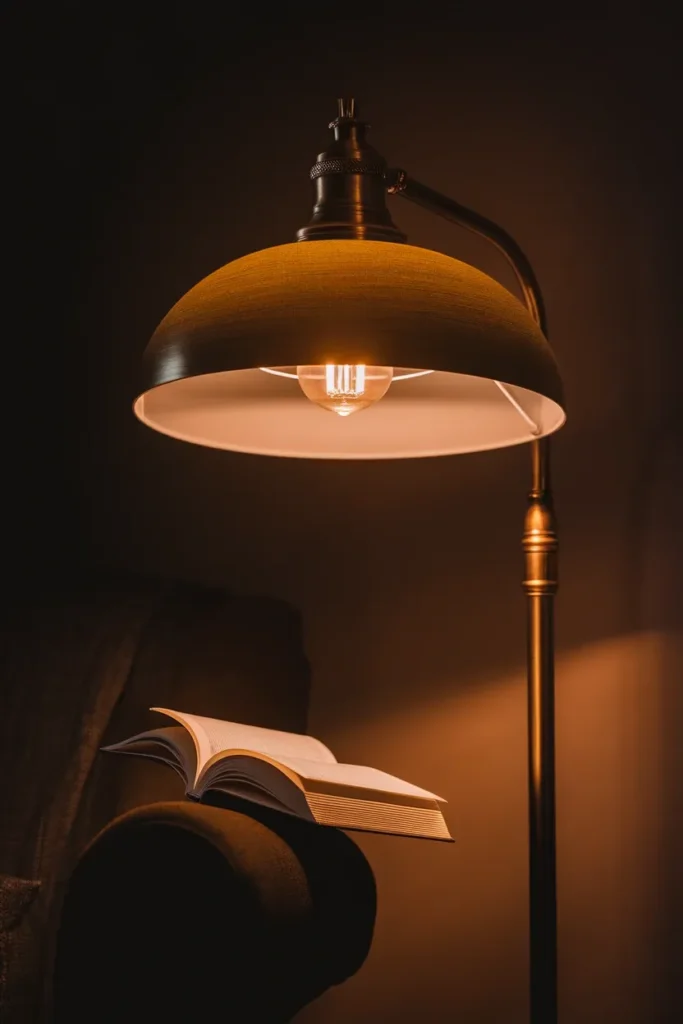
What Dark Academia Actually Is (and What It Is Not)
Dark academia is an interior style borrowed from a literary subculture: old university libraries, Gothic reading rooms, the specific hush of a place where people study for a living. In a home it translates to deep saturated color, warm wood, brass and leather, layered lamp light instead of overhead light, and books treated as the main decorative material rather than as filler.
What it is not: goth, and not a haunted house. The palette runs earthy rather than black. Oxblood, ink, olive, mahogany, tobacco, parchment, and a dark green that reads almost brown at night.
Dark academia vs light academia
Same furniture vocabulary, opposite light. Light academia keeps the antique wood, the brass, and the stacked books, then swaps the walls to cream, sand, and soft sage and lets daylight run the room. Dark academia closes the curtains and lets the lamps run it.
If your apartment gets punishing afternoon sun and you cannot control it, light academia is the honest choice. If you have a north-facing room that everyone else calls dim, you have been handed the good version.
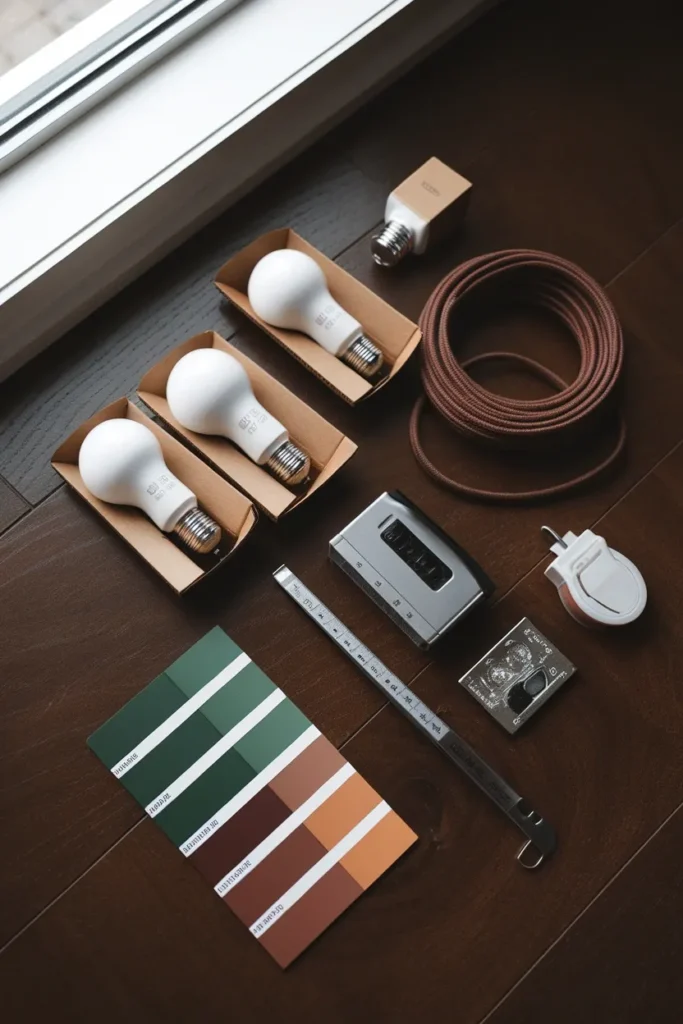
The Five Rules That Keep Moody From Turning Gloomy
Screenshot this part. The difference between a room that reads scholarly and a room that reads like a basement comes down to five decisions, and only the first one involves lighting.
Rule 1. Three lights, no ceiling. Covered above. It is first because nothing else works until it is done.
Rule 2. Every dark surface needs a warm one within arm’s reach. Dark green wall, put oak, cane, or unbleached linen against it. Dark on dark on dark absorbs everything and the room stops having edges.
Rule 3. Nothing shiny above eye level. Keep brass, glass, and gloss low: lamp bases, hardware, a tray, a decanter. Up high, matte only. Reflective objects near the ceiling catch light from the wrong angle and flatten the whole illusion.
Rule 4. One thing per shelf that is not a book. A brass bookend, a small framed print, a dried stem in a bottle, a stack of three books laid flat. One. Two objects per shelf reads as a gift shop.
Rule 5. If it fails the 10-page test, it is a set, not a room. Sit down and read ten actual pages. If your neck aches, the light is behind you, or you have to hold the book at arm’s length to catch the lamp, the corner is styled and not finished. Fix the seat, then the light, then take the photo.
That fifth one is the whole difference between a Pinterest image and a place you use on a Tuesday.
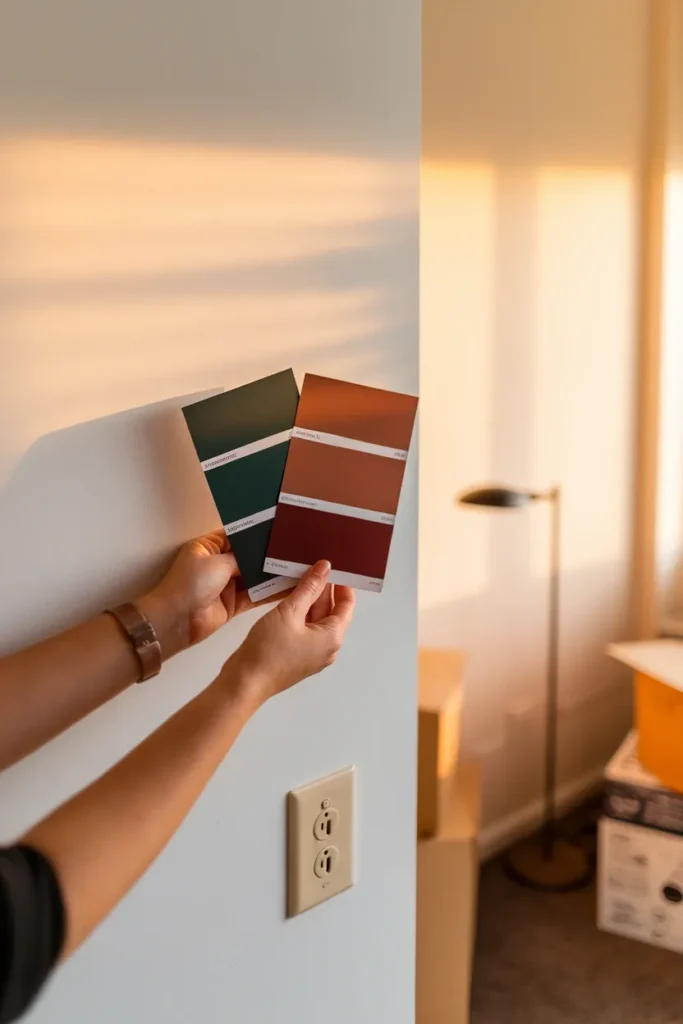
Color: How to Go Dark When You Cannot Paint
This is where most renters quit, and they quit too early. Paint is the loudest way to get depth. It is not the only one, and in a small apartment it is often not even the best one.
Rank your surfaces by square footage and work down the list. Curtains are the biggest fabric area in almost any room, and floor-to-ceiling panels in ink, olive, or oxblood do more visual work than an accent wall for less money and zero deposit risk. Hang the rod 4 to 6 inches above the window frame and let the panels break on the floor. Short curtains are the fastest way to make a room look rented.
Next, the rug. A dark, low-pile wool or washable rug under the chair does two jobs: it absorbs light instead of bouncing it, and it kills the echo in an empty-ish apartment. Front legs of the chair on the rug, always.
Then peel-and-stick paneling or wallpaper on one wall only, ideally the wall behind the chair rather than the one you face. Behind you, the pattern is atmosphere. In front of you, it is a distraction you will get tired of.
Wall art is the cheap layer, and the SERP proves it: dark academia print sets on Etsy were running $2.65 to $21.99 in early August 2026, with a 40-piece gallery bundle at $15.59. Prices on print-on-demand art move constantly, so treat those as a live snapshot rather than a promise.
For the full breakdown of what actually comes off cleanly at move-out, our guide to no-damage rental apartment decor ideas covers adhesive limits and reversal steps in detail.
One honest limit: peel-and-stick behaves very differently on smooth eggshell than on textured orange-peel drywall. On heavy texture it lifts at the seams within weeks. Test one 12-inch square in a corner and wait 72 hours before you buy for the whole wall.
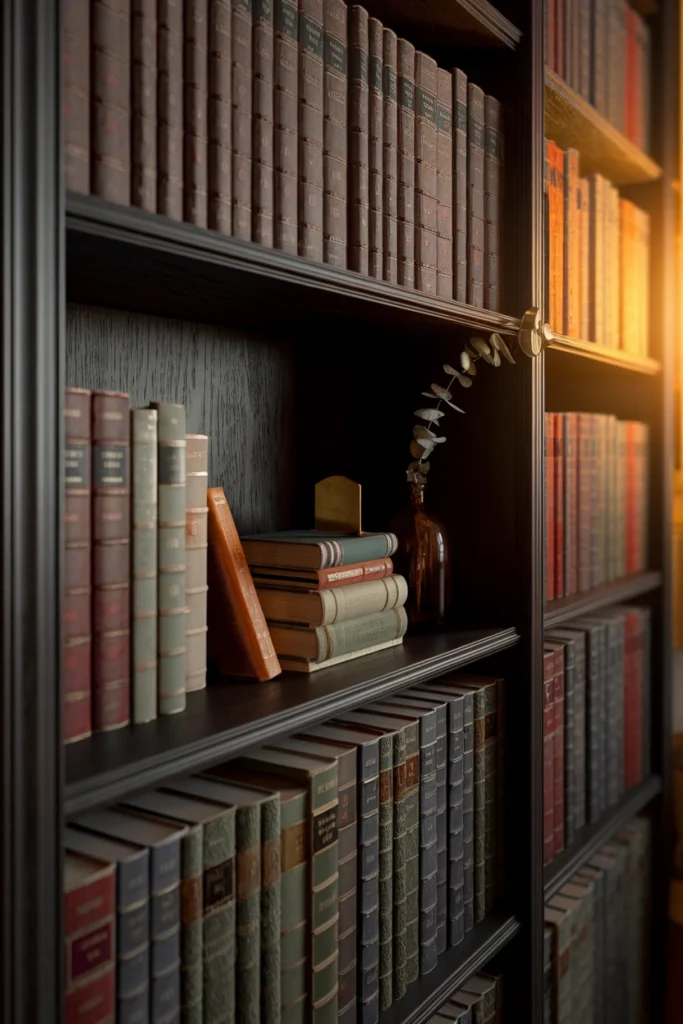
Bookshelves: Style Them So the Books Actually Survive
Nobody else writing about this style will tell you this, so here it is. The exact things that make a shelf photograph well are the things that destroy books.
Direct sun fades cloth bindings permanently. Candle soot settles on top edges. Cramming volumes in tightly warps boards, and stacking a book spine-up cracks the hinge over time. If you are building a personal library rather than a prop wall, five habits protect it, and none of them cost anything:
- Shelve books upright and supported, never leaning. Use bookends where a row is short.
- Group volumes of similar height together so each cover is supported by its neighbors.
- Never store a large book spine up. Lay it flat or shelve it spine down.
- Keep the shelf out of direct light. The Library of Congress recommends minimal exposure to all light and ideally none that is direct or intense.
- Aim for a cool, moderately dry room: 70°F or below and 30 to 55 percent relative humidity. The Library of Congress book storage guidance spells out the full range.
Convenient overlap: a room with the curtains half drawn and the ceiling light off is already close to ideal book storage. The aesthetic and the preservation want the same thing.
The one place they conflict is candles. Burn them on the coffee table or the mantel, not on the bookshelf, and never inside an alcove where the smoke has nowhere to go. Soot on a top edge does not come off.
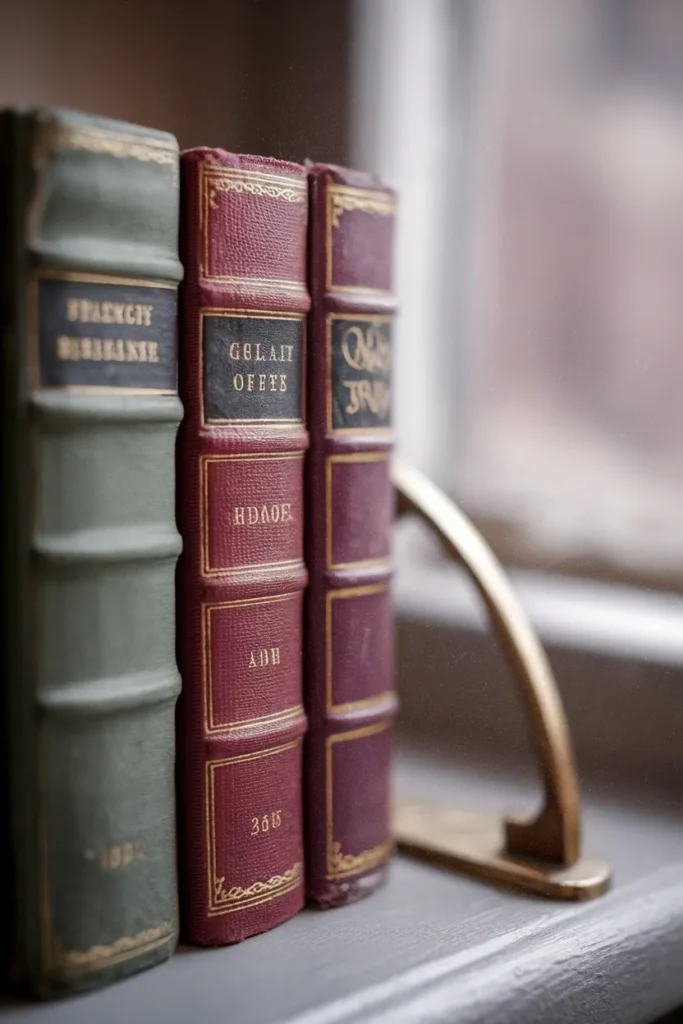
Three Setups You Can Copy Exactly
Pick the one that matches your floor plan, not the one that matches the prettiest pin.
The corner chair (smallest footprint, roughly 4 by 5 feet)
A leather or velvet armchair angled about 30 degrees off the corner, a floor lamp behind the reading shoulder, a small round side table, a dark low-pile rug, and a two-shelf ladder shelf or low bookcase within reach. This fits in a studio apartment and reads as a deliberate hideaway rather than leftover space.
The desk-as-study (best for a dark academia home office)
A dark wood or black desk facing into the room rather than at a wall, a swing-arm task lamp clamped to the edge, one large framed print above, a stack of reference books held with brass ends, and a green glass or brass banker’s lamp if you want the shorthand. This is the setup the annotated Pinterest floor-plan pins keep showing, and it is the highest-converting version for anyone who works from home.
The bed-adjacent library wall (bedrooms, rentals, no floor to spare)
Two tall bookcases flanking the bed, a plug-in sconce on each side at roughly 48 inches from the floor, blackout curtains in a deep tone, and a wool throw folded at the foot. No floor space consumed at all.
Numbers that make any of the three work:
| Element | The number | Why it matters |
|---|---|---|
| Side table height | 24 to 26 in. | Lands within 2 in. of a standard chair arm, so you set a mug down without looking |
| Lampshade bottom edge | 40 to 42 in. from floor, seated | Light hits the page, not your eyes |
| Reading bulb | 2700K, 450 to 800 lumens | Warm enough for the mood, bright enough to actually read |
| Bookcase depth | 11 in. (a standard IKEA BILLY) | Fits hardcovers without eating the walkway |
| Rug size under a chair | 5 by 7 ft minimum | Keeps the front legs on the rug so the corner reads as one zone |
| Sconce height | 48 to 52 in. from floor | Above a nightstand, below the top of a headboard |
Sizes confirmed against IKEA’s current US BILLY listing, which runs 31 1/2 in. wide by 11 in. deep by 79 1/2 in. tall for the standard unit. The rest are working dimensions, so measure your own chair before you order.
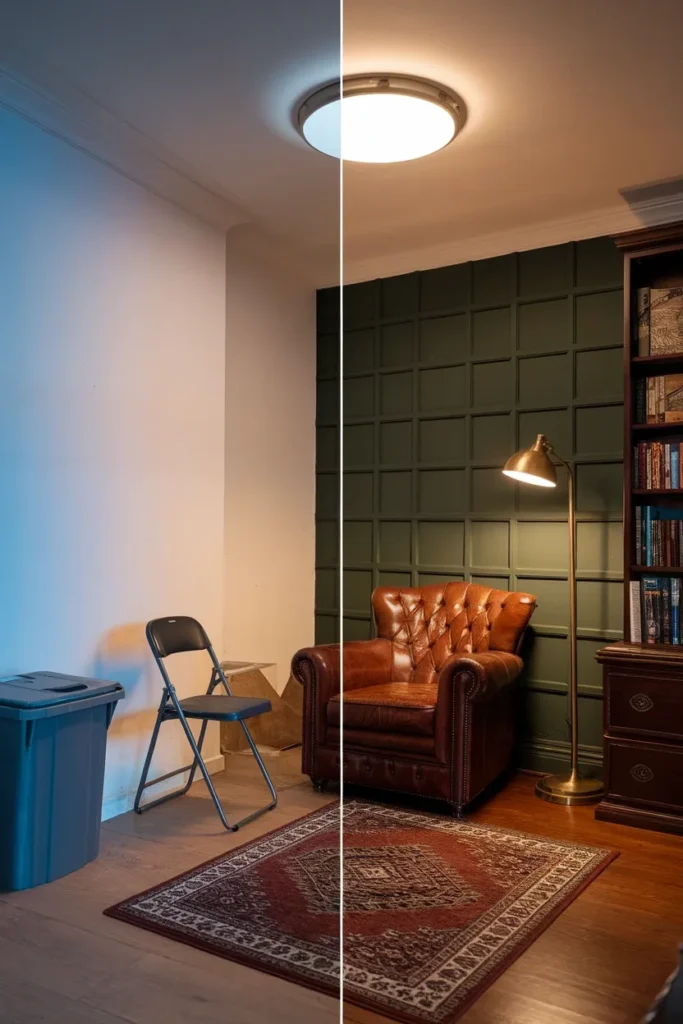
The Under-$200 Version and the Order to Buy It In
Buy in this sequence. Each step makes the next one look better, which is the point of doing it in order rather than all at once.
| Order | Buy | Estimated band (Aug 2026) | Why it comes here |
|---|---|---|---|
| 1 | Four 2700K LED bulbs | $10 to $18 | Changes the room before you spend anything else |
| 2 | Plug-in dimmer | $10 to $15 | Turns one lamp into three moods |
| 3 | Floor-length curtain panels in a deep tone | $30 to $60 | Largest color surface, zero damage |
| 4 | Secondhand floor lamp | $20 to $50 | Thrift and estate shelves are where the brass lives |
| 5 | Dark low-pile or washable rug, 5 by 7 | $50 to $90 | Absorbs light, kills apartment echo |
| 6 | Printed wall art set | $3 to $22 verified live | Cheapest visual density per dollar |
| 7 | Brass bookends, tray, or a small object | $10 to $25 | Last, because Rule 4 caps how many you need |
Everything except row 6 is a good-faith estimate rather than a verified price, and secondhand pricing swings hard by region. Row 6 is the one number pulled straight from live US shopping results on August 9, 2026.
Skip for now: the antique globe, the vintage typewriter, the leather chesterfield. They are the finish, not the foundation, and buying them first is how people end up with an expensive room that still feels wrong. If lighting is the piece you want to get right before anything else, we walk through layering warm lighting in a small room step by step.
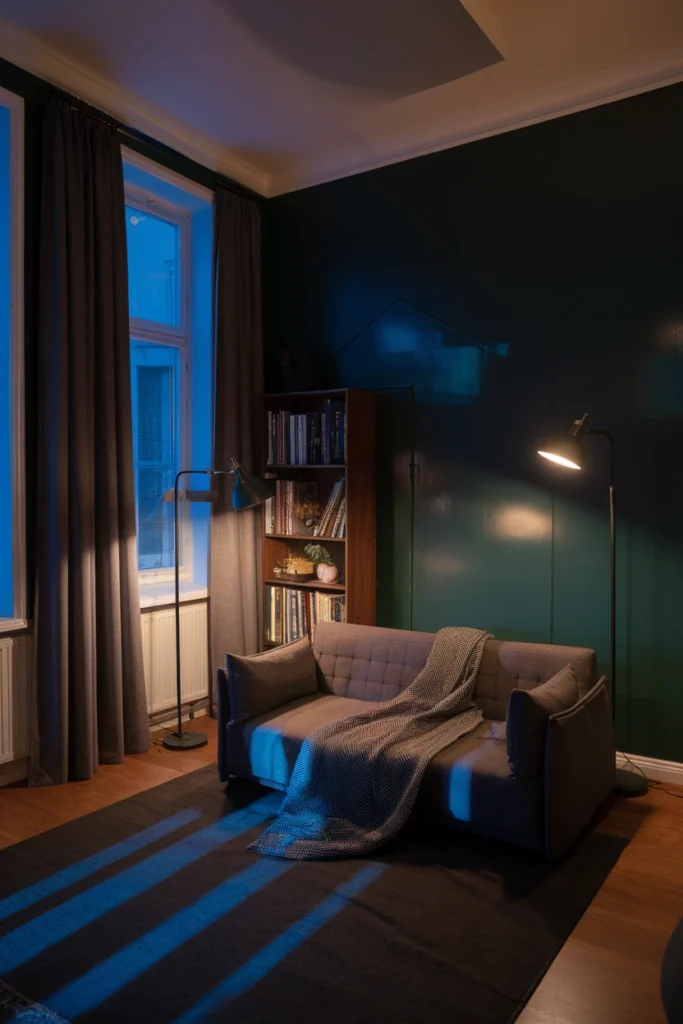
Texture and Objects: What Reads Vintage Without Reading Like a Prop
Texture is what separates a moody room from a dark room. Aim for four different surfaces you would want to touch: something woven, something with pile, something worn smooth, and something cold.
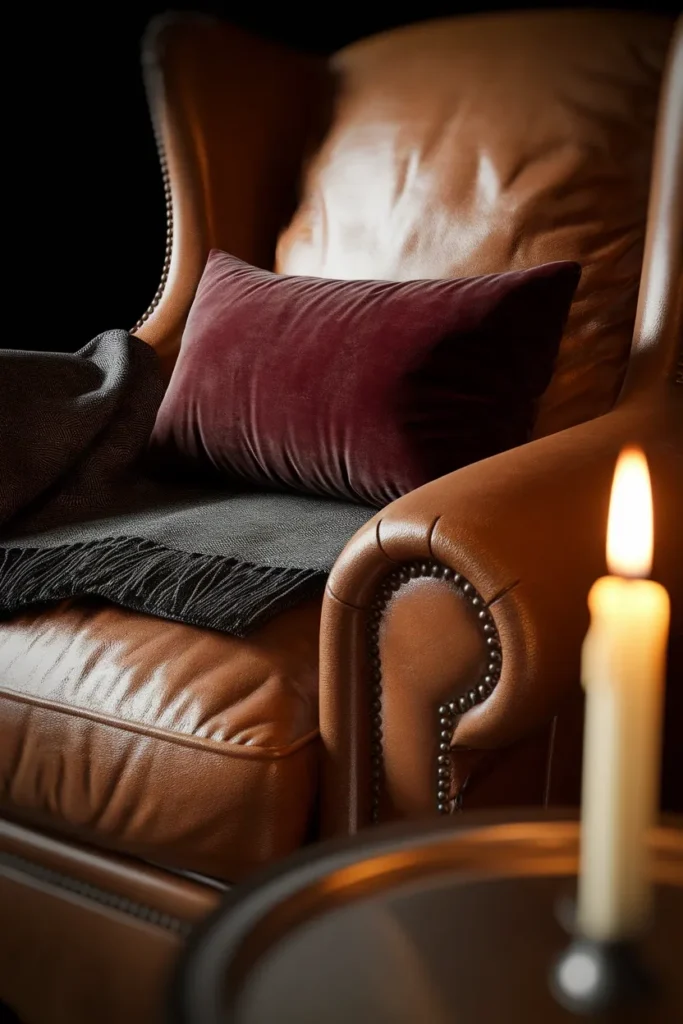
In practice that means a wool or boucle throw, a velvet or sheepskin lumbar pillow, an oiled leather chair arm or a wood surface with visible grain, and one piece of brass, glass, or marble. Four is enough. Six starts looking staged.
Objects are where dark academia goes wrong fastest. The failure mode is buying a themed kit: the globe, the chess set, the fake stack of leather-bound spines, all arriving in the same box on the same day. Rooms that work look accumulated because they were, and the fix is patience plus a rule for what earns a spot.
The rule we use: an object stays if you can say where it came from. Grandmother’s, a flea market in October, the estate sale two towns over, the thrift shelf where somebody clearly donated a whole desk set. Provenance is the thing a catalog cannot sell you.
Dried stems beat fresh flowers here, since the palette wants muted and dried eucalyptus, wheat, or ruscus goes brown-gold in exactly the right direction. And if the moodier end of this appeals to you, the overlap with dark cottagecore bedroom ideas is worth a look, since both styles run on deep color and warm low light.
Making It Work in a Bright, White, Builder-Grade Apartment
If your walls are flat builder white, your ceiling is 8 feet, and your one light source is a dome fixture, you are the reader nobody writes this style for. Here is the sequence that works anyway.
Kill the overhead first. If the room has no wall switch you can leave off without losing power to your outlets, put the lamps on a cheap smart plug or a plug-in remote and stop touching the wall switch entirely.
Then borrow height instead of adding it. Curtain rods mounted just under the ceiling line rather than just above the window frame stretch an 8-foot wall visually. Tall narrow bookcases beat wide short ones for the same reason.
Handle the wall art without hardware. Command Picture Hanging Strips hold 1 pound per set for small, 3 pounds for medium, and 4 pounds for large, per 3M’s own published limits. Frames get heavy faster than people expect, so use two sets for anything above roughly 11 by 14 inches and weigh the frame on a kitchen scale before you commit. A frame that falls at 2 a.m. takes the paint with it, and that is the deposit gone.
Last, accept one bright wall. Trying to darken every surface in a sunlit box apartment produces a muddy gray room. Make one wall deep, keep the rest light, and let the lamps and textiles do the rest of the work after sundown.

Frequently Asked Questions
What is dark academia in interior design? It is a style built from deep saturated color, warm wood, leather, brass, and layered lamp light, with books used as the primary decorative material. The reference points are old university libraries and Gothic reading rooms rather than any single historical period, which is why it mixes Victorian, mid-century, and thrifted pieces without looking wrong.
What is dark academia style, in one sentence? A scholarly, low-light interior that trades brightness and open space for depth, texture, and the sense that somebody reads in the room every day.
What is the difference between light academia and dark academia decor? Same furniture and objects, opposite light strategy. Light academia uses cream, sand, and sage walls with daylight running the room. Dark academia uses ink, olive, oxblood, and mahogany with lamps running it. Pick based on how much sun your room actually gets, not on which one photographs better.
How do you decorate a dark academia room in a rental? In this order: swap every bulb to 2700K and stop using the ceiling light, hang floor-length curtains in a deep tone, add a dark low-pile rug, then a secondhand floor lamp, then art on adhesive strips within their rated weight. Peel-and-stick paneling on one wall is the only semi-permanent step, and it should be tested on a 12-inch square first.
What colors work for dark academia home decor? Forest and olive green, oxblood and burgundy, ink navy, chocolate and mahogany brown, charcoal, tobacco, and parchment as the relief tone. Avoid true black on large surfaces, since it reads flat under lamp light. Every dark surface should have a warm wood or unbleached linen surface near it.
Can dark academia work in a small apartment? Yes, and small rooms are frequently easier. Fewer square feet means fewer lamps needed to make the pools of light overlap. Keep the footprint honest: one chair, one lamp, one bookcase, one rug in a 4 by 5 foot corner beats a half-finished version spread across the whole room.
How do I keep a dark academia room from feeling gloomy? Three things, in order. Turn off the overhead and use three lower warm sources. Put a warm-toned surface against every dark one. Keep anything reflective below eye level. Rooms read as gloomy when they are underlit and uniform, not when they are dark.
Start With the Bulbs
You do not need a Gothic apartment, an antique budget, or a landlord who says yes. You need to stop lighting the room from the ceiling, put a deep color on the largest fabric surface you own, and let everything else arrive slowly enough that it looks like it accumulated.
Do step one tonight. Swap the bulbs, turn the overhead off, and sit in the corner with ten pages. You will know within a chapter whether the chair or the lamp needs to move.
Then, when the light is right, work on the layer that carries the most weight for the least money: warm lighting in a small room, and the deep moody bedroom version of this same palette.
Keep reading
More cozy nook ideas
 Boho
Read →
Boho
Read →
Boho Bathroom Checklist: Everything to Decide Before You Start
No gut job, no new tile, no landlord permission slip. A boho bathroom mostly comes down to eight decisions made in the…
 Cozy Home
Read →
Cozy Home
Read →
25 Cozy Bedding Ideas for a Cozier Home
If your bed right now is one flat comforter, two pillows that fold in half, and a throw that ends up on…
 Farmhouse & Country
Read →
Farmhouse & Country
Read →
Modern Farmhouse Bedroom Checklist: Everything to Decide Before You Start
Ten decisions, made in the right order, and a modern farmhouse bedroom stops being a pile of saved pins and starts being…