
25 Cozy Bedding Ideas for a Cozier Home

If your bed right now is one flat comforter, two pillows that fold in half, and a throw that ends up on the floor by midnight, you don’t need a bigger budget. You need layers that each do a job.
These 25 cozy bedding ideas are built for real bedrooms: rentals, small rooms, beds shoved against a wall, and couples who can’t agree on the thermostat. Each idea names a fabric, a size, or a price, so you can shop once and stop guessing.
You’ll find the five-layer stack that fixes most flat beds and the flannel weight that keeps you warm (ignore thread count). There’s a pillow order that takes three moves and a real $85 refresh from one IKEA trip.
There’s also a setup for reading in bed without your pillows collapsing. And there are two safety notes worth knowing before you buy anything heated or weighted.
Start with idea 1. It tells you which layer your bed is missing, and every idea after it fills one.
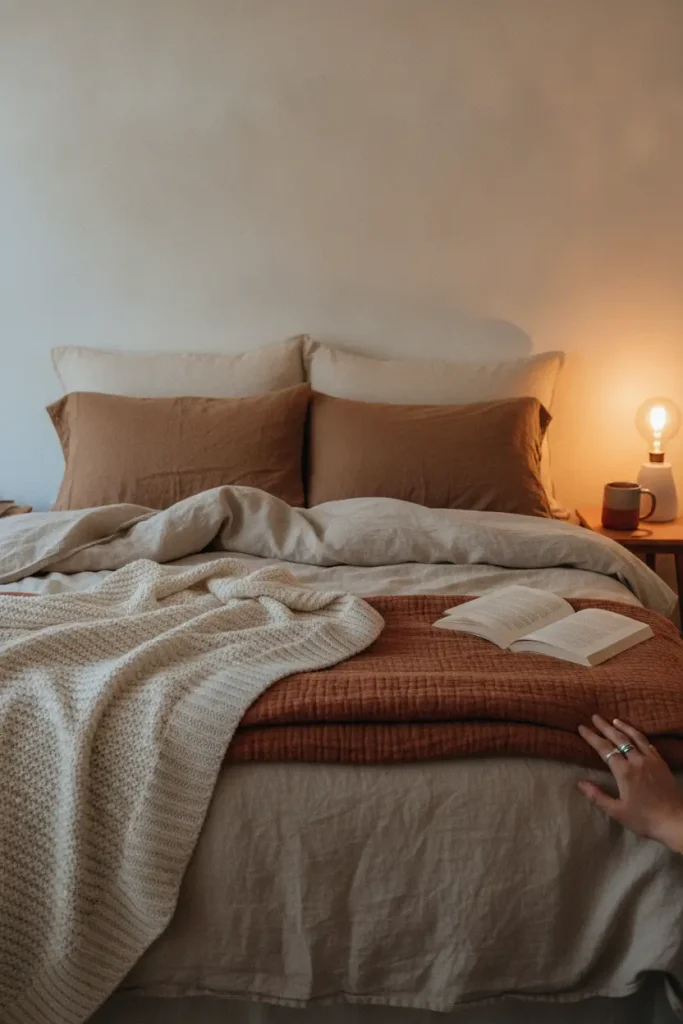
1. The Five-Layer Stack: Layered Bedding With a Job for Every Layer
Most flat-looking beds are missing a layer, not money. Every layer below has one job. When a bed feels thin or looks sad, one of these jobs isn’t getting done.
Work bottom to top:
Pillows get their own formula in idea 9.
Skipping the flat sheet is the most common gap. Without one, you end up washing the whole duvet cover every week, so it looks tired by spring.
Name the missing job first. Then shop for it.
2. Pick Flannel Sheets by Weight, Not Thread Count
Thread count means almost nothing on flannel. Flannel is sold by weight in grams per square meter (GSM), and that number tells you how warm a set will sleep.
Here’s how the two common weights compare:
| Around 170 gsm | Around 135 gsm |
|---|---|
| Holds more warmth | Sleeps cooler |
| Usually more durable | Lighter on the body |
| Best for drafty rooms and cold sleepers | Best for early fall and warm sleepers |
Look for a brushed nap on both sides, since that feels softest against bare legs. A good set typically runs $100 to $200.
Thinner flannel tends to pill first at the foot of the bed, where your heels rub all night. Dry it on low heat and it lasts longer.
3. Size Your Duvet Insert One Step Up
A queen mattress is 60 by 80 inches. A full/queen insert is usually about 92 by 96 inches, which barely clears the sides once two people pull on it.
Go up to a king insert, around 110 by 96 inches, and the difference is instant. It drapes lower on both sides, the bed looks fuller from the doorway, and nobody wakes up with a cold shoulder.
The catch is that you’ll need a king duvet cover too. On a low platform frame, a king insert can also puddle on the floor, which the cat will treat as an invitation.
4. Stonewashed Linen for a Bed That Looks Slept-In on Purpose
Wrinkles are the whole point of linen. A rumpled linen duvet cover looks relaxed even when you’ve made the bed in 20 seconds, and it breathes better than polyester on the first warm nights of fall.
New linen can feel stiff and a little scratchy. Stonewashed linen skips most of that break-in because it’s been washed and tumbled before it ships.
💡 Quick Tip
Wash any new linen twice before you decide how it feels. The fibers relax a lot in the first few cycles, and line drying keeps the soft, slubby texture you bought it for.
Iron it and you’ve missed the point.
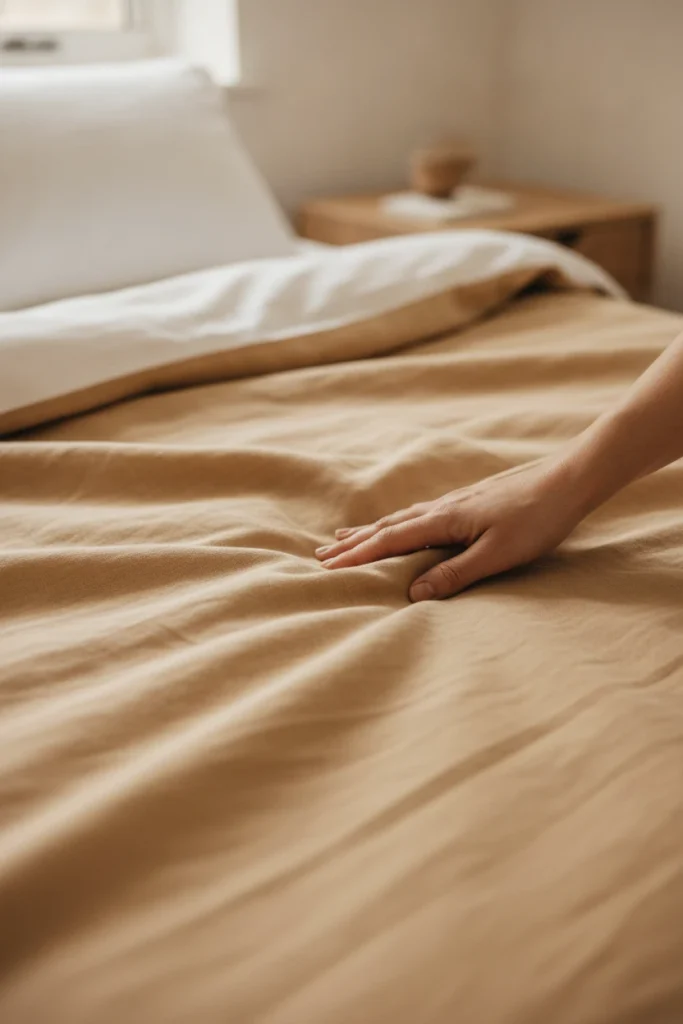
5. Fold a Quilt in Thirds at the Foot
September nights swing hard. Bedtime still feels like summer, and by 4 a.m. you’re hunting for your socks. A quilt handles that swing better than a heavier comforter.
Fold it in thirds across the bottom third of the bed. When your feet get cold, pull it up without turning on a light. Quilts that work well here:
- ▸A cotton channel quilt in a solid color, for clean lines
- ▸A thrifted patchwork quilt, for color without buying a new duvet
- ▸A velvet quilt, for sheen under lamplight
- ▸A cotton gauze quilt, for the lightest weight
Wash a thrifted quilt on cold and gentle before it goes near your pillows. Old dyes can bleed.
6. A Chunky Knit Throw You’ll Actually Reach For
Nobody grabs a throw that’s folded into a tight square. Drape it loose over one corner so it’s already half-open when you climb in.
The IKEA DYSTERMAL is a chunky off-white knit at 51 by 67 inches for $39.99. The flatter-knit HUMLEMOTT is the same size for $24.99.
Recreate this look
Chunky knits snag on rings, zippers, and pet claws. If a dog shares your bed, a tighter knit will outlast a loose one.

7. Mix Gingham With a Small Floral
Gingham and florals look planned when they share one color and differ in scale. Pinterest’s cottage bedding boards are full of this pairing, and the trick is easy to copy.
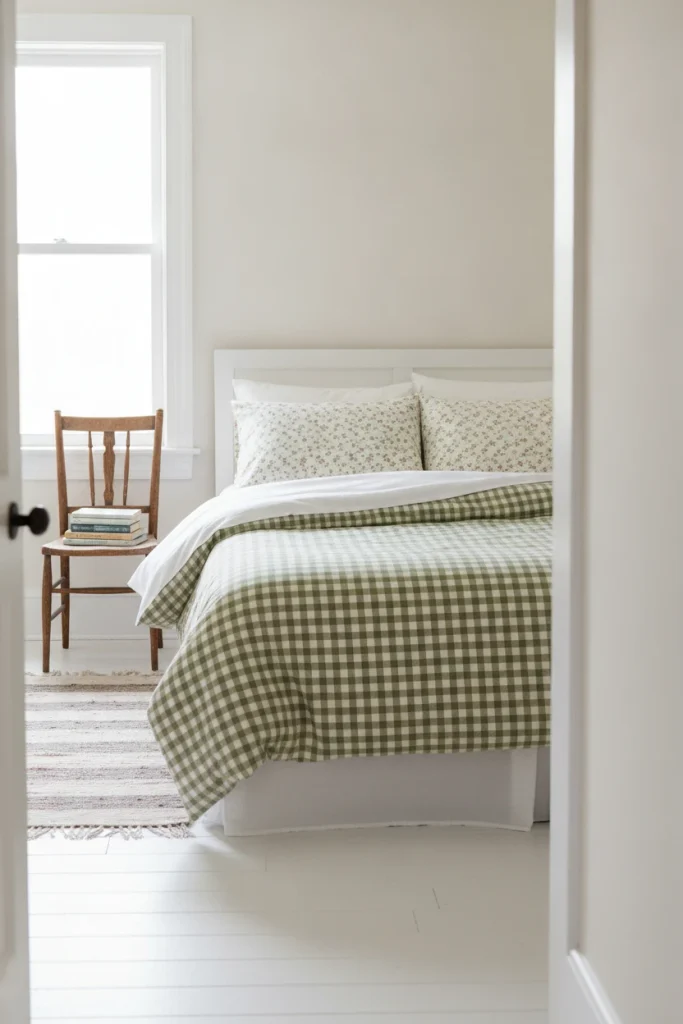
Pair a large gingham duvet with a small, busy floral on the shams.
Pull one shared color, like olive, into both prints.
Ground it with plain white sheets.
Two prints at the same scale, which read as noise.
A third print bigger than the first two.
Patterned sheets under patterned everything.
When you aren’t sure, make the third pattern a stripe so thin it reads as texture.
8. Borrow Fall Colors From the Trees Outside
Rust, olive, and oatmeal look warm because they echo late September leaves. Put the darkest color low on the bed, where it hides wear, and keep the lightest near your face.
Swap only the quilt and the shams in spring. The sheets and duvet stay year-round, and the whole bed changes season for the price of two pieces.
9. Stack Pillows Back to Front in Three Moves
Pillows go on back to front, biggest first. Sizes matter here. A Euro sham is 26 by 26 inches, a standard is 20 by 26, and a king is 20 by 36.
Stand two Euro shams against the headboard on a queen, three on a king. They’re the backdrop.
Lean your sleeping pillows in front, in standard or king cases that match the sheets.
Finish with one lumbar pillow centered in front. One is enough.
Five pillows total on a queen. Past that, you’re just moving pillows to the floor every night.
10. Set Up the Bed for Reading, Not Just Sleeping
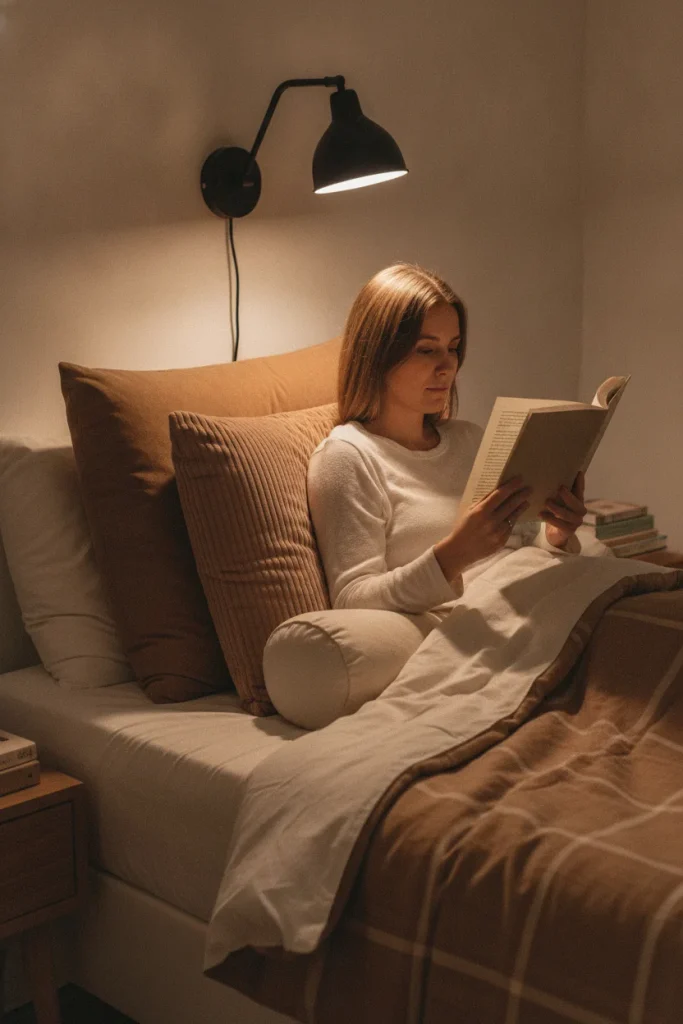
Sleeping pillows fold in half the second you sit up to read. After twenty minutes your neck is bent forward and the book is on your chest.
Give your back something firm to lean on and your book a light that stays put. The Euro shams from idea 9 do double duty here. For more ways to build a reading spot right beside the bed, browse these bedroom reading nook ideas for small rooms.
Two soft pillows stacked and sliding. The overhead light is on, glaring off the page, and you’re squinting by chapter two.
A reading pillow with arms or two firm Euros behind you, a bolster under your knees, and a plug-in sconce or clip-on light with a warm 2700K bulb aimed at the page. No drilling needed.
The bolster under your knees is the part people skip. It takes the pressure off your lower back more than any pillow behind you.
11. Split the Layers When One of You Runs Hot
Couples rarely agree on temperature. The fix is to share the fitted sheet and the look, then split everything that decides warmth.
Many Scandinavian homes skip the shared duvet entirely and put two twin duvets on one bed. That’s the idea here:
| 🔥 Warm sleeper’s side | ❄️ Cold sleeper’s side |
|---|---|
| Lightweight twin duvet | Heavier twin duvet |
| Percale or linen pillowcase | Flannel pillowcase |
| Nothing extra on top | Half a quilt folded over their side |
During the day, lay one king coverlet over both duvets and the bed looks like a single, finished bed again. Nobody has to know about the treaty underneath.
12. Weighted Blankets Are for Grown-Ups Only
Adults can sleep under a weighted blanket. Babies and small kids shouldn’t. The steady pressure some adults like at night is exactly what makes these blankets risky for someone too small to push one off.
Safety note: anchor tall furniture to the wall, keep candles and cords away from fabric, and use a licensed electrician or contractor for hardwired lighting, ceiling mounts, or anything structural. For weighted and heated bedding, follow the maker’s age and weight limits, and ask your pediatrician before using either with a child.
For babies, the rule is simple. The CPSC’s safe sleep guidance for babies says not to use weighted blankets or weighted swaddles, and to keep the crib bare except for a fitted sheet.
⚠️ Watch Out
In December 2022, Target recalled about 204,000 Pillowfort children’s weighted blankets after two young children died. A child could unzip the cover and get trapped inside. Keep zippered weighted covers out of kids’ reach.
For adults, most makers suggest a blanket around 10% of your body weight. Weighted blankets also trap heat, so a cotton cover beats a minky one if you run warm.
13. Put the Heat Under You With a Heated Mattress Pad
Heat under you beats weight on top. A heated mattress pad goes under the fitted sheet and warms the whole bed before you get in, so you can sleep under a lighter duvet.
Warm the bed from below for twenty minutes, then switch it low or off. You climb into heat without piling on three heavy layers.
A few rules keep it safe:
- Lay it flat with no folds or bunching.
- Buy it new, never secondhand.
- Replace it at the first frayed cord or scorch mark.
- Skip it on waterbeds and on some adjustable beds, and keep young children off heated bedding entirely.
If you also run a space heater, CPSC advises keeping it at least 3 feet from the bed.
14. A Featherbed Topper for the Sink-In Feeling
Old mattress, rental mattress, too-firm mattress: a topper fixes all three for far less than a new bed. A down-alternative featherbed adds that soft, sink-in first layer you feel in hotel beds.
The trade-off is that a featherbed flattens where you sleep unless you shake it out. It also adds several inches of height.
Measure your mattress depth plus the topper before you buy sheets, or your fitted sheet will pop off a corner at 2 a.m.
15. Check the Label Before Anything Touches Your Skin
Sheets spend eight hours against your skin every night, so what’s in the fabric matters as much as how it feels. The OEKO-TEX STANDARD 100 label is the easiest check to make in a store aisle or on a product page.
What that label tells you:
- ▸Every thread, button, and zipper was tested against a list of more than 1,000 harmful substances.
- ▸Bed linens fall in Class 2, the class for direct skin contact.
- ▸Baby items fall in Class 1, which has the strictest limits.
- ▸Certificates last one year, so an old claim can lapse.
Worth knowing: the label covers harmful substances, not whether the cotton is organic. Those are two separate claims.
16. Sherpa and Bouclé Belong in Small Doses
Sherpa photographs soft and sleeps hot. A whole sherpa comforter feels great for ten minutes, and then you’re kicking it off.
Use these nubby, furry textures where your hands land instead of where your whole body lies.
A bouclé lumbar pillow in front of linen shams.
A sherpa-lined throw at the foot for reading.
One fuzzy piece against smooth ones, so each stands out.
Sherpa sheets or a full sherpa duvet if you run warm.
Washing sherpa with towels, which leaves it matted with lint.
High dryer heat, which turns the pile crunchy.
Texture works by contrast. One rough piece next to smooth linen does more than five fuzzy ones.
17. Go Tonal: One Color, Five Textures
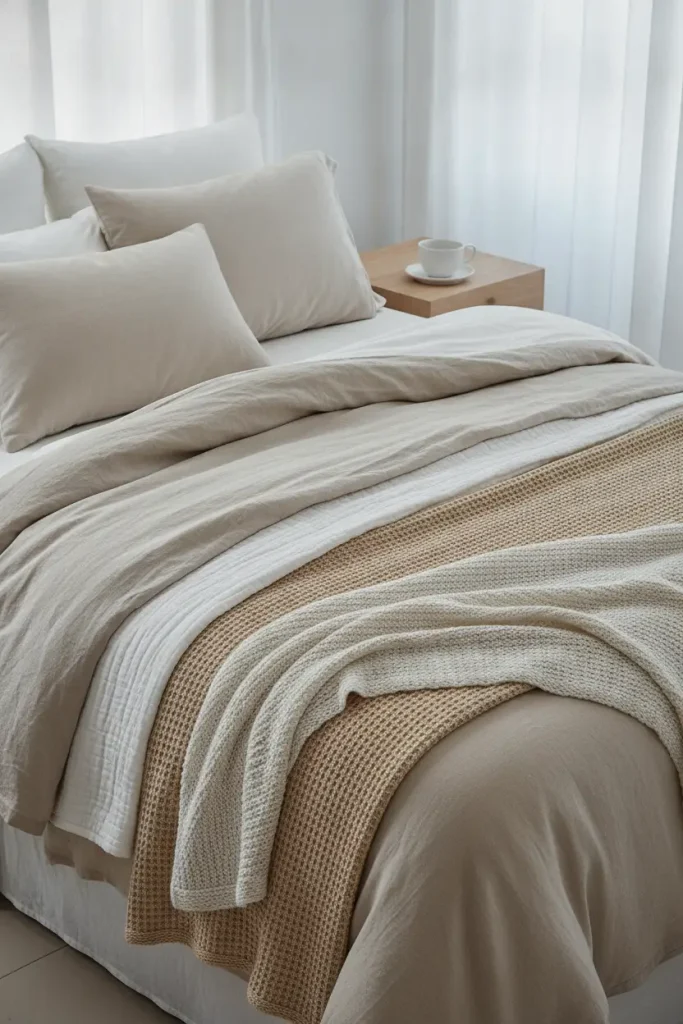
Pick one color and let texture do the talking. An all-oatmeal or all-cream bed looks calm, but it only works when every layer feels different under your hand.
Pantone named Cloud Dancer, a soft white, its 2026 Color of the Year, so this look lines up with where bedding is heading.
Keep every piece within two shades of each other. Once one piece is a whole shade brighter, it looks like a mistake instead of a choice.
18. Dress a Daybed So It Works as a Couch and a Bed
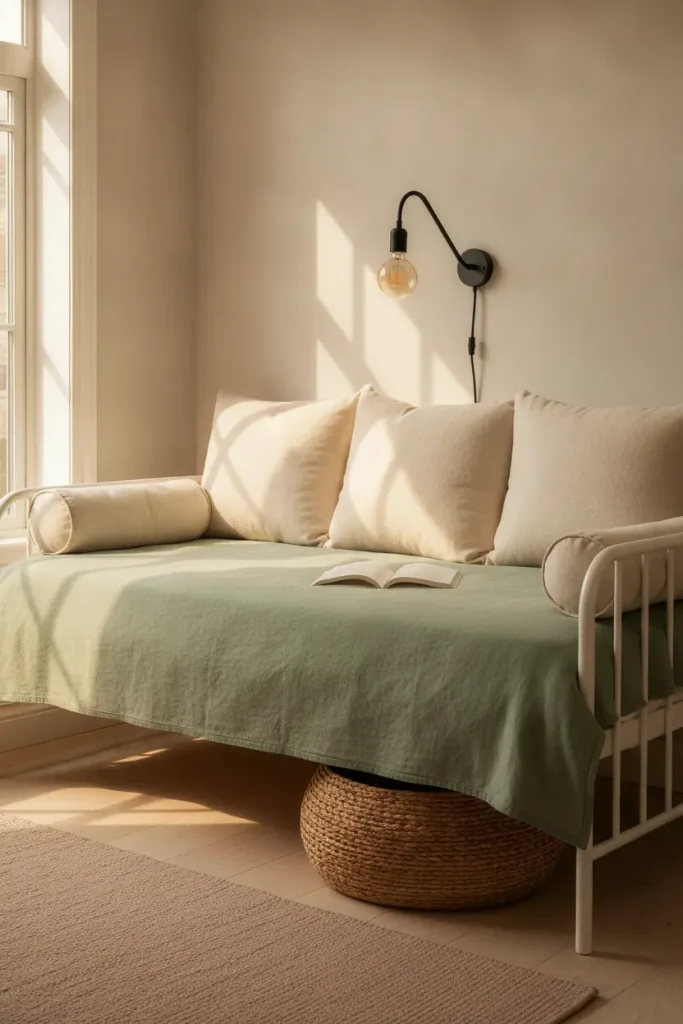
Daybeds live two lives. By day they need to look like a sofa, and by night they need to sleep like a bed. Most daybeds take a twin mattress, 38 by 75 inches.
Cover the mattress with a twin fitted sheet, then a twin coverlet tucked tight on all three open sides. That gives you the upholstered look.
Line three Euro shams along the long back wall as a backrest.
Set a bolster at each end as an armrest, and keep the sleeping pillow and duvet in a lidded basket underneath.
Guests can unmake it in two minutes. For layouts that put a daybed in a spare corner, see these daybed reading nook ideas for spare corners.
Skip the bed skirt. On a daybed it catches on your legs every time you sit.
19. Bedding That Behaves When Your Bed Hugs a Wall
Pushing the bed into a corner frees up floor space in a small bedroom. It also makes the wall side almost impossible to tuck.
A heavy comforter and a flat sheet you tuck by crawling across the mattress. The wall side is always bunched, and the whole bed looks half made.
Deep-pocket fitted sheet only, no flat sheet, and a duvet you shake out from the open side. Pillows lean against the wall like a daybed, and a quilt covers the one visible edge.
Zipper bedding is worth a look here too. The top layer zips onto a fitted base, so there’s nothing to tuck at all.
20. Lumbar Pillows, Chosen for the Job They Do
Lumbar pillows earn their spot when they do a job, not when they just fill space. Before you buy one, decide what it’s for.
Pick the lumbar by its job
The same pillow often moves between the bed and a reading chair. Our guide to reading nook cushions and pillows covers fills and shapes that hold up to both.
A down-alternative insert one size bigger than the cover looks plump. An exact-size insert looks deflated by Friday.
21. A Little Lace on the Pillowcase Edge
Lace is back. Pinterest’s 2026 trend report called it out, and searches for “lace doily” were up 105%.
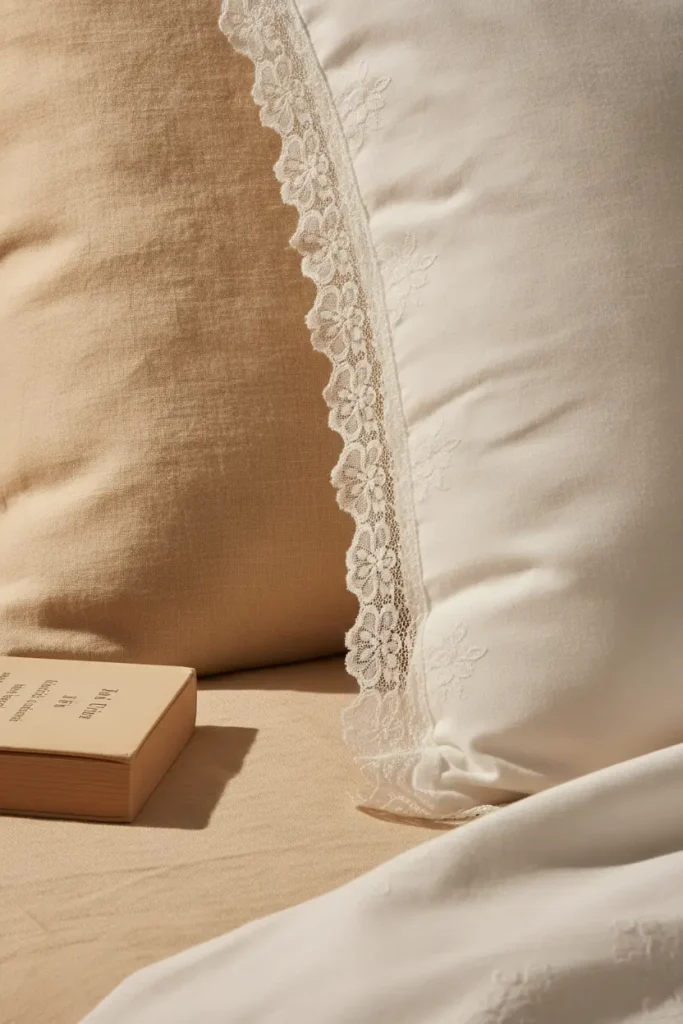
On a bed, lace works best as a trim, never the main fabric. A lace-edged pillowcase or a crochet-trimmed sheet hem softens a plain linen bed without turning it frilly.
📌 Good To Know
Thrift stores and estate sales often have vintage lace-trimmed pillowcases for a few dollars. Soak them in cool water with a gentle detergent, then dry them flat so the lace keeps its shape.
Keep the lace near your face and nowhere else, and it reads as a detail rather than a theme.
22. Cool Blue for Hot Sleepers
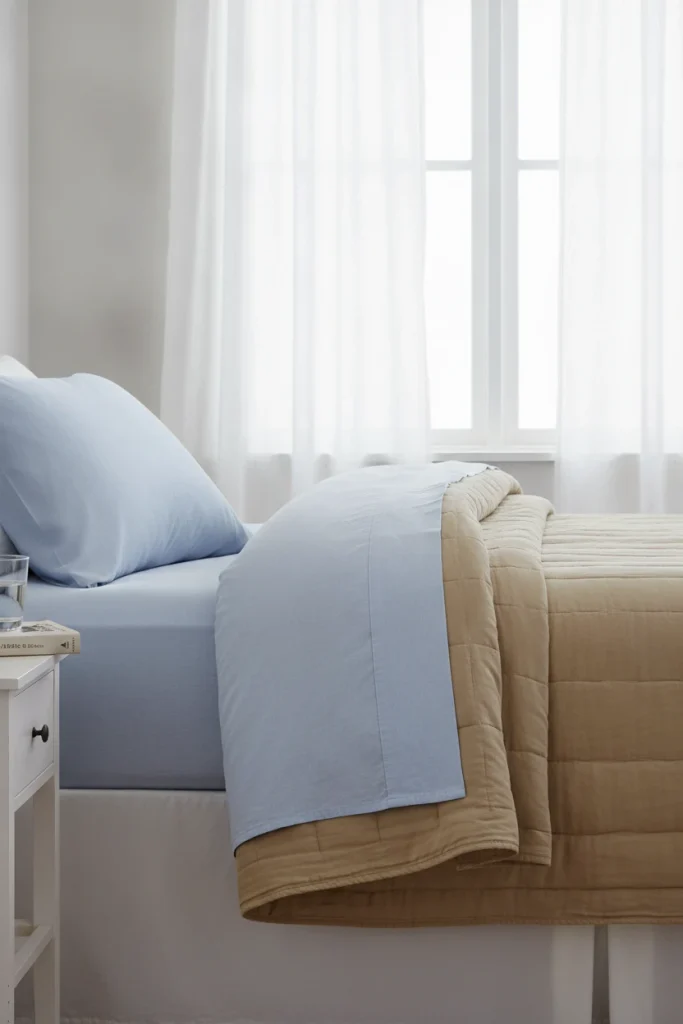
Pinterest named cool blue one of the signature colors of 2026, alongside khaki. It suits the warm sleeper who wants a bed that looks cool as well as feels it.
Warm it up with a khaki or camel quilt when October arrives. Blue next to warm tan looks deliberate. Blue next to more blue starts to feel like a hotel.
23. An $85 Cozy Bedding Refresh From One IKEA Trip
Eighty-five dollars buys a real change if you spend it on the layers you touch. These are IKEA US prices listed in September 2026, so check before you go.
| Piece | Archetype | Price |
|---|---|---|
| 🛏️ Sheets | IKEA DVALA sheet set, queen | $29.99 |
| 🔁 Spare | IKEA DVALA fitted sheet, queen | $14.99 |
| 🧶 Throw | IKEA DYSTERMAL chunky knit, 51 x 67 in | $39.99 |
| Total | $84.97 |
The spare fitted sheet is the quiet hero. You can strip and remake the bed the same day you do laundry, instead of waiting on the dryer.
Keep your current duvet and pillows. New sheets and one good throw change how the bed feels more than a new comforter would.
24. Make the Bed Sound and Smell Like Rest
Close your eyes and your bed still has a sound. Percale crinkles faintly, like fresh paper, every time you roll over. Sateen is quiet and slick. Flannel is nearly silent and holds warmth like a sweater.
Light sleepers should pick sheets by sound first and look second. Sateen or flannel for quiet, percale for crisp.
Scent matters just as much. Line-dry pillowcases on a sunny day and they come in smelling like outside air. Or tuck a cedar block or a small lavender sachet into the linen closet so clean sets smell fresh when they come out.
Skip heavy fabric sprays on anything near your face. Faint is the goal.
25. The 90-Second Morning Make
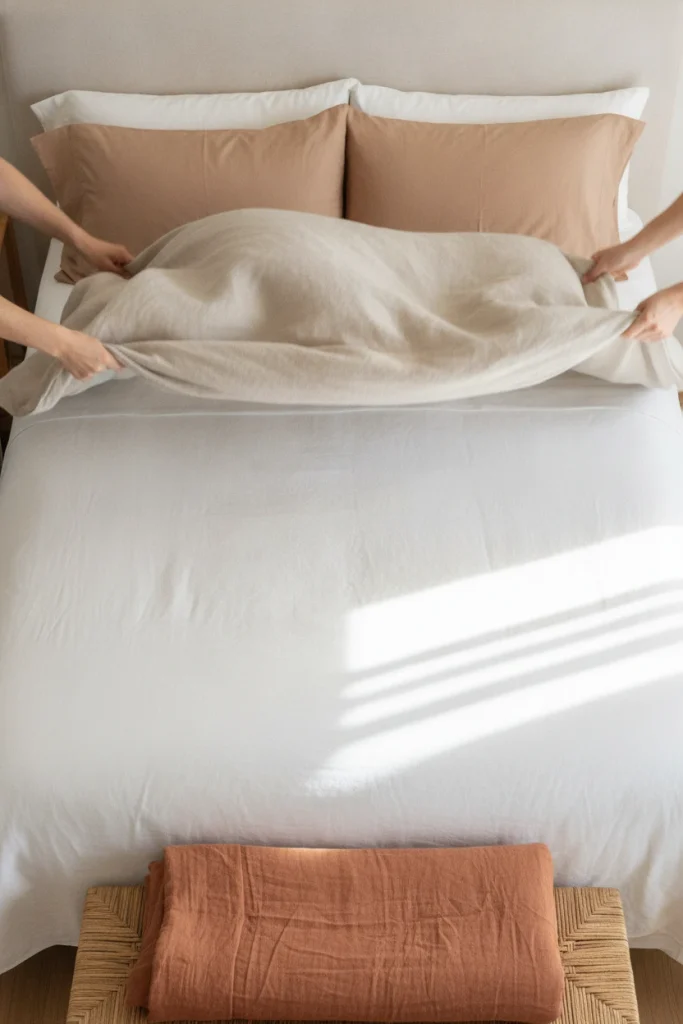
Ninety seconds is all a layered bed needs each morning once the pieces are right. Do it in the same order every day and it becomes automatic.
Pull the flat sheet up taut and fold the top edge over about a hand’s width.
Grab the duvet by its two bottom corners, snap it once from the foot, and let it settle.
Rebuild the pillows back to front: Euros, sleeping pillows, then one lumbar.
Drop the folded quilt at the foot and toss the throw over one corner. Done.
Coming home to a made bed at 6 p.m. is the whole payoff.
Frequently Asked Questions
How do you layer bedding for warmth without it feeling heavy?
Build warmth from several thin layers instead of one thick one. Start with flannel or percale sheets, add a medium-weight duvet, and keep a quilt folded at the foot to pull up when the room cools off. A heated mattress pad under the fitted sheet adds warmth with no weight on top. Thin layers trap air between them, and trapped air is what keeps you warm.
Which sheet fabric is the warmest: flannel, fleece, jersey, or cotton?
Flannel and fleece are the warmest. Flannel is brushed cotton, so it breathes better than polyester fleece and is less likely to make you sweat. Flannel is measured by weight, and sets around 170 gsm hold more heat than lighter ones around 135 gsm. Jersey knit feels like a soft T-shirt and sits in the middle. Plain cotton percale is the coolest of the four.
What bedding works for couples when one person runs hot and the other runs cold?
Split the layers that control warmth. Share one fitted sheet, then give each person their own twin-size duvet in a different weight, which is common in Scandinavian homes. The cold sleeper can add a folded quilt or a flannel pillowcase on their side. During the day, a king coverlet over both duvets makes the bed look like one neat, finished bed.
What’s the difference between a down and a down-alternative comforter?
Down comforters are filled with the soft under-feathers of ducks or geese. They’re very warm for their weight and compress easily. Down-alternative comforters use synthetic fibers such as polyester, so they’re usually less expensive, easier to wash at home, and a good fit for people with feather allergies. Down tends to feel lighter and last longer, while down alternative is simpler to care for.
What thread count or weight should you look for in bedding?
For cotton percale and sateen, a mid-range thread count from a reputable maker matters more than a sky-high number, since very high counts often use thinner, twisted threads. Flannel skips thread count entirely and is sold by weight in GSM. Some brands list a TOG rating for duvets, and a higher TOG means warmer. Many US brands say lightweight, all-season, or extra warm instead.
How do hotel beds look so fluffy?
Hotels layer a mattress topper, crisp white sheets, a lofty duvet inside a slightly oversized cover, and several pillows stacked back to front. The duvet is often one size bigger than the mattress, so it drapes low on both sides. You can copy the look at home by sizing up your insert, adding Euro shams behind your sleeping pillows, and shaking the duvet out every morning.
Bringing It Home
You don’t need all 25 of these. Start with the five-layer stack, find the job your bed isn’t doing, and fix that one first. Maybe it’s a flat sheet, a quilt at the foot, or a firm backrest so you can finally read past chapter two.
Good cozy bedding comes down to a few honest choices: the right weight, the right size, and textures that feel different under your hand. Buy for how the bed feels at 10 p.m., not how it looks in a listing photo.
Save this list to your bedroom board so you have it the next time the nights turn cold.
