
15 Basement Reading Nook Ideas to Turn Your Underground Floor Into a Cozy Hideaway

Your basement sits there, a little chilly, a little forgotten, with a fluorescent tube buzzing overhead and a treadmill nobody uses. There’s a corner near the stairs that collects nothing but holiday bins and dust. You scroll Pinterest at 10 p.m. saving cozy basement reading nook inspiration to a board called “someday,” and you wonder if it’s actually possible down there with the low ceilings and that one tiny window. It is. Honestly, basements make some of the best reading nooks in the whole house, because they’re already quiet, already private, and already begging for a transformation.
I converted a 4-foot corner of my own walkout basement into a reading nook two winters ago, and I’ve helped two friends do versions of theirs since. So this isn’t a fantasy roundup. These basement reading nook ideas are tested, sourced, and ranked by what actually works in a real basement with real basement problems.
Who This Is For
This guide is built for the homeowner with a finished, partly finished, or fully unfinished basement who wants a quiet reading retreat without spending thousands. It works for renters with a basement-level apartment, parents who want a calm zone away from the upstairs chaos, and anyone whose basement currently feels like wasted square footage. We cover budget builds under $100, mid-range setups in the $200 to $500 range, and a couple of splurge moments if you want a built-in.
How This Guide Is Organized
The 15 ideas are grouped by where in the basement you can put a nook, because that’s the first real decision. Then we move into styling, lighting, basement-specific problems (humidity, low ceilings, cold floors), and the mistakes that ruin most basement nook attempts. Finally, the FAQ tackles the stuff Pinterest can’t answer.
Under the Stairs Basement Reading Nooks
That awkward triangle of dead space under your basement stairs is the most-saved zone on Pinterest for a reason. It’s already enclosed on two sides, which gives you instant cave-vibes, and the angled ceiling makes it feel intentional even when you’ve barely done anything.
1. The Built-In Bench Under the Stairs
What it is: A custom or IKEA-hacked bench that fits the full footprint of your understair zone, topped with a cushion and styled with pillows.
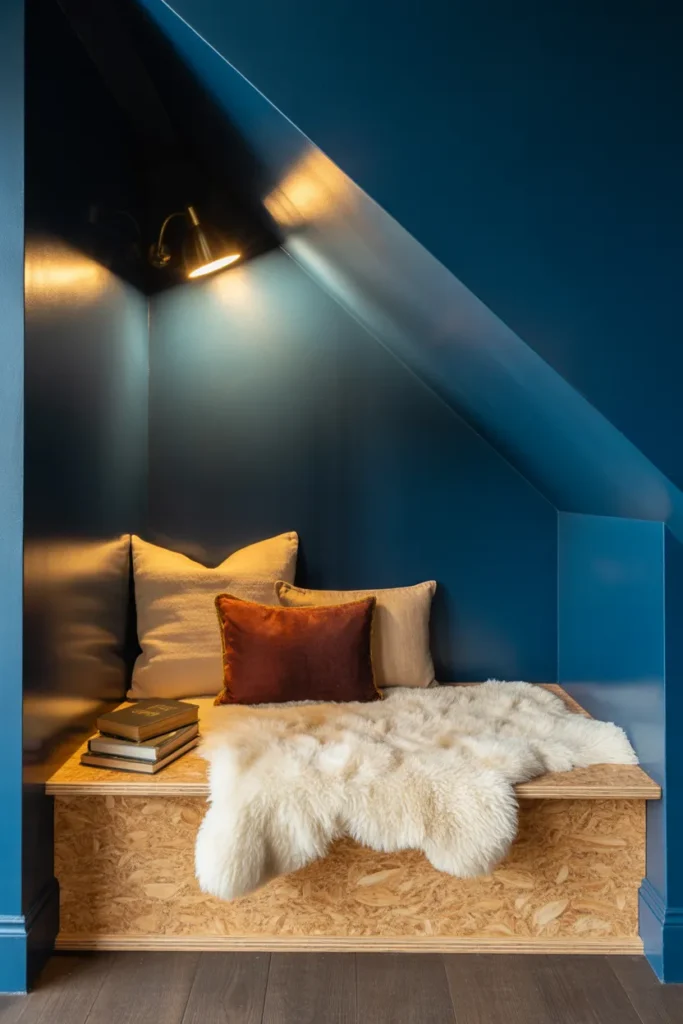
Why it works: The slanted ceiling is doing 80% of the cozy work for you. You’re enclosing the reader on three sides, which is exactly what the brain reads as “safe little hideout.”
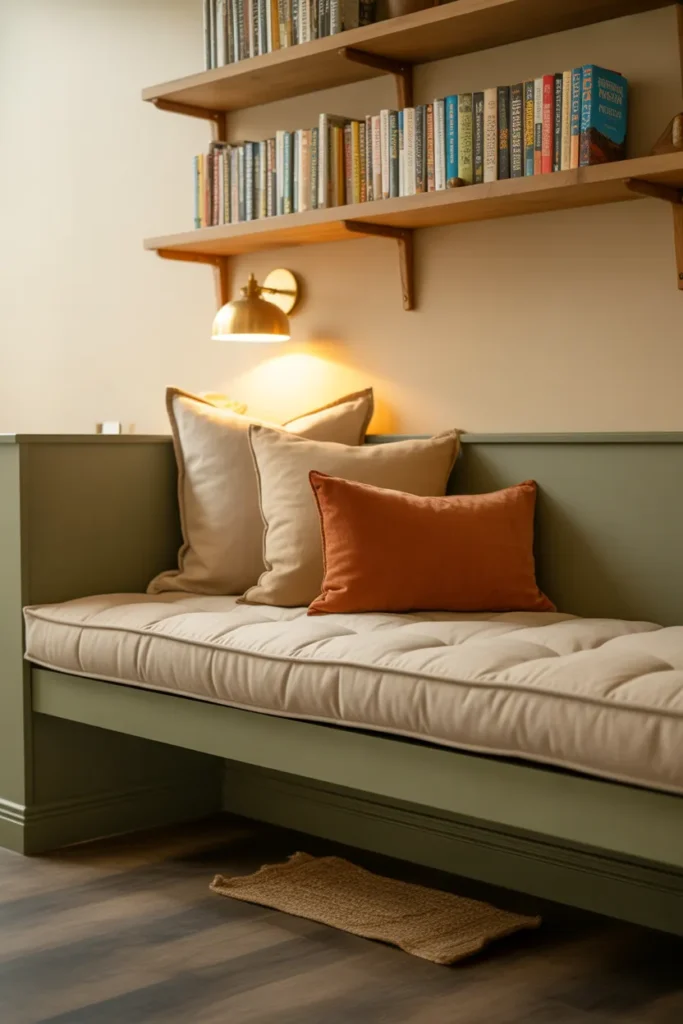
How to execute: Measure the deepest point and the lowest point of the under-stair zone first. For a budget build, line up two IKEA KALLAX or BESTÅ units sideways, top them with a 1.5-inch foam cushion in a 100% linen cover (Amazon sells custom sizes for $40 to $90), and call it done. For a mid-range moment, frame out a simple plywood box and paint it the same color as the wall behind it so the bench reads as architecture, not furniture. Want the full step-by-step? Our guide on building a DIY under stairs reading nook walks through every cut, screw, and finish.
2. The Curtain-Closure Trick for Maximum Hideout Energy
What it is: A 96-inch linen curtain panel mounted on a tension rod or ceiling track at the entrance of the under-stair zone, so the reader can pull it shut.
Why it works: It triggers full-cocoon mode. Sound dampens, light softens, and your brain immediately downshifts. Renters can install this without a single drill hole using a tension rod.
How to execute: Pick an IKEA AINA linen panel ($30) or a Target Threshold linen-blend curtain ($25). Hang the rod 4 inches above the highest opening point. For a splurge upgrade, swap to a CB2 raw cotton panel ($89 to $129). Skip blackout fabric, you want light to filter through, not get blocked entirely.
Corner Basement Reading Nook Ideas
If you don’t have an under-stair zone, a corner is your best friend. Two walls meeting at 90 degrees give you a natural enclosure to work with, and corners are where most basement reading nook setups actually live.
3. The Single Chair and Floor Lamp Setup
What it is: One excellent reading chair, one tall arc-style or tripod floor lamp, one small side table, one rug. That’s the entire formula.
Why it works: It’s the lowest barrier-to-entry basement reading nook idea on this list. No drilling, no committing, no contractor. Renters and “I just want to start” people, this is your move.
How to execute: Budget tier (under $300 total): IKEA POÄNG armchair in birch with a beige cushion ($129), Target Threshold tripod lamp ($65), a 2×3 jute rug from HomeGoods ($30), and a $20 thrifted side table sanded and oiled. Mid-range tier ($500 to $900): an Article Sven slipcovered chair, a West Elm Mid-Century floor lamp, and a marble pedestal side table. Splurge tier ($1,500+): an Anthropologie Laila bouclé chair with a CB2 brass arc lamp.
4. The Cozy Corner Daybed
What it is: A daybed pushed into a basement corner, layered with body pillows, throws, and a small floating shelf overhead for a lamp and a glass of water.
Why it works: Daybeds give you stretch-out reading, not just sit-up reading, which is the actual dream for a Sunday afternoon with a paperback. Plus they double as a guest bed.
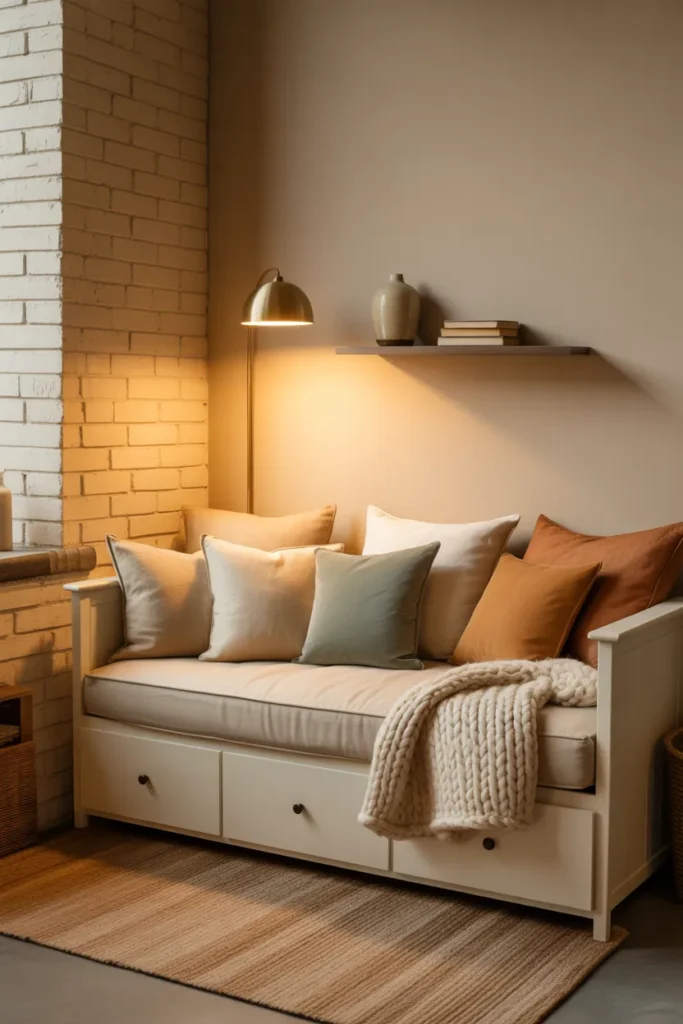
How to execute: IKEA HEMNES daybed ($379) is the workhorse pick because it has built-in storage drawers underneath for blankets and book overflow. Dress it in a cream linen-look duvet ($60 from Target), three lumbar pillows in autumnal tones, a chunky knit throw ($35 from Walmart), and a tall potted snake plant in the bare corner.
Window Well Basement Reading Nooks
If your basement has an egress window or a daylight window well, plant the nook there. That’s where the natural light lives, even if it’s only a few hours a day, and your reader’s eyes will thank you.
5. The Window Seat Built-In
What it is: A bench built directly into the window well or beneath the window, often with hidden storage in the base.
Why it works: You’re stacking three “cozy” cues at once: window light, enclosed seat, soft cushion. It’s the most photographed basement reading nook configuration on Pinterest for a reason.
How to execute: Frame a 16-inch deep box from 3/4-inch plywood, attach hinges to the lid for storage access, and top with a 4-inch high-density foam cushion. Paint the box the same color as the adjacent wall to blend it in. Add three pillows: one large lumbar in linen, one square in a textured weave, one small accent in the warmest color in your palette. For more ways to work with a window-anchored layout, see our roundup of built-in reading nook ideas.
6. The Faux Window Light Box (For Basements With No Real Window)
What it is: A backlit acrylic panel mounted to the wall, printed with a soft sky scene or a forest view, lit from behind with daylight-temperature LEDs.
Why it works: It tricks the brain. Even though you know it’s fake, peripheral vision reads “window,” and the basement instantly feels less buried. This is the underground basement reading nook hack nobody talks about.
How to execute: Amazon sells pre-made faux window kits in the $80 to $200 range. For a splurge version, custom-printed lightboxes from Wayfair run $300 to $500. Pair it with a real linen curtain panel on either side to commit to the illusion.
Full-Wall Basement Reading Nook Ideas
If you’ve got a long blank wall in your finished basement, build the whole thing as a reading wall. This is where the “library moment” Pinterest searches go to live.
7. The Floor-to-Ceiling Bookshelf Wall
What it is: A built-in or IKEA-hacked floor-to-ceiling bookshelf system covering one entire wall, with a chair pulled in front of it.
Why it works: Books on shelves are the world’s softest sound-absorption panel. They warm the room visually AND acoustically, two things basements desperately need.
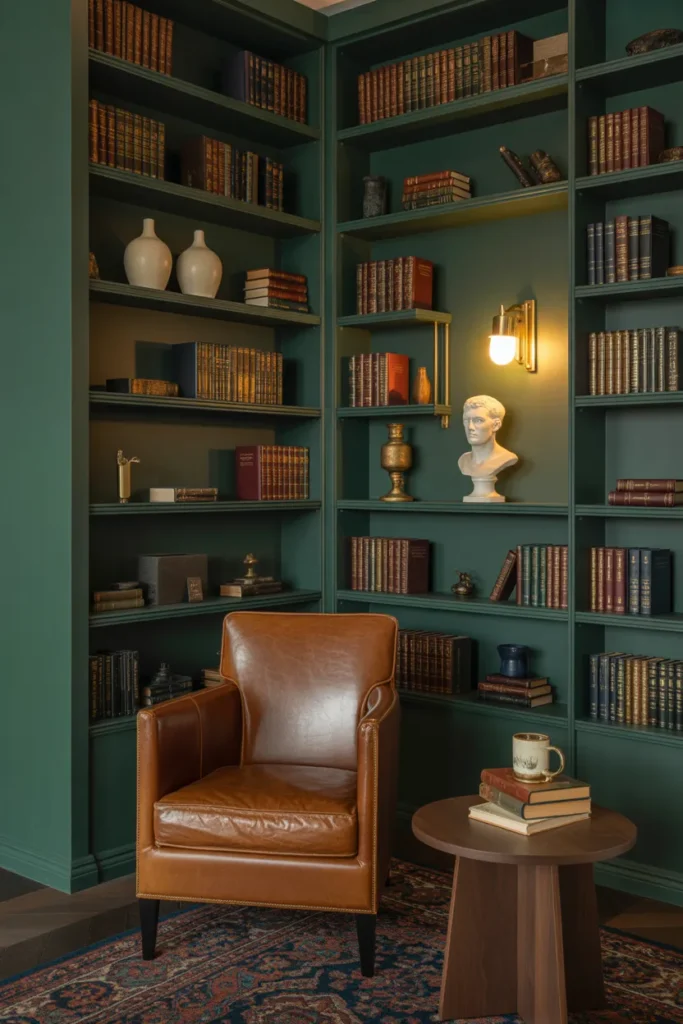
How to execute: Three IKEA BILLY bookcases lined up and trim-built look like custom millwork once you add a 1×4 face frame and crown molding. Total cost around $400 to $600. Stain the bookcases a warm walnut for cottagecore vibes, or paint them deep forest green for that BookTok dark academia look. Style with 70% books, 20% objects, 10% empty space (the ratio that keeps it from looking cluttered). Our guide on reading nook shelving ideas goes deeper on styling ratios.
8. The Book Ledge Gallery Wall
What it is: Five to seven narrow picture-ledge shelves mounted at varying heights on one wall, used to display books face-out like a bookstore.
Why it works: Face-out display turns your books into wall art. It’s especially good for basements because it doesn’t require deep shelves (which eat already-tight square footage), and it puts color and texture on a wall that probably needs both.
How to execute: IKEA MOSSLANDA ledges run $10 to $15 each. Mount them 12 inches apart vertically, slightly staggered horizontally for a relaxed gallery feel. Pair with a single armchair, a floor lamp, and a small jute rug below. Total nook cost: under $250 if you already own the chair.
Multipurpose Basement Reading Nook Ideas
Most basements are doing five jobs already (laundry, storage, guest room, playroom, gym). The reading nook has to share space with at least one of them. Here’s how to make it work.
9. The Reading-Plus-Playroom Hybrid
What it is: A small reading bench or pillow pile tucked into a kid playroom, designated as the calm zone with a bin of books beside it.
Why it works: Kids actually use it. Build a quiet pocket inside the chaos zone and you’ll be amazed how often they crawl into it on their own. It also models reading as an activity, not a chore.
How to execute: A Target Pillowfort floor cushion ($45), a Dollar Tree wicker book bin ($5), a Walmart battery-operated puck light ($12), and a string of warm-white fairy lights ($10) under the play table is genuinely all you need. Total cost: under $75.
10. The Office-Plus-Reading-Nook Combo
What it is: A reading chair tucked into the corner of your basement home office, positioned as the deliberate “I’m done staring at a screen” spot.
Why it works: Switching seats switches your brain mode. Walking 3 feet from the desk chair to the reading chair is a cheap, effective end-of-day ritual.
How to execute: Pick a chair that visually contrasts with your desk chair so the brain registers the shift. If your desk chair is black mesh, go for a cream bouclé. If your desk chair is leather, go for upholstered linen. Add one shared floor lamp positioned between them so you don’t double up.
Moody and Dark Basement Reading Nook Ideas (Lean Into the Low Light)
Here’s the angle every other roundup misses: a basement’s low natural light is a feature, not a flaw. Stop fighting it. Lean in. This is where Dark Academia and Moody Cottagecore live.
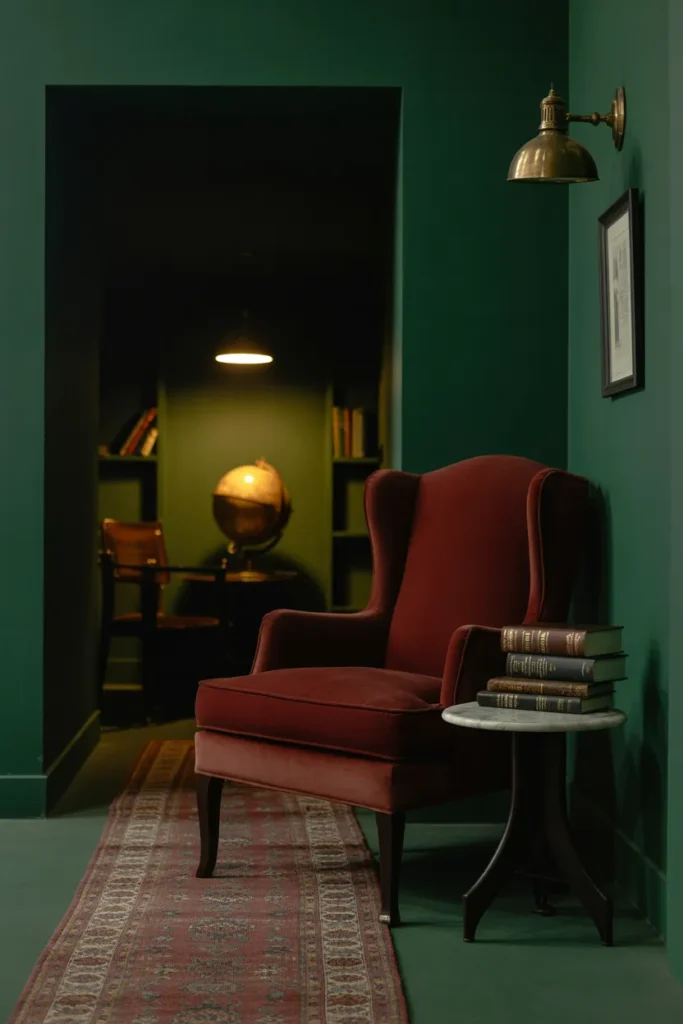
11. The Dark Academia Basement Library
What it is: Deep saturated paint colors (forest green, oxblood, charcoal, rich navy), brass and antique gold hardware, leather and velvet textiles, and old-book-smell levels of bookishness.
Why it works: Basements already have the temperature, the privacy, and the slight chill that Dark Academia is built around. You’re not faking a vibe, you’re amplifying what’s already there.
How to execute: Paint two adjacent walls in Benjamin Moore Salamander or Sherwin-Williams Dard Hunter Green. Add one wingback chair (HomeGoods has them for $200 to $400, West Elm splurge versions hit $1,000+). Layer in a vintage Persian-style runner ($80 to $250 from Wayfair or Ruggable), a brass library picture light over the chair, and stack hardcovers in untidy piles. The slight mess is the point.
12. The Cottagecore Basement Snug
What it is: Cream-painted walls, a mix of vintage florals and ticking stripes, a slipcovered chair, dried flowers in clay vessels, and a beat-up wood side table thrifted for $15.
Why it works: Cottagecore softens basements. Where Dark Academia leans into the cave, cottagecore tries to make the basement feel like a tucked-away cottage room instead. Both work, just commit to one.
How to execute: Paint walls Sherwin-Williams Alabaster or Benjamin Moore White Dove. Slipcovered armchair from IKEA ($249 EKTORP) or thrifted and re-covered with a drop cloth ($25). Layer with a quilted throw, two floral pillows, a dried hydrangea bunch in a stoneware crock, and a Pottery Barn jute rug.
Bright Finished Basement Reading Nook Ideas (Japandi and Organic Modern)
If your basement is actually bright (good lighting plan, decent windows, light walls), the move is to keep it visually airy and not overcrowd it.
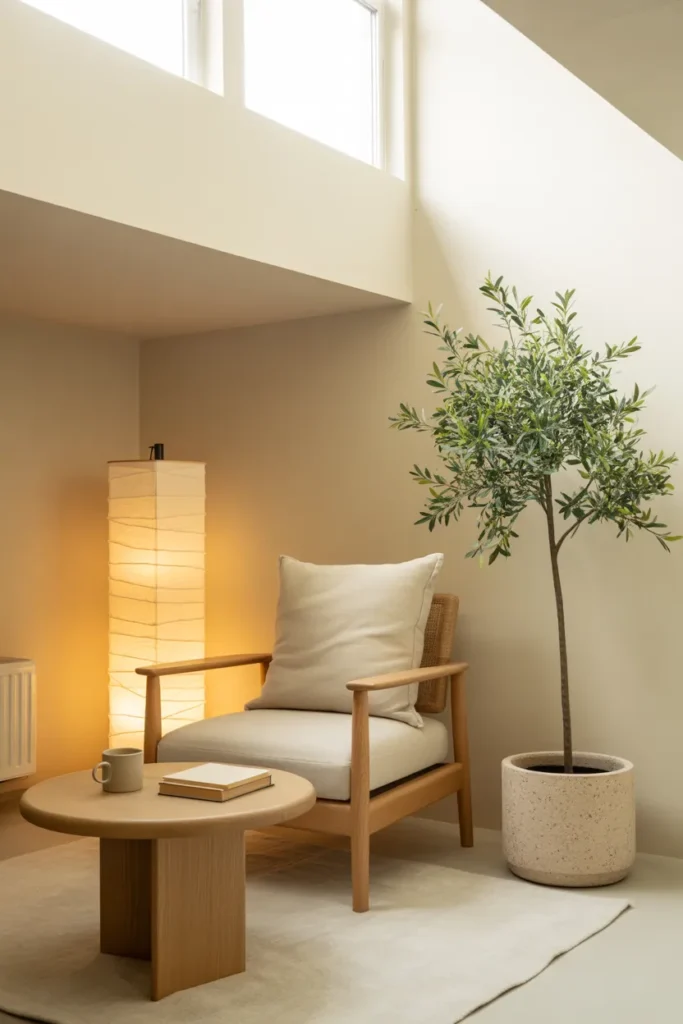
13. The Japandi Basement Nook
What it is: A simple oak-frame chair, one paper-shade floor lamp, a low oak side table, a single olive tree in a beige stoneware planter, neutral textiles only.
Why it works: Japandi’s whole language is “calm and uncluttered,” which is exactly what a small basement needs to avoid feeling cramped. Limited palette + natural materials = visually expanded space.
How to execute: Article Ceni chair in oak ($349), IKEA REGOLIT paper shade pendant kit ($30 if you can hardwire it, or use a plug-in cord conversion), a 4-foot faux olive tree ($120 from Target), and a 4×6 wool-and-jute blend rug. Keep accent colors to two: oat and warm wood. That’s it.
14. The Organic Modern Basement Reading Nook
What it is: Curved bouclé chair, sculptural side table, layered cream-on-cream textiles, plaster wall accents, one piece of large abstract art.
Why it works: The curves and softness counterbalance the harder lines that basements naturally have (boxy rooms, low ceilings, exposed beams). It feels expensive without being expensive.
How to execute: West Elm Anton chair (splurge, $1,400) OR Amazon dupe in bouclé ($300 to $500), a Target Studio McGee travertine pedestal side table ($90), a single large textured canvas from Minted or HomeGoods, and a soft cream area rug.
Rental-Friendly and Unfinished Basement Reading Nook Ideas
If you can’t drill, can’t paint, or you’re working with concrete floors and exposed joists, you still have options. Most basement reading nook roundups skip you entirely. We’re not doing that here.
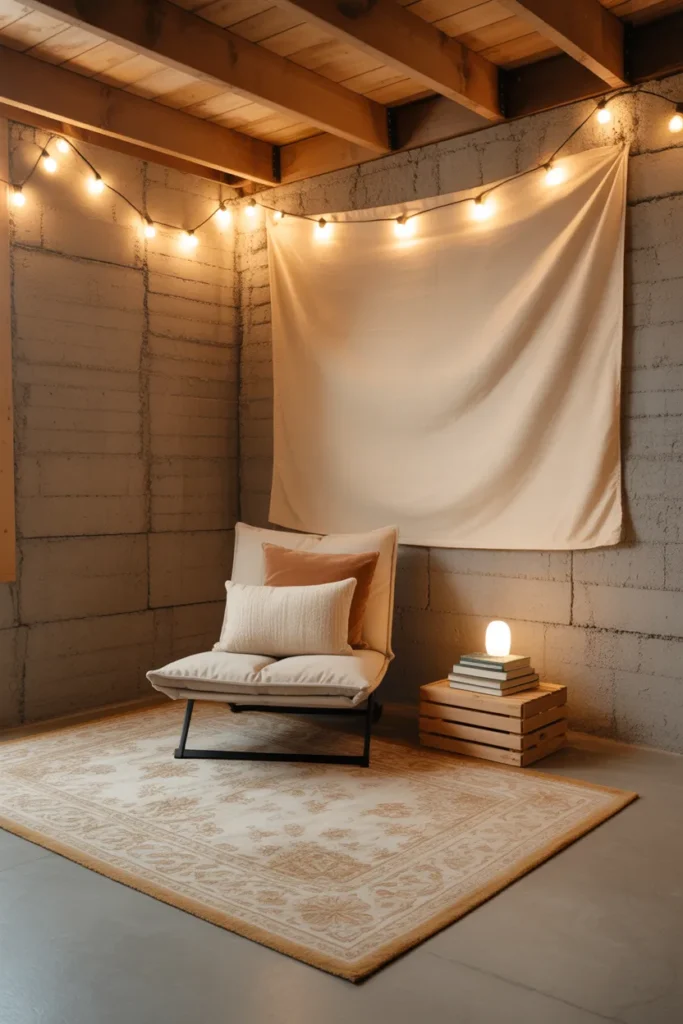
15. The Concrete-Floor Cozy Pile
What it is: A massive area rug, a foldable floor cushion or floor chair, layered throws, battery-operated lighting, and a portable side table on wheels.
Why it works: It’s 100% renter-safe and 100% basement-safe. Nothing’s drilled, nothing’s painted, and everything packs up if you move.
How to execute: Buy the biggest rug your budget allows (an 8×10 changes a basement more than any other single purchase). IKEA STRANDKÖPING is $180 and looks great over concrete. Add a Yogibo Max floor lounger ($229) or a $40 thrifted floor cushion. String 50-foot warm-white LEDs along the exposed joists with adhesive clips ($25 from Amazon). One battery puck light per “zone” you want lit. Bonus rental tip: throw a 9×12 painter’s drop cloth over an ugly section of unfinished wall, weight the bottom edge, and you’ve got an instant linen wall hanging.
Lighting a Basement Reading Nook the Right Way
Lighting is the single biggest variable in whether a basement reading nook feels cozy or feels like a cave. Most basements have one harsh overhead fixture and call it done. That’s the problem.
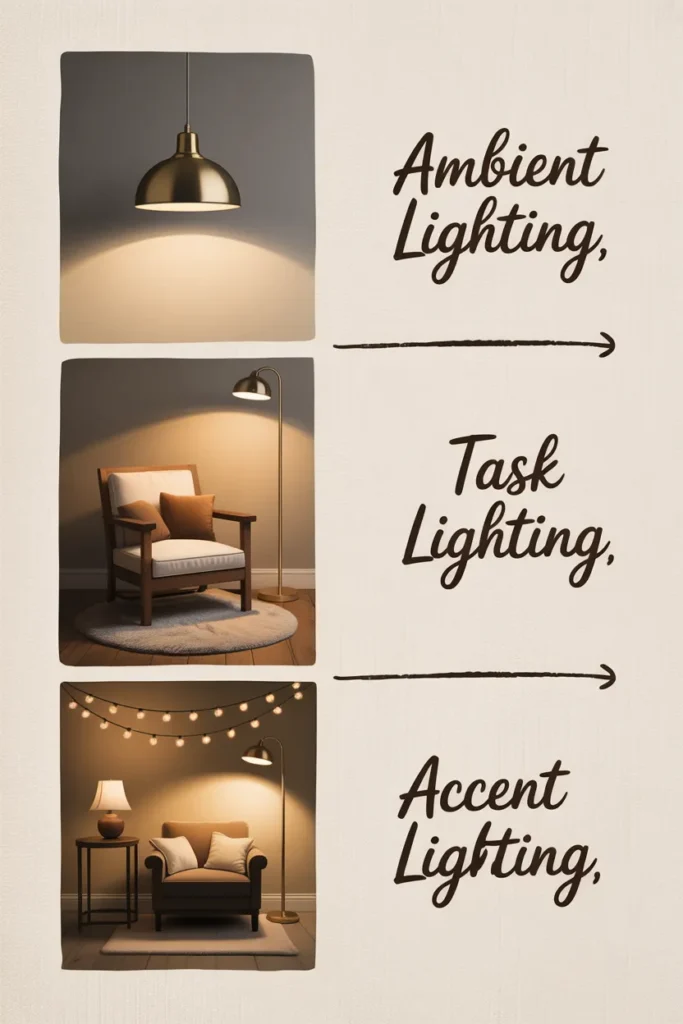
The fix is layered lighting in three tiers:
- Ambient layer: Replace any harsh overhead bulbs with warm 2700K bulbs. If you have can lights, add smart dimmers ($25 each).
- Task layer: One reading-specific light source (floor lamp, sconce, picture light) within 3 feet of the reading chair, bright enough that you don’t squint.
- Accent layer: String lights, a small table lamp, or a candle (LED if you’re worried about basement air). This is the layer that adds the “Pinterest glow.”
For unfinished basements with no outlets where you want them, look for rechargeable cordless table lamps. The Brightech Maxwell rechargeable ($99) and the Pottery Barn Owen rechargeable ($150 to $200) both run for 8 hours per charge and need zero electrician.
The Basement-Specific Problems Nobody Talks About (And How to Fix Them)
Here’s where the other articles bail out. A basement reading nook isn’t a corner of a sunny living room. It’s an environment with real concerns. Address these before you spend a dollar on cushions.
Humidity and That Musty Smell
Basements run damp. Books, fabric, and your sinuses all hate damp. The EPA recommends keeping indoor relative humidity between 30 and 50 percent to prevent mold and dust mites, which is exactly the range a reading nook with paper books needs to live in. (Source: EPA, Care for Your Air.)
Buy a $15 hygrometer, plug a quiet basement dehumidifier ($180 to $280, the Frigidaire and hOmeLabs models are well-reviewed) into the nook zone, and let it run continuously. Dump the tank weekly or hardline-drain it to a floor drain. This single step does more for basement coziness than any cushion.
Cold Floors
Basement floors are concrete or concrete-adjacent. They steal heat from your feet, which means you’ll abandon the nook by minute 14. Layer it: an 8-pound felt rug pad, a wool or wool-blend area rug at least 6×9 feet, and a smaller sheepskin or shag layered on top of that exactly where your feet land. Three layers, total floor warmth.
Low Ceilings (Under 7 Feet)
Don’t fight low ceilings, lean into them. A low ceiling makes a small enclosed nook feel intentional, not cramped. Paint the ceiling the same color as the walls (yes, including the trim, what designers call “color drenching”), and skip the pendant light, which will only make the ceiling feel lower. Use sconces, picture lights, and floor lamps instead.
No Outlets Where You Need Them
Don’t run extension cords across the floor (trip hazard, looks bad, and your insurance company will note it after a fire claim). Use rechargeable lamps, battery-operated puck lights, and cordless candles instead. If you’re committing long-term and you own the house, hire an electrician for one or two new outlets ($250 to $500 total).
Radon and Air Quality
This one nobody mentions and it actually matters. The EPA recommends testing for radon on the lowest lived-in level of your home. (Source: EPA, Remodeling Your Home and Indoor Air Quality.) If you’re going to spend hours in a basement reading nook, do a $15 short-term radon test before you build anything permanent. It’s the cheapest peace of mind in this entire article.
Budget vs Splurge: A Basement Reading Nook Comparison Table
Pin this table for screenshot reference. It’s the no-fluff version of every product recommendation in this article.
| Element | Budget (Under $100) | Mid-Range ($100 to $500) | Splurge ($500+) |
|---|---|---|---|
| Reading chair | Thrifted armchair, $30 to $80 | IKEA POÄNG with sheepskin, $180 | West Elm Haven swivel, $1,200+ |
| Floor lamp | Walmart tripod, $35 | Target Threshold arc, $129 | CB2 Big Dipper arc, $499 |
| Rug (5×7 size) | HomeGoods jute, $60 to $90 | Ruggable washable, $200 | Anthropologie wool, $700+ |
| Throw blanket | Walmart chunky knit, $20 | Target Casaluna linen, $50 | Parachute alpaca, $209 |
| Bookshelf | Single IKEA BILLY, $69 | Three BILLYs trim-built, $400 | Custom built-in, $2,500+ |
| Lighting (rechargeable) | Battery puck lights x3, $30 | Brightech Maxwell, $99 | Pottery Barn Owen rechargeable, $200 |
| Total nook cost | Under $300 | $700 to $1,200 | $3,000+ |
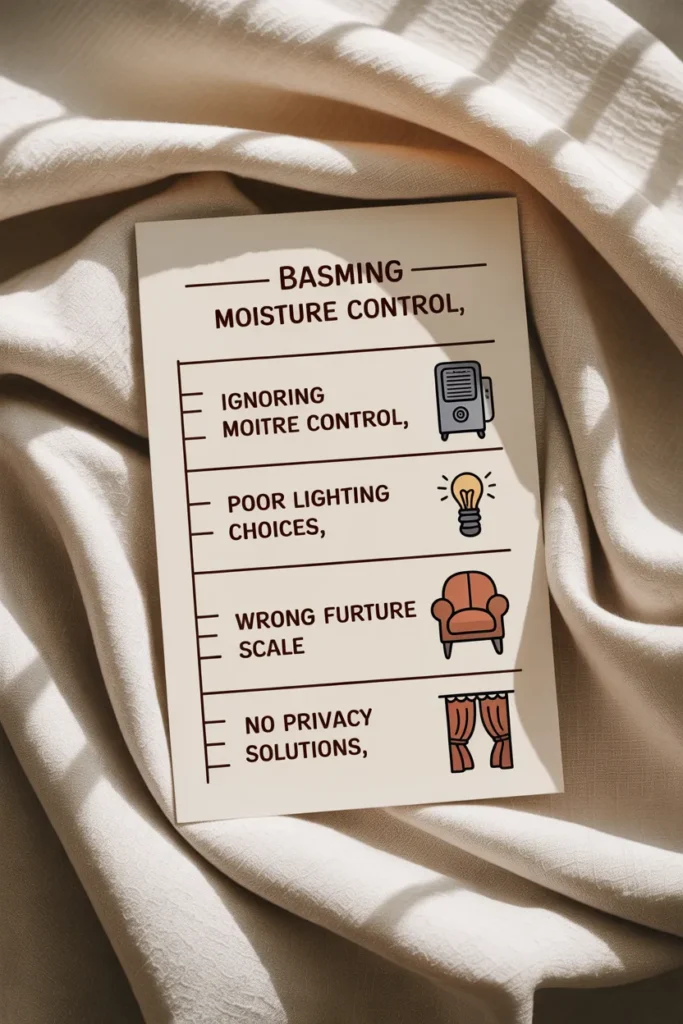
Common Basement Reading Nook Mistakes to Avoid
These are the four traps that turn a great-on-Pinterest plan into a sad corner nobody actually sits in. I have personally made three of the four.
- Skipping the dehumidifier. Your books will warp, your cushions will smell, and you’ll wonder why the whole nook feels off. Buy the dehumidifier first, decorate second.
- Using cool-temperature LED bulbs. That blue-white 5000K bulb you grabbed at Home Depot is fine for a garage. It is the death of any cozy basement nook. Get warm 2700K bulbs. All of them. Every single one.
- Buying the chair last. People shop pillows and rugs and throws and then realize the chair they ordered doesn’t actually fit the corner or isn’t comfortable for two-hour reading sessions. Buy the chair first. Sit in it for an hour at the store before you commit.
- Ignoring sound. Basements echo more than you think. If your nook feels off and you can’t figure out why, it’s probably the bare walls. A rug, a curtain panel, and a packed bookshelf together solve almost every basement acoustic problem.
How to Style Your Basement Reading Nook Like Pinterest Actually Will Save It
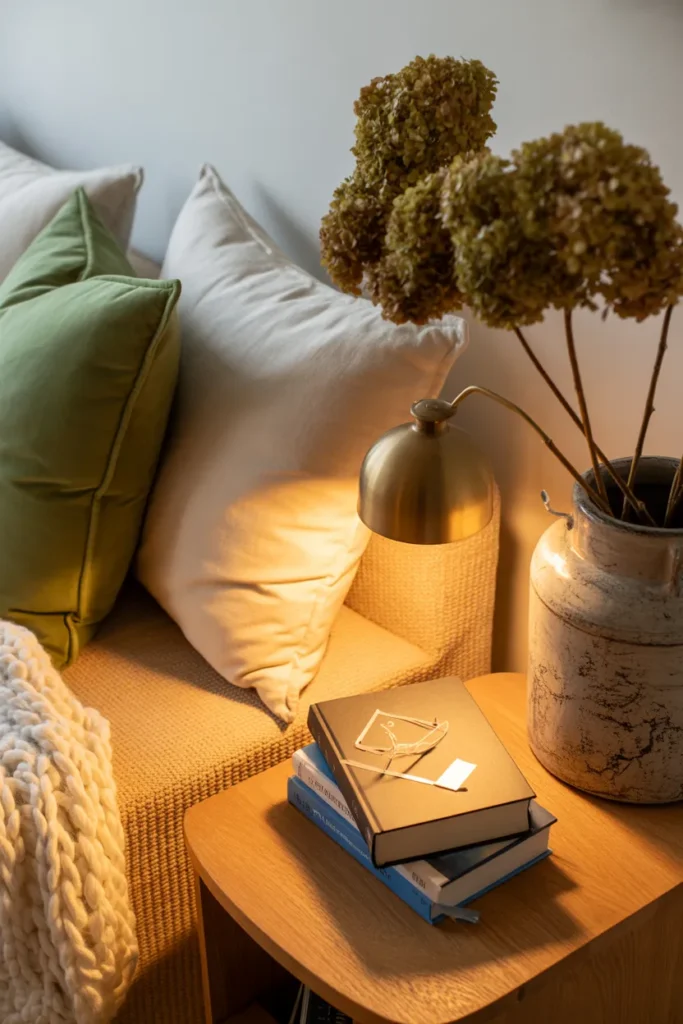
The styled photo is half the reward. Here’s the formula that consistently wins saves on Pinterest:
- Cream or oat base. Walls, cushion, rug. Cream reads cozy AND photographs warm.
- One accent color. Pick rust, sage, navy, or oxblood. ONE. Repeat it three times in the frame.
- Three textures. Linen, wool, and wood is the easiest combo. Linen pillow + wool throw + wood side table.
- One flame source. A real candle, a flameless candle, or a glowing bulb in a paper shade. Photographs read this as “warm.”
- One book moment. A stack of three hardcovers with a bookmark, OR an open paperback face-down on the cushion. Either works.
- One unexpected object. Brass globe, vintage clock, ceramic mug, dried flowers in a crock. Adds personality.
Frequently Asked Questions About Basement Reading Nooks
How do you make a basement reading nook cozy?
Start with three things: warm 2700K lighting, soft layered textiles (rug, throw, pillows), and a real enclosure (corner, under-stair zone, or curtain panel). Then run a dehumidifier so it doesn’t feel damp. Cozy is a sensory thing, not a styling thing.
How much does a basement reading nook cost to build?
Budget setups land at $200 to $400 (chair, lamp, rug, pillows, no construction). Mid-range setups with an IKEA-hacked bench or daybed run $700 to $1,500. Custom built-in setups with millwork, paint, and electrical run $2,500 to $5,000+ depending on your zip code and contractor rates.
How do I make my basement reading nook brighter?
Add three layers: warm overhead light, task light next to the chair, and accent light somewhere else in the room. Use 2700K bulbs in everything. Hang a mirror across from any small window to bounce daylight deeper into the room. Consider a faux window light box if you have no window at all.
What is the best chair for a basement reading nook?
Anything with good lumbar support, deep enough to tuck your legs under you, and upholstered (not leather) if your basement runs cold. The IKEA POÄNG is the most-recommended budget pick. Mid-range, the Article Ceni or Sven. Splurge, the Anthropologie Laila or West Elm Haven. Test it in person if you can.
How do I deal with humidity in a basement reading nook?
Buy a hygrometer ($15) and a dehumidifier rated for your basement square footage ($180 to $280 for most home basements). Keep humidity between 30 and 50 percent (the EPA-recommended range). Run the dehumidifier continuously in summer. Skip felt-heavy upholstery and stick to washable covers if you have any moisture history.
How long does it take to set up a basement reading nook?
A no-build corner setup (chair, lamp, rug, pillows) takes one weekend including the shopping trip. An IKEA-hacked bench takes a second weekend. A full custom built-in with paint and electrical runs 2 to 4 weekends if you’re DIY-ing it, or 1 to 2 weeks for a contractor.
What if my basement is unfinished?
Lean into it. An 8×10 rug, a foldable floor lounger, string lights along the joists, and a portable rolling side table give you a real reading nook on concrete with zero permanent changes. Hang a painter’s drop cloth as a soft wall hanging if the cinderblock is bringing you down. Add a dehumidifier (this is non-negotiable in unfinished basements) and a quiet space heater for the cold months.
How do I do this in a small basement or rental?
Stick to the corner-with-a-chair formula (idea #3) and the curtain-closure trick (idea #2). Both are 100% rental-friendly. Skip drilling. Use tension rods, command-strip-mounted picture lights, and rechargeable lamps. Total footprint can be as small as 5 feet by 5 feet.
What is the budget version of a built-in basement reading nook?
Two IKEA KALLAX bookcases laid sideways, topped with a custom foam cushion in a linen cover. Total cost: $200 to $300. It looks like a built-in, especially if you paint a 12-inch trim board around the top to match the wall.
Final Thoughts and What to Pin
Your basement doesn’t need to be finished, big, or bright to host a great reading nook. It needs three honest things: a comfortable seat, warm layered light, and the humidity in check. Everything else is styling, and styling is the fun part.
If you’re saving this article (please do, my Pinterest stats love you), pin the under-stairs bench image (#2) for the design-build crowd, the dark academia bookshelf (#4) for moody cozy lovers, and the unfinished basement pile (#7) for renters and “I’ll start small” people. Then come back to the DIY under stairs reading nook post when you’re ready to actually swing a hammer.
Now go claim that corner. Your future Sunday afternoons are going to thank you.
Keep reading
More cozy nook ideas
 Small Spaces
Read →
Small Spaces
Read →
10 Small Reading Nook Ideas for Adults
One high-back chair, one clamp-on lamp, one $19.99 tray table. At IKEA US prices this month, that’s a full reading corner for…
 Home Library & Bookshelves
Read →
Home Library & Bookshelves
Read →
14 Ideas for a Fireplace with Bookshelves on Each Side on a Budget
Two bookcases, two plug-in lamps, two wall straps. At IKEA US list prices this month, that adds up to $237.98 before tax,…
 Study & Craft Nooks
Read →
Study & Craft Nooks
Read →
16 Kids Homework Station Ideas Little Ones Will Love
Two IKEA pieces, one empty corner, $109.98 before tax. That’s the first kids homework station on this list, and it fits in…