
How to Decorate Your Entryway for Fall (Even If You’re Not Handy)

No drill, no ladder, no awkward email to your landlord. This fall entryway decor goes up with an over-the-door hanger, a tape measure, and one free afternoon.
That matters if your “entryway” is a four-foot strip between the front door and the couch. Or a hallway where the shoe pile already won. You don’t need a mudroom or a steady hand with a hammer. You need a plan for the three spots people actually see when they walk in: the door, the surface, and the floor.
Here’s the order we’ll follow. First, how every piece hangs, leans, or sits without leaving a single hole. Then the one measurement that keeps a narrow entry from turning into an obstacle course. After that comes color, the table, pumpkins that won’t rot on your console, warm light with no wiring, soft layers, and a swap plan for November, so the work you do now still earns its keep in December.
Grab a tape measure. We’ll start at the door.
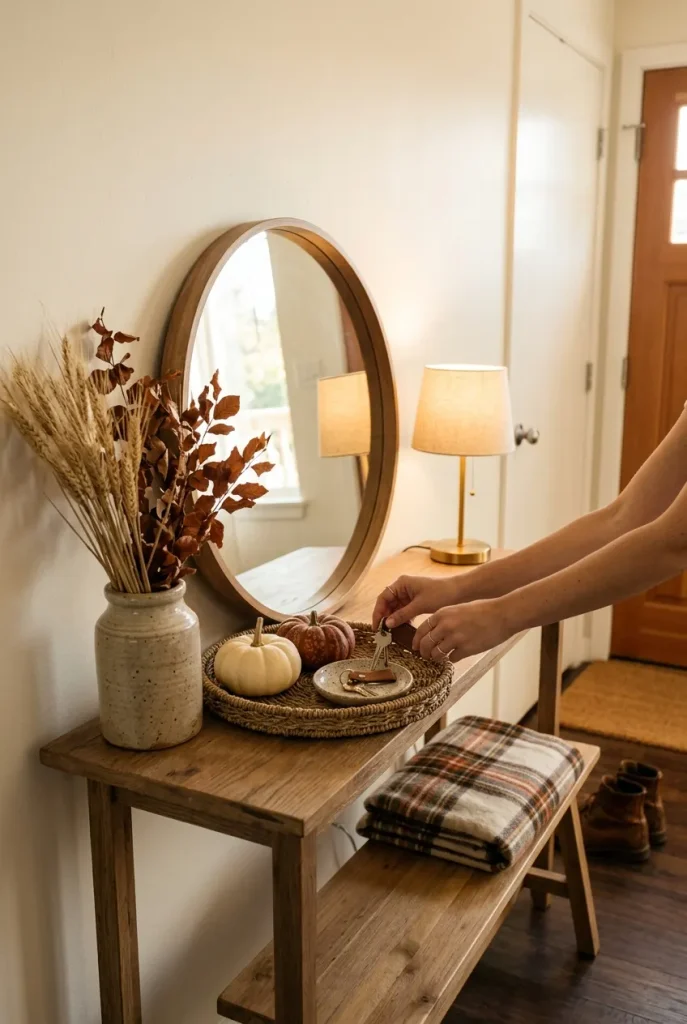
No Drill, No Nails: How Every Piece Goes Up
Every idea below hangs, leans, or sits. Nothing here needs a stud finder, a drill bit, or a tube of spackle on move-out day.
Four no-drill methods cover almost everything:
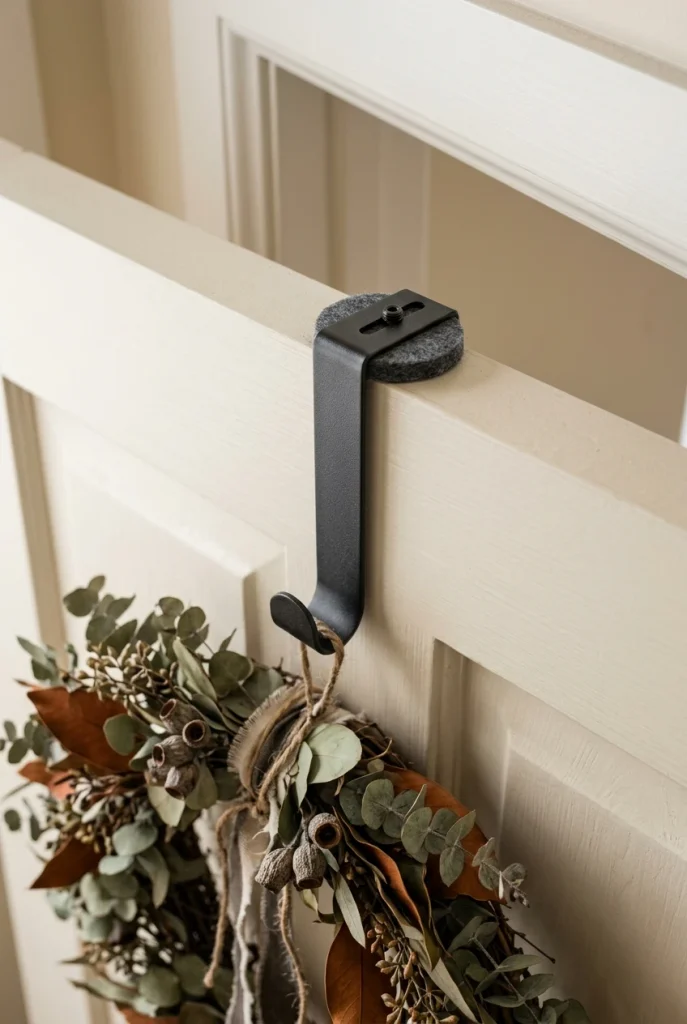
- Over-the-door hangers hook across the top edge of the door. Adjustable metal ones handle a real wreath, and some are rated for up to 20 pounds.
- Adhesive hooks stick to a smooth door, mirror, or glass. Read the weight rating on the package, and give the adhesive an hour to set before you hang anything.
- Magnetic hangers grip a metal door or clamp across a glass sidelight.
- Leaning does the rest. A mirror or framed print propped on the console reads as intentional when its base is heavy and its top rests against the wall.
The honest trade-off: an over-the-door hanger can scuff the paint along the top edge, and it adds a little thickness where the door meets the frame. Stick a felt furniture pad under the hook and close the door once before you walk away. If it needs a hard push to latch, switch to an adhesive hook.
If a wreath is on your list, our fall wreath ideas with real prices walk through ten DIY versions and what each one cost to make.
| 🔑 Method | Best for | Watch out |
|---|---|---|
| Over-the-door hanger | Medium or heavy wreaths on any door | Can scuff the top edge; add a felt pad |
| Adhesive hook | Light wreaths, garland, mirrors, glass | Check the weight rating; wait an hour |
| Magnetic hanger | Metal doors and glass sidelights | Hold depends on magnet strength |
| Leaning | Mirrors, framed prints, tall branches | Needs a heavy base or a lip on the table |
The 30-Inch Walkway Rule for Small Entryway Fall Decor
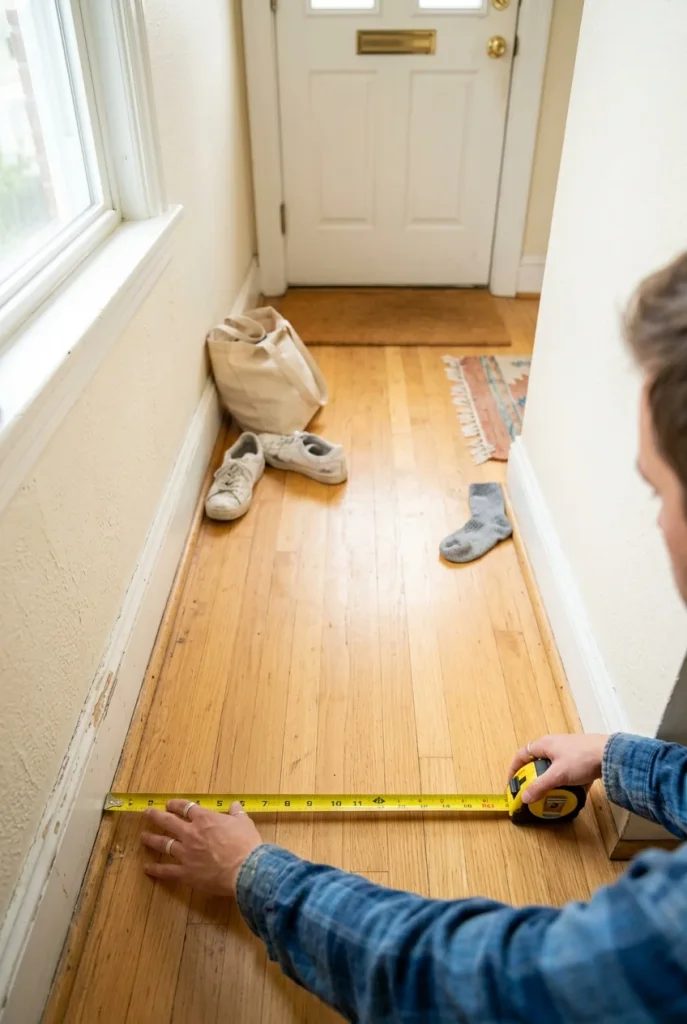
Measure before you shop. It takes two minutes and saves you a return trip.
Here’s the rule: your hallway width minus 30 inches is the deepest table you can fit. Thirty inches is the clear walking lane furniture sizing guides recommend, and 36 inches is the ADA minimum for an accessible passage. If you share the entry with a stroller, a dog, or someone carrying laundry, lean toward the wider number.
Skip this step and you’ll feel it within a week. A deep console in a narrow hall means bruised hips, bags that knock the pumpkins off, and a front door that bumps the table every time it swings open.
Got a hall under 36 inches wide? Put the table idea away. A tall crock of branches in the corner behind the door, a slim leaning ladder shelf, or a basket on the floor gives you the fall layer with none of the squeeze. For more workarounds in tight spots, browse our small space ideas for awkward corners.
📏 The 30-Inch Walkway Rule
Hall width minus 30 inches = deepest table. In wider halls, leave a little buffer below the max.
Pull Your Fall Entryway Ideas From Colors You Already Own
Before you buy a single leaf stem, walk around your place with a basket. Grab anything in brown, rust, deep green, mustard, or cream. Throws, a stoneware pitcher, a brass candlestick, old hardcovers with brown spines, a wooden bowl.
Now edit down to three colors:
- One dark anchor: chocolate brown, bottle green, or oxblood.
- One warm middle: terracotta, rust, or straw yellow.
- One quiet neutral: cream, oatmeal linen, or natural jute.
That mix lines up with where fall color is heading this year. Homes & Gardens’ fall 2026 color roundup names chocolate brown, straw yellow, terracotta, maroon, and bottle green among the season’s standouts. You get a current look without buying a thing.
The mistake most people make is going orange on everything. One orange piece reads warm. Five read like a seasonal aisle.
Keep one dark, one warm, and one neutral color.
Repeat each color at least twice so it looks planned.
Mix textures: wool, stoneware, dried stems, wood.
Bright orange on every surface.
Five small decor items in five colors.
Shiny plastic leaves next to real wood.

Fall Entryway Table Decor in Three Heights
A table looks styled when the eye moves up and down across it. A row of same-height objects looks like stuff someone set down.
So think in three heights, and keep one side lighter than the other. Uneven reads as relaxed. Strict symmetry at the front door tends to feel like a hotel lobby.
Build it in this order:
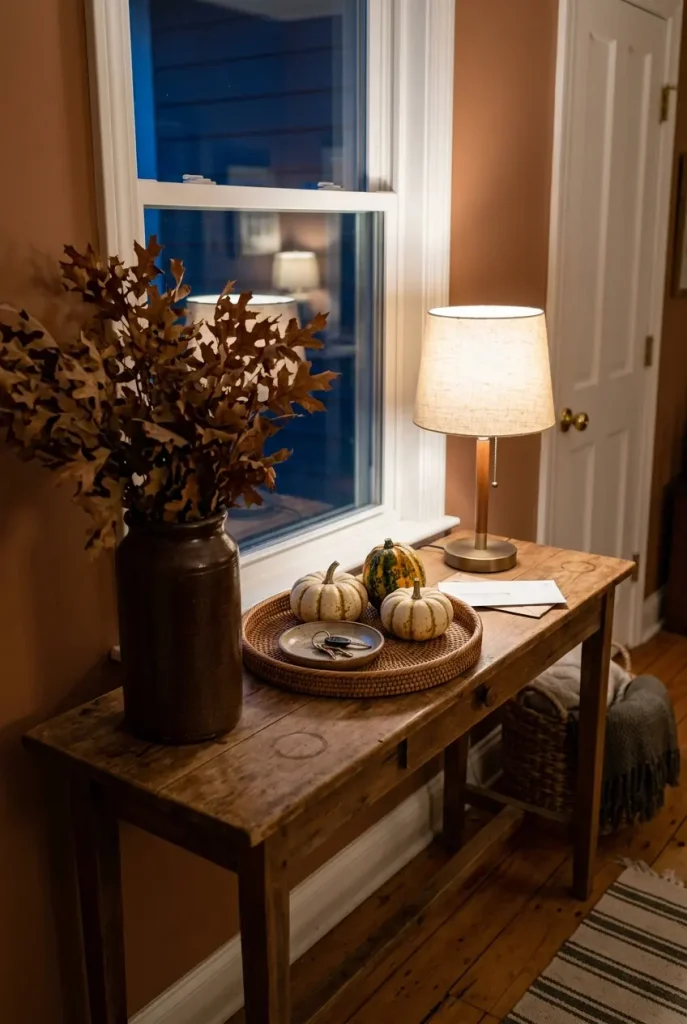
Tall, off to one side. A crock or pitcher of dried wheat, oak leaf stems, or branches, or a mirror leaning against the wall. This sets the height of the whole setup.
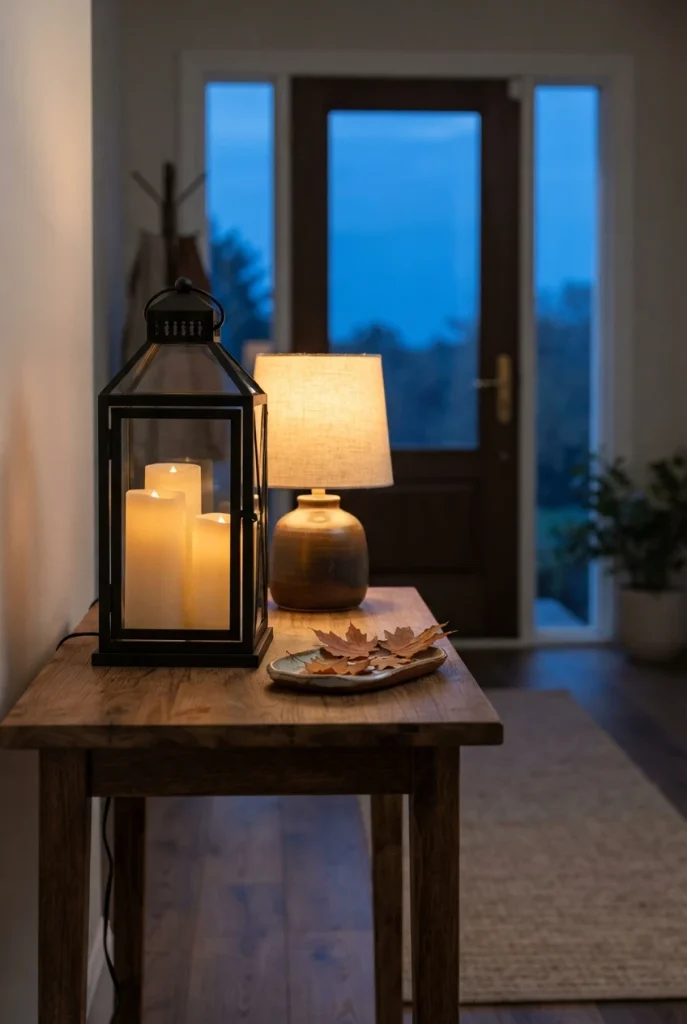
Middle, on the opposite side. A small plug-in lamp or a lantern with a flameless candle. It balances the tall piece and gives the entry a glow after dark.
Low, in the center. A tray holding two or three small pumpkins or gourds and a key dish. The tray corrals everything so the table doesn’t become a mail pile.
Leave a landing spot. Keep one clear patch for a phone or a coffee cup. If you have to move a pumpkin to set your keys down, the table is too full.
One warning on dried stems: wheat and grasses shed, especially near a door that opens fifty times a day. A tray or a runner under the crock catches the bits, and a quick shake outside before you bring them in helps a lot.
Real Pumpkins vs Faux: Pick by Where They’ll Sit
Both work. The better choice depends on where the pumpkin sits and how long you want it there.
Real pumpkins last longer than most people expect. According to NC Cooperative Extension pumpkin care advice, a properly cured and stored pumpkin can last up to three months. The same guidance says to leave 3 to 6 inches of stem attached, never carry a pumpkin by the stem, and wash it in a 10% bleach solution (9 parts water to 1 part bleach) if you’re using it right away. Check for soft spots before you buy, because those rot first.
Faux pumpkins make more sense on a wood console. A real one that goes soft can leak onto the finish before you notice, and that’s a stain you’ll look at long after fall. Faux ones cost more on day one and nothing next year.
A middle path that works well: faux on the table, real ones on the floor or the front step in a basket, where a slow leak doesn’t matter.
| 🎃 Real pumpkins | 🧡 Faux pumpkins |
|---|---|
| Up to three months when cured and stored well | Reusable for years |
| Keep out of direct sun, rain, and frost | Fine anywhere indoors |
| Set on a tray or saucer, never bare wood | Safe on wood, stone, or painted finishes |
| Best spot: floor basket or front step | Best spot: console tray or bench |

Warm Light Without Hardwiring
Light changes an entry more than any pumpkin will. And you can do all of it with an outlet.
Start with a small plug-in table lamp. Put a warm bulb in it: look for 2700K on the box, labeled “warm white” or “soft white.” ENERGY STAR’s bulb guide explains that lower Kelvin numbers look more yellow, which is the candlelit color you want by the door. A bulb around 450 lumens (the old 40-watt level) gives a soft glow without glare.
Add a plug-in timer and set the lamp to switch on before you usually get home. Walking into a lit entry at 6 p.m. in November, keys still in hand, is the whole point of this project.
Candles are where the fall look and fire safety collide. The U.S. Fire Administration candle safety tips say to keep candles at least 12 inches from anything that burns, and to consider battery-operated flameless candles instead. In an entry full of dried wheat, paper leaves, and wool throws, flameless is the easy call. Plenty of them come with a built-in timer, too.
Safety note: anchor tall furniture to the wall, keep candles and cords away from fabric, and use a licensed electrician or contractor for hardwired lighting, ceiling mounts, or anything structural.
Run the lamp cord down the back leg of the table and along the baseboard, not across the walkway. A strip of painter’s tape holds it without marking the floor.
📌 Good To Know: reading the bulb box
Kelvin (K) is color. 2700K looks warm and golden. 5000K looks bright and bluish, better for a desk than a front door.
Lumens is brightness. About 450 replaces an old 40-watt bulb; about 800 replaces a 60-watt.
Dimmer switch: buy a bulb marked “dimmable” or it may flicker.
Soft Layers: Rug, Throw, and a Bench That Isn’t a Catch-All
The floor gets muddy first. Fall means wet leaves, rain boots, and dog paws, so choose the rug for traffic, not for looks alone.
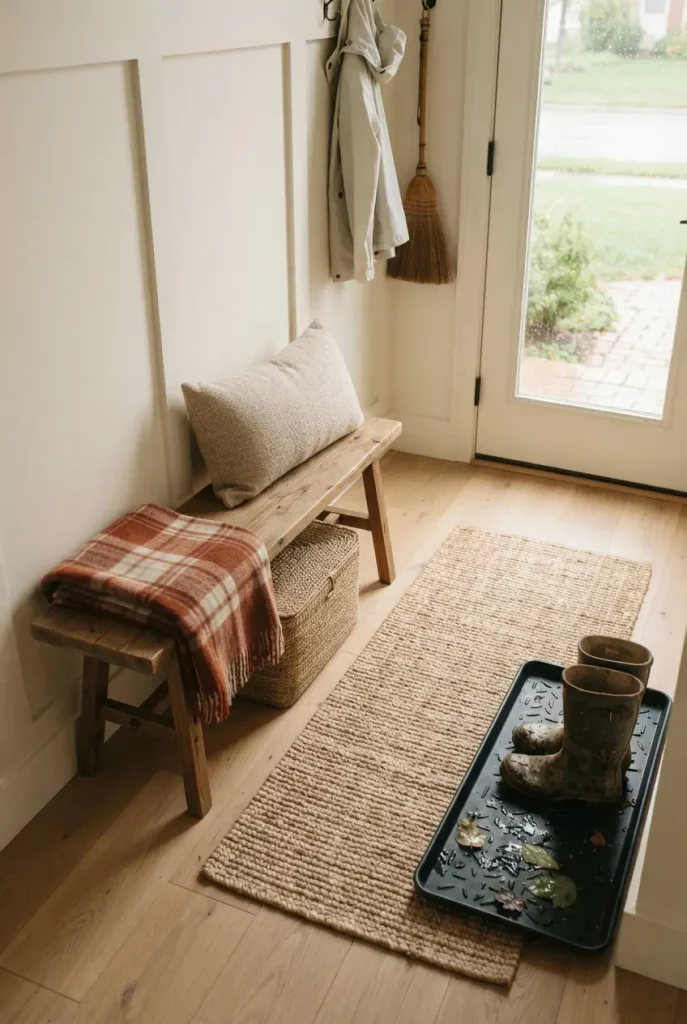
A washable runner or a flatweave jute rug handles grit well. Keep it low-pile so the door still clears when it swings over it. Test that before you trim or buy a rug pad, and add a non-slip pad underneath so it doesn’t slide on hard floors.
If you have room for a bench, dress it with a light touch. A folded plaid or wool throw at one end, one lumbar pillow, and a lidded basket underneath for gloves and scarves. Stop there. The same layering order from our guide to building a reading nook in any room works here at a smaller scale: seat first, then soft layer, then something useful within reach.
One trade-off to know up front: white boucle at the front door turns gray by Halloween. Rust, brown, and heathered wool hide a lot.
For a layer you notice without seeing it, hang a cinnamon broom behind the door on an adhesive hook. When the heat kicks on, the whole entry smells faintly like a bakery. Some people find it strong at first, so start near the door and not in a closed hallway.
Bare bench stacked with tote bags and mail. Slippery floor, shoes everywhere, nowhere to sit and pull on boots.
Washable runner on a grip pad, a boot tray by the door, a folded wool throw on one end, and a lidded basket underneath for gloves. One clear spot left to sit.
Plan the November Swap Before You Buy Anything
Here’s the gap almost every fall entry guide skips: fall decor has a short shelf life, and the holidays arrive fast. Plan for it now and you buy less, store less, and redo less.
Split everything you own into three groups. The base layer stays up through winter. Only the top layer changes when the calendar flips.
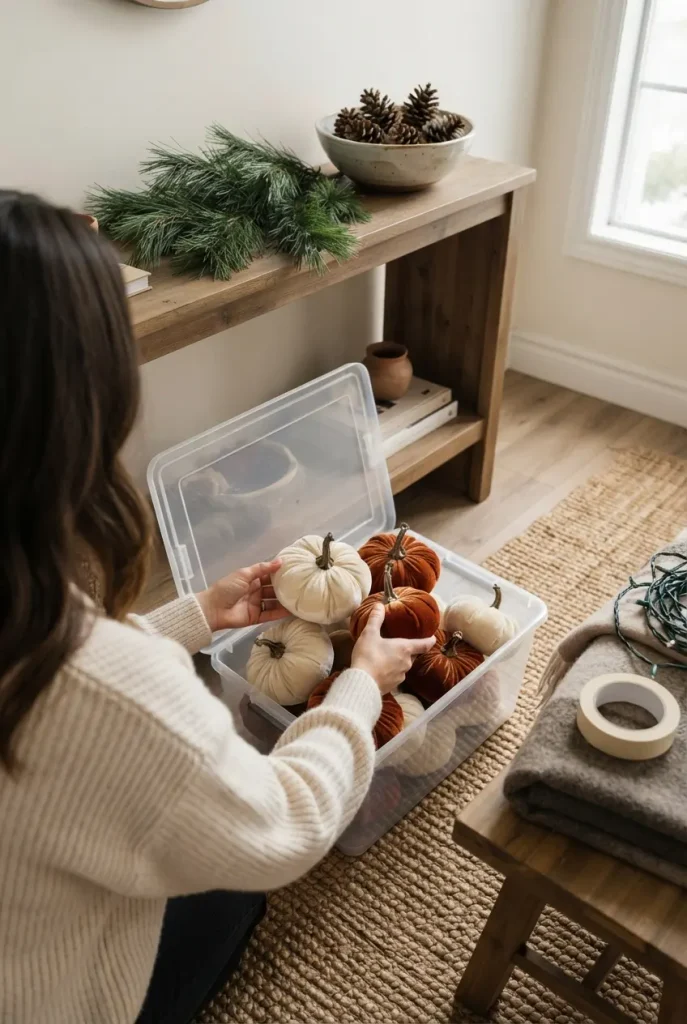
Buy base pieces in colors that work past Thanksgiving: a brown crock, a brass or black lantern, the lamp, the runner, the throw. Then when November ends, swap the pumpkins and leaf stems for pine branches and a bowl of pinecones. The entry changes in ten minutes, and nothing new goes on the wall.
Store faux pumpkins and stems in a lidded bin with a label, and keep it on the top shelf of the coat closet if you have one. Real pumpkins that are still firm can go to a compost bin or a community drop-off after the season.
FAQ
How do I decorate my entryway for fall without drilling holes?
Use methods that hang, lean, or sit. An over-the-door hanger holds a wreath, adhesive hooks handle light garland or a small mirror, and a mirror or framed print can lean on a console. Everything else sits on a table, a bench, or the floor: a crock of dried stems, a tray of small pumpkins, a plug-in lamp, and a washable runner. Nothing needs tools or leaves a mark.
What do you put on an entryway table for fall?
Style it in three heights. Put something tall on one side, like a crock of dried wheat or branches, a lamp or lantern on the other side, and a low tray in the middle with two or three small pumpkins and a key dish. Keep one clear landing spot for keys or a phone so the table stays useful, not just decorative.
How do I decorate a small entryway for fall?
Measure first. Subtract 30 inches from your hallway width to get the deepest table that still leaves a clear walking lane. Under 36 inches wide, skip the table and use a floor crock of branches, a leaning ladder shelf, or a basket. Then add fall through the door, a runner, and one warm light instead of lots of small items.
How do I hang a fall wreath on my front door without nails?
An adjustable over-the-door hanger is the sturdiest option and works on almost any door. Put a felt pad under the hook to protect the paint, and check that the door still latches. For lighter wreaths, an adhesive hook works on smooth doors and glass. Add a second small hook near the bottom to stop the wreath from swinging and tapping.
How long do pumpkins last as indoor decor?
An uncarved pumpkin that’s been properly cured and stored can last up to three months, according to NC Cooperative Extension. Pick one with no soft spots and 3 to 6 inches of stem, keep it away from direct sun and heat, and set it on a tray rather than bare wood. Carved pumpkins last only about 8 to 11 days.
When should you put out fall entryway decor?
There’s no fixed rule. Many people start around Labor Day or the first official day of fall in late September. Harvest pieces like wheat, leaves, and neutral pumpkins can stay through Thanksgiving, which gives you a solid two to three months of use. Save anything Halloween-specific for October so it doesn’t feel dated by November.
What colors work best for fall entryway decor?
Pick three: one dark anchor such as chocolate brown, bottle green, or oxblood, one warm middle like terracotta, rust, or straw yellow, and one neutral like cream or oatmeal linen. Repeat each color at least twice so the entry looks planned. Going light on bright orange keeps the look from feeling like a store display.
Your Entry, Done in an Afternoon
You don’t need tools or a big entry for this. Measure the hall, hang the wreath from the top of the door, give the table three heights, and put a warm bulb on a timer. That covers the parts people notice when they walk in.
The rest is small edits: a runner that handles mud, a throw that hides it, and a bin ready for the November swap.
Save this guide to your fall decor board so the walkway rule and the bulb numbers are there when you shop. And when the lamp clicks on at dusk, you’ll know the entry is doing its job.
Keep reading
More cozy nook ideas
 Fall Decor
Read →
Fall Decor
Read →
Fall Coffee Table Decor: The Complete Guide for Small Apartments
No mantel, no entry console, no spare shelf. In a small apartment, the coffee table is the one surface everyone sees, and…
 Fall Decor
Read →
Fall Decor
Read →
The Fall Kitchen Checklist: Everything to Decide Before You Start
Most fall kitchen regret starts the same way. You buy the pumpkins first, carry them in, and discover the counters were never…
 Fall Decor
Read →
Fall Decor
Read →
25 Outdoor Halloween Decor Ideas for Balconies That Renters Can Actually Put Up
Your balcony is four feet by nine feet, the railing belongs to the building, and the lease says nothing may be attached…