
The Fall Kitchen Checklist: Everything to Decide Before You Start

Most fall kitchen regret starts the same way. You buy the pumpkins first, carry them in, and discover the counters were never going to hold them. So the toaster moves, the fruit bowl migrates to the table, and by the second week you are cooking around a display instead of in a kitchen you like.
Deciding is the part everyone skips. Not because it is hard, but because every guide out there hands you sixty ideas and zero order. Ideas are the easy half. The hard half is knowing how much counter you can actually spend, which three colors you are committing to, and what happens in week three when the stems drop and the pumpkin goes soft on the bottom.
This is that missing half. Seven decisions, in the order that keeps you from buying twice, plus what a real starter set costs, totaled at September 2026 prices. Work down it once and you can shop in a single trip.
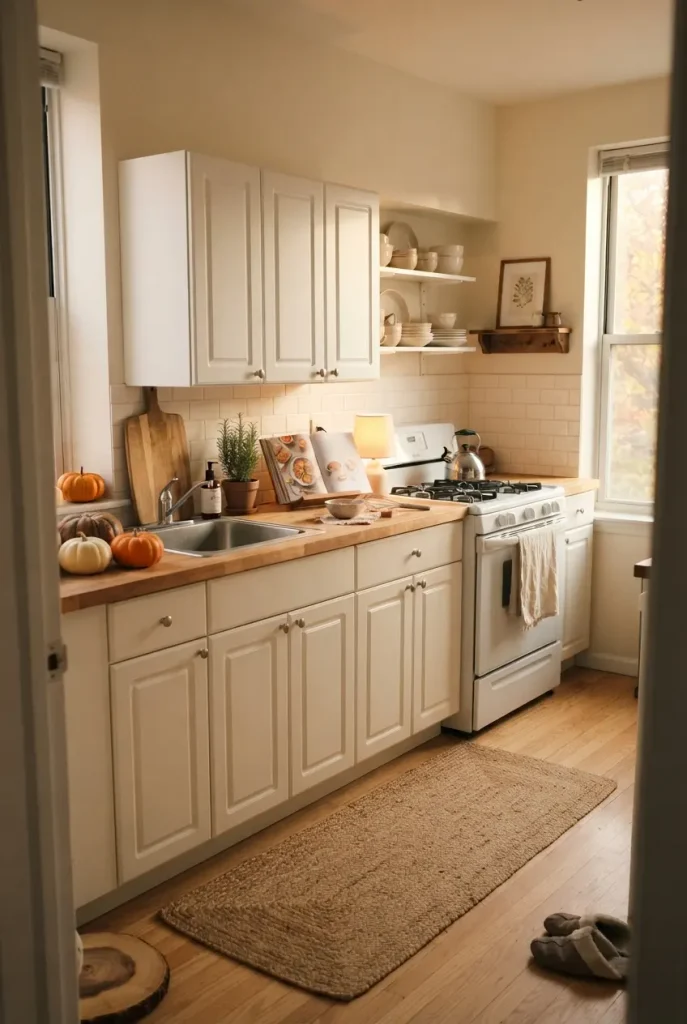
1. The Five Decisions, Before You Spend Anything
Here is the whole fall kitchen in five choices. Make them in this order and each one narrows the next, which is the entire point.
Color first, because it kills half the options in the store. Surfaces second, because that sets your budget more honestly than any price tag does. The last three are just filling in the shape those two made.
2. Decision One: Commit to Three Colors and Stop
Three is the number because a kitchen already has four or five colors in it before you add anything. Cabinet color, counter color, backsplash, floor, and whatever your appliances are doing. Add five more and you get noise.
Pick one deep anchor, one warm mid-tone, and one neutral that is already in your room. That last one matters more than the two you are excited about, because it is the reason the new things look like they belong.
| Warm classic | Muted modern |
|---|---|
| Anchor: deep rust or burnt clay | Anchor: aubergine or near-black green |
| Mid: honey wood, brass, amber glass | Mid: sage, oat, pale clay |
| Neutral: cream, unbleached linen | Neutral: white oak, warm gray |
| Reads: farm kitchen, vintage, harvest | Reads: quiet, current, less seasonal |
Both columns are backed by where searches are actually moving. Pinterest’s Spring Trend Report 2026 clocked “sage green and cream kitchen” up 410 percent and “aubergine kitchen” up 495 percent, alongside “warm wood kitchen” and “rustic farm kitchen.” Orange is not the assignment. Warmth is.
One practical filter before you commit: hold your candidate color next to your cabinets at night, under the light you actually cook by. Daylight flatters everything and lies about undertone.

3. Decision Two: Choose Your Surfaces With the 3-Surface Rule
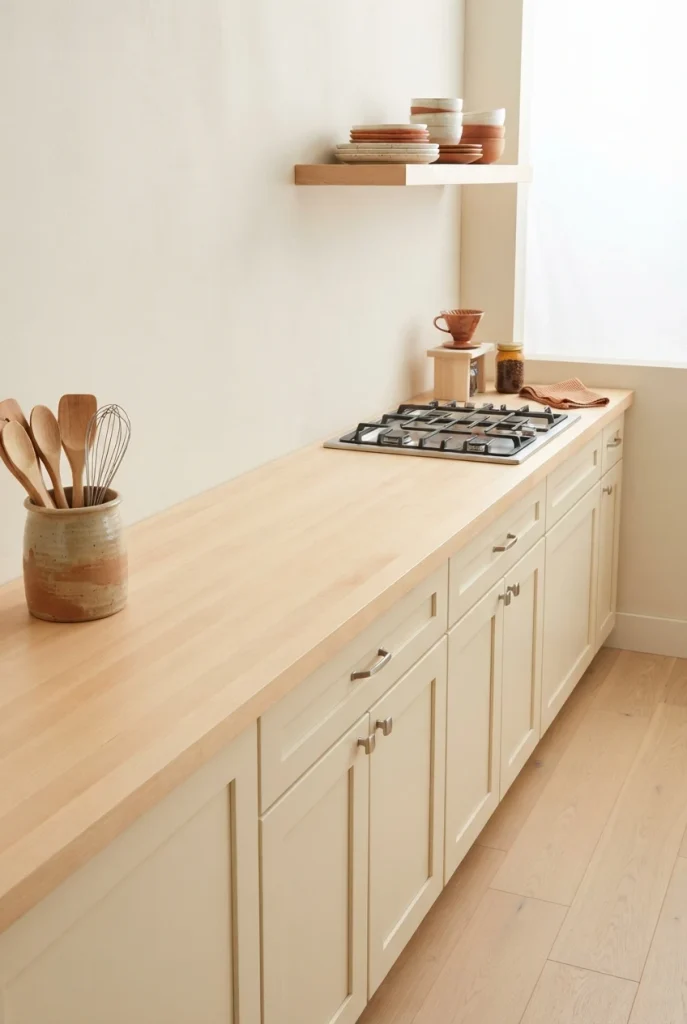
Counter space is the real currency here, and almost nobody budgets it. A galley kitchen might have six linear feet of usable counter, total, and two of those feet are already doing a job.
So spend it deliberately. Here is the rule this whole article is built on.
Dress three surfaces in the kitchen and leave every other surface completely alone. One tall, one low, one you touch daily. The empty ones are what make the dressed ones read as intentional instead of cluttered.
One tall means eye level or above: open shelf, top of the fridge, a wall hook, the windowsill. One low means the island, the table, or a counter run you do not cook on. One you touch daily is the small one, the sink ledge or the coffee corner, where a single object earns its keep because you see it forty times a day.
The surface you never dress is the working zone beside the cooktop. Keep it clear, and keep it clear on purpose. Open flame near fabric and dried stems is a genuine hazard, and a decorated counter next to a burner is the most common version of that mistake.
Small kitchen, one counter run, nowhere obvious to put anything? That is a corner problem more than a kitchen problem, and the same logic that rescues an awkward eight square feet anywhere else applies here too. These small space ideas for awkward corners work the same way on a kitchen end wall.
4. Decision Three: Real Pumpkins or Faux, and Where Each Belongs
Answer this per surface, not once for the whole kitchen. Real and faux fail in opposite ways, so the right call depends on where the thing is sitting and how warm that spot gets.
Real produce brings something faux cannot: uneven color, a stem that looks like it grew, weight when you pick it up. It also has a clock on it. A real pie pumpkin ran $2.49 at Kroger and $2.62 at Walmart this week, so the cheap option is the one that expires. Faux costs more up front and then costs nothing for six years.
Faux pumpkins are priced all over the map right now. Target’s Threshold ceramics run $5.00 for a 4 inch, $10.00 for a 5.24 inch, and $15.00 for an 8 inch. Walmart multi-packs start near $5.99 for a seven piece assortment. Hobby Lobby had velvet pumpkins at $2.99 each on sale. Buy odd numbers in three sizes and they group better than five identical ones ever will.
Where real pumpkins go wrong: bottom first, quietly. The underside sits flat against a warm counter, holds moisture, and softens days before the top shows anything. Lift each one when you wipe the counter and you will catch it a week early.

5. Decision Four: Which Textiles Actually Earn Counter Space
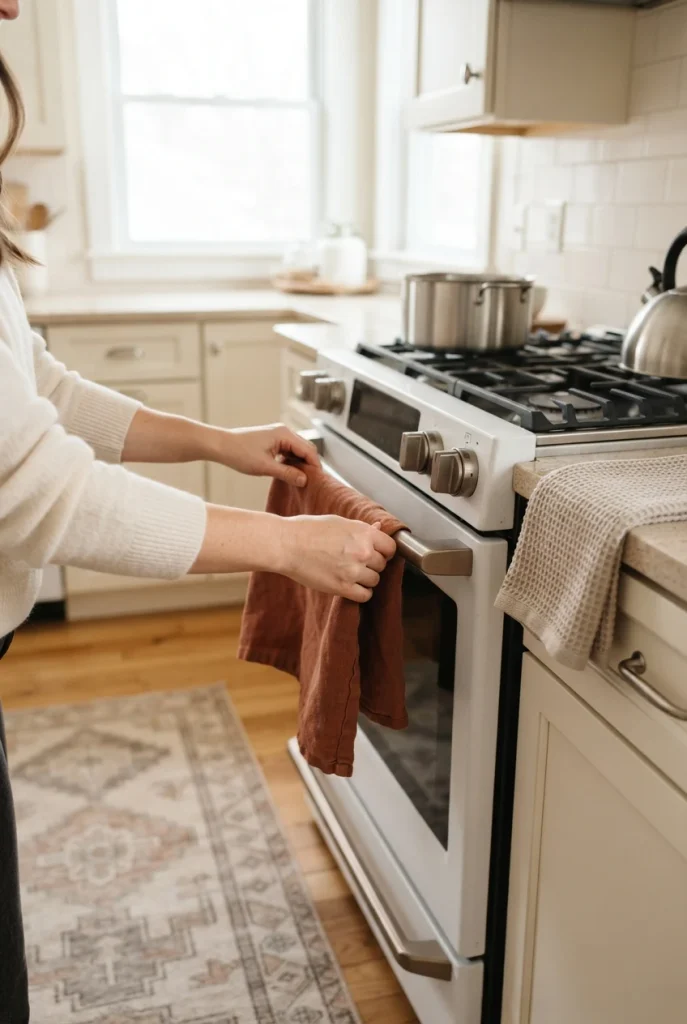
Textiles do more seasonal work per dollar than anything else in a kitchen, because fabric changes how a room sounds and feels, not just how it looks. A runner underfoot deadens the clatter of a hard floor. Linen over a bar softens a hard edge you brush past all day.
The filter is simple. If it cannot go in your washer, it does not belong in a kitchen.
The four textiles worth buying
Low pile is doing real work in that list. High pile under a sink is a mop you cannot wring out, and a kitchen runner takes more splashes than any rug in the house.
6. Decision Five: Warm the Light Before You Buy Another Thing
Swapping bulbs changes a kitchen more than a hundred dollars of decor, and almost nobody does it. A kitchen lit at 4000K reads like a pharmacy at seven in the evening no matter what you put on the counter.
Light color is measured on the Kelvin scale, and lower numbers are warmer. The Department of Energy’s consumer guide to energy-efficient lighting explains why the number on the box is the one to read: since 2011 the Lighting Facts label has listed brightness in lumens, energy cost, life expectancy, light appearance as warm or cool, wattage, and mercury content. Warm, yellow light is the one that resembles old incandescent bulbs, which is the quality people mean when they say a kitchen feels good at night.
Read the Lighting Facts label on the bulbs already in your ceiling fixture. If it says 3500K or higher, that is your evening problem.
Swap to 2700K soft white. A GE 4-pack of 60W-equivalent 2700K A19 bulbs was $9.99 at Target and $13.98 at Home Depot; Philips ran $10.17 for four.
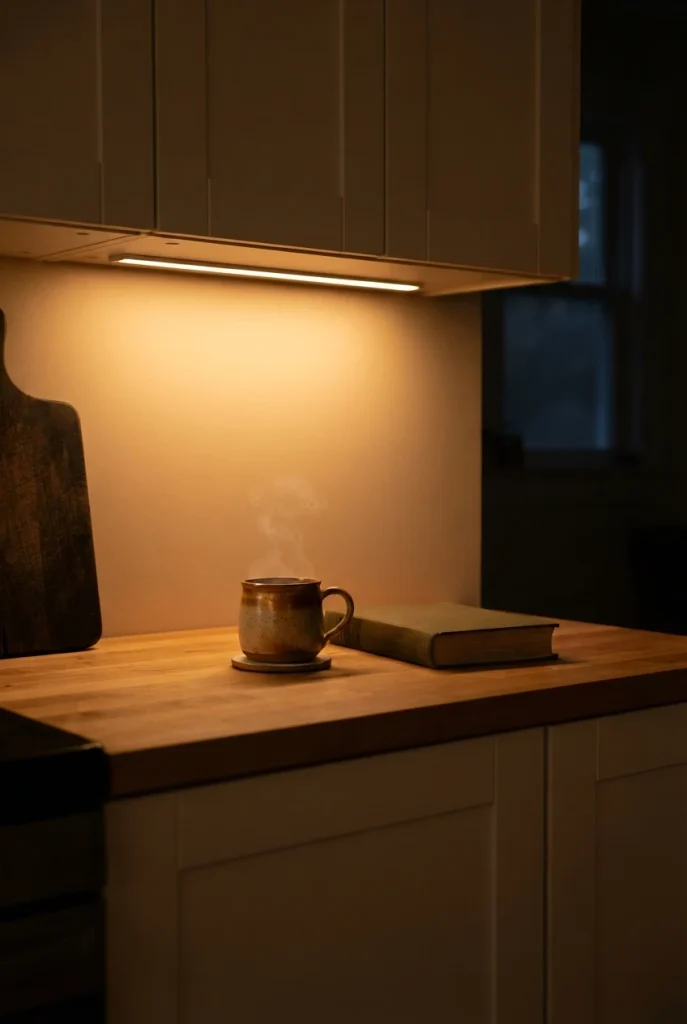
Add one low source so the ceiling light can stay off. Plug-in under-cabinet puck kits ran $21.18 to $32.47 at Home Depot, and a 16 foot plug-in LED strip was $12.98.
Renters, note the word plug-in. Hardwired sconces and picture lights mean a new circuit and an electrician. A plug-in puck kit sticks under a cabinet with adhesive and leaves nothing behind.
Step three is the one that actually does it. One warm light at counter height, ceiling fixture off, is the difference between a kitchen you leave after dinner and one you sit in.
7. Scent, and the Safety Part Nobody Puts in the List
Smell is the one decorating channel a photo cannot carry, which is exactly why it is worth spending on. It is also the one with real risk attached.
Safety note: anchor tall furniture to the wall, keep candles and cords away from fabric, and use a licensed electrician or contractor for hardwired lighting, ceiling mounts, or anything structural.
⚠️ Watch Out
Keep lit candles at least 12 inches from anything that burns, put them in stable holders where they cannot be knocked over, and blow them out when you leave the room. A kitchen counter dressed with dried stems, linen and paper is exactly the surface that rule is written for.
Those are not house rules, they are the U.S. Fire Administration’s candle safety guidance, which also notes that an average of 20 home candle fires are reported every day and recommends battery-operated flameless candles as a look-alike alternative.
Three ways to get the smell without the flame, in order of how long they last:
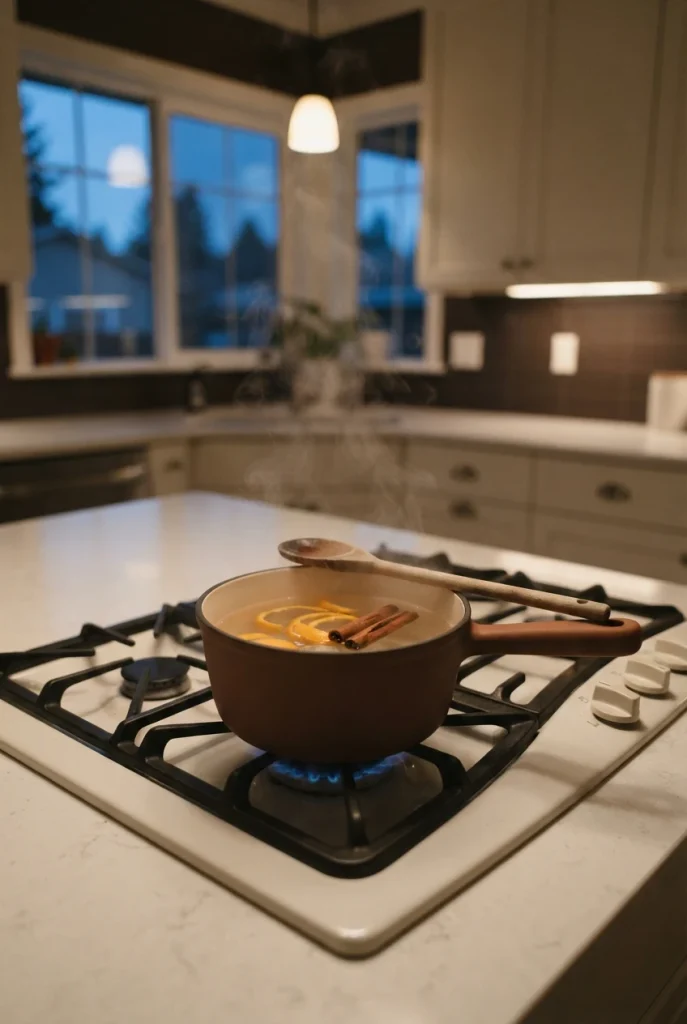
A simmer pot costs whatever the produce costs. Orange peel, two cinnamon sticks and a few cloves in a small pan of water on low fills a kitchen in about fifteen minutes and dies the moment you turn it off, which is the point. A jar candle holds longer: mass-brand 12 ounce two-wicks ran $9.78 to $10.87 at Walmart and $10.00 at Target this week. A reed diffuser runs quietly for weeks with no flame at all, and it is the only one of the three you can leave alone in an empty house.
Then there is the free one. Bake something. Nothing bought smells as much like fall as an apple in an oven.
8. What a Starter Set Actually Costs, Totaled
Nobody prints the total, so here it is. Prices below were read off retailer pages on September 22, 2026, at US national listings. They move by store and by week, and several were sale-marked when checked, so treat them as a band rather than a receipt.
| Piece | What to buy | Price band |
|---|---|---|
| 💡 Light | 2700K A19 soft white, 4-pack | $9.99 to $13.98 |
| 🔌 Second light | Plug-in LED strip, 16 ft | $12.98 to $24.98 |
| 🧺 Towels | Cotton tea towels, 2 to 4 pack | $5.73 to $10.00 |
| 🎃 Pumpkins | Three faux, three sizes | $6.00 to $30.00 |
| 🌾 Stems | Dried wheat or pampas bundle | $1.79 to $23.99 |
| 🪵 Board | Wood serving board, medium | $5.97 to $22.00 |
| 🕯️ Scent | 12 oz jar candle, mass brand | $9.78 to $10.87 |
| Total | seven pieces | $52.24 to $135.82 |
Two lines in that table carry most of the effect, and they are the two cheapest. Bulbs and a plug-in strip come to under $40 at the low end and change the room every single evening, which the pumpkins do not.
Add a washable runner at $12.99 to $45.00 and a stoneware crock at $9.74 to $27.99 if your floor is loud or your utensils are homeless.

9. The Eat-In Corner Everyone Skips
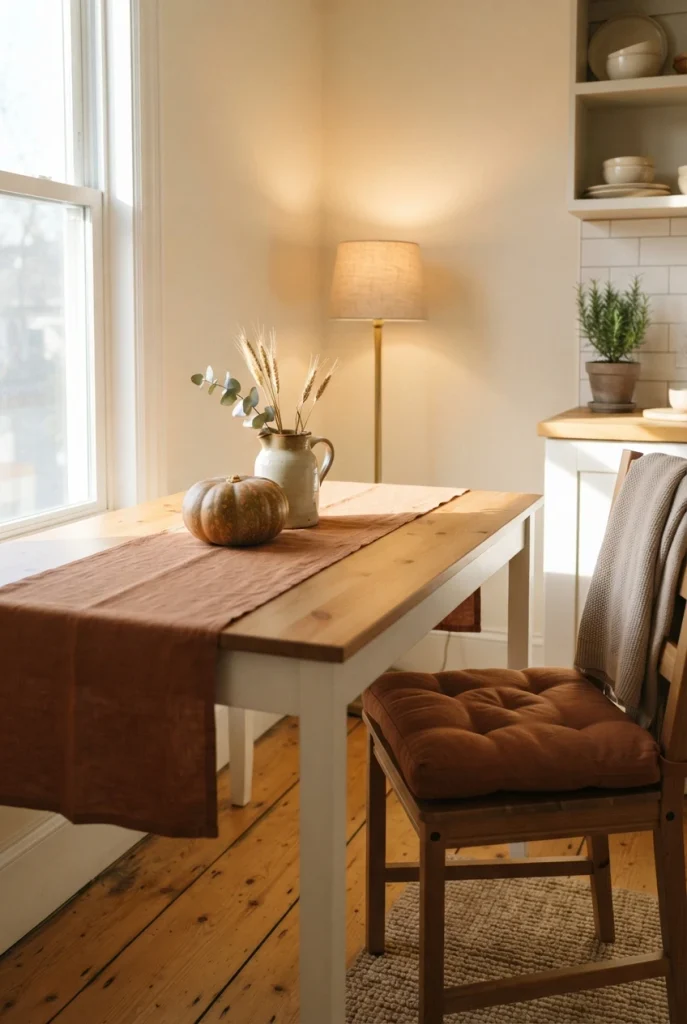
Here is the part the idea lists overlook. Most people decorate the working kitchen and ignore the four square feet where anybody actually sits, which is the only spot in the room where someone lingers long enough to notice what you did.
A small table pushed flat to the wall, two chairs nobody sits in, mail in a pile, overhead light only.
Folded linen down the center, one low grouping instead of mail, a seat cushion, and a lamp or plug-in sconce at sitting height.
A lamp at sitting height is the whole trick. Overhead light makes a table a surface; side light at eye level makes it a place. That single change is why a breakfast corner starts getting used in October and stops being where the mail lands.
Sizing one from scratch is its own problem, and there are real measurements involved before you buy a table. These breakfast nook ideas measured for small kitchens cover the dimensions worth knowing first.
10. Week Three: What Goes Wrong, and What to Do About It
Every guide is written for the day you decorate. Almost nothing survives untouched to Halloween, so plan the maintenance the way you planned the buy.
- ▸Real pumpkins soften from the underside. Lift each one when you wipe the counter. A weeping bottom means it goes outside today.
- ▸Dried stems shed. Wheat and pampas drop near heat and air vents. Keep them off the surface you prep on and out of the range hood’s draft.
- ▸Jar candles tunnel. The first burn sets the memory. Let it pool all the way to the glass before you blow it out, or you lose most of the wax.
- ▸Textiles go grubby fast. A kitchen runner sees more splashes than any rug you own, which is why washable was a requirement, not a preference.
- ▸The clear zone creeps. Objects migrate toward the stove over three weeks. Push them back every Sunday and the 3-Surface Rule holds all season.
Once the kitchen is settled, the same five decisions port straight to the next room without buying anything new, because color, surface count, light temperature and washability are not kitchen rules. They are room rules. The nearest place to spend them is wherever you sit down after dinner, and these fall reading nook ideas for the next room over run on exactly the same logic.

Fall Kitchen FAQ
When should I decorate my kitchen for fall?
Early to mid September works for anything faux, textile or lighting-based, since none of it expires. Hold real pumpkins and gourds until the last week of September or the first week of October. Indoors on a warm counter they soften in roughly two to four weeks, so buying them the day the leaves turn means replacing them before Halloween.
How do I decorate a small kitchen for fall?
Dress three surfaces and leave the rest bare, using one tall spot, one low spot, and one small daily spot. In a galley or one-wall kitchen, group everything at the end farthest from the cooktop so your prep zone stays clear. Vertical space carries the most weight in a small room: a shelf, a windowsill, or a wall hook adds season without costing counter.
What are the best fall colors for a kitchen?
Pick three: one deep anchor, one warm mid-tone, and one neutral already in the room. Pinterest’s 2026 kitchen search data favors warmth over orange specifically, with sage and cream, aubergine, warm wood and rustic farm palettes all rising sharply. Deep rust, honey wood and cream is the safe warm set; aubergine, sage and white oak reads more current.
How do I decorate my kitchen for fall without spending much?
Two bulb-and-light purchases do more than everything else combined, and both come in under $40 together. A 4-pack of 2700K soft white bulbs ran $9.99 to $13.98 and a 16 foot plug-in LED strip ran $12.98 at national retailers in September 2026. After that, shop your own cabinets: wooden boards, stoneware, glass jars and real produce are already in the room.
What can I use for fall kitchen decor besides pumpkins?
Dried wheat or pampas bundles, a bowl of apples or pears, glass jars of dried beans and grains, wooden boards leaned against the backsplash, a stoneware crock, copper or brass pieces, and textiles in your anchor color. Real food is the most reliable substitute because it brings color, texture and smell at once, then gets eaten instead of stored.
How do I keep fall decor from getting in the way of cooking?
Name one counter zone as untouchable before you place anything, usually the stretch beside the cooktop and the space between sink and stove. Nothing decorative crosses into it, including a candle. Check it weekly, because objects drift toward the stove over a season without anyone moving them on purpose.
Do real pumpkins go bad indoors?
They do, and they fail from the bottom first where the flesh sits flat and holds moisture against a warm surface. Set them on a wooden board rather than straight onto a counter, keep them away from the stove and the dishwasher’s vent, and lift each one when you clean. A soft or weeping underside means it goes outside the same day.
One Trip, Not Four
Decide the five, buy once, and the fall kitchen stops being a project that eats three weekends. Color, then surfaces, then the small stuff. Swap the bulbs even if you skip everything else, because the room you cook in at six in the evening is the one you actually live in.
Then keep the working counter clear and check the pumpkins on Sundays. That is genuinely the whole maintenance plan.
Save this checklist to your fall board so it is in your pocket at the store, which is the moment you will want the price bands and the three-color rule most.
Keep reading
More cozy nook ideas
 Fall Decor
Read →
Fall Decor
Read →
How to Decorate Your Entryway for Fall (Even If You’re Not Handy)
No drill, no ladder, no awkward email to your landlord. This fall entryway decor goes up with an over-the-door hanger, a tape…
 Fall Decor
Read →
Fall Decor
Read →
Fall Coffee Table Decor: The Complete Guide for Small Apartments
No mantel, no entry console, no spare shelf. In a small apartment, the coffee table is the one surface everyone sees, and…
 Fall Decor
Read →
Fall Decor
Read →
25 Outdoor Halloween Decor Ideas for Balconies That Renters Can Actually Put Up
Your balcony is four feet by nine feet, the railing belongs to the building, and the lease says nothing may be attached…