
25 Fall Garland Ideas for Small Spaces That Need Zero Holes in the Wall

No mantel. No banister. No landlord who says yes to nails. That rules out almost every fall garland tutorial online, and it is exactly the situation most of us are decorating in.
A 700 square foot apartment still has shelf edges, a window frame, a headboard, and a curtain rod. Every one of those holds a garland, and not one of them needs a drill.
So this list is built backward from the wall you actually have. Twenty-five ideas sized for tight corners, with real 2026 prices where store-bought beats a craft night, and the numbers that usually get left out: how much weight each hook holds, how thick to cut an orange, how long a swag needs to be before it drapes instead of sags.
Some take ten minutes and a spool of jute twine. A couple take an afternoon and an oven set to 215°F.
Entry one is the hardware, because the hanging method decides everything that comes after it. Get that part right and the rest is just picking leaves.
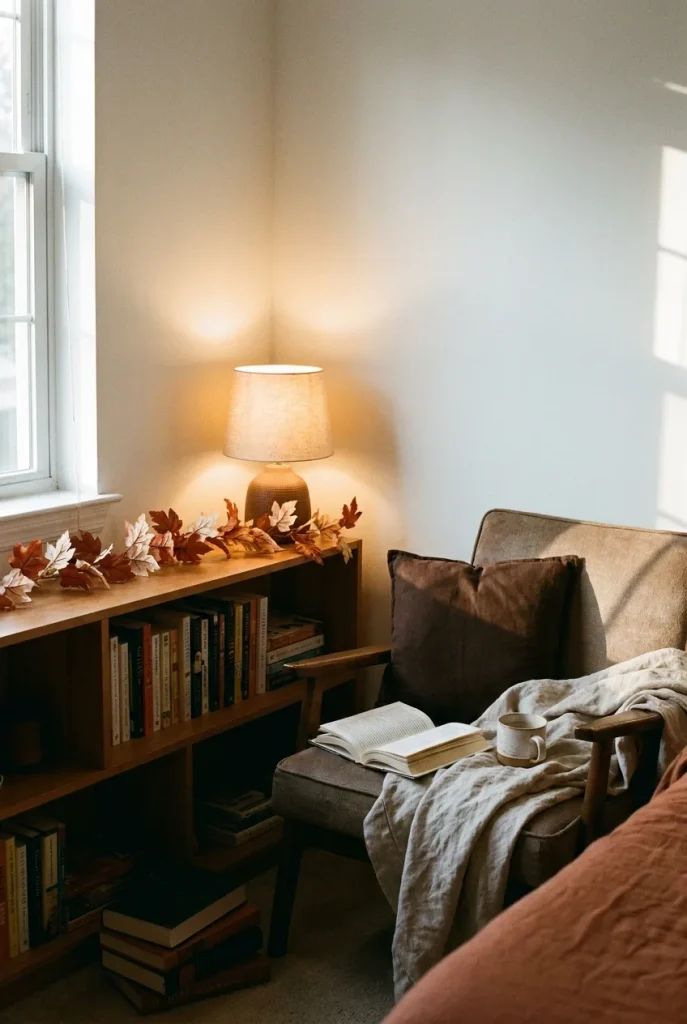
1. Start With the Hardware, Not the Garland
Pick the hook first and the whole project stops being a gamble. 3M publishes a weight limit for every Command product it sells, and the numbers are lower than most people assume. A Clear Mini Hook holds half a pound. A Designer Small Hook holds one. That is fine for paper and felt, and nowhere near enough for a wet-look faux cedar garland with an iron spine.
Weigh your garland on a kitchen scale before you buy a single hook. Then check it against 3M’s published weight limits by hook size and go one size up.
Skipping this step is why garlands end up on the floor at 2 a.m.
The Renter Hang Chart
| Command product | Published limit | Garland it handles |
|---|---|---|
| Clear Mini Hook | 1/2 lb | Paper, ribbon, felt |
| Clear Small Hook | 1 lb | Dried oranges, wood beads |
| Clear Medium Hook | 2 lb | Most 6 ft faux leaf garland |
| Large Clear Hook | 4 lb | Dense cedar or berry garland |
| Large Hook | 5 lb | Iron-spined garland, doubled swags |
Figures as published by 3M, © 3M 2026. Decorating Clips are sold for light strands and carry no listed weight capacity.
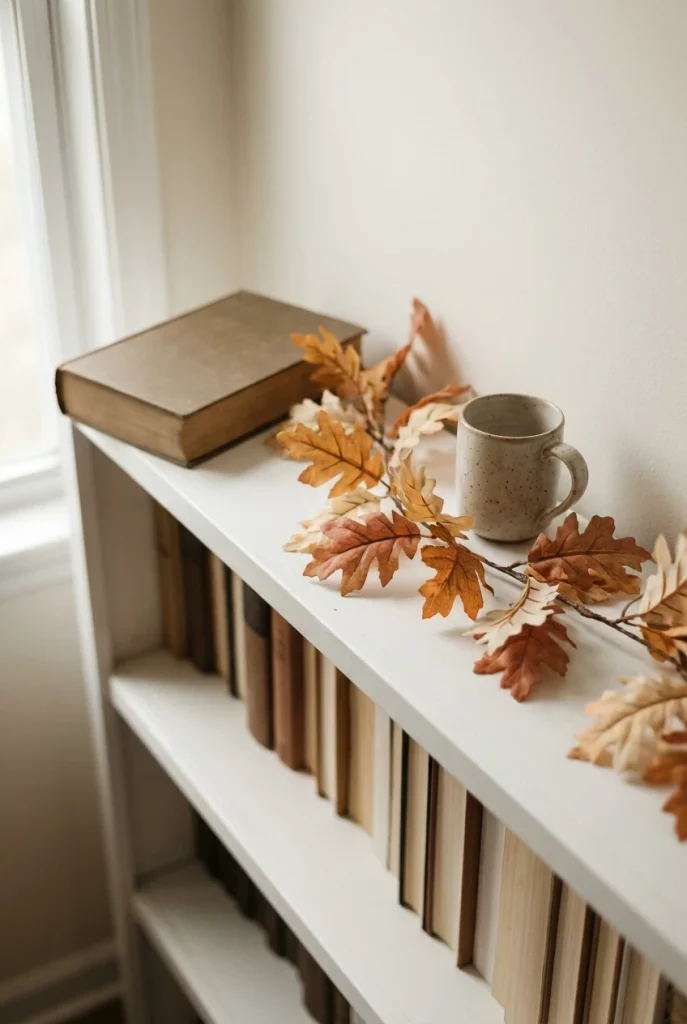
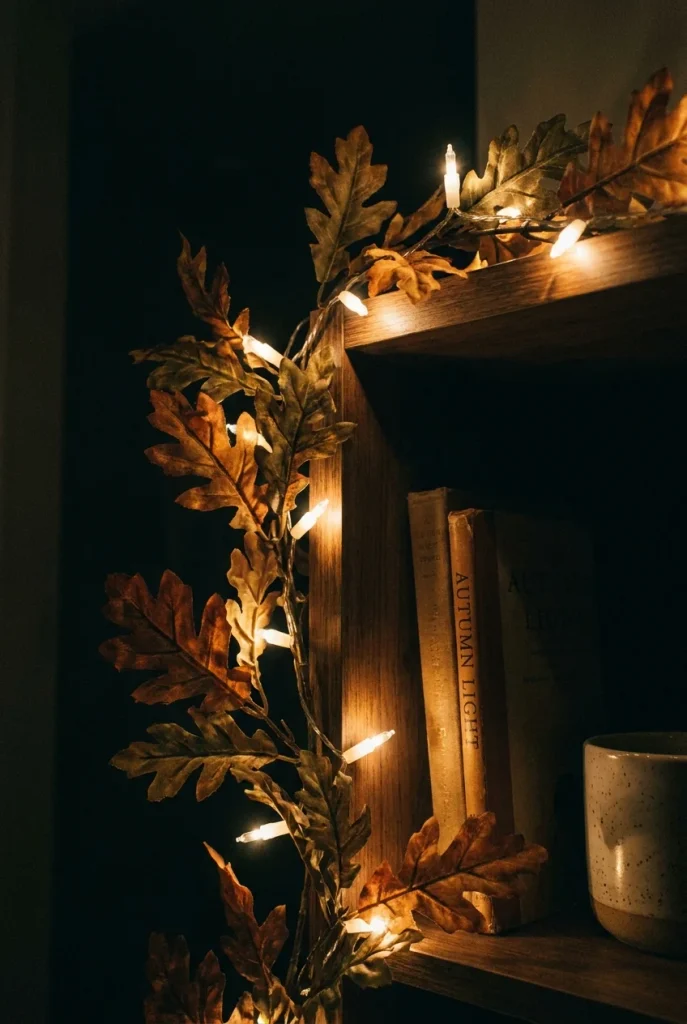
2. Run It Along a Bookcase Edge
Bookcase edges are the most overlooked garland rail in a small apartment. The top shelf already sits at eye level, it is dead flat, and nothing you hang there touches a wall.
Lay the garland along the edge and let roughly six inches spill down at each end. Books hold the middle in place. No adhesive at all.
If your shelves are open-backed, thread the twine behind a row of spines instead of resting it on top, and the garland stops sliding every time you pull a book.
Shelf styling gets easier once you stop treating the top surface as storage. There is more on that in these reading nook with bookshelves setups, which use the same trick year round.
Recreate this shelf edge
3. Frame the Only Window You Have
Rentals almost always have one window that gets all the light and all the attention. Treat the frame as a mantel turned sideways.
Two Outdoor Medium Clear Window Hooks hold two pounds each and stick to glass, so the garland can sit just inside the top corners of the pane with nothing touching the painted trim. A shorter garland across the top third looks intentional. A full drape down both sides reads as holiday, not autumn, so stop at the corners.
Bay windows change the math completely, since you are working with three planes instead of one. These bay window reading nook layouts show how the seat depth changes what fits.
Bare white frame, thin curtains, nothing to look at until the sun goes down.
Garland across the top third on glass hooks. The frame reads as architecture and the trim stays untouched.
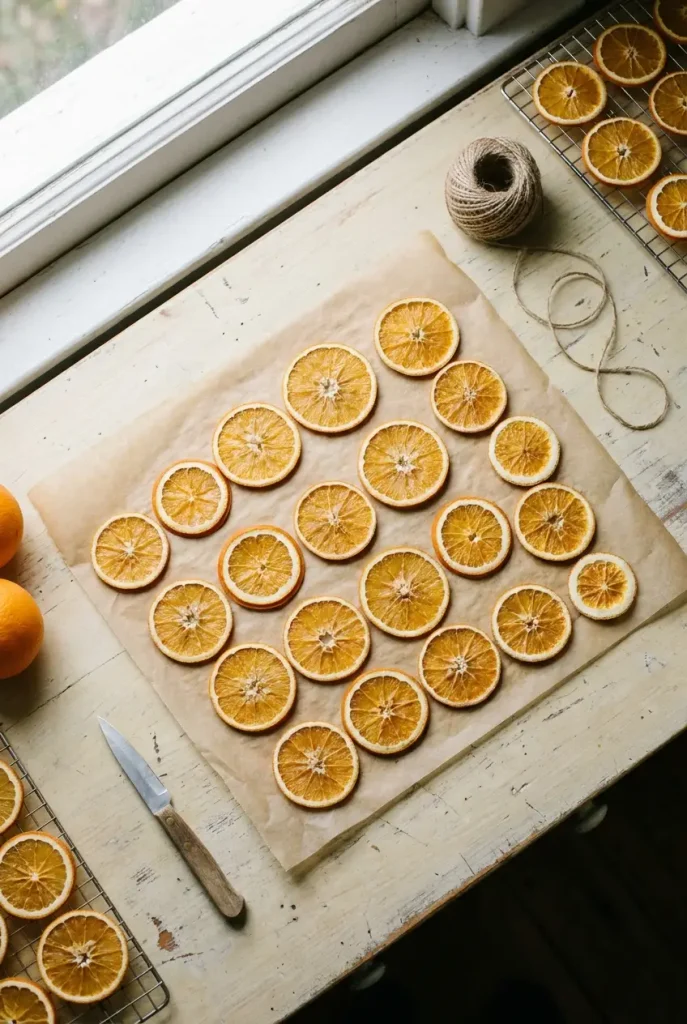
4. Dry Your Own Orange Slices
Oranges dry into stained glass. Backlit on a window or a shelf edge, they throw amber onto the wall behind them, which no faux garland does.
Cut across the equator, 1/8 to 1/4 inch thick, and lay the slices in a single layer. Oven at 200 to 225°F, with 215°F named as the sweet spot by the tutorial most people follow, since 200 drags on and 225 browns them. Three to five hours. Flip about every hour unless you are using a wire rack.
Then poke two holes near the rind, an inch or two apart, and thread jute twine through both so the slices hang flat instead of spinning.
Slice across the middle, 1/8 to 1/4 inch. Thinner slices dry faster and go translucent.
Single layer on parchment. Oven at 215°F for 3 to 5 hours, flipping hourly.
Slightly tacky is fine. They keep hardening as they cool.
Two holes near the rind, an inch or two apart, then thread the twine through both.
Dried properly and stored flat in the dark, these last for years. A dehydrator at 130 to 135°F for about 8 hours keeps them lighter, which is the version that ages best.
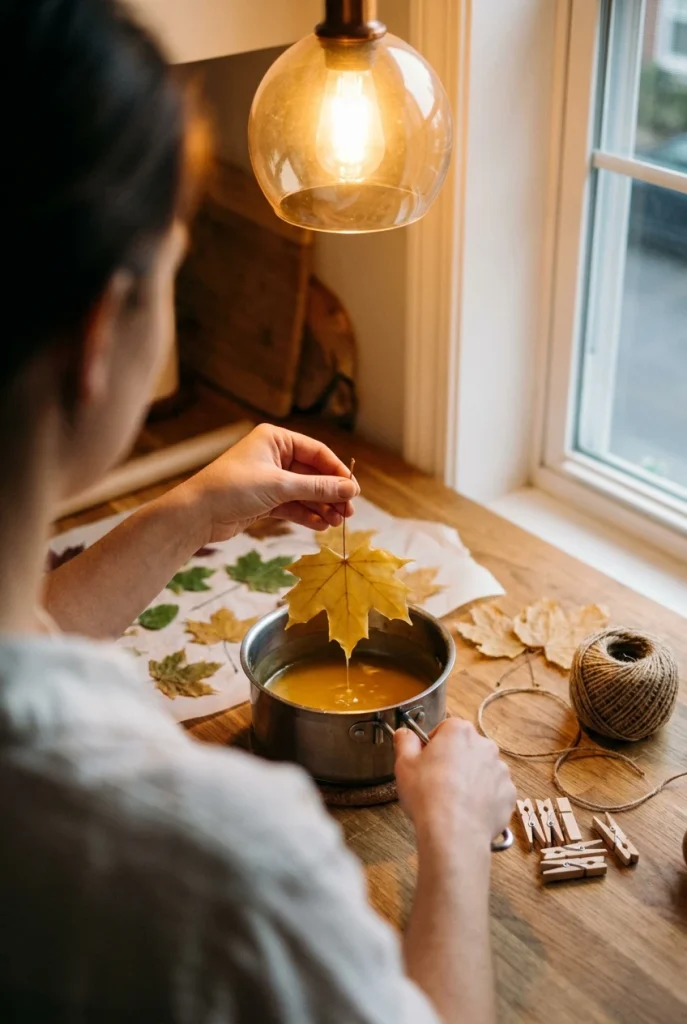
5. Seal Real Leaves in Beeswax
Real leaves keep their color for weeks if you seal them, and they cost nothing but a walk.
Collect fallen leaves rather than picking fresh ones, since fresh leaves carry too much moisture. Press them in a book for 24 to 48 hours and no longer, because past that they start losing color. Melt half a cup to a cup of beeswax pastilles in a double boiler until you have a pool a quarter to half an inch deep, warm but not piping hot. Too hot cooks the leaf. Too cool leaves a chunky white film.
Dip, wiggle off the excess, and they set within ten minutes. Color holds several weeks and sometimes a couple of months. Clip them to jute twine with petite clothespins so you can swap out any that fade early.
⚠️ Watch Out
Beeswax is highly flammable. Use a double boiler every time, never a pan straight on the burner, and keep the finished leaves away from any heat source.
Safety note: anchor tall furniture to the wall, keep candles and cords away from fabric, and use a licensed electrician or contractor for hardwired lighting, ceiling mounts, or anything structural.
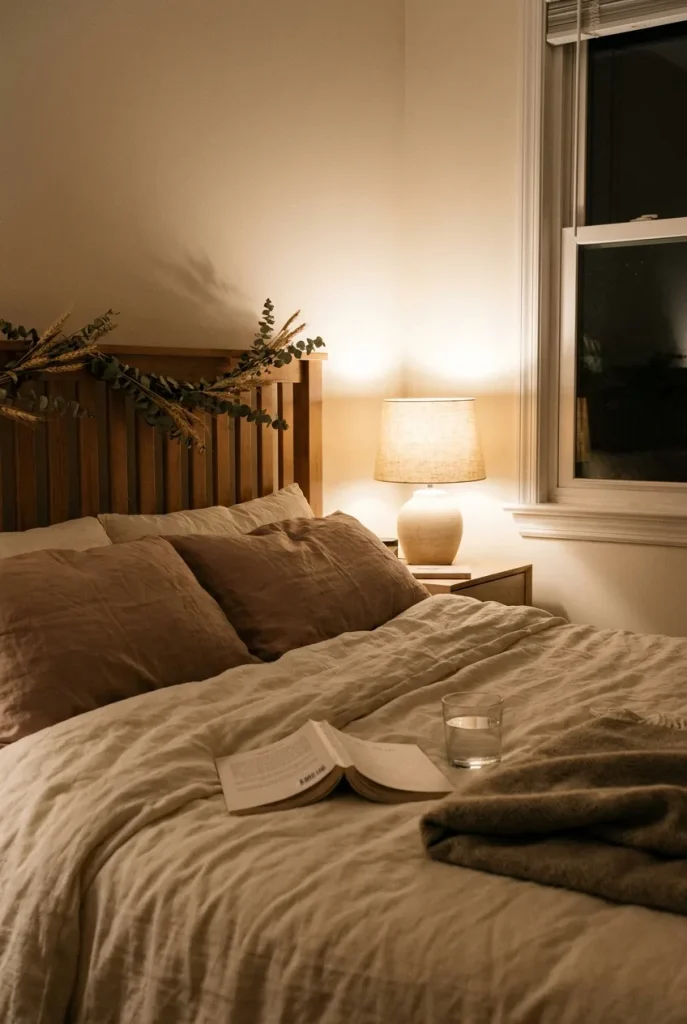
6. Hang It Across the Headboard
Beds eat a whole wall in a studio, which makes the headboard the largest flat surface in the room and the one nobody decorates.
A garland tucked behind the top rail and pulled slightly forward gives the bed a frame without adding a single object to the floor. Upholstered headboards take safety pins pushed in from the back. Slatted or spindle headboards need nothing at all, just weave the twine through.
Keep it to one strand. Two reads as a canopy.
7. Use the Curtain Rod You Already Paid For
Curtain rods already hold weight, already span the widest wall opening in the room, and already have brackets bolted into studs. That is a free mounting point most people walk past.
- ▸Loop the garland over the rod between the rings, not around them, so the curtains still slide.
- ▸Weight the two ends with a knot so the middle sags on purpose.
- ▸Skip this on a tension rod. The extra load pulls it out of the frame.
- ▸Sheer curtains underneath make the garland read heavier, which is usually the goal.
The one catch: you lose the ability to yank the curtains shut in a hurry. Worth knowing before you commit the bedroom window.
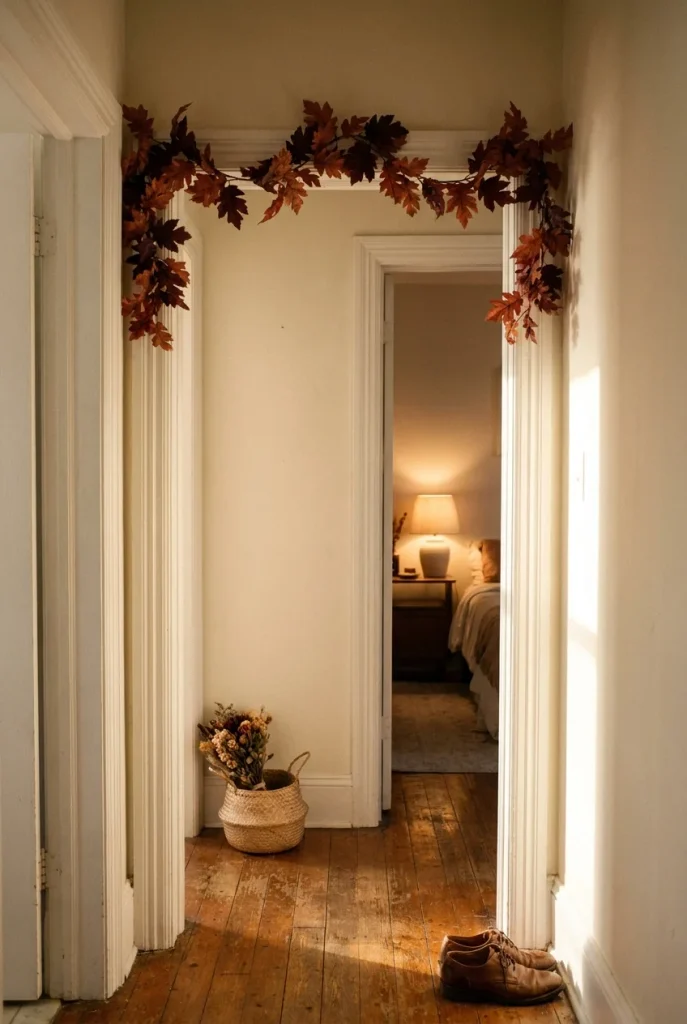
8. Swag the Doorway With the 1.5x Rule
Doorways want a swag, not a straight line, and the reason most doorway garlands look sad is that they were bought to exactly the width of the door.
Measure the span you want to cross. Multiply by 1.5. That is the garland length you buy. A standard 32 inch interior door needs about 48 inches of garland to dip properly, which means one 6 foot garland covers the door and gives you a foot of tail on each side.
Anchor both top corners, then pull the center down until the lowest point sits roughly one sixth of the span below the corners. Any deeper and people walk into it.
Buy garland at 1.5 times the span you want to cross. Under that it stretches flat and looks tense. Over that it hangs into head height.
9. Drape Wood Beads Over a Book Stack
Wood beads look wrong hanging from nothing. They were made to pool.
Stack four or five hardbacks on a side table, set a small object on top, and let a beaded garland fall over the corner of the stack and down onto the surface. The stack gives the beads a shape to follow, and the whole thing takes about forty seconds to arrange.
Natural wood beads read warmer than painted. A single felt or leather tassel at one end stops it looking like a curtain tieback.
💡 Quick Tip
Odd numbers of books look composed, even numbers look stacked. Three or five, and put the biggest one on the bottom.
10. Scale It Down for a Narrow Console
Narrow consoles get crowded fast. A 6 foot garland on a 36 inch console buries everything else on the surface.
Cut a faux garland in half with wire cutters, wrap the cut ends with floral tape, and you have two 3 foot pieces that each fit a small surface without swallowing it. Run one along the back edge and keep the front two thirds clear for whatever you actually use the console for.
The half you do not use becomes the bathroom shelf garland in November.
11. Make the Kids’ Corner Version Pull-Proof
Kids’ corners need garland that survives being pulled, because it will be.
Felt is the right material here. It has no sharp edges, it does not shatter, and a felt leaf garland can be sewn straight onto a length of wide cotton tape rather than strung on thread. Skip anything glass, anything with small beads, and any strand long enough to loop.
Hang it high, above standing reach, and keep the ends short.
Sew felt shapes onto flat cotton tape so there is no loose loop.
Anchor any bookcase in a kids’ corner to the wall with furniture straps.
Choose cordless blinds in the same corner.
Long strands that can loop over a head or a crib rail.
Small wood beads on thin thread within reach.
Anything glass, ceramic or wired at floor level.
12. Build a $30 Kitchen Shelf Garland
Kitchens in small apartments have more shelf edge than wall, and open shelving takes a garland better than a mantel does because the eye already expects things to sit there.
Keep it edible-adjacent. Dried citrus, bay leaves, cinnamon sticks and wheat all belong in a kitchen in a way that faux maple does not. Here is what a real build costs at 2026 prices.
| Piece | Archetype | Price |
|---|---|---|
| 🍊 Base strand | Walmart 3 Pack Fall Garland | $13.99 |
| 🌾 Filler | Home-dried orange slices, 2 oranges | about $2 |
| 🧵 String | Natural jute twine spool | about $5 |
| 📌 Fixings | Command Clear Small Hooks, 1 lb each | about $6 |
| Total | about $27 |
Garland price as listed by Homes & Gardens, August 2026. Twine and hook figures are typical US drugstore and craft store shelf prices, not quotes from a specific listing.
13. Pair It With Warm Light, Not More Stuff
Warm light does more for a fall corner than another pumpkin. A leaf garland in daylight is decor. The same garland lit from below at night is the reason the room feels different in October.
Run a plug-in fairy light strand along the same line as the garland, not woven through it, so you can pull one out without unpicking the other. Choose a warm 2700K strand. Anything cooler turns amber leaves gray-green.
Most small-space lighting problems are really placement problems, and these reading nook lighting setups cover the plug-in options that need no electrician.
This is the entry that makes a corner feel cozy at 9 p.m. rather than just decorated.
📌 Good To Know
Plug-in beats hardwired for renters every time. Hardwired sconces, picture lights or any new circuit is licensed electrician work, and that is a conversation with your landlord, not a Saturday project.
14. Go Dried Instead of Faux
Wheat and dried hydrangea age well, which is the opposite of how most faux garland behaves after two seasons in a storage bin.
Dried stems also weigh almost nothing. A full dried strand usually comes in under a pound, which puts it inside the range of a Clear Small Hook and means you can hang it on a surface that would refuse a wired faux garland.
The trade-off is real: dried hydrangea sheds. Expect to sweep under it, and do not hang it over a sofa you care about.
Dried stems that hold their shape
15. Tear Fabric Scraps Instead of Buying Ribbon
Fabric scraps beat store-bought ribbon on texture, because torn edges fray and frayed edges catch light.
Snip one inch into the selvage of an old cotton shirt or flannel sheet, then tear straight down. The fabric tears on the grain by itself.
Cut the strips to about 8 inches, which gives a 4 inch tail once knotted.
Lark’s head knot each strip onto jute twine, pushing them tight together as you go.
Three fabrics maximum, and keep one of them plain. Plaid plus plaid plus plaid turns into a picnic blanket.
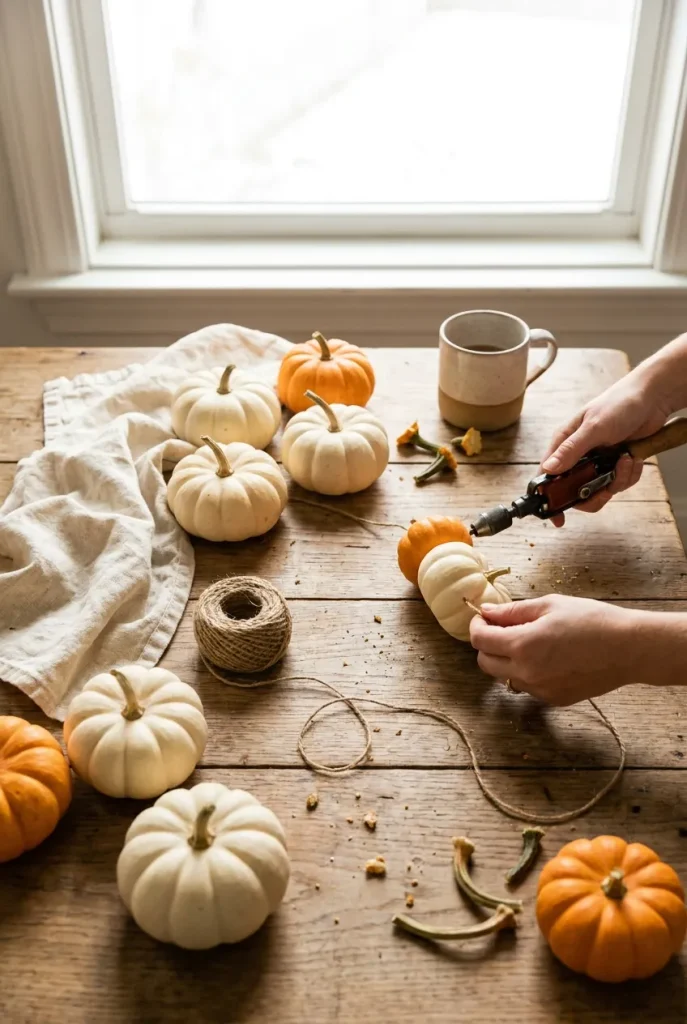
16. String Mini Pumpkins
Mini pumpkins turn into a garland with a drill bit and twine, and they are the one seasonal item that costs less than the faux version of itself.
Use fake ones if you want it to last. Real mini pumpkins hold up about three to four weeks indoors before the stems go soft, so time them for late October rather than putting them up on September 1.
Drill through the shoulder, not the stem. The stem is the first part to give out.
17. Hang It Off a Mirror Frame
Mirrors double whatever you hang on them, which makes a mirror the highest-return surface in a small room.
- ▸Drape across the top corner at a diagonal rather than straight across the top.
- ▸Asymmetry matters here. A centered garland on a mirror looks like a wreath that failed.
- ▸Check the reflection before you commit. You are decorating two views at once.
- ▸Leaning floor mirrors take the most weight because the frame rests on the ground.
18. Collect Acorn Caps and Pinecones
Acorn caps are free in October, and they are the one natural material that reads unmistakably as fall without reading as Halloween.
Bake foraged pinecones and acorns at a low oven temperature on foil for about half an hour first. Anything that came from outside brings small residents with it, and this is the step people skip and then regret in a warm apartment.
Damp, gritty, and carrying whatever was living in it. Pinecones stay shut.
Dry, clean, and fully opened up. Glue holds, and the twine does not stain.
Hot glue the caps back onto acorns before stringing. They pop off on their own otherwise, usually while you are holding the finished strand.
19. Borrow the Persimmon and Plum Color Story
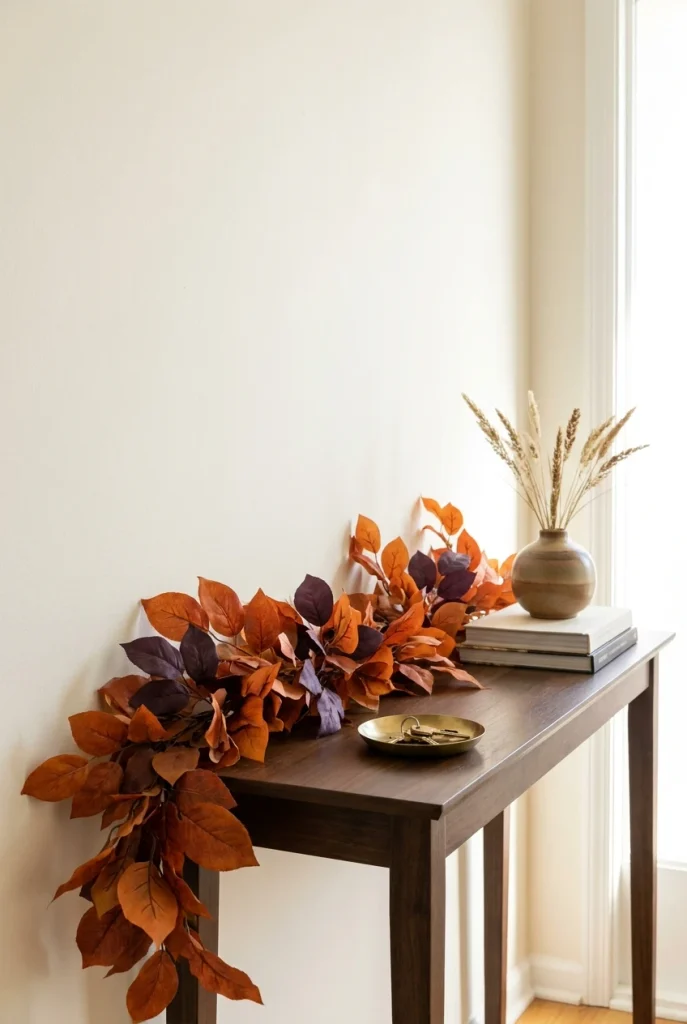
Persimmon and Plum Noir both landed in the 2026 Pinterest Palette, and Pinterest paired them as a named sub-palette called Persimmon-Plum. Persimmon is described as part orange, part red. Plum Noir is a deep purple with burnt burgundy in it.
For a garland, that pairing is more useful than the usual orange-and-brown default, because the plum gives the eye somewhere dark to land. Run mostly persimmon-toned leaves with roughly one in five in deep plum.
Against a cream wall it reads modern. Against a white rental wall it reads intentional, which is harder to pull off with orange alone.
20. Cover the Radiator or the Window AC
Radiator covers and window AC units are ugly and unavoidable, and a garland is the cheapest way to stop them being the first thing you see.
There is a hard rule here though, and it depends on which one you have.
Dress a window AC unit, which is cold when running, freely.
Use a radiator shelf above the unit, never the unit itself.
Keep the airflow path at the top and front fully clear.
Anything draped on a working radiator. It gets hot enough to scorch fabric.
Beeswax-dipped leaves anywhere near a heat source.
Blocking a vent to hide it. Heat has to go somewhere.
21. Knot Ribbon and Nothing Else
Ribbon alone reads as garland if you knot it right, and it is the version that works in a place with genuinely no surfaces.
Take three ribbon widths in one color family, cut them into 10 inch lengths, and knot them onto twine with about an inch of gap between each. What you get is texture rather than shape, which suits a narrow wall between two doors, or the side of a wardrobe.
Velvet is the one to spend on. Everything else can be craft store grosgrain.
The three-ribbon formula
22. Give the Work Corner Three Feet of It
Desk corners take a 3 foot garland and nothing more. Any longer and it starts landing in the keyboard.
A short strand along the back edge of a desk, or across the top of a pinboard, changes the corner without taking a single inch of working surface. For a work-from-home setup where the desk is also the dining table, this is the only seasonal decor that packs away in four seconds.
| Piece | Archetype | Price |
|---|---|---|
| 🍂 Garland | Michael’s Pumpkin & Mum Mix, cut in half | $17.99 |
| 📌 Fixings | Command Clear Mini Hooks, 1/2 lb each | about $5 |
| Total, two desks’ worth | about $23 |
Garland price as listed by Homes & Gardens, August 2026, marked down from $29.99. Hook figure is a typical US shelf price.
23. Keep Candles 12 Inches Clear
Candles and dry leaves are a bad pairing at close range, and a shelf garland puts the two closer together than almost any other setup in the house.
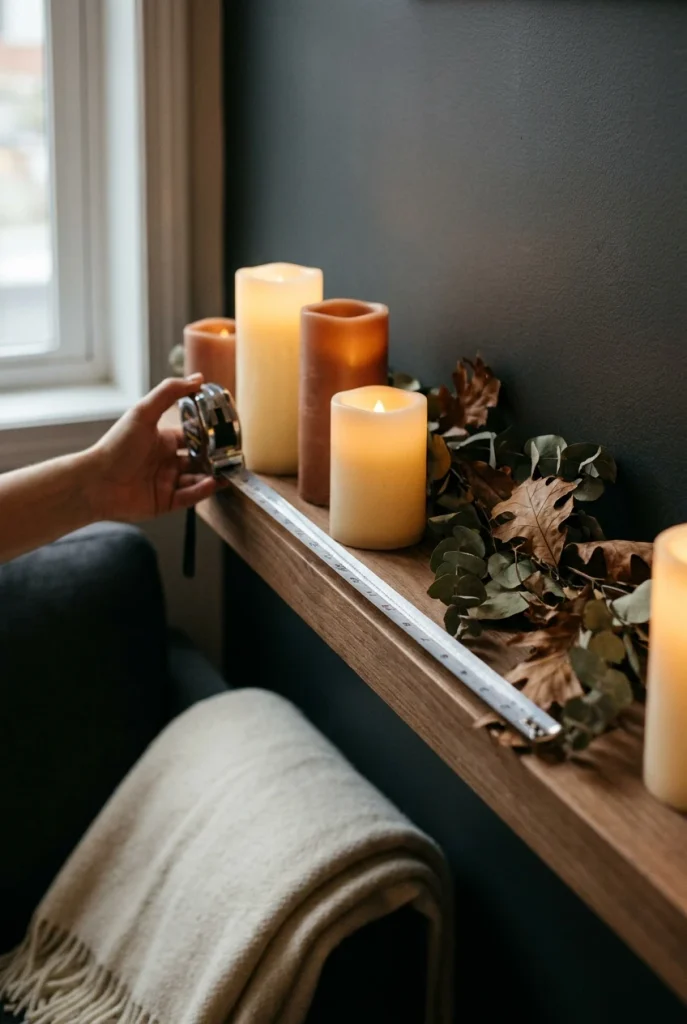
The number worth memorizing comes from the U.S. Fire Administration’s candle safety guidance: keep candles at least 12 inches away from anything that burns. The same page notes that on average, 20 home candle fires are reported each day, and its lead recommendation is to use battery-operated flameless candles instead, which now look and even smell close enough to the real thing.
On a shelf that is 10 inches deep, 12 inches of clearance means the candle goes on a different shelf. Measure it once rather than guessing.
⚠️ Watch Out
Dried oranges, wheat, paper and beeswax leaves are all fuel. If a garland and a flame have to share a corner, switch to flameless and stop thinking about it.
24. Store It So Next Year Is Free
Storage decides whether you buy this again next year, and most people find out in September that they did it wrong in December.
Dried orange slices are the best case. Kept flat, cool and in the dark, they last for years, and dehydrator-dried ones hold their lighter color longest. Beeswax leaves are the worst case at several weeks to a couple of months, so plan to remake those annually and compost the old ones.
Lay strands flat, never coiled. Coiling sets a permanent kink in wired garland.
Layer tissue paper between anything dried so the pieces cannot grind against each other.
Under the bed beats the top of a closet. Cool and dark matters more than convenient.
Write the hook size you used on the box lid. Next October you will not remember.
25. Or Just Buy the Fall Garland and Be Done
Store-bought is fine. Skipping the craft night is not a failure, and the price spread in 2026 is wider than most people expect. Here is what the market actually looked like in August.
| Under $35 | Worth the jump |
|---|---|
| Walmart 3 Pack Fall Garland, $13.99 | Terrain Jewel Tones Dried Floral, $64 |
| Michael’s Pumpkin & Mum Mix, $17.99 | Magnolia Magnolia Leaf Garland, $74 |
| Meri Meri Gold Oak Leaves, $28 | Anthropologie Orange Marigolds Iron, $98 |
| Target 6′ Orange Maple Leaf, $30 | McGee & Co 6′ Faux Golden Fern, $118 |
| Home Depot Berries and Leaves, $34.99 | Williams Sonoma Quince and Cinnamon Stick, $139.95 |
All prices as listed by Homes & Gardens, August 14, 2026. Check current pricing before you buy.
For a small space, the left column is almost always the right answer, because you will be cutting it in half anyway.
Frequently Asked Questions
What is the easiest fall garland to make?
Torn fabric strips knotted onto jute twine. There is no drying time, no oven, no glue and no sewing, and a 3 foot strand takes about fifteen minutes from a single old flannel shirt. Cut strips to 8 inches, knot them tight against each other on the twine, and trim the tails level at the end. It is also the only version on this list that survives being crushed in a storage box.
How do I hang a fall garland without damaging my walls?
Use an adhesive hook rated above the garland’s actual weight. Weigh it on a kitchen scale first, then check 3M’s published limits: mini hooks hold half a pound, small hold one pound, medium hold two to three, and large hold four to five. Go one size above what you measured. Better still, hang nothing on the wall at all and use a shelf edge, a curtain rod, a headboard or a mirror frame instead.
How long should a fall garland be?
Measure the span you want to cross and multiply by 1.5. A 32 inch doorway wants about 48 inches of garland so it dips rather than stretching flat. A 36 inch shelf wants roughly 54 inches, which is why a standard 6 foot garland fits most small-space runs with a little spill at each end. Cut anything longer in half and use both pieces.
Can I reuse my fall garland every year?
Faux and store-bought garland reuses indefinitely if you store it flat instead of coiled, since coiling sets a kink in the wire that never fully comes out. Dried orange slices last for years when kept cool, dark and dry. Beeswax-dipped leaves do not: they hold color for several weeks and sometimes a couple of months, so treat those as an annual remake and compost the old ones.
How do you preserve real leaves for a garland?
Collect fallen leaves rather than fresh ones, since fresh leaves hold too much moisture. Press them flat in a heavy book for 24 to 48 hours, no longer, or they start losing color. Then dip each one in melted beeswax from a double boiler, kept warm but not piping hot, and let it set for about ten minutes. The wax seals the color in and gives the leaf a slight sheen.
How do you hang garland on a mantel without nails?
Adhesive hooks on the underside of the mantel lip work on a painted or sealed surface, and stay invisible from the front. On brick or stone, skip adhesive entirely and weight the ends instead: set two heavy candlesticks or bookends on the garland tails so the middle swags on its own. For a floating shelf, thread the twine behind the shelf bracket rather than over the top.
When should you put up fall decor?
Most people go up in early to mid September, which works for faux and dried materials. Real mini pumpkins are the exception. Indoors they hold up about three to four weeks before the stems soften, so if a garland uses real ones, hang it in mid to late October and get full value through Thanksgiving instead of watching it slump through September.
Pick the Wall First, Then Pick the Leaves
Most fall garland advice starts with what to make. In a small apartment it works better backward: find the surface that costs you nothing, then choose a garland that fits it. A shelf edge, a window frame, a headboard, a curtain rod. None of those need permission, hardware, or a single hole.
Weigh what you hang, measure at 1.5 times the span, and give any flame a full 12 inches. That is the whole system.
Save this to your fall board so the sizing chart is there when you are standing in the craft aisle in October, guessing.
📌 Good To Know
Three numbers carry this whole list: 1.5 times the span for length, one hook size above the measured weight, and 12 inches between any flame and anything that burns.
Keep reading
More cozy nook ideas
 Fall Decor
Read →
Fall Decor
Read →
How to Decorate Your Entryway for Fall (Even If You’re Not Handy)
No drill, no ladder, no awkward email to your landlord. This fall entryway decor goes up with an over-the-door hanger, a tape…
 Fall Decor
Read →
Fall Decor
Read →
Fall Coffee Table Decor: The Complete Guide for Small Apartments
No mantel, no entry console, no spare shelf. In a small apartment, the coffee table is the one surface everyone sees, and…
 Fall Decor
Read →
Fall Decor
Read →
The Fall Kitchen Checklist: Everything to Decide Before You Start
Most fall kitchen regret starts the same way. You buy the pumpkins first, carry them in, and discover the counters were never…