
Small Bathroom Storage Ideas for Renters Who Can’t Drill a Single Hole

Most small bathroom storage ideas quietly assume you own the walls. You don’t. So here’s the version that works when your only tools are adhesive, tension, and gravity: five mounts with published weight limits, one rule that stops your towels smelling like a gym bag, and a short list of things you should stop storing in there entirely. Everything below comes down in about ten minutes on move-out day. No stud finder, no drill, no email to your landlord.
Start with the mounts, because every other idea hangs off them. Literally.
Start Here: Five Zero-Drill Mounts That Actually Hold
Renter-friendly bathroom storage lives or dies on five mounting methods. That’s the whole toolkit.
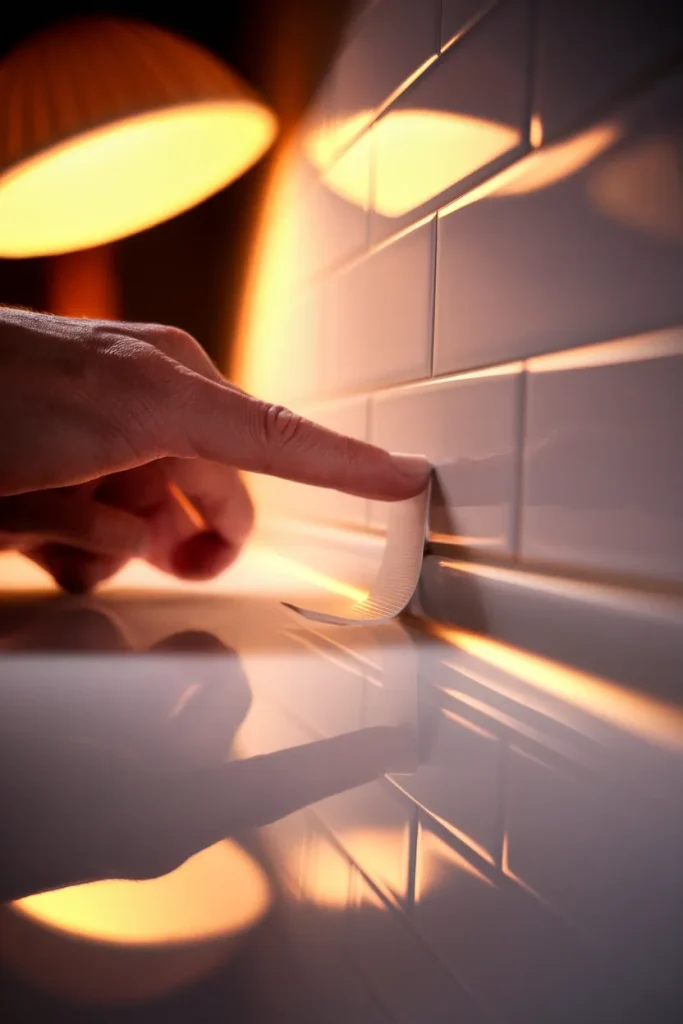
- Adhesive hooks and strips. Fast, cheap, and rated in pounds by the manufacturer. Read the rating.
- Tension rods. Wedge between two walls or floor to ceiling. Zero damage, zero hardware.
- Freestanding gravity units. Etageres, carts, ladders, stools. Nothing touches the wall at all.
- Over-the-door racks. They hook over the top edge of the door and carry real weight.
- Friction-fit corner poles. A spring-loaded pole jammed between tub floor and ceiling.
Suction cups are the sixth option and I’d skip them. They hold on perfectly clean glass in a dry room, which is not a description of anybody’s shower.
Now the part nobody publishes. Here are the actual load limits 3M puts on its bath range, next to what that weight really means in your hand.
The Renter Mount Load Table
| Product | Published max load | What that honestly holds |
|---|---|---|
| Command Bath Medium Hook (BATH18-ES) | 3 lb | One dry hand towel. A loofah. Not a bathrobe. |
| Command Large Towel Hook (BATH17-ES) | 5 lb | One dry bath towel. One, not two. |
| Command Multi-Hook (BATH21-ES) | 5 lb | Two hand towels, or a robe you actually hang up dry. |
| Command Shower Caddy (BATH11-ES) | 7.5 lb | Roughly three full-size bottles, and that’s the ceiling. |
| Command Corner Caddy (BATH12-ES) | 7.5 lb | Shampoo, conditioner, body wash. Stop there. |
| Command Bathroom Hook (17600B) | 7.5 lb | A soaked bath towel with margin to spare. |
Ratings are 3M’s own published figures for the Command bath line.
Here’s the number that catches people out: a cotton bath towel gets dramatically heavier when it’s wet, and a 3 lb hook does not know you meant well. Weigh your heaviest towel soaked before you trust anything to a small hook. It takes thirty seconds on a kitchen scale and it’s the difference between a system and a pile of wet cotton on the floor at 6am.
Two failure modes to design around. Adhesive fails when it’s loaded before the strip has cured, so let it sit for the time printed on the pack before you hang a thing. Adhesive also fails on a surface that looks clean but isn’t, because bathroom cleaner leaves a film that adhesive slides right off. Wipe the spot with rubbing alcohol, let it flash off, then stick.
The 3-Foot Dry Line
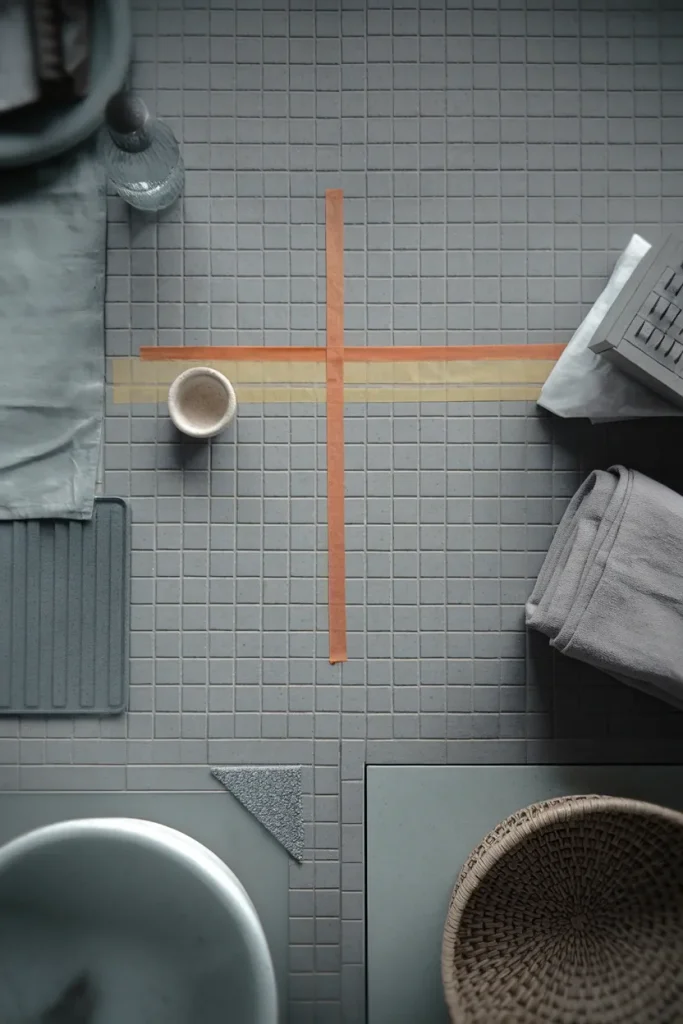
Draw an imaginary line three feet out from your shower or tub opening. Inside that line, only two categories are allowed: waterproof things, and things you’ll use today and put back. Outside the line goes everything that absorbs.
That’s the rule. It sounds fussy until you look at the numbers behind it.
The EPA recommends keeping indoor relative humidity between 30 and 50 percent, and under 60 percent as a hard ceiling. A small bathroom during a hot ten-minute shower blows through that, which is fine and normal, as long as it comes back down fast. Where it stops being fine is the 24 to 48 hour window: per EPA guidance on mold and moisture, damp materials dried within 24 to 48 hours will usually not grow mold. Anything sitting inside your dry line that can’t dry in that window is on borrowed time.
You already know this smell. Not mildew exactly, just flat and faintly sour, the particular thing a towel does when it dried slowly instead of fast. That’s the dry line being violated.
Two practical moves. Run the exhaust fan or crack the window during and for a while after every shower, which is exactly what the EPA recommends for moisture-prone rooms. And give absorbent things airflow on at least two sides, which is why a towel on a hook dries slower than the same towel spread across a bar.
Stop Storing These Six Things in Your Bathroom
Every other article treats a small bathroom as a volume problem. It isn’t. It’s a humidity problem wearing a volume costume, and the fastest square footage you’ll ever gain is removing what should never have been in there.
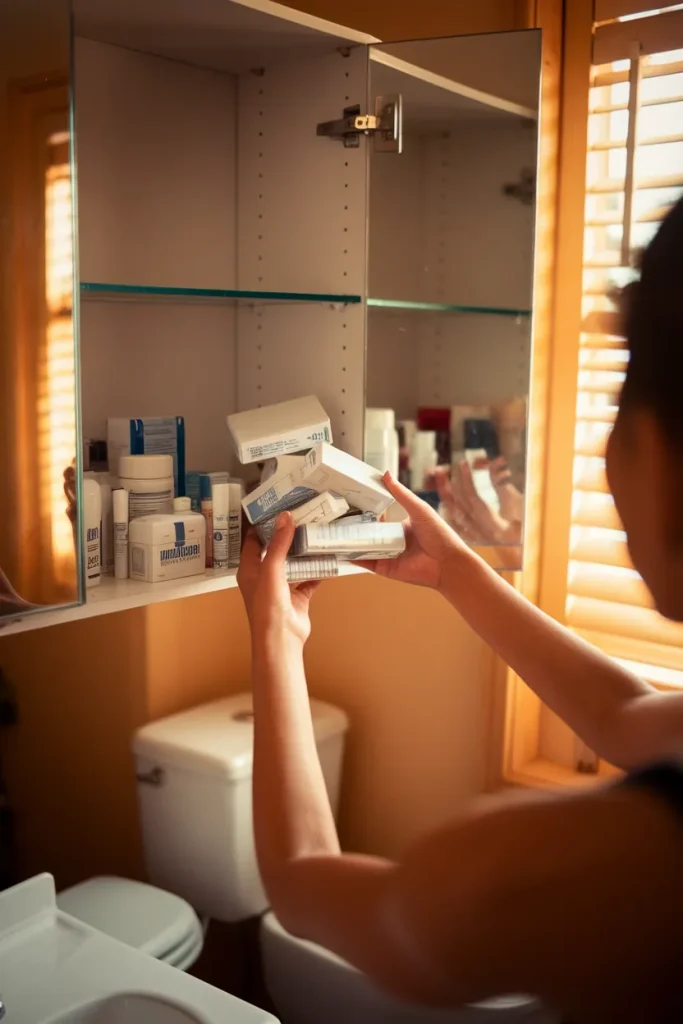
1. Medicine. The bathroom cabinet is the single most common wrong answer. Per FDA guidance on storing your medicines, improper storage such as a damp bathroom cabinet can contribute to decreased effectiveness. FDA’s own suggested alternatives: a dresser drawer, a storage box, a closet shelf, or a kitchen cabinet kept away from the sink and hot appliances. Move it tonight. You just got a whole shelf back.
2. Bulk toilet paper. Keep the roll in use plus one spare. The rest of the twelve-pack goes in a bedroom closet or under the bed, because paper and cardboard wick humidity and take it right back out again as a stale smell.
3. Spare towels and linens you don’t use weekly. A linen stack in a wet room is a stack that never fully dries. Two towels per person in rotation, the rest live elsewhere.
4. Cardboard packaging. Boxes of anything. It softens, it warps, and it’s the first thing to grow something.
5. Makeup and skincare you actually care about. Heat plus humidity degrades formulations faster than a cool dark drawer would. Daily items can stay. Your good serum shouldn’t.
6. Spare razor blades and anything steel you’re not using. They rust in storage, not in use.
A plain note, because this touches health: this isn’t medical advice. If you’re unsure whether a medication has been affected by heat or moisture, ask your pharmacist. They’ll tell you for free.
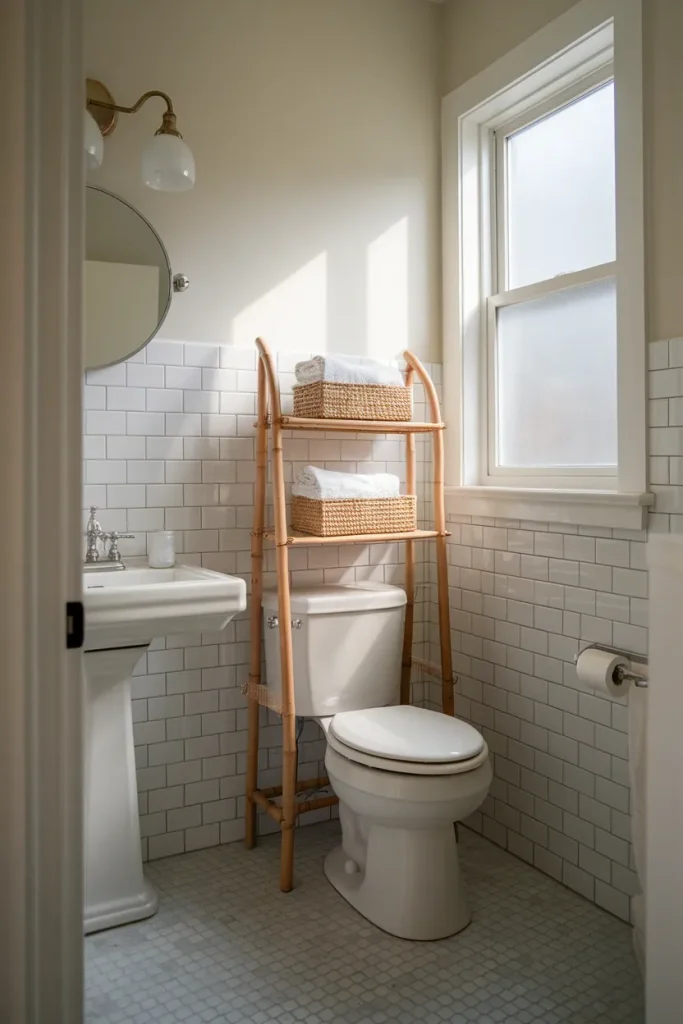
Take the Vertical Foot Above the Toilet
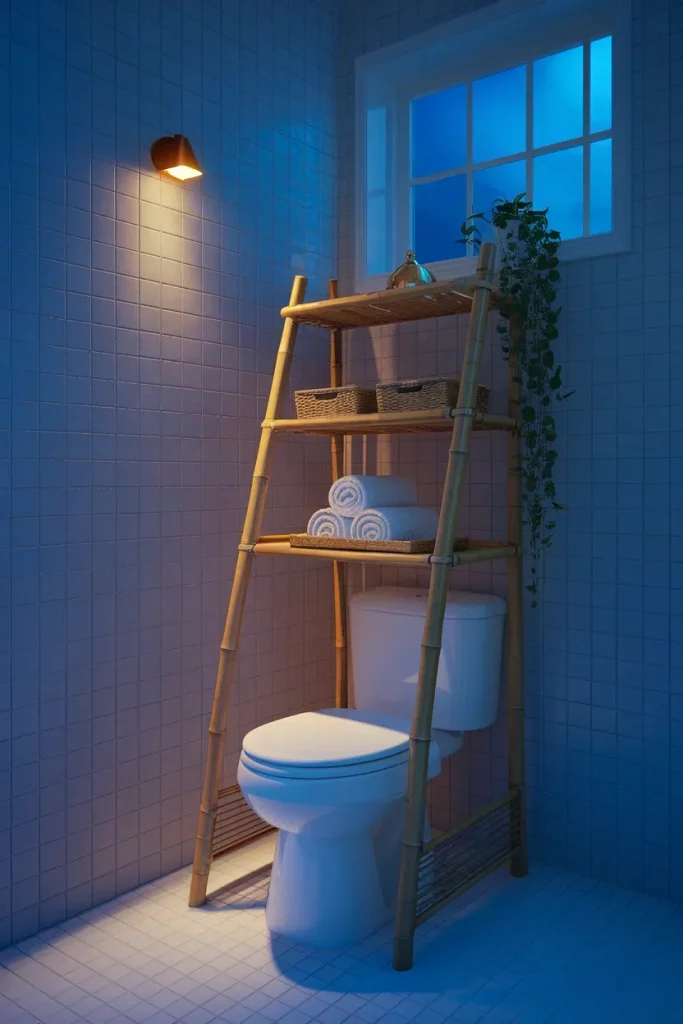
Over the toilet storage ideas usually mean drilling a cabinet into the wall. You don’t need to. A freestanding etagere straddles the tank on four legs and holds itself up with nothing but its own weight and your floor.
The IKEA RAGRUND bamboo shelf unit is the archetype here: 14 5/8 inches wide, 14 5/8 inches deep, 41 inches tall, listed at $39.99 on IKEA US as of August 22, 2026 (down from $59.99, so check whether that promo is still running). Bamboo handles bathroom humidity better than particleboard, which is the real reason to spend the extra ten dollars over a laminate unit.
Before you buy any over-toilet unit, run the tank lid lift test. Lift your toilet tank lid straight up and note how far it travels before it clears the tank. That distance, plus about two inches for your knuckles, is your minimum shelf height above the tank. Skip this and you’ll find out the day your fill valve fails, at which point you’ll be unloading a shelf of toiletries one-handed while the tank runs.
Load it bottom-heavy. Baskets and folded towels down low, light and pretty up top. A tall narrow unit with weight at the top is a unit that tips when someone bumps it.
The Pedestal Sink Problem
A pedestal sink is lovely and gives you exactly zero storage. It’s the most common small bathroom complaint I see, and there are only four honest fixes that don’t involve replacing the sink.
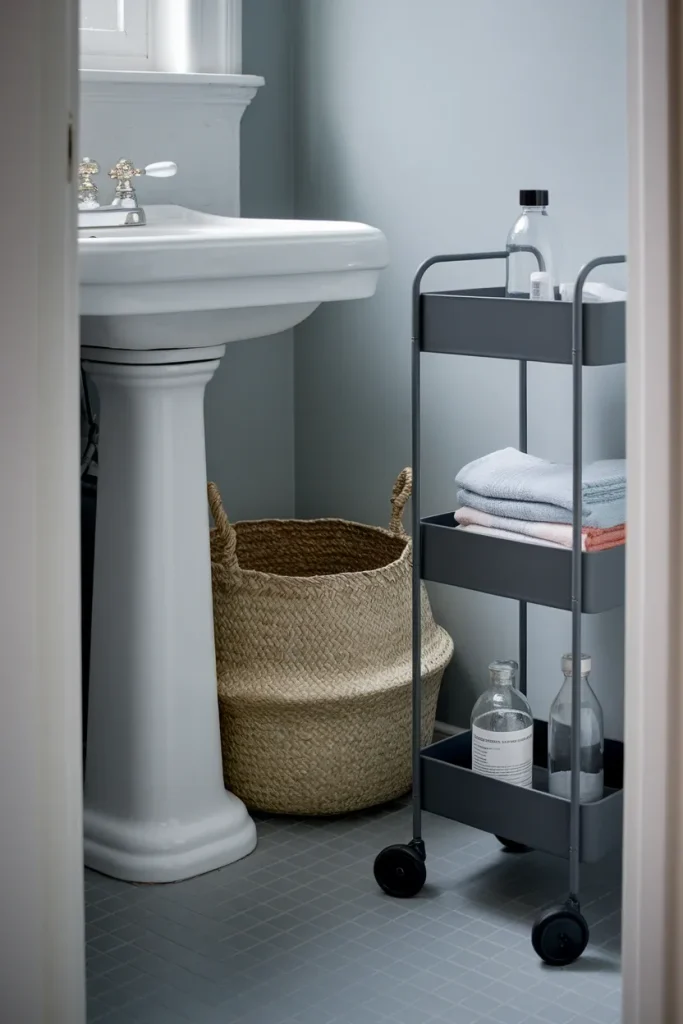
A narrow rolling cart beside it. Look for something under 12 inches deep so it doesn’t crowd the door swing. Three tiers, casters, done.
A basket on the floor underneath. Undignified in theory, invisible in practice. One woven basket tucked behind the pedestal column holds a surprising amount and reads as decor rather than storage.
A tray on the tank. Not a shelf, just a tray. It corrals the four things you touch daily and gives the eye one edge instead of six objects.
A freestanding shelf in the dead corner. Every bathroom has one corner doing nothing.
If you’re leaning into the look rather than fighting it, these cottage powder room design ideas walk through the same pedestal problem from the styling side, including how to keep a tiny half bath from reading as sparse when there’s nothing on the walls.
Under the Sink: The Two-Level Rule
If you do have a vanity, the P-trap is eating your middle. Most people respond by shoving one deep bin in there and losing everything behind the pipe.
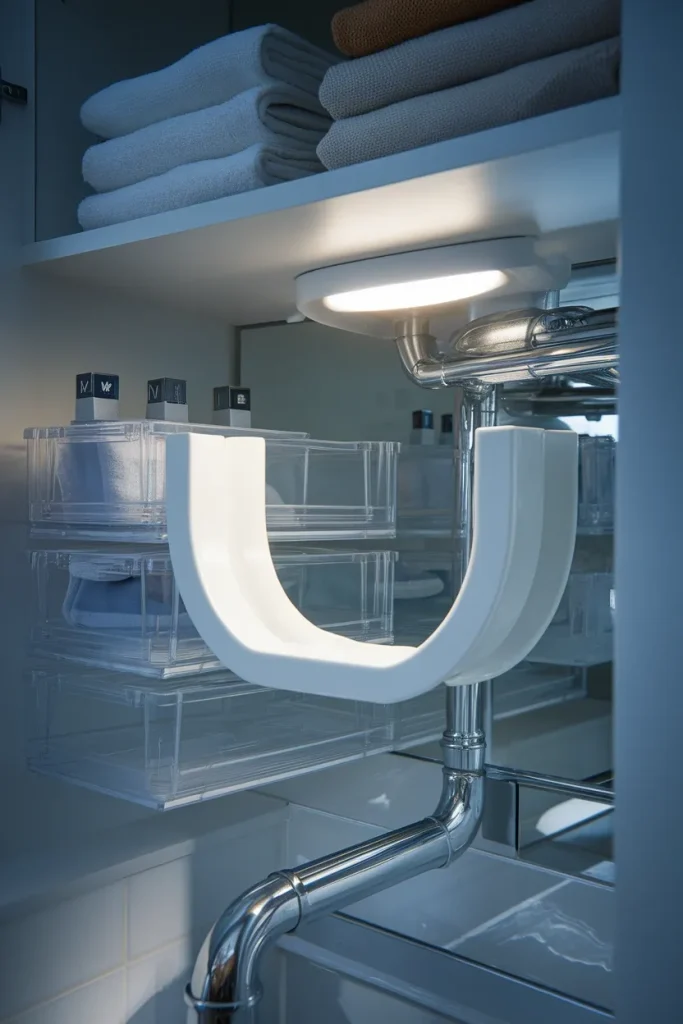
Use two shallow levels instead of one deep one. A U-shaped expandable shelf steps over the trap and gives you a second floor. Below it goes the tall stuff (cleaning spray, the backup shampoo). On top goes the flat stuff (folded cloths, a caddy of hair tools). Nothing lives behind the pipe, because behind the pipe is where things go to be forgotten.
Sort by how often you reach for it, not by category. Daily items at the front edge where you can grab them without kneeling all the way down. Monthly items at the back. If you want the full version of this logic, the zero drill kitchen storage build order applies the same height-zone thinking to a rental kitchen, and the reasoning transfers straight across.
One more thing: don’t store anything absorbent under the sink. That cabinet shares a wall with the drain and it’s the first place you’ll notice a slow leak, ideally before it costs you a deposit.
Shower Storage That Doesn’t Slide Down the Tile
Three options, three honest trade-offs.
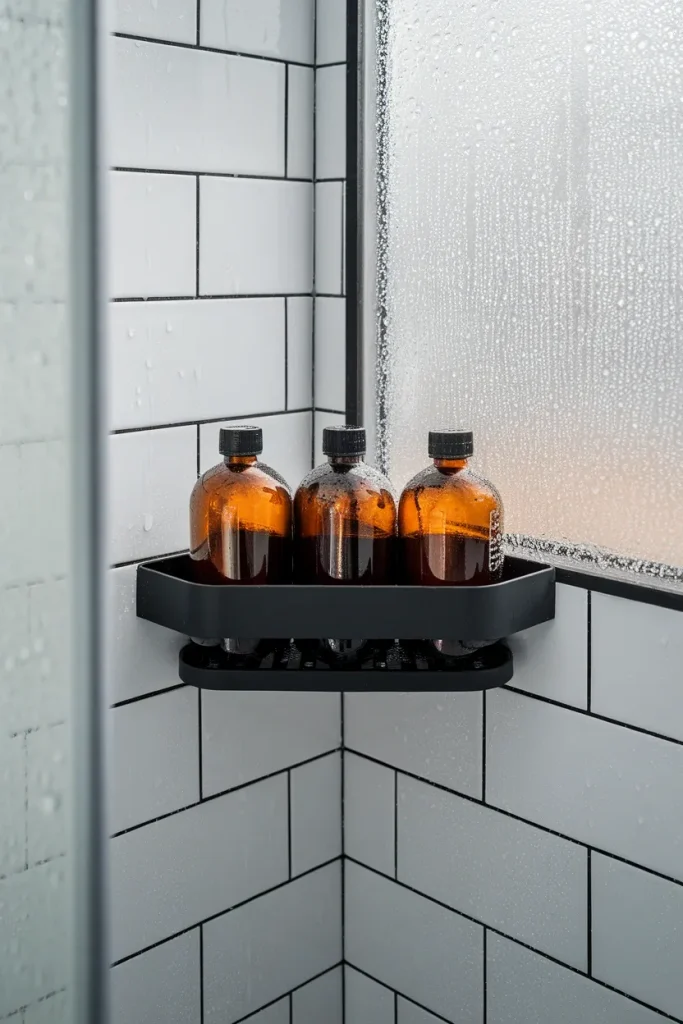
Over-the-showerhead caddy. Zero mounting, costs the least, holds the most. It rusts at the welds within a year or two unless you buy stainless or aluminum, and it slides if the neck isn’t padded. Best pick for a short lease.
Friction-fit corner pole. A spring-loaded pole wedged between the tub floor and the ceiling gives you four baskets of vertical storage without a single hole. It needs a genuinely solid ceiling and a level floor, and it will slowly creep down over months, so check the tension every so often.
Adhesive corner caddy. Cleanest look. Command’s corner caddy is rated to 7.5 pounds, which sounds generous until you weigh a full liter bottle of conditioner. Two big bottles and you’re at the limit.
Whatever you choose, the thing that kills shower storage isn’t the mount. It’s volume. Most people are storing six products and using three. Take the three you actually use, put them on the caddy, and put the rest outside the dry line where they aren’t sitting in steam twice a day.
Towels When There’s No Linen Closet
Bars beat hooks for drying, every time, because a spread towel exposes more surface to the air than a bunched one. Hooks beat bars for compliance, because people actually use them. Pick based on who lives with you.
For renters, the answer is usually an over-the-door towel rack. It hooks over the top edge, carries two or three bath towels, and needs nothing from the wall. Check the top edge of your door for wear when you take it off, and put a felt pad between the metal and the paint on day one.
A leaning ladder is the other move, and it’s the one that photographs well: five rungs, roughly 15 inches of wall, holds four rolled towels and a robe. Lean it in the corner your door doesn’t swing into.
Rolled towels in a basket work too, with one condition. They have to go in dry. A basket of damp rolled towels is the exact thing the 24 to 48 hour window is warning you about.
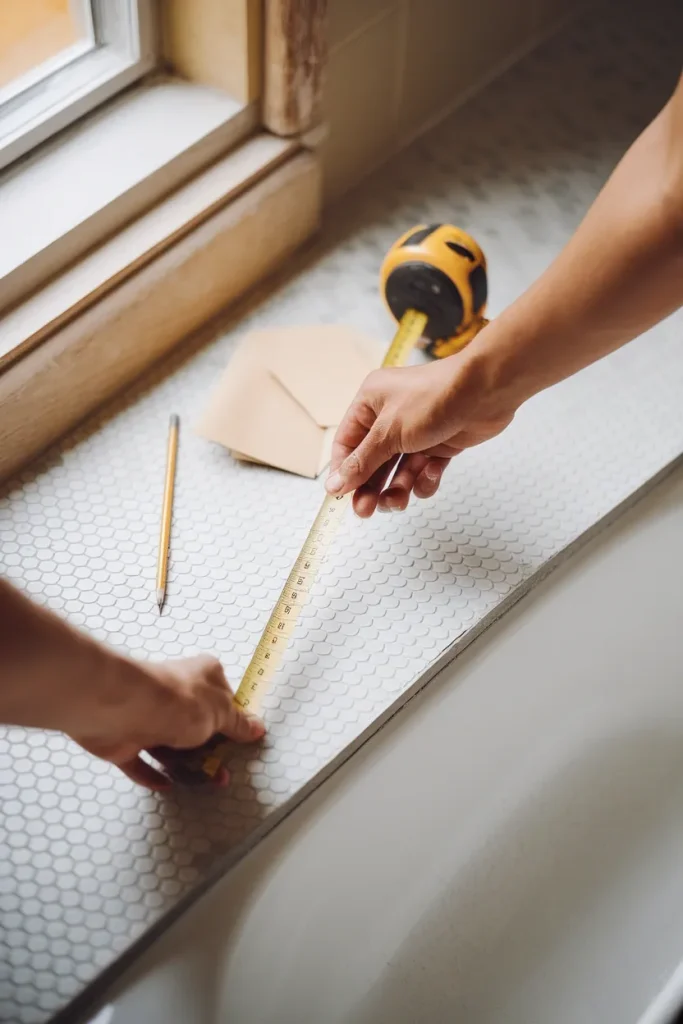
Make the Counter Read Calm, Not Bare
Storage that looks like storage still reads as clutter. Three things fix that fast.
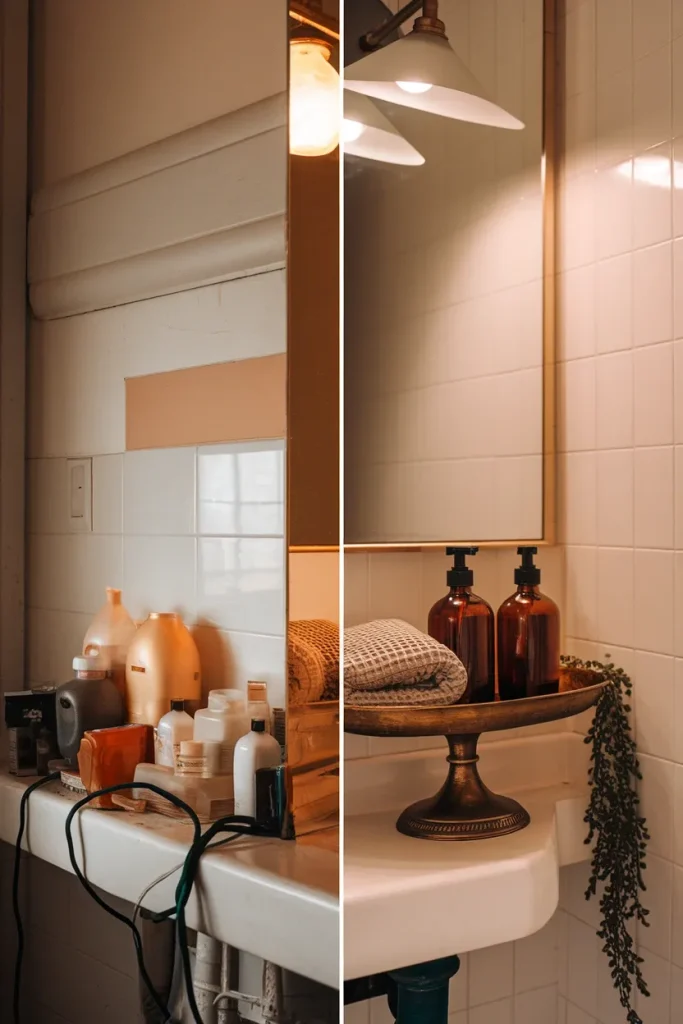
Give everything a tray. A single footed tray under your daily four turns six scattered objects into one composed group. It’s the cheapest visual upgrade in the room.
Decant what you can. Matching glass or ceramic beats a row of shouting plastic labels. You don’t need to decant everything, just the three things sitting out.
Warm the light. Swap the bulb to 2700K. Builder-grade vanity light at 4000K makes white tile look like a waiting room, and no amount of styling survives it. Brass and amber glass in particular need warm light to do anything at all, and brass is having a genuine moment: Pinterest’s 2026 trend report lists brass aesthetic up 35 percent and red marble bathroom up 80 percent, so warm metals are where the saves are going.
For the shoppable version of this, our roundup of vintage bathroom accessories for renters covers the 3-2-1 Counter Rule (three heights, two materials, one living thing) plus which finishes actually survive daily humidity, which matters more than it sounds.
The Move-Out Math
Nobody costs this out, so here it is. What each solution takes to undo.
| Solution | Removal | Real risk |
|---|---|---|
| Adhesive strips | Pull the tab straight down, slowly | Yanking outward takes paint with it |
| Tension rod | Twist and lift out | None if the wall was sound |
| Freestanding etagere | Carry it out | None, it never touched the wall |
| Over-the-door rack | Lift off | Scuffing on the door’s top edge, use felt |
| Friction-fit corner pole | Release the spring | Ceiling dent if it was overtightened |
| Suction cups | Pop off | None, they’ll have fallen already |
Two habits protect your deposit. Photograph every wall the day you move in, before you hang anything. And take the adhesive down a week before your final walkthrough, not the night before, so you have time to touch up whatever surprises you.
Three Builds, Three Budgets
Approximate current listing prices, checked August 2026. Only the IKEA figure is a confirmed listed price; the rest are typical US ranges and will move.
Under $60, one afternoon. Over-the-showerhead caddy, one pack of Command bath hooks, one woven floor basket, one bulb swap to 2700K. Fixes the shower and the towels and nothing else, which is fine.
Under $150, one weekend. Everything above, plus the IKEA RAGRUND bamboo shelf unit at $39.99, plus a U-shaped under-sink shelf and two clear stackable bins. This is the version most renters should build.
Under $300, a full reset. Add a slim rolling cart, an over-the-door towel rack, a footed tray, and matching decanted bottles. Now it photographs.
Build in that order regardless of budget. Shower first, because it’s the wettest and the most annoying. Towels second. Counter last, because styling an unsolved room is how you end up with a styled mess.
Frequently Asked Questions
How do I get more storage space in my small bathroom? Remove before you add. Pull the medicine, the bulk toilet paper, and the spare linens out of the room entirely, then take the vertical space above the toilet with a freestanding etagere. Those two moves alone usually free more room than any product you can buy.
Where do I put towels in a small bathroom? Over-the-door rack for renters, leaning ladder if you have a spare corner, hooks if the people you live with won’t use anything fussier. Keep two towels per person in rotation and store the rest outside the bathroom so they can dry properly between uses.
Where do I put shelves in a small bathroom? Above the toilet, in the dead corner, and inside the shower. Skip the wall above the sink, since that’s mirror and light territory. If you can’t drill, freestanding and tension-fit units reach all three of those spots without hardware.
How do you maximize storage in a small bathroom? Go vertical, go into corners, and get things off the counter and onto a wall or a tray. Then apply the 3-Foot Dry Line so you’re not wasting your best storage on items that shouldn’t be in a wet room.
How do you organize a small bathroom without cabinets? Lean on gravity and tension: an etagere over the toilet, a rolling cart beside the sink, a basket on the floor, an over-the-door rack, and a shower caddy. Five pieces, zero hardware, and every one of them leaves with you.
Where do you store toilet paper in a small bathroom? One roll in use, one spare in a lidded basket or a covered tray within arm’s reach of the toilet. The rest of the pack lives in a bedroom closet or under the bed, since paper holds humidity and gets stale in a damp room.
Is it safe to keep medicine in the bathroom? The FDA advises against it. Its guidance notes that improper storage such as a damp bathroom cabinet can contribute to decreased effectiveness, and suggests a dresser drawer, storage box, closet shelf, or kitchen cabinet away from the sink instead. If you’re unsure whether something has been affected, ask your pharmacist.
Where to Start Tonight
Pick one thing. Weigh a wet towel, then check it against the hook you’re about to trust. Or open the medicine cabinet and move the medicine somewhere dry, which takes four minutes and gives you back a whole shelf.
The rest of it will still be there this weekend. And if the room you’re really trying to rescue is a corner rather than a bathroom, the same logic (measure first, mount second, style last) is what turns an awkward eight square feet into somewhere you’d actually sit down with a book.
Keep reading
More cozy nook ideas
 Small Spaces
Read →
Small Spaces
Read →
10 Small Reading Nook Ideas for Adults
One high-back chair, one clamp-on lamp, one $19.99 tray table. At IKEA US prices this month, that’s a full reading corner for…
 Small Spaces
Read →
Small Spaces
Read →
18 Twin Bed Ideas for a Small Room
A twin bed in a small room can look like a leftover dorm setup or like the best seat in the house.…
 Small Spaces
Read →
Small Spaces
Read →
14 Modern Apartment Decor Ideas That Make a Small Room Feel Bigger
Four hundred and sixty square feet. That is the average size of a new US studio apartment, according to RentCafe’s 2025 numbers,…