
Vintage Bathroom Accessories That Make a Rental Bath Feel Cottagecore

Five vintage bathroom accessories, zero holes in the wall, one Saturday afternoon. That is the entire build, and the next section lists all five in order so you can screenshot it and go.
Most cottagecore bathroom advice starts with a clawfoot tub and a gut renovation. Yours probably starts with a builder-grade vanity, a lease you have actually read, and about 30 inches of counter. Here is the good part: accessories carry more of the look than fixtures do. Swap the plastic pump for glass, put warm light on the mirror, and a beige rental bath reads as an old cottage bath by dinnertime.
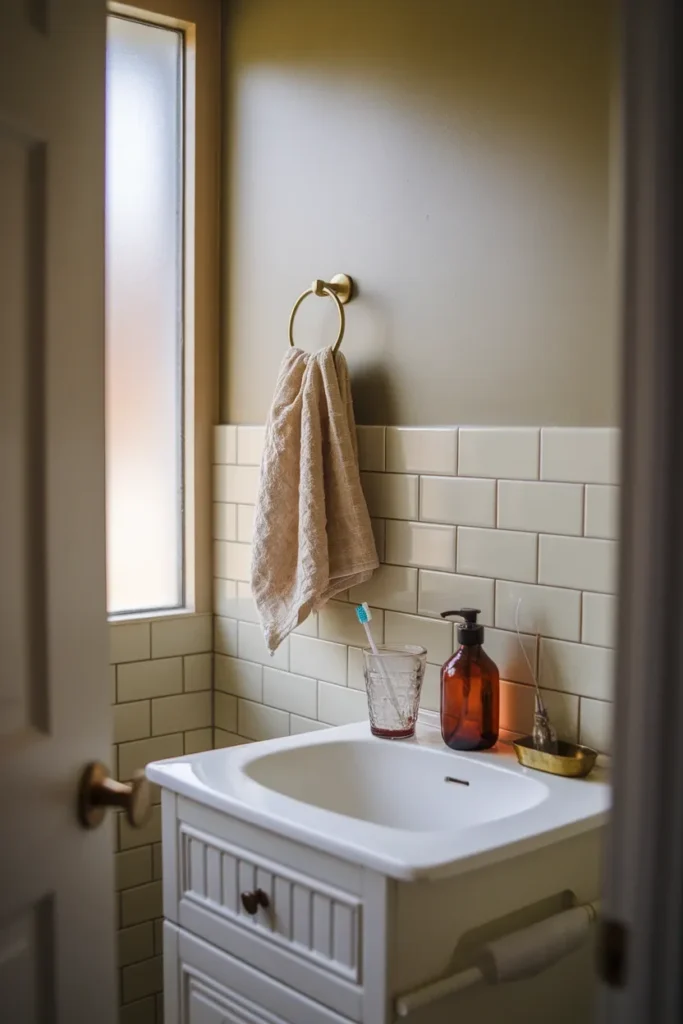
Start Here: Five Vintage Bathroom Accessories, No Drilling Required
Buy in this order. The first item changes the room more than the other four combined, so if your budget stops at one, stop there.
- A glass or ceramic soap dispenser. Getting the plastic pump bottle off the counter is the single highest-return swap in the room. Amber apothecary glass, milk glass, or plain pressed glass all work.
- A tumbler or toothbrush holder in the same material family. Two matching pieces on a counter reads as intentional. One reads as leftover.
- A small footed tray, 8 to 10 inches wide. Everything that lives on the counter goes on it. Suddenly clutter looks like a vignette.
- A linen or waffle-weave hand towel in an undyed or faded color. Bright white towels fight a vintage look. Oatmeal, faded sage, and dusty rose do not.
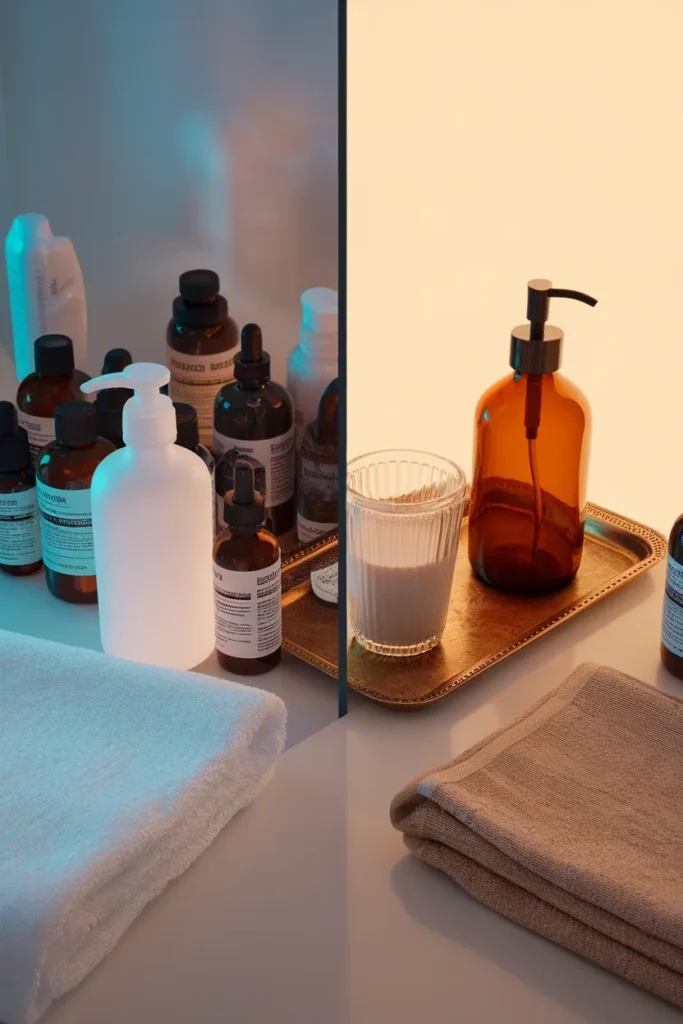
- A warm bulb, 2700K, on a dimmer if the fixture allows it. Cool 4000K light makes brass look yellow and skin look gray. Warm light makes both look like candlelight.
That is the whole no-drill kit. Items one through four sit on a surface. Item five screws into a socket you already have.
What the five actually cost
Real listings, checked August 2026. Prices on secondhand and small-maker sites move constantly, so treat these as the band you are shopping inside rather than a quote.
| Piece | Where it was listed | Price seen (Aug 2026) |
|---|---|---|
| Vintage-style glass soap dispenser + toothbrush holder set | Etsy | $19.80 (marked down from $28.29) |
| Antique Victorian towel ring + paper holder set | Etsy | $28.34 (marked down from $35.42) |
| Kingston Brass Victorian wall-mount toothbrush and tumbler holder, model HBA1116PB | Home Depot | $51.97 |
| Handcrafted solid brass towel ring and roll holder set | Etsy | $69.55 |
Go thrifted glass and the five-piece kit lands near $80. Go new solid brass and it lands closer to $150. Neither number requires a contractor.
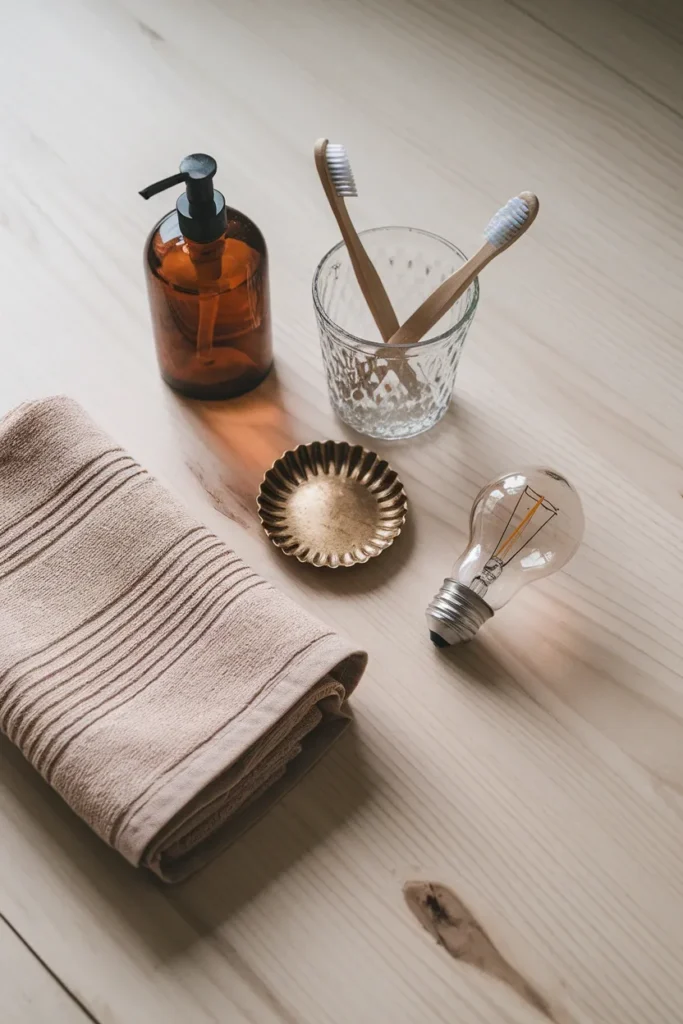
The Counter Trio That Does the Heaviest Lifting
Three objects on a vanity is the sweet spot. Two looks unfinished, four starts looking like a store display, and five means you are storing things on the counter and calling it decor.
Here is the rule we use on every surface, bathroom counters included.
The 3-2-1 Counter Rule
3 heights. One tall (dispenser or bottle), one medium (tumbler or jar), one low (dish, tray, or folded cloth). 2 materials. Pick two and stop. Glass and brass. Ceramic and wood. Milk glass and nickel. 1 living thing. A sprig of eucalyptus, a tiny pothos cutting rooting in a bud vase, a bar of soap with visible botanicals in it.
Odd numbers and mixed heights are what make a grouping read as styled instead of stored. Apothecary glass earns its Pinterest popularity here because the shapes come in exactly those three heights already: the tall stoppered bottle, the mid-height wide-mouth jar, the squat cream pot.
Cotton rounds and swabs go in the wide-mouth jar. Nothing with a printed plastic label goes on the counter at all. If you love the product and hate the bottle, decant it. That single habit does more for a cottagecore look than any purchase, and it is the same decanting logic we use in our cottagecore home decor guide for kitchen shelves.
One honest trade-off: decanted shampoo and conditioner look wonderful and are genuinely annoying to refill. Decant the things you top up monthly, not weekly.
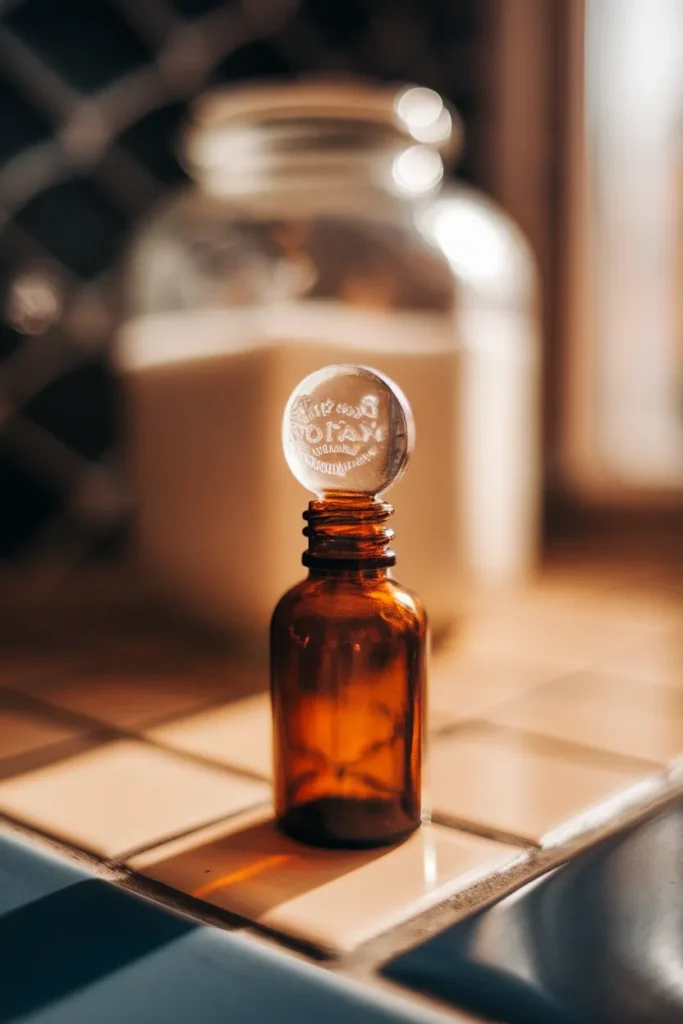
Metals: What Actually Survives a Steamy Bathroom
Brass is the finish Pinterest is rewarding right now. Pinterest’s own 2026 trend report has searches for “brass aesthetic” up 35 percent and “antique bar cart” up 100 percent, so pinning a brass-heavy bathroom shot is swimming with the current rather than against it.
But brass comes in two versions and they behave nothing alike.
Lacquered brass has a clear coat over it. It stays bright indefinitely, needs only a damp cloth, and is the finish manufacturers generally point toward for high-moisture rooms. The catch: once that lacquer gets scratched, moisture gets underneath and you get a spot you cannot polish out evenly.
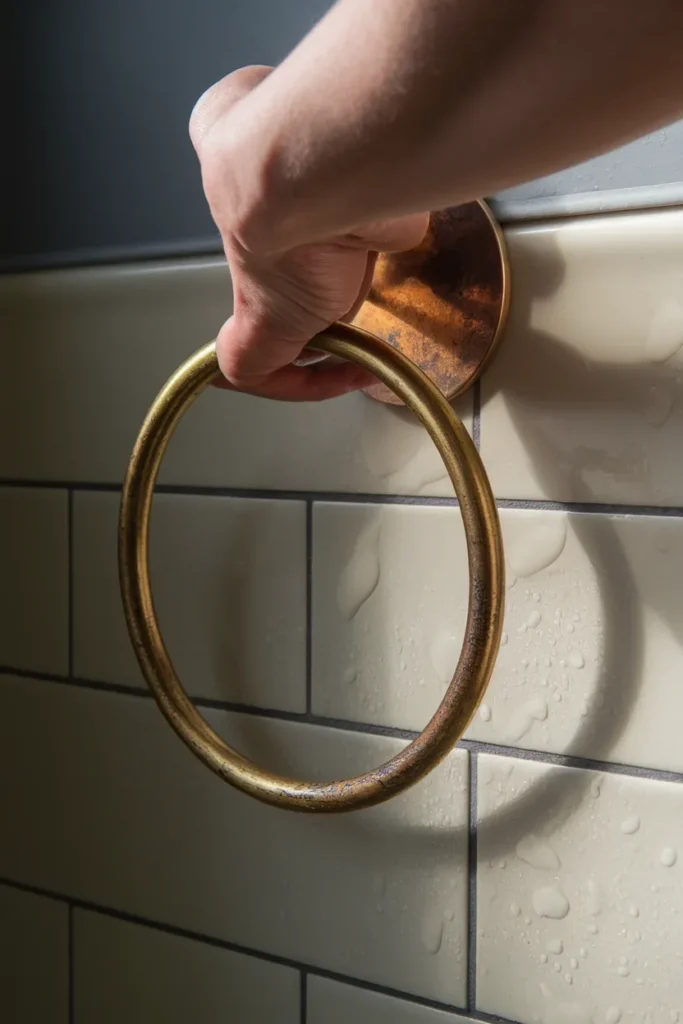
Unlacquered brass is bare metal. It darkens toward bronze and brown as it meets air and moisture, and it darkens fastest exactly where your hands touch it. That is the look everyone is pinning. Two things nobody tells you: it goes blotchy before it goes evenly antique, and the patina on a toilet paper holder will run about six months ahead of the patina on a towel ring across the room, because one gets handled constantly and the other barely gets touched.
If you want them to match, either buy them together and touch them equally, or accept the mismatch as the point.
Vintage Bathroom Material Survival Table
| Material | Survives a steamy bath? | What actually happens |
|---|---|---|
| Cast iron with porcelain enamel | Yes | Chips at the rim, then rust blooms outward from the chip |
| Milk glass and pressed glass | Yes | Nothing. Wash it like a drinking glass |
| Unlacquered brass | Yes, but it changes | Darkens first at touch points, blotchy before even |
| Lacquered brass | Yes | Stays bright until the coating scratches, then spots |
| Vintage chrome | Yes | Pitting where the plating has already worn thin |
| Worn nickel | Mostly | Shows water spots far more than chrome does |
| Wicker and rattan | Risky | Swells and unravels if the exhaust fan is weak |
| Untreated wood | Risky | Cups and splits at the joints within a season |
| Paper-labeled bottles | No | Labels lift and brown within weeks |
| Cardboard-backed mirrors | No | Backing delaminates, silvering spots at the edges |
Run the fan. A bathroom with a working exhaust fan can host wicker and wood happily. A windowless bath with a dead fan will eat both.
Textiles: Where Cottagecore Lives or Dies
Hardware gets the attention. Fabric is what people actually feel when they walk in.
Swap three things and the room softens immediately: the hand towel, the bath mat, and whatever is at the window. Linen and waffle weave both dry faster than terry and look better rumpled, which matters because a rumpled towel is what your bathroom looks like 95 percent of the time.
Skip the matched three-piece bath set. Nothing kills a vintage look faster than four items that clearly shipped in the same box. Mismatched-but-related is the whole aesthetic: an oatmeal hand towel, a faded sage bath sheet, a small jute or washable cotton runner on the floor instead of a plush rectangle.
For the window, a cafe curtain covering only the bottom half of the glass is the move. Privacy where you need it, daylight where you want it, and a shape that reads distinctly old-house. Cotton ticking stripe, ditsy floral, or plain unbleached muslin all land. Hang it on a tension rod inside the frame and you have not touched the wall.
Color-wise, this is the same restrained palette logic that makes our vintage living room decor ideas hold together: two neutrals, one faded color, nothing at full saturation.
Then there is the non-visual half nobody photographs. A vintage bathroom should smell like real soap, not synthetic vanilla. A bar of unwrapped olive oil or tallow soap sitting in a drainable dish scents a small bathroom on its own, and the faint clink of a ceramic dish when you set the bar down is oddly the most old-house detail in the whole room.
Light: The 2700K Rule Nobody Mentions
You can buy every correct object and still lose the room to the bulb.
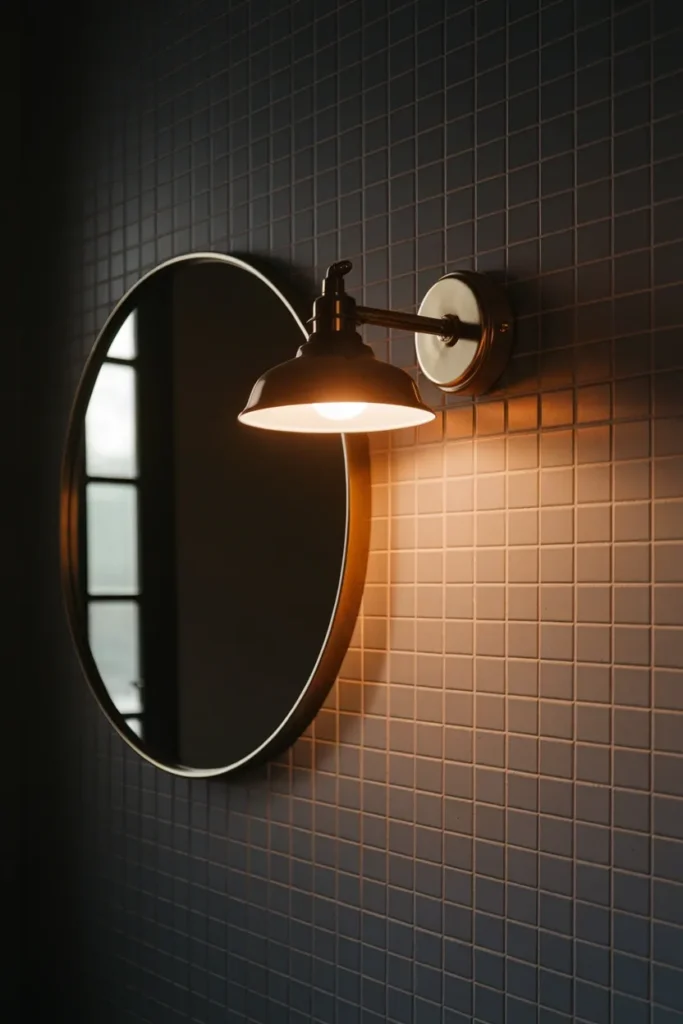
Vanity fixtures in rentals ship with cool white bulbs somewhere between 4000K and 5000K. Cool light turns aged brass a flat yellow, makes cream tile look faintly blue, and gives linen a gray cast. Every vintage cue in the room quietly cancels out.
Swap to 2700K. That is the warm, slightly amber range that reads as lamplight and candlelight, and it is the same temperature that makes a reading nook feel like a retreat rather than an office. If the fixture takes a dimmer, add one. If it does not, a single plug-in sconce or a small battery picture light above the mirror gives you a second, lower light source for evenings.
Two light levels in a bathroom is the actual luxury. Bright overhead for getting ready at 7am, one warm low light for a bath at 9pm. Most rentals give you exactly one, and adding the second costs less than a takeout dinner.
Fairy lights around a mirror frame are the one shortcut here that photographs better than it lives. They look wonderful in a pin and they buzz faintly in a tiled room. Your call.
Thrifting Vintage Bathroom Pieces Without Bringing Home a Problem
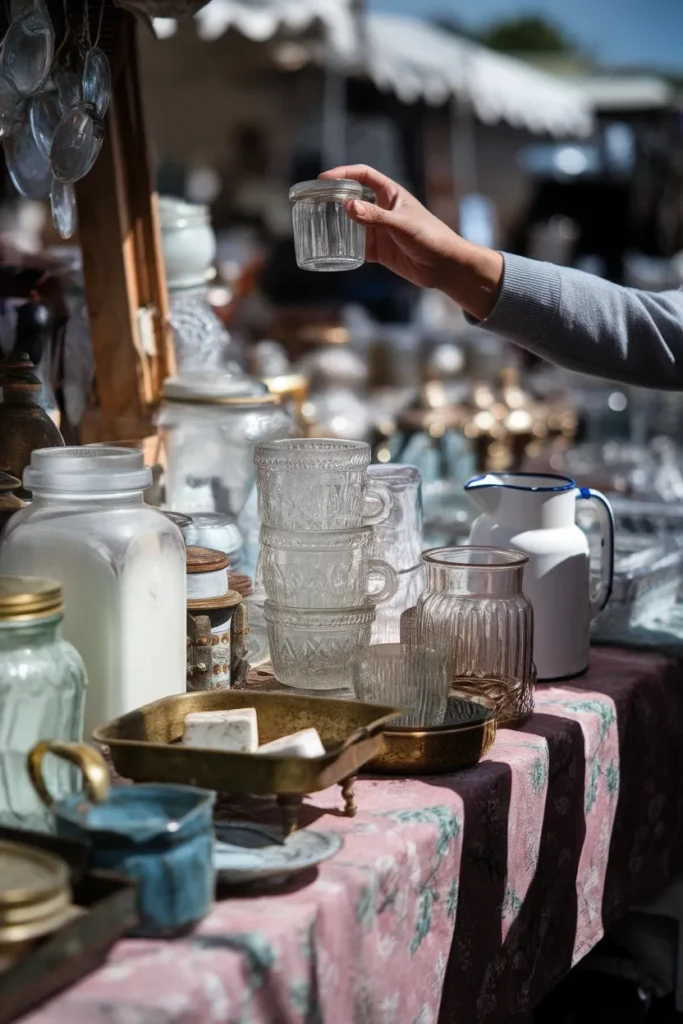
Estate sales, church rummage sales, and the housewares aisle of any Goodwill are where the real pieces are. Milk glass in particular is still cheap because it is common, and it is one of the few vintage materials that does not care at all about humidity.
Five things to check before anything comes home with you:
- Hold glass up to the light. Look for chips at the rim and hairline cracks running from the base. A cracked jar in a wet room will eventually let go.
- Sniff the inside of any lidded container. Old cold cream and talc leave a smell that survives three washes.
- Check metal for pitting, not just tarnish. Tarnish polishes off. Pitting means the plating is already gone and the base metal is exposed.
- Turn mirrors around. Cardboard backing plus bathroom humidity equals a warped, spotted mirror inside a year.
- Assume painted metal and painted wood might be a problem. If a piece looks like it came out of a building older than the late 1970s and you plan to sand or strip it, read the EPA’s lead-safe renovation guidance for DIYers first. Wiping and using a piece as-is is a different risk profile from creating dust, and the dust is the part that matters.
That last one is the step every roundup on this topic skips, which is strange, because stripping a flea market cabinet is exactly the kind of Saturday project that generates a lot of dust in a small room.
The Renter’s Install Kit: Everything Above, Nothing Drilled
Here is the section the big shelter sites never write, because they assume you own the walls.
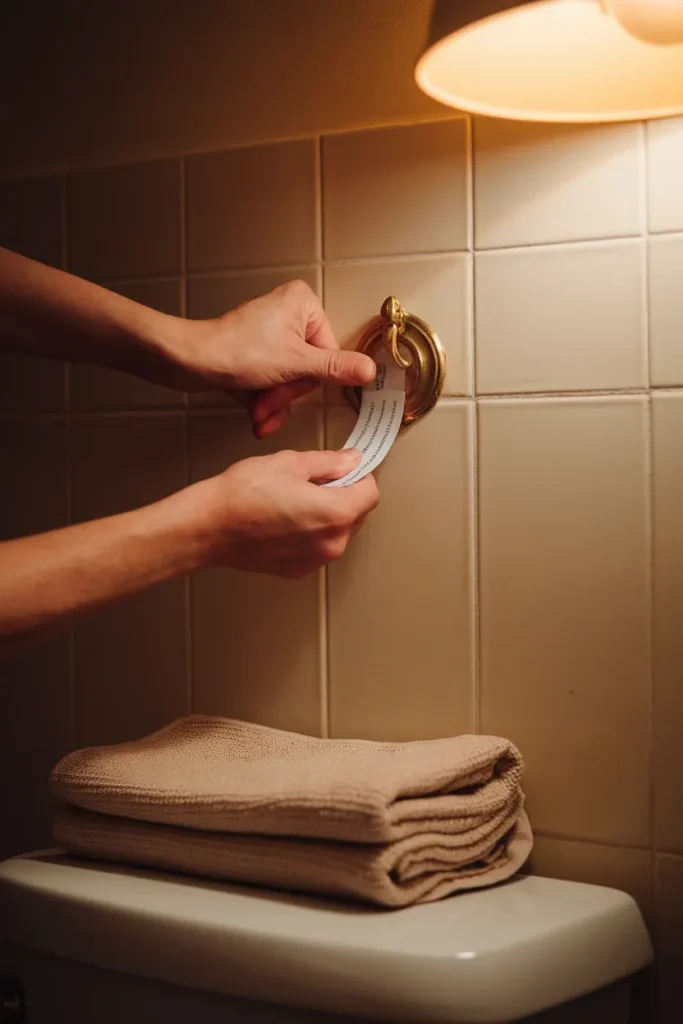
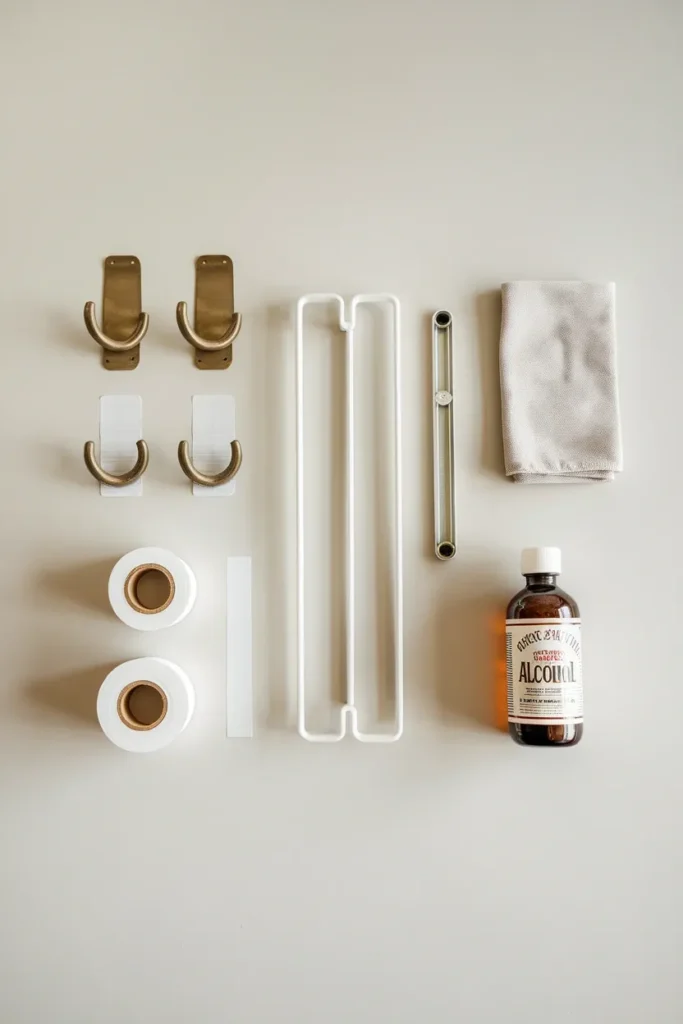
Adhesive hooks and rails. Brass-look adhesive hooks hold a hand towel or robe easily. Check the weight rating on the package and then halve it in your head for a bathroom, because steam and adhesive are not friends. Press for 30 seconds, then leave it alone for an hour before hanging anything.
Tension rods. A tension rod inside the window frame carries a cafe curtain. A second tension rod inside the shower niche or under the sink holds spray bottles by their trigger handles.
Freestanding over-the-toilet shelving. The legs straddle the tank, nothing touches the wall, and you gain three shelves of apothecary jar real estate in a footprint you were not using.
A leaning ladder rack. Rests against the wall at an angle, holds four rolled towels, moves out on moving day without a patch kit.
Command-style picture strips for a small mirror or framed print. Vintage botanical prints and old advertising cards are perfect bathroom art precisely because nobody minds if humidity ages them a little further.
The one place to spend on hardware you cannot install: nothing. If a piece requires drilling and you cannot drill, it is not for this apartment. There is always a freestanding version. More renter workarounds live in our renter-friendly apartment decor ideas, and most of them apply to a bathroom without modification.
On placement, one real number worth having: the standard towel bar height is 48 inches above the floor, per common US installation guidance, and a towel ring goes higher, at 48 inches plus however far the ring hangs below its mounting plate. For a kids’ bathroom the recommended heights drop to roughly 36 inches for ages 3 to 4, 40 inches for ages 5 to 8, and 44 inches for ages 9 to 12. Adhesive hooks follow the same logic. Most people mount them too high and then wonder why the towel never gets hung up.
Before You Replace Anything: Keep the Old Stuff You Already Have
If you rent or own a place built before roughly 1960, walk in and look again before you buy a single thing.
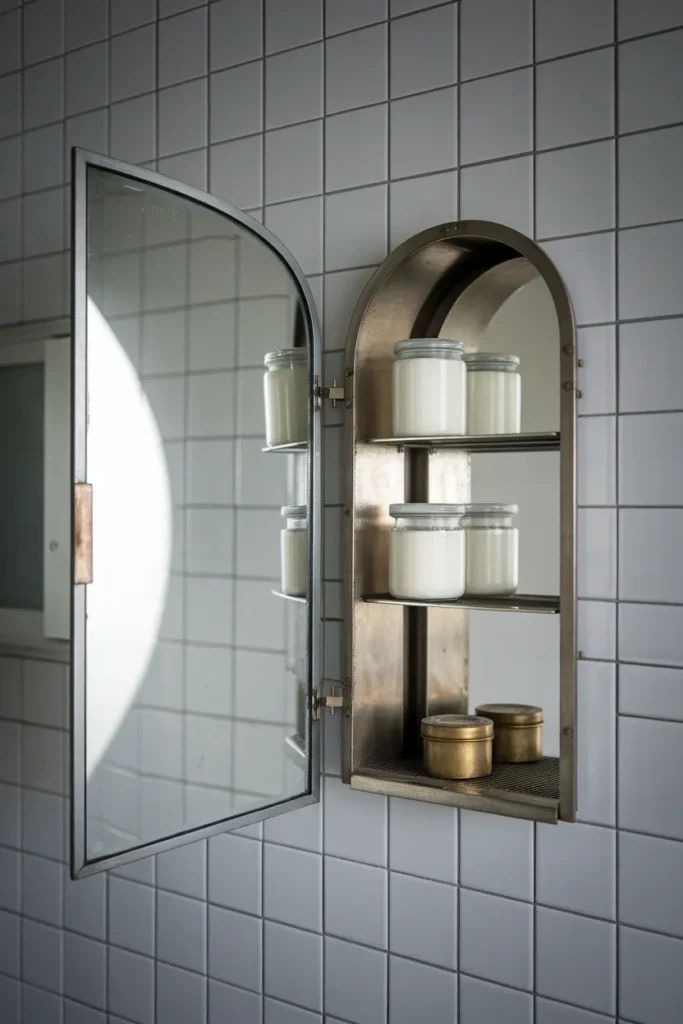
That recessed metal medicine cabinet with the beveled mirror, the chrome-and-black tile soap ledge built into the shower wall, the little porcelain toothbrush slots set into the tile, the octagonal floor tile under a bath mat: those are the pieces people spend real money reproducing. Preservation guidance from the National Park Service, which is the closest thing the US has to an official standard here, frames this as identifying the character-defining features of an interior before you change it. You can read the reasoning in the National Park Service brief on rehabilitating historic interiors, and it applies just as well to a 1938 duplex bathroom as it does to a landmark building.
A built-in soap ledge you clean and keep beats any accessory you can buy. Original beats reproduction every single time, and it is free.
Clean, do not replace: a magic eraser on old chrome, a soft toothbrush and baking soda paste in tile grout, mineral oil on a wooden cabinet door. Most 1940s bathroom hardware is not damaged. It is just dirty.
Three Ways This Goes Wrong
Worth knowing before you spend anything.
Everything matches. A five-piece coordinated set in one finish, bought new, in one order, reads as a hotel amenity rather than a collection built over time. Mix two eras or two materials on purpose.
The counter becomes storage. The 3-2-1 rule exists because a vanity with nine objects on it is a shelf, not a vignette. Whatever does not make the cut goes in the cabinet or in a lidded jar.
You buy the aesthetic and skip the maintenance. Unlacquered brass wants a wipe. Wicker wants a working fan. Milk glass wants nothing, which is exactly why it should be the first thing you buy.
Frequently Asked Questions
What are the key elements of a vintage bathroom? Warm metal (brass or worn nickel), glass or ceramic containers instead of plastic, a soft rumpled textile, warm 2700K light, and one architectural cue like subway tile, hex floor tile, or a beveled mirror. You do not need all five. Three of them will carry the room.
How can I update a vintage bathroom without losing its charm? Change the things that are consumable and reversible: bulbs, textiles, containers, and art. Leave the things that are original: tile, built-in cabinets, soap ledges, and hardware that still works. Modern function belongs in the shower valve and the exhaust fan, not on the counter.
Where can I find vintage bathroom fixtures and decor? Estate sales and church rummage sales for real vintage glass at low prices, architectural salvage yards for fixtures and cabinets, Etsy for vintage-style reproductions with fast shipping, and specialty period-hardware retailers when you need something that has to fit an existing hole. Goodwill housewares aisles are underrated for milk glass specifically.
How do you style a vintage bathroom counter? Use the 3-2-1 Counter Rule: three heights, two materials, one living thing. Tall dispenser, medium jar, low tray, all in two materials, plus a sprig of something green. Anything else goes in the cabinet.
What styles pair well with vintage in a bathroom? Cottagecore is the easiest pairing because both lean on natural materials and faded color. Dark academia works if you go moody green or oxblood with brass. Scandinavian works if you keep the vintage pieces to glass and pale wood. Skip pairing vintage with high-gloss contemporary, which reads as unfinished rather than eclectic.
Can renters really do this without drilling? Yes, and it is most of this article. Adhesive hooks, tension rods, freestanding over-the-toilet shelving, a leaning ladder rack, and picture-hanging strips cover almost everything a vintage bathroom needs. The only things genuinely off the table are wall-mounted fixtures and anything plumbed.
Does unlacquered brass hold up in a bathroom? It holds up structurally, it just does not stay bright. It darkens toward bronze wherever air and moisture reach it, fastest at the spots your hands touch most. If you want that living patina, buy unlacquered. If you want it to look identical in three years, buy lacquered and avoid scratching the coating.
Your Next 20 Minutes
Do not buy anything yet. Go stand in your bathroom, take one photo on your phone, and count the printed plastic labels visible in the frame.
That number is your project. Every one of them you replace with glass, ceramic, or a decanted bottle moves the room closer, and you can do the first three for less than $20 at a thrift store this weekend.
Once the bathroom is handled, the same three moves (warm 2700K light, two materials, one soft textile) are exactly how a dead corner turns into a reading spot. Our cottagecore home decor guide picks up there.
Keep reading
More cozy nook ideas
 Living Room
Read →
Living Room
Read →
Cabin Living Room Checklist: Everything to Decide Before You Start
No log walls, no stone hearth, no lake outside the window. You can still build a cabin living room in a regular…
 Bedroom
Read →
Bedroom
Read →
English Cottage Bedroom Checklist: Everything to Decide Before You Start
You saved forty pins of floral quilts and sloped ceilings, then looked up at your own bedroom: beige walls, one window, a…
 Nursery & Teen Rooms
Read →
Nursery & Teen Rooms
Read →
25 Teen Boy Bedroom Ideas That Feel Grown-Up, Not Childish
If his room still has the race car lamp and the glow-in-the-dark stars, and the door has started staying shut, he’s telling…