
Small Apartment Christmas Decor Ideas for Tiny Spaces

Your Christmas tree isn’t too big. It just eats 11.5 square feet of a living room that only has 200.
That number is where small apartment christmas decor actually starts, and almost nobody hands it to you. So here it is first, along with the three clearance numbers your lease already assumes you know, the real weight limit printed on the back of a Command strip package, and the storage math that decides what you should buy in November.
Twelve ideas below. No drilling, no landlord conversation, nothing permanent. Most of them take an afternoon.
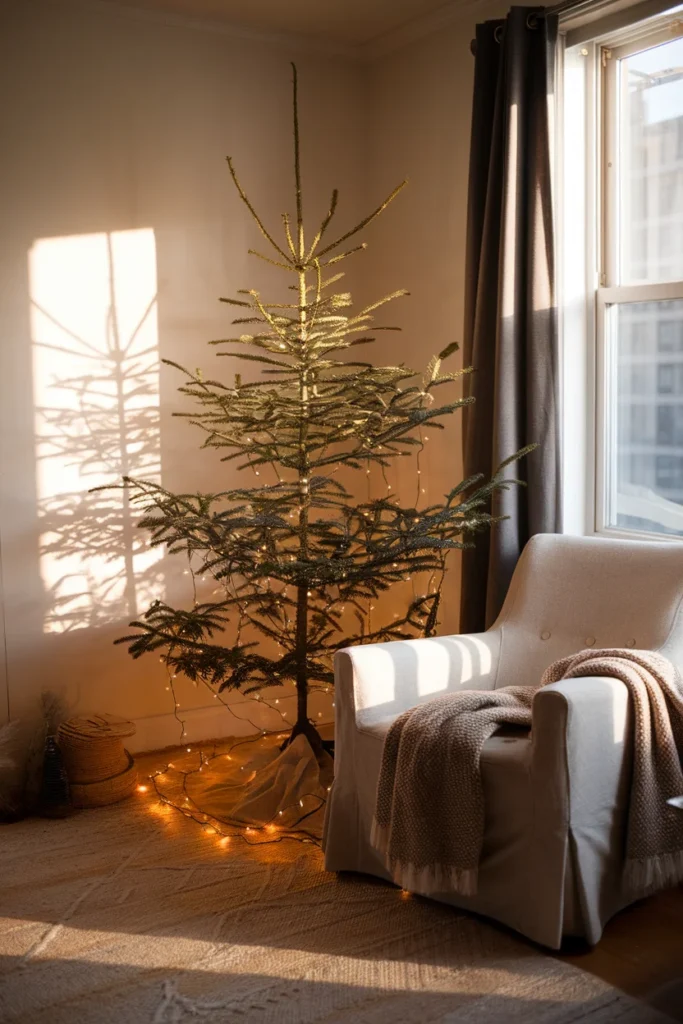
Start With Floor Math, Not Ornaments
Measure the open floor before you shop. Not the room, the open floor: the part with nothing on it.
Here’s the piece competitors skip. A tree’s advertised width is a diameter, so the space it steals is a circle, and circles grow fast. Going from a 24 inch tree to a 46 inch tree doesn’t cost you twice the floor. It costs you almost four times the floor.
Tree footprint against a 200 square foot living room
| Tree type | Real width | Floor footprint | Share of a 200 sq ft room |
|---|---|---|---|
| Tabletop tree, 26 in tall | 5.5 in | 0 sq ft (sits on a surface) | 0% |
| Wall mounted flat tree, 4.5 ft tall | 28.25 in wide, 7.25 in deep | 0 sq ft (hangs) | 0% |
| Tinsel pencil tree, 6 ft tall | 20 in | 2.2 sq ft | 1.1% |
| Pencil tree, 7 ft tall | 22.8 in | 2.8 sq ft | 1.4% |
| Slim tree at the 24 inch cap | 24 in | 3.1 sq ft | 1.6% |
| Standard full tree, 6 ft tall | about 46 in | 11.5 sq ft | 5.8% |
Screenshot that table. It’s the whole argument.
The practical takeaway: stay at or under 24 inches of width and your tree costs you about as much floor as a dining chair. Cross 40 inches and it starts costing you a walkway.
Failure mode: buying a 6 footer online because the height sounded reasonable. Height is the number retailers lead with. Width is the number that decides whether you can still reach your closet.
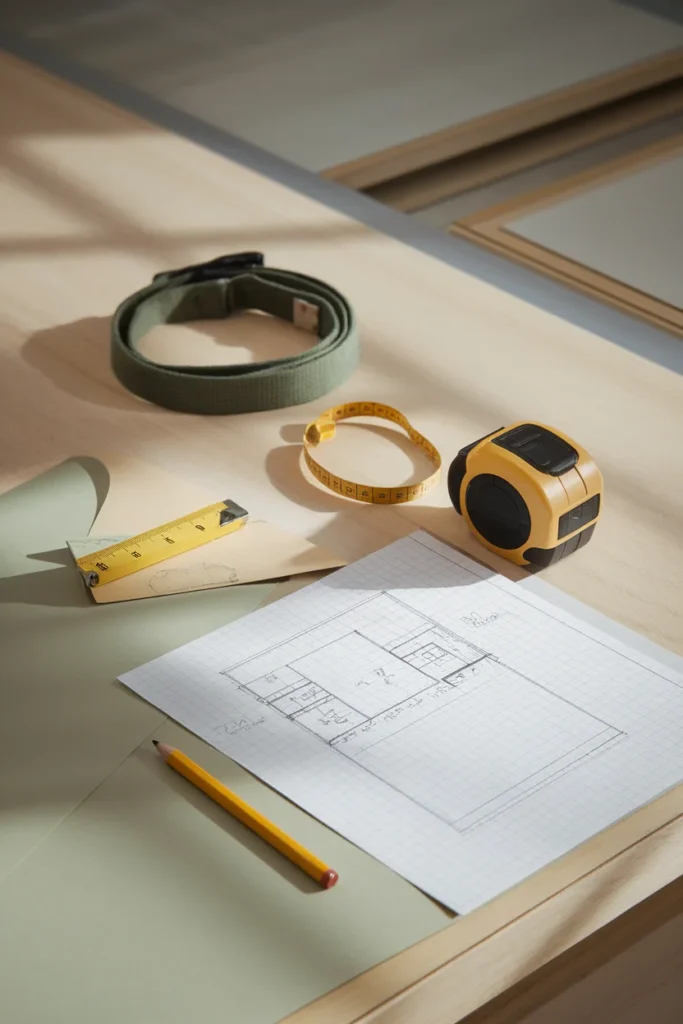
Three Numbers Your Lease Already Assumes You Know
Call it the 3-12-24 Rule. Three numbers, memorized once, and your layout decisions get easier for the rest of December.
3 feet. That’s the minimum distance between your tree and any heat source, which in an apartment means a radiator, a baseboard heater, a heat vent, a space heater, or a lit candle. This one quietly rules out the cheerful corner next to the radiator that every small apartment has.
12 inches. That’s the clearance around any burning candle, measured to the nearest thing that can catch, which is usually the garland you just draped behind it. According to the U.S. Fire Administration’s holiday safety guidance, candles also need a stable holder and a spot where a sleeve or a tail won’t knock them over.
24 inches. Your working width cap for a tree in a tight corner, from the footprint math above.
Three numbers. They aren’t a warning label bolted onto the end of a decorating article. They’re the constraint that tells you where the tree goes before you’ve unboxed it, which saves you the sad experience of assembling something in the only spot that turns out to be wrong.
Hang Everything Without a Single Hole
This is where most renters guess, and guessing is expensive.
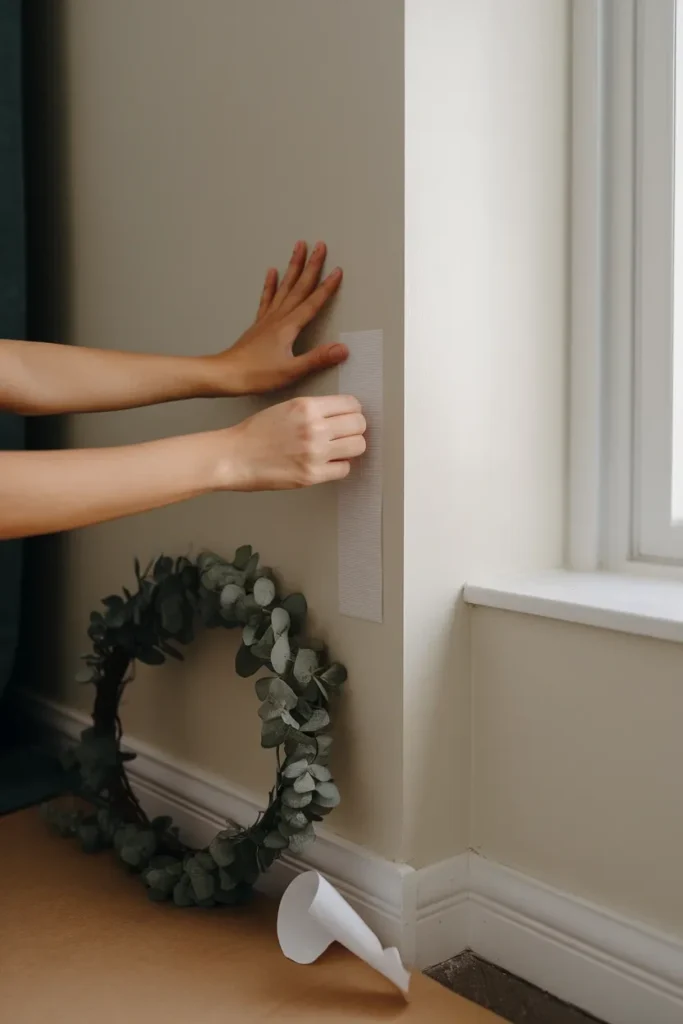
The back of a Command 15 lb Large Picture Hanging Strips package says four pairs hold 15 pounds and caps the frame at 24 by 36 inches. That number covers almost every wreath, every lightweight faux garland, and most framed holiday prints. What it doesn’t cover is your wall type. The same packaging rules out wallpaper, textured walls, brick, and rough surfaces, which is most older rentals and a lot of newer builds with orange peel texture.
So test one strip in a low stakes spot two days before you decorate. Press for 30 seconds, wait, then hang something you don’t love and leave it overnight.
If your wall fails the test, go to hardware that doesn’t touch the wall at all: an over the door wreath hook, a tension rod across a window recess, the top edge of a bookcase, a curtain rod you already have. Our full guide to no-damage rental decor methods works through the weight ratings and the move out reversal in more detail.
Failure mode: hanging a 4 pound wreath on textured paint and finding it on the floor at 2 am, along with a dinner plate sized patch of paint.
Pick a Tree Shape That Matches Your Floor Plan
Slim trees are not all the same tree. Three shapes behave differently in a small room.
Pencil trees run roughly 20 to 23 inches wide at 6 to 7 feet tall. Costway’s unlit pencil in the 5 to 7 foot range sits around $36.99 to $44.99 at Target, and their green pencil in a 5 to 9 foot range runs about $39.99 to $99.99. These read tall and graphic and they’re the right call in a room where vertical space is the only space you have.
Slim trees widen to the 24 to 30 inch band. Best Choice Products’ pre lit flocked slim runs about $49.99 to $199.99 depending on height. They look more like a “real” Christmas tree from across a room and cost you an extra square foot of floor.
Short and full trees at 4 to 4.5 feet skip the ceiling problem entirely. A Northlight real touch 4.5 footer sits around $102.99. These work beautifully on a table or a low bookcase, where the added height puts the tree back at eye level anyway.
Now the ceiling. An 8 foot ceiling minus a 7 foot tree leaves 12 inches, and a star topper eats eight of them. At that point the tree reads compressed instead of tall. Under 8 foot ceilings, a 6 footer photographs better than a 7 footer, which is the opposite of what the box implies.
Honest tradeoff on pre lit: you save maybe 20 minutes of stringing on setup day. You also lose the entire strand when one section fails in year three, and you can’t swap the color temperature. Unlit plus your own warm white strand costs a little more time and gives you control for a decade.
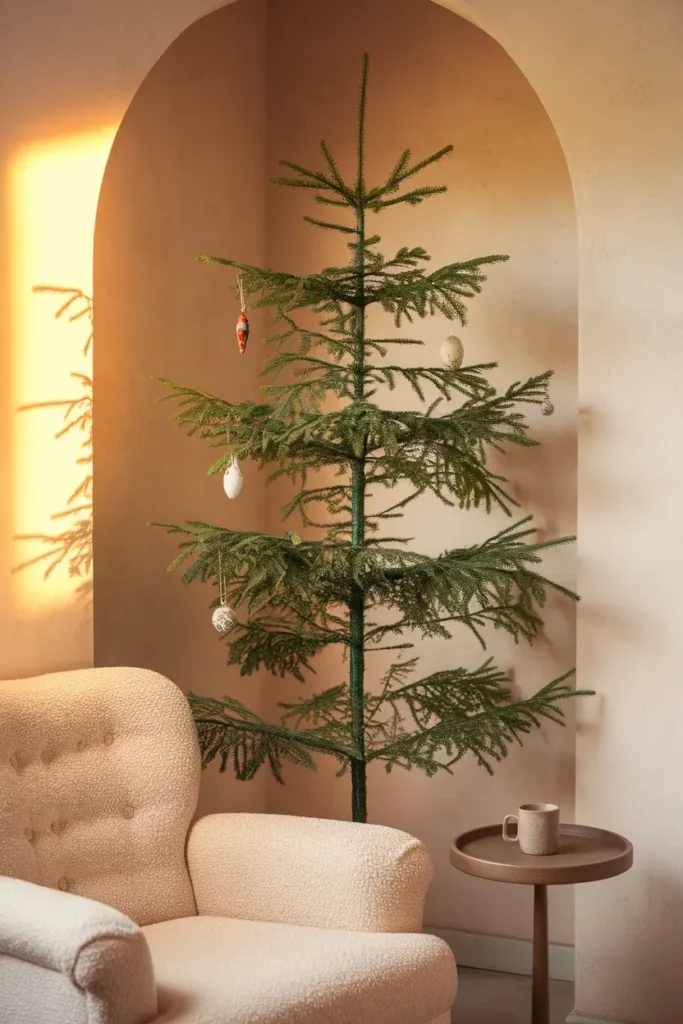
Skip the Tree Entirely If the Floor Says No
Some floor plans just don’t have 2.8 spare square feet, and that’s a real answer, not a failure.
Wall mounted flat trees hang like art and project about 7.25 inches off the wall at 4.5 feet tall. Zero floor cost.
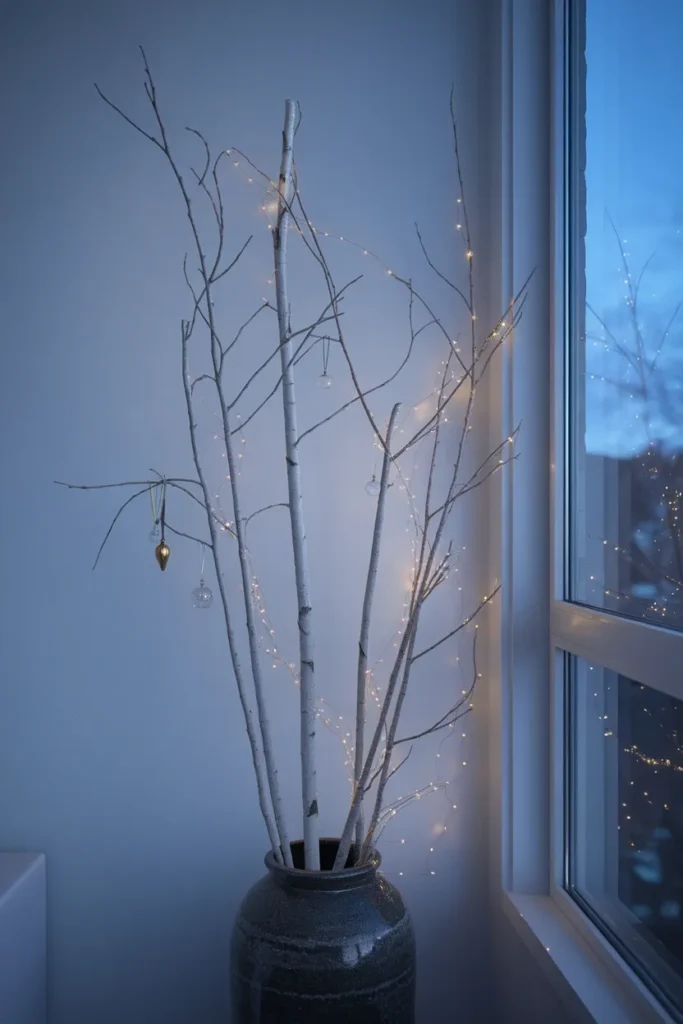
Branch trees are the cheapest version of the idea. Three or four bare birch or manzanita branches in a weighted floor vase, ornaments hung from the twigs, a strand of fairy lights threaded through. It occupies the same footprint as the vase you already own.
Vertical shelf trees. A ladder shelf styled with bottle brush trees on descending steps reads as a tree silhouette without being one.
A ribbon and light tree taped in a triangle on a blank wall, with ornaments hung from removable hooks along the lines. It photographs surprisingly well and comes down in ten minutes.
One thing every tree alternative loses is smell, and smell is most of what makes a room feel like December. Fix it with a bundle of real cedar or fresh eucalyptus tucked somewhere warm, near a lamp or above a radiator. Ten dollars of real greenery does more for the feeling of a room than fifty dollars of faux garland.
Warm the Light Before You Add One More Object
Small rooms get read as cold before they get read as small. The bulb is usually why.
Here’s the scale that matters:
| Kelvin | Reads as | Use it for |
|---|---|---|
| 2000K to 2200K | Candle, amber | Late evening, accent only |
| 2700K | Soft white | Lamps, string lights, the default |
| 3000K | Warm white | Task lamps, kitchen counters |
| 4000K and up | Neutral to cool | Nothing in December |
String lights labeled “warm white” usually land between 2700K and 3000K, which sits nicely with a lamp. Anything sold as “pure white” or “cool white” runs 4000K and higher, and next to a 2700K lamp it goes visibly blue. Two color temperatures in one small room is the single fastest way to make a space feel like a waiting area.
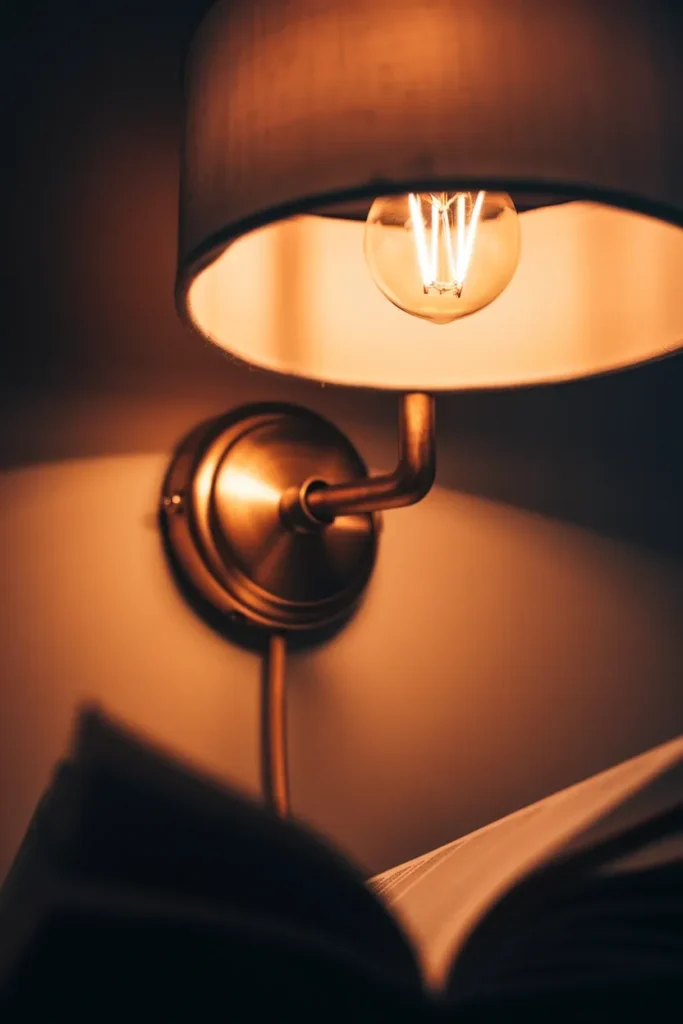
Get the glow down low too. Light sources between 30 and 60 inches off the floor make a room feel intimate, while a ceiling fixture flattens it. A plug in sconce, a swing arm lamp beside the armchair, a strand of lights along a bookcase shelf. Around 800 lumens is plenty for actually reading by, and 1600 is too much for a room this size. Our breakdown of warm lighting ideas for renters walks through the bulb swap in order.
Cheapest high impact move in this article: swap two bulbs to 2700K before you buy anything seasonal.
Build the Mantel You Do Not Have
Almost no apartment has a fireplace, and almost every holiday decorating idea assumes one. Build the substitute instead.
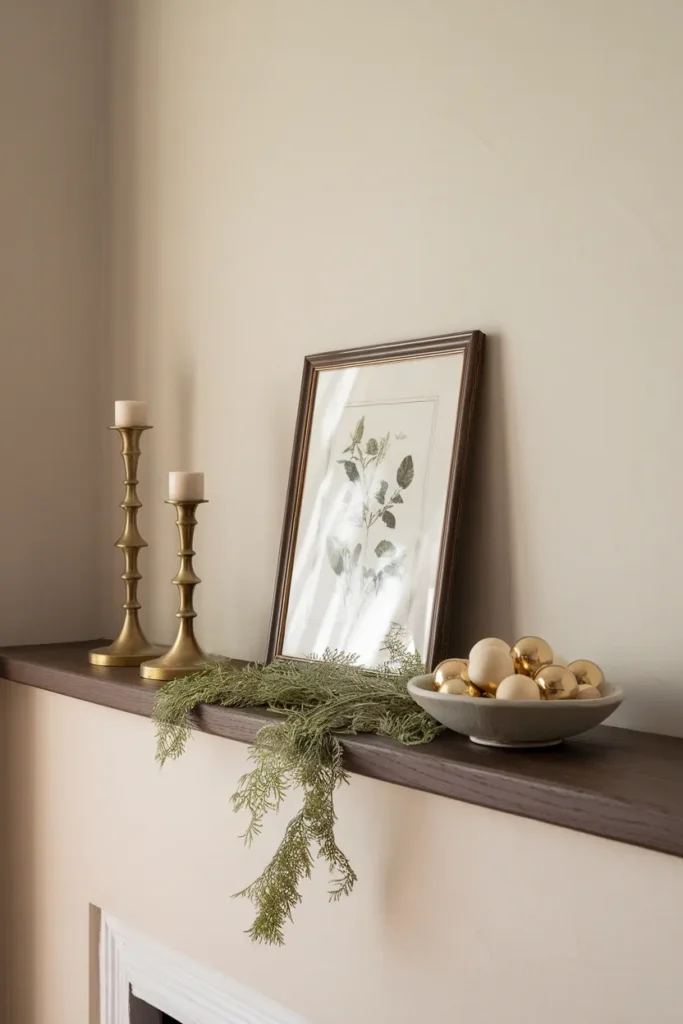
Any horizontal surface at roughly chest height works: a console table, a floating shelf, the top of a bookcase, a wide windowsill, a dresser, even the back of a sofa if it’s against a wall.
Then style it with three heights, which is the only composition rule you need:
- Tall: a candlestick, a bottle brush tree, a framed print leaning at the back
- Mid: a loose swag of greenery, a small lantern, a stack of two books
- Low: a shallow bowl of ornaments, pinecones, a tiny brass bell
Three heights, odd numbers, one repeated color across all three. That’s it. Most small space mantel vignettes fail because everything sits at the same height, which reads as clutter no matter how nice the individual pieces are.
Leave a third of the surface empty. In a small room, negative space is what tells the eye the arrangement was deliberate.
Where the Lights Actually Plug In
Small apartments have fewer outlets than the decorating photos assume, and this is where people improvise badly.
The numbers are worth knowing. NFPA’s five year data through 2024 counts an annual average of 143 home fires that started with a Christmas tree, causing 7 deaths, 13 injuries, and $15 million in property damage. Of those, 40 percent involved electrical distribution or lighting equipment, 24 percent started with lamps or bulbs, and 11 percent with candles. You can read the full breakdown in NFPA’s home Christmas tree fire research.
Three practical rules fall out of that:
- Read the strand connection limit on the box. Every set states a maximum number of strands you can link end to end. LED sets allow far more than incandescents. That printed number is the actual limit, not a suggestion.
- Use one surge protected power strip with a built in timer, not a chain of extension cords. A timer set to shut off at bedtime removes the decision entirely.
- Never run a cord under a rug. Foot traffic wears the insulation where you can’t see it, which is exactly the failure mode in that 40 percent.
Battery powered fairy lights with their own timers solve the outlet problem for anything that isn’t a tree: a garland on a shelf, a wreath, a bowl of lights on a side table.
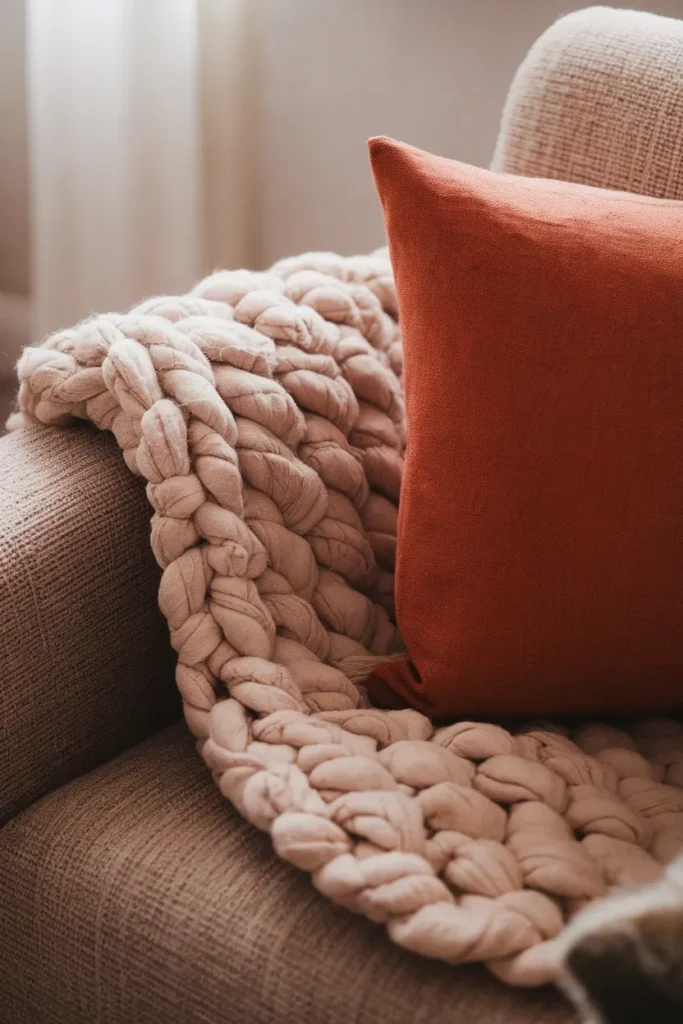
Soft Layers Do the Work Furniture Cannot
You can’t add furniture to a small apartment in December. You can add texture, and texture is what people actually register as warmth.
Swap two textiles, not five. A wool or boucle throw over the arm of the accent chair, and one lumbar pillow in a seasonal color. That’s the whole intervention. Adding a fifth pillow to a loveseat doesn’t make it warmer, it makes it a place nobody sits.
Pick one accent color and repeat it exactly three times across the room. Rust, oxblood, forest green, or a warm cream all work against builder beige. Repeating a color three times is what makes a room look decorated rather than accumulated.
Honest tradeoff: velvet photographs richly and pills fast on a sofa you use every night. Wool and boucle hold up. If a piece is going to live under a person daily, buy the boring durable one and save velvet for a pillow that mostly gets looked at.
If you have a jute or washable rug already, a folded throw at the foot of it does more than a new rug would.
Shop for January Before You Shop for December
This is the step nobody publishes, and it’s the one that decides whether you enjoy next Christmas.
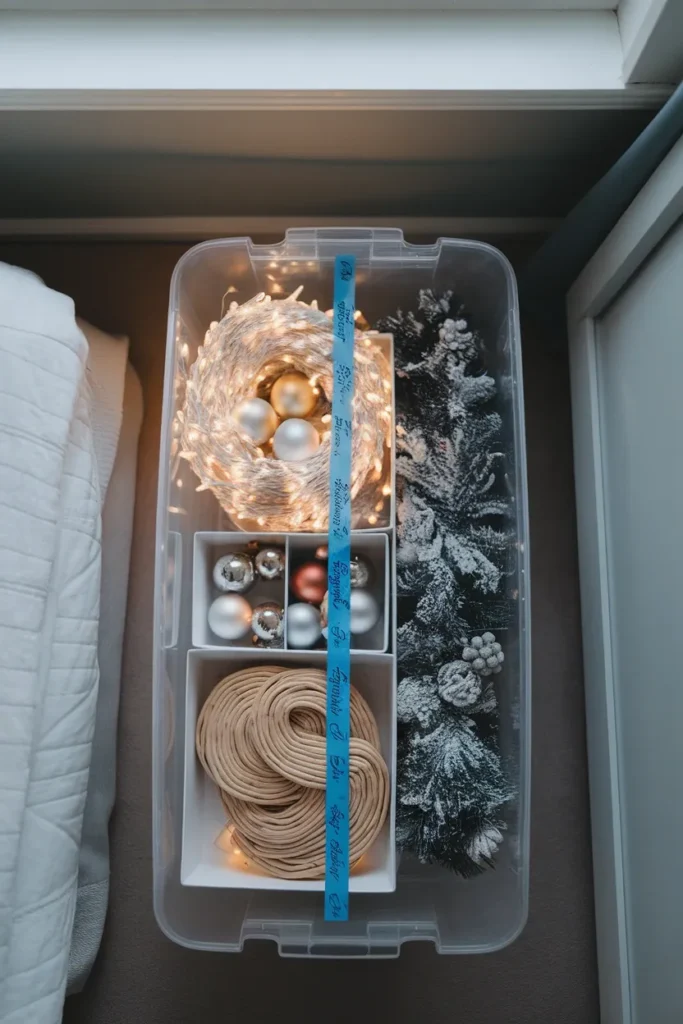
Before you buy anything, measure your storage. A standard 66 quart bin is 23 5/8 inches long, 16 3/8 inches wide, and 13 1/4 inches tall. Most platform beds clear the floor by only 7 to 11 inches, so that 13 inch bin will not slide under. Dedicated under bed bins run about 6 inches tall, which changes what fits inside them dramatically.
So set a purchase rule: if it doesn’t fit the bin, it doesn’t come home.
That single rule quietly answers the biggest question in small apartment christmas decor. It rules out the oversized ceramic village. It pushes you toward a tree that collapses, garland that coils flat, and ornaments that nest. It’s why the collapsible pencil tree beats the rigid one even at the same price.
Label with painter’s tape and a date. Vacuum bags work for textiles but never compress anything with down or feathers for more than a season. Our guide to small space storage ideas that protect your deposit covers the under bed measurements and the vertical options in full.
Buy your bins in November. In January the storage aisle is picked clean, which is how decorations end up in a garbage bag on top of a closet.
What Goes Wrong in a Small Apartment (and the 10 Minute Fix)
Five failures show up in almost every small space, and each one has a fast fix.
Too many small objects. Twelve tiny decorations across six surfaces reads as clutter. Fix: pick three surfaces, put everything on those, clear the rest completely.
Mismatched color temperature. Cool white string lights next to a 2700K lamp turns the room blue and clinical. Fix: match every light source to 2700K.
The tree blocking a path. If you’re turning sideways to get past it, the tree is in the wrong place, and it’s also blocking an exit route. Fix: move it to the corner furthest from your walking line, not the corner that looks best empty.
Adhesive on textured paint. It will fail, usually overnight, usually taking paint with it. Fix: test 48 hours ahead, or switch to a door hook or tension rod.
Buying storage in January. Fix: bins in November, decorations after.
Your Weekend Build Order
Do it in this sequence and nothing gets undone.
- Friday, 15 minutes. Measure the open floor. Pick the tree spot using the 3-12-24 Rule.
- Friday, 10 minutes. Test one adhesive strip on your actual wall. Leave it overnight.
- Saturday morning, $15 and 20 minutes. Swap two bulbs to 2700K. Do this before buying anything seasonal, because it changes how everything else looks.
- Saturday, 45 minutes. Assemble the tree or hang the alternative. Lights first, always, before ornaments.
- Saturday, 30 minutes. Build the mantel substitute using three heights.
- Sunday, 20 minutes. Add the two textiles. Stop at two.
- Sunday, 15 minutes. Add real greenery somewhere warm for the smell.
- Sunday, 10 minutes. Set the timer on the power strip and buy the storage bin.
Total active time is under three hours across a weekend, and the only thing you can’t reverse in ten minutes is the bulb swap, which you’ll want to keep anyway.
Small Apartment Christmas Decor FAQs
Where do you put a Christmas tree in a small apartment? In the corner furthest from your main walking line, at least 3 feet from any radiator, vent, or heat source, and never in front of an exit or a window you open. Corners work because a tree only needs contact with the room on two sides. If your only free corner has the radiator in it, that’s the corner you skip.
How do you decorate for Christmas when you have no space? Go vertical and go off the floor. A wall mounted flat tree, a branch tree in a vase you already own, or a ladder shelf styled with bottle brush trees all cost zero square feet. Then add warmth through light and texture instead of objects: a 2700K bulb swap, one wool throw, real greenery for the smell.
What do you put in a small living room for Christmas? Four things, in this order: warm light at 2700K, one tree or tree substitute under 24 inches wide, one styled surface using three heights, and two seasonal textiles. Adding a fifth category is where small living rooms tip into cluttered.
How do you store holiday decorations in a small apartment? Buy the bin before the decorations and shop to fit it. A 66 quart bin measures 23 5/8 by 16 3/8 by 13 1/4 inches, which won’t fit under a platform bed with only 7 to 11 inches of clearance, so measure your under bed gap first. Use a 6 inch under bed bin for flat items and a taller bin on a closet shelf for the tree.
Can you hang Christmas decorations without damaging apartment walls? Yes, within limits. Four pairs of Command 15 lb Large Picture Hanging Strips hold 15 pounds on a frame up to 24 by 36 inches, but they are not rated for wallpaper, textured walls, brick, or any rough surface. Test one strip 48 hours ahead. If your wall fails, use over the door hooks, tension rods, or existing curtain rods instead.
What size Christmas tree fits in a studio apartment? Under 24 inches wide is the working cap, which puts you in pencil tree territory at roughly 2.2 to 3.1 square feet of floor. Under an 8 foot ceiling, a 6 foot tree looks better than a 7 foot one once you add a topper. If your studio doubles as a bedroom, a 4 to 4.5 foot tree on a dresser gets the height back without touching the floor at all.
How do you make a small apartment feel festive on a budget? Spend on light and smell, not objects. Two 2700K bulbs run under $15 total, a strand of warm white LEDs is inexpensive and reusable for years, and a bundle of real cedar or eucalyptus costs about ten dollars and does more for the feeling of a room than any single decoration you could buy at that price.
Start With the Bulbs
If you only do one thing from this list this week, swap two bulbs to 2700K and see what the room looks like at 6 pm. It costs less than a coffee run and it changes the temperature of every other decision you’re about to make.
Then measure your open floor, write down the number, and take it shopping. The 3-12-24 Rule does the rest.
Once the corner is warm, the next question is usually how to keep it that way in February, when the tree comes down but the dark evenings don’t.
Keep reading
More cozy nook ideas
 Small Spaces
Read →
Small Spaces
Read →
10 Small Reading Nook Ideas for Adults
One high-back chair, one clamp-on lamp, one $19.99 tray table. At IKEA US prices this month, that’s a full reading corner for…
 Small Spaces
Read →
Small Spaces
Read →
18 Twin Bed Ideas for a Small Room
A twin bed in a small room can look like a leftover dorm setup or like the best seat in the house.…
 Small Spaces
Read →
Small Spaces
Read →
14 Modern Apartment Decor Ideas That Make a Small Room Feel Bigger
Four hundred and sixty square feet. That is the average size of a new US studio apartment, according to RentCafe’s 2025 numbers,…