
Small Space Storage Ideas That Won’t Cost You Your Deposit

Your apartment isn’t too small. It’s holding your things in the wrong places, on walls you’re not allowed to touch.
That’s the flaw in most small space storage ideas: they quietly assume a stud finder, a cooperative landlord, and a garage full of tools. You have a security deposit and an Allen key that came with a bookcase.
So this list runs the other direction. Twelve fixes, every one of them reversible, each with a real number attached: what it holds, what it costs, how tall it is, and what goes wrong if you skip a step. Start with the wall test below, because buying before you measure is how a $40 organizer ends up back in the box.
First, Find Out What Your Wall Can Actually Hold
Here is the part every other storage list skips. A damage-free hook is not a general promise. It’s a rated part, and the rating is published.
Learn what we call the 3-5-7 rule and you’ll never guess again: a medium adhesive hook holds about 3 pounds, a large one holds 5, and a jumbo holds 7.5. Everything else is a variation on those three numbers.
| Damage-free product | Rated to hold | Realistic job |
|---|---|---|
| Clear small hook | 1 lb | Charging cable, dish towel |
| Medium hook | 3 lb | Tote bag, robe, hat |
| Large hook | 5 lb | Winter coat, hanging planter |
| Jumbo hook | 7.5 lb | Folding step stool, full yarn bag |
| Broom gripper | 4 lb | Broom, mop, Swiffer |
| Shower caddy | 7.5 lb | A loaded caddy of bottles |
| Medium picture strips (per set) | 3 lb | Small framed print |
| Large picture strips (per set) | 4 lb | A 16 by 20 inch frame |
| Sticky nail wire-back hanger | 8 lb | Mirror or larger art |
Those figures come straight from the manufacturer’s own Command product weight limits by category, and they’re worth bookmarking before your next order.
Failure mode: hang a 6-pound bag on a 3-pound hook and it won’t fall the same day. It creeps for two weeks, then lets go at 2 a.m. and takes a chip of paint the size of a playing card with it. That chip is a line item on your move-out statement.
One more thing nobody tells renters: adhesive strips fail on textured wall paint, unfinished wood, brick, and anything wallpapered. Press a test strip somewhere hidden, behind a door, inside a closet, and leave it a week before you commit the good stuff to it.
1. Put a Tension Rod Where a Shelf Won’t Fit
A spring-loaded tension rod is the highest-value 12 dollars in small-space storage because it needs no wall at all. It braces between two surfaces and comes out clean.
Under the kitchen sink, one rod hung horizontally turns spray bottles into a hanging row and gives you back the entire cabinet floor. In a closet, a second rod mounted 36 inches below the first doubles your hanging space for shirts. In a shallow window recess, a rod plus a clip-on curtain hides a shelf of mismatched storage bins in about four minutes.
Product archetype: any 22 to 36 inch spring tension rod rated for 20 pounds or more.
Failure mode: tension rods slip on glossy tile and painted metal. A wrap of clear rubber shelf liner at each end fixes the grip permanently.
2. Measure Before You Buy the Under-Bed Bin
“Utilize under-bed space” is the laziest tip in this entire category, because it never tells you the one number that decides everything.
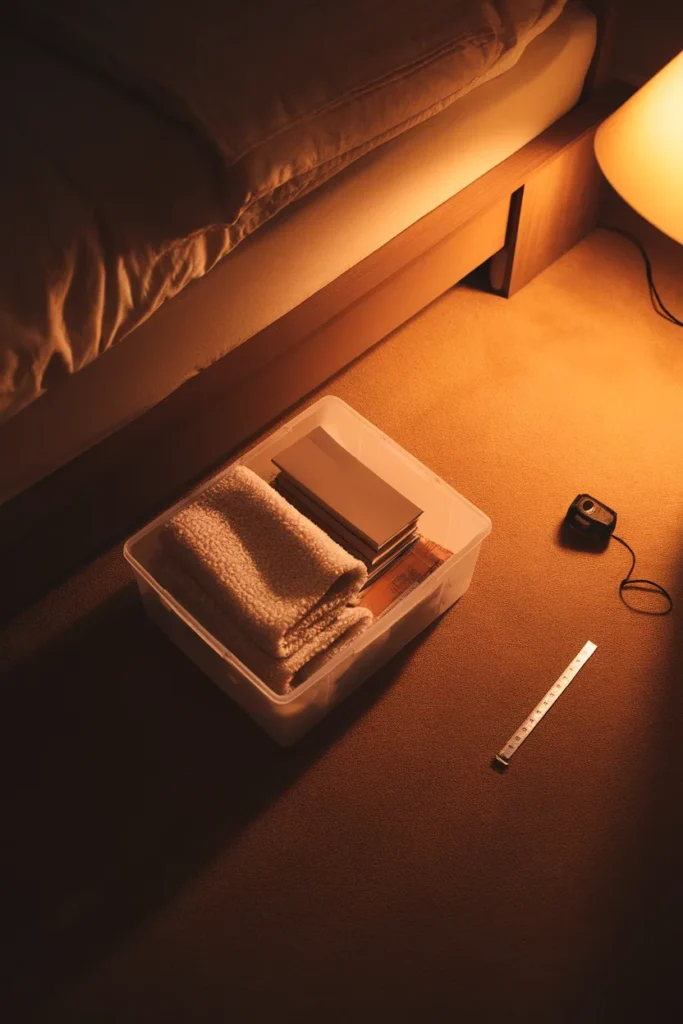
A standard 66-quart clear latch box measures 23 5/8 inches long by 16 3/8 inches wide by 13 1/4 inches tall. Most platform beds clear the floor by 7 to 11 inches. That box is not going under your bed, and no amount of shoving will change the math.
So flip the order of operations. Measure your clearance first, subtract half an inch for the lid catching on the frame, and buy to that number. Under-bed-specific bins run 6 inches tall and slide; general storage totes run 13 and don’t.
Product archetype: a 6-inch rolling under-bed box for anything you touch monthly, a 13-inch latch box only if your bed sits high.
Failure mode: skip the half-inch of slack and the lid drags every single time you pull it out, so you stop pulling it out, so the bin becomes a place things go to disappear.
3. Treat the Back of Every Door as Free Wall
You already own this square footage and you’re paying rent on it. A standard interior door gives you about 30 by 79 inches of vertical surface nobody is using.
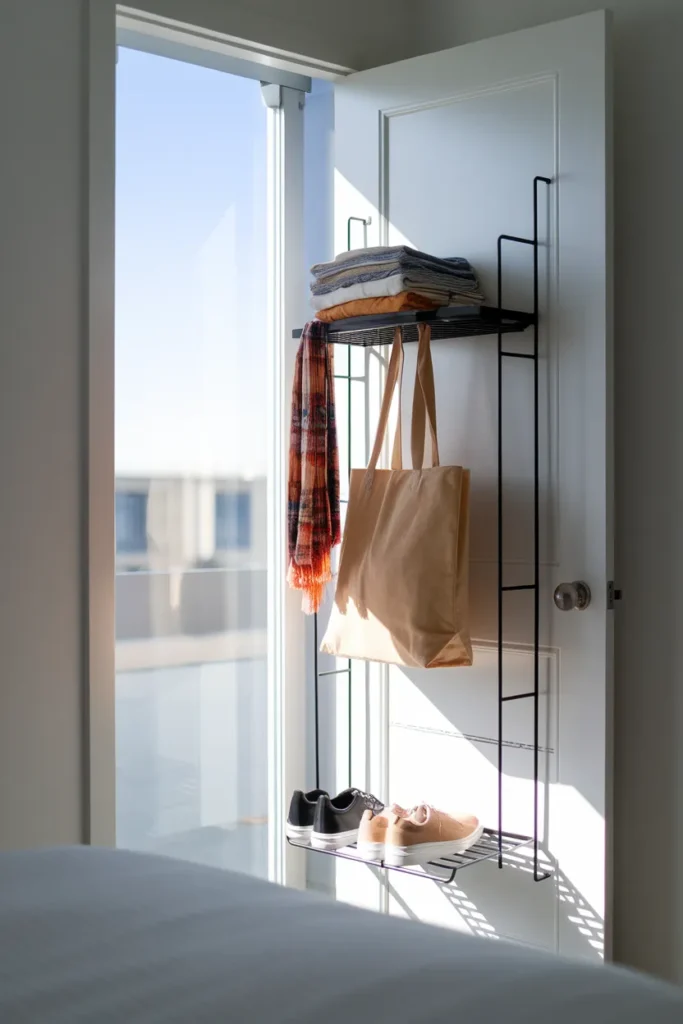
Over-door racks hook over the top edge and need zero hardware. Put shoes behind the bedroom door, cleaning supplies behind the pantry door, and a five-pocket organizer behind the bathroom door for the products crowding your sink. Cabinet doors count too: a small adhesive caddy inside the sink cabinet holds sponges and gloves off the shelf.
Product archetype: any over-door rack with a hook depth of 1 3/8 inches or more, since older apartment doors are thicker than new ones.
Failure mode: an over-door rack on a door that swings into a wall will chip the drywall behind it every time. Add a felt bumper or move it to a door that opens into open air.
4. Buy One Piece of Furniture That Swallows Clutter
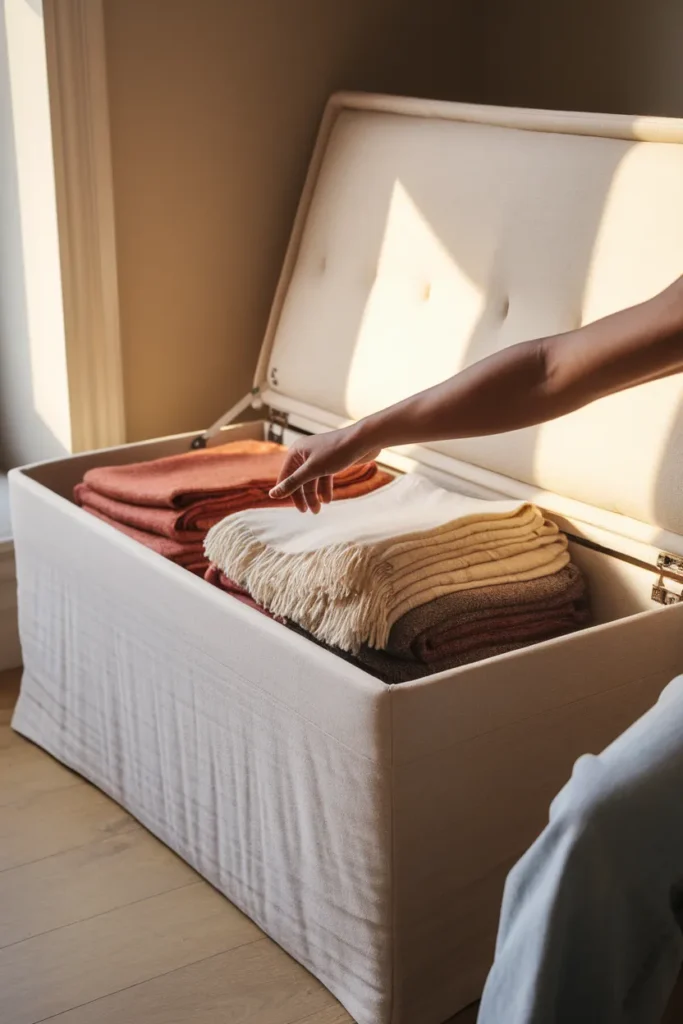
In a room under 400 square feet, every piece should hold something. A storage ottoman at the foot of the bed takes two folded duvets. A lift-top bench by the entry hides shoes, tote bags, and the shipping boxes you keep meaning to break down.
Here’s the trade-off nobody prints: hinged-lid storage is wonderful for things you need seasonally and terrible for things you need daily. If you have to move a tray, a book, and a lumbar pillow to open it, you’ll stop opening it inside a week.
Drawers beat lids for daily items. If you’re building rather than buying, hidden storage built into a reading bench is the version that stays usable, because a drawer opens with one hand while you’re still holding your coffee.
Product archetype: a 30 to 36 inch lift-top storage bench, or a cube bench with two pull-out fabric drawers.
Failure mode: an ottoman with a flimsy lid becomes a permanent table and never opens again.
5. Go Tall Instead of Wide
Floor space is the thing you’re short of. Wall height is the thing you have in surplus, and most renters stop using it at about 5 feet.
A narrow bookcase is the cheapest correction. An IKEA BILLY in the 15 3/4 inch wide version stands 79 1/2 inches tall, takes up under 1.3 square feet of floor, and runs $59. A KALLAX unit at 30 1/8 by 15 3/8 by 57 5/8 inches runs $79.99 and is rated for 29 pounds per shelf, which is roughly 30 hardcovers.
Now the honest safety part, because this is the one place we’ll tell you to make a hole. Tall furniture tips. The CPSC’s furniture anchoring safety guidance recommends anchoring top-heavy pieces with anti-tip brackets and keeping tempting objects off high surfaces so children don’t climb. Two anchor screws leave two holes the size of a pencil lead, and spackle costs $4. Any landlord who would rather have an unanchored 6 1/2 foot bookcase in a unit with a toddler is not a landlord worth protecting drywall for.
Failure mode: loading the top shelf with the heaviest books. Heavy goes low, light goes high, always.

6. Use a Ladder Shelf You Can Lift With One Hand
A leaning ladder shelf gives you four tiers of storage while touching the wall in one spot and the floor in two. It carries no hardware, moves in ten seconds, and reads as furniture rather than as an organizing product.
The depth is the trick. Ladder shelves taper, so the bottom tier takes cookbooks or folded blankets while the top tier takes exactly one candle and one small frame. Load it accordingly and it looks deliberate. Load it evenly and it looks like a display rack.
Product archetype: any 4-tier leaning ladder shelf around 63 inches tall and 24 inches wide.
Failure mode: on a plush carpet the feet sink unevenly and the whole thing racks sideways. Two furniture coasters under the front feet level it.
7. Claim the Corner Nobody Uses
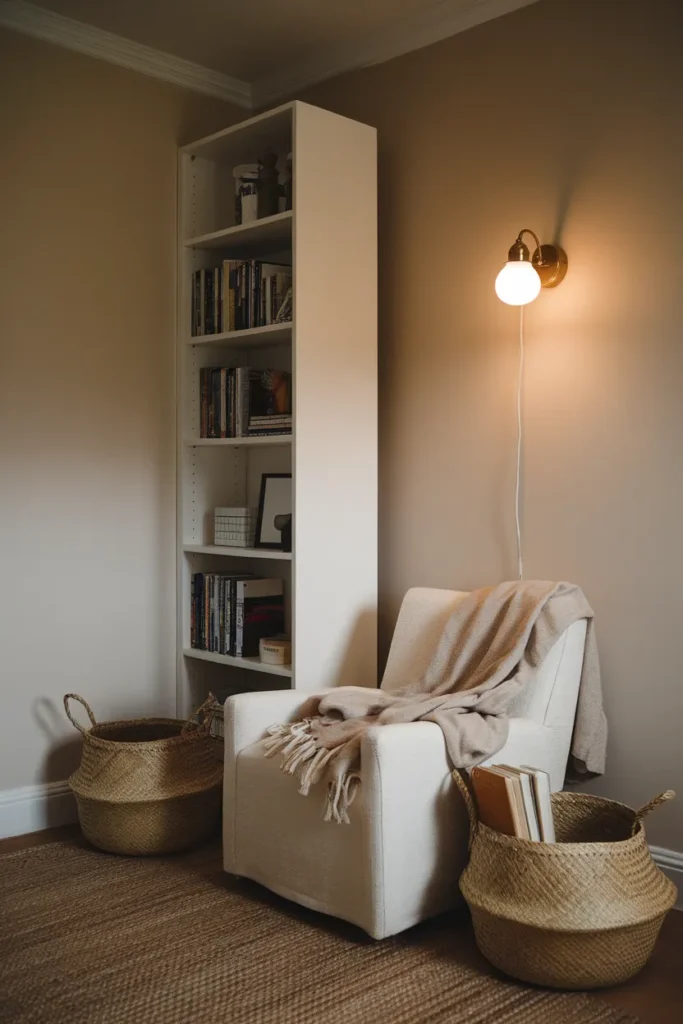
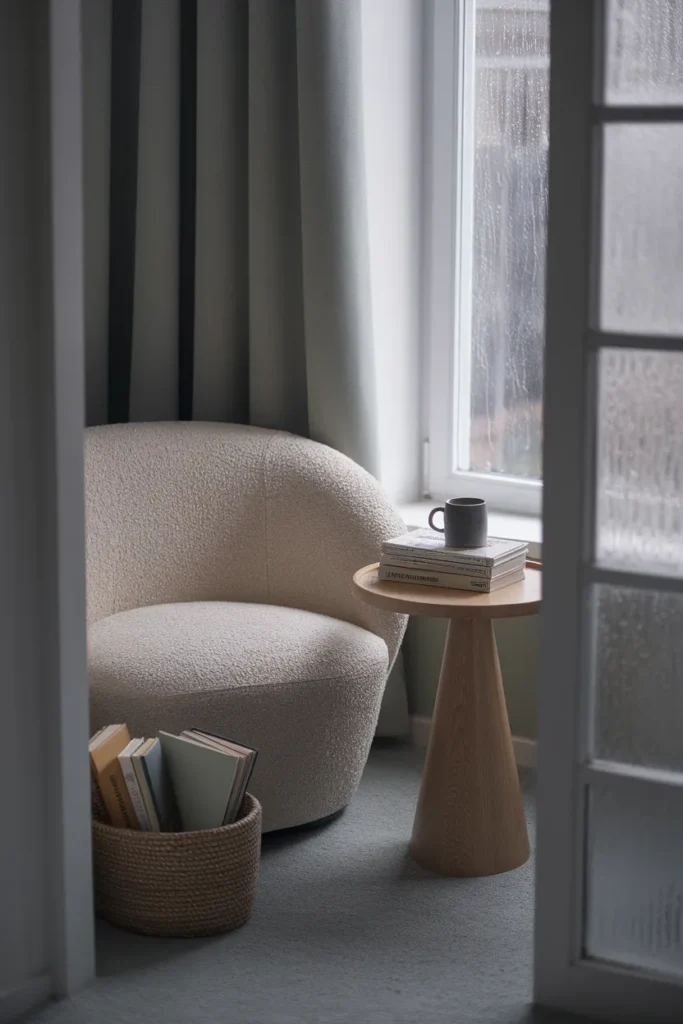
Every small apartment has one dead corner. It collects a laundry pile, a spare chair, and three tote bags. It’s also usually the only spot in the place where you could actually sit down and read.
So here’s the argument the other storage lists won’t make: the point of filling your dead inches is to protect the one comfortable corner from becoming storage. Push the bins under the bed and behind the doors, then leave that corner alone. A chair, a small side table within an 18-inch reach of your shoulder, a warm 2700K bulb, and a basket for the TBR pile. That’s the whole build.
If your lease has you nervous, the no-drill reading nook setups for renters guide covers the plug-in sconce and clip-on light versions in detail.
Failure mode: letting the corner take “just one” storage bin. It never stays one.
8. Hide the Unlovely Stuff Behind a Curtain
Not everything needs a container. Some things need to stop being visible.
A tension rod plus a linen panel across an open closet, a shelving unit, or an awkward alcove costs less than any storage system and solves the actual problem, which is visual noise. Behind the fabric you can keep cheap plastic bins, mismatched boxes, and the vacuum. In front of it, the room reads calm.
Pick a fabric with weight. A thin sheer will billow every time the heat kicks on, and the movement pulls your eye straight to the thing you were hiding.
Product archetype: a floor-length cotton or linen-blend panel on a tension rod, hemmed to clear the floor by half an inch.
Failure mode: hanging the rod at shelf height instead of ceiling height. Ceiling-height panels make a wall. Shelf-height panels make a skirt, and everyone can tell.
9. Stack Cubes That Do Two Jobs
Cube shelving is the most flexible thing you can put in a rental because it changes orientation. Stand a 2 by 4 unit upright and it’s a bookcase. Lay it on its side and it’s a bench, a media console, or a window seat base with cubbies underneath.
Fill roughly two thirds of the openings with books and objects, and the rest with matching fabric drawers. All bins reads like a storage unit. No bins reads like clutter. Two thirds and one third reads like a room.
That laid-on-its-side trick is the backbone of most IKEA reading nook hacks on a budget, and it’s why a single $79.99 unit can do three different jobs across three different apartments.
Failure mode: using a cube unit on its side as a bench without checking the load rating. The KALLAX top is rated for 55 pounds, which is fine for cushions and a person sitting lightly, and not fine as a step stool.

10. Store Books Where You Actually Read Them
Books migrate. They end up on the floor by the bed, on the arm of the sofa, on the kitchen counter, because the shelf is in the wrong room.
Fix the geography instead of nagging yourself. A shallow 5 1/2 inch deep picture ledge holds a row of paperbacks flat against the wall and takes almost no floor. A single stacked crate beside the chair takes 12 to 15 hardcovers. A slim rolling cart parked at arm’s reach takes the current stack plus a mug and a pair of glasses.
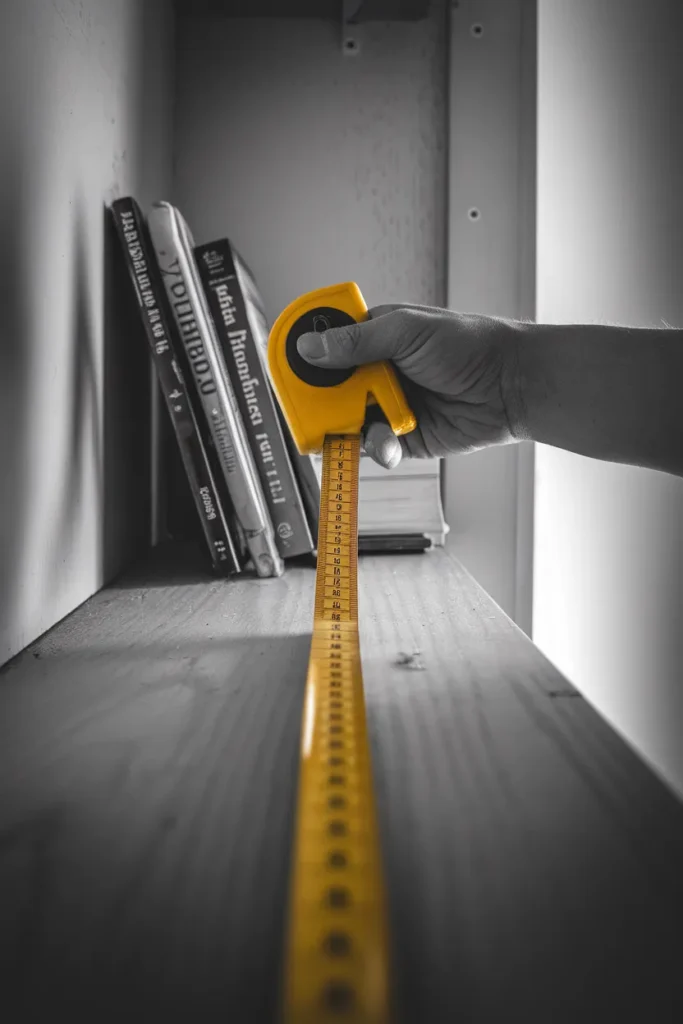
Measure your shelf depth before you buy the ledge. A standard mass-market paperback runs about 4 1/4 inches deep and a trade paperback about 5 1/4, so a 5 1/2 inch ledge holds both and a 4 inch one holds neither properly.
Failure mode: buying a deep shelf for books. Extra depth doesn’t hold more books, it just collects a second row you’ll never see again.
11. Rethink the Nightstand
A nightstand with a flat top and no drawer is a clutter magnet with legs. In a small bedroom it’s also often the single worst use of 2 square feet in the apartment.
Three better versions, all renter-safe. A small three-drawer cart holds the same footprint but swallows medication, chargers, and the lip balm collection. A wall-mounted floating shelf frees the entire floor beneath it for a basket. A short stack of two storage cubes gives you a surface on top and a closed bin below for about $30.
Product archetype: a 3-drawer narrow rolling cart, roughly 12 by 16 by 26 inches.
Failure mode: going drawerless to save money. Open surfaces beside a bed fill within 48 hours, every time.
12. Give Seasonal Things a Vacuum Bag and a Deadline
Compression bags shrink bulky bedding and coats to about a third of their loose volume, which is the difference between a closet shelf that closes and one that doesn’t.
Two rules keep this from turning into a problem. Never compress down or feather items long-term, because sustained compression damages the loft and they come out flat. And write the date on painter’s tape on every bag. Anything still bagged twelve months later isn’t storage, it’s a donation pile you haven’t admitted to.
Product archetype: a jumbo vacuum compression bag around 40 by 30 inches, used with a standard vacuum hose.
Failure mode: stacking compressed bags at the bottom of a closet where you can’t see the labels. They go on the top shelf, labels facing out, or they vanish.
The Move-Out Reversal Plan
Nobody in the top search results mentions this, and it’s the part that actually costs money. Every damage-free product in your apartment has a correct removal method, and doing it wrong turns a $6 hook into a $150 wall repair charge.
Removal order, two weeks before you hand back the keys:
- Adhesive strips come off last, not first. Warm the strip with a hair dryer for about 20 seconds, then pull the tab straight down along the wall, slowly, never outward. Outward pull is what takes paint.
- Over-door racks come off first, so you can check for pressure marks on the door top and buff them while you still have time.
- Tension rods leave faint circular marks on painted door frames. A magic eraser used lightly clears them. Used hard it removes the paint sheen, so test in a corner.
- Anchor screw holes get a dab of lightweight spackle, a swipe of a putty knife, and 30 minutes to dry. Sand with a fingertip, not sandpaper.
- Photograph every wall the day you finish. Timestamped photos have settled more deposit disputes than any argument ever has.
The two mistakes that cost the most: pulling adhesive tabs outward instead of downward, and leaving strips on the wall for years in direct sun, which cures the adhesive and makes clean removal much harder. If a strip has been up longer than a year, budget extra heat and extra patience.
What a $200 Small-Space Storage Kit Actually Buys
Real prices, checked in July 2026, so you can see where the money goes before you spend it.
| Item | Price | What it solves |
|---|---|---|
| IKEA BILLY bookcase, 15 3/4 in wide | $59.00 | 79 1/2 inches of vertical book storage on 1.3 sq ft of floor |
| IKEA KALLAX shelf unit, 30 1/8 in wide | $79.99 | Bookcase, bench, or console, 29 lb per shelf |
| Two tension rods | ~$24 | Under-sink hanging row plus a curtain screen |
| Over-door rack | ~$20 | 30 by 79 inches of unused door |
| Damage-free hook multipack | ~$15 | Coats, bags, brooms, per the 3-5-7 rule |
That lands right around $198 and covers vertical, hidden, hanging, and behind-the-door storage in one order. Buy the bookcase and the hooks first. The rest can wait a paycheck.
Small Space Storage Ideas Frequently Asked Questions
How can I add storage to a rental without drilling holes? Stack four no-drill methods: tension rods braced between surfaces, over-door racks that hook on, freestanding tall furniture, and rated adhesive hooks and strips. Between them you’ll cover hanging, shelving, and concealment without a single wall anchor. The one exception worth making a hole for is an anti-tip bracket on tall furniture.
How much weight can a damage-free hook actually hold? It depends on the size, and the manufacturer publishes the number. A medium hook is rated for 3 pounds, a large for 5, and a jumbo for 7.5. Picture-hanging strip sets run 1 to 4 pounds depending on size, and a sticky nail wire-back hanger goes to 8. Round down, never up.
What size storage bin fits under a bed? Measure the clearance from floor to the underside of your bed frame, then subtract half an inch. Most platform beds give 7 to 11 inches, which rules out a standard 66-quart latch box at 13 1/4 inches tall. Under-bed-specific rolling boxes around 6 inches tall fit almost everything.
How do you store a lot of books in a small apartment? Go vertical and shallow. A 79 1/2 inch tall narrow bookcase uses about 1.3 square feet of floor, and 5 1/2 inch picture ledges hold paperbacks flat on walls too shallow for real shelving. Keep the heaviest books on the bottom shelves, both for stability and for your own back.
What is the cheapest way to add storage to a small space? Tension rods and the backs of doors, in that order. A rod under the sink and an over-door rack together run under $35 and give you storage that needs no hardware, no permission, and no repair on the way out.
Can I use adhesive hooks on any wall? No, and this is where most renters lose money. Adhesive strips need a smooth, clean, fully cured painted surface. They fail on textured or flat matte paint, brick, unfinished wood, and wallpaper. Test one hidden strip for a week before you trust the system with anything heavy.
Does under-bed storage make a small bedroom look messier? Only if you can see it. Matching opaque bins in one color plus a bedskirt or a longer duvet reads as intentional. Mismatched clear bins with visible contents read as overflow, no matter how neatly they’re packed.
Where to Start This Weekend
Pick the wall test. Press one adhesive strip somewhere hidden, set a reminder for seven days out, and while you wait, measure two things: your under-bed clearance and the depth of the shelf you keep meaning to buy. Those three numbers will save you more money than any organizing product on the market.
Then, once the bins are under the bed and the coats are on the door, go sit in the corner you just freed up. That’s the actual reward, and it’s the one thing on this list that doesn’t come in a box.
Keep reading
More cozy nook ideas
 Small Spaces
Read →
Small Spaces
Read →
14 Modern Apartment Decor Ideas That Make a Small Room Feel Bigger
Four hundred and sixty square feet. That is the average size of a new US studio apartment, according to RentCafe’s 2025 numbers,…
 Small Spaces
Read →
Small Spaces
Read →
10 Small Space Ideas for Tiny Apartments and Awkward Corners
No bay window. No landlord who answers texts. No drill. Those three facts kill most corner projects before they start, and they…
 Small Spaces
Read →
Small Spaces
Read →
Small Bathroom Storage Ideas for Renters Who Can’t Drill a Single Hole
Most small bathroom storage ideas quietly assume you own the walls. You don’t. So here’s the version that works when your only…