
Rental Apartment Decor: No-Damage Ideas to Cozy Up Any Space

Your lease says no holes. Your landlord says no paint. And your living room still looks like a furnished waiting room that happens to contain your things.
Most rental apartment decor ideas skip the part that decides whether any of it works, which is the number printed on the back of the package. So this one starts there.
You’ll get the real load ratings, the single bulb swap that changes a room more than furniture does, and the exact dollar cost of a peel-and-stick accent wall, totaled out.
Nine changes. Zero drilling, with one honest exception I’ll flag when we get to it. Everything comes back off the day you hand in the keys.
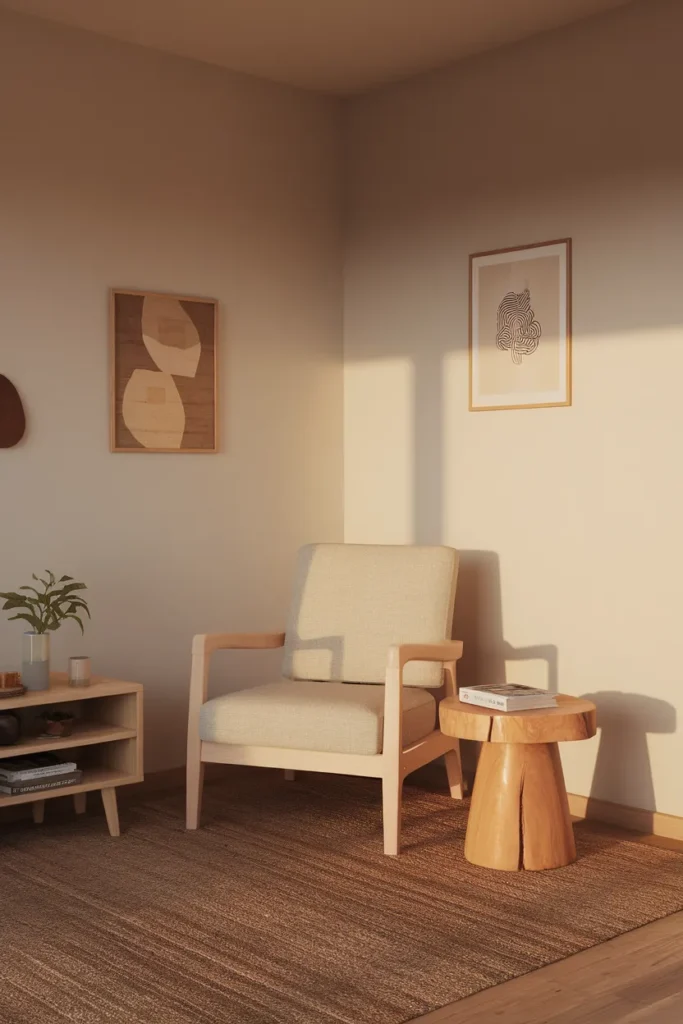
The No-Damage Rules That Come Before Everything Else
Nothing goes on your wall until you know two numbers: what the thing weighs, and what the hanger is rated to hold.
That sounds obvious. Almost nobody does it. They eyeball a frame, grab whatever adhesive strips are in the junk drawer, and press.
Here’s the thing about a strip that fails. It doesn’t let go politely and set your frame on the floor. It peels a coin-sized patch of paint and primer off the drywall on the way down, usually at 3 a.m., and now you don’t have a nail hole to spackle. You have a repair.
The Kitchen Scale Rule
Put the frame on your kitchen scale, glass and backing and all. Write the number down. Then check it against the rating below and use enough sets to clear that weight with room left over, not exactly at it.
A “set” means a pair of strips, one on the wall and one on the frame. Four sets of Large strips gives you sixteen pounds of rated hold, which is why they’re sold in multiples.
These are 3M’s own published figures, pulled from the official Command weight limit chart:
| Command product | Rated hold |
|---|---|
| Poster Strips | 1 lb |
| Small Picture Hanging Strips | 1 lb per set |
| Medium Picture Hanging Strips | 3 lb per set |
| Narrow Picture Hanging Strips | 3 lb per set |
| Large Picture Hanging Strips | 4 lb per set |
| Sawtooth Sticky Nail Hanger | 5 lb |
| Sticky Nail Wire-Back Hanger | 8 lb |
| Medium Hook | 3 lb |
| Large Hook | 5 lb |
| Jumbo Hook | 7.5 lb |
| Broom Gripper | 4 lb |
Read that table twice. Large Picture Hanging Strips hold four pounds per set. Four. Most people assume “large” means fifteen or twenty, and that assumption is exactly how a mirror ends up in pieces.
Failure mode: hanging anything with glass in it on a single set of strips. Glass is heavy and glass falls badly. Weigh it, then double the sets.
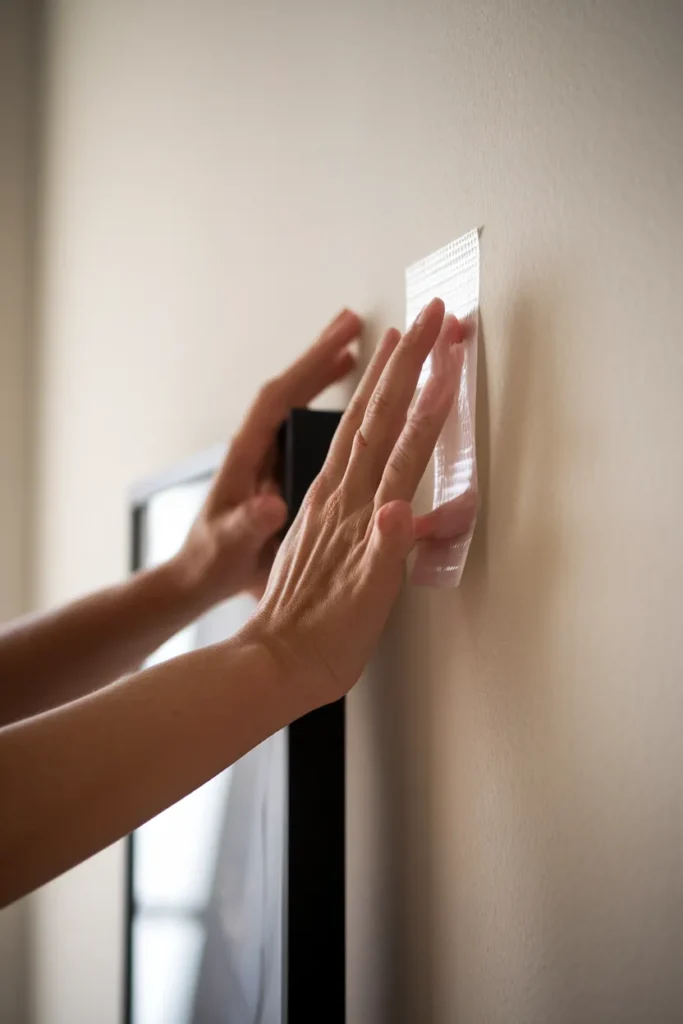
Build One Corner Before You Touch the Whole Apartment
The mistake almost every renter makes is spreading a small budget across four rooms. You end up with four rooms that each look 20% better, which reads as no change at all.
Pick one corner instead. Finish it completely. The corner you already gravitate toward, not the one you think should be nice.
For most people that’s a reading spot, and there’s a reason it works as a starting point: a chair, a light, a soft thing and a surface is a very short shopping list, and all four pieces move with you.
An IKEA POÄNG runs $249 and measures 26¾ inches wide by 32¼ inches deep, with a seat height of 16½ inches. Note the depth. That chair reclines, so you need clearance behind it, and 32¼ inches plus recline swing eats more of a small room than the floor plan in your head suggests. Measure from the baseboard out before you order anything.
The 18-Inch Reach Rule
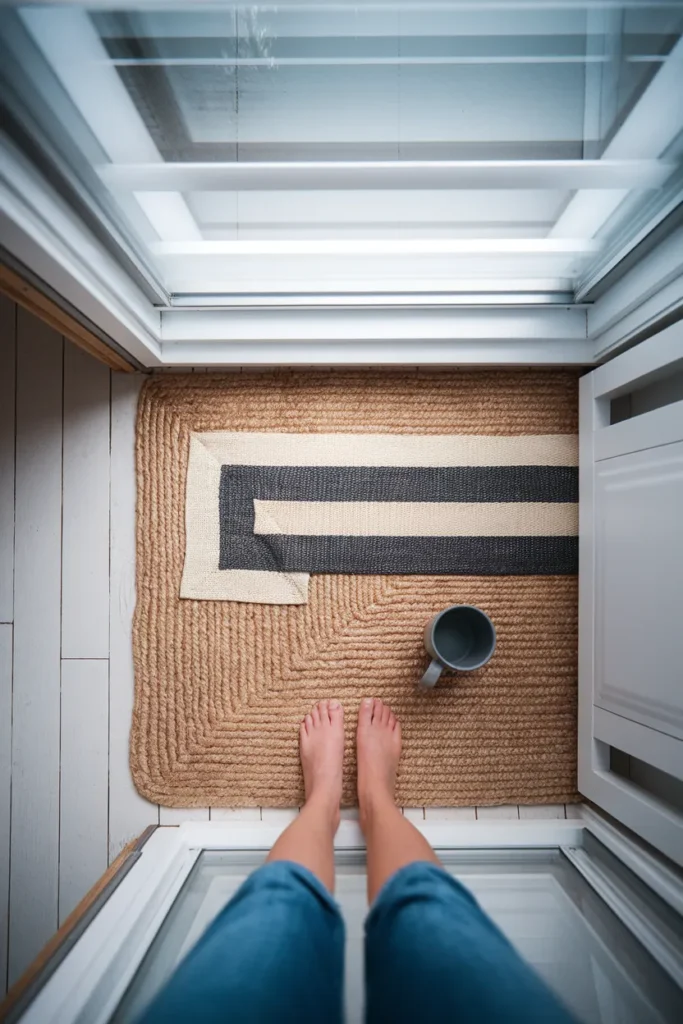
Your side table surface should land within 18 inches of your shoulder when you’re seated, and within about two inches of the chair’s arm height. Higher and you lift your mug awkwardly. Lower and you fumble for it without looking, which is how a mug ends up on a jute rug.
Then layer texture, because texture is what a rental is missing, not color. A boucle cushion against smooth linen. A sheepskin thrown over a hard chair back. Something your hand wants to touch on the way past.
If you want the full room-by-room version of that logic, the room-by-room hygge decor ideas guide breaks it down space by space with rental constraints built in.
Failure mode: buying the chair first. Measure the corner, then shop.
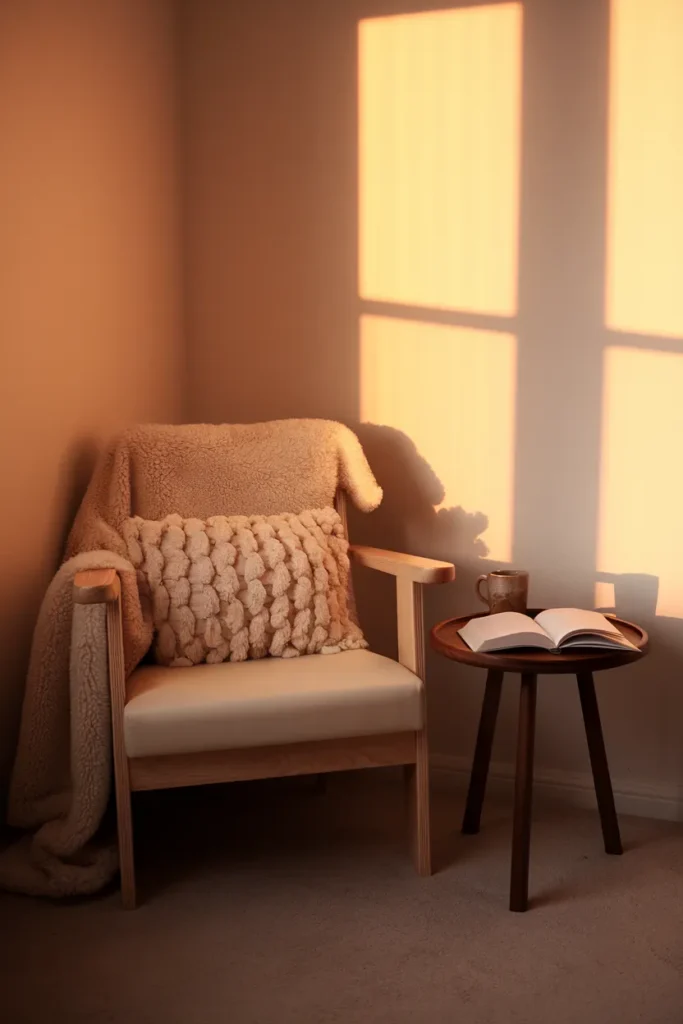
Swap Three Bulbs Before You Buy Anything Else
Walk into almost any rental and the overhead fixture is throwing a flat, faintly blue-white light. That’s the single biggest reason a unit feels institutional, and it costs about fifteen dollars to fix.
Bulb color is measured in Kelvin. Per Department of Energy color temperature guidance, warm-white light sits at roughly 2700K, while cool-white runs 5000K to 6500K. Builder-grade rentals skew toward the cool end because those bulbs get bought in bulk.
So swap three. Not all of them, three:
- The bulb closest to where you actually sit
- Whatever lamp you use at night
- The entry, because it sets the tone before you’ve taken your coat off
All at 2700K. Skip the ceiling fixture entirely for now, because you’re going to stop using it anyway.
The DOE’s Energy Saver figures put LED bulbs at 75% less energy and up to 25 times the lifespan of incandescent, so this isn’t a cost you’ll repeat.
Failure mode: mixing 2700K and 4000K in one room. Your eye reads that as a fixture being broken, not as layered lighting. Pick one temperature per room and commit.
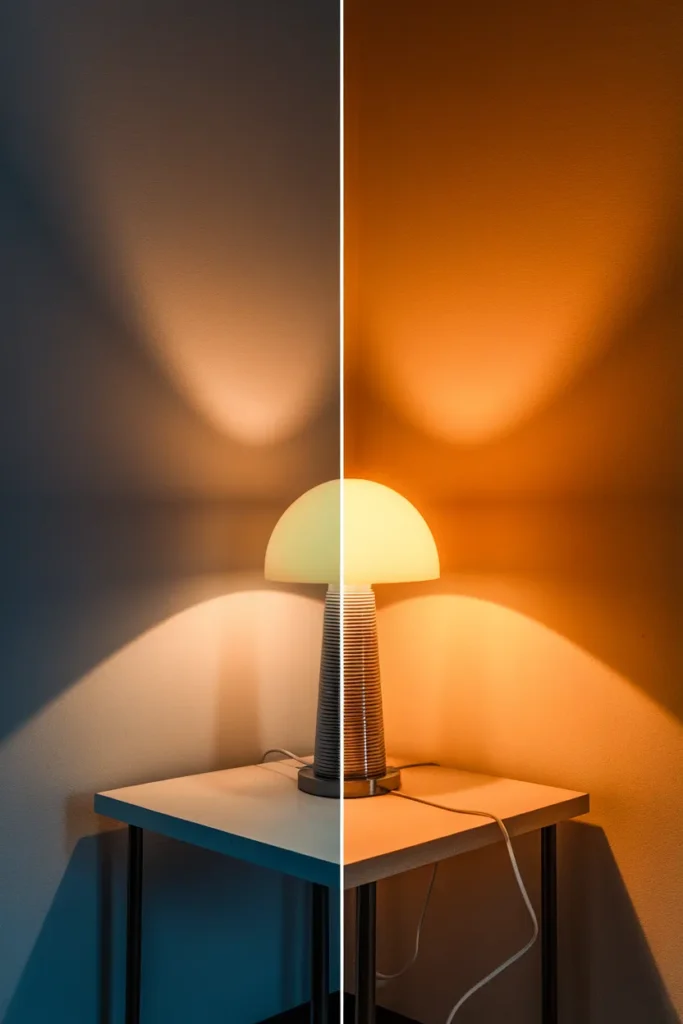
Add Light Where the Builder Forgot To
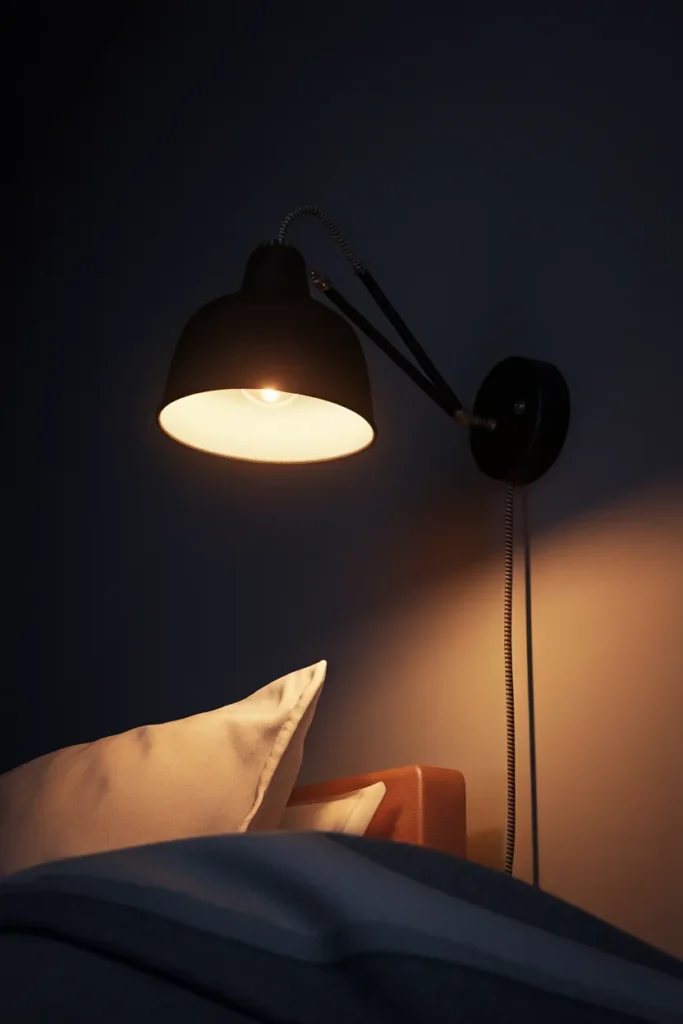
Swapping bulbs fixes what’s already there. Now you add what isn’t, and rentals are almost always missing light exactly where you’d want to read.
Your no-drill options, roughly in order of how much they change a room:
- Arc floor lamp. Reaches over a chair and gives you overhead light with no ceiling work at all. Costs you floor space at the base, so measure that footprint too.
- Plug-in swing-arm sconce. Reads as a built-in fixture from across the room. Honest caveat below.
- Clip-on reading light. Clamps to a shelf edge or a headboard. Ugly up close, invisible in use.
- LED puck lights. Adhesive-backed, battery or USB, they turn the underside of any shelf into indirect light.
- Fairy lights. Only if warm-toned and only if hidden behind something. Draped bare across a wall, they read dorm room.
Here’s the trade-off nobody puts in these articles: most plug-in sconces are designed to be screwed into the wall, and the ones sold as adhesive-mount are frequently heavier than the strips holding them. Check the fixture weight against that table from earlier. And then there’s the cord, which hangs down your wall in plain sight. Cord covers exist, they’re adhesive, they help, and they still look like cord covers.
The bigger point is that one warm light source at seated height will do more for a room than three fixtures at ceiling height, which is the whole argument behind these warm lighting ideas for renters.
Failure mode: putting every light source at the same height. Vary the height and the room gains depth.
Soften the Floor First, Then Worry About Walls
Renters obsess over walls because walls are what the lease restricts. Meanwhile the floor is doing more damage to how the place feels, and nobody’s rules apply to it.
Builder-grade carpet in a flat beige, or cold laminate that’s freezing under your feet in January. Either one tells your body you’re in temporary housing before you’ve consciously registered anything.
Layer it. A large jute rug as the base for texture and sound absorption, then a smaller washable rug or a runner on top where your feet actually land. Wool if the budget allows, because wool feels warm underfoot in a way that polypropylene never manages.
Size rule: the front legs of your seating should sit on the rug. A rug floating in the middle of a room with nothing touching it makes the room read smaller, which is the opposite of what you paid for.
And here’s a deposit risk that almost no rental decor article mentions. Use a rug pad. Rubber-backed rugs and some cheap latex-backed ones can react with laminate and vinyl plank flooring over time, leaving a discolored patch that will absolutely be inspected at move-out. A felt-and-natural-rubber pad costs less than replacing a floor.
Failure mode: buying a 5×7 for a room that needs an 8×10. Small rugs shrink rooms.
The Peel-and-Stick Math Nobody Actually Shows You
Every rental decor article recommends temporary wallpaper. None of them tell you what it costs, so here’s an actual accent wall, totaled.
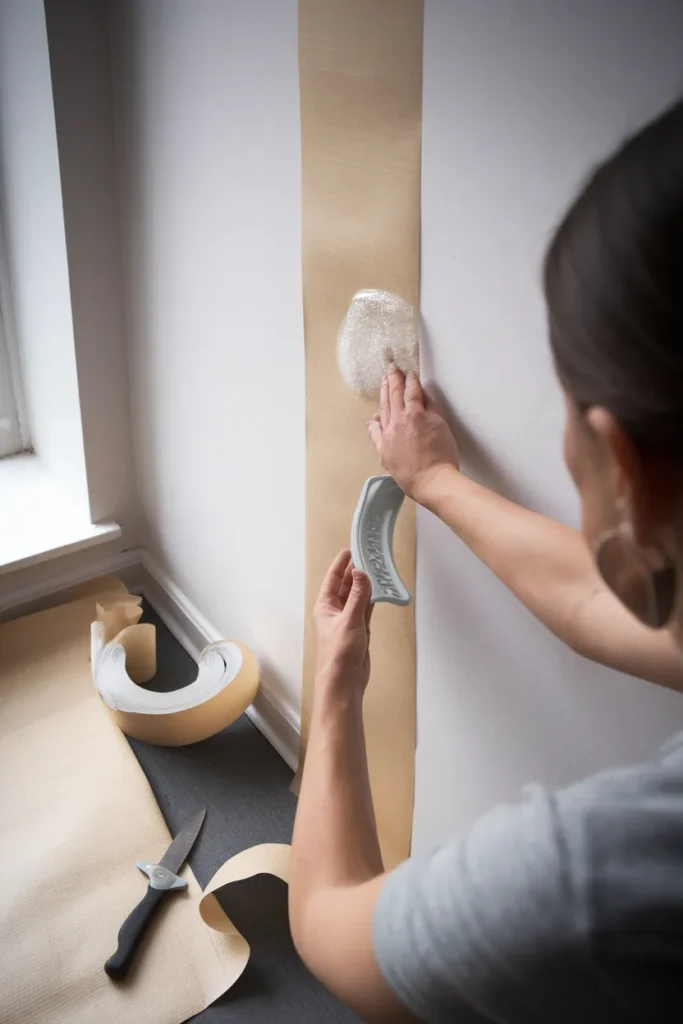
Take a standard roll of NextWall peel-and-stick from Home Depot: $49.99 per roll, 20.5 inches wide by 18 feet long, covering 30.75 square feet. That works out to $1.63 per square foot.
Now a typical rental accent wall, 10 feet wide with 8-foot ceilings. That’s 80 square feet.
Divide 80 by 30.75 and you get 2.6, so you round up and buy three rolls. Easy. Except square footage is the wrong way to calculate it, and this is where people get stranded.
You hang wallpaper in vertical strips, not in square feet. Each strip has to run the full 8-foot height. A 20.5-inch-wide roll means 10 feet of wall needs six strips (10 feet divided by 1.7 feet, rounded up). An 18-foot roll gives you exactly two 8-foot strips with two feet of waste. Six strips divided by two per roll is three rolls.
Three rolls, $149.97. Same answer, correct method.
Where That Number Doubles
Watch what happens at a 10-foot ceiling. Each strip now needs 10 feet, and an 18-foot roll only yields one usable strip, because the leftover 8 feet can’t reach top to bottom. Six strips now means six rolls.
Six rolls, $299.94. The wall didn’t get twice as big. The math cliff did.
Add a pattern repeat and the waste climbs again, because each strip has to be cut to align with the one before it. Buy an extra roll for anything with a large repeat.
One more honest warning: peel-and-stick vinyl can pull paint off walls that were painted with cheap flat paint, or painted recently and not fully cured. Test a six-inch square inside a closet, leave it a week, then pull it. If it takes paint, that’s your answer, and you found out for free.
Failure mode: buying by square footage, coming up one strip short, and discovering the pattern is out of stock.
Curtains Change a Rental More Than Paint Would
If you can only do one thing on this list, do this one. Rental windows come with vinyl blinds and nothing else, and vinyl blinds are the visual equivalent of fluorescent lighting.
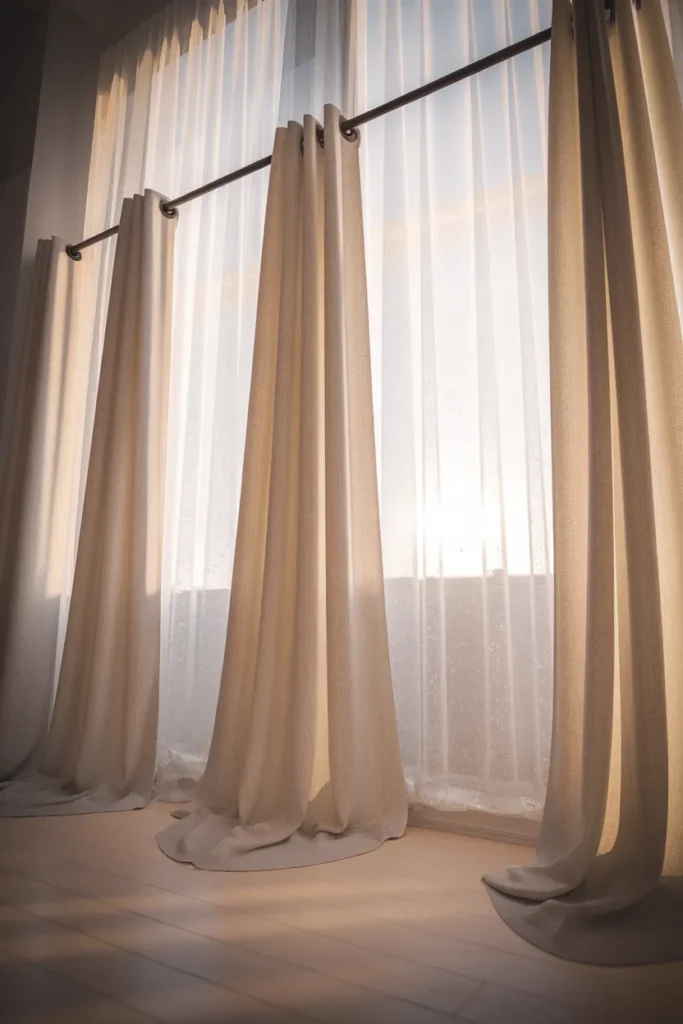
Hang the rod 4 to 6 inches above the window frame and extend it 8 to 12 inches past the frame on each side. Both numbers matter and both get ignored. Hanging high makes the ceiling read taller. Hanging wide means the panels stack off the glass when open, so you keep your daylight instead of blocking a third of it.
Then let the fabric touch the floor. Panels that stop three inches short look like they shrank in the wash, and everyone notices even when they can’t say why.
For a genuinely zero-hole version, run a tension rod inside the window recess. Honest limit: tension rods will not hold heavy blackout panels across a wide span. They sag, then they fall, usually in the middle of the night. Under about 36 inches with lightweight sheers, they’re fine. Past that, you’re using a bracket.
The sensory part is the one you’ll notice on day two: the low wooden clack of rings sliding along a rod every morning. Vinyl blinds rattle. Curtains announce.
Layer sheers behind blackout panels if the window faces a streetlight. Sheers by day for softened light, blackout by night for actual sleep.
Failure mode: hanging the rod flush to the window frame. It’s the default and it’s wrong, and it makes every window in the apartment look smaller than it is.
Storage That Never Touches a Wall
Clutter reads as “temporary” faster than any decor choice, and rentals are chronically short on closets.
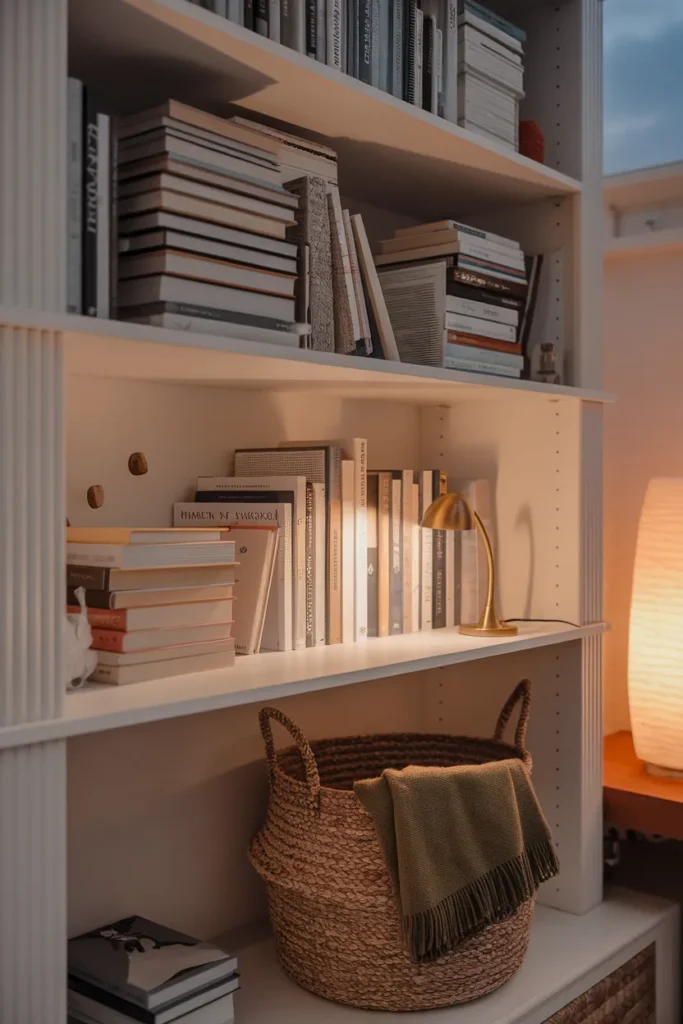
An IKEA BILLY bookcase costs $79 and measures 31½ by 11 by 79½ inches, with one fixed and four adjustable shelves rated to 66 pounds per shelf.
Run the numbers on that rating, because it’s tighter than it sounds. A hardcover book weighs roughly a pound and a half to two pounds. A 31½-inch shelf packed spine to spine holds somewhere near 28 to 30 hardcovers. Call it 30 books at 2 pounds and you’re at 60 pounds, sitting right up against the limit on a single shelf. Paperbacks give you far more headroom. A shelf of art books does not.
And here’s the exception I promised in the intro. A 79½-inch bookcase must be anchored to the wall. That means one screw, into one wall, and yes it makes a hole. Take the hole.
A tall bookcase loaded with books is a tip-over hazard, and that risk is not theoretical, particularly in a home with kids or pets. A single anchor screw is a spackle-and-touch-up repair that costs a few dollars at move-out. The alternative outcome is not a deposit problem. If you truly cannot put a screw in the wall, buy the shorter BILLY instead of skipping the anchor.
Everything else can stay hole-free: over-door hooks, under-bed bins on casters, a storage ottoman that hides throws and doubles as a footrest, baskets stacked in an alcove. For the full playbook on squeezing storage out of a small unit, the small space storage ideas for renters guide goes deeper on the awkward-corner problem.
Failure mode: loading the top shelf heaviest. Heavy goes low, always, anchor or no anchor.
The Move-Out Reversal Plan, in Order
Every article about decorating a rental ends when the decor goes up. That’s the half that costs you money.
Removal has an order, and doing it wrong turns three reversible projects into one drywall invoice. Run it like this:
- Photograph the wall before you install anything. Date-stamped, in daylight, wide enough to show the whole wall. This is your baseline and it is the single most valuable two minutes in this entire article.
- Keep the packaging. Removal instructions are printed on it, and they differ by product more than you’d expect.
- Remove in reverse order of installation. Last thing up comes down first. Anything layered over something else gets peeled back before the layer underneath is touched.
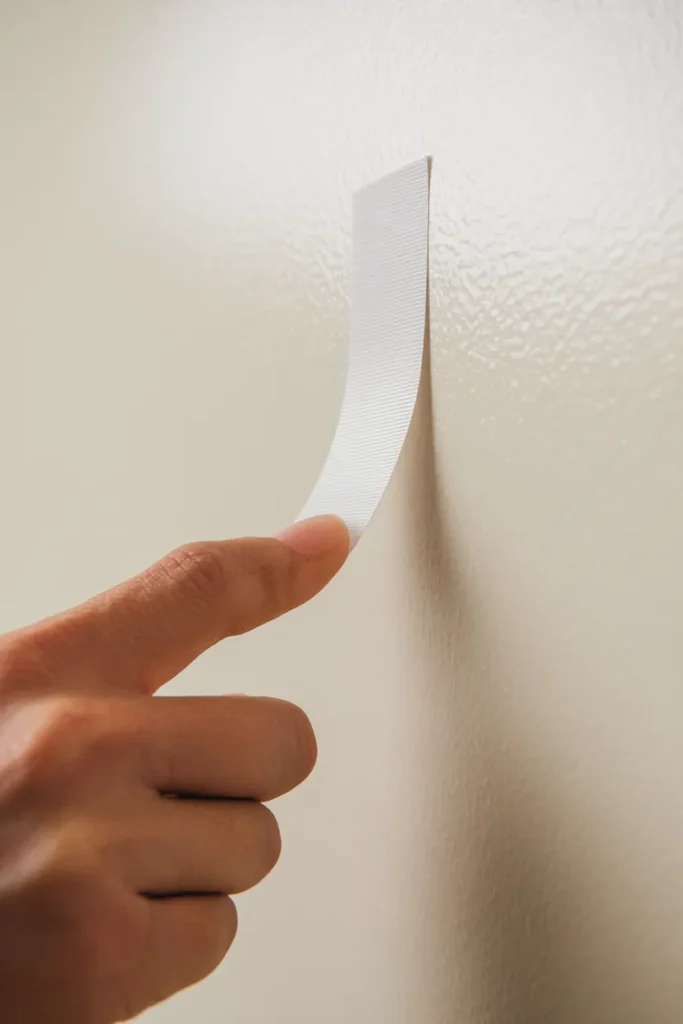
- Pull adhesive strip tabs straight down, slowly, flat against the wall. Never outward. Pulling out is what tears paint. Down and slow lets the adhesive stretch and release.
- Warm peel-and-stick before removing it. A hairdryer on low, held back a few inches, softens the adhesive. Peel at a shallow angle, close to the wall, steadily. Fast and steep takes paint.
- Test any residue remover on a hidden patch first. Closet interior, behind a door. Then work on the visible wall.
- Photograph again when the wall is bare. Same angle, same light if you can manage it. A matched before-and-after pair is what settles a dispute quickly.
A note on deposits: rules on wear and tear, allowable deductions, and deposit return timelines vary by state and by lease, and none of this is legal advice. Read your actual lease before you install anything, and if a landlord withholds a deposit you believe you’re owed, contact a licensed tenant attorney or your state’s tenant rights office. They handle this constantly.
Failure mode: removing everything in a rush on the last day. Reverse the whole plan across a weekend instead.
Frequently Asked Questions
How can I decorate a rental apartment without losing my security deposit?
Use reversible methods only, document the walls before and after with dated photos, and match every hanger to the actual weight of what it’s holding. The three things that cost renters deposits are adhesive failures that take paint with them, wallpaper pulled off too fast, and unpatched holes. All three are avoidable. Read your lease first, since some leases restrict things a landlord verbally waved off.
Can a landlord charge you for nail holes?
It depends on your state and your lease. Small nail holes from normal picture hanging are commonly treated as ordinary wear and tear, but that is not universal, and a wall with dozens of holes is a different conversation than a wall with four. Check your lease language and your state’s tenant rights office for how your jurisdiction defines it.
How much weight can Command strips actually hold?
Less than most people assume. Per 3M’s published ratings, Large Picture Hanging Strips hold 4 pounds per set, Medium hold 3 pounds, and Small hold 1 pound. Hooks run higher: a Jumbo Hook is rated to 7.5 pounds. Weigh your frame on a kitchen scale and use enough sets to clear that number with margin.
Does peel and stick wallpaper damage rental walls?
Usually not, on well-cured quality paint. It can pull paint off walls painted with cheap flat paint or painted within the last few weeks. Test a six-inch square inside a closet, leave it about a week, then remove it and look at the wall. That test costs you nothing and answers the question for your specific unit.
Can I paint my apartment if I rent?
Only with written permission, and get it in writing even if your landlord says yes in a text. Many leases require you to return walls to the original color, which means you also need the paint code. If painting isn’t an option, removable wallpaper, large-scale art and curtains change a room’s color story without touching the paint.
What’s the cheapest way to make a rental feel less generic?
Bulbs. Swapping three fixtures to 2700K warm white runs about fifteen dollars total and changes how every surface in the room reads. Curtains hung high and wide are the second cheapest high-impact move. Both come with you when you leave.
What counts as normal wear and tear in a rental?
Broadly, the deterioration that happens from ordinary living: minor carpet wear in walkways, small nail holes, faded paint, worn finishes. Damage is different from wear, and the line between them is drawn differently state by state. Since deposit disputes turn on this distinction, check your state’s specific standard rather than relying on a general definition, and talk to a licensed tenant attorney if real money is at stake.
Start With the Corner You Already Sit In
You don’t need permission, a drill, or a landlord who returns texts. You need three warm bulbs, a rug that’s actually big enough, curtains hung higher than feels correct, and a scale in the kitchen you were already using for bread.
Pick the corner you gravitate to in the evening. Finish that one completely, down to the mug-height side table and the throw you actually reach for. A single finished corner will change how the whole apartment feels more than four half-done rooms ever will.
Then work outward from there, one reversible layer at a time, with the photos already taken.
If that corner turns out to be where your TBR pile lives, build it properly. Start with the chair, then the light, then the thing you put your tea on.
Keep reading
More cozy nook ideas
 Small Spaces
Read →
Small Spaces
Read →
14 Modern Apartment Decor Ideas That Make a Small Room Feel Bigger
Four hundred and sixty square feet. That is the average size of a new US studio apartment, according to RentCafe’s 2025 numbers,…
 Small Spaces
Read →
Small Spaces
Read →
10 Small Space Ideas for Tiny Apartments and Awkward Corners
No bay window. No landlord who answers texts. No drill. Those three facts kill most corner projects before they start, and they…
 Small Spaces
Read →
Small Spaces
Read →
Small Bathroom Storage Ideas for Renters Who Can’t Drill a Single Hole
Most small bathroom storage ideas quietly assume you own the walls. You don’t. So here’s the version that works when your only…
2 Comments