
Small Home Library Corner Ideas You Can Set Up This Month

You rent, you have maybe nine square feet of awkward corner, and your books live in three leaning stacks by the bed. This fixes that. These library corner ideas are built for a small home and a real budget, and most of them need zero drilling.
I say that as someone who set up my first book corner in a 700 sq ft rental where I wasn’t allowed to touch the walls. The first thing you’ll want is the setup that costs almost nothing and comes off clean when you move.
Here’s the build order, starting with the renter-safe stuff.
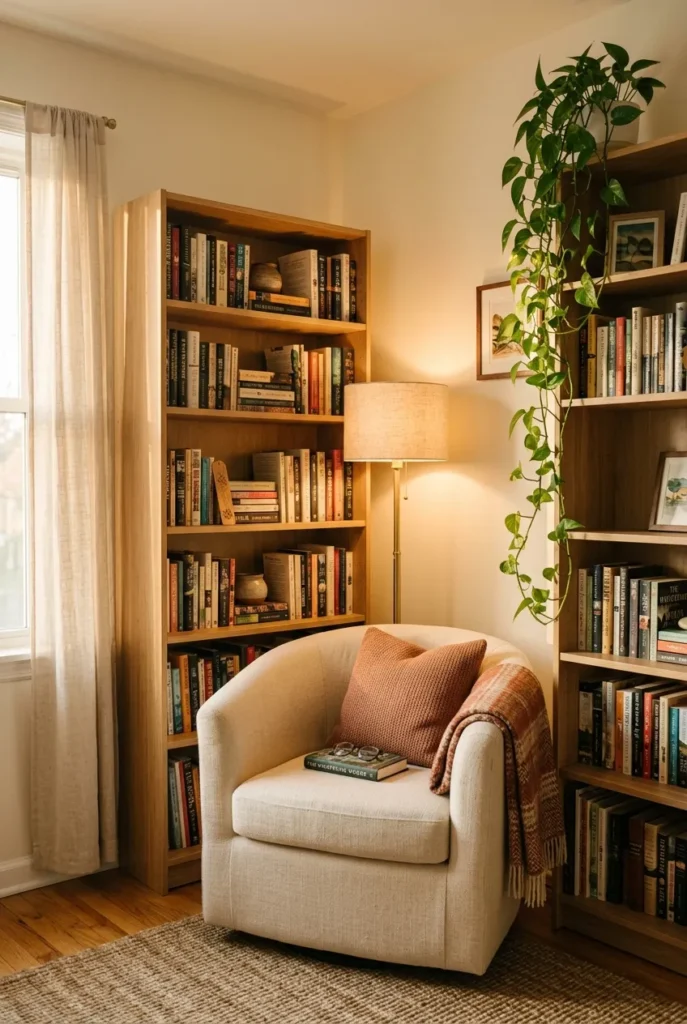
1. The No-Drill Corner: Renter-Safe From the Start
If you rent, start here before anything else. You can build a full library corner without a single hole in the wall.
Use a freestanding corner bookcase or two slim leaning ladder shelves that meet at the corner. Add a floor lamp instead of a hardwired sconce. Swap drilled hooks for adhesive strips rated for your shelf weight.
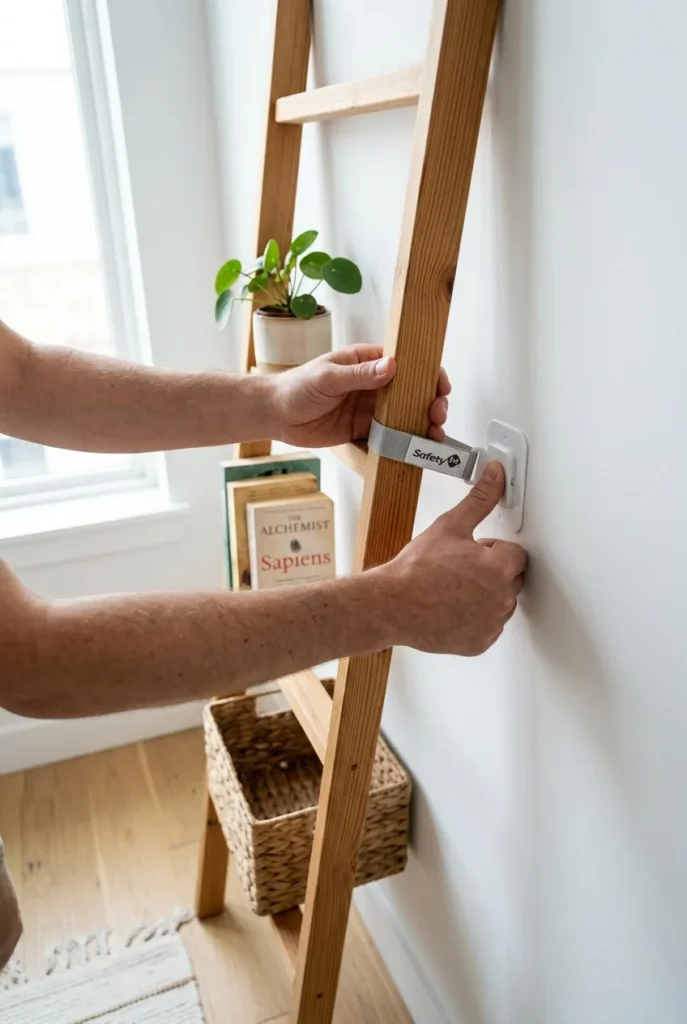
The one measurement that matters: keep any leaning shelf tilted against the wall at roughly a 5 to 10 degree lean, and anchor it with a removable furniture strap if you have kids or pets. [VERIFY: the removable strap brand and price band you actually used]
Failure mode: skip the anchor on a tall leaning shelf and it becomes a hazard the first time someone tugs a bottom book. Anchor it, always.
If your whole setup has to survive a security deposit, our full playbook for a reading nook designed for renters walks through no-damage seating and wall tricks in more detail.
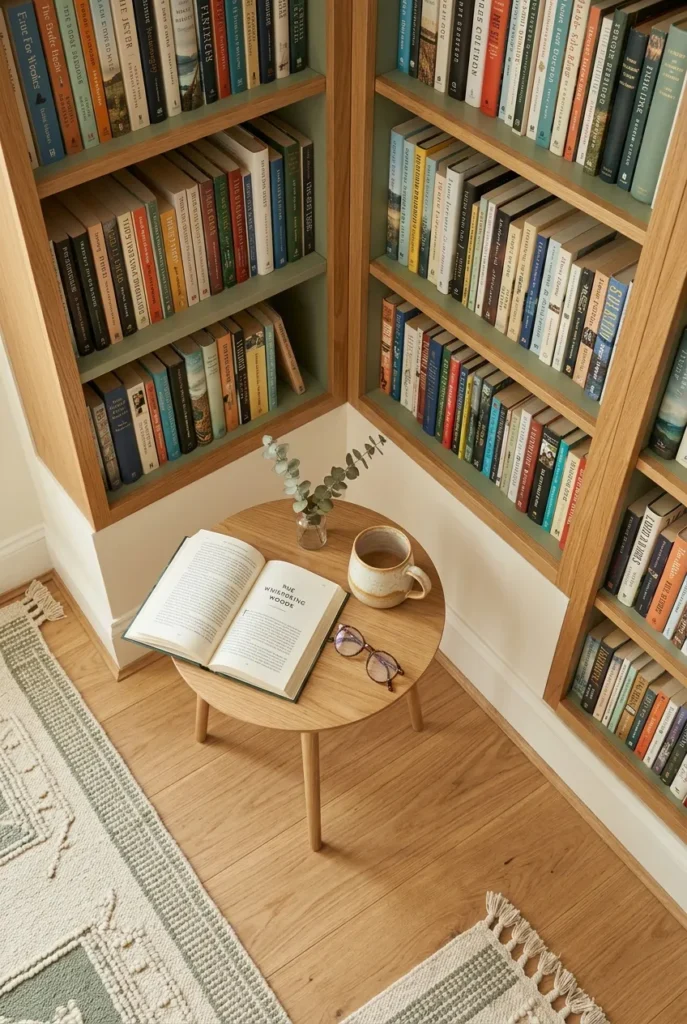
2. Work the Actual Corner: Shelving That Turns 90 Degrees
Most guides show a nook against one flat wall. You have a corner, so use both walls.
A true corner unit or two bookcases butted together gives you double the storage in the same footprint. Keep shelf depth around 10 to 12 inches for standard hardcovers, and leave the very corner shelf a little shallower so you can still reach the back.
Here’s a rule I use: the 18-inch reach rule. Anything you want to grab without standing up should sit within an 18-inch arc of where your hand rests in the chair. Put your current read and your mug there. Everything else can climb the walls.
A quick spec cheat sheet:
| Item | Small-home size | Why |
|---|---|---|
| Shelf depth | 10 to 12 in | Fits hardcovers, keeps the corner walkable |
| Aisle to chair | 24 in min | Enough to pass without shin-barking |
| Reachable zone | 18 in arc | Grab a book without getting up |
For the shelving itself, our guide to a reading nook built around bookshelves covers corner layouts and how to style them without the shelves looking cluttered.
3. Pick Seating That Fits an Inside Corner
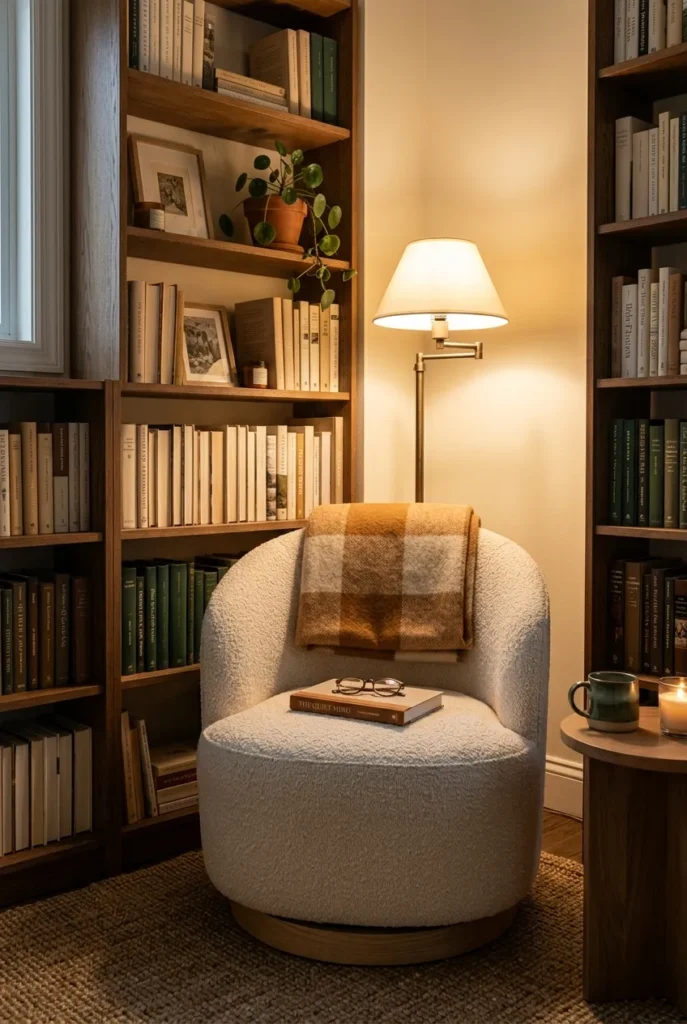
Boxy sofas fight corners. Rounded seating loves them.
A curved accent chair, a small round swivel chair, or a floor cushion with a bolster tucks into a corner far better than a square armchair. In the Pinterest results dominating this keyword right now, the round cocoon-style chair shows up again and again, and it’s popular because it hugs the corner geometry.
Trade-off honesty: floor cushions photograph beautifully and cost the least. After about 40 minutes your lower back files a complaint. If you read for hours, spend on a real chair with lumbar support instead.
For a rundown of corner-friendly seats by body type and room size, see our picks for the best reading nook accent chairs.
4. Light It With 2700K, Not the Ceiling Bulb
Overhead light kills a reading corner. It flattens everything and casts a shadow right onto your page.
Add a dedicated warm light instead. Aim for a 2700K to 3000K bulb, which reads as soft and golden rather than blue and clinical. A swing-arm floor lamp or a plug-in wall sconce both work with no wiring.
That warmth matters more than people expect. A cool 5000K bulb makes a cozy corner feel like a dentist’s office at 9 pm. If you want the why behind the numbers, the U.S. Department of Energy explains how color temperature affects the look of a room in plain language.
Non-visual beat: there’s a specific quiet that lands when the ceiling light is off and one warm lamp is on, just the page and the hum of the fridge two rooms away.
For lamp styles that suit tight corners, browse our reading nook lighting ideas.
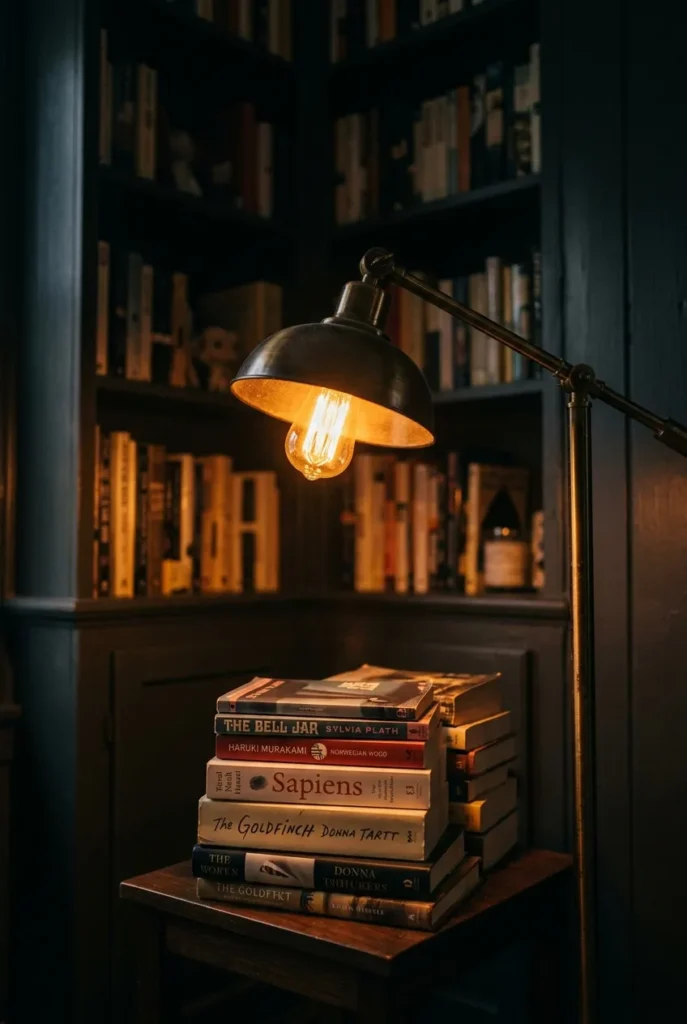
5. The Real $200 Corner Build
Competitors say “affordable.” Let’s put actual numbers on it.
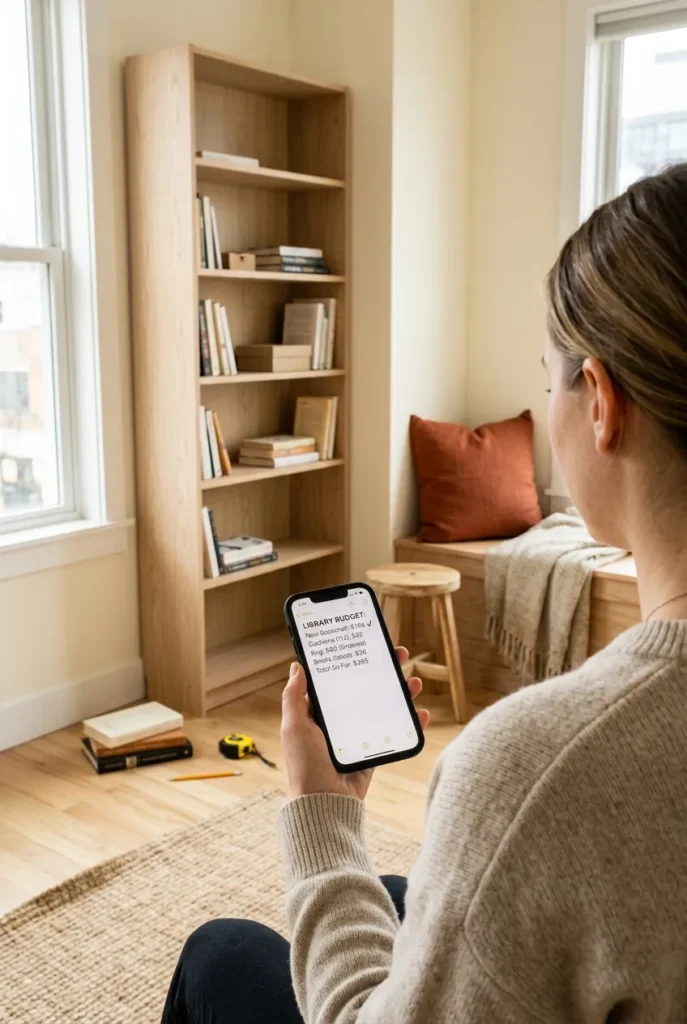
Here’s a corner library you can total up, not just admire. Prices are a real 2025 to 2026 band I saw at US retailers, so treat them as a starting estimate and check current tags.
- Two slim bookcases or ladder shelves: about $100 to $130 [VERIFY: the exact units and store you bought from]
- A round floor cushion or a secondhand accent chair: about $40 to $70
- A plug-in swing-arm lamp with a 2700K bulb: about $30 to $45
- A small washable rug to define the zone: about $25 to $40
Front-load the shelving, because storage is the part you’ll regret skimping on. Add the soft layers second. The rug last, since it’s the easiest thing to upgrade later.
Want the corner-cutting version under budget? Our reading nook on a budget guide stretches the same dollars further with thrift and IKEA swaps.
6. Make It a Bedroom Corner Without Shrinking the Room
Most small-home readers put the corner in the bedroom, and the autocomplete data backs that up. The trick is not stealing floor space you need.
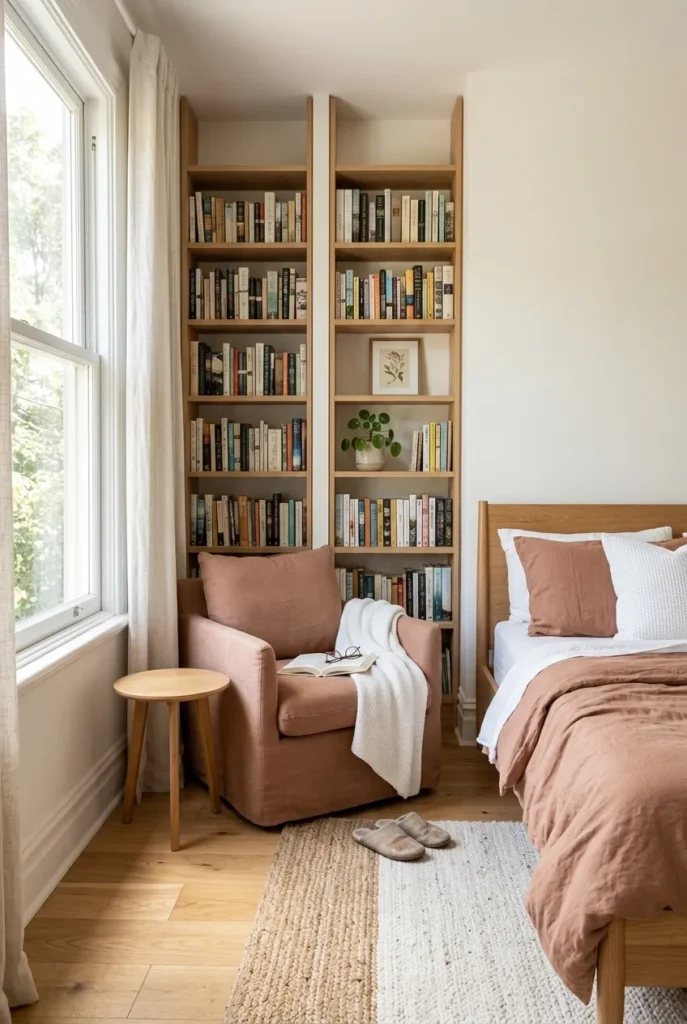
Use the corner beside the window or behind the door, the two spots that are usually dead anyway. Go vertical so the footprint stays small: tall narrow shelves, a wall-mounted swing lamp, a single chair.
Keep the palette close to your bedding so the corner reads as part of the room, not a bolt-on. A bedroom corner works best when it disappears into the space until you sit down in it.
For layouts that respect a small bedroom, see our bedroom reading nook ideas.
7. Give It an Aesthetic: Cozy, Dark Academia, or Japandi
“Library corner aesthetic” is a live search for a reason. A point of view makes a small corner look intentional instead of leftover.
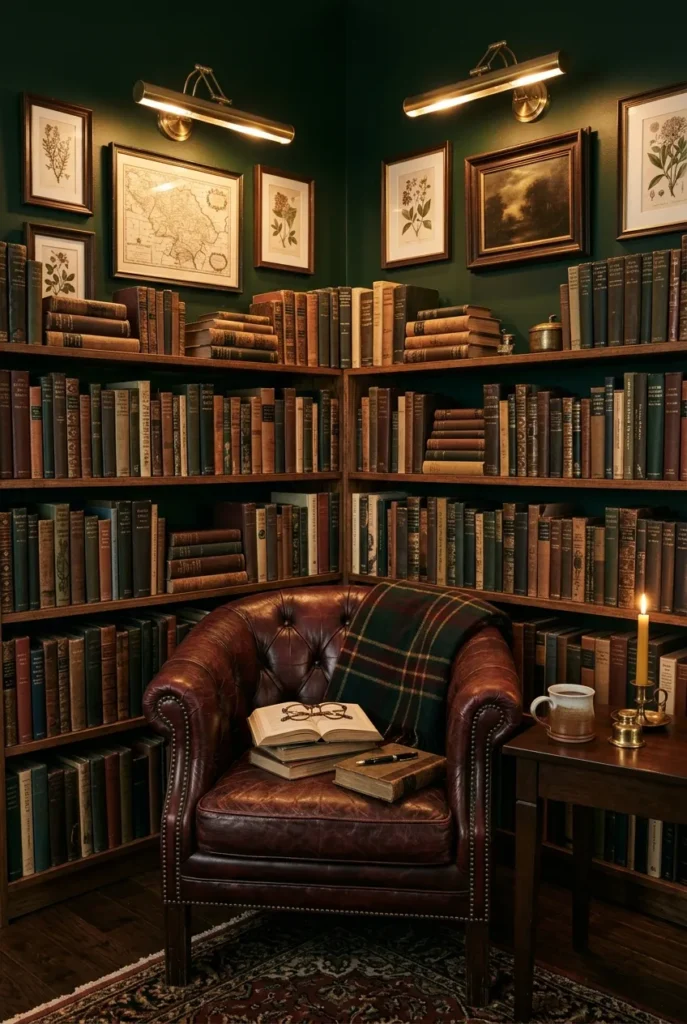
Three easy directions: warm cozy with layered throws and amber light, dark academia with deep green or oxblood walls and brass, or japandi with pale wood, low seating, and almost nothing extra. Pick one and let it guide every purchase, so the corner feels styled rather than random.
The screenshot-worthy rule: one hero color, one metal, one wood tone, and stop. That restraint is what separates a Pinterest-looking corner from a cluttered one.
8. Style the Shelves So the Corner Looks Finished
A finished corner is mostly about how the shelves read from the doorway.
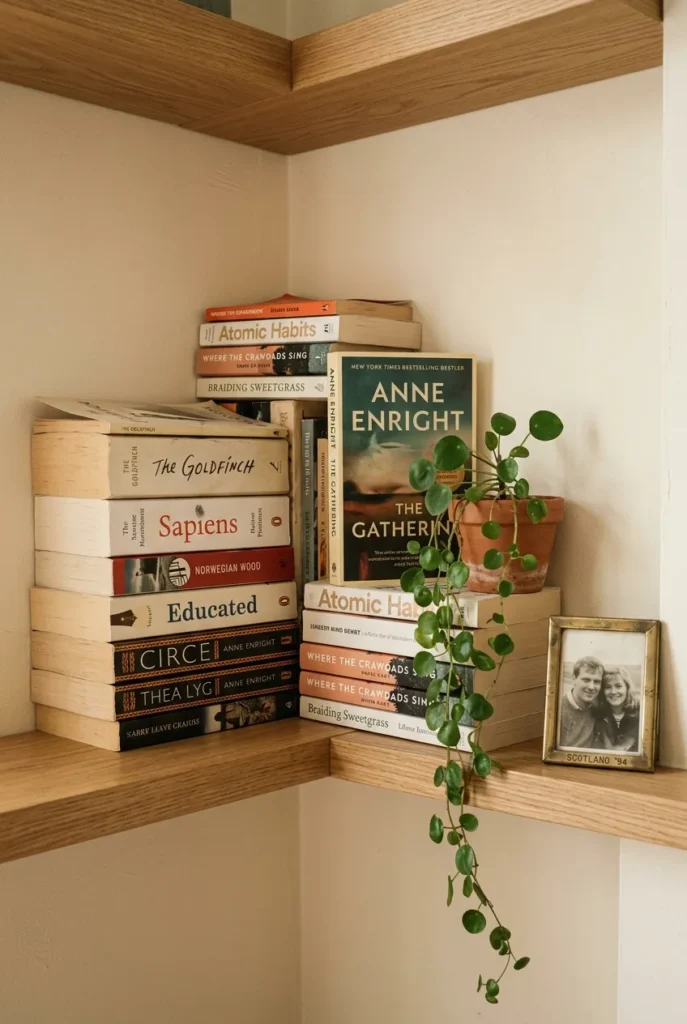
Mix vertical book spines with a few horizontal stacks, leave one shelf breathing with a plant or a small object, and turn a couple of favorite covers face-out like a tiny bookstore display. Keep the heaviest books low so the whole unit feels grounded.
This is also where you answer “how to make a library corner unique,” which is one of the top questions people ask Google about this. Put one personal thing on the shelf that nobody else has: a travel find, a framed ticket stub, your grandmother’s copy of something. [VERIFY: the real personal object on your own shelf]
For more ways to dress the corner, our reading nook decor ideas has styling combinations you can copy shelf by shelf.
9. Add Sound, Scent, and One Soft Layer
A library corner is more than what it looks like. The senses seal the deal.
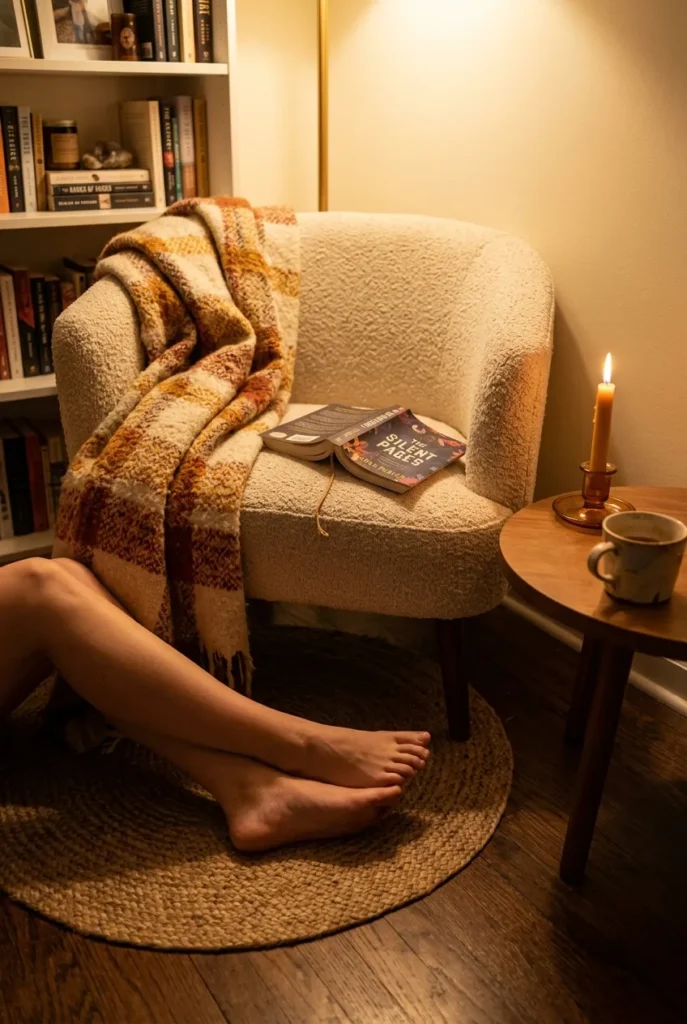
Add a small rug so your feet land on wool instead of cold floor, a candle or a warm cedar scent nearby, and keep the space quiet enough that turning a page is the loudest thing. These three cheap touches do more for the feel than another expensive chair would.
One soft layer is non-negotiable: a linen throw in summer, a chunky wool one when it drops below 60°F (16°C). It’s the thing your hand reaches for without thinking.
Library Corner Ideas Frequently Asked Questions
How do you make a library corner?
Start with a freestanding or corner bookcase, add one comfortable corner-friendly seat, layer in a warm 2700K lamp, and finish with a rug and a throw. Renters can do all of it with no drilling.
What should you put in a reading corner?
A seat, storage for books, a dedicated warm light, a small side surface for a mug within 18 inches of the chair, and one soft layer like a throw or floor cushion.
How do you make a library corner look attractive?
Limit yourself to one hero color, one metal, and one wood tone, style the shelves with a mix of vertical and horizontal books, and light it with a warm bulb instead of the ceiling fixture.
How do you make a library corner unique?
Give it a clear aesthetic (cozy, dark academia, or japandi) and add one genuinely personal object on the shelf that reflects you.
What size corner do you need for a library nook?
As little as a 3 ft by 3 ft footprint works if you go vertical with tall slim shelves and a compact round chair.
Can renters build a library corner?
Yes. Use freestanding shelves, plug-in lighting, removable straps, and a rug to define the zone, all of which come out clean when you move.
Ready to Claim Your Corner
Pick the one corner in your home that’s currently doing nothing, and start with the shelving. That single move turns a dead spot into the place you actually want to sit.
If your space is really tight, the next read to grab is our full set of reading nook ideas for small spaces, built for exactly the square footage you’re working with.
Keep reading
More cozy nook ideas
 Small Spaces
Read →
Small Spaces
Read →
10 Small Reading Nook Ideas for Adults
One high-back chair, one clamp-on lamp, one $19.99 tray table. At IKEA US prices this month, that’s a full reading corner for…
 Home Library & Bookshelves
Read →
Home Library & Bookshelves
Read →
14 Ideas for a Fireplace with Bookshelves on Each Side on a Budget
Two bookcases, two plug-in lamps, two wall straps. At IKEA US list prices this month, that adds up to $237.98 before tax,…
 Study & Craft Nooks
Read →
Study & Craft Nooks
Read →
16 Kids Homework Station Ideas Little Ones Will Love
Two IKEA pieces, one empty corner, $109.98 before tax. That’s the first kids homework station on this list, and it fits in…