
Reading Nook Floor Cushion Setup: No-Furniture Corners That Actually Look Designed

If your reading corner is currently a slumped floor pillow, three books you keep tripping over, and absolutely zero plan, this is the guide that fixes it.
A reading nook floor cushion setup doesn’t need furniture. It doesn’t need a bay window, a landlord who likes you, or a room you can dedicate to reading. It needs the right cushion diameter, a fill depth that holds up past the first chapter, and one layer of textiles arranged deliberately. That’s the whole formula. I’ve built a lot of these corners, from a 28-inch square of unused bedroom wall to a full living room alcove. The ones that looked designed all shared the same bones. We’re covering those bones here: exact sizing specs, the fill types worth buying, the back problem every floor cushion reading nook eventually runs into, and five complete setups you can copy this weekend.
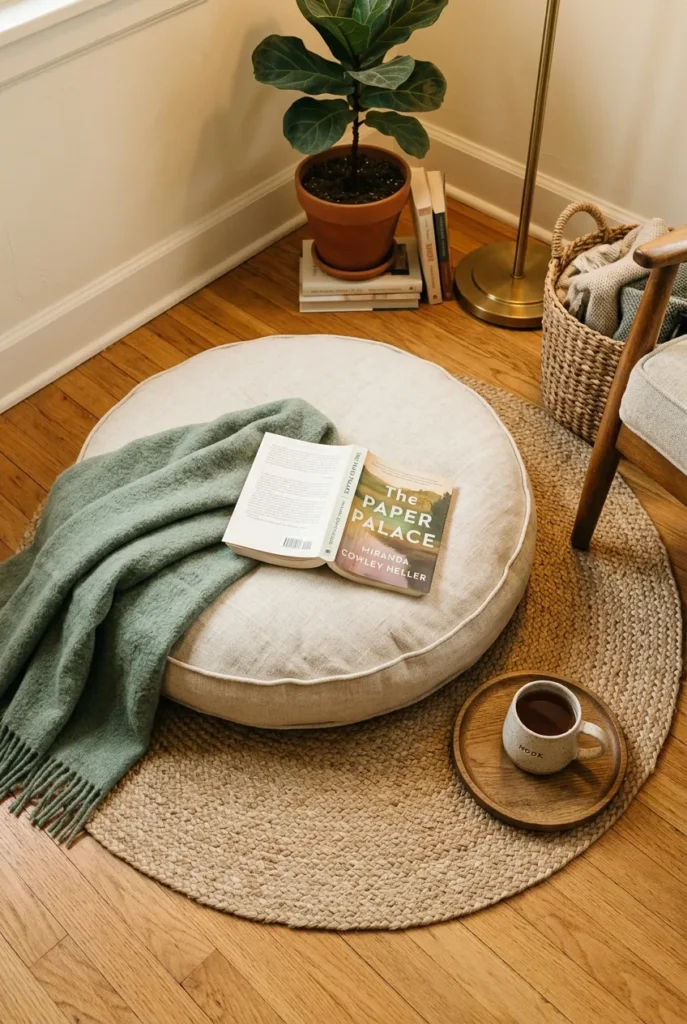
Why a Floor Cushion Corner Outperforms Furniture in Tight Spaces
A standard accent chair needs about 28 to 32 inches of clearance in front of it just so you can sit down without your knees hitting the bookcase. Add a side table and a lamp and you’re looking at a 4-by-4-foot footprint at minimum. A floor cushion? The seat itself is 24 to 30 inches across. That’s it. Push it into a corner, lean against the wall, and you’ve used every inch of a space that furniture simply cannot occupy.
Honestly, this is why floor cushion nooks look better in tight apartments than chairs do. A chair in a 3-foot corner looks crammed. A floor cushion in a 3-foot corner looks intentional. The difference is mostly the eye level: a floor-seated reader blends into the corner rather than competing with it.
The other advantage is flexibility. A floor cushion moves. It goes under the window in summer and near the radiator in winter. It shifts to the living room for a movie night and tucks away in a closet when guests arrive. No furniture does that.
Where floor cushions fall short: they’re not good for readers who need to get up frequently, anyone with knee or hip issues that make sitting low painful, or corners where you have no wall to lean against. For those situations, a low accent chair or a daybed edge is the smarter seat. But for the reader who wants to sink into a corner and get lost in a book for two hours, a floor cushion nook consistently wins.
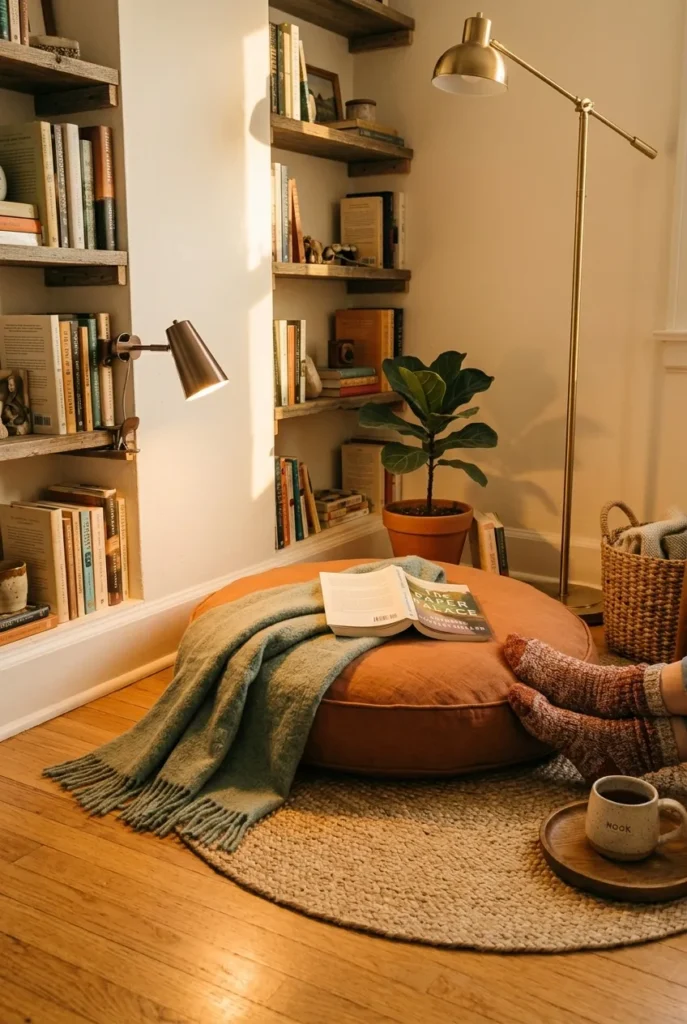
The Floor Cushion Size and Fill Spec (With the Mini-Table You’ll Screenshot)
This is the part nobody tells you, and it’s the part that determines whether your reading nook floor cushion is a decor piece you use daily or a throw pillow you step over.
Diameter first. A 24-inch round cushion fits one adult seated cross-legged, but barely. You’ll feel the edge under one knee. Go to 26 inches and you have room. For tall adults or anyone who shifts position while reading (which is everyone), 28 to 30 inches is the sweet spot. Anything over 32 inches reads more as a lounging pad than a reading seat, which is fine if that’s the use.
Fill depth second. This is the one nobody measures. A 2-inch polyfill cushion collapses to half an inch under your weight. You end up sitting on the floor with a fabric disc underneath you. For adult reading, the minimum usable fill depth under body weight is 4 inches for shredded memory foam, and 3.5 inches for buckwheat hull (which compresses less than foam but molds to your shape). Polyfill needs 5 to 6 inches to hold up, which is why cheap polyfill cushions almost always disappoint.
Fill material quick-reference:
| Use Case | Min Diameter | Min Fill Depth | Best Fill Material |
|---|---|---|---|
| Solo adult reading | 26 in (66 cm) | 4 in | Shredded memory foam or buckwheat hull |
| Large adult or tall reader | 30 in (76 cm) | 4.5 in | Buckwheat hull or kapok blend |
| Two people sharing | 36 in (91 cm) | 5 in | High-density foam insert |
| Tween reader (10-14) | 24 in (61 cm) | 3.5 in | Shredded foam |
| Toddler (under 5) | 18-20 in (46-51 cm) | 2.5 in | Polyfill (washable) |
One thing worth knowing: if you’re buying a cover separately, look for fill and cover fabrics that carry OEKO-TEX Standard 100 certification, which confirms no harmful substances in either layer. This matters more than most people realize when you’re spending 90-minute sessions with your face near the fabric.
For more on sizing and foam depth across different nook seat types, the reading nook bench cushion sizing and foam depth guide at Little Nook Home is worth a read alongside this one. The principles carry across floor cushions and bench cushions more than you’d expect.
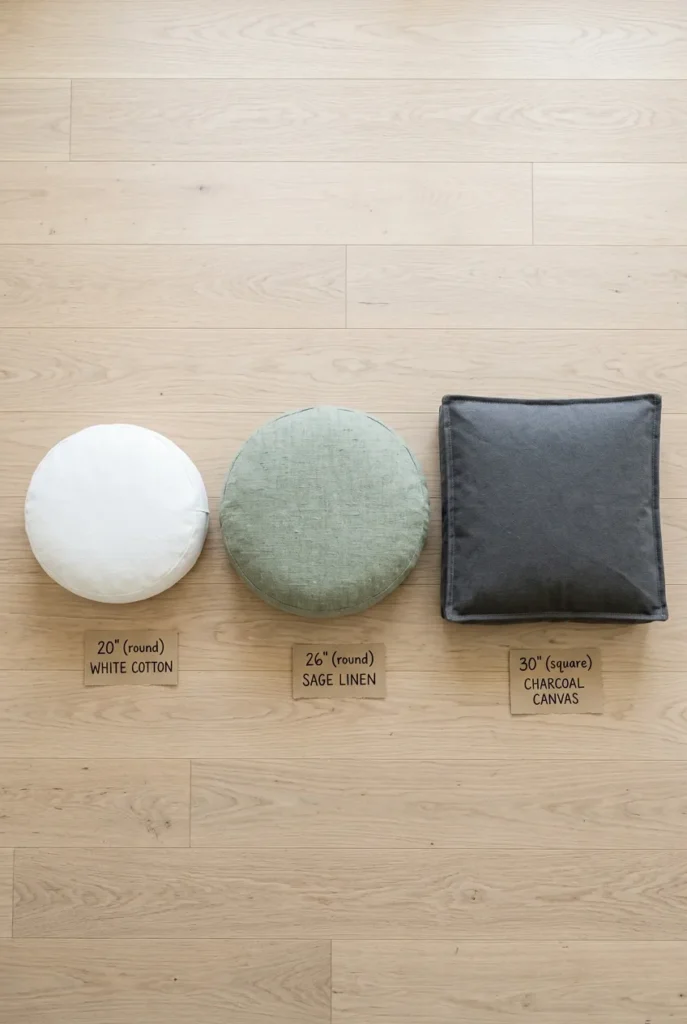
The 40-Minute Back Problem Every Floor Cushion Nook Eventually Hits
Floor cushions look incredible in photos. After 40 minutes of reading, your back disagrees.
Here’s what happens: floor sitting eliminates the lumbar curve that a chair back normally supports. For the first 20 to 30 minutes, your core holds the position. Then fatigue sets in, your lower back rounds, and the lumbar vertebrae take uneven load. This is not a floor-cushion problem specifically. It’s what floor sitting does to most adult spines after extended time, as Harvard Health’s guidance on floor sitting and lumbar strain documents in the context of prolonged low-level seated positions.
The fix is not abandoning floor cushion nooks. It’s the “stacked lean method.”
The stacked lean setup:
- Place your floor cushion 6 to 8 inches from the wall.
- Put a firm 10-inch round pouf or a tightly rolled yoga bolster between the cushion and the wall.
- Lean back so the pouf catches your mid-lower back, not your upper back. This recreates a rough approximation of lumbar curve without a chair back.
- Your shoulder blades should rest lightly against the wall, not carry your full weight.
The first time I tried this, I honestly didn’t expect it to work. I’d given up on a floor cushion nook twice before because of the back issue. Adding a rolled wool throw tucked into the small of my back bought me an extra 20 minutes. Switching to a proper 12-inch cylindrical lumbar bolster made floor reading genuinely unlimited in duration.
One additional note: a 4-inch minimum fill depth in the cushion itself makes the stacked lean far more effective. A flat cushion puts your hips lower and angles your pelvis backward from the start, which fights the lumbar curve before you even lean.

The Layer Stack: Pillows, Throws, and Rugs That Make a Floor Corner Look Designed
This is what separates a floor cushion that looks like it was left there from one that looks like it was placed there.
The layer stack has five components, and order matters:
Layer 1: The rug. The rug anchors the corner. A 3-by-5 foot washable jute rug or a small wool rug extends about 12 inches past the cushion edge on two sides. This is what tells the eye “this is a zone.” Skip the rug and the cushion floats on the floor like a forgotten thing. The rug does not need to be large, but it does need to be there.
Layer 2: The floor cushion. Centered on the rug, or pushed into the corner with the rug behind and beside it.
Layer 3: The lumbar support. A cylindrical bolster or a firm round pillow, 12 to 14 inches in diameter, placed between the cushion and the wall. (See the previous section.)
Layer 4: The decorative pillows. Two pillows, one taller and one shorter, stacked against the wall beside the seat rather than directly behind your back. Behind your back is where the lumbar bolster lives. Beside you is where the decorative pillows live. This is the mistake I see most often in floor cushion nook setups: pillows stacked behind the reader, which then get shoved aside the second anyone sits down.
Layer 5: The throw. Fold it in thirds lengthwise. Drape it over one corner of the cushion. Not fully spread, not balled up. Folded and draped. This single fold is what makes a throw look intentional rather than abandoned.
Color note: keep the rug and the floor cushion within the same temperature range, either both warm (terracotta, cream, sand, rust) or both cool (slate, sage, dusty blue, stone). The pillows can go one or two shades in either direction. The throw is where you introduce a texture contrast, a boucle, a chunky knit, or a sherpa that reads as a layer rather than just a blanket. Keep it to one strong texture. Two competing textures in a small corner reads as clutter.
There is something specifically good about the weight of a folded wool throw against the back of your knee when you settle in. That texture signal is what tells your brain this is a reading corner, not just a floor.
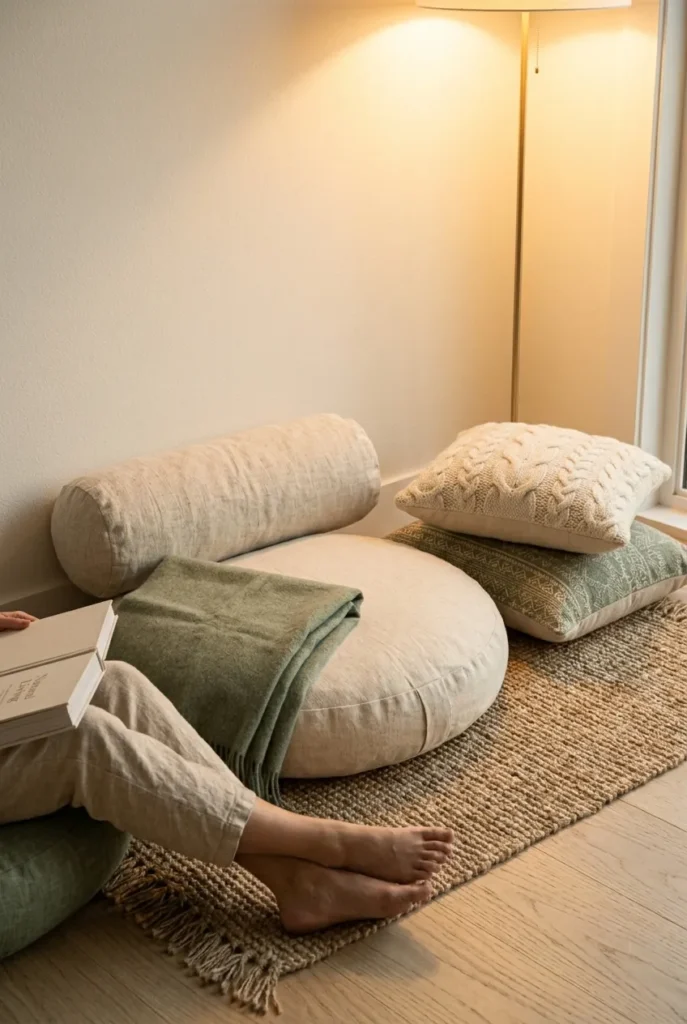
5 Cozy Floor Cushion Reading Nook Setups Worth Copying
These are five setups you can build from scratch, each with a rough total budget and a specific product archetype for the main seat.
Setup 1: The Hygge Corner (approx. $95)
A 26-inch round buckwheat hull cushion in natural linen. A sheepskin throw folded over one edge. Fairy lights coiled in a glass jar on a low ladder shelf beside the corner. A small round wooden tray on the rug with one ceramic mug. No furniture, no shelf system, nothing overhead. The entire effect comes from the texture of the sheepskin against the linen and the warm amber of the fairy light glow at floor level. It smells like dry grass and woodsmoke if you light a candle on the tray, which is the finishing touch.
Setup 2: The Boho Stack (approx. $140)
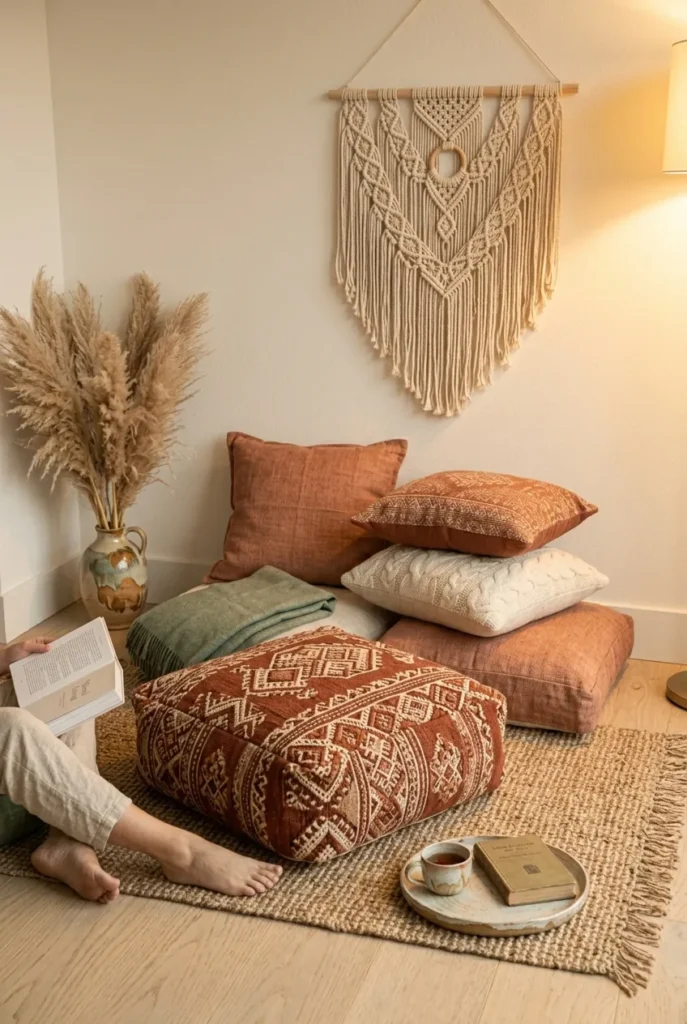
A 28-inch Moroccan-style pouf cushion in a rust-and-cream geometric pattern. Three mismatched floor pillows at different heights (one 18-inch square, one round bolster, one oversized lumbar) stacked against the wall. A jute rug in natural tan underneath. A macramé wall hanging centered 20 inches above the cushion’s top edge, which gives the corner overhead visual weight without anything structural. The height variation in the pillow stack is what reads as curated rather than random.
Setup 3: The Japandi Edit (approx. $120)
A flat, firm 26×26-inch Japanese zabuton cushion in charcoal linen. One cylindrical bolster in undyed cotton behind it. A thin woven rug in pale ash underneath. Nothing else. No wall hanging, no visible books, no throw. The edit is the point. This one only works if the wall behind it is clean or has one low, deliberate shelf. A busy wall destroys the whole effect.
Setup 4: The Kids Tent Corner (approx. $80)
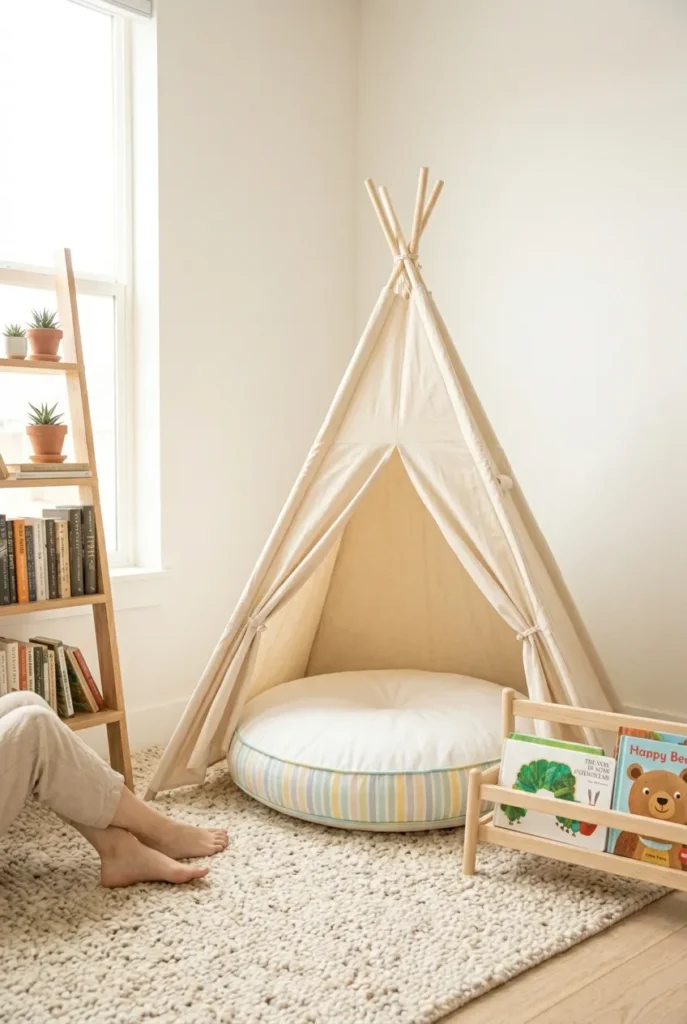
An IKEA-style teepee or cotton canopy tent frame set in the corner with a 20-inch round cushion in washable cotton canvas inside. Two firm floor pillows in a primary color alongside it. A low clip-on LED reading light attached to the tent pole, aimed at the page. The overhead definition of the canopy is the key detail: kids use reading nooks dramatically more when the corner has something overhead that creates enclosure. Without it, it’s just a pillow on the floor. With it, it’s a hideaway.
Setup 5: The Renter’s Ledge Corner (approx. $110)
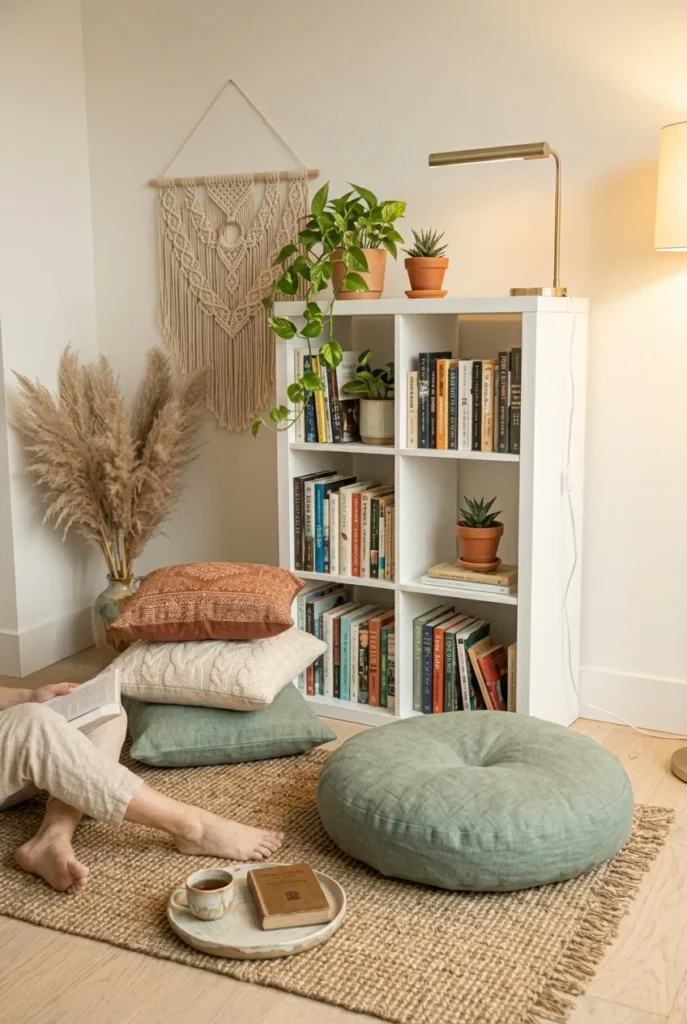
A 26-inch round cushion in washable canvas backed against the side of a freestanding IKEA Kallax 2×2 unit. The Kallax acts as a backrest and a book storage system. No drilling, no anchors. A plug-in picture light is clipped to the top shelf edge, angled down at the reading position. The whole unit can roll or move if needed. The cushion color should match or complement the Kallax finish: white cushion with white Kallax disappears into the wall (intentionally). A contrasting cushion pops the reading zone as a distinct corner.
Renter-Safe Floor Cushion Corners: No Drill, No Damage, Still Looks Good
The good news about floor cushion reading nooks: they are, by default, the most renter-friendly nook format. No wall mounting, no built-in millwork, no paint. The floor cushion itself requires nothing from your landlord.
The challenge is the supporting elements. A wall sconce needs a hook. A shelf needs a bracket. A canopy needs a ceiling mount. Here is how to work around each one without touching the walls.
For book storage beside the cushion: A freestanding ladder shelf or a leaning IKEA VITTSJO sits flush against the wall without anchors. Load the bottom shelf with books, keep the top shelves lighter, and it’s stable enough for daily use.
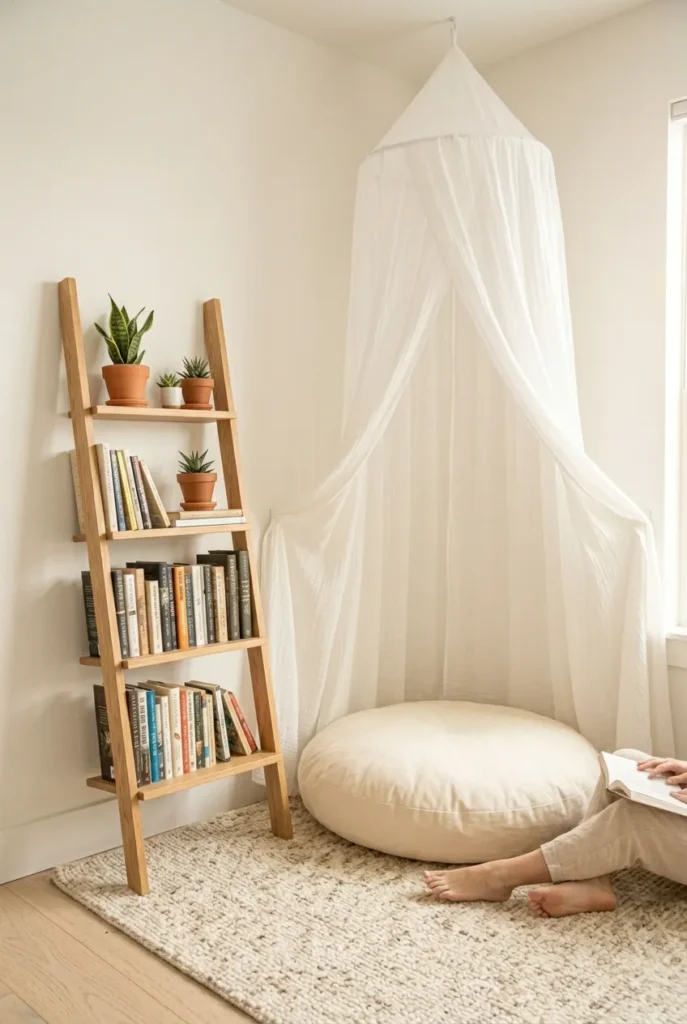
For a canopy or overhead definition: A tension rod ceiling canopy works between two parallel walls with no damage. So does a large freestanding macramé arch frame, which is a freestanding hoop shape that leans in a corner and costs around $40 to $70 from most home decor retailers.
For a shelf at low seated eye level: Command strip picture ledges hold up to 4 pounds each. At seated floor level, that is enough for a row of paperbacks face-out. Mount four of them in a horizontal line at 18 inches off the floor and you have a Montessori-style face-out display at exactly the right height for someone seated on a floor cushion.
For a mirror to add depth: A large leaning floor mirror placed at a 15-degree angle in the corner doubles perceived light and adds spatial depth without any wall contact.
For more zero-drill corner setups using the same principles, the renter-safe tiny reading nook builds under one square meter guide walks through ten complete layouts with exact dimensions.
Kids and Toddler Floor Cushion Reading Nooks: What Changes
Floor cushion nooks are genuinely excellent for kids. Low to the ground, soft, no fall risk, no sharp corners. But the spec and setup adjustments are real.
Size and fill for kids: A toddler (under 5) needs an 18 to 20-inch round cushion with 2.5 to 3 inches of polyfill. Polyfill is the right call for this age group because the covers will be washed frequently, and polyfill handles repeated washing far better than buckwheat hull. Ask me how I know. Washing a buckwheat hull cushion cover without emptying the fill first is a mistake you make once. For tweens, a 24-inch round cushion with shredded foam fill works the same as an adult setup, just slightly smaller.
Cover fabric for kids: Washable cotton canvas, outdoor-grade fabric, or waterproof-backed linen. The reading nook will have juice spills, snack crumbs, and at least one incident with a marker. A removable, machine-washable cover is not optional.
The overhead enclosure rule for kids: Kids use a reading corner consistently when it has overhead definition. This means the tent corner (Setup 4 from the previous section) or a simple canopy draped from a tension rod. Without overhead enclosure, the floor cushion is just a seat. With it, the cushion becomes a dedicated reading spot that children return to on their own.
Book access at seated height: A low Montessori-style face-out shelf at 10 to 14 inches off the floor (for a toddler seated on a floor cushion) is the single biggest behavior driver for reading frequency. If the books are face-out and at reach from the cushion, kids pick them up. If books are spine-out on a high shelf, they ask you to get them and often just don’t bother.
Lighting a Floor-Level Reading Corner (The Rule That Changes Everything)
Here is the lighting problem nobody talks about in floor cushion nook guides: your floor lamp is pointed at the wrong height.
Standard floor lamps are calibrated for armchair or sofa sitting, meaning the shade sits at 60 to 65 inches off the floor and the light pools at chest height for a seated adult. When you’re seated on a floor cushion at 4 to 6 inches off the floor, that same lamp is pointing directly over your head. You end up reading in shadow while the wall above you is beautifully lit.
The fix is getting the light source down to your level. Here are the options that work:
A table lamp on a low side surface. A 12-inch crate or a low wooden stool beside the cushion puts a table lamp shade at 18 to 22 inches off the floor, which is right at seated-cushion eye level. This is the cheapest and most flexible solution.
A clip-on reading light. Attached to a ladder shelf or the side of a Kallax unit at 20 to 24 inches off the floor, a clip-on LED arm directs task light exactly at the page. Zero installation, movable, and around $15 to $30 at most retailers.
A plug-in wall sconce mounted low. If your landlord or situation allows one small hook, a plug-in sconce at 24 to 28 inches off the floor changes the whole corner. No wiring, cord covers the cable, and the light is directed at a reading angle. For plug-in options by style and price range, the full plug-in wall sconces for a reading nook corner guide covers the best current picks.
Bulb spec: 2700K warm white, 450 to 600 lumens. Brighter is not better at floor level. A high-lumen source close to eye level creates glare on the page. The “skip the dimmer” failure mode is real here: a 2700K bulb without a dimmer on a plug-in sconce still reads cool and flat. Add a simple plug-in dimmer cord ($8 at any hardware store) and the same bulb becomes genuinely warm.
Fairy lights in a glass container at floor level add ambient glow and considerable hygge, but they are not task lighting. Use them in addition to a directed source, not instead of.

Frequently Asked Questions
What size floor cushion is best for a reading nook?
For most adults, a 26-inch round or a 26×26-inch square is the minimum comfortable size for cross-legged reading. If you shift positions frequently or are taller than 5 feet 8 inches, go to 28 to 30 inches. The key measurement is fill depth, not just diameter: you need at least 4 inches of shredded memory foam or buckwheat hull fill under body weight to avoid sitting on the floor beneath the cushion.
What is the best filling for a large floor cushion reading nook?
Buckwheat hull and shredded memory foam both outperform standard polyfill for reading sessions. Buckwheat hull compresses less under weight, molds to your body, and stays cool. Shredded memory foam gives a slightly plusher feel and recovers its shape faster when you get up. Polyfill is fine for kids’ cushions where washability is the priority, but for adult reading sessions over 30 minutes, it compresses too flat to be comfortable.
Can floor cushions replace a chair in a reading nook?
Yes, for most people and most reading sessions. The condition: you need the stacked lean setup (floor cushion, lumbar bolster between you and the wall) to support your lower back past the 40-minute mark. Without that support, floor sitting rounds the lumbar spine and becomes uncomfortable quickly. With it, a floor cushion reading nook is a legitimate chair replacement for sessions of 60 to 90 minutes or more.
How do I make a floor cushion reading nook more comfortable for long reading sessions?
Three adjustments make the biggest difference: first, add a cylindrical lumbar bolster (12 to 16 inches in diameter) between your lower back and the wall. Second, make sure your floor cushion has at least 4 inches of fill depth under body weight. Third, bring your light source down to seated eye level (18 to 24 inches off the floor), because reading in shadow for 90 minutes creates eye fatigue that gets attributed to the chair, not the lighting.
Where can I find reading nook floor cushion dupes?
The best dupe sources in 2025-2026 are Amazon basics round floor cushions in 24-26 inch diameters (search “round floor cushion linen”), TJ Maxx and HomeGoods for seasonal finds in the $30-$60 range, and IKEA’s DIHULT and pouf-style seats. The dupe to avoid is any polyfill cushion under 5 inches of fill depth — it will collapse under adult weight within a few uses. Check the fill depth in the product specs before buying.
Are floor cushions safe for toddler reading nooks?
Yes, floor cushions are one of the safest reading nook seats for toddlers. Low to the ground, no fall risk, no sharp edges. For toddlers under 5, use an 18 to 20-inch round cushion with washable polyfill and a machine-washable cotton cover. Avoid buckwheat hull fill for this age group because the small hulls can be a hazard if the cover tears.
What is a corner floor cushion and how do I use it?
A corner floor cushion is typically a large triangular or oversized square cushion designed to fit snugly into a 90-degree corner, with two sides that meet the wall. They work well for readers who want wall contact on two sides without the stacked lean method. The main limitation: they tend to be very large (36 inches or more per side) and work best in dedicated corners with nothing else nearby.
The Corner You’ve Been Walking Past
You know which corner it is. The one you keep meaning to do something with. The floor cushion setup doesn’t need a renovation, a weekend trip to a furniture store, or a landlord who returns calls. It needs a cushion with real fill depth, a rug that anchors the zone, and a light at the right height.
Start with the sizing table in section two, pick one of the five setups that matches your style, and get the lumbar bolster lined up before you buy anything else. That back problem is coming. Better to be ready for it.
If you want to take the corner further after this, the reading nook bench cushion guide is the next natural step, especially if you’re eyeing a window seat or low bench alongside the floor cushion layer. And if the corner you’re working with is genuinely tiny, the tiny reading nook guide has ten renter-safe builds that fit under one square meter.
What’s your corner looking like? Drop your setup in the comments. I read every single one.
Keep reading
More cozy nook ideas
 Fall Decor
Read →
Fall Decor
Read →
Fall Door Decor on a Budget: Where to Spend and Where to Save
If your fall door every year is a wreath that sheds on the mat, two mums that are crispy by Halloween, and…
 Fall Decor
Read →
Fall Decor
Read →
12 Thanksgiving Tablescape Ideas for Small Spaces (That Still Leave Room for the Food)
Twenty-four inches. That’s how much table edge one person needs to eat without bumping elbows, and it’s the number most Thanksgiving tablescape…
 Fall Decor
Read →
Fall Decor
Read →
18 Fall Coffee Bar Ideas for Sweater-Weather Evenings
No counter space to spare, no espresso machine, no landlord permission needed. This fall coffee bar runs on three pieces: a slim…