
Reading Nook Ideas Under the Eaves: Smart Setups for Every Awkward Roofline

You don’t need a perfect dormer, a renovation budget, or a landlord who answers texts. You need a ceiling that clears 54 inches at the peak, one seat low enough to fit under it comfortably, and an afternoon to pull it together. That’s the entire build.
The space under your eaves is the most misunderstood corner in any home. Most people shove boxes in there and forget it exists. But it’s actually the most contained, naturally cocooning spot in the whole floor plan. The low ceiling isn’t the problem. It’s just an unmeasured one.
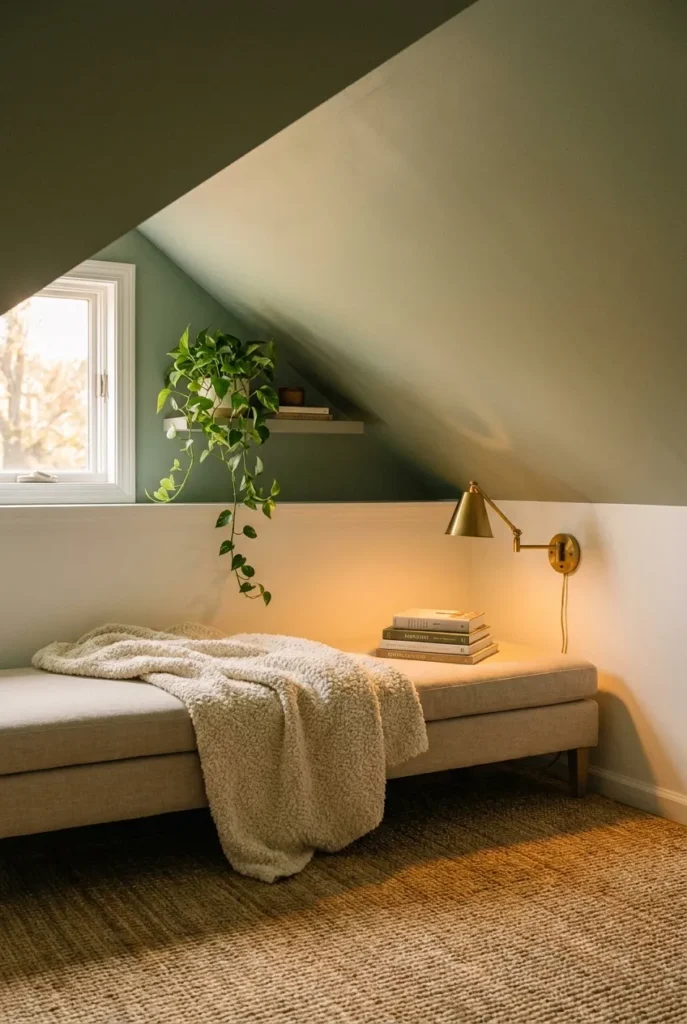
Here are nine setups for a reading nook under eaves, covering every ceiling height, every budget, and yes, every renter who can’t touch a wall.
The Eaves Measurement Rule: Know Your Zone Before You Buy a Single Piece of Furniture
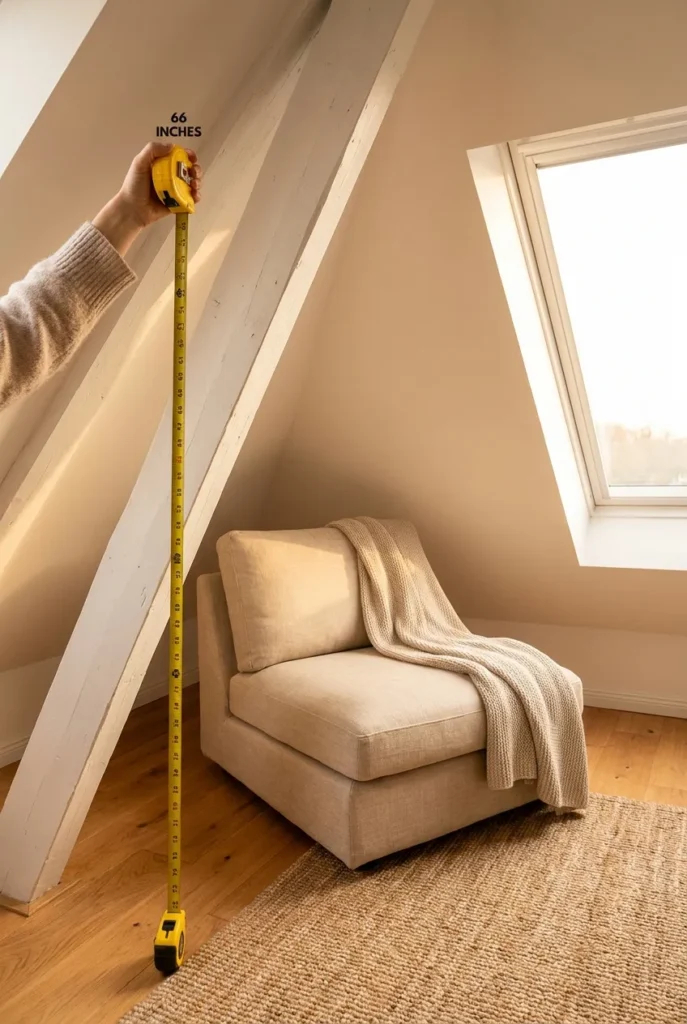
Measure your ceiling height at two points before anything else: at the peak (the highest point of the usable space) and at the knee wall (the short vertical wall where the slope begins). Those two numbers tell you exactly which setup you can build and which ones to skip.
Here’s the zone chart used on every eaves project at Little Nook Home. None of the articles about a reading nook under eaves seem to publish this, which is baffling, because it’s the single most useful piece of information you can have before you open a shopping tab:
| Peak Height | Zone Name | Best Seating Setup | Notes |
|---|---|---|---|
| Under 48 in (4 ft) | Dead Zone | Storage only | Bins, baskets, rolled blankets. No seating. |
| 48 to 54 in (4 to 4.5 ft) | Recline Zone | Floor pillow lying flat | Cross-legged sitting is uncomfortable here |
| 54 to 66 in (4.5 to 5.5 ft) | Floor Cushion Zone | Large floor cushion or daybed slab | Most common eaves height in pre-1980 US homes |
| 66 to 78 in (5.5 to 6.5 ft) | Low Chair Zone | IKEA Poäng-style armchair or pouf | Works beautifully with a plug-in sconce |
| 78 in and above (6.5 ft+) | Full Build Zone | Built-in bench, chaise, or standard armchair | All options open |
For context: the International Residential Code (IRC) requires at least 7 feet of ceiling height over 50 percent of the floor area for a space to qualify as a habitable room. An eaves reading nook isn’t a bedroom. It’s a retreat. The full standard lives at the International Code Council’s IRC ceiling height requirements. No one’s issuing a permit for a reading corner.
Most attic eaves in US homes built before 1980 peak somewhere between 60 and 72 inches. That puts most readers in the floor cushion zone or the low chair zone, which, honestly, are the two most atmospheric setups anyway.
Measure. Write the numbers on a sticky note. Then keep reading.
The Built-In Bench Seat Setup: The Most Photogenic Eaves Nook You Can Build
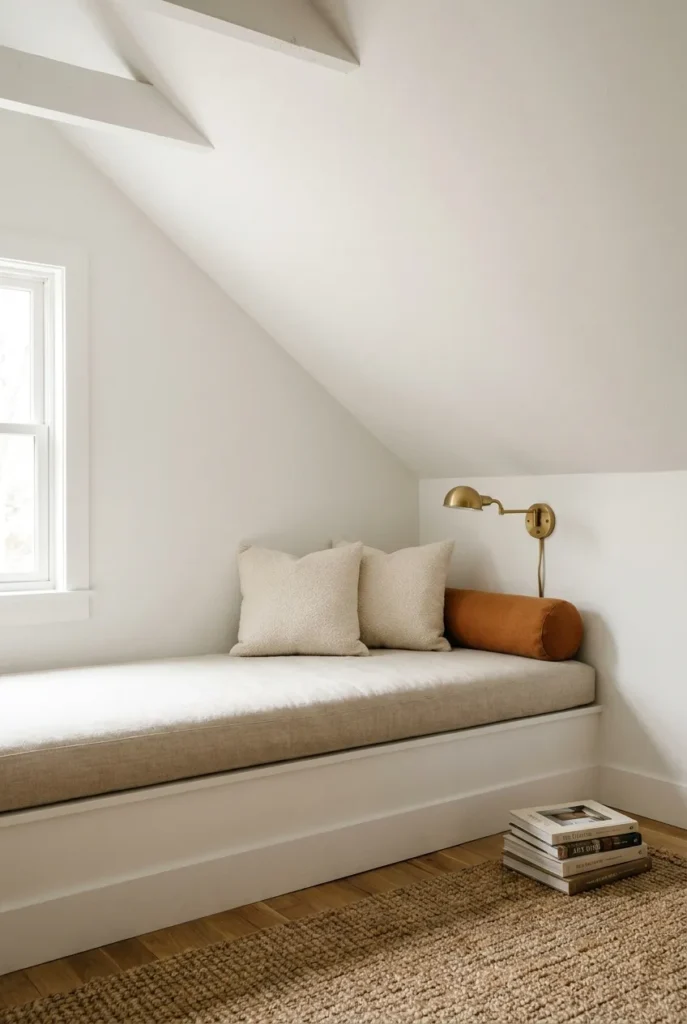
This is the setup that stops people mid-scroll on Pinterest. A bench seat runs flush along the knee wall at exactly 18 inches tall (standard bench height), your body sits low enough that the rafter slope clears your head, and the geometry works almost by accident.
You need at least 78 inches of peak clearance for this to be comfortable. Below that, the bench edge crowds into the slope too early and you end up ducking every time you sit down.
For a renter-safe version: skip the built-in entirely. Cut a single plywood sheet to 16 inches deep by however wide your space allows (48 inches is a practical starting width for most eaves alcoves). Sand it, paint or stain it, add a 3-inch-thick high-density foam pad covered in washable linen, and you have a bench that looks fully custom but lifts straight out on move day. Materials run about $80 to $130 from Home Depot or Lowe’s.
I built this exact version for my own attic nook three years ago. The first attempt was 2 inches too tall. Every single time I went to sit down, the back of my skull caught the rafter slope. Took 30 seconds to realize the mistake and 20 minutes to fix it. Measure at your seated head height, not just the peak clearance.
The cushion is where most people underinvest. A 3-inch-thick foam core in a removable linen cover is the minimum for genuine comfort. Thinner than that and you’re sitting on plywood after 15 minutes. For foam density ratings, cover materials, and ready-made cushion options at every price point, the built-in reading bench dimensions and material plans guide covers it with real measurements.
Failure mode: Building the bench 24 inches deep when your floor-to-knee-wall distance is only 36 inches. That leaves 12 inches of walkway in front, and getting in and out becomes annoying enough that you stop using the nook entirely. Keep bench depth to your floor-to-knee-wall distance minus 18 inches minimum. That 18-inch walkway is non-negotiable.
The Floor Cushion and Daybed Setup: Best for Peaks Between 54 and 66 Inches
If your peak runs between 54 and 66 inches, the single best move is to get lower than the slope rather than fight it.
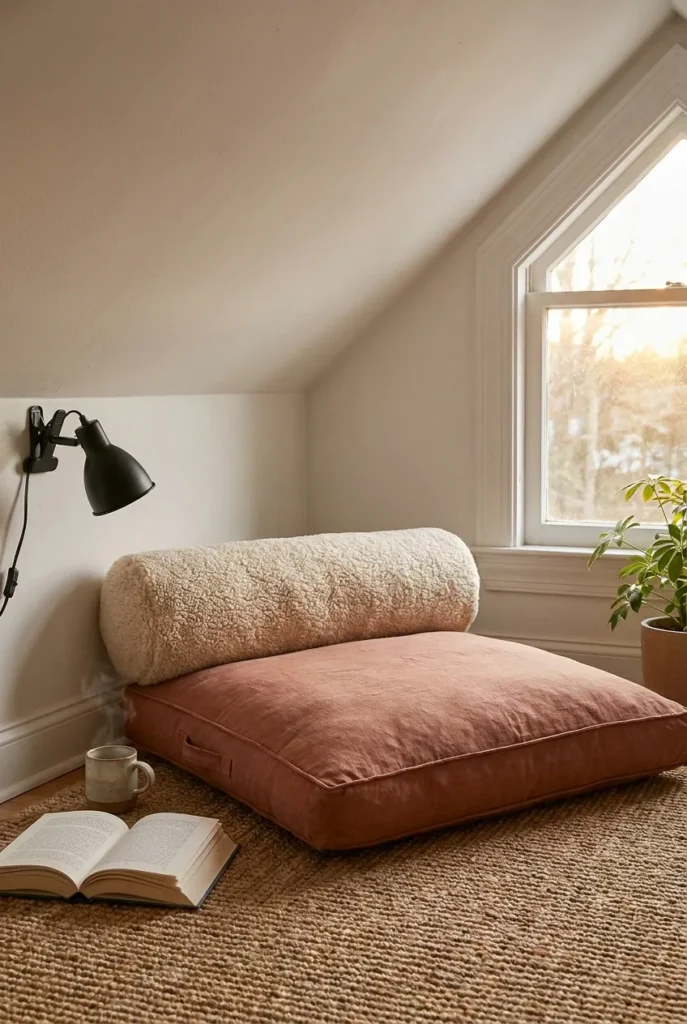
A large floor cushion (at least 24 inches square, no less than 4 inches thick, high-density foam insert) lets you sit cross-legged without your head anywhere near the rafter line. Add a bolster pillow against the knee wall for lower back support and a pouf or second floor cushion to the side for your feet. That’s a complete seating setup for under $150, sourced easily at Target, HomeGoods, or Pottery Barn.
The daybed slab is the other option. Take a twin XL mattress topper (2 to 3 inches, medium-firm) and lay it on a simple plywood platform: 12 inches off the floor, 38 inches wide, whatever length your eaves allow. You can recline fully, read sideways, and drift off after three chapters without hitting the slope. Both setups are completely renter-safe. No drilling, no paint, no issue.
So good for cold weekend mornings. The weight of a sherpa throw across your legs, the low ceiling just above, the muffled sound of rain on the rafter insulation above, a fantasy novel you’ve been carrying for two weeks. That’s exactly what this setup is built for.
For tight footprints where even a floor cushion has to earn its square footage, the tiny reading nook setups under one square meter guide shows floor cushion arrangements that make every inch of an eaves space count.
Failure mode: Buying a floor cushion under 4 inches thick. It compresses immediately and after one real reading session you’re sitting directly on the floor. Spend the extra $20 for a high-density insert. That single variable separates a comfortable floor cushion from a decorative one.
Lighting an Eaves Nook When Overhead Wiring Is Not an Option
There is almost never a ceiling fixture where you actually need one in a reading nook under eaves. The overhead wiring, when it exists, is in the center of the attic floor, nowhere near the slope. So you work around it.
A plug-in swing-arm sconce on the knee wall is the single best solution. Mount it at 40 to 48 inches above the floor (just above seated shoulder height) so it throws directed light onto your book without hitting your eyes. It keeps the overhead zone completely lamp-free. Two small screws go into the knee wall for most sconce brackets. In most rentals, two screw holes patch invisibly on move-out. If you’re avoiding even that, a peel-and-stick adhesive mounting bracket holds most lightweight sconces on standard drywall with no tools at all.
The bulb matters more in an eaves nook than in any other room in the house. Use a warm-white LED at exactly 2700K. Cooler than that (3000K and above) and the slope starts to feel like a storage closet. The U.S. Department of Energy’s LED lighting guide for home spaces breaks down color temperature by use case with actual lumens data. Worth a read if you’re starting from scratch.
Buy a dimmer-compatible bulb from day one. Bright for reading, dimmed for sitting quietly with a cup of tea. The same sconce covers both.
Fairy lights strung along the rafter line add zero usable reading light but they make the slope look entirely intentional. Use them alongside the sconce, never instead. About four dollars of warm-white fairy lights on the rafter edge changes the visual quality of the whole ceiling.
For tested plug-in sconce picks at three price points with zero permanent wiring required, the no-wiring wall sconces for attic and eaves reading nooks roundup has current options with real photos.
Failure mode: Skipping the dimmer and wondering why the nook still feels harsh at 10 pm. A 2700K bulb at full brightness in a small enclosed space is still a lot of light. Always a dimmer.
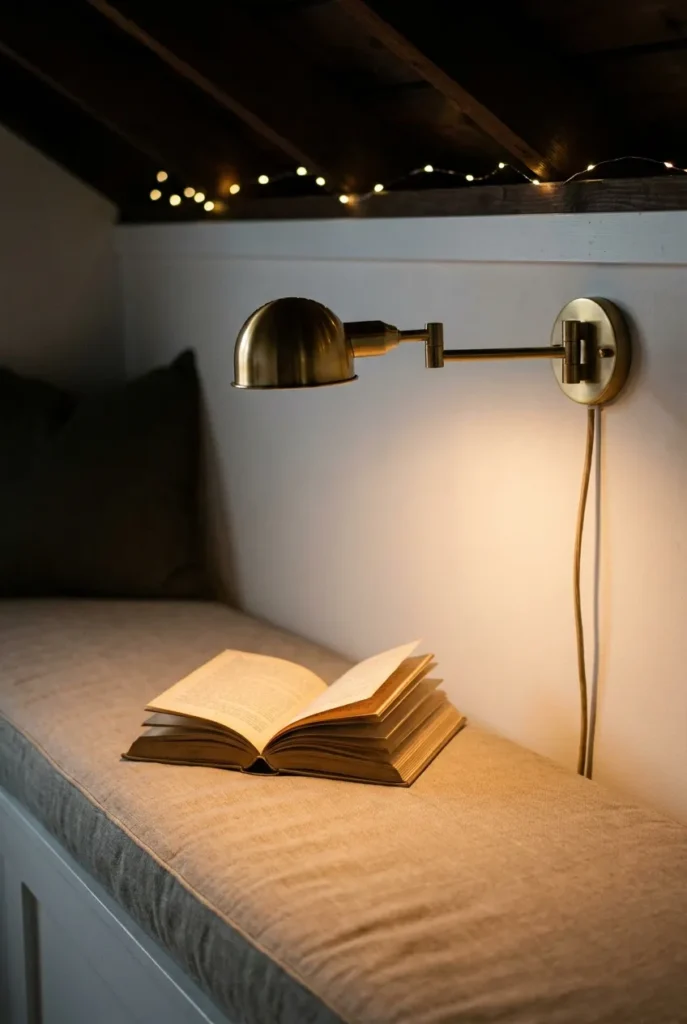
Shelving the Knee Wall: Your Vertical Space Is Doing Nothing Right Now
The knee wall is typically 36 to 60 inches tall, depending on your attic. That’s 3 to 5 feet of usable vertical surface that most eaves nooks leave completely bare.
A single floating shelf at seated eye level (roughly 36 to 42 inches from the floor) runs the full length of the knee wall and holds your current read, one small ceramic pot, and a candle. Three objects. That’s the whole shelf. It reads as intentional and takes about 30 minutes to install with a level and two wall brackets.
For more capacity, a low ladder shelf at the wide end of the eaves (where the peak clearance is highest) works well. A 5-tier KALLAX-style unit from IKEA sits at 58 inches tall and clears a 60-inch peak without contact. It holds a full season of your TBR pile and frees up the knee wall for the sconce and the cushion.
One rule worth following: anything below seat height (under 18 inches) goes into closed storage tucked into the dead zone under the lowest part of the slope. Woven seagrass baskets or lidded canvas bins keep that zone tidy and invisible. Anything above seat height is display. Books, one small object, one plant. Not all three at once.
Don’t crowd the knee wall with too many shelves. Four linear feet of open display shelf is generous for most eaves nooks. More than that and the retreat starts to feel like a stockroom.
Failure mode: Installing shelves before you’ve placed your lighting. A shelf that sits directly in the swing arc of your sconce arm forces you to choose between the light and the shelf on move-in day. Sconce placement locks in first. Everything else works around it.
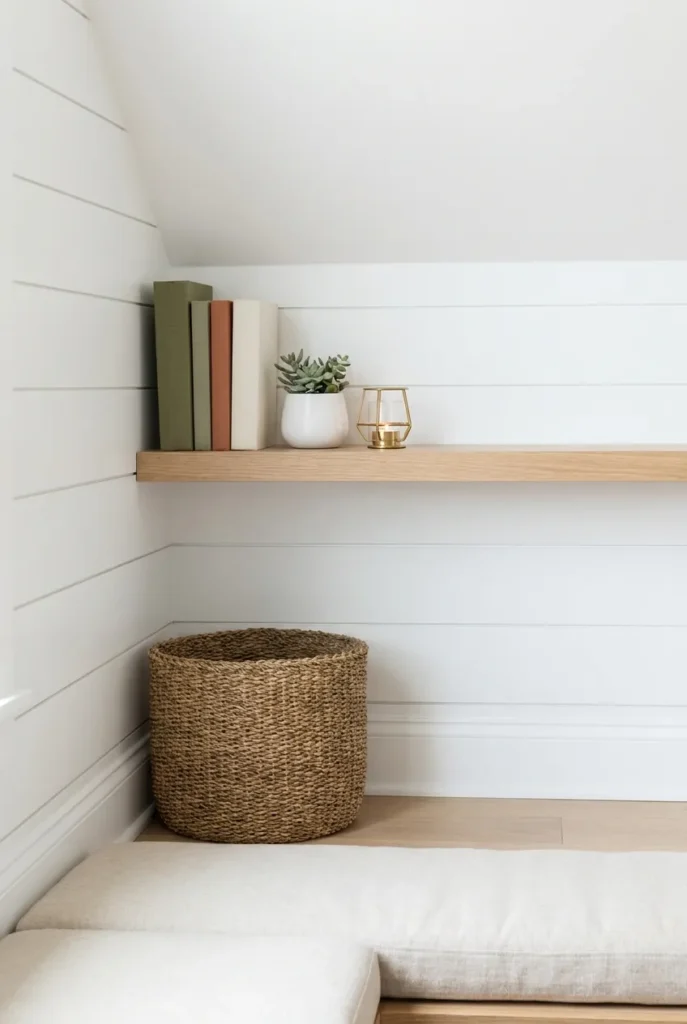
The Low-Profile Armchair Setup: When Your Peak Hits 66 to 78 Inches
A lot of people with a 66 to 78-inch peak assume they can fit a standard armchair under the eaves. Most can’t, not comfortably. A standard armchair sits 40 to 42 inches tall at the back. Add your seated height (roughly 33 to 38 inches for most adults) and you’re right at the rafter line if the chair is pushed back against the slope.
The solution is a low-profile armchair with a seat height of 15 to 16 inches and a back height under 33 inches. The IKEA Poäng is the most widely available archetype at $149 to $229. The Article Sven Chair is a step up in quality at around $499. Both clear a 66-inch peak comfortably when the chair is angled slightly away from the slope rather than pushed flat against the knee wall.
That angling decision (facing outward from the knee wall rather than backed against it) gives you 6 to 8 extra inches of clearance overhead and opens the knee wall behind the chair for a shelf at arm height.
A round side table at 20 to 22 inches tall sits flush with the armrest of a low-profile chair. The 18-inch reach rule: the center of your side table should be within 18 inches of your seated elbow. Any farther and you’re putting your mug down at full arm extension. Any closer and it crowds the armrest and the throw blanket you’ll definitely drape over the side.
Failure mode: Choosing a low armchair with a deeply reclined back angle. Reclined backs feel incredible in a showroom and ache after 40 minutes of actual reading. Look for an armchair with a 95 to 100-degree back angle (nearly upright), not the 110-degree lounge position most accent chairs default to.
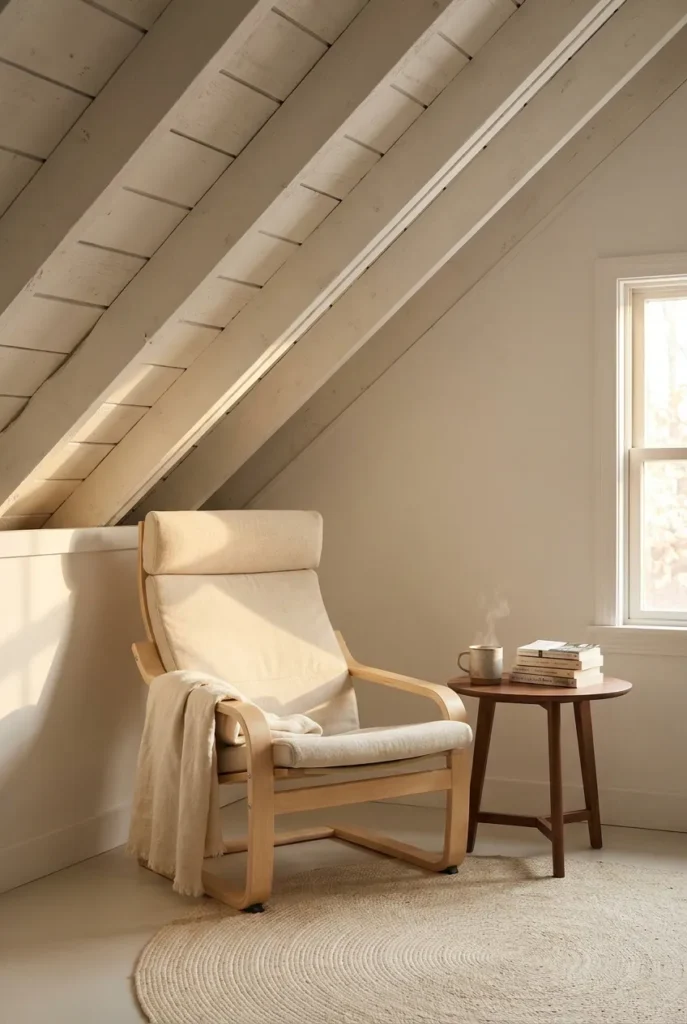
Color, Textiles, and the Cocoon Effect Under a Sloped Ceiling
A sloped ceiling is a natural enclosure. Every design decision in an eaves reading nook should lean into that quality rather than fight it.
If you can paint: keep the ceiling slope the same color as the walls. This is the single most effective move for making a reading nook under eaves feel like an intentional room rather than a cleared-out storage corner. Earthy muted tones work best here: soft clay, a greyed sage, or a warm off-white with a slight green or brown undertone. These shades absorb low light rather than bouncing it, which keeps the space feeling warm rather than dingy after dark.
If you rent and paint is off the table, textiles do the same job. A sheer linen panel hung from a tension rod stretched between the two side walls at the peak softens bare plaster and makes the ceiling feel lined rather than unfinished. It costs about $25 and leaves zero marks on move-out day.
Layer at least three textile types on the seat: a base cover in linen or cotton canvas, a throw (boucle in winter, a lighter cotton knit in summer), and at least one lumbar pillow behind your lower back. Three different textures read as intentional in photos and feel completely different on your spine after an hour with a hardcover. The boucle throw has a faint tactile warmth to it, almost like the weight of a hand on a shoulder. Sounds like an overstatement. Try it once.
Failure mode: Going dark on the walls without adding a second light source. A moody sage wall looks incredible in magazine photos, which are shot with supplemental lighting rigs. In a real eaves nook with one sconce and no window, that same wall reads as a cave. Pair any paint color darker than a mid-tone with at least two light sources before committing to it.
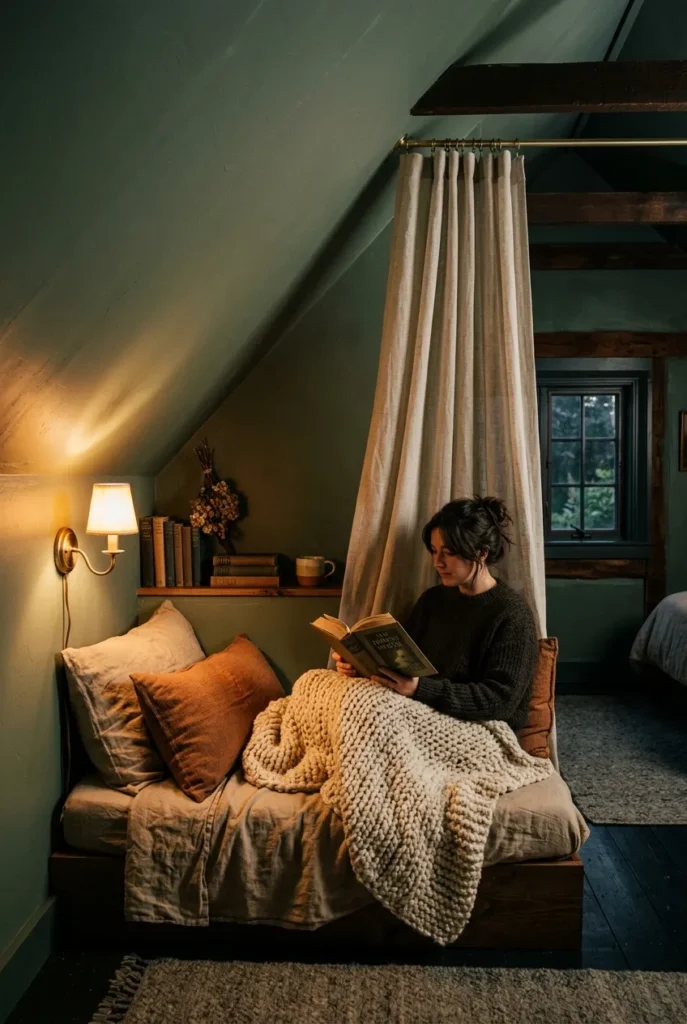
Plants, Curtains, and the Small Details That Finish the Space
One plant. Not a collection, not a shelf of propagations, not a cluster of pots on the floor. One plant.
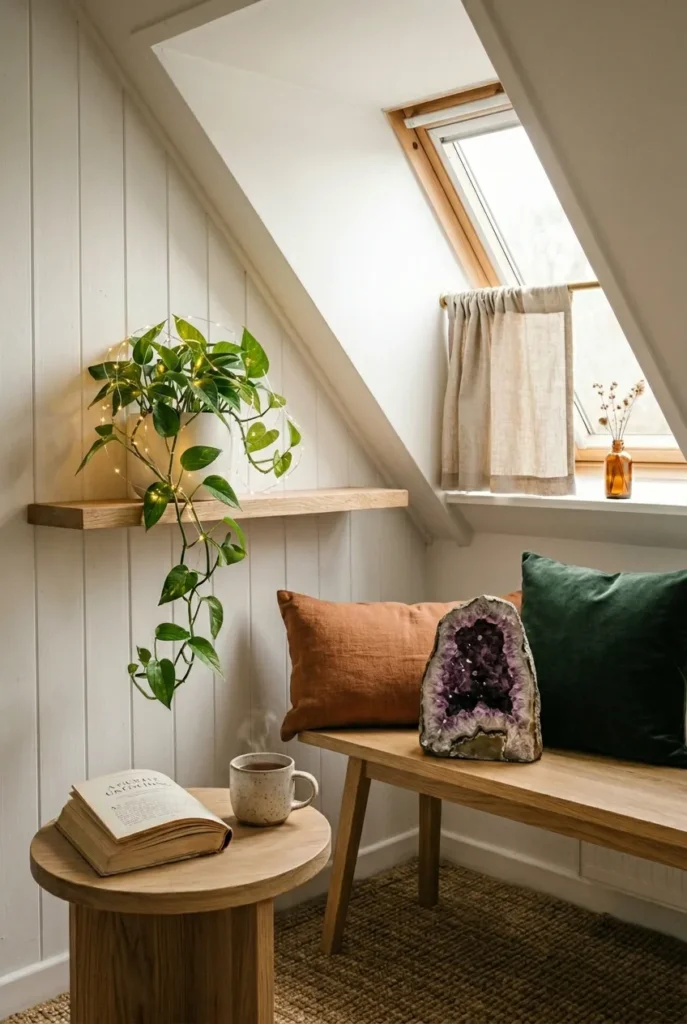
A single trailing pothos on the floating knee-wall shelf at shoulder height does more visual work than three pots anywhere else in the nook. It brings the eye toward the seat (exactly where you want attention) and adds one breath of living green without crowding a space that’s already small by definition. Pothos tolerates the low light conditions of most attic eaves nooks better than almost any other houseplant. A 4-inch pot runs about $6 at Home Depot.
If your eaves nook has a small window, a dormer or gable, hang a café curtain at the midpoint of the glass rather than covering the full opening. A 24-inch linen café curtain on a tension rod lets in the top half of natural light while giving you privacy at seated eye level. No drilling. Installs in about 90 seconds.
Small details that actually change how the nook feels: a clip-on reading light as backup to your sconce (about $18 at Target) for late nights when you want the main light off, a round side table at 16 to 18 inches tall (anything taller catches the slope at the wrong visual angle), and one scented candle on the knee-wall shelf. The smell of cedar or sandalwood in a wood-rafter space is one of those specific sensory things that makes a room feel claimed and personal rather than just decorated.
Failure mode: Overfilling the shelf. Three objects per linear foot, maximum. One book or plant, one small object, some breathing room. Negative space in a small enclosed nook isn’t wasted. It’s the reason the space feels like a retreat.
The Eaves Nook Decision Matrix: Which Setup Fits Your Exact Space
Use this before you add anything to your cart. Find your situation in the left column, confirm your peak height, and match to the setup row. The budget ranges reflect real 2025 to 2026 pricing.
| Your Situation | Peak Height | Best Setup | Primary Products | Est. Budget |
|---|---|---|---|---|
| Renter, no tools at all | Any | Floor cushion + clip-on light | Large floor cushion, clip-on light | $60 to $130 |
| Peak under 54 in | Under 54 in | Recline setup: mattress topper slab on plywood | Twin XL topper, plywood platform | $80 to $160 |
| Peak 54 to 66 in, casual reader | 54 to 66 in | Floor cushion with bolster and pouf | Floor cushion (4 in+ foam), sherpa bolster | $90 to $180 |
| Peak 66 to 78 in, prefers sitting upright | 66 to 78 in | Low armchair + plug-in swing-arm sconce | IKEA Poäng style, swing-arm sconce | $150 to $320 |
| Peak 78 in+, wants storage | 78 in+ | Freestanding bench + knee-wall shelf + sconce | Plywood bench, foam cushion, floating shelf | $180 to $380 |
| Homeowner, wants a full permanent build | 78 in+ | Built-in bench + hardwired sconce + floating shelves | Plywood built-in, licensed electrician for sconce | $280 to $600+ |
| Maximum cozy, minimum spend | Any | Floor cushion + fairy lights + one throw | Floor cushion, fairy lights, boucle throw | Under $90 |
The bottom row is the one I tell most people to start with. Spend under $90. Sit in the space for two weeks. Read there four or five real evenings before you commit to anything permanent. Every eaves nook that became a genuine sanctuary started exactly this way. Every one that felt disappointing after six months was built too fast, too finished, before the person knew how they’d actually use it.

Frequently Asked Questions
How do you use space under eaves?
The most practical use is a low-profile reading nook, with the specific seat type determined by your peak ceiling height. Under 48 inches: closed storage only (bins, baskets, rolled throws). At 54 inches and above, you can fit a floor cushion, a low seat, or a daybed slab. At 78 inches and above, a full built-in bench is possible. The peak height decides the setup. That’s the whole decision.
Where should you put a reading nook?
Any corner with containment on at least two sides works well: under eaves, in a dormer alcove, beside a chimney breast, under a loft, or in a recessed living room wall. The key is enclosure (so the nook feels separate from the rest of the room) and a dedicated light source within arm’s reach of the seat. You don’t need a window, but a small one helps enormously with daytime use.
How deep does a reading nook need to be?
For a floor cushion setup: at least 24 inches from wall to front edge. For a bench seat using the knee wall as the backrest: at least 18 inches of usable seat depth. For a bench with a proper built-in backrest: at least 30 inches total depth. Anything under 18 inches of seat depth becomes uncomfortable for most adults after about 20 minutes of real reading.
How do you make a reading nook in an alcove?
Measure depth, width, and peak height first, then match to the zone chart in this article. Add a cushioned seat at the right height (18 inches for a bench, floor level for a cushion), one light source on a side wall at 40 to 48 inches above the floor, and a shelf at head height. Those four elements complete the core build. Textiles and plants come after the structure is working.
Can you make a reading nook under the eaves if you rent?
Yes, entirely. A freestanding plywood bench with a foam cushion, a plug-in swing-arm sconce on a peel-and-stick adhesive bracket, a tension-rod café curtain, and a clip-on reading light are all zero-drill and zero-paint. The bench lifts out on move day. The peel-and-stick bracket removes without marking the drywall.
What lighting works best for an eaves reading nook?
A plug-in swing-arm sconce at 40 to 48 inches above the floor, mounted on the knee wall, with a 2700K warm-white LED bulb on a dimmer-compatible switch. That single fixture covers reading light, ambient light, and evening mood in one install. Add fairy lights along the rafter edge purely for visual atmosphere.
How small can a reading nook under the eaves actually be?
The smallest functional setup is about 24 inches wide by 24 inches deep with a 54-inch peak ceiling. A single large floor cushion, a clip-on light, and a narrow shelf. That’s under 4 square feet. If you can fit one floor cushion, you can fit a reading nook under eaves.
One More Thing Before You Measure
The awkward roofline isn’t the obstacle. It’s the reason the nook feels contained and private in a way no open-plan corner ever will. The low ceiling does the work of four walls.
Start with the ceiling height zone chart. Pick one setup. Add one light source before anything else. The throws, the shelves, the trailing pothos: all of that comes after you’ve spent a few real evenings actually sitting there.
Which ceiling height zone does your eaves space fall into? That’s the only question worth answering first.
Keep reading
More cozy nook ideas
 Living Room
Read →
Living Room
Read →
Cabin Living Room Checklist: Everything to Decide Before You Start
No log walls, no stone hearth, no lake outside the window. You can still build a cabin living room in a regular…
 Bedroom
Read →
Bedroom
Read →
English Cottage Bedroom Checklist: Everything to Decide Before You Start
You saved forty pins of floral quilts and sloped ceilings, then looked up at your own bedroom: beige walls, one window, a…
 Nursery & Teen Rooms
Read →
Nursery & Teen Rooms
Read →
25 Teen Boy Bedroom Ideas That Feel Grown-Up, Not Childish
If his room still has the race car lamp and the glow-in-the-dark stars, and the door has started staying shut, he’s telling…