
Tiny Reading Nook Ideas Under 1 Square Meter (10 Renter-Safe Builds That Actually Fit)
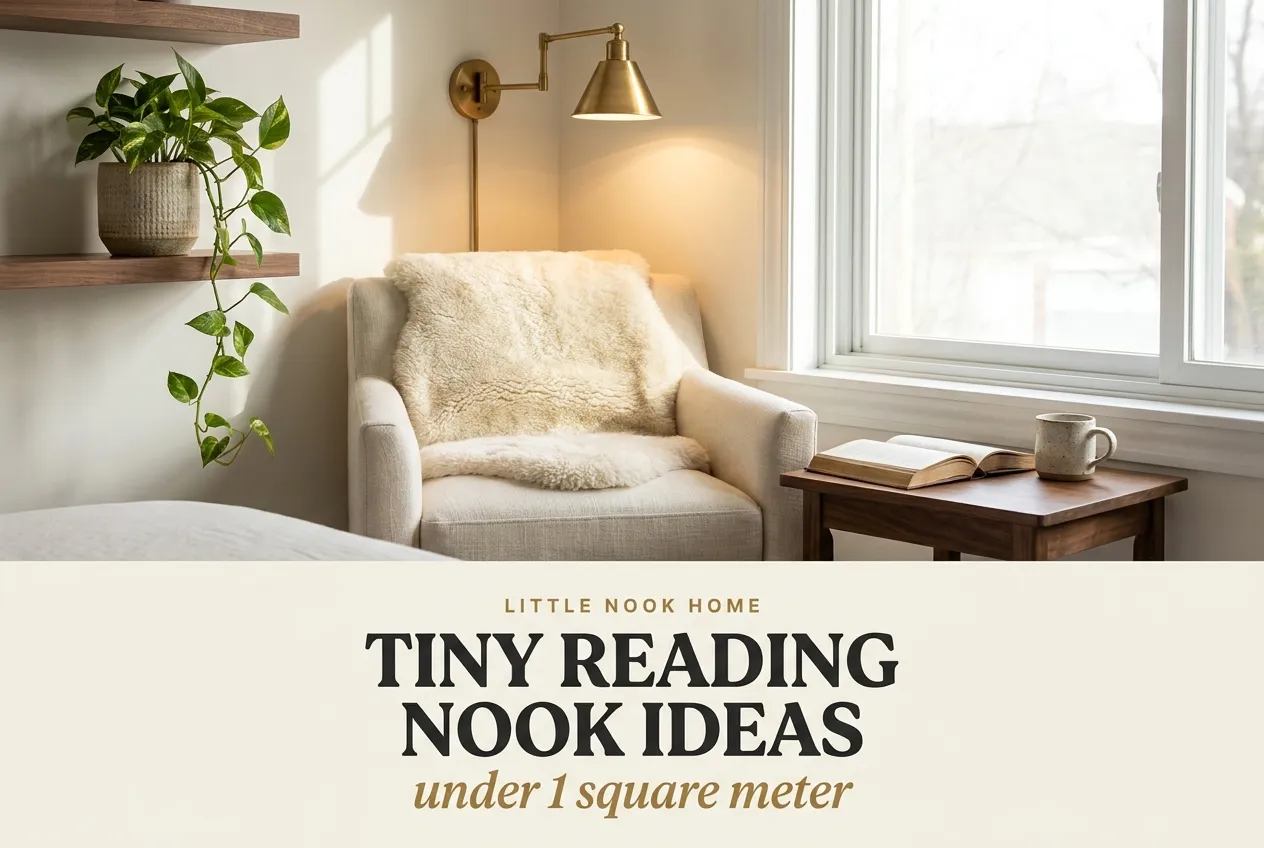
You don’t need a bay window. You don’t need a renovation budget. You don’t need a landlord who likes you. You need about 10 square feet, three pieces of furniture, and one quiet afternoon.
That’s the whole pitch behind a tiny reading nook under 1 square meter. Ten square feet. Roughly 39 inches by 39 inches. A corner most people walk past every day without noticing.
I’ve built four of these in three different apartments, including one I set up directly under an air vent (the throw kept getting pulled sideways every time the AC kicked on, and I had to redo the whole layout). Below: ten tiny reading nook ideas that actually fit, plus the spec sheet I wish someone had handed me on day one.
Most are no-drill. Most are under $200 where it counts. All of them work for adults, and a couple work brilliantly for a tween corner too.
1. What “Under 1 Square Meter” Actually Looks Like (the 3-Piece Tiny Nook Rule)
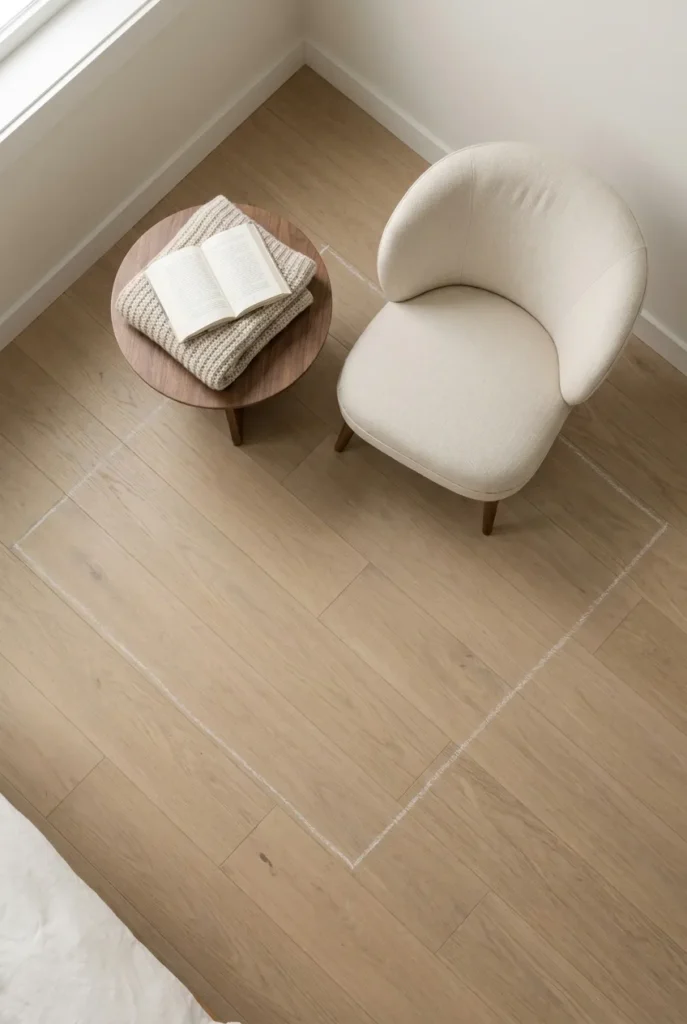
Here’s the part every Pinterest pin skips. One square meter is 39 inches by 39 inches. In US-customary terms, that’s a hair under 11 square feet. Smaller than a queen-size pillow plus the case. Bigger than a kitchen sink. Just enough.
The trick is what I call the 3-Piece Tiny Nook Rule: in 10 square feet, you get exactly three furniture pieces. A seat. A light. A surface. Everything else is soft layer, which doesn’t count toward the footprint because it lives on top of those three pieces.
Skip this rule and you end up with a corner that looks crowded from your bed, which is where you’ll be scrolling Pinterest at 11 p.m. wondering if it was worth the money. Honest answer: only if you stayed under three.
Seat options that fit a 1 sq m corner:
- A 28-inch round floor cushion
- A compact accent chair 28 to 32 inches wide
- A shallow window bench 16 inches deep
Light options that don’t eat floor space:
- A plug-in swing-arm wall sconce (no drilling for renters who skip the hardwire kit)
- A clip-on reading light on a shelf or beam
- A small arc floor lamp with the base tucked behind the seat
Surface options under 18 inches:
- A 14-inch round side table
- A wall-mounted shelf at elbow height
- A stack of three hardbacks (yes, really, this works as a mug perch in a pinch)
That’s the whole framework. Three pieces, soft layer, done. Save this paragraph if you remember nothing else.
2. The Floor-Cushion Corner (No-Build, Renter-Safe, Done Tonight)
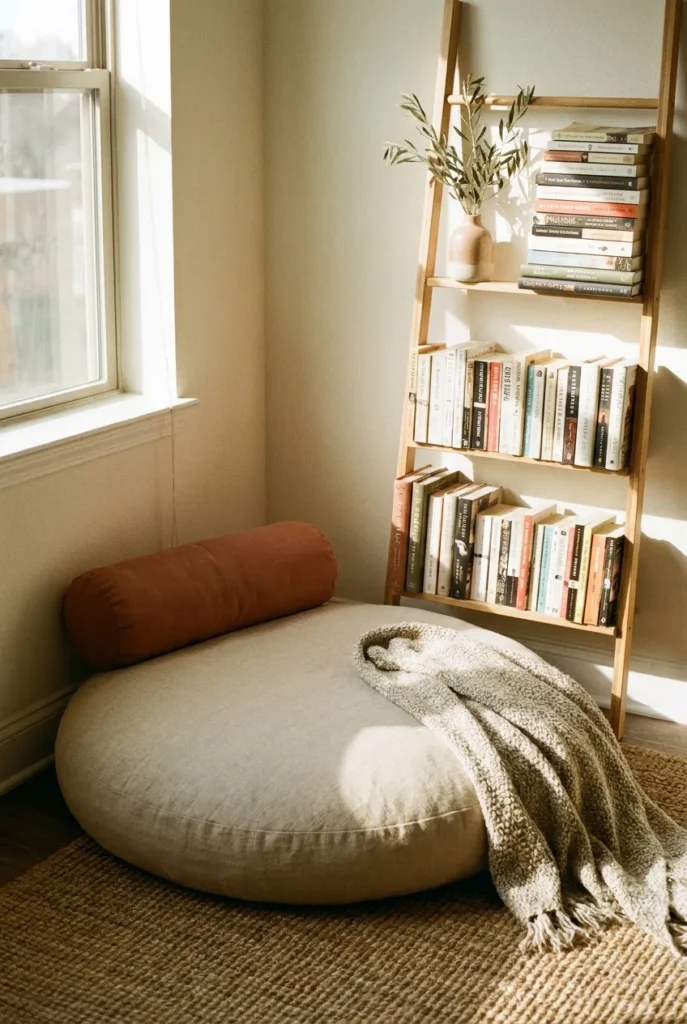
If you live somewhere you can’t drill, paint, or even lean too hard on a wall, this one’s for you. A single 28-inch round floor cushion in oat-colored linen, a thin leaning ladder shelf for your TBR pile, and a jute rug to anchor the whole thing. That’s it.
Setup time: 20 minutes. Cost band: $80 to $140 if you’re patient about cushion deals at HomeGoods and TJ Maxx. Less if you snag a cushion shell and stuff it yourself.
Here’s the honest trade-off. Floor cushions photograph beautifully and feel amazing for about 40 minutes. Then your back starts negotiating. The fix is a 12-inch bolster jammed against the wall behind your lumbar, which buys you another hour of marathon-read comfort.
A jute or washable rug under the cushion is non-negotiable. Without it, the cushion slides every time you reach for a book. With it, the whole corner reads as intentional rather than thrown-together.
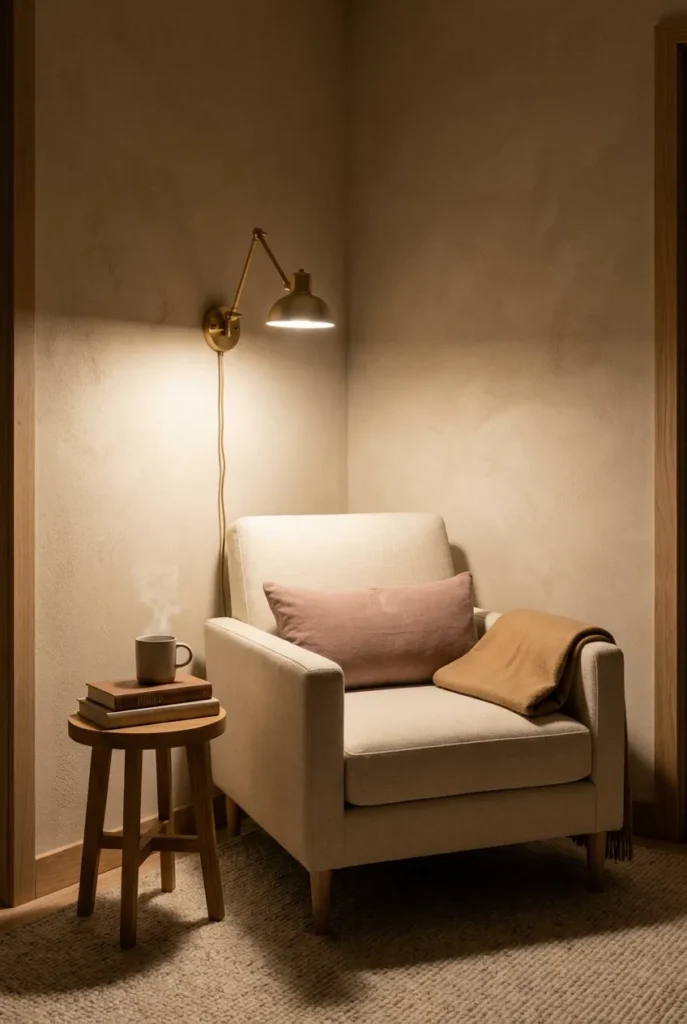
3. The Armchair-and-Plug-In-Sconce Combo (the Adult Default)
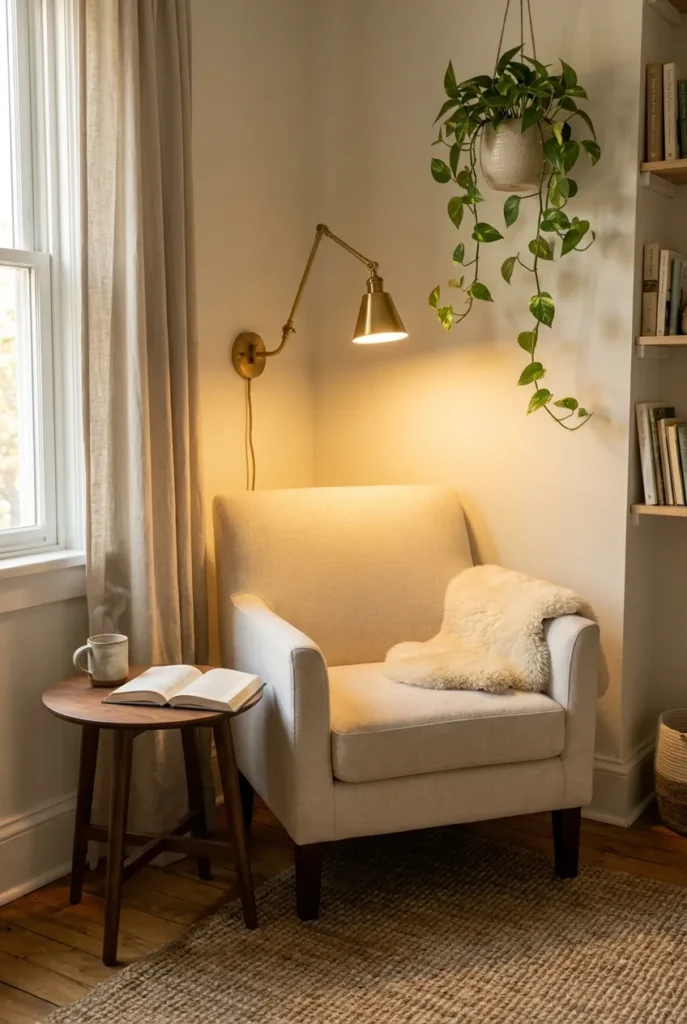
This is the tiny reading nook for adults that ends up on most of our reader photos. A compact armchair (an IKEA Poäng is the archetype, but anything 28 to 32 inches wide works), a plug-in brass swing-arm sconce mounted next to it, and a small round side table. No floor lamp needed. No drilling if you go plug-in.
The single biggest mistake here is the bulb. Daylight bulbs at 5000K look fine in stores and read like a dentist’s office at night. For a reading nook, you want 2700K, full stop. According to Energy Star’s guide on bulb color temperature, most warm-white certified bulbs sit in the 2200K to 3000K range, which matches the glow of a traditional incandescent. 2700K is the cozy sweet spot. Pair it with a dimmer (the plug-in kind, $12, no electrician needed) and you have one corner that does both 9 a.m. focus reading and 10 p.m. wind-down. ENERGY STAR
The 18-inch reach rule applies here: keep your side table within 18 inches of the chair so you don’t have to lean for the mug. Sounds obvious. Almost nobody does it.
Budget band for this build: $180 to $320 depending on whether the chair is new or thrifted. Target, Amazon, and West Elm all carry compact armchairs under 32 inches.
4. The Tiny Closet Conversion (1 Square Meter of Pure Cocoon)
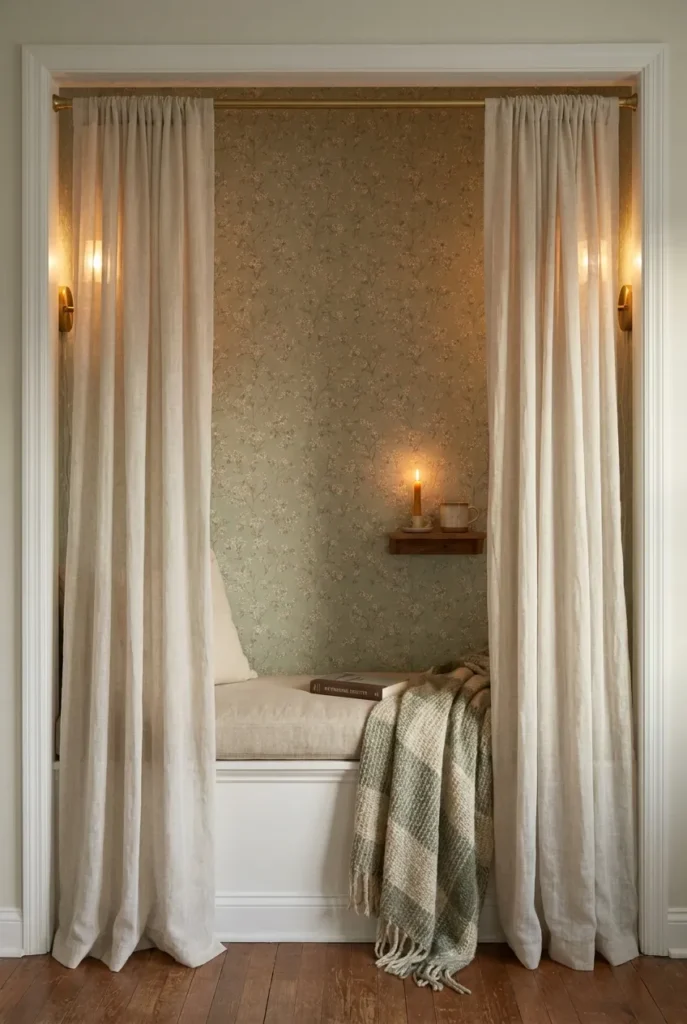
Open a coat closet, take the door off the hinges, and you have a 1-square-meter cave waiting to become the best reading nook in the house. This works in studios, in tight bedrooms, in hallways with a useless closet nobody uses for coats anyway.
The build: pull the door, paint the back wall a moody color (a removable peel-and-stick wallpaper if you rent), add a 16-inch-deep cushion bench or a stack of two firm floor cushions, hang a curtain rod across the closet opening with tension rods (no drilling), and run a string of warm LED lights along the inside top edge. For curtain hardware, fabric weight, and a dozen real-room layouts, our guide on hanging reading nook curtains in tight spaces walks through the rod heights and fabric drops that actually work in a closet.
Ventilation is the failure mode here. A closet with a closed curtain and a body inside heats up faster than you’d think. Leave a 4-inch gap at the top or run a small USB fan on a low setting. I learned this in July, in a Texas apartment, the hard way.
Cost band: $90 to $220 including paint, curtain, cushion, and lights. This is the highest “wow per dollar” idea on the list, especially for renters.
5. The Window-Sill Bench (When Your Window Is Just a Window)
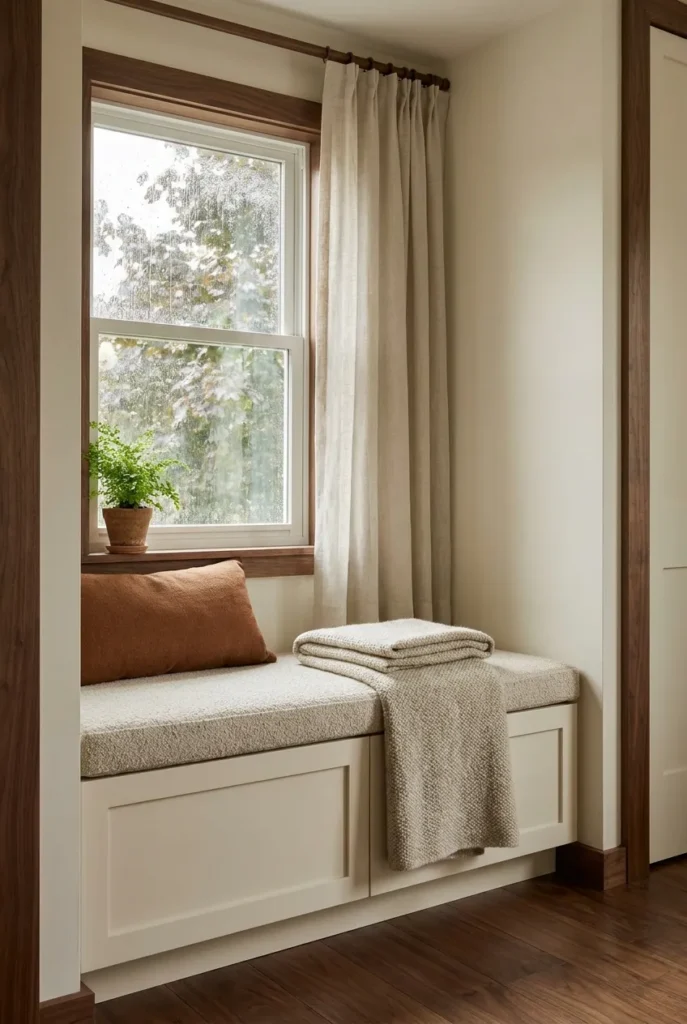
Most tiny reading nooks with a window aren’t bay windows. They’re a flat wall with a flat window, a sill 24 inches off the floor, and no built-in seat. Good news: you don’t need a contractor.
A 16-inch-deep bench, 30 to 36 inches wide, tucked under the window. Top it with a tailored boucle cushion, a rust lumbar pillow, and a folded wool throw. The window itself does the heavy lifting, and you spend almost nothing on the seat compared to a custom built-in. Our built-in reading bench plans with real dimensions cover the cushion math, the hidden-storage hinges that don’t slam your fingers, and a no-drill version for renters.
Here’s a sensory beat the photos won’t show you. A bench under a single-pane window on a winter morning is colder than you expect. A wool throw isn’t decor here, it’s insulation. Layer it under your hips, not just over your lap.
If you face east, you’ll get morning light. If you face west, late afternoon. Plan your reading habit around the window’s light hours and the whole nook earns its square footage three times over.
6. The Under-Stairs Pocket (Tiny but Tucked-Away)
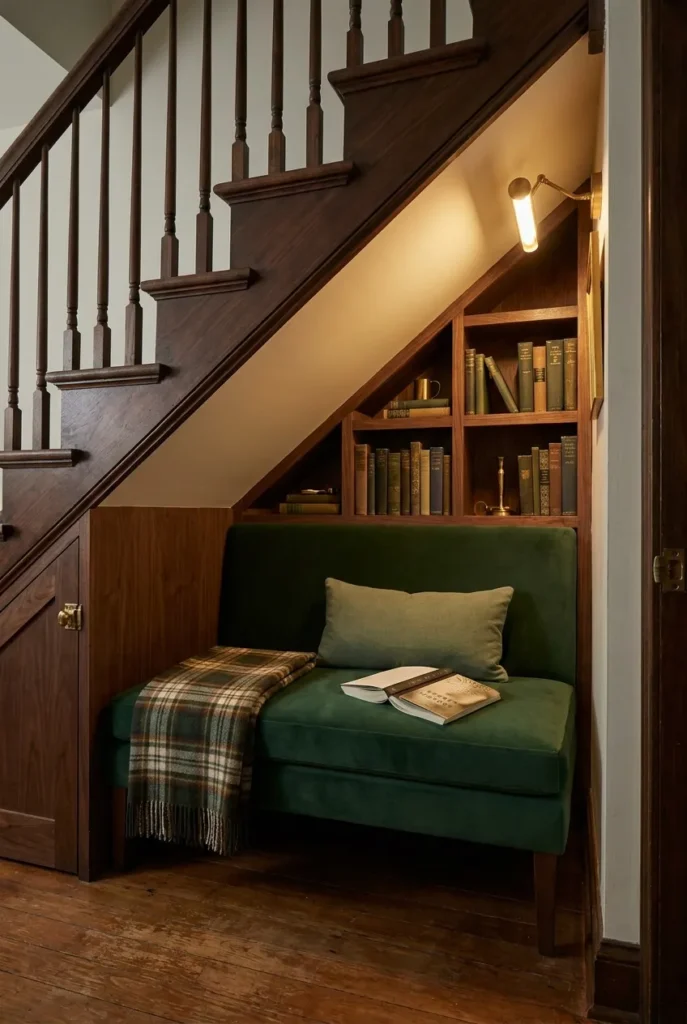
Most under-stair spaces are 1 to 2 square meters total. Even the smallest end can hold a real reading hideaway. The footprint at the shallow end of your staircase is usually right around 1 square meter, with a sloping ceiling overhead.
The piece order: a short upholstered bench sized to the wall (custom or a piano bench you upholster yourself), a picture light or low wall sconce, two side cubbies for books built directly into the wall using two slim shelves. Done. The triangle ceiling becomes a sensory feature, not a problem. There’s something about a sloped overhang that makes a corner feel two times smaller and ten times safer. The closest feeling I can name is a tent in the rain.
For the build order, materials list, and a no-tools-required version, our step-by-step under-stairs reading nook tutorial breaks down the bench depth, the cubby placement, and how to wire a picture light without ripping into drywall.
Failure mode: people put a deep cushion in a sloped space and then can’t sit up. Keep the cushion 3 inches thinner than you think. You’ll thank me.
7. The Living-Room “Furniture Wedge”
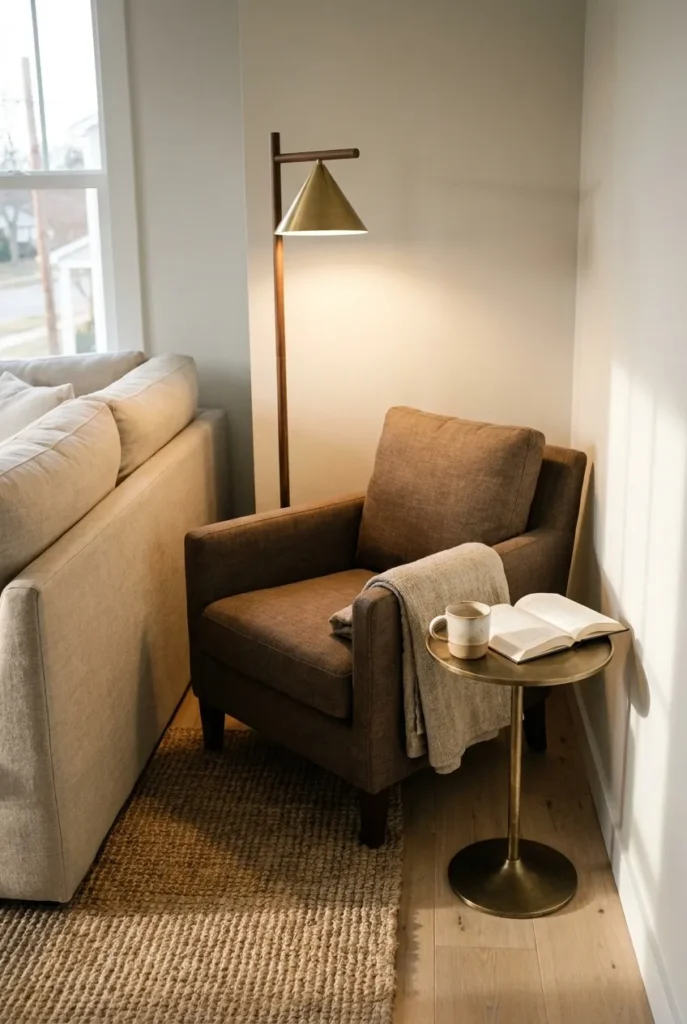
The gap between your sofa and the wall is usually 18 to 30 inches wide. Wedge a compact armchair in there at a slight angle, drop a narrow walnut floor lamp behind it, and put a small brass tray or 14-inch round side table within reach. You just built a 1-square-meter reading retreat without taking a single inch from the rest of the living room.
This is the one for households where the living room is the only room. Renters in studios. New parents who can’t claim a whole bedroom corner. Anyone whose partner declared the spare wall “off limits” for shelves.
The key is the angle. Don’t square the chair to the sofa. Tilt it 30 degrees. The reader sits facing into the room (which feels social and open) but with the wall behind them (which feels protected, the same way booth seating in a restaurant feels safer than a center table). It’s a tiny psychological move that turns a wedge into a nook.
Throw a jute runner under the chair if your floor is hard. Soft-floor sound matters more than people admit. Hardwood plus an unanchored chair equals a tiny, scraping squeak every time you shift your weight.
8. The Attic-Eave Floor Setup
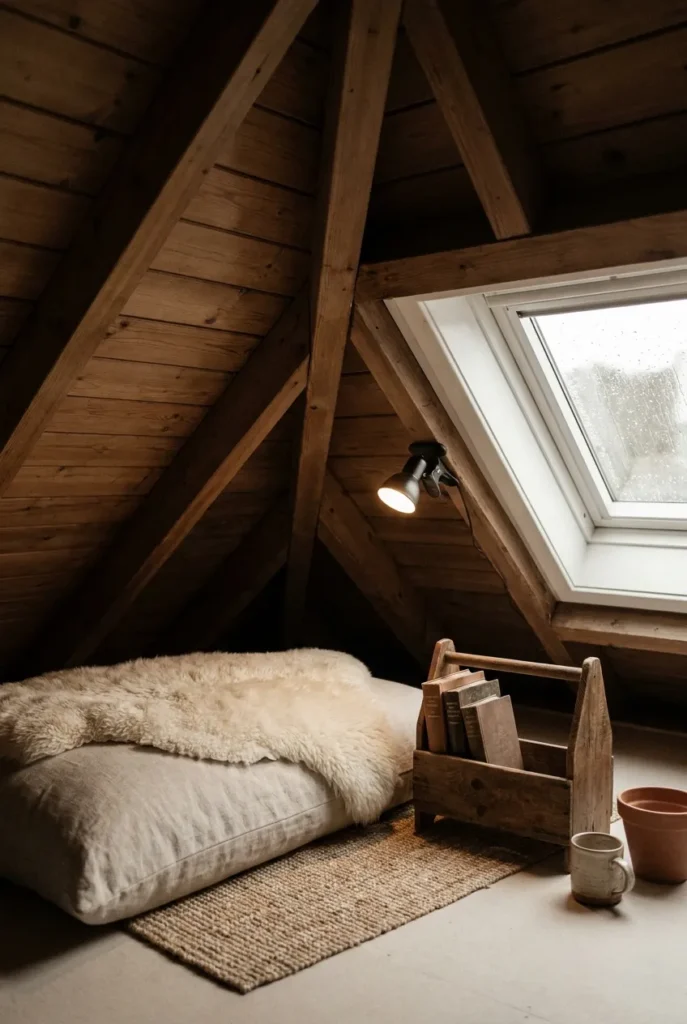
If you have an attic, a finished loft, or a finished space under sloped roof eaves, you have a built-in tiny reading nook waiting. The footprint where the ceiling is lowest is usually around 1 square meter of unusable storage space. Most people fill it with bins. You should fill it with books.
A large linen floor pillow, a sheepskin throw layered on a small jute rug, a low wooden book caddy beside it, and a single clip-on reading light attached to a beam. The slope of the ceiling does the cocooning work for free.
The sensory beat here is the sound. Rain on a roof, three feet above your head, while you read, is one of the best inputs a human being can give themselves. I’ve read entire novels in an attic eave during March storms, and I can still tell you the specific page I was on when the hail started.
Failure mode: skipping the rug. Attic floors are usually unfinished or rough plywood, and a bare floor pillow will collect splinters and dust. The rug is the buffer.
9. The Fairy-Light Cocoon (For Adults, Not a Nursery)
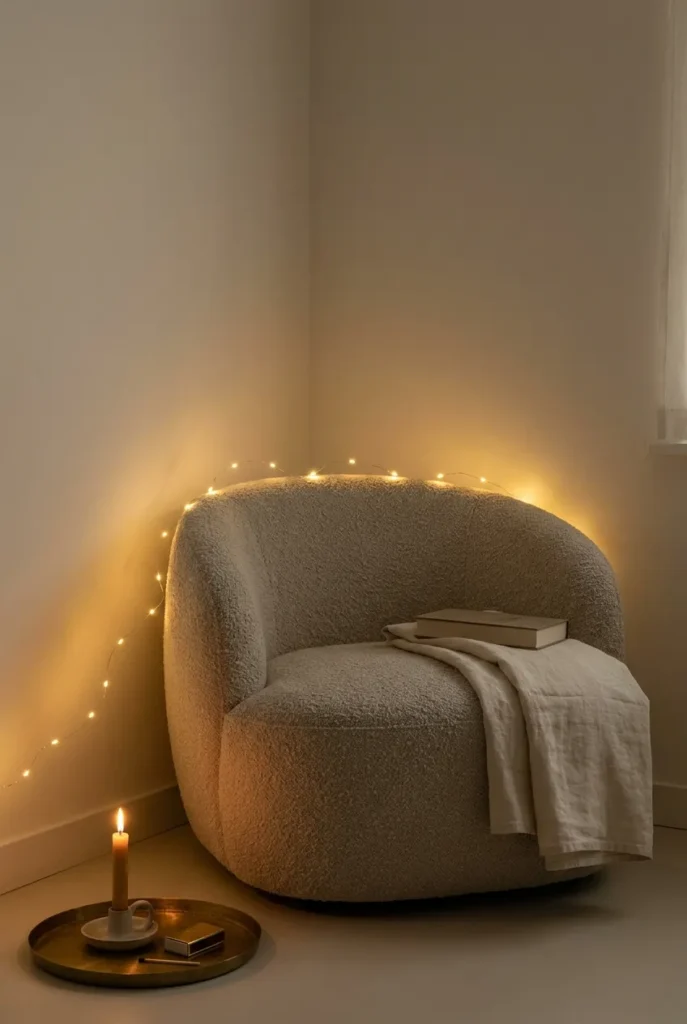
Fairy lights have a reputation problem. Done badly, they look like a tween’s dorm room. Done well, they’re the cheapest possible way to make a tiny corner feel like a hideaway after sunset.
The rules for adults: warm white only (2700K), single strand only (not three crisscrossed strands), and tucked behind or above (not draped across the front of the corner). A 10-foot strand pinned with Command hooks along the top edge of two walls, behind a low boucle armchair. That’s it. Renters, this is your move.
One safety note that gets skipped on every Pinterest blog. CPSC holiday safety guidance warns against stringing more than three sets of incandescent lights together and against overloading outlets. Stick with one LED strand, plug it directly into a wall outlet, and unplug it before you sleep. LED string lights run cool, but plug strips full of decor accessories don’t. CPSC
The sensory shift at the moment you flip them on is the entire payoff. A 4 p.m. reading corner becomes a 9 p.m. reading corner. Same chair. Same throw. Different planet.
10. The 1-Square-Meter Build Cheat Sheet (Screenshot This)
If you’re scrolling this on your phone in bed (which most of you are), here’s the whole article compressed into one screenshottable table. Every measurement is the version I’d give a friend over coffee.
| Piece | Target spec | Why this number |
|---|---|---|
| Seat depth | 16 to 18 inches | Deep enough to sit cross-legged, shallow enough not to crowd 1 sq m |
| Seat width | 28 to 32 inches | Fits a 39-inch wall with breathing room either side |
| Side table height | 22 to 25 inches | Within 18-inch reach rule of an armchair seat |
| Side table diameter | 12 to 16 inches | Mug, book, lamp base. Anything bigger steals the footprint |
| Bulb color temperature | 2700K | Warm white, matches incandescent feel |
| Bulb brightness | 450 to 800 lumens | Bright enough to read, dim enough to relax with a dimmer |
| Sconce mounting height | 60 inches from floor | Light pool lands on book at shoulder level |
| Floor cushion diameter | 26 to 30 inches | Big enough for cross-legged, small enough to clear walking path |
| Throw size | 50 by 60 inches | Covers a curled-up adult, folds small |
| Rug under nook | 3 by 5 feet | Anchors the corner, defines the visual edge |
| Budget low end | $80 | Floor cushion + thrifted ladder shelf + clip-on light |
| Budget mid | $180 | Plug-in sconce + compact chair + side table |
| Budget high | $320 | Boucle armchair + brass sconce + custom cushion + rug |
These numbers aren’t theoretical. Every row came from a corner I or a reader built and then tested for at least a month.
Frequently Asked Questions
How small can a reading nook really be?
About 10 square feet, or 1 square meter, is the practical floor. Smaller than that, and your knees start hitting the wall when you sit. A 39-inch by 39-inch square is the sweet spot for one seated adult plus a side surface and a light.
How do I make a tiny reading nook for adults that doesn’t feel like a kid’s corner?
Two rules. First, warm 2700K light only, never daylight bulbs and never cool white string lights. Second, real soft layers: linen, wool, boucle, sheepskin. Skip primary colors, plush characters, and pom-pom trim. A grown-up tiny reading nook reads as quiet, neutral, and a little moody.
What do you actually put in a tiny reading nook?
The 3-Piece Tiny Nook Rule covers it: a seat (chair, bench, or floor cushion), a light (plug-in sconce, clip-on, or compact floor lamp), and a surface (small side table, wall shelf, or book caddy). Soft layer goes on top. A 12-inch lumbar bolster is the one accessory worth its weight.
Can I build a tiny reading nook without drilling anything?
Yes, and most of the ideas above are designed exactly for that. Plug-in sconces, Command hooks for fairy lights, tension rods for closet curtains, freestanding ladder shelves, no-stud floor cushion setups. Renters can hit at least 7 of the 10 ideas on this list with zero hardware.
What’s the best light for a small reading nook?
A plug-in swing-arm wall sconce with a 2700K warm-white LED bulb in the 450 to 800 lumen range, paired with a plug-in dimmer. That single combo handles morning focus reading and evening wind-down reading without swapping a thing. A clip-on reading light works as a backup or for under-stair pockets.
How do I create a reading corner in a small bedroom?
Take the corner furthest from the door and closest to a window if you have one. Apply the 3-Piece Tiny Nook Rule with a compact 30-inch accent chair, a plug-in wall sconce, and a small side table. A 3 by 5 jute rug anchors the corner visually so it reads as a separate space from the rest of the bedroom.
What’s the cheapest way to build a tiny reading nook?
Around $80 if you’re patient. A round floor cushion from Target or HomeGoods ($35 to $50), a thrifted leaning ladder shelf ($20), a clip-on book light ($10 to $15), and a wool throw you already own. The rug is optional if you have hardwood that already looks intentional.
Your Next Move
Pick the idea on this list that fits the corner you already have. Not the corner you wish you had. The actual one, the one you walked past this morning on your way to coffee. Measure it tonight (a tape measure on your phone counts), screenshot the cheat sheet table, and order one piece by the end of the week.
Most readers tell us they spent more time pinning ideas than building, and the corner is still empty six months later. The pin is not the nook. The cushion is the nook. Start with the seat, add the light, add the surface. Three pieces, one quiet weekend, one tiny reading nook you’ll actually use.
Which corner are you starting with?
Keep reading
More cozy nook ideas
 Nook Ideas
Read →
Nook Ideas
Read →
10 Dog Nook Ideas You’ll Want to Curl Up In
Warm light from one floor lamp, a chair turned away from the TV, and your dog asleep on a bolster bed beside…
 Nook Ideas
Read →
Nook Ideas
Read →
21 Window Sill Reading Nook Ideas for Adults
Most apartment window sills are deep enough for a candle and not much else. By October the glass breathes cold on your…
 Home Library & Bookshelves
Read →
Home Library & Bookshelves
Read →
12 Ideas for Built-In Bookshelves Around the Fireplace for Book Lovers
Thirty-two inches between uprights. Six inches of bare masonry around the firebox. Twelve inches of shelf depth. Get those three numbers right…