
Hallway Reading Nook Ideas That Fit a Narrow Space (Without Blocking the Walk)

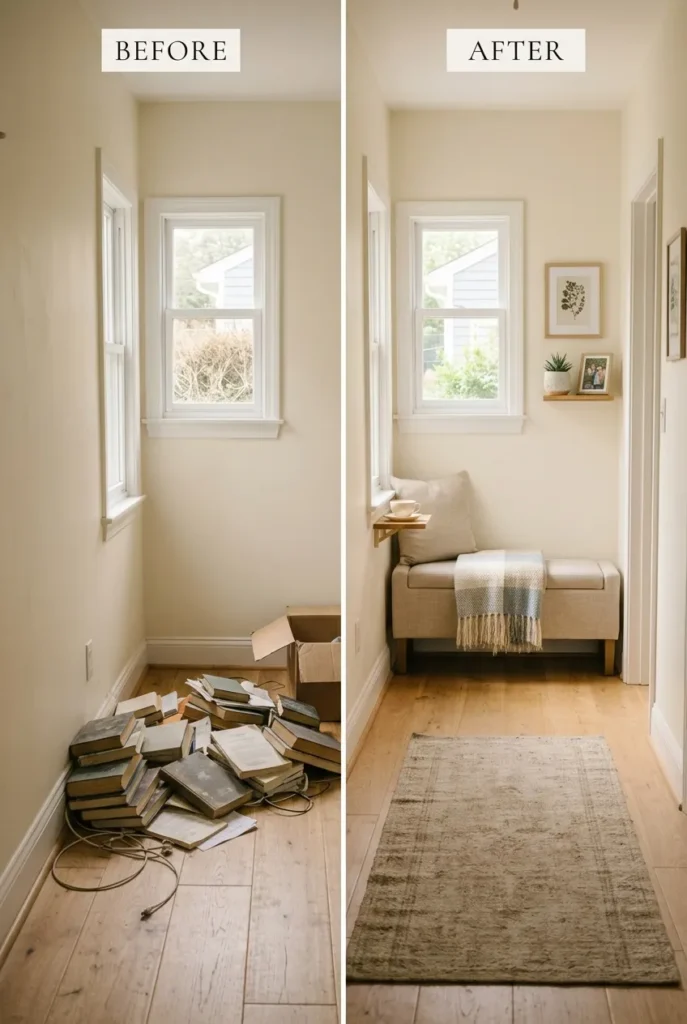
No bay window, no reno budget, no drill-friendly landlord required. You need one blank stretch of wall, about 20 inches of depth, and a free Saturday. That’s the whole hallway reading nook, and I’m going to show you the exact build order so you stop tripping over the same pile of books by the linen closet.
Here’s the thing most Pinterest photos won’t tell you. A hallway is a walkway first. Squeeze a chair into it wrong and you’ve made a beautiful obstacle course. Get the depth right and you’ve got the coziest spot in the house, the one nobody expected and everybody fights over.
This is written for the renter and the first-time owner working with one awkward stretch of wall and a budget in the low hundreds. Let’s build it.
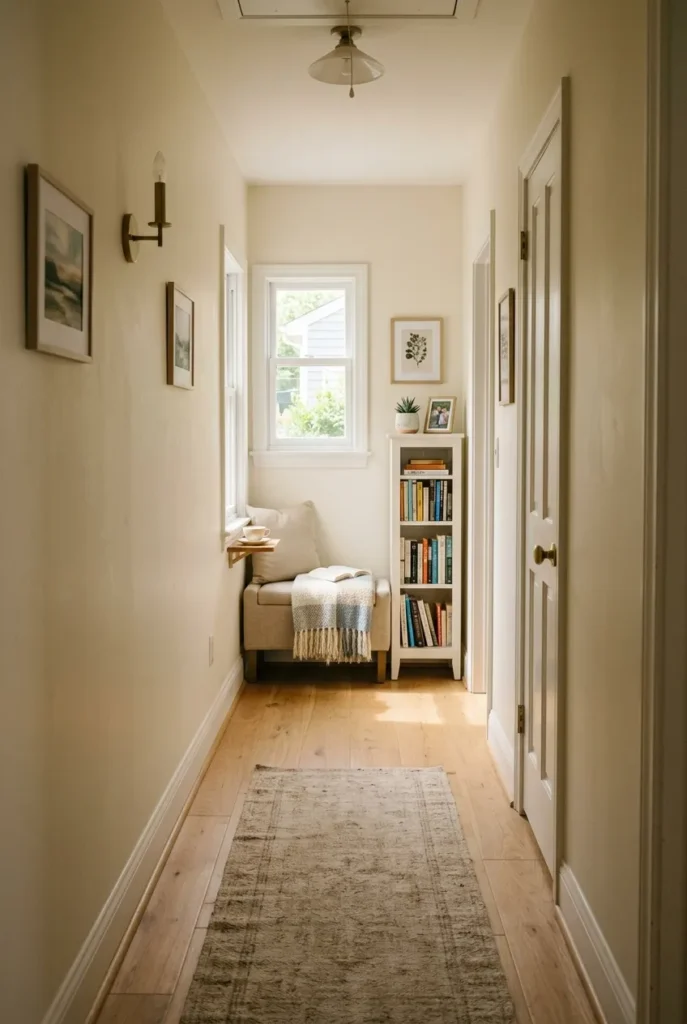
Start Here: Will a Nook Actually Fit Your Hallway? (The 20-Inch Rule)
Before you buy anything, measure. This is the step everyone skips and then regrets when the delivery box won’t clear the doorway.
Grab a tape measure and get the width of your hallway wall to wall. A standard walking path needs to stay clear, and there’s a real number for this. The U.S. Access Board sets the minimum clear width for an accessible route at 36 inches, allowed to pinch down to 32 inches for short stretches. That’s your walking lane. Whatever seat you add has to leave that lane open.
So the math is simple. Take your hallway width, subtract 32 to 36 inches for walking, and what’s left is your seat depth. Most hallways run 36 to 48 inches wide, which leaves you a shallow bench of roughly 12 to 16 inches. Tight, but real.
Here’s a quick reference I keep taped inside my planning notebook:
| Your hallway width | Keep clear for walking | Depth left for a seat | What fits |
|---|---|---|---|
| 36 in (3 ft) | 32 in | 4 in | Wall shelf + floor cushion only |
| 42 in | 32 in | 10 in | Slim wall-mounted bench |
| 48 in (4 ft) | 34 in | 14 in | Shallow bench, one accent chair angled |
| 54 in + | 36 in | 18 in + | Full bench or armchair, side table |
If you’ve got under 42 inches, don’t force a chair. Go vertical instead (more on that below). A jammed walkway reads as clutter, not cozy, and it’s the fastest way to make a small space feel smaller.
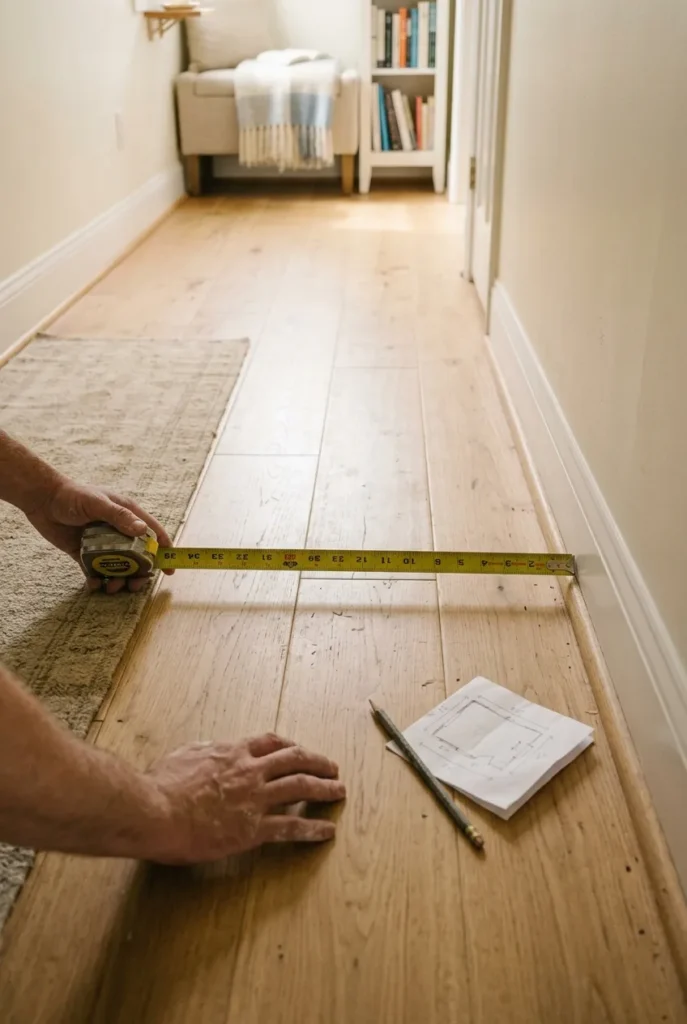
The Fastest Win: End-of-Hallway Nook on a Dead Wall
If your hallway dead-ends at a blank wall, congratulations, you drew the easy card. That end wall is begging for a bench, and because nobody walks past it, you’re not stealing an inch of your walking lane.
Push a compact bench flat against the end wall. A cushion, two throw pillows, a slim shelf overhead for your current stack, done. This is the “hide away at the end of a hallway” move that keeps showing up on the top-ranking roundups, and it works because a dead end has no traffic to protect.
Failure mode: skipping the back support. A bench against a bare wall gets uncomfortable in about ten minutes. Add a lumbar pillow or a tall bolster so your spine has something to lean into.
If your hallway has no window at all, and a lot of interior halls don’t, you can still make this glow. I’ve walked through the full windowless playbook in this guide to a reading nook without a window, from mirror placement to layered lamps.
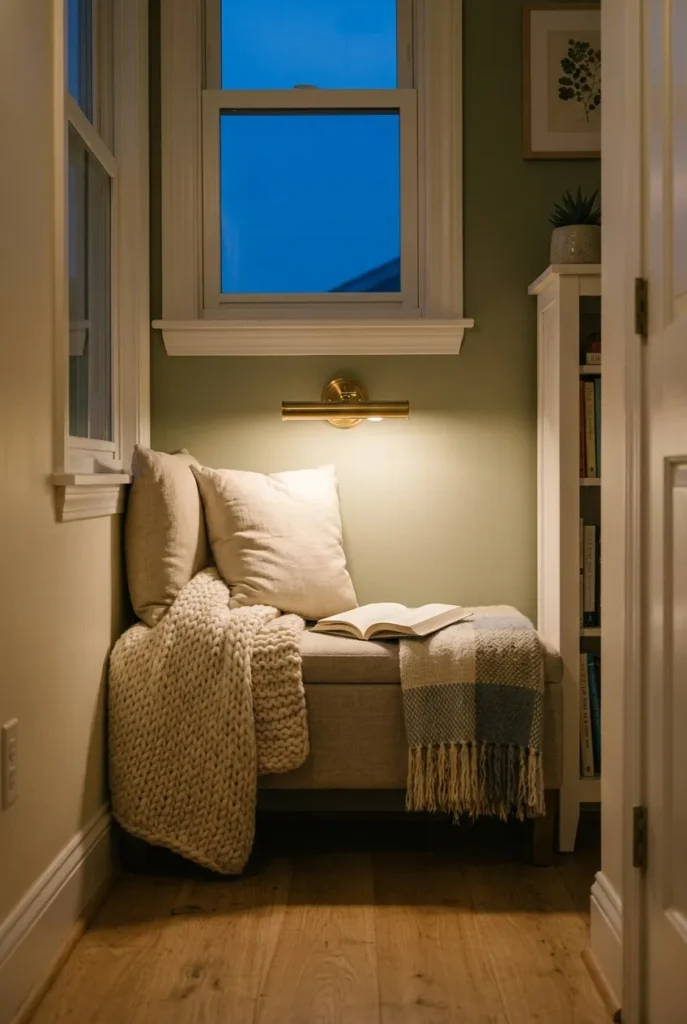
Renter-Safe and No-Drill: A Hallway Nook That Won’t Cost Your Deposit
Can’t drill, can’t paint, can’t build? You can still do this, and it’s honestly my favorite version because it forces you to be clever.
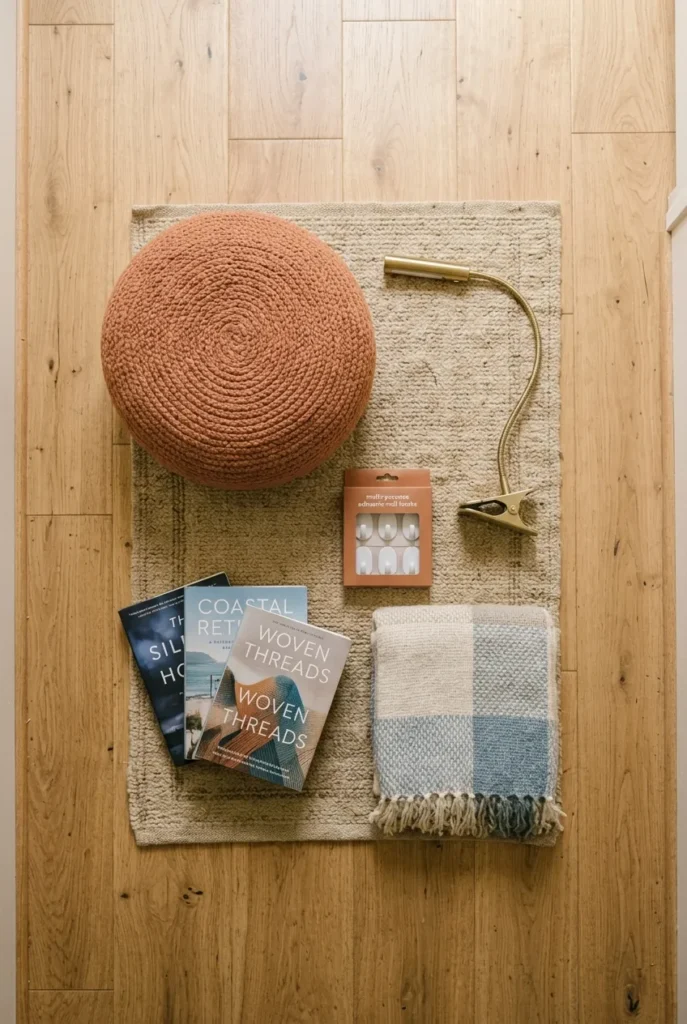
Skip the built-in entirely. Use freestanding and leaning pieces:
- A leaning ladder shelf (it rests against the wall, zero holes) for books and a small lamp.
- A floor cushion or a low pouf instead of a bench, so nothing is anchored.
- A plug-in wall sconce with a cord channel, or a clip-on reading light, no hardwiring.
- Removable adhesive hooks for a light curtain or fairy lights, rated for the weight you’re hanging.
Front-load this one because it’s the highest-value tip for most of you reading on your phone in a rental: everything here lifts out on moving day and leaves the wall exactly as you found it. For the full no-damage kit, I put together a whole walkthrough of no-drill reading nook setups for renters.
Failure mode: overloading an adhesive hook. Check the weight rating, then hang about half of it. A curtain rod that lets go at 6 a.m. is a bad way to wake up.
Go Vertical When the Floor Is Full
Under 42 inches of width and no dead-end wall? Stop fighting for floor space and climb the walls instead.
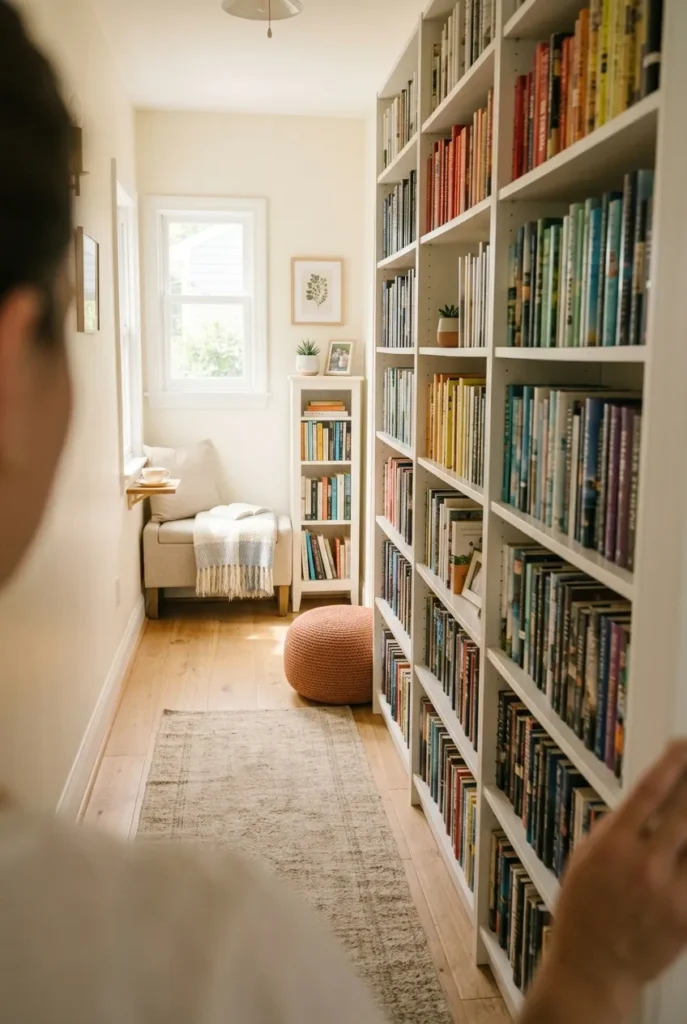
A narrow hallway has one thing in surplus: vertical wall. Run a tall, shallow bookcase (think 10 to 12 inches deep) along one side, then add a single floor cushion you can pull out only when you sit and tuck back when you walk. The books do the cozy work at eye level, the seat stays out of the traffic lane.
This is the “creative use of nooks and crannies” idea the Pinterest crowd keeps saving, and it’s smart because it separates storage (permanent, on the wall) from seating (temporary, on the floor).
Failure mode: a bookcase that’s too deep. Anything past 12 inches starts clipping shoulders as you pass. Measure your own shoulder-to-shoulder reach and leave two inches of grace.
Upstairs Landing: The Nook Hiding at the Top of the Stairs
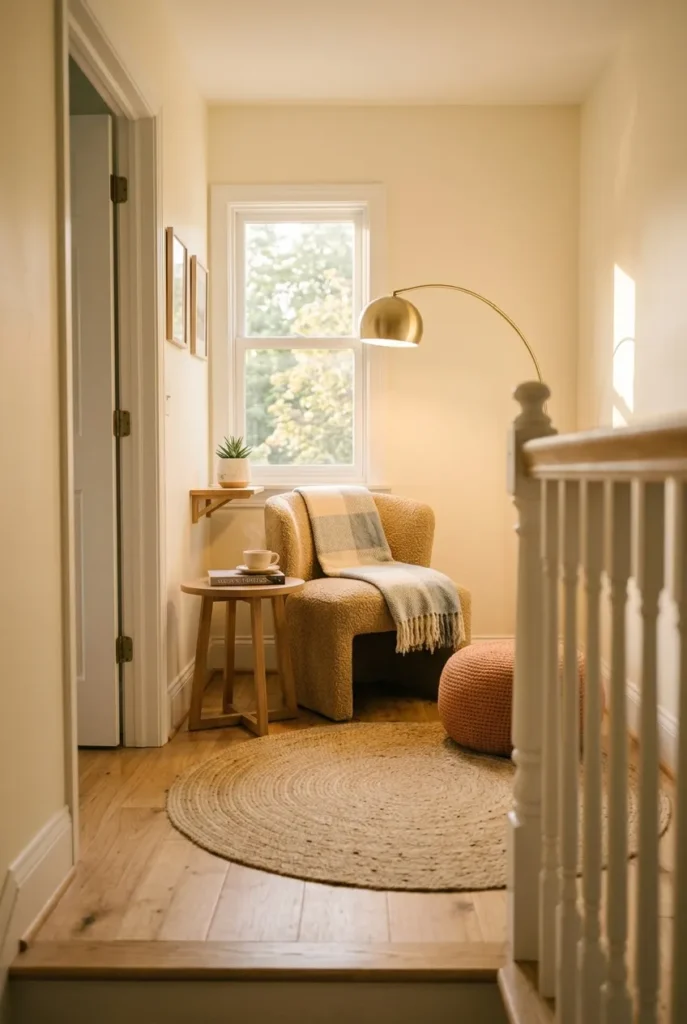
That flat spot at the top of the stairs, the landing, is a hallway nook waiting to happen. It usually has a little more square footage than a corridor and often catches better light.
Angle a compact accent chair toward whatever light source you’ve got, slide a small round side table within arm’s reach, and add a floor lamp. The “18-inch reach rule” helps here: keep your side table within about 18 inches of the chair so you can set down a mug without leaning. Any farther and you stop using it.
Landings photograph beautifully, which is why “upstairs hallway reading nook” is a top-saved Pinterest search. If yours has a railing, resist crowding it. Leave breathing room so the spot feels open, not boxed in.
Failure mode: forgetting the top-of-stairs safety line. Keep every piece of furniture back from the edge of the stairwell so nothing can be tripped over in the dark.
Light It Like You Mean It (Skip the Overhead)
Here’s where most hallway nooks fall apart. The ceiling light was built to help you find the bathroom at night, not to read by. It’s flat, it’s harsh, and it kills the mood instantly.
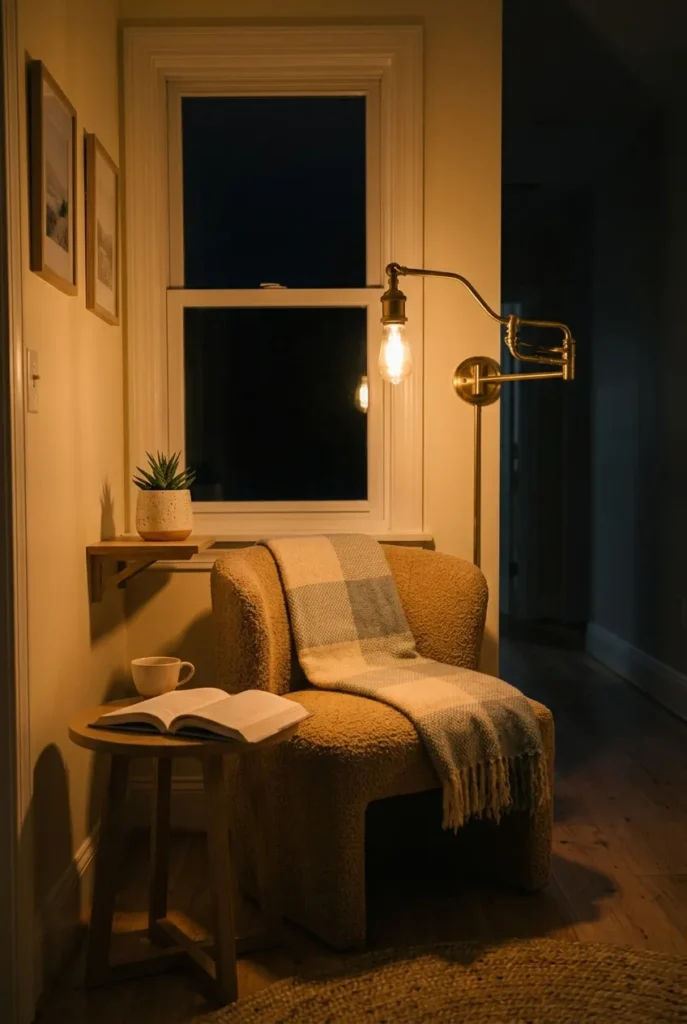
Layer instead. You want one task light for the page and one soft glow for the vibe:
- Task: a swing-arm wall lamp or a plug-in sconce positioned just over your shoulder.
- Ambient: a warm bulb, fairy lights, or a small table lamp.
Bulb color is the detail that makes or breaks it. Go warm. The U.S. Department of Energy notes that cozy home lighting sits around 2700K, the soft amber end of the scale, not the blue-white daylight bulbs. Grab a bulb labeled “soft white” or “warm white” and your corner instantly feels like evening, even at noon.
Failure mode: one cold overhead and nothing else. You’ll get a well-lit hallway and a nook nobody wants to sit in.
Layer the Softness: Textiles That Do the Heavy Lifting
A hard bench and a bare wall will never feel cozy no matter how good your lighting is. Softness is what turns a seat into a nook.
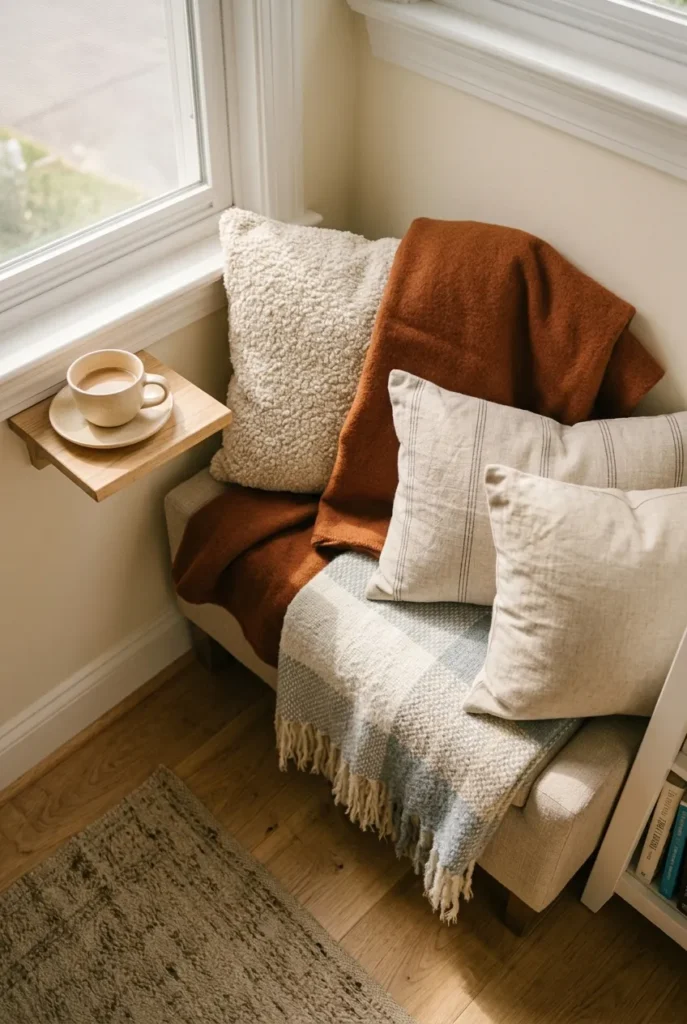
Stack your textures. Start with a washable seat cushion, add a linen or wool throw, then two pillows of different sizes so it looks collected instead of staged. A small jute or washable runner underfoot defines the zone and quiets footsteps, which matters more than you’d think in a hard-floored hall. For a plug-in, no-drill glow that pairs with these layers, the whole fairy lights reading nook approach leans on the same warm-light trick.
There’s a sensory payoff here you can’t see in a photo: a wool throw over your knees changes the whole temperature of a drafty hallway corner in about a minute. That’s the moment the spot stops being decor and starts being yours.
Failure mode: all-matching pillows from one set. It looks like a showroom, not a hideaway. Mix one pattern, one solid, one texture.
Style the Wall So It Feels Intentional
An empty wall above the seat reads as unfinished. Give the eye something to land on and the whole nook snaps into focus.
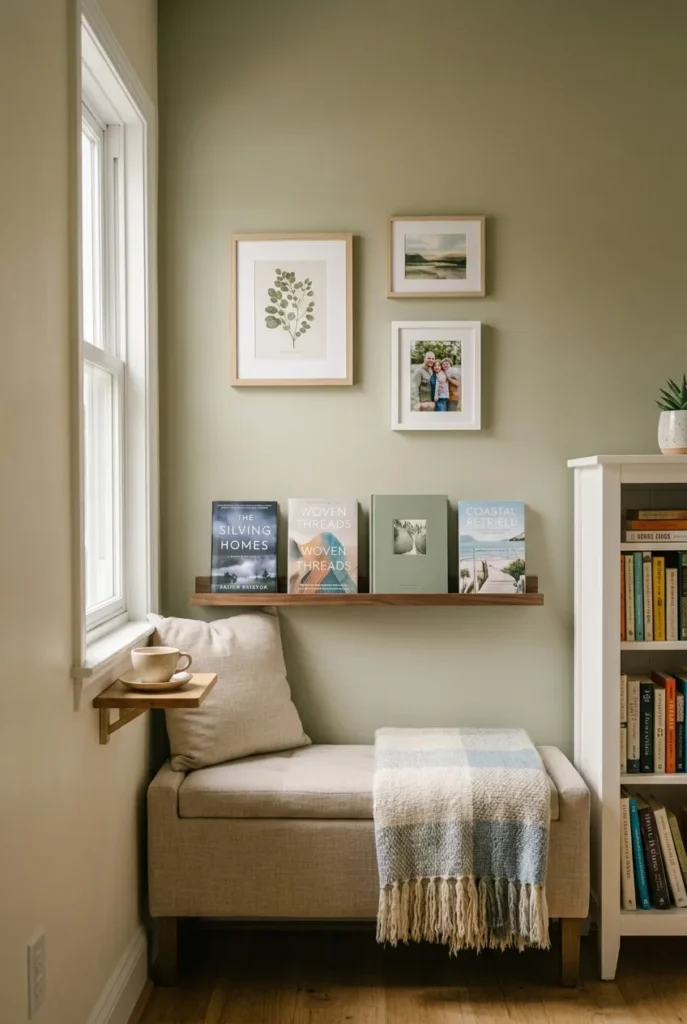
Three easy options, pick one: a small gallery wall of framed prints, a single oversized piece of art, or a slim picture ledge holding your current reads face-out. The face-out ledge doubles as function, your to-be-read pile becomes the decoration.
Keep the arrangement tight and low so it relates to a seated person, not a standing one. Art hung too high floats and disconnects from the nook below it.
Failure mode: hanging everything at standing eye level out of habit. Sit down first, then mark your wall. The whole point is the seated view.
The Weekend Build Order (Copy This Exactly)
You’ve got the pieces. Here’s the sequence so you don’t buy backward:
- Measure the width and lock your seat depth using the clearance table above.
- Choose your type: end-wall bench, no-drill freestanding, vertical, or landing chair.
- Set the seat first, then confirm your walking lane is still clear.
- Add layered light: one task lamp, one warm 2700K glow.
- Pile on textiles: cushion, throw, mixed pillows, small runner.
- Style the wall last, marked from a seated position.
That’s a Saturday. Do it in order and you won’t end up with a chair you have to return because the box never cleared the door.
Frequently Asked Questions
What is a cozy reading nook?
It’s a small dedicated spot built for one job: comfortable reading. At minimum you need a seat, a light you can actually read by, and a surface for a mug and your book. Everything else, the throws, the art, the warm bulb, is what tips it from functional to inviting.
Where is the best place for a reading nook in a hallway?
A dead-end wall is the easiest because it has zero foot traffic to protect. After that, an upstairs landing wins for extra room and better light. Mid-hallway pass-through spots work too, but only if you can keep 32 to 36 inches of walking clearance open.
How do you decorate a narrow nook space?
Work in layers and stay shallow. A shallow seat, a vertical bookshelf, layered textiles, and warm lighting do more in a tight space than any single big piece. Keep art low and tied to the seated sightline, and let your book stack double as decor.
What are some reading nook ideas for small spaces?
Go vertical with a slim bookcase, use a pull-out floor cushion instead of a fixed chair, lean a ladder shelf instead of drilling, and light it with a plug-in sconce. Shallow-and-tall beats deep-and-wide every time in a narrow footprint.
Can I build a hallway reading nook if I rent?
Yes. Stick to freestanding and leaning pieces, plug-in lights, and removable adhesive hooks. Nothing gets drilled, everything lifts out on moving day, and your deposit stays safe.
Your Next Step
Measure your hallway tonight. Just that. Once you know your seat depth, the rest of this is a single trip and one free afternoon. Start with the end-wall bench if you’ve got a dead end, or the no-drill setup if you rent, and build in the order above.
Want to keep going? Pick your next corner and steal a few more tricks from the small-space guides linked above.
Keep reading
More cozy nook ideas
 Nook Ideas
Read →
Nook Ideas
Read →
10 Dog Nook Ideas You’ll Want to Curl Up In
Warm light from one floor lamp, a chair turned away from the TV, and your dog asleep on a bolster bed beside…
 Nook Ideas
Read →
Nook Ideas
Read →
21 Window Sill Reading Nook Ideas for Adults
Most apartment window sills are deep enough for a candle and not much else. By October the glass breathes cold on your…
 Home Library & Bookshelves
Read →
Home Library & Bookshelves
Read →
12 Ideas for Built-In Bookshelves Around the Fireplace for Book Lovers
Thirty-two inches between uprights. Six inches of bare masonry around the firebox. Twelve inches of shelf depth. Get those three numbers right…
One Comment