
25 Fall Window Box Ideas for Small Spaces

If your window box still holds August’s petunias, stringy at the stems and brown at the tips, this list fixes it before the first hard frost. Every idea fits a small space: one narrow window, a balcony rail, a stoop ledge, or a box you can carry inside when the lease ends.
Fall window boxes play by different rules than summer ones. Plants barely grow once nights turn cold, so a box looks finished on the day you plant it, or it never does. That’s good news if you’re short on time. One afternoon is enough.
Below you’ll find 25 ideas, starting with a 24-inch starter box totaled at $142.52 in listed prices. After that come no-drill railing setups, plants that hold up after frost, and the Glass-Line Rule, which keeps the view from your reading chair as good as the view from the sidewalk. Renter-safe options come first, homeowner upgrades second.
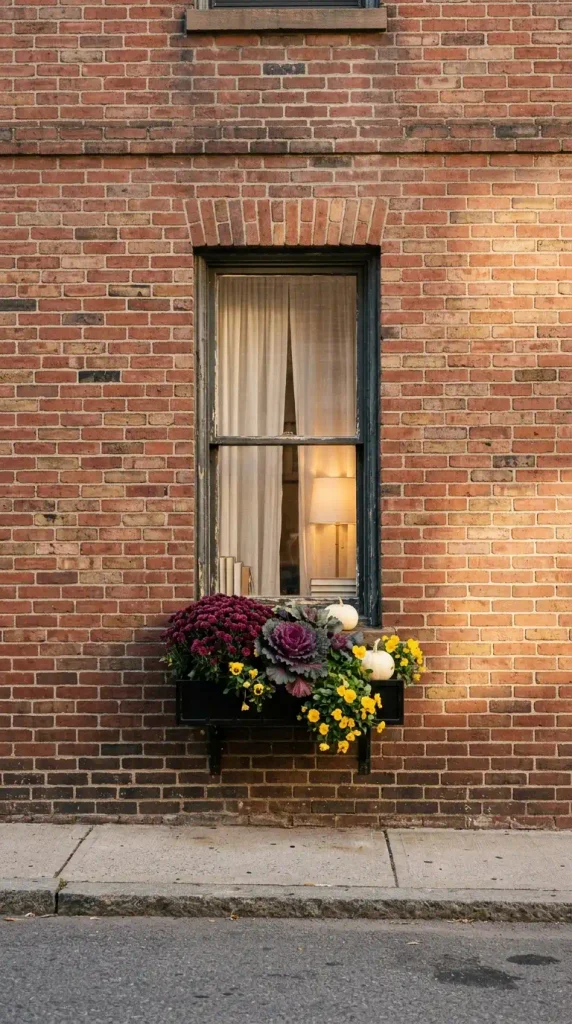
Grab a tape measure before anything else. Your window’s width decides more than you’d think.
1. The 24-Inch Starter Box for One Small Window
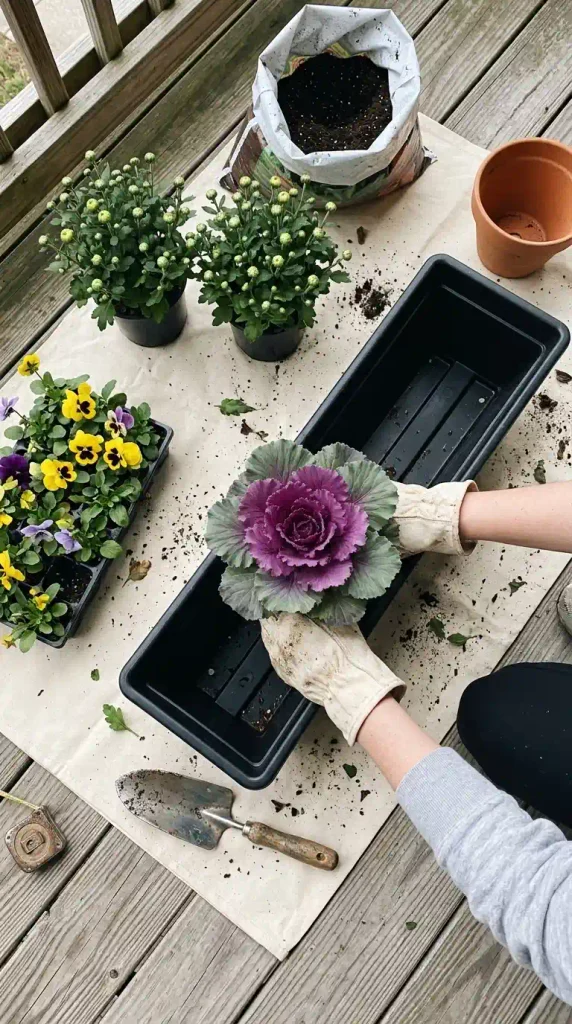
Eight plants, one box, one afternoon. That’s the whole starter setup for a single small window, and it covers the three jobs every fall box needs: height, bulk, and something trailing over the edge.
- Back row: two 3-quart garden mums, bought in tight bud.
- Center: one 2-quart flowering kale, which colors up as nights cool.
- Front edge: five pansies, low enough to spill over the lip.
| Piece | What to buy | Listed price |
|---|---|---|
| 🪟 Box | Mayne Nantucket 24 in. self-watering black window box | $69.28 |
| 🌼 Back row | Two 3 qt purple garden mums (2-pack) | $29.58 |
| 🥬 Center | One 2 qt flowering kale | $9.98 |
| 🌸 Front edge | 1 qt giant pansy mix (5-pack) | $33.68 |
| Total | Home Depot listed prices, October 2026 | $142.52 |
If you already own a box, the plants alone come to $73.24. Prices shift week to week, so treat the total as a ballpark.
Set the root balls shoulder to shoulder. In fall, nothing grows in to fill the gaps for you.
2. Hook a Box Inside the Balcony Rail, No Drill Needed
Leases rarely mention planters. They almost always mention holes.
An adjustable rail bracket handles both problems. It hooks over the top rail and cradles the box from below, so nothing gets screwed into a railing you don’t own. Measure your box before buying: Y&M’s adjustable brackets widen from 6 to 12.5 inches, which clears the 11.5-inch box from idea #1. Single no-drill holders from brands like Happon list around $18.99 at Walmart.
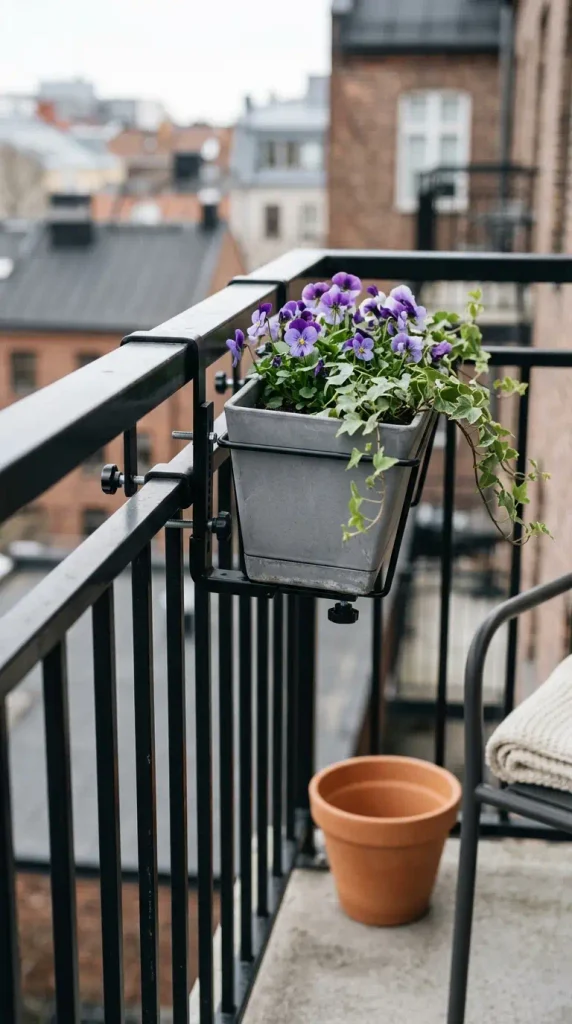
Hang the box on the inside of the rail, so drips land on your floor and not a neighbor’s.
Pick plastic or polyethylene. Plastic shrugs off the freeze cracking that clay can suffer.
Read your lease or HOA rules before you hang anything.
A loose box resting on a sill with nothing holding it.
Heavy garden soil, which packs down and doubles the load.
Tall grasses on upper floors, where wind catches them.
Safety note: anchor tall furniture to the wall, keep candles and cords away from fabric, and use a licensed electrician or contractor for hardwired lighting, ceiling mounts, or anything structural. A filled window box is heavy and sits above people. One New York property manager warned that a box can’t sit on a sill unless an enclosure keeps it from falling, so if your box hangs over a sidewalk, get it properly secured or move it to the inside of a rail.
3. The Window Box Fit Check
Most window box mistakes happen at the tape measure, not the garden center. A box that’s too short makes the window look pinched, and one that hangs far past the trim looks like an afterthought.
Exterior designers at Brick & Batten use a simple sizing rule, and Garden Gate’s tested fall planting plan gives you a real depth to aim for. Put them together and you get four numbers worth checking before you buy anything.
📏 The Window Box Fit Check
Garden Gate’s box measured 8 x 8.75 x 30 inches, and it still needed plants packed tighter than most people expect. Narrow is normal. Screenshot the card before you shop.
4. Keep the Mums in Their Nursery Pots
Mums fade first. They give a big, bright month, then the blooms brown and the plant looks tired long before the kale does. One longtime gardener skips them entirely for that reason.
The Home Depot’s planting advice offers a smarter middle ground: leave each mum in the pot it came in.
Fill the box about halfway with fresh potting mix.
Sink each mum, still in its nursery pot, so the rim sits just below the box edge.
Pack mix around the pots so they don’t wobble, then plant everything else around them.
When the blooms brown, lift the pot straight out and drop in a pansy or kale in the same size pot.
No digging, no torn roots on the neighbors. The swap is a single lift.
5. Ornamental Kale for a Box That Outlasts the Mums
Kale does its best work after you’ve stopped paying attention. Cool nights pull out the pink, cream, and purple centers, and the color keeps deepening long after mums give up.
Two names, one plant family. Frilly, curly leaves get sold as ornamental kale. Broad, flat leaves with a contrasting edge get sold as ornamental cabbage. UW Madison Extension’s ornamental cabbage and kale guide suggests one plant in the center with pansies around it, and recommends choosing plants that are already nearly or fully colored. That matters late in the season, when there’s no time left to wait.
Mums are the opening act. Kale closes the show.
6. The Glass-Line Rule: Plant for the View From Your Chair
Every fall window box has two audiences. The sidewalk sees the front. You, curled in the chair or window seat behind the glass, see the top few inches: the crowns of the plants, the backs of the pumpkins, and every gap.
Most fall window box ideas are styled only for the street. Flip that. Face the best side of each plant toward the glass, set a few pansies along the back edge so you get flowers too, and keep anything tall from swallowing your daylight. On a rainy afternoon, water beads on the waxy kale leaves right at eye level, and that’s the whole point of a box you can read beside.
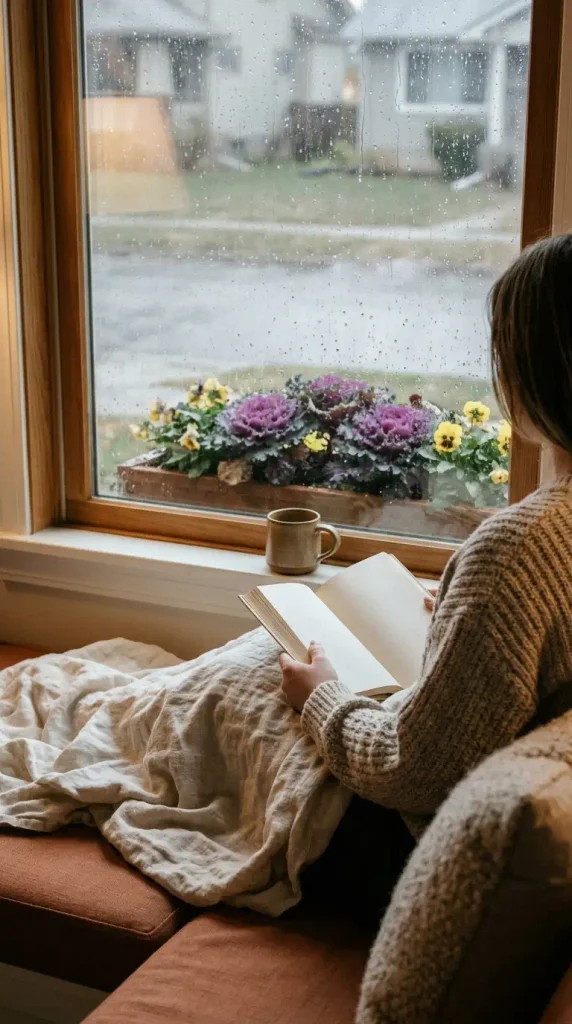
For the seat side of this view, our window seat reading nook ideas cover cushions, light, and storage for the inside half.
Nothing in the box rises past the bottom quarter of the glass. The sidewalk still gets a full box, and your reading chair keeps its light and its view.
Before you plant, sit in your chair and look down. Plan from there.
7. A Shade Box for a North-Facing Window
North light is soft, steady, and stingy. Sun-hungry mums sulk here, but foliage plants carry color without needing much light.
A landscaping panel asked about a north-facing apartment window recommended English ivy as the base. Build from there:
Plant this shade box
Skip mums on a north window. They want full sun, and in shade they open patchy and fade fast.
8. Mini Pumpkins Raised on Upturned Clay Pots
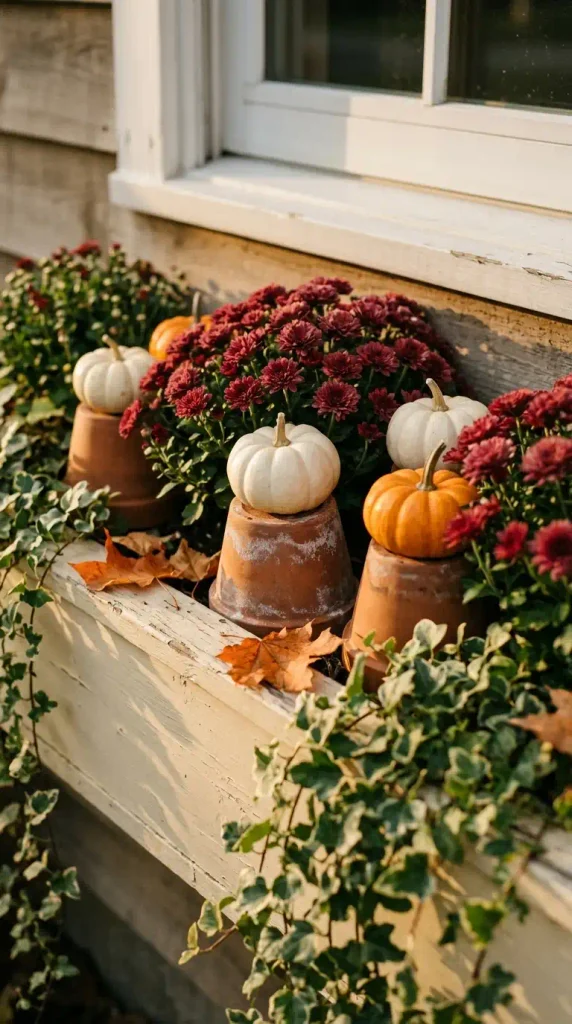
Pumpkins sitting flat in damp potting mix go soft from the bottom up. Small ones are the right scale for a box: ‘Baby Boo’ for white and ‘Jack Be Little’ for orange both fit between plants without crowding them.
One gardener’s trick fixes the rot and the layout at once. She propped her small pumpkins on little clay flowerpots to lift them higher, and shaped the planting so the tops formed a triangle peaking near the middle of the box.
💡 Quick Tip
Flip a small clay pot upside down under each pumpkin. The base stays out of wet soil, and the pumpkin sits high enough to read from the street.
Odd numbers look less staged. Three pumpkins beat four.
9. No Window Box Spot? Set the Box Where You Already Sit
A window box doesn’t strictly need a window. On a stoop, a deck, or a tiny patio, the same long planter works on a rail or on a stand, and it lands right next to your chair instead of above it.
One porch gardener without under-window boxes set two metal boxes on top of upside-down wire baskets, then ran wire through the drainage holes to hold each box steady. For balconies, a railing planter like the BirdRock Home metal railing planter lists at $49.96 at Walmart.
| 🪴 Railing planter | 🧺 Box on a stand |
|---|---|
| Uses zero floor space. | Takes one corner of the porch or step. |
| Best for: balconies and deck rails. | Best for: stoops, steps, and patios. |
| Watch out for wind on upper floors. | Wire the box to its stand so it can’t tip. |
| 🔑 Renter-safe with clamp brackets. | 🔑 Renter-safe, nothing attached. |
Put the stand beside your outdoor seat, on the side you don’t set your mug.
10. Free Color From Yard Cuttings
The cheapest fall window box filler is often already growing ten steps away. Garden designers in Michigan suggested tucking cut stems from shrubs with strong fall color, like hydrangea, dwarf fothergilla, or PJM rhododendron, between the plants in a box, then watering well so they stay fresh.
Cut stems don’t need roots to look good for a few weeks. They just need to stand up straight and stay moist.
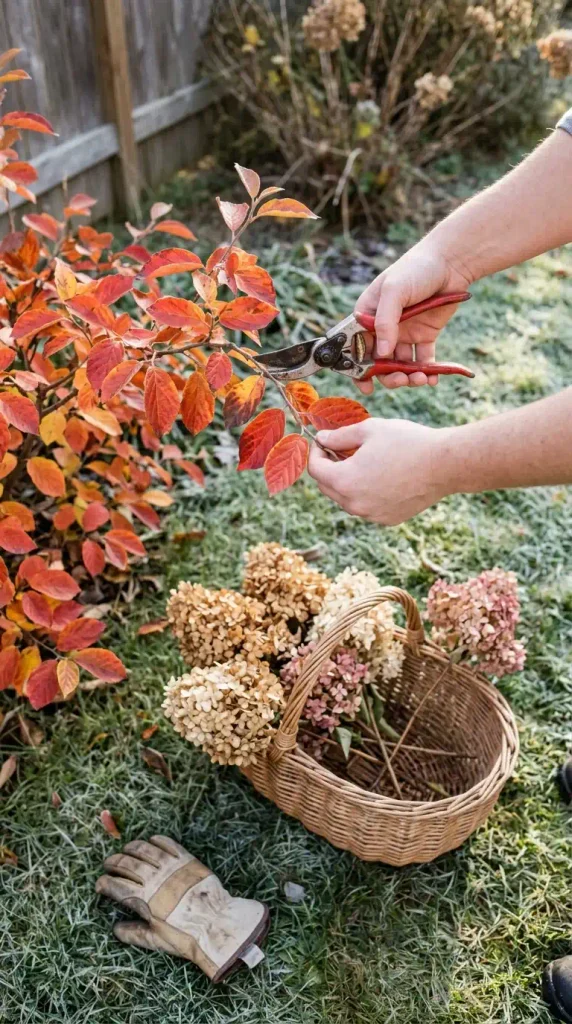
Summer annuals pulled, two mums left standing, and bare soil showing in every gap.
Fothergilla and hydrangea stems pushed deep into the gaps, watered in, and the box reads full for the cost of a pair of pruners.
Renters, ask before you cut the landlord’s shrubs. Most say yes to a few stems.
11. Dried Stems for Height That Doesn’t Block Light
Height is where small windows get into trouble. A plant tall enough to impress from the street is often tall enough to darken the room behind it.
Dried material fixes that. Garden Gate tucked these along the back of a fall box and between plants in the center:
- ▸Field corn tassels, for a pale gold fringe.
- ▸Cattails, for brown vertical lines.
- ▸Maiden grass seedheads, which catch late sun.
- ▸Dried hydrangea blooms, for soft, papery bulk.
Stems are thin, so light slips past them. Cut each one to stop at your glass line from idea #6.
On an exposed corner, push them deep. Dried heads are light and the first gusty night will test them.
12. An All-White Box for Brick or Dark Siding
White holds on at dusk, when orange has already gone gray. Against red brick, navy clapboard, or black siding, a white box pops from the end of the block.
Gardeningetc points out that white flowers paired with crisp green foliage give a fall box a polished look, and lists pansies, heather, and hellebores among the whites that work in fall.
One color, three textures. That’s what keeps a single-color box from looking flat.
13. A Kitchen Window Herb Box
Kitchen windows earn a working box. Many herbs are sized right for window boxes and handle light shade, and a couple of leafy greens add harvest color without needing much room.
Plant this herb box
Brush the thyme when you water and the whole kitchen corner smells green for a minute.
Harvest outer leaves only. Cut from the center and the box goes bald by Thanksgiving.
14. A Jewel-Tone Box Instead of Straight Orange
Plum, ruby, and deep gold look richer than orange against white siding, and they keep a box from blending into every pumpkin display on the street.
Build it from plants that carry color in the leaves as well as the flowers. A garden center’s fall window box used celosia ‘Intenz’ for bright plumes and heuchera for colorful foliage. One decor blogger added purple ornamental peppers for gloss.
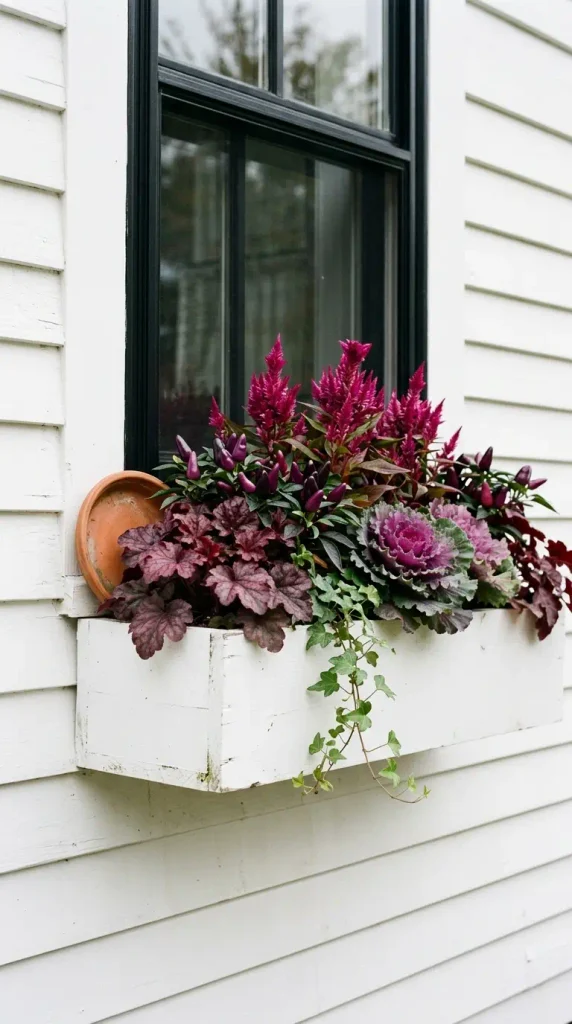
Pull the peppers at the first frost and slide a second heuchera into the hole.
15. A Garden Center’s Exact Fall Window Box Plant List
Counts help more than plant names. Mahoney’s Garden Center published the exact shopping list behind one of its fall window boxes, and it shows how full a fall box really gets.
| Plant | Count |
|---|---|
| 🌾 Annual fountain grass | 2 |
| 🥬 Ornamental cabbage | 1 |
| 🌼 Yellow mums | 3 |
| 🔥 Celosia ‘Intenz’ | 4 |
| 🍂 Heuchera | 3 |
| 🌸 Pansies | 4 |
| 🎃 Sugar pumpkins | 4 |
That’s 17 plants plus 4 pumpkins in one full-size box. For a narrow 24-inch window, halve the counts and keep the ratios.
Seventeen sounds like too many. In fall, it’s about right.
16. Grass in the Middle, Kept Short
Ornamental grass gives a box the one thing most fall plants lack: movement. Annual fountain grass adds height and sways in every breeze.
Placement matters. One gardener’s rule for long plantings is that the tops of the plants should form a triangle that peaks near the middle, not tall spikes stuck on each end. Garden Gate went the other way with a soft grass, letting stipa spill over the front edge to soften it.
⚠️ Watch Out
Full-size fountain grass can plume well past a small window’s glass line. On a short window, use one compact grass in the center, or let a fine-textured stipa trail over the front instead.
Annual fountain grass browns after frost. Many people like the tan plumes through November, so leave them until they flop.
17. A Faux Insert You Reuse Every Fall
Live arrangements cost real money every season. One Ohio blogger with four window boxes found Pinterest’s live designs could run into hundreds of dollars, so she built faux inserts instead and reuses them year after year.
The method is simple:
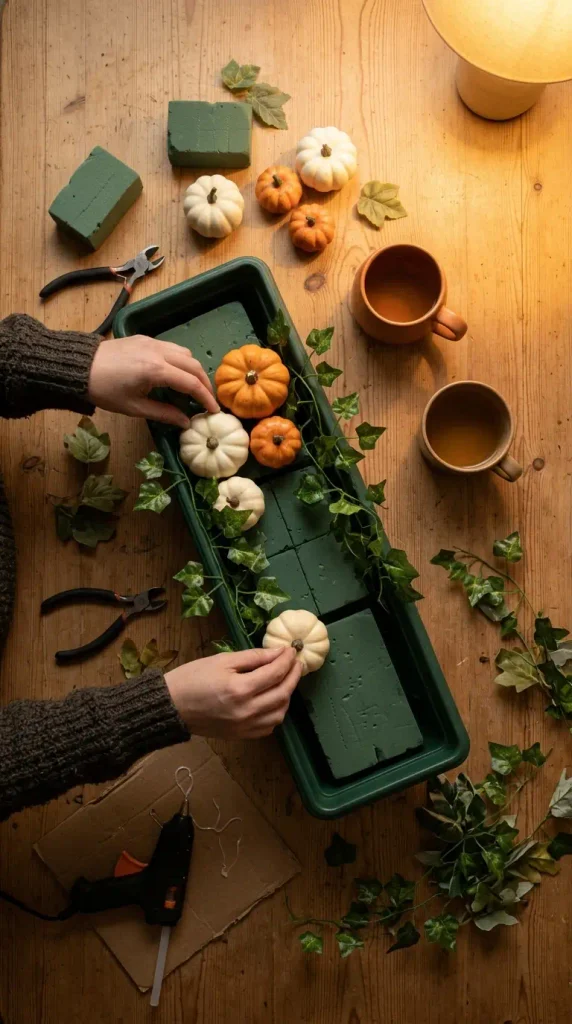
Cut dry floral foam to fill a liner that fits inside your box.
Push faux ivy stems into the front edge so they trail over the lip.
Set faux pumpkins or gourds on wooden picks and press them in across the middle.
Drop the whole liner into the box. Lift it out and store it in a bin after Thanksgiving.
Swap faux leaf garland for the ivy and the same insert changes its look next year.
18. A Succulent Box for Dry Western Windows
Desert and dry-climate gardeners can skip mums entirely. Rose-shaped echeveria and bold crassula work as both the focal plants and the fillers in a box, and their blue-green, red-tipped rosettes read as fall without a single pumpkin.
Fill the box with a gritty cactus mix, not standard potting soil.
Let the mix dry out between waterings.
Bring the box in, or cover it, when a frost is forecast.
Mixing succulents with thirsty pansies in the same box.
A box with no drainage holes.
Leaving soft succulents out through a hard freeze.
Tuck two or three small gourds between the rosettes in late October. That’s all the fall signal this box needs.
19. A Halloween Box That Still Looks Right at Noon
Halloween boxes tend to look great at 9 p.m. and odd at lunch. The fix is to build the box on plants, then add a few props, instead of the other way round.
A recent Halloween window box roundup suggested starting from dark foliage and dry texture, keeping decorations small enough that the window still opens, and using ribbon only under a covered porch or bay window.
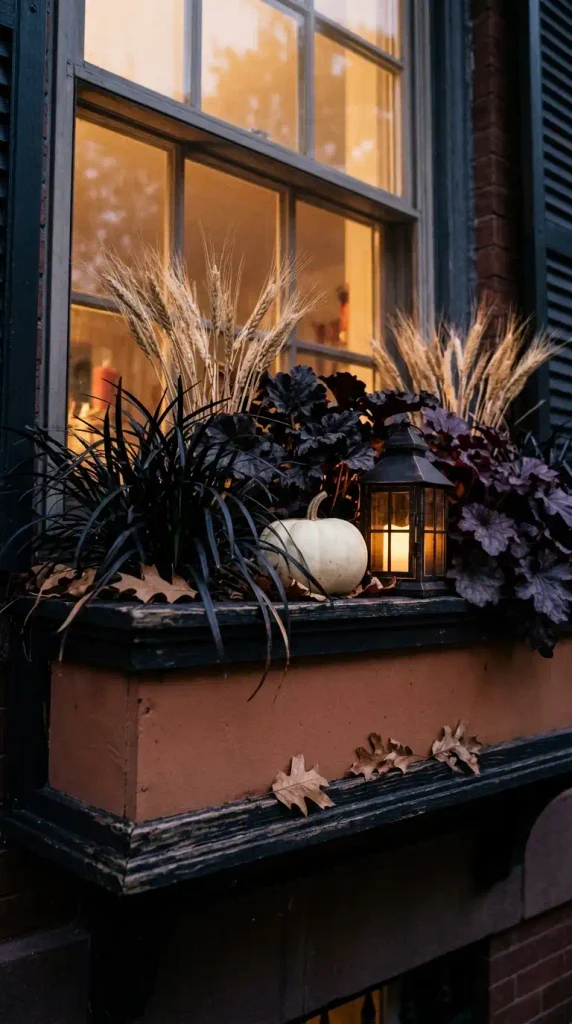
- ▸Plant first: black mondo grass and dark heuchera carry the mood by daylight.
- ▸Add one white pumpkin for contrast, not a crowd of props.
- ▸Light it with a warm LED lantern, never a real flame near dry stems.
- ▸Skip blue-white bulbs. Cold light flattens warm fall colors to gray.
On November 1, pull the props and keep the plants. The box rolls straight into fall.
20. Pansies, Snapdragons, and Dusty Miller for Blooms Into Winter
Cold-loving flowers are the backbone of a box that lasts. Mississippi State Extension pairs pansies with dusty miller and ornamental kale for cold-weather containers, with the dusty miller as the tall focal plant and pansies as the spiller. Its horticulturists also point to snapdragons as one of the most overlooked fall plants, and a natural partner for kale, pansies, and violas.
Pick dwarf snapdragons for a window box. Tall cutting types topple in a narrow container. If you want the same trio in freestanding pots by the door, our 16 fall planter ideas for sweater-weather evenings carry it onto the porch.
21. Plant a Second Liner Now for the Winter Swap
Swapping seasons is easiest when the whole planting lifts out in one piece. HomeZada’s fall window box tips suggest a liner inside the box to simplify every seasonal change, then lifting the liner out at the fall-to-winter switch.
December, cold fingers, digging spent mums out of half-frozen mix one plant at a time.
Lift the fall liner out, drop in a winter liner you filled with evergreen boughs in the garage, and you’re done in minutes.
Perennials like heuchera in the fall liner can go into the garden instead of the trash, as long as the ground isn’t frozen yet.
22. Planting Late in October? Go Big and Pack Tight
Most guides tell you to plant fall window boxes 6 to 8 weeks before your first expected frost. If you’re reading this in late October, that window may already be closing. You can still plant. You just shop differently.
Garden Gate’s advice for late-season containers is to pack plants together, since growth slows to a crawl at the end of the season and you want the finished look on day one. Pair that with UW Madison Extension’s tip to buy kale already colored.
| On schedule | Planting late |
|---|---|
| Smaller pots are fine. | Buy the biggest pots you can carry. |
| Snug spacing. | Root balls touching, no soil showing. |
| Buy kale green and wait. | Buy kale already colored. |
| Mums in tight bud. | Lean on pansies and kale over mums. |
If you’re unsure how close your first frost is, watch the overnight low instead of the calendar, using the Night-Temp Ladder in our beginner fall garden guide.
23. Evergreens and Twigs for the Thanksgiving Handoff
The box doesn’t have to go bare after the last mum. Garden designers in Michigan build winter boxes on evergreens like holly and cedar, then add red- or yellow-twig dogwood, curly willow, or kiwi vine for color that stands up in snow.
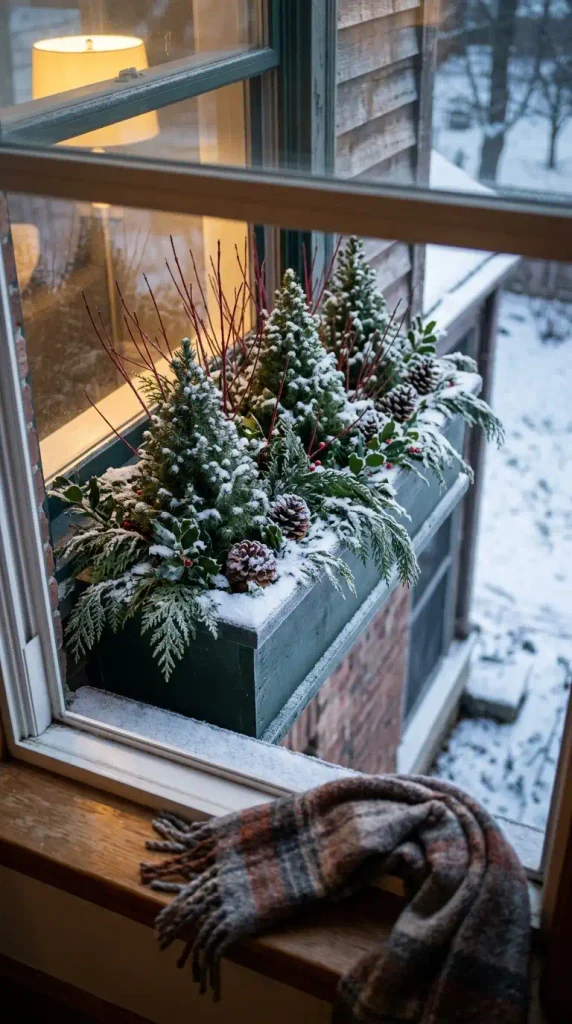
Build the winter handoff
One honest catch: dwarf evergreens in a box often don’t survive the winter, so plan to plant them in the ground in spring. Check the USDA Plant Hardiness Zone Map by zip code first, so you know whether a spruce will make it in your yard.
24. Water Less, but Check More
Fall boxes dry out slower than summer ones, until a windy, sunny week proves otherwise. The Home Depot’s rule of thumb is simple: water when the soil feels dry.
A box under eaves or an awning can stay bone dry through a week of rain. Feel the mix, don’t trust the weather.
For ceramic boxes, one New York landscaper’s advice is to empty them before winter, turn them upside down, and store them in a garage, shed, or attic.
25. Match the Box to the Trim
Plants change every season. The box stays. Gardeningetc points out how sharp a box looks when it coordinates with the window frame, and Brick & Batten’s designers suggest staining a box to suit the house rather than leaving it builder white.
Owners can paint the box to match the trim, or one shade darker. Renters can get the same effect at the store by choosing a box color that already matches what’s there: black boxes under black frames, white under white.
A box that matches the trim looks built in. Even a half-planted box in late November reads as part of the house, not a leftover.
Get the box right once, and every season after is just a planting job.
Fall Window Box FAQ
When should you plant fall window boxes?
Aim for 6 to 8 weeks before your first expected frost, which lands in September for much of the US. You can still plant later in October. Buy larger plants, pack them tightly since growth nearly stops in cold weather, and choose ornamental kale that’s already colored. Pansies and kale handle late planting better than mums do.
What do you put in fall window boxes?
Start with cold-tolerant plants: garden mums, ornamental kale or cabbage, pansies, heuchera, snapdragons, and dusty miller. Add a trailing plant like ivy or creeping jenny over the front edge. Then layer in small pumpkins, gourds, dried hydrangea, or cut stems from your yard for texture. Keep anything tall below the lower part of your window glass.
Can you put mums in window boxes?
Yes, and the easiest way is to leave each mum in its nursery pot and sink the pot into the box. Mums need full sun, so skip them on north-facing windows. They also fade faster than kale or pansies, so when the blooms brown, lift the pot out and drop in a fresh plant without disturbing the rest of the box.
How many plants do you need for a fall window box?
More than you’d use in spring. Fall plants barely grow, so pack root balls shoulder to shoulder. A 24-inch box holds about eight plants, such as two mums, one kale, and five pansies. One garden center’s full-size fall box used 17 plants plus four pumpkins. Halve that for a narrow window and keep the same mix of tall, bushy, and trailing plants.
How do you hang a window box without drilling?
On a balcony or deck, use adjustable rail brackets that hook over the top rail and support the box from below. Hang the box on the inside of the rail so water doesn’t drip on anyone below, and check your lease or HOA rules first. Never leave a box loose on a sill above a sidewalk. It needs a bracket or enclosure holding it in place.
What do you do with fall window boxes in winter?
Lift out the fall planting, ideally in a removable liner, and plant any perennials in the garden if the ground isn’t frozen. Then fill the box with evergreen boughs, dwarf evergreens, red-twig dogwood, and pinecones for a winter look. Empty ceramic boxes and store them upside down in a garage or shed so freezing soil doesn’t crack them.
Your Window, Your View
Fall window boxes don’t need a big house or a big budget. They need the right length, a tight planting, and plants that like the cold. Start with the 24-inch starter box, check the Glass-Line Rule from your favorite chair, and let the kale handle the rest of the season.
When the last mum browns, lift it out and keep going. A box that changes with the weather is one you’ll actually notice every day.
Save this list to your fall porch board, so it’s ready the next time the garden center rolls out a fresh rack of kale.
Keep reading
More cozy nook ideas
 Fall Decor
Read →
Holiday Decor on a Budget: Where to Spend and Where to Save
If last December’s holiday decor money went to plastic picks, a glitter sign, and a box of red balls you were tired…
 Fall Decor
Read →
21 Vintage Pumpkin Ideas for Small Apartments, No Porch or Nails Needed
No porch, no mantel, and a lease that frowns on nail holes. You still get a fall corner. You need one shelf,…
 Fall Decor
Read →
14 Witchy Backyard Ideas for a Whimsical, Storybook Halloween
No old oak grove, no permission to dig, no money for a garden cottage. A witchy backyard still fits. You need one…