
Cozy Textures and Layering: How to Make a Room Feel Warm, Not Just Look Warm

Your corner has a chair, a lamp, and a blanket. It still feels like a waiting room.
That gap is exactly what cozy textures layering decor fixes, and it has almost nothing to do with buying more things. Most small apartment corners fail the same way: everything in them feels identical under your hand. Same softness, same weight, same finish. Your eye reads variety in the photo. Your body reads flat.
Change that and the corner turns over in a single afternoon. No paint. No drilling. No landlord conversation.
Here’s what you get below: the 3-Touch Rule that tests any corner in about ten seconds, five layering rules that follow from it, three real texture stacks with current IKEA prices, and the two ways all of this quietly falls apart around month three.
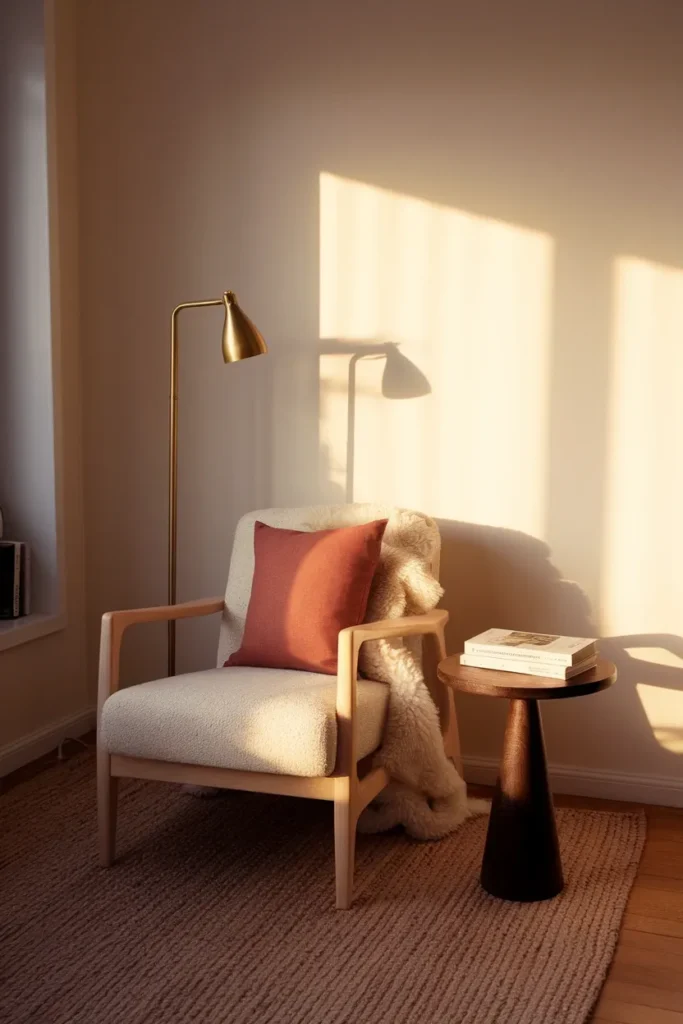
The 3-Touch Rule: Three Feels Within Arm’s Reach
Here is the whole method, and it is the highest value thing on this page, so it goes first.
Within 18 inches of where your hand naturally lands when you sit down, you need three different kinds of touch:
- Something that gives. It compresses when you press it and slowly comes back. Sheepskin, a down blend lumbar pillow, a boucle cushion, a floor pouf.
- Something with tooth. It has grip, nap, or a visible weave you can feel with a fingertip. Waffle cotton, chunky knit wool, jute, linen with slub, a ribbed ceramic.
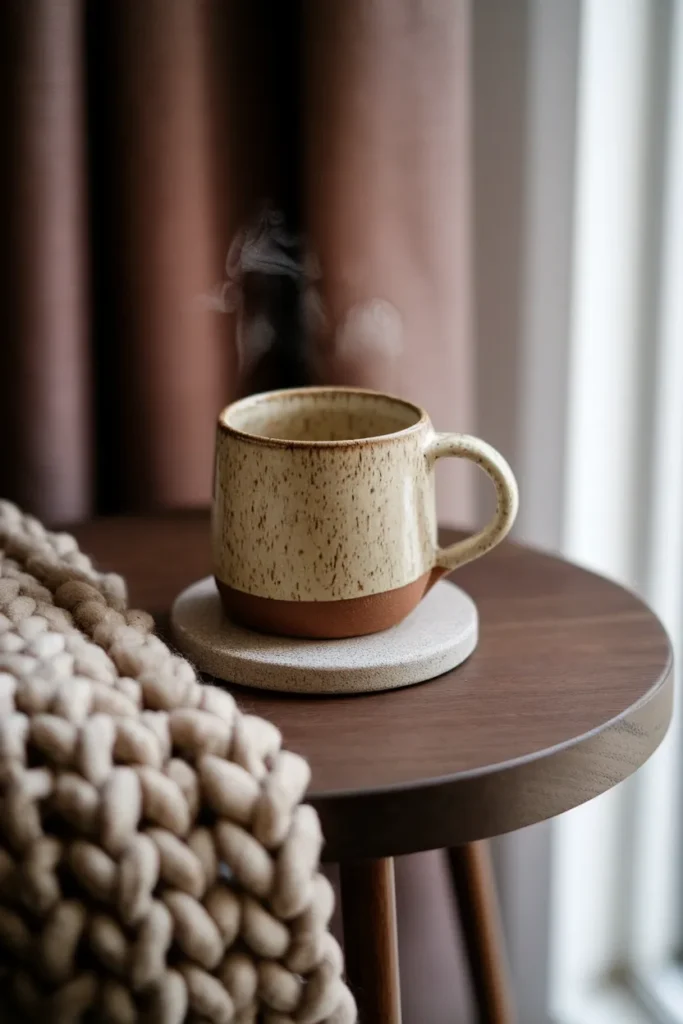
- Something smooth and cool. It resists you. Raw wood, a glazed mug, a stone coaster, a metal lamp neck, a leather book spine.
Miss any one of the three and the corner reads flat. Miss the third one most often, because the smooth cool layer is the one nobody thinks of as texture at all.
Test it right now without moving anything. Sit in your corner, close your eyes, and touch three things without leaning. If two of them feel like the same thing, that is your fix, and it usually costs less than a takeout dinner.
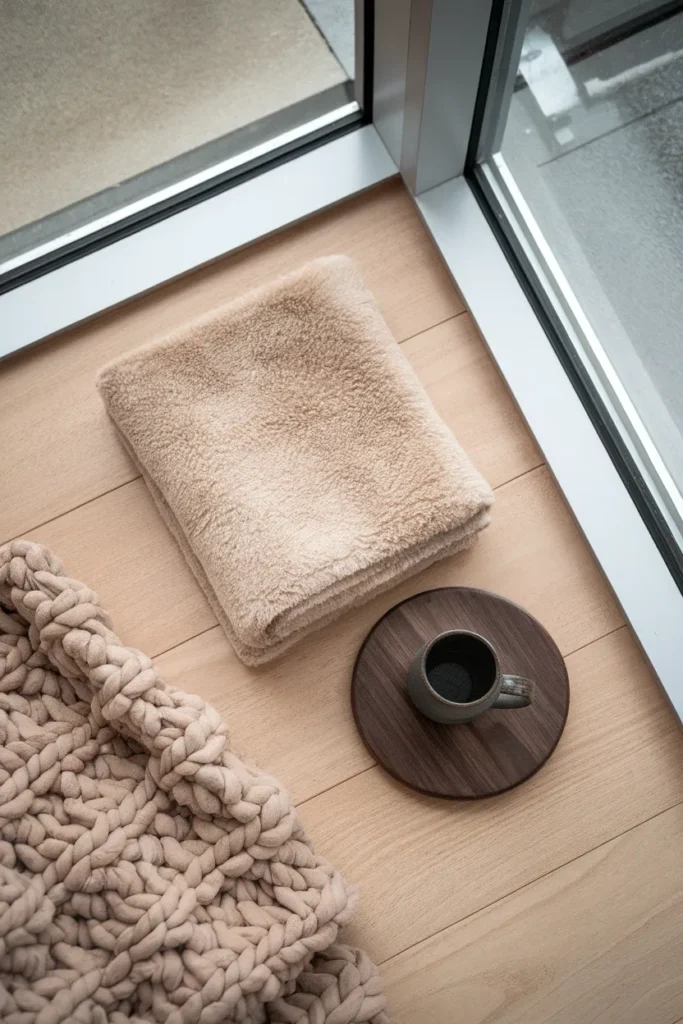
What Texture Actually Does to a Room
Texture is the surface quality of a thing, and it comes from two places: how the material is built, and what is printed or applied on top of it. Design educators split those into structural texture and added visual texture, and the Utah State University Extension guide to design elements lists the vocabulary worth stealing: rough, smooth, dull, shiny, firm, crisp, fuzzy, bulky, nubby, soft, shaggy, flat, sheer, loopy.
Read that list out loud and notice something. Almost every word describes how a thing behaves when you touch it, not how it photographs.
That is the whole reason flat rooms feel cold. A room can be full of texture pictures, a grasscloth print, a photo of a knit, a rug with a woven pattern printed flat, and still give your hand nothing.
So the working definition we use: texture is what your skin finds when your eye stops looking.
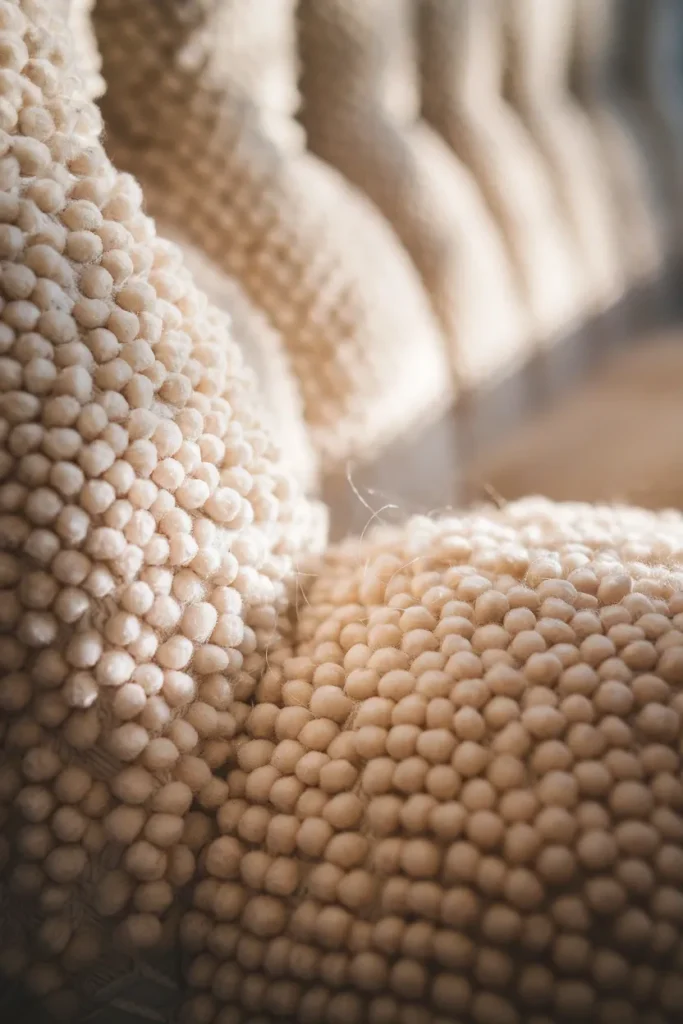
Rule 1: Layer by Weight, Not by Color
Most guides tell you to start with a neutral palette. Fine, but that advice sorts your corner by color and leaves the actual problem untouched.
Sort by weight instead. Every corner has six weight slots, from the floor up, and each slot wants a different density. Fill all six and the color question mostly solves itself, because you will have accidentally built variety.
The Texture Weight Table
| Slot | Job it does | Spec to look for | Real example |
|---|---|---|---|
| Floor | Kills echo, warms bare feet | Natural fiber, 1/2″ pile or more | IKEA LOHALS jute, 5’3″ x 7’7″, 100% jute, $129.99 |
| Seat | The “gives” layer | Real pile, not printed | IKEA ULLERSLEV sheepskin, 33″ x 22″, $79.99 |
| Back | Lumbar support disguised as decor | 12″ x 20″ insert, feather or down blend | Boucle or chunky knit lumbar pillow |
| Lap | The layer you actually use | 50″ x 60″, wool or waffle cotton | Waffle weave cotton throw |
| Window | Softens the hardest surface in the room | Hung 4 to 6 inches above the frame | Linen or linen blend panel |
| Light | Warms every other texture at once | 2700K, on a dimmer | Warm white LED in a low lamp |
Print that table, walk your corner, and mark the empty slots. Most people find they have three of six filled and four throw pillows in one of them.
The chair itself does more work than any accessory, which is why Pinterest search for “comfy reading chair small spaces” ran up 455% year over year into 2026 while generic texture searches stayed flat. Seating is where texture pays off first.
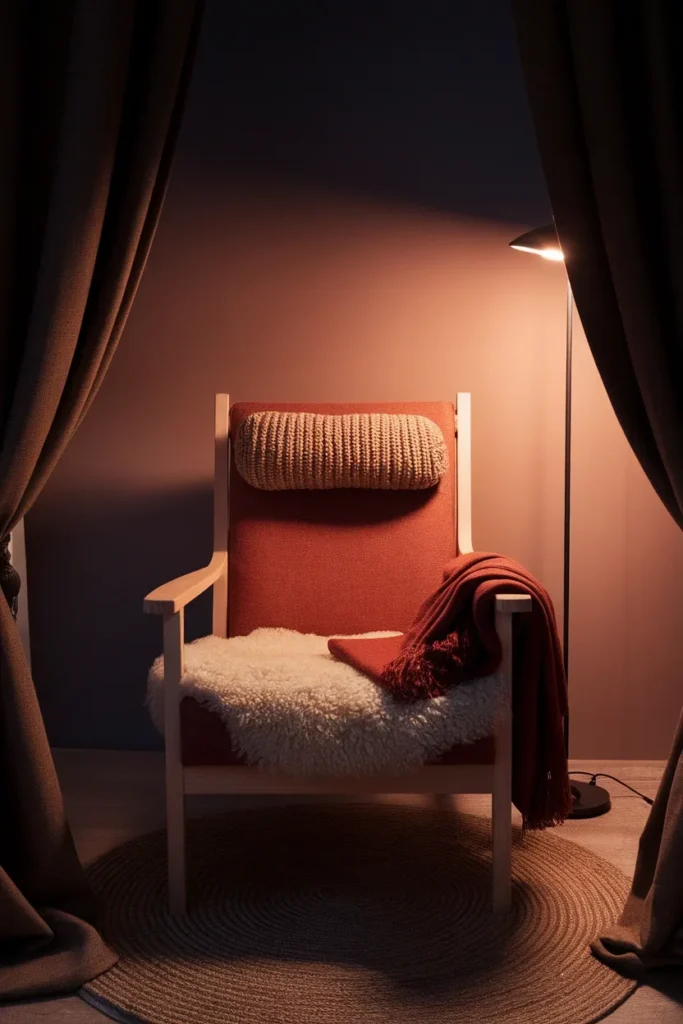
Rule 2: Every Soft Thing Needs a Hard Partner
Pile softness on softness and you do not get warmth. You get a laundry basket.
The correction is a pairing habit. For every soft layer you add, put one hard or smooth object within reach of it. Sheepskin on the seat gets a bare wood arm left uncovered. A chunky knit throw gets a glazed ceramic mug on a stone coaster. A wall of fabric gets one brass or blackened metal lamp neck.
Hard surfaces do something soft ones cannot: they bounce a little light and hold a crisp edge. That edge is what keeps the corner from reading like a pile.
Two practical pairings that work in almost any small space:
- Jute plus glazed ceramic. The rug is rough and matte, the mug is slick and reflective, and they sit two feet apart. Instant contrast, zero cost if you already own a mug.
- Wool plus raw wood. Leave one arm of the chair bare. Resist the urge to cover every inch.
The trade-off worth naming: bare wood is colder to the touch in a drafty apartment in January. If your corner sits under a single pane window, put the hard partner on the side table instead of the chair arm.
Rule 3: Warm Light Is the Texture Everyone Forgets
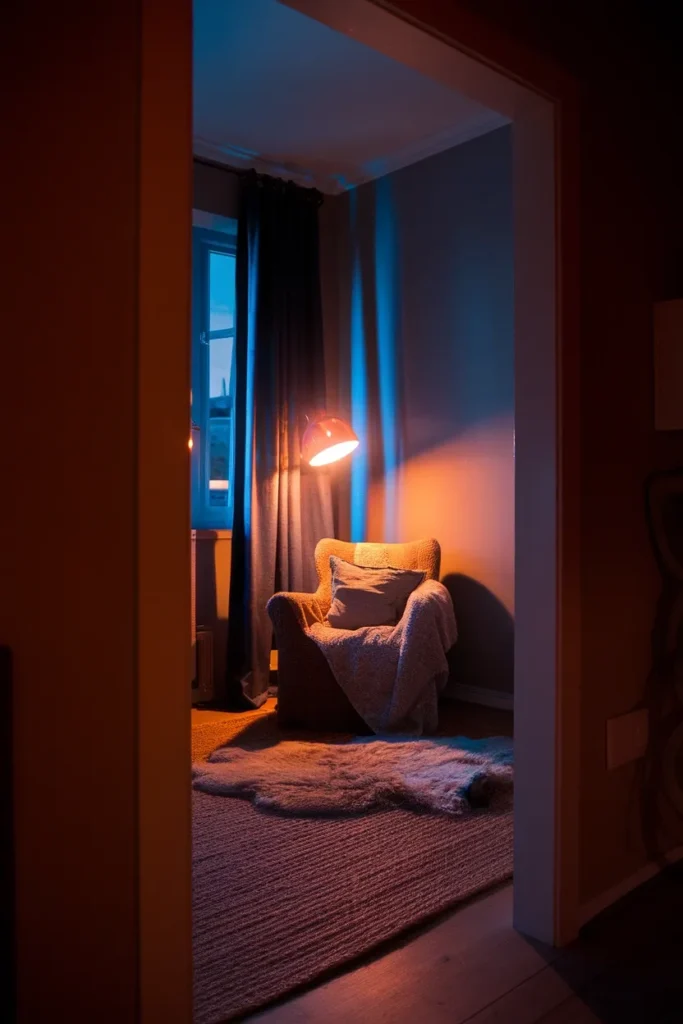
You can own five textures and still have a corner that feels like a break room, because a 4000K ceiling bulb flattens every one of them.
Color temperature is the lever. Warm white sits around 2700K and gives wool, jute, and wood their depth back by pushing amber into the shadows. Cool white pushes blue in and drains it out. Same throw, same rug, completely different corner.
Height matters as much as temperature. Get the light source below eye level, which for most seated readers means the bulb lands somewhere under 48 inches. A low pool of light rakes across a knit and shows every loop. An overhead source hits it straight on and erases the shadows that make texture visible in the first place.
Three quick moves, in order of payoff:
- Swap the bulb in whatever lamp you already own to 2700K.
- Move that lamp behind and slightly to one side of the chair, not in front.
- Add a dimmer plug so 8pm and 11pm are not the same brightness.
If you want the full setup with fixture heights and a real evening dimming schedule, we broke it down in our guide to warm living room lighting that actually works.
Rule 4: The Texture You Hear
Here is the angle almost nobody writes about, and it is the reason hard-floored rentals feel cold no matter how many pillows you buy.
Soft texture is sound absorption. A room with bare laminate, blank drywall, and a single thin curtain has nothing to stop a sound wave, so speech bounces, footsteps crack, and your own page turns sound loud. Your brain files all of that under “empty.” You interpret empty as cold, and then you go buy another throw pillow, which does almost nothing because pillows are small.
Surface area is what fixes echo, not softness alone. Rank the layers by how much square footage they cover:
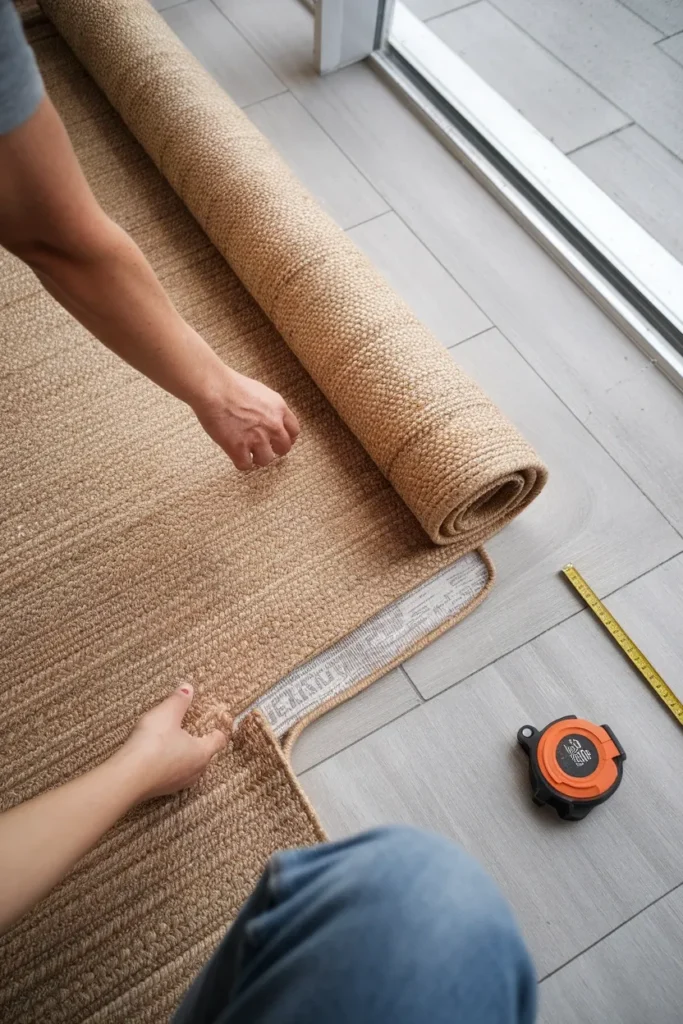
- Rug: a 5’3″ x 7’7″ jute rug covers roughly 40 square feet. Biggest single win in the room.
- Curtains: floor length panels on a wide rod cover more wall than most people expect, and they work even when the window behind them is small.
- Bookcase full of books: paper is a genuinely good diffuser. A full shelf breaks up sound where a bare wall reflects it.
- Throw pillows: roughly 3 square feet total. Nice to touch, nearly irrelevant to sound.
The sensory test: read one page out loud in your corner. If your own voice comes back at you, you have a surface area problem, not a styling problem.
Rule 5: Anchor the Whole Stack to One Real Corner
Texture layering fails when it is spread thin across a whole room. Six half-layered zones read as clutter. One fully layered corner reads as intentional, and it is also the version you can afford.
Pick the corner by traffic, not by looks. You want the spot nobody walks through, which in most one bedrooms is the corner diagonally opposite the door.
Then check three dimensions before you buy anything:
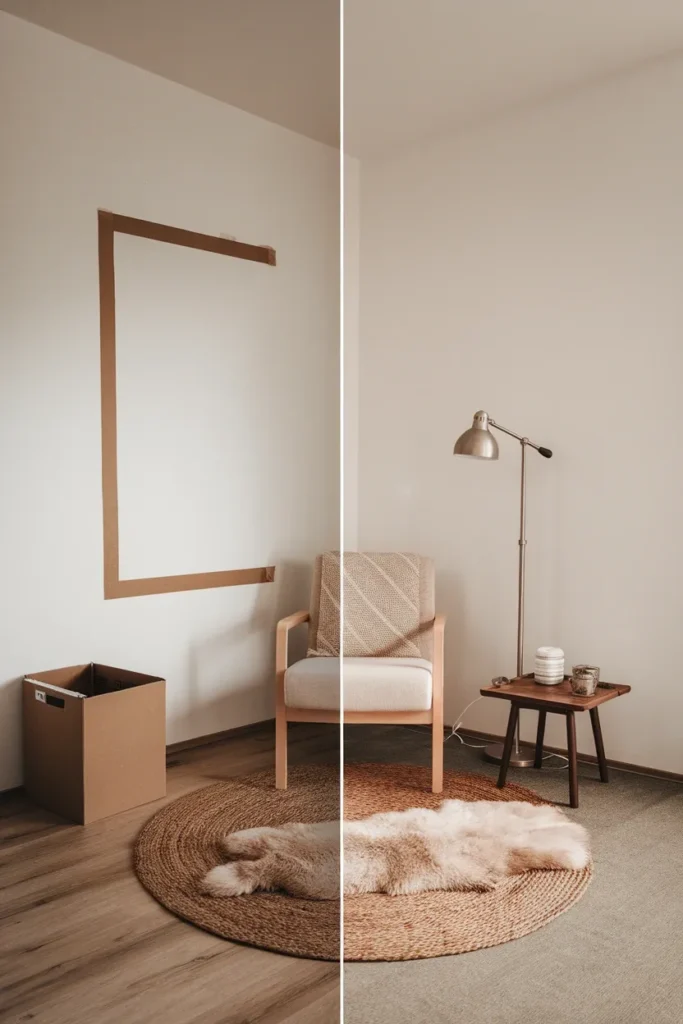
- Chair footprint. A POÄNG measures 26 3/4″ wide by 32 1/4″ deep. Chalk that outline on the floor with painter’s tape first.
- Clearance. Leave at least 24 inches of walking space on the open side, or you will bang a shin every day and quietly stop using the corner.
- Reach. Side table surface within 18 inches of the chair arm, at roughly seat height. A POÄNG seat sits 16 1/2″ off the floor, so a side table between 16″ and 22″ tall lands right.
Walk it, tape it, sit on the floor inside the tape for two minutes. If the tape outline already feels tight, the chair will feel worse. Our full walkthrough for turning an unused corner into seating lives in this dead corner reading nook build.
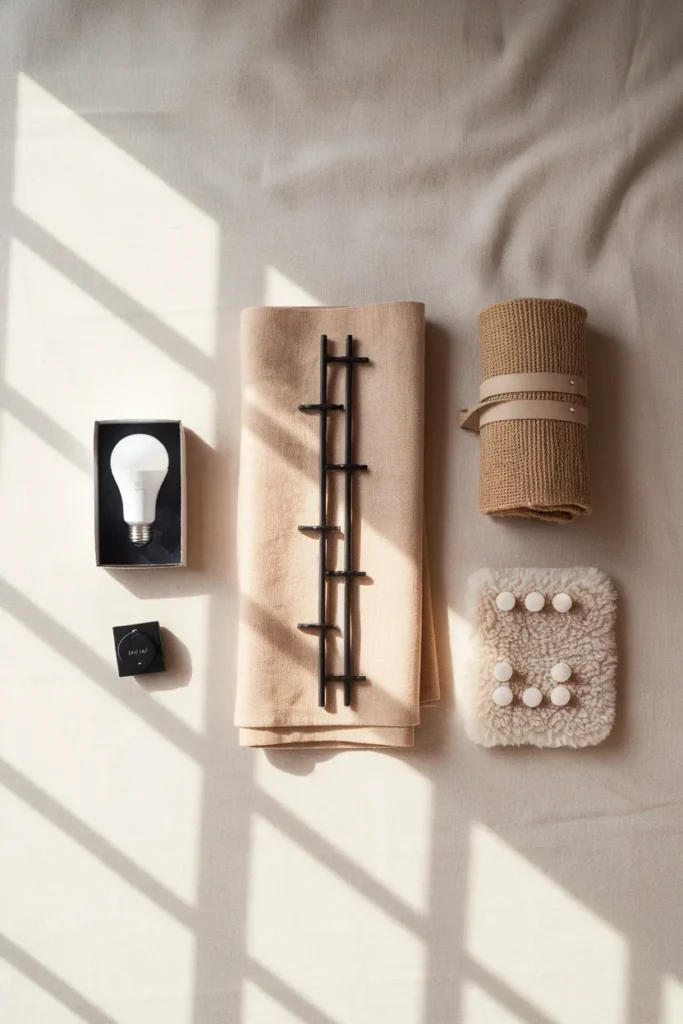
The Renter’s Texture Kit: No Drill, No Paint
Every competing guide on this topic assumes you can wallpaper, reupholster, or repaint. If your lease says otherwise, here is the cozy textures layering decor version that leaves no marks.
Five moves, all reversible:
- Bulb swap. A 2700K warm LED in an existing lamp, roughly $5. The Department of Energy notes that residential LEDs use at least 75% less energy and last up to 25 times longer than incandescents, and that incandescents release about 90% of their energy as heat, which also means an LED will not scorch a linen shade.
- Tension rod curtains. Inside mount, no anchors, no holes. Linen or linen blend for slub texture.
- A real rug over the bad floor. Jute if you want tooth and echo control, low pile washable if you have pets.
- Drape, do not upholster. A sheepskin over the seat and a wool throw over one arm changes the feel of a landlord grade chair without touching the chair.
- Command hooks for one soft wall piece. A woven wall hanging or a quilt on a slim rod adds surface area where drilling is banned.
The order matters. Bulb first, floor second, everything else after, because those two change the most square footage per dollar. If you are furnishing a whole rental and not just a corner, our renter friendly apartment decor guide sequences the rest.
Three Texture Stacks With Real 2026 Prices
Three ways to build the same corner, depending on what you already own. All prices below were checked on ikea.com/us in August 2026 and are used as archetypes, so swap in any brand that hits the same spec.
Stack A: Chair First (about $229 in verified pieces)
- POÄNG armchair, birch veneer with Knisa light beige cushion: $149.00
- ULLERSLEV sheepskin, 33″ x 22″, over the seat: $79.99
- Add from what you own: one 12″ x 20″ lumbar pillow, one 50″ x 60″ throw, one hard surface side object.
Best when you have a decent floor already and nowhere to sit. The 16 1/2″ seat height is low enough to curl sideways in, which is the actual reason this chair keeps showing up in reading corners.
Stack B: Floor First (about $210 in verified pieces)
- LOHALS jute rug, 5’3″ x 7’7″, 1/2″ pile: $129.99
- ULLERSLEV sheepskin on top of existing seating: $79.99
- Add from what you own: floor cushion or pouf, one throw.
Best when the room echoes, the floor is laminate or tile, or you are working with a window seat or a built-in bench and do not need a chair at all.
Stack C: Zero Furniture (under $100 if you own the seating)
- Sheepskin or a chunky knit throw on whatever you sit on now.
- One 2700K bulb and a dimmer plug.
- One hard smooth object within 18 inches: a wood tray, a ceramic mug, a stone coaster.
Best for a bedroom corner, a dorm, or a rental you are leaving in six months. It hits all three touches of the 3-Touch Rule for roughly the price of one throw pillow set.
Where Texture Layering Goes Wrong at Month Three
Styling day photographs well. Month three is where the truth lives, and no competing article on this topic mentions any of it.
Jute sheds. A new jute rug drops loose fibers for the first several weeks, especially along cut edges. It is normal and it stops. Vacuum without a beater bar, or the rotating brush will chew the weave and speed up the shedding you are trying to end.
Boucle and chunky knits pill. Anywhere your arm rests, the loops abrade. A cheap sweater comb fixes it in about two minutes per throw. Do it before the pills mat together, not after.
Sheepskin flattens. Sitting on real sheepskin compresses the pile. Shake it out weekly and brush against the nap with a wide tooth comb. It comes back. Machine washing usually does not end well, so check the care label before you assume it can go in.
Jute plus moisture equals a stain. Natural jute browns when it gets wet and stays browned. If your corner is near a plant you water or a window that leaks, choose a washable low pile instead and give up a little tooth.
Everything shows pet hair. Sheepskin and boucle are hair magnets. If you have a shedding animal, put the texture where the animal does not sit, and keep the low pile washable rug on the floor.
Failure mode to plan for: skip the vacuum and comb routine entirely and a layered corner looks tired inside one season, which people usually blame on the pieces rather than on the ten minutes a month they never spent.
Frequently Asked Questions
How many textures should a room have? Three distinct touch types is the working minimum, which is what the 3-Touch Rule tests for. Five to six is comfortable. Past that you are usually adding count without adding contrast, so the room gets busier and no warmer.
What textures make a room feel warm? The ones with depth you can feel: sheepskin, wool, boucle, waffle cotton, jute, raw wood. Anything printed to look woven adds nothing to the feel. Warm light at 2700K makes all of them read warmer without buying a thing.
How do you layer textures without it looking cluttered? Anchor everything to one corner instead of scattering pieces around the room, and pair every soft layer with a hard or smooth one. Clutter is usually a pairing failure, not a quantity failure.
Can you layer textures in a small apartment? Yes, and small spaces respond faster because one corner is a larger share of the room. Start with the floor and the bulb, since those two change the most square footage per dollar.
What is the difference between texture and pattern? Pattern is what your eye sees. Texture is what your hand finds. A printed basketweave is pattern. An actual basketweave is texture. Rooms that feel flat usually have plenty of the first and none of the second.
How do I add texture if I cannot paint or drill? Tension rod curtains, a rug, a sheepskin or throw draped over existing furniture, adhesive hooks for one soft wall piece, and a warm bulb. All five come out clean at move out.
Do I really need a rug? If the floor is hard and the room echoes, yes, because nothing else covers that much surface area. If you already have carpet, put the money into seating and lighting instead.
Start With One Slot
You do not need the whole table filled this weekend. Pick the one empty slot that covers the most square footage, usually the floor or the window, and fill just that.
Then sit down, close your eyes, and run the 3-Touch Rule again. When your hand finds something that gives, something with tooth, and something smooth and cool without you having to reach, the corner is done, and you will know it before you ever look at a photo of it.
Next up, if the corner still feels dim after all this, work through the warm living room lighting guide and get the bulbs sorted before you buy another textile.
Keep reading
More cozy nook ideas
 Fall Decor
Read →
Fall Decor
Read →
Fall Door Decor on a Budget: Where to Spend and Where to Save
If your fall door every year is a wreath that sheds on the mat, two mums that are crispy by Halloween, and…
 Fall Decor
Read →
Fall Decor
Read →
12 Thanksgiving Tablescape Ideas for Small Spaces (That Still Leave Room for the Food)
Twenty-four inches. That’s how much table edge one person needs to eat without bumping elbows, and it’s the number most Thanksgiving tablescape…
 Fall Decor
Read →
Fall Decor
Read →
18 Fall Coffee Bar Ideas for Sweater-Weather Evenings
No counter space to spare, no espresso machine, no landlord permission needed. This fall coffee bar runs on three pieces: a slim…