
Cozy Living Room Lighting Ideas That Actually Warm Up Your Evenings

Three bulbs, two lamps, one switch. That is the whole build, and it costs less than a decent takeout order.
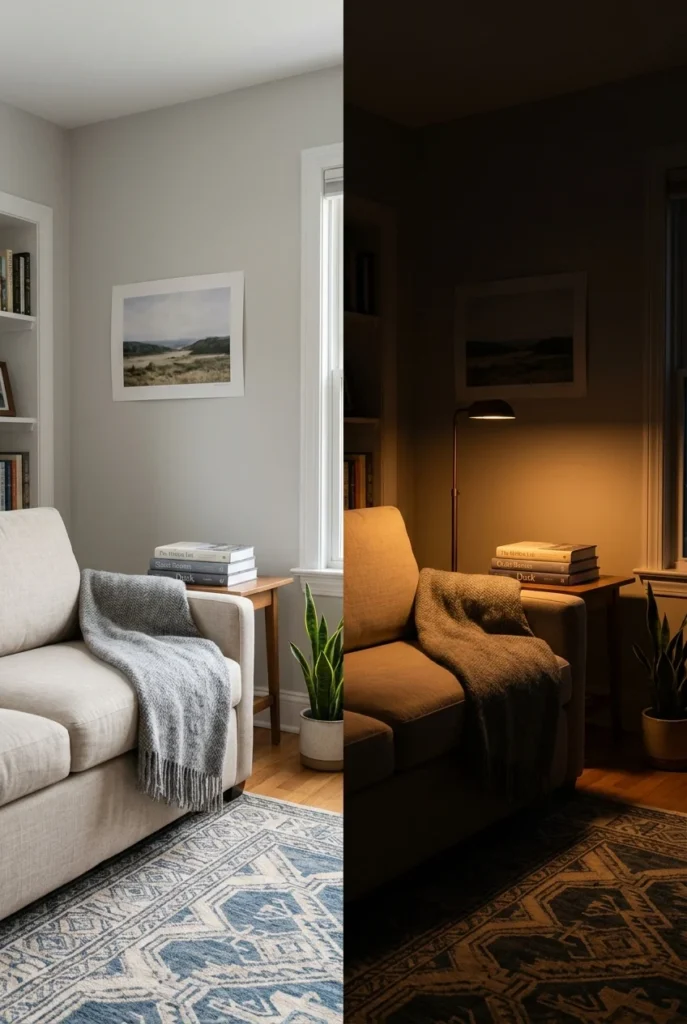
Right now your ceiling light is doing all the work, and it is doing it badly. Cold white, straight down, every scuff on the drywall lit like evidence. You sit down at seven, flip that switch, and the room goes from empty to interrogated.
Cozy living room lighting is not about buying a chandelier. It is about moving light down, warming it up, and putting it on one control so you stop walking laps around the room. By eight tonight this can look like a different apartment. No drill, no landlord conversation, no electrician.
The order matters more than the shopping list, which is the part most people get backwards
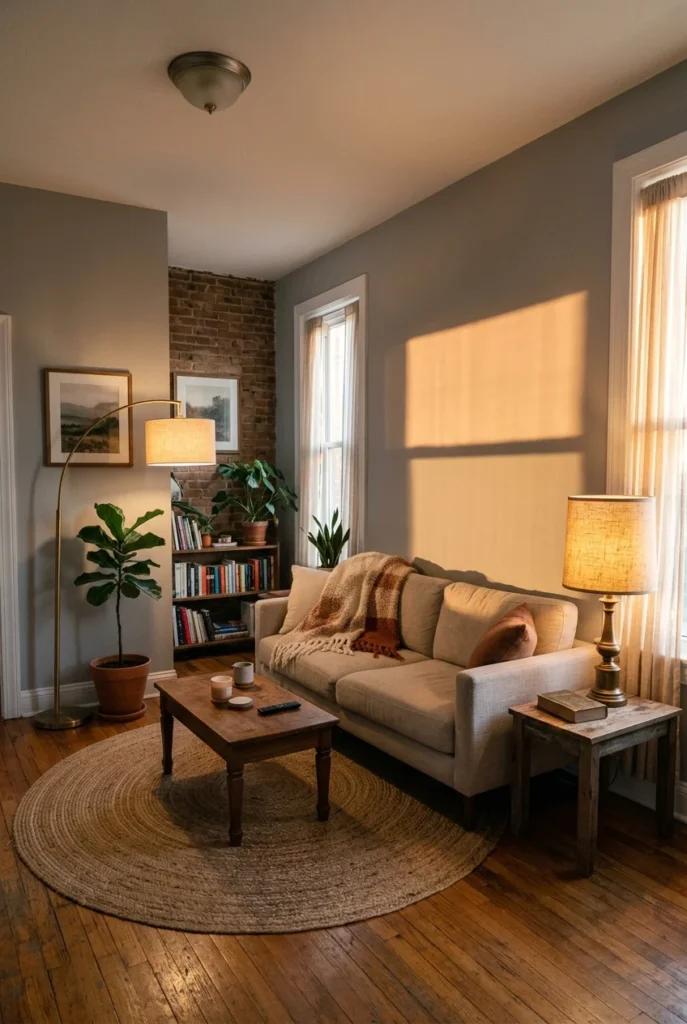
Start Here: The 3-2-1 Evening Light Rule
Everything below fits into one rule you can remember at the hardware store.
- Three warm bulbs at 2700K. Not one. Three separate sources, all the same color temperature, so the room reads as one warm space instead of a patchwork.
- Two of those sources below eye level. Light coming from around 40 to 50 inches off the floor is what makes a room feel low and held. Light from the ceiling does the opposite.
- One switch that runs all of them. A remote or a smart plug group. If turning on your lighting takes four separate clicks in four corners, you will stop doing it by Thursday.
That is it. Three, two, one.
The 2700K number is the single biggest change on this page, which is why it is first. A $4 bulb swap changes a room more than a $200 lamp does, and you can do it before the water boils for pasta.
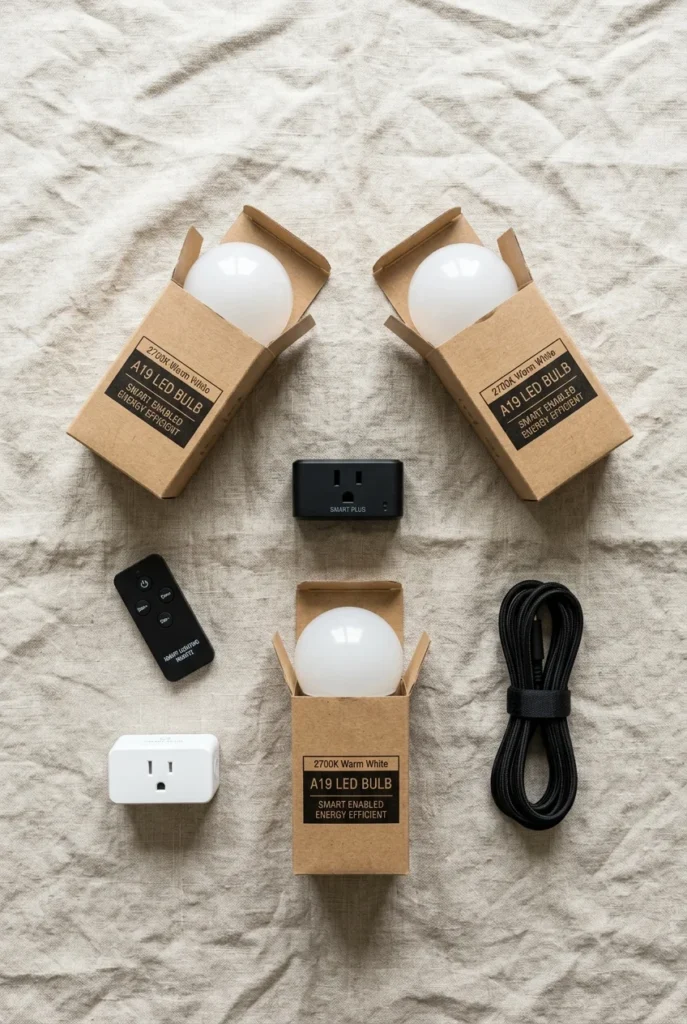
Swap Three Bulbs Before You Buy a Single Lamp
Most rooms that feel cold are not underlit. They are overlit in the wrong color.
Look at the tiny print on your current bulbs. If it says 4000K or 5000K, that is office light. It renders skin gray and makes a beige wall look like a hospital corridor. Drop to 2700K and the same wall goes honey. Nothing else in the room changed.
Go one step further if you want candle territory: 2200K bulbs push amber, closer to firelight. They are gorgeous in a corner lamp and terrible for reading a paperback, so use them as accent, not as your main.
Brightness is a separate dial from warmth, and people constantly confuse the two. You want roughly 800 lumens per main lamp, which is what an old 60-watt incandescent used to put out. Two of those plus one dimmer accent covers a standard 12 by 14 foot living room without turning it into a showroom.
While you are swapping, LED is the obvious call, and not only for the power bill. According to the Department of Energy’s LED lighting guide, residential LEDs use at least 75% less energy and last up to 25 times longer than incandescent bulbs, and incandescent bulbs dump 90% of their energy out as heat. That last number is the one nobody expects. Old bulbs made your reading corner physically warmer in August, which is a real reason your window seat felt stuffy.
The best version of this swap is a dim-to-warm LED. Ordinary dimmable LEDs just get dimmer while staying the same color, which reads flat and slightly sad at 20%. Dim-to-warm bulbs shift toward amber as they dim, the way a real filament does. They cost a few dollars more per bulb and they are the difference between “the light is low” and “the room is glowing.”
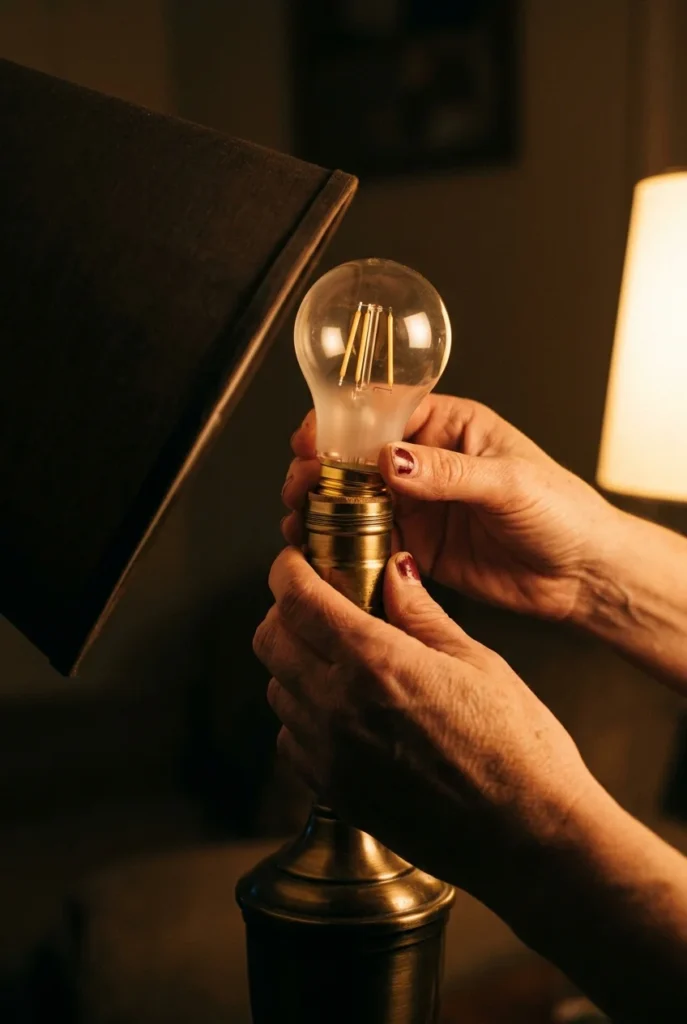
Get the Light Below Eye Level, Because That Is the Whole Trick
Here is the thing nobody says out loud: cozy is a height problem before it is a color problem.
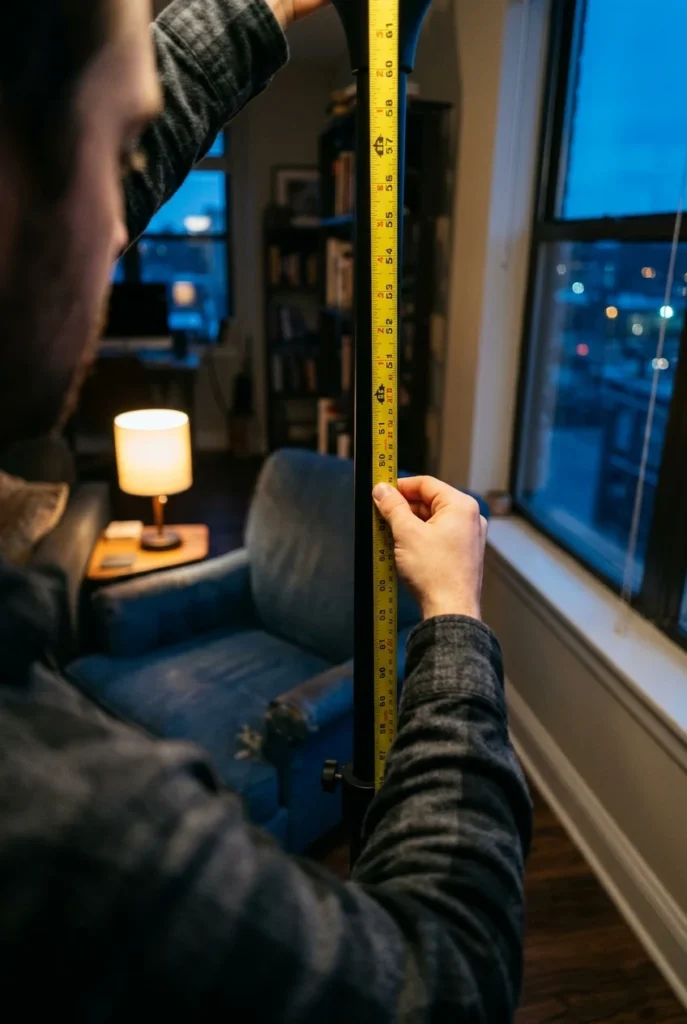
Overhead light flattens faces and throws every shadow downward. Light at seated eye level wraps around you instead. Sit on your sofa and hold your hand at eye height. That line, usually somewhere around 40 to 42 inches off the floor for an adult on a standard 17-inch seat, is where the bottom edge of a lamp shade wants to live. Below it, you get glow. Above it, you get a bare bulb glaring into your retina every time you look up.
Run the arithmetic before you buy. A 24-inch side table plus a 26-inch lamp puts the shade bottom near 44 inches, which is right in the sweet spot. A 30-inch lamp on that same table shoots to 50 inches and you will squint at it all winter.
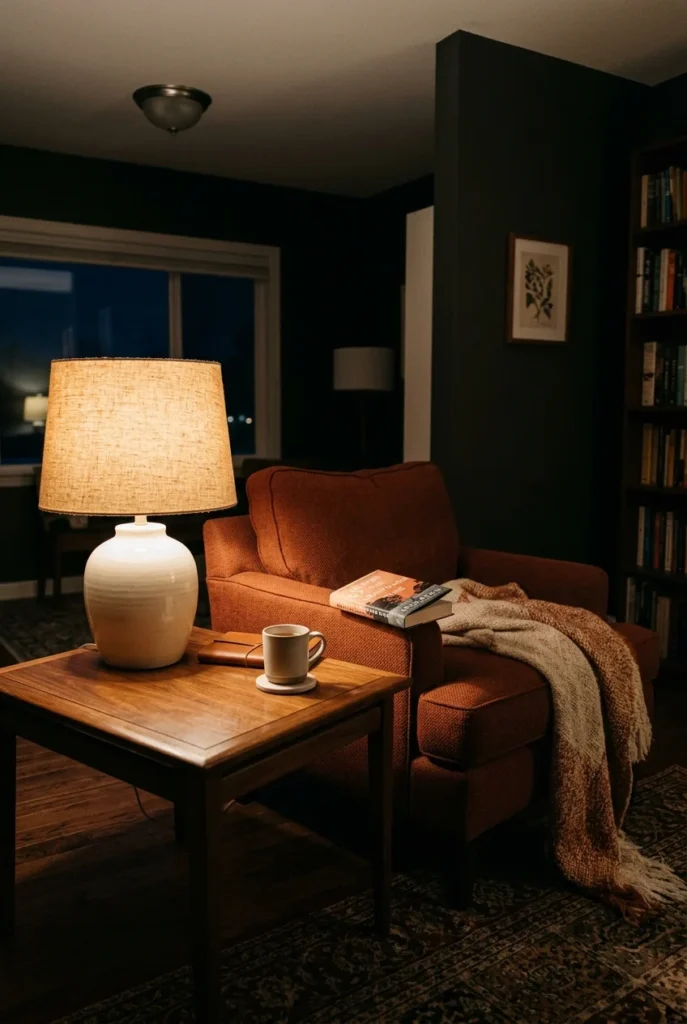
Rough numbers to aim for:
| Zone | Fixture | Height off floor | Color temp | Rough lumens |
|---|---|---|---|---|
| Beside the sofa | Table lamp on a 24 in side table | Shade bottom 42 to 46 in | 2700K | 800 |
| Reading seat | Floor lamp or swing-arm | Shade bottom 47 to 52 in | 2700K | 800 to 1100 |
| Behind the sofa | Arc lamp | Shade 65 to 81 in, aimed down | 2700K | 800 |
| Sofa wall | Plug-in sconce, pair | 60 to 66 in, or 18 to 24 in above sofa back | 2700K | 400 each |
| Bookcase or art | Picture light or LED puck | On the shelf, aimed at the spines | 2700K | 200 to 300 |
| Floor accent | Small uplight behind a plant or pouf | 6 to 12 in | 2200K to 2700K | 150 |
Notice that the whole table lives under 66 inches except the arc lamp, and the arc lamp is pointing down. That is the pattern. If you want the same logic applied to bedrooms, hallways and the rest of the house, there are more warm lighting ideas for every room in the whole-home version of this guide.
Light the Zones, Not the Room
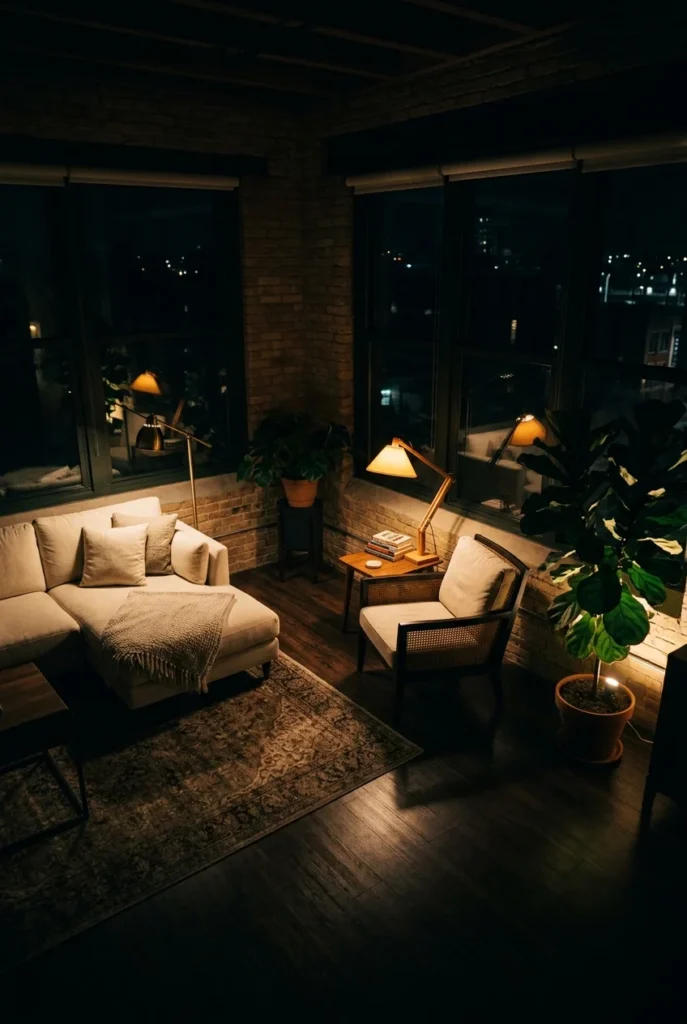
Stop thinking about the living room as one box that needs filling. Think of it as three or four small pools of light that happen to share a floor.
A standard American living room has the same four zones almost every time. The conversation zone around the sofa. One chair somebody always claims. A walkway in from the door. And the wall with the screen on it.
Give each zone its own source and its own reason to exist:
- Sofa zone. One table lamp at each end if you have the tables, or a pair of plug-in sconces on the wall behind if you do not. Symmetry does a lot of quiet work here.
- The claimed chair. This is the one that needs real light, not mood light. A swing-arm floor lamp positioned behind and slightly to the side of your shoulder puts light on the page instead of in your eyes. If that chair is currently marooned in a corner doing nothing, the fix is a whole small project of its own, and building a reading nook in a dead corner is the fastest way to make a room feel bigger by using more of it.
- Walkway. A single low source, a floor uplight behind a plant or an LED puck under a console, so you are not crossing a dark strip to get anywhere. This zone gets forgotten in every living room I have ever rearranged.
- Screen wall. Its own section below, because it has its own rules.
Leave gaps between the pools. A room lit evenly at one level is a room with no depth, and depth is most of what you are actually reacting to when a photo looks warm. Let the corners go dark. The dark parts are what make the lit parts feel like somewhere to sit.
You will hear this as “layering ambient, task and accent,” which every lighting article says. Zones is the same idea, but you can actually walk around your apartment and point at zones.
The TV Problem Nobody Talks About
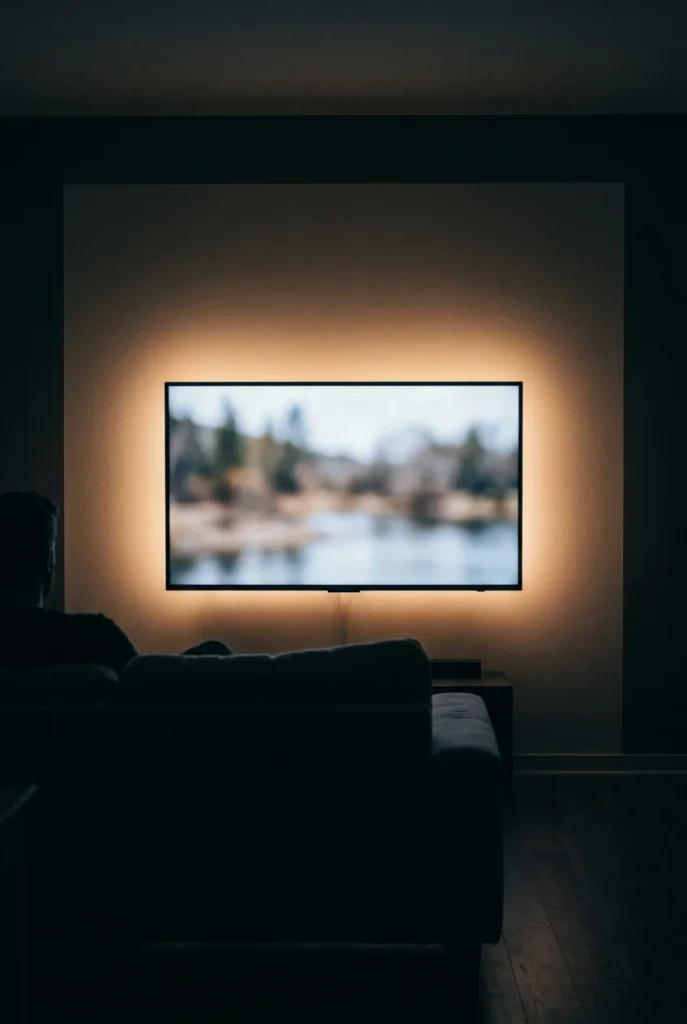
Every article about living room lighting quietly pretends the television is not there. Meanwhile it is the largest, brightest, coldest light source in your room for four hours a night.
Two things go wrong. First, people kill every light for movie night, which sounds right and is actually the worst setup for your eyes. A bright rectangle floating in a black room forces your pupils to fight the contrast constantly, and that is where the dull ache behind your eyes at 11 p.m. comes from. Second, people leave a lamp on directly across from the screen and spend the evening looking at a reflection of their own shade.
The fix is bias lighting: a low light source placed behind the screen, washing the wall it sits against. The screen stops being an island. Contrast drops, the picture reads richer, and your eyes stop working overtime.
The proper reference standard is D65, roughly 6500K, which is deliberately neutral so it does not tint how you perceive color on screen. An LED strip taped to the back edge of the TV runs about $20 to $30 and takes maybe six minutes to install.
Now the honest trade-off, because this is where the standard collides with a warm room. A 6500K strip is technically correct and it will look faintly blue and clinical against the 2700K glow you just built everywhere else. My call for a living room that is a living room first and a home theater second: run the bias strip at 2700K to 3000K and accept slightly less color accuracy. You lose a little fidelity. You keep the room feeling like a room. If you are grading photos or you genuinely care about reference-accurate color, go 6500K and let the TV wall be its own island of neutral.
Either way, keep it dim. The bias light should be a soft wash you barely register, not a second screen.
Outlets, Cords, and the One-Switch Fix
This is the section that decides whether your setup survives past the first week, and I have never once seen a lighting article cover it.
US homes are wired to a rule most people have never heard of. Under NEC 210.52(A)(1), no point along the floor line of a wall can be more than 6 feet from a receptacle, which puts outlets a maximum of 12 feet apart. Useful in two directions: it tells you roughly where power exists before you shop, and it tells you that any lamp more than 6 feet from a wall is going to need a cord solution, not a wish.
Measure the run before you buy the lamp. A standard lamp cord is about 6 feet. Sofa-floating-in-the-middle-of-the-room layouts eat that instantly.
Three cord fixes that do not look like a dorm:
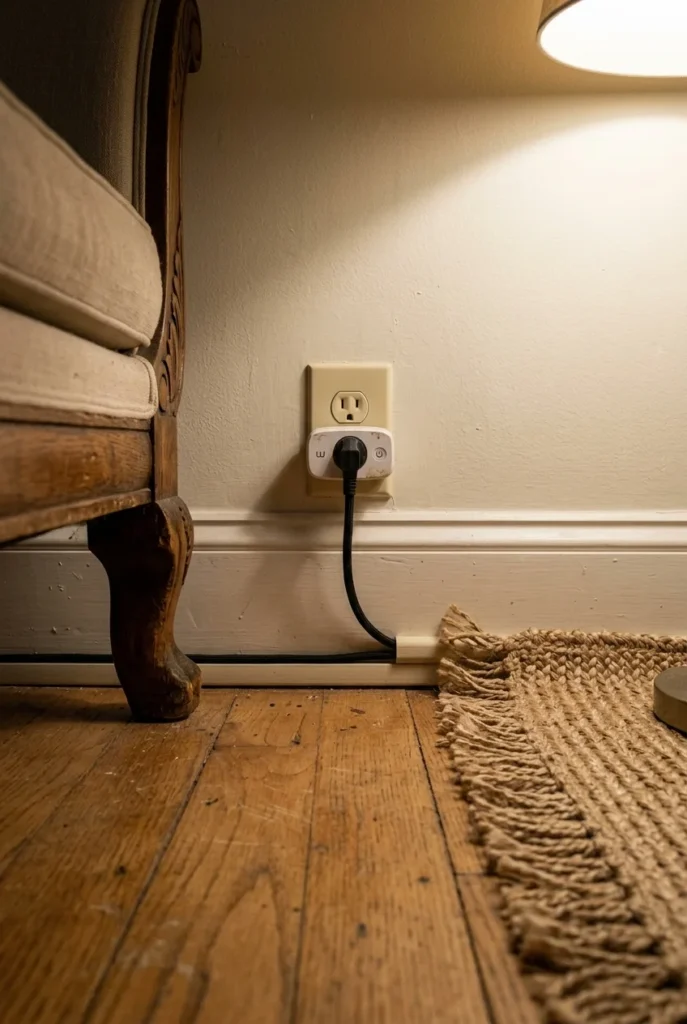
- Run the cord along the baseboard inside a paintable cord channel, then let the last 12 inches drop behind a chair leg where nobody looks.
- Tuck the run underneath the edge of a jute rug, along the rug’s binding rather than diagonally across it. Diagonal cords under rugs create a ridge you will feel with your foot every single time.
- Use a flat under-rug extension cord rated for it. Do not improvise this one with a regular round cord and a heavy rug on top.
Then the part that actually changes your behavior: put everything on one switch. Three smart plugs plus a single small remote, or a plug-in dimmer group, means one press turns the whole room on at your chosen level. This is not a gadget flex. It is the difference between a lighting scheme you use nightly and three lamps you turn on when guests come.
Two small things worth knowing. Not every dimmable LED plays well with every dimmer, so check the bulb packaging for compatibility before you buy six of them. And if you are renting, all of this is reversible in about ten minutes, which puts it in the same category as the other no-damage rental apartment upgrades worth doing in a place you do not own.
There is a small sound payoff here too. A physical wall dimmer has a faint click and slide to it. A remote is silent. If you like the ritual of a room switching over for the evening, the wall dimmer is more satisfying, and satisfaction is why you keep doing it.
Your Evening on a Dimmer: 6 p.m. to 11 p.m.
Lighting gets treated as an install. It is closer to a soundtrack. The same room wants different light at six than it does at ten, and building that into your setup takes zero extra hardware once everything is on one dimmer.
Here is the schedule I run, and you can shift it an hour either way for your own life:
- 6 p.m. Everything at full. Dinner, dishes, the last work email, kids doing homework on the rug. Bright is correct here.
- 8 p.m. Drop the main lamps to about 50%. Turn on the bias light behind the screen. The room narrows and starts pointing at the seating instead of the whole floor.
- 9:30 p.m. Main lamps to 25%, dim-to-warm doing its amber shift, and only the one lamp closest to whoever is still reading stays up. This is the point where people start actually settling in rather than sitting upright.
- 11 p.m. One low source only, ideally 2200K, ideally below knee height. Enough to cross the room. Not enough to convince your brain it is still daytime.
That last step is doing more than setting a mood. Harvard Health’s explainer on blue light reports that in one study, blue light suppressed melatonin for about twice as long as green light of comparable brightness, and shifted circadian rhythms by three hours versus one and a half. The number that surprises most people is how little light it takes to register at all: as little as 8 lux has an effect, which is dimmer than most nightlights.
So the warm, low, late-evening setting is not just aesthetic preference. Warm and dim after nine gives your body a clearer signal that the day is closing.
Quick note, and I am not a doctor: this is general information about light and sleep timing, not medical advice. If you are dealing with real insomnia or a sleep disorder, talk to a licensed US physician or a board-certified sleep specialist rather than rearranging lamps and hoping.
What Goes Wrong, and the 60-Second Fix
Five failures, in the order I see them most often.
Mixed color temperatures. One 3000K bulb in a room of 2700K reads as a mistake even when you cannot name why. Your eye clocks it instantly. Fix: buy a six-pack of one temperature and do the whole room in one pass.
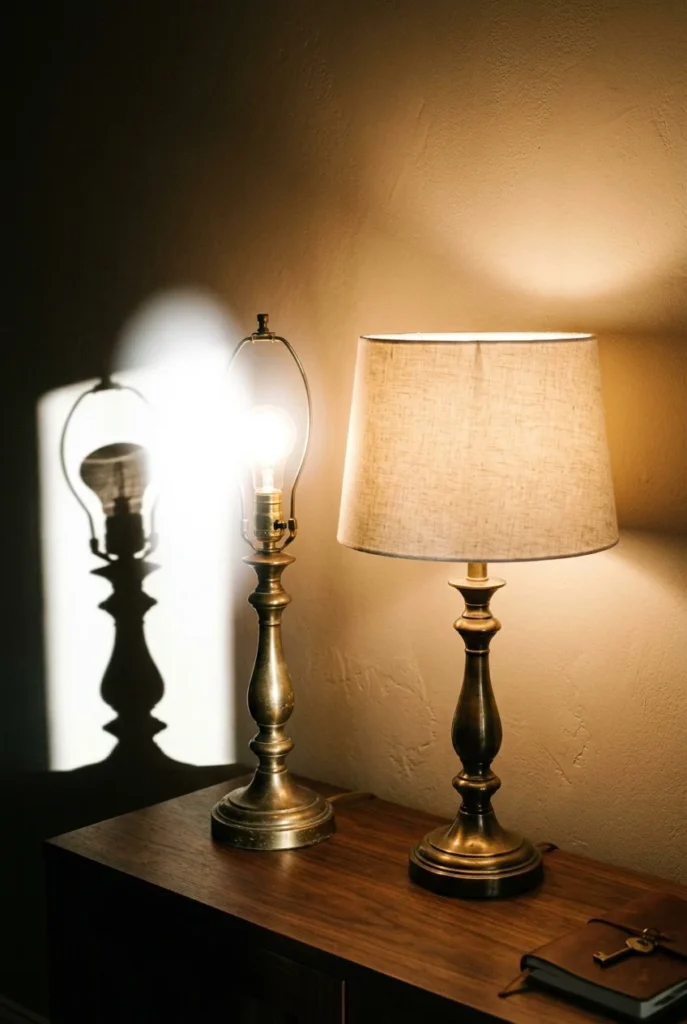
A visible bare bulb. If you can see the filament from where you sit, you are not looking at a lit room, you are looking at a bulb. Fix: lower the lamp, add a shade, or move the chair back six inches.
Everything at the same brightness. Even light is flat light. Fix: turn one source off entirely and see if the room improves. It usually does.
Fairy lights doing the heavy lifting. They photograph beautifully and they light nothing. Sweet as a fourth layer, useless as a first. Fix: keep them, but add a real 800 lumen source before you count them as lighting.
Nothing on a timer or a remote. This is the failure that kills the whole build. If the setup takes four trips around the room, you will default to the ceiling light within a week and quietly conclude that lighting does not work for you. Fix: one remote. Tonight.
Cozy Living Room Lighting FAQs
How do I make my living room cozy with lighting? Swap to 2700K bulbs, get at least two light sources below 50 inches off the floor, and put them all on one dimmer or remote. Those three moves account for most of the change. Everything else is refinement.
How many lamps should a living room have? Three separate light sources is the working minimum for a standard 12 by 14 foot room, and four to five is comfortable. Count sources, not fixtures: a pair of sconces on one wall functions as one zone, not two.
What color light is best for a living room, 2700K or 3000K? 2700K for living rooms and bedrooms. 3000K reads slightly cleaner and works in kitchens and bathrooms where you want crisper edges. The rule that matters more than either number is picking one and using it everywhere in the same room.
Where should I place lamps in a living room? Behind and slightly to the side of where you sit, never directly across from your eyeline or the TV. For reading, the light should come over your shoulder onto the page. For ambience, aim it at a wall or a bookcase and let it bounce.
How do I light a living room with no overhead lighting? This is the most common version of the question and it is entirely solvable. Two plug-in sconces on the sofa wall, one floor lamp in a corner aimed at the ceiling to bounce, and one table lamp will out-light a builder-grade ceiling fixture and look considerably better doing it. No drilling required if you use adhesive-mount sconces rated for the weight.
Are dimmers worth it in a rental? Yes, and you do not need to touch the wall plate. Plug-in dimmers and smart plugs sit between the lamp and the outlet, cost less than a lamp, and travel with you to the next place. A hardwired wall dimmer is nicer to use, but it is a screwdriver-and-permission project.
Does warm lighting really help you sleep better? Warm, dim light in the last hour or two before bed sends a clearer wind-down signal than bright cool light does, and the research on blue light and melatonin supports the general principle. It is one input among many, and it is not a treatment for a sleep disorder. Talk to a doctor for that.
Start With One Bulb Tonight
Do not build the whole scheme this evening. Go find the lamp you sit closest to, check the tiny print on the bulb, and if it says anything above 2700K, change it. That is a ten-minute errand and a five-second install, and you will notice it the second the sun goes down.
Next week, add the second source below eye level. The week after, put them on one remote.
If this corner of the room is currently doing nothing except holding a laundry pile, that is where the real gain is hiding. Pick the chair, aim the light over your shoulder, and see how fast a dead corner turns into the place everyone fights over.
Keep reading
More cozy nook ideas
 Lighting
Read →
Lighting
Read →
Warm Lighting Ideas to Make Your Home Feel Cozy
Your ceiling light is the problem. That single bright disc overhead, the one every landlord installs, floods a room with flat blue-white…
 Decor and Styling
Read →
Decor and Styling
Read →
Fairy Lights Reading Nook: 9 Soft-Glow Ideas You Can Copy This Weekend
Picture 9 pm, the overhead light off, and one warm strand tracing the wall behind your chair. That soft amber wash is…
 Decor and Styling
Read →
Decor and Styling
Read →
Best Reading Nook Wall Sconces for Cozy, No-Wiring Corners
Your reading corner is currently lit by a ceiling fan with one yellowed bulb and the cold glow of your phone. That’s…
One Comment